
Research article · 2026 · Full text
International Journal of Geography Geology and EnvironmentPolitical transformation and voting patterns in Haryana assembly elections: A geographical perspective
Volume 8(7) · Pages 131–140 · DOI: 10.22271/27067483.2026.v8.i7b.813 ↗
Research areasElectoral Systems and Political ParticipationSouth Asian Studies and ConflictsIndian Economic and Social Development
Abstract
Author-writtenHaryana, a politically vibrant state of north India, has witnessed remarkable electoral transformations since its formation in 1966. The period from 2009 to 2024 has been particularly significant, marked by the decline of the Indian National Congress (INC), the meteoric rise of the Bharatiya Janata Party (BJP), the fragmentation of the Indian National Lok Dal (INLD), and the brief emergence and decline of the Jannayak Janta Party (JJP). This paper undertakes a comprehensive geographical analysis of the changing political scenario in Haryana's assembly elections from 2009 to 2024. Using district-wise electoral data, constituency-level voting patterns, and manifesto analysis of leading political parties, the study examines the spatial dimensions of electoral shifts, voter behaviour, caste mobilisation, anti-incumbency factors, and the role of development promises in shaping electoral outcomes. The findings indicate a clear geographic differentiation in party support, with the Jat-dominated regions of western Haryana behaving differently from the urban-industrial belts of Gurgaon and Faridabad, and the sub-Himalayan districts of northern Haryana. The study reveals that party manifestos, while largely aspirational, have become increasingly important in determining voter choices, particularly among younger and urban constituencies. The paper concludes by identifying emerging trends and patterns that will likely shape Haryana's political geography in the years ahead
Summary
Source-checkedPlain-language reading of the full paper, prepared with AI and checked against the text. Each point links to the authors' own words.
Why it matters
- Haryana is a politically active state in northern India that has experienced significant changes in its electoral landscape since 1966. View evidence ↗
- The Jat community, making up about 27-29% of the population, has historically held a disproportionate amount of influence over Haryana's politics. View evidence ↗
The question
- The study aims to analyze voting patterns in Haryana's assembly elections from 2009 to 2024, focusing on geographic party support, voter behavior shifts, and socio-economic influences. View evidence ↗
What they did
- The researchers used a multi-method approach that combined quantitative electoral data analysis with qualitative reviews of party manifestos and existing literature. View evidence ↗
- The analysis was conducted at three levels: statewide (macro), divisional/district (meso), and constituency-level swings (micro). View evidence ↗
What they found
- The most significant electoral shift happened between 2009 and 2014, with the INC losing 25 seats and the BJP gaining 43 seats. View evidence ↗
- Voter turnout spiked by over 19 percentage points in 2014, rising from 57.34% to 76.54%. View evidence ↗
- The gender gap in voting has narrowed, with women's turnout in 2024 reaching 66.47%, nearly equal to the overall turnout of 67.90%. View evidence ↗
- The INLD experienced a severe decline, falling from a 25.52% vote share in 2009 to negligible levels by 2024. View evidence ↗
- The BJP consistently performed better in urban and semi-urban areas, especially within the Gurgaon-Faridabad industrial belt. View evidence ↗
What it means
- The authors conclude that the BJP has established a stable new electoral equilibrium through a multi-caste coalition, welfare delivery, and strong urban support. View evidence ↗
- The authors suggest that future research should use GIS-based spatial analysis for more precise identification of party support boundaries at the constituency level. View evidence ↗
Visual summary
3 visualsIllustrations explain the paper; charts are replotted from the paper's own table values.
Urban vs Rural Voting Divergence
AI-generated conceptual illustration (Haryana landscape featuring a modern industrial city skyline and traditional rural farmland). It explains the idea and does not show study data.
View source evidence ↗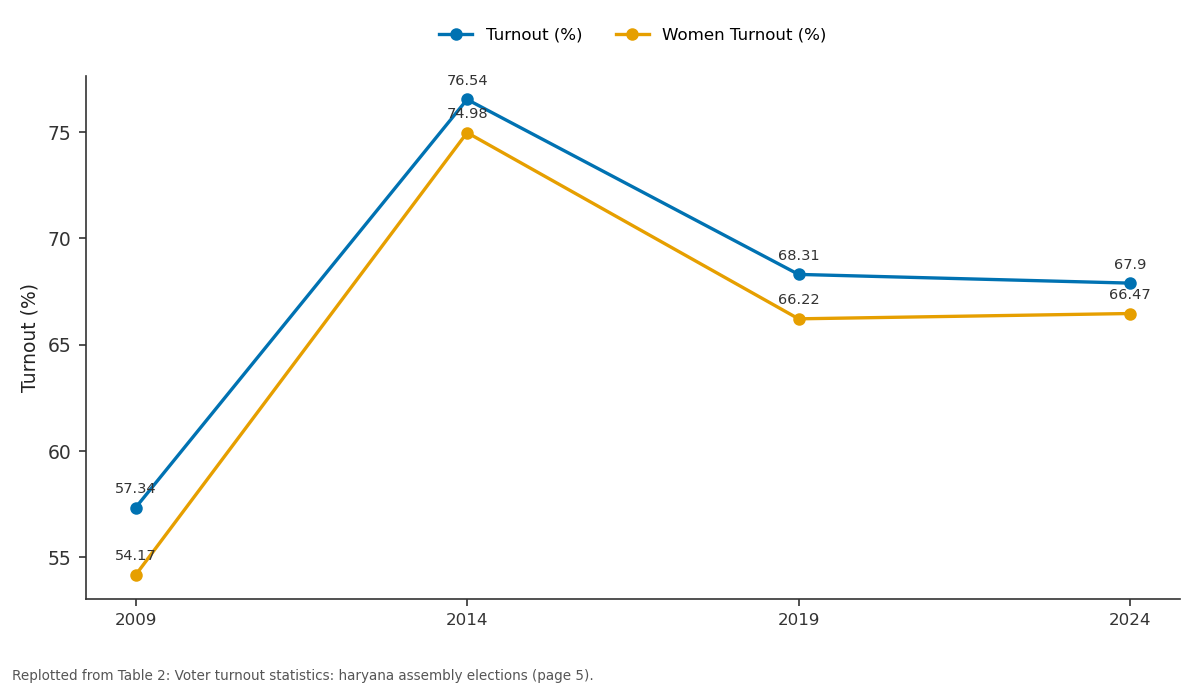
Turnout (%) and Women Turnout (%): 2009 vs 2014 vs 2019 vs 2024
Replotted from Table 2 (page 5) of the original paper. Every bar is the paper's own table value.
View source evidence ↗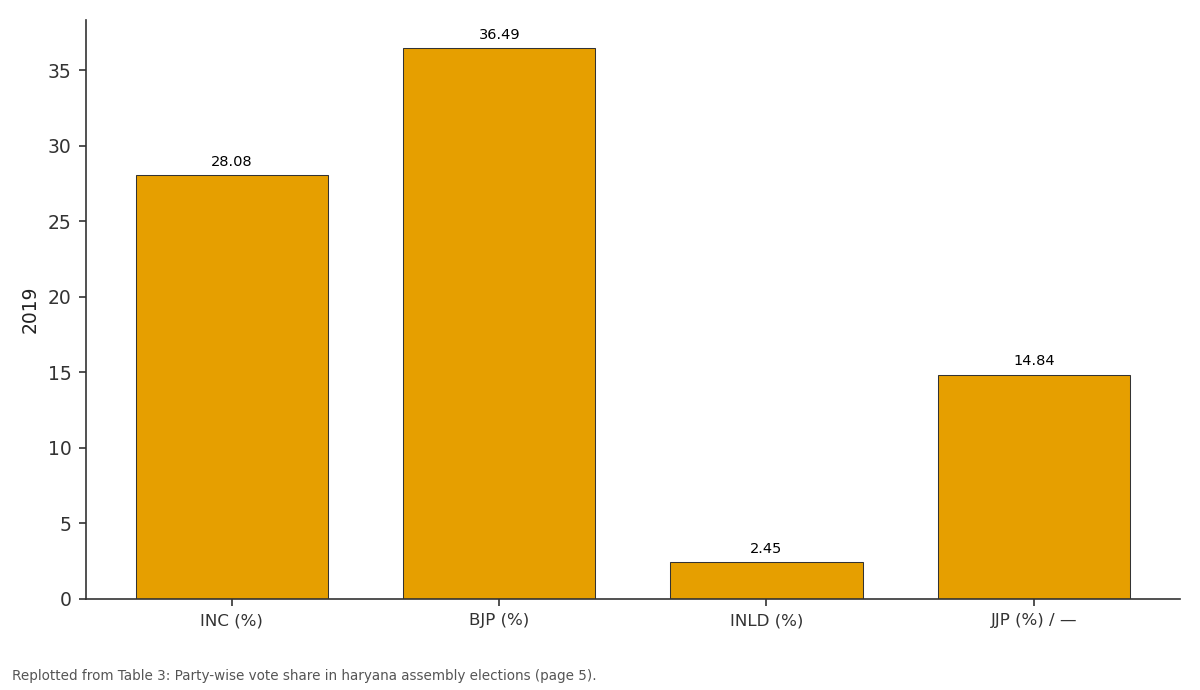
2019: INC (%) vs BJP (%) vs INLD (%) vs JJP (%) /,
Replotted from Table 3 (page 5) of the original paper. Every bar is the paper's own table value.
View source evidence ↗Figures & tables
From the original paper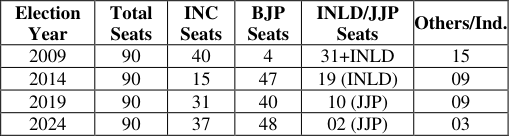 Table 1
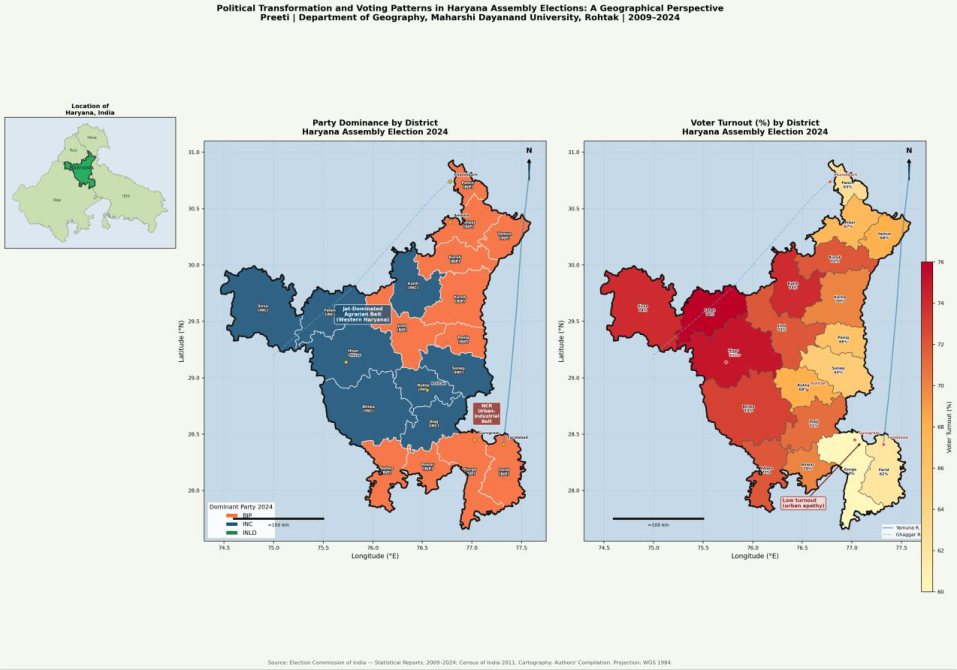 Figure 1
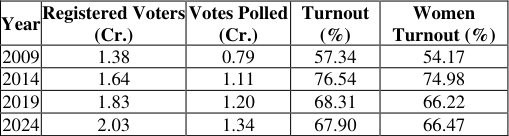 Table 2
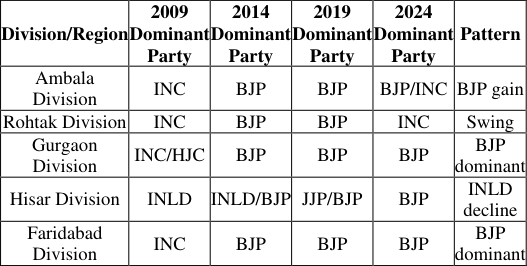 Table 4
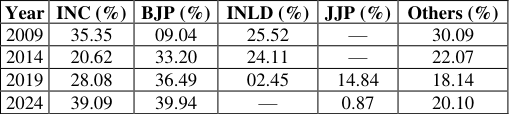 Table 3
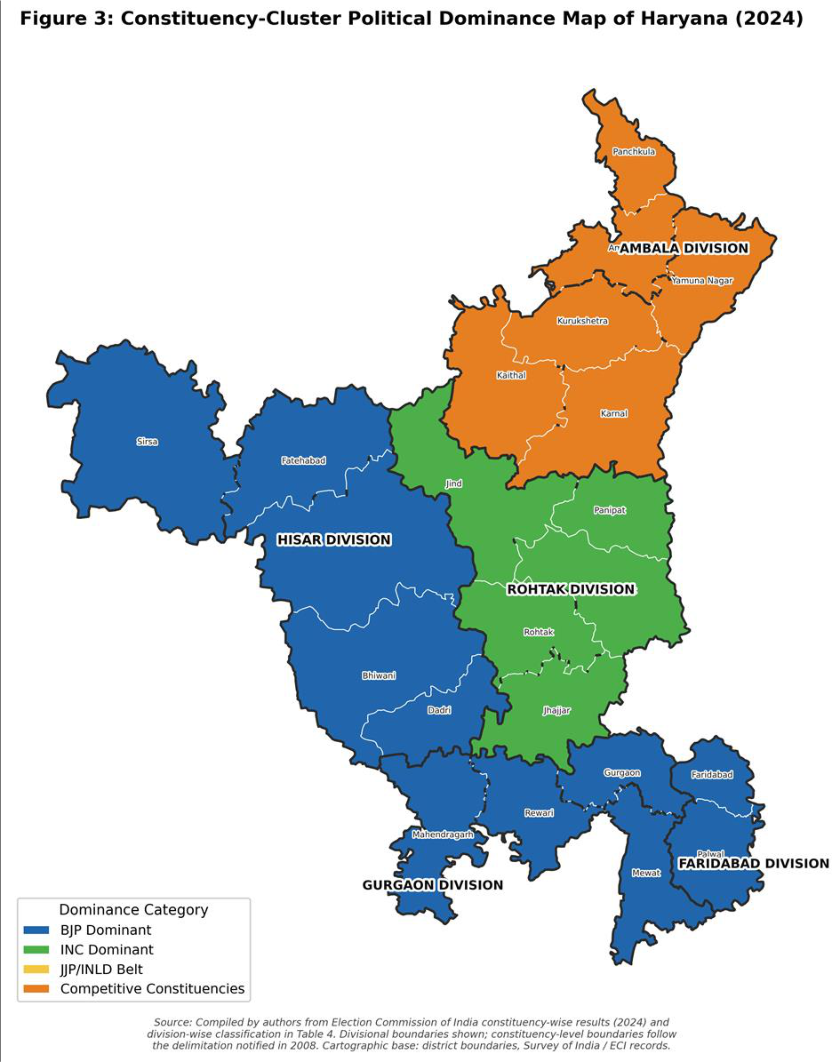 Figure 2
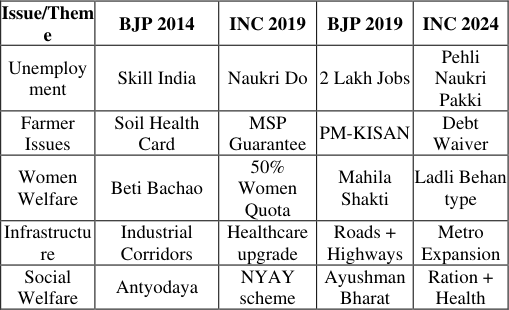 Table 5
Introduction
Haryana, carved out of the erstwhile state of Punjab on 1 November 1966, has been one of India's most politically dynamic states. With 90 assembly constituencies spread across 22 districts, the state has oscillated between periods of single-party dominance and coalition politics, reflecting broader national trends while simultaneously exhibiting distinctive regional characteristics rooted in its agrarian economy, caste demography, and cultural identity [1] The study of electoral geography in India has evolved significantly over the past four decades. Political geographers have increasingly recognised that elections are not merely political events but spatially embedded phenomena, shaped by the physical, social, and economic contours of the landscape. Haryana presents a particularly compelling case study given its compact geographic area of 44,212 square kilometres, its relatively homogeneous linguistic character, and yet its remarkable political diversity manifested through distinct regional voting blocs. The elections of 2009, 2014, 2019, and 2024 each tell a different story of voter aspiration, political mobilisation, and governance performance. The 2009 election saw the INC return to power under Chief Minister Bhupinder Singh Hooda with a comfortable majority. The 2014 election witnessed a seismic shift as the BJP, riding on the 'Modi wave', secured an absolute majority for the first time in the state's history. The 2019 election saw the BJP retain power but fall short of majority, forming a coalition government with the JJP. The 2024 election, Widely anticipated to see an INC victory, surprised observers when the BJP secured its third consecutive term, albeit with a different composition of support bases. [2] This paper situates these electoral transformations within a geographical framework, examining how spatial factors including urbanisation, agricultural belt distribution, caste concentration zones, and infrastructure development have shaped voting behaviour across the state. The analysis draws on official electoral data from the Election Commission of India, district census data, and content analysis of party manifestos from all four election cycles.
Background and context
Haryana's political landscape has been historically shaped by the dominant presence of the Jat community, which constitutes approximately 27-29 per cent of the state's population and has wielded disproportionate influence over its politics. The Jat-dominant INLD, founded by Devi Lal and later led by Om Prakash Chautala, represented the agrarian interests of the western districts for decades. However, the period under study witnessed the progressive erosion of this dominance, as BJP successfully created a coalition of non-Jat communities, urban professionals, and aspirational rural voters. [3] The demographic composition of Haryana has undergone significant changes between 2001 and 2011. The state's population grew from 2.11 crore to 2.54 crore, with urbanisation increasing from 28.9% to 34.9%. This urban shift has had profound implications for electoral politics, as urban constituencies tend to prioritise different issues governance, employment, urban amenities compared to the agrarian concerns of rural constituencies. [4]
Significance of the study
The geographical analysis of elections provides insights that purely political or sociological analyses often miss. By mapping electoral patterns onto the physical and socioeconomic landscape, we can identify the structural factors that shape political behaviour beyond individual candidate performance or specific campaign issues. This study contributes to the growing body of literature on electoral geography in Indian states and provides a template for analysing political change in other similarly constituted states. Furthermore, Haryana's position as a border state adjacent to the national capital gives its politics a particular significance. The agricultural hinterland of Delhi, the industrial corridors connecting to western India, and the military cantonments spread across the state create a unique political geography that merits careful examination.
Objectives of the Study
The present study is guided by the following primary objectives: 1. To study the voting patterns in the assembly elections in Haryana during the period 2009-2024, with particular attention to the geographic distribution of party support, shifts in voter behaviour across election cycles, and the role of socio-economic variables in determining electoral outcomes. 2. To examine the implications of manifestos of leading political parties particularly the Indian National Congress (INC), Bharatiya Janata Party (BJP), Indian National Lok Dal (INLD), and Jannayak Janta Party (JJP) on voters in the assembly elections in Haryana, and to assess the degree to which manifesto promises have been fulfilled and how this has influenced subsequent electoral behaviour.
In addition to these primary objectives, the study also aims to:
Review of literature
The study of electoral geography in India has a rich tradition dating back to the work of scholars like Selig Harrison, Paul Brass, and Rajni Kothari in the 1950s-1970s. Brass's foundational work on Indian politics established the importance of factional politics and community affiliations in determining electoral outcomes, laying the groundwork for subsequent geographical analyses. [5] Yogendra Yadav's seminal analysis of India's 'third electoral system' highlighted the growing importance of what he called the 'silent revolution' the increasing electoral participation of lower castes, minorities, and women. His work demonstrated that the post-1989 period witnessed a fundamental restructuring of India's political landscape that had specific geographic manifestations. [6] At the state level, Singh's analysis of dominant caste politics in Haryana provides important contextual grounding for the present study. Singh argued that the Jat community's electoral dominance was always more precarious than it appeared, resting on a coalition of interests that was vulnerable to disruption by external shocks economic distress, governance failures, or the emergence of alternative political entrepreneurs. Chhibber and Kollman's work on party system formation in federal democracies offers a useful theoretical framework for understanding the emergence of regional parties in Haryana. Their argument that party systems at the state level often diverge from national patterns due to the specific issues and cleavages that dominate regional politics helps explain the long presence of INLD and the more recent emergence of JJP. [7] Verma and Sardesai's analysis of media effects on voting behaviour in India is particularly relevant given the dramatic expansion of digital media and social media platforms during the study period. Their finding that media exposure does affect political preferences, but in complex interaction with existing social identities, cautions against simplistic accounts of the 'mediadriven' election. [8] The National Election Studies conducted by the Centre for the Study of Developing Societies (CSDS) have provided invaluable survey-based data on voter behaviour in Haryana. Their findings on the determinants of vote choice including assessments of incumbent performance, party identification, leader evaluation, and issue salience form an important empirical foundation for the present analysis. [9] Despite
Physiographic and socio-economic context
The state can be broadly divided into three physiographic regions: the Shivalik hills in the north-east, the alluvial plains of the Ghaggar-Yamuna interfluve that constitute the agricultural heartland, and the semi-arid sandy plains of the south-west. These physiographic zones broadly correspond to distinct agricultural systems wheat-rice cultivation in the plains, mixed farming in the hill fringe areas, and livestockbased and dryland agriculture in the south-west.
Economically, Haryana has undergone a dramatic transformation since the 1990s. The state has emerged as a major centre of automobile manufacturing, information technology, and real estate, particularly in the Gurgaon-Manesar-Faridabad belt adjacent to Delhi. This industrial development has created new social classes and new political constituencies that have disrupted traditional patterns of agrarian politics.
Methodology
The study employs a multi-method approach combining quantitative analysis of electoral data with qualitative analysis of party manifestos and secondary literature. The primary data sources include:
voter behaviour analysis. The analytical framework involves three levels of analysis: macro-level analysis of statewide trends; meso-level analysis of divisional and district patterns; and micro-level analysis of constituency-level swings and specific geographic clusters. Electoral data is analysed in terms of seats won, vote share percentages, and swing calculations between election cycles. Content analysis of party manifestos employs a structured coding scheme that identifies promises under key thematic categories: agriculture, employment, women welfare, infrastructure, social security, governance, and identity/community-based promises. This allows systematic comparison across parties and election years.
Geographical maps of the study area
Geographical maps of the study area
Electoral analysis: 2009-2024 5.1 Overview of electoral results
The four assembly elections held in Haryana between 2009 and 2024 reveal a state in political flux, with no single party securing an unchallenged mandate across the entire period. The overall trajectory shows a decline of the INC from its 2009 position of comfortable majority, followed by a period of BJP dominance beginning in 2014, and a surprising reaffirmation of that dominance in 2024 despite strong antiincumbency signals. As Table 1 illustrates, the most dramatic shift occurred between 2009 and 2014, when the INC lost 25 seats while the BJP gained 43 seats. This swing of historic proportions was driven by a combination of national factors the 'Modi wave' and disillusionment with the UPA government's governance record and state-specific factors including allegations of corruption against the Hooda government and growing farmer distress. [10] The 2019 election presented a more nuanced picture. While the BJP retained its position as the largest party, the JJP's emergence with 10 seats largely drawn from the Jat community in western Haryana denied the BJP an outright majority and signalled the fragmentation of the opposition vote rather than a consolidation of anti-BJP sentiment. The 2024 election is perhaps the most analytically interesting of the four. Pre-election surveys and exit polls widely predicted an INC victory, citing strong antiincumbency against the 10-year BJP government and the impact of the farm laws controversy. The actual result, with the BJP winning 48 seats and the INC 37, with virtually the same vote shares (BJP INC 39.09%), highlighted the importance of seat-level conversion of votes and the strategic deployment of resources by a well-organised incumbent machinery. 2 reveals a striking pattern in voter mobilisation across the study period. The 2014 election saw a dramatic increase in turnout from 57.34 per cent to 76.54 per cent an increase of more than 19 percentage points. This level of mobilisation, unprecedented in Haryana's electoral history, was driven by high enthusiasm for the BJP-led NDA at the national level and an effective get-out-the-vote operation by both major parties at the state level. Equally significant is the progressive narrowing of the gender gap in voter turnout. The difference between male and female turnout has consistently declined, with women's participation in 2024 (66.47%) approaching parity with overall turnout (67.90%). This increasing participation of women voters has had political implications, as both major parties have adapted their manifesto promises and candidate selection strategies to appeal to this growing constituency. The vote share data in Table 3 reveals several important patterns that are not visible from the seat count alone. Most notably, the BJP's vote share in 2024 (39.94%) was only marginally higher than the INC's (39.09%), yet translated into a 11-seat advantage. This discrepancy between vote share and seat count reflects the geographic concentration of INC support in certain constituencies and the more efficient spatial distribution of BJP votes across the state. Panini's work on the political economy of dominant castes provides a useful lens for understanding how such spatial distributions of support come to be structured. [11] The INLD's collapse from 25.52% in 2009 to negligible levels by 2024 represents one of the most dramatic electoral declines in the state's history. This decline reflects both the organisational disruption caused by the family feud between Om Prakash Chautala and his son Ajay Chautala (which led to the formation of JJP in 2018), and the broader erosion of the Jat community's cohesive voting behaviour as younger Jat voters increasingly diversified their political affiliations.
| Year | INC (%) | BJP (%) | INLD (%) | JJP (%) | Others (%) |
|---|---|---|---|---|---|
| 2009 | 35.35 | 09.04 | 25.52 | — | 30.09 |
| 2014 | 20.62 | 33.20 | 24.11 | — | 22.07 |
| 2019 | 28.08 | 36.49 | 02.45 | 14.84 | 18.14 |
| 2024 | 39.09 | 39.94 | — | 0.87 | 20.10 |
Table text extracted from the original PDF; superscript letters are shown inline. The original table image is below.
View original table image
| Election Year | Total Seats | INC Seats | BJP Seats | INLD/JJP Seats | Others/Ind. |
|---|---|---|---|---|---|
| 2009 | 90 | 40 | 4 | 31+INLD | 15 |
| 2014 | 90 | 15 | 47 | 19 (INLD) | 09 |
| 2019 | 90 | 31 | 40 | 10 (JJP) | 09 |
| 2024 | 90 | 37 | 48 | 02 (JJP) | 03 |
Table text extracted from the original PDF; superscript letters are shown inline. The original table image is below.
View original table image
Voter Turnout Patterns
Voter Turnout Patterns
Geographic patterns of electoral change 6.1 Division-wise analysis
The geographic patterning of electoral support in Haryana reveals distinct regional clusters that correspond broadly to the state's physiographic, economic, and caste-demographic zones. A division-wise analysis across the four elections under study reveals both patterns of persistence and significant changes.
Caste geography and electoral outcomes
Caste geography the spatial distribution of different caste communities across constituencies is perhaps the single most important structural factor shaping electoral outcomes in Haryana. The state can be crudely divided into a Jatdominant western belt, a Dalit-significant south-eastern zone, a Ahirwal region in the south (dominated by the Yadav/Ahir community), and a mixed-caste northern fringe.
Manifesto analysis and voter behaviour 7.1 Content analysis of party manifestos
Political party manifestos represent the formal articulation of a party's policy agenda and electoral promises. In the Indian electoral context, manifestos have often been dismissed as wish-lists that bear little relationship to actual governance. However, recent research suggests that manifesto promises do shape voter perceptions, particularly in terms of setting expectations against which incumbent performance is subsequently evaluated [13] .
The INC manifestos for Haryana across the study period consistently emphasised social welfare, farmer support, and employment generation. The 2014 manifesto, titled 'Congress ka Haath, Aam Aadmi ke Saath', promised agricultural debt relief, expansion of MGNREGA, and 100 units of free electricity for rural households. The 2019 manifesto introduced a 'Naukri Do' (Give Employment) campaign centre-piece, promising 2 lakh government jobs annually. The 2024 manifesto 'Haath Badlega Halat' adopted a transfer-of-power narrative, focusing on governance accountability and welfare scheme expansion [14].
Manifesto promises and electoral outcomes
The relationship between manifesto promises and electoral outcomes in Haryana is complex and non-linear. Several patterns emerge from the analysis: First, there is evidence that parties which make credible and specific promises as opposed to vague aspirational statements tend to gain more electoral traction, particularly among more educated urban voters. The BJP's highly specific enumeration of scheme benefits in its 2019 manifesto appears to have been more effective than the INC's broader narrative-driven approach [16]. Second, the fulfilment or non-fulfilment of previous manifesto promises has had significant retroactive electoral effects. The INC government's failure to fully deliver on its 2009 promises regarding farmer debt relief and employment contributed substantially to its 2014 defeat. Similarly, the BJP's handling of the farm laws a policy not explicitly mentioned in its 2019 manifesto but widely seen as contrary to farmer interests created significant electoral liability in agricultural constituencies in 2024. Third, the 'manifesto effect' appears to be moderated by the perceived credibility of the party making the promises. Voters discount promises made by parties they perceive as unlikely to form government or to deliver on promises even if they do. This credibility filter helps explain why both the INLD and JJP's manifestos, however elaborate, failed to generate significant electoral support as their perceived government-formation capacity declined.
Identity-based versus development-based voting
A recurring tension in Haryana's electoral politics during the study period has been between identity-based voting caste, regional identity, community affiliation and developmentbased voting evaluation of incumbent performance, assessment of policy delivery, and future orientation towards better governance and economic growth. This tension mirrors broader debates in Indian electoral studies about the relative weight of 'identity politics' versus 'performance politics' in determining electoral outcomes [17] . The evidence from Haryana suggests that these two modes of voter behaviour are not mutually exclusive but interact in complex ways. Caste-based mobilisation provides the organisational infrastructure for electoral campaigns, while development promises and governance assessments operate as 'switchers' that determine which caste community follows which organisational direction. The CSDS National Election Study data for 2019 and 2024 indicates that even among voters who report caste considerations as important, assessments of government performance and manifesto promises are significant secondary considerations [18].
Key factors shaping electoral change 8.1 Anti-incumbency and governance assessment
Anti-incumbency has been a powerful force in Haryana's elections. No party has won three consecutive elections in the state since its formation until the BJP's 2024 victory, which bucked this historical pattern. The persistence of antiincumbency sentiment, even against a party that retained power, suggests that the BJP in 2024 successfully managed to convert anti-incumbency against its government into a comparison with the INC's previous governance record. District-wise development indices including literacy rates, sex ratio, per capita income, and access to basic amenities show a complex relationship with party performance. The most developed districts do not uniformly favour the BJP, nor do the least developed uniformly favour the opposition. Rather, the relationship appears to be mediated by the perceived role of the incumbent government in generating development outcomes and by community-specific distribution of benefits.
Role of local leadership
Haryana's electoral contests are, at the constituency level, often decided by the local standing, caste affiliation, and resource mobilisation capacity of individual candidates rather than purely by party choice. The 'winnability' criterion in candidate selection which prioritises candidates with strong local support networks over party loyalists means that intra-party dynamics significantly shape the final electoral map. The 2024 election saw several instances where rebel candidates, denied party tickets, ran as independents and significantly affected outcomes. This phenomenon of 'rebel factor' seats where a disgruntled party member draws votes away from the official candidate reflects the relative weakness of party discipline in Haryana compared to more ideologically cohesive parties.
Women's political participation
One of the most significant trends across the study period has been the increasing political participation and assertiveness of women voters in Haryana. The state, which has historically been associated with patriarchal social norms and a skewed sex ratio, has witnessed a progressive convergence in male and female voter turnout, reaching near-parity in 2024. This increased female participation has had political implications. Both the INC and BJP have adapted their manifesto and campaign strategies to specifically address women voters through promises of direct benefit transfers, women-specific welfare schemes, and female candidate quotas. The BJP's 'Lado Lakshmi' scheme and similar promises in 2024 reflected the recognition of women as a pivotal swing constituency.
Urbanisation and changing voter preferences
The ongoing urbanisation of Haryana has created new political constituencies that cut across traditional caste lines. Urban professional voters particularly in the Gurgaon-Faridabad IT and industrial belt tend to prioritise governance quality, infrastructure development, ease of doing business, and security concerns over caste identity. This segment has been consistently supportive of the BJP, contributing to the party's strong performance in urban constituencies across all four elections in the study period [19] Peri-urban constituencies the ring of rapidly urbanising villages around major cities have shown more volatile behaviour, oscillating between parties based on land acquisition policies, provision of urban amenities, and the resolution of farmer-developer conflicts. These constituencies present a distinct electoral challenge as they contain voters with both agricultural and urban identities. 9. Party Profiles and Strategic Adaptations
Indian National Congress (INC)
The INC's electoral journey in Haryana during the study period has been one of decline, attempted revival, and partial recovery. From its dominant position in 2009 (40 seats, 35.35% vote share), the party fell to its worst performance in 2014 (15 seats, 20.62%), made a partial recovery in 2019 (31 seats, 28.08%), and came tantalizingly close to power in 2024 (37 seats, 39.09%) [20] The INC's strategic challenge in Haryana has been to rebuild a coalition that spans both the Jat and non-Jat communities while retaining the support of Dalit, Muslim, and other minority voters who have historically backed the party. The 2024 near-miss suggests that the party has made progress in this coalition-building effort, but the failure to translate near-equivalent vote share into comparable seats indicates ongoing weakness in spatial distribution of support and in last-mile voter mobilisation.
Bharatiya Janata Party (BJP)
The BJP's rise to dominance in Haryana represents one of the most significant political transformations in the state's history. From a marginal force in the early 2000s (winning only 4 seats in 2009), the party built a formidable state-level organisation by combining national-level Modi brand appeal with strategic caste coalition building at the local level. Key to this strategy was the mobilisation of non-Jat Hindu communities Brahmins, Rajputs, Banias, and various backward classes into a coherent voting bloc [21] The BJP's governance in Haryana (2014-2024) has been marked by both accomplishments and controversies. On the positive side, significant infrastructure development highways, industrial corridors, housing schemes, and rural electrification has provided a tangible governance record to campaign on. On the negative side, the handling of the farm laws crisis, the Jat reservation agitation, and perceptions of centralised governance have created vulnerabilities that opposition parties have sought to exploit.
INLD and JJP
The Indian National Lok Dal's decline from its position as the principal opposition party in 2009 to electoral irrelevance by 2024 is a cautionary tale about the vulnerabilities of parties built on single-community dominance and family leadership. The Chautala family feud, which led to the formation of the JJP in 2018 under Dushyant Chautala, essentially split the INLD's support base and reduced both parties to minor players. The JJP's brief period of influence as the BJP's coalition partner (2019-2024) ended ignominiously when the party was reduced to barely 0.87% vote share in 2024. 22 The INLD/JJP trajectory illustrates the limits of 'catch-all' strategies for historically community-based parties. When the core community's voting behaviour diversifies, parties that have not built sufficiently broad social coalitions are left exposed and vulnerable to rapid decline.
Discussion
The analysis presented in the preceding sections reveals several overarching patterns and trends in Haryana's electoral geography during 2009-2024. These findings have implications not only for understanding Haryana's specific political dynamics but also for broader theorisations of electoral change in India's states. First, the findings confirm the importance of geographic heterogeneity in understanding state-level electoral outcomes. Haryana is not a politically monolithic entity but a collection of distinct electoral regions that respond to political stimuli in different ways. The Jat-dominant western belt, the urban industrial south, the agrarian plains, and the northern hill fringe each have distinct electoral cultures that party strategists must navigate. A one-size-fits-all electoral strategy is insufficient; successful parties must develop geographically differentiated approaches. Second, the study confirms the continued relevance of caste as an organising principle of electoral politics in Haryana, while also demonstrating that caste alone cannot explain electoral outcomes. The BJP's victories in 2014, 2019, and 2024 were achieved despite the party lacking overwhelming Jat support demonstrating that sufficiently broad cross-caste coalitions can overcome the arithmetic of any single dominant community. Alam's observation that democracy in India involves the negotiation of multiple identities rather than the simple expression of pre-formed community interests is well supported by the Haryana evidence [24] Third, the manifesto analysis reveals an increasing sophistication in the way parties communicate policy promises to voters. The move from vague aspirational slogans to specific, enumerable scheme-based promises reflects both the growing educational attainment of the electorate and the influence of national-level scheme-based governance on state electoral politics. The 'nationalisation' of Haryana's electoral politics the degree to which national party brands, national leadership personalities, and national policy issues shape state elections has increased significantly during the study period. Fourth, the study highlights the growing importance of women voters as an autonomous political constituency rather than as dependents of male household heads. The convergence of male and female turnout, combined with the policy responsiveness of parties to women-specific concerns, represents a significant structural shift in Haryana's political landscape that has been insufficiently recognised in the existing literature.
Major Findings
The major findings of the study are summarised as follows:
Conclusion
The changing political scenario in Haryana's assembly elections between 2009 and 2024 reflects the complex interplay of historical legacies, structural forces, and contingent political events. The geographical analysis undertaken in this paper has illuminated several dimensions of this change that purely political or sociological analyses tend to overlook. The most fundamental conclusion is that Haryana's political transformation during this period represents a genuine and deep-seated realignment rather than a superficial swing of the electoral pendulum. The BJP's construction of a multicaste coalition, its systematic investment in welfare scheme delivery as a mode of political communication, and its success in the urban and peri-urban constituencies of a rapidly urbanising state have created a new electoral equilibrium that will be difficult to dislodge.
Figures and tables from the paper
| Year | Registered Voters (Cr.) | Votes Polled (Cr.) | Turnout (%) | Women Turnout (%) |
|---|---|---|---|---|
| 2009 | 1.38 | 0.79 | 57.34 | 54.17 |
| 2014 | 1.64 | 1.11 | 76.54 | 74.98 |
| 2019 | 1.83 | 1.20 | 68.31 | 66.22 |
| 2024 | 2.03 | 1.34 | 67.90 | 66.47 |
Table text extracted from the original PDF; superscript letters are shown inline. The original table image is below.
View original table image
References
13 in the original paper- Alam, Javeed. (2004). Who Wants Democracy? New Delhi: Orient Longman.
- Brass, Paul R. (1994). The Politics of India since Independence. Cambridge: Cambridge University Press.
- Chhibber, Pradeep and Kollman, Ken. (2004). The Formation of National Party Systems. Princeton: Princeton University Press.
- Kumar, Sanjay. (2020). 'Understanding Voting Behaviour in Indian States: The Case of Haryana'. Journal of Indian Politics, 12(2), 45-72.
- Singh, Jagpal. (2015). 'Dominant Caste Politics in Haryana'. Economic and Political Weekly, 50(8), 31-38.
- Verma, Rahul and Sardesai, Shreyas. (2014). 'Does Media Exposure Affect Voting Behaviour and Political Preferences in India?'. Economic and Political Weekly, 49(39), 82-88.
- Yadav, Yogendra. (1999). 'Electoral Politics in the Time of Change: India's Third Electoral System'. Economic and Political Weekly, 34(34/35), 2393-2399.
- Census of India 2011. Primary Census Abstract for Haryana. New Delhi: Office of the Registrar General & Census Commissioner, India.
- Election Commission of India. (2009, 2014, 2019, 2024). Statistical Report on General Elections to the Legislative Assembly of Haryana. New Delhi: ECI.
- National Election Study (NES). (2019, 2024). Centre for the Study of Developing Societies (CSDS). New Delhi.
- Bharatiya Janata Party. (2014, 2019, 2024). Haryana Vidhansabha Chunav Sankalp Patra (Election Manifesto). New Delhi: BJP Central Office.
- Indian National Congress. (2009, 2014, 2019, 2024). Congress Manifesto for Haryana Assembly Elections. New Delhi: AICC.
- Indian National Lok Dal. (2009, 2014). INLD Manifesto Haryana Assembly Elections. Sirsa: INLD State Office.