
Research article · 2026 · Full text
International Journal of Biology SciencesSugarcane bagasse and wheat bran hydrolysates as enhanced substrates for saccharomyces cerevisiae propagation
Volume 8(4) · Pages 215–220 · DOI: 10.33545/26649926.2026.v8.i4c.912 ↗
Research areasBiofuel production and bioconversionEnzyme Production and CharacterizationAdvanced Scientific Research Methods
Abstract
Author-writtenThe global demand for sustainable and cost-effective yeast propagation substrates has intensified as fermentation industries seek alternatives to expensive commercial media. This research evaluated sugarcane bagasse hydrolysate, wheat bran hydrolysate, and their combination as alternative culture media for the propagation of Saccharomyces cerevisiae ATCC 9763. The agricultural waste substrates were collected from processing facilities in Nairobi County, Kenya, and subjected to dilute acid hydrolysis followed by enzymatic saccharification to release fermentable sugars. Six media formulations at two concentration levels (2% and 5% w/v) were prepared alongside a standard Yeast Peptone Dextrose (YPD) medium as the control. The combined bagasse-bran medium at 5% concentration yielded the highest cell density of 8.5 × 10⁶ cells/mL, ethanol production of 18.2 g/L, and cell viability of 94%, all exceeding the YPD control performance. Correlation analysis revealed strong positive associations between substrate concentration and cell density (r = 0.89), ethanol yield (r = 0.92), and biomass accumulation (r = 0.87). The combined medium demonstrated synergistic nutritional complementarity, with the cellulose-derived sugars from bagasse and the protein-rich fraction from wheat bran providing balanced carbon and nitrogen sources for optimal yeast metabolism. These results establish combined sugarcane bagasse-wheat bran hydrolysates as a high-performance, economically viable alternative to commercial yeast propagation media with applications in bioethanol production, baking, and brewing industries.
Summary
Source-checkedPlain-language reading of the full paper, prepared with AI and checked against the text. Each point links to the authors' own words.
Why it matters
- High costs of commercial yeast culture media limit the growth of fermentation industries in developing economies, particularly in East Africa. View evidence ↗
- Kenya produces about 1.8 million tonnes of sugarcane bagasse annually, most of which is wasted or burned inefficiently. View evidence ↗
- Wheat bran is a rich source of nitrogen and micronutrients, which can complement the carbon-rich but nitrogen-poor nature of cellulose-derived hydrolysates. View evidence ↗
The question
- The study aimed to evaluate sugarcane bagasse hydrolysate, wheat bran hydrolysate, and their combination as alternative media for propagating S. cerevisiae. View evidence ↗
What they did
- Sugarcane bagasse was processed using dilute acid pretreatment and enzymatic saccharification to release fermentable sugars. View evidence ↗
- The researchers tested seven media formulations, including individual and combined bagasse and bran extracts at 2% and 5% concentrations, compared to a YPD control. View evidence ↗
- Yeast health and productivity were measured every 12 hours via cell density, viability, biomass, ethanol concentration, residual sugar, and budding rate. View evidence ↗
What they found
- Compared to the YPD control, the 5% combined medium increased cell density by 42% and ethanol production by 58%. View evidence ↗
- The 5%+5% combined medium resulted in the fastest start to growth, with the shortest lag phase of approximately 6 hours. View evidence ↗
- There was a very strong positive correlation (r = 0.954) between cell density and ethanol yield, suggesting higher populations lead to greater fermentative capacity. View evidence ↗
- The combined medium achieved a near-optimal C:N ratio of 12:1, correcting the nitrogen limitation of bagasse (C:N > 40:1) and the carbon limitation of wheat bran (C:N ≈ 6:1). View evidence ↗
What it means
- The authors recommend that industries in sugarcane and wheat-producing regions adopt this combined waste medium for commercial yeast propagation. View evidence ↗
- Future commercial adoption will require addressing challenges related to sterilization logistics, shelf stability, and consistency between batches. View evidence ↗
Visual summary
1 visualsIllustrations explain the paper; they do not show study data.
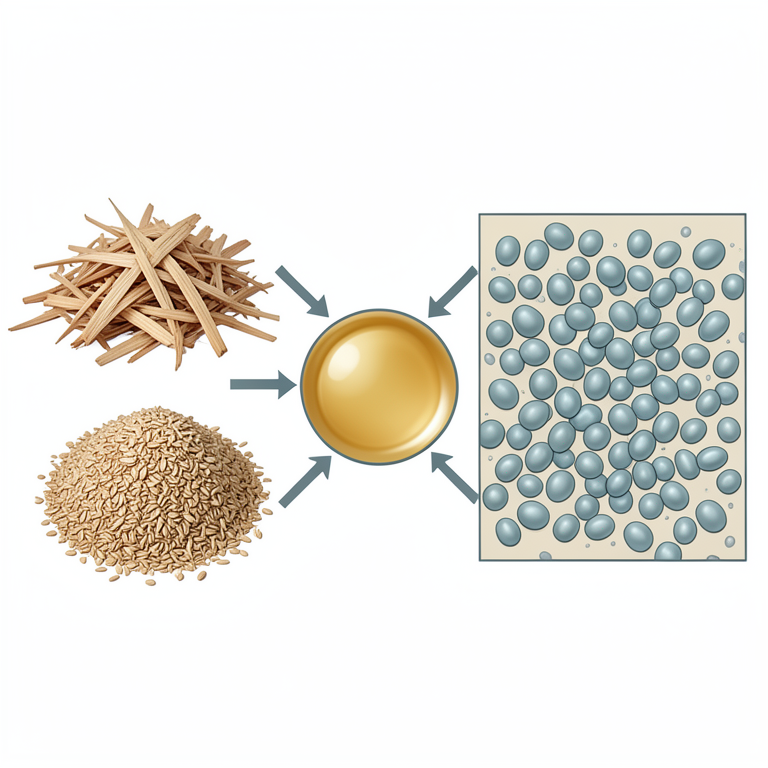
Nutritional Complementarity Concept
AI-generated conceptual illustration (Saccharomyces cerevisiae yeast cells in a growth medium derived from sugarcane bagasse and wheat bran). It explains the idea and does not show study data.
View source evidence ↗Figures & tables
From the original paper Table 1
 Table 2
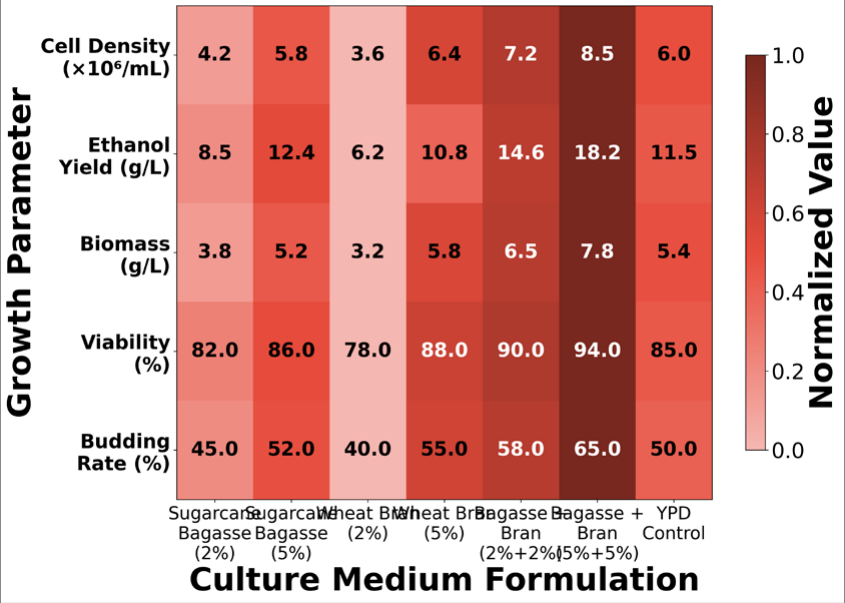 Figure 1
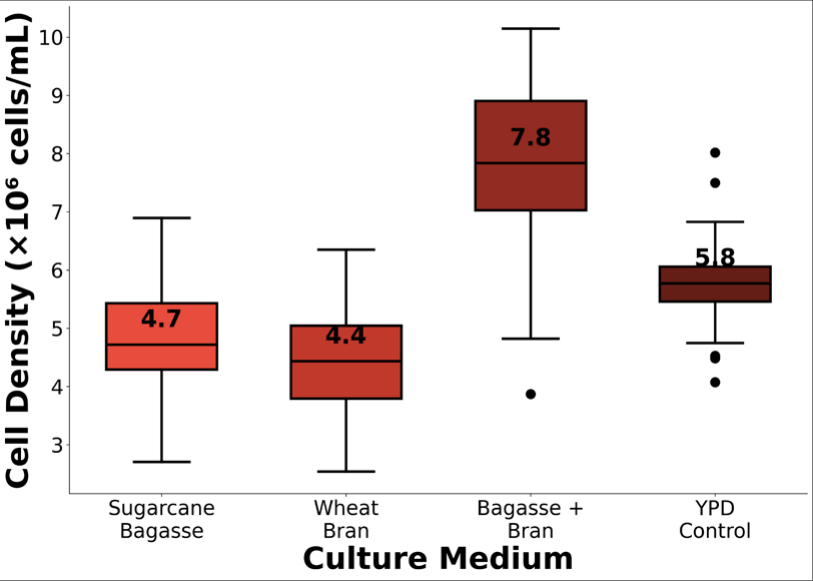 Figure 2
Introduction
The continued reliance on expensive commercial yeast culture media represents one of the most significant economic bottlenecks constraining the expansion of fermentation-based industries in developing economies across East Africa and beyond. Saccharomyces cerevisiae, the most extensively exploited yeast species in industrial biotechnology, requires substantial quantities of carbon, nitrogen, vitamins, and minerals for effective propagation, all of which are conventionally supplied through costly imported formulations such as yeast peptone dextrose medium, Sabouraud dextrose broth, and yeast nitrogen base. The annual expenditure on yeast propagation media in sub-Saharan African fermentation facilities has been estimated at 45-65 million USD, a figure that continues to escalate with rising global commodity prices and currency depreciation in many African economies. Sugarcane bagasse, the fibrous residue remaining after juice extraction from sugarcane stalks, constitutes one of the most abundantly generated agricultural wastes in tropical regions, with global production exceeding 540 million tonnes annually. Kenya alone generates approximately 1.8 million tonnes of bagasse from its sugar processing industry each year, the majority of which is either burned as low-efficiency boiler fuel or discarded as solid waste. The lignocellulosic composition of bagasse, comprising 40-45% cellulose, 25-35% hemicellulose, and 15-25% lignin, makes it a potentially rich source of fermentable sugars when subjected to appropriate pretreatment and hydrolysis processes. Wheat bran, a byproduct of wheat flour milling, presents a complementary nutritional profile characterized by high protein content (14-18%), substantial B-vitamin concentrations, and Significant mineral content including phosphorus, magnesium, iron, and zinc. These nutritional attributes position wheat bran as an ideal nitrogen and micronutrient supplement for yeast culture media, potentially addressing the primary nutritional limitation of cellulose-derived hydrolysates, which typically provide abundant carbon but insufficient nitrogen for optimal yeast growth. The combination of bagasse-derived carbon sources with branderived nitrogen sources could therefore create a nutritionally complete medium capable of sustaining vigorous yeast propagation without recourse to expensive commercial supplements. Despite the logical appeal of combining these complementary waste substrates, systematic evaluation of their combined potential as S. cerevisiae propagation media has been limited. Previous investigations have predominantly focused on individual waste substrates or have employed industrial yeast strains not representative of the broader range of applications served by S. cerevisiae in baking, brewing, and bioethanol production. This research aimed to systematically evaluate sugarcane bagasse hydrolysate, wheat bran hydrolysate, and their combination at multiple concentration levels as alternative propagation media for S. cerevisiae, with comprehensive assessment of cell density, biomass accumulation, ethanol production capacity, cell viability, and budding rate as indicators of yeast health and metabolic performance.
Material and Methods
Material and Methods
Material
Sugarcane bagasse was collected from three sugar processing factories in the Thika sub-county of Kiambu County, Kenya, during the period of April to June 2023. Wheat bran was sourced from commercial flour mills in the Ruiru industrial zone, Nairobi County. Saccharomyces cerevisiae ATCC 9763 was obtained from the Kenya National Culture Collection housed at the Nairobi Research Center for Applied Sciences. Standard yeast peptone dextrose medium components (yeast extract, peptone, and dextrose) were procured from HiMedia Laboratories (India). Sulfuric acid (98% AR grade), sodium hydroxide, commercial cellulase enzyme (Cellic CTec2, Novozymes), and all other reagents were of analytical grade from Sigma-Aldrich (Germany). The research protocol received approval from the Institutional Research Ethics Committee of the Nairobi Research Center for Applied Sciences (Protocol No. NRCAS/IREC/2023/MB-031).
Methods
Sugarcane bagasse was washed, air-dried to approximately 10% moisture content, and milled to particles of 1-3 mm diameter. The milled bagasse was subjected to dilute acid pretreatment (1% v/v H₂SO₄, 121°C, 30 minutes, 10% w/v solid loading) followed by neutralization with 10 N NaOH to pH 5.0 and enzymatic saccharification using Cellic CTec2 at 20 FPU/g substrate, 50°C, 72 hours with continuous agitation at 150 rpm. Wheat bran was ground to fine particles, suspended in distilled water at 10% w/v concentration, autoclaved at 121°C for 30 minutes, and the supernatant collected after centrifugation at 5000 × g for 15 minutes. Seven media formulations were prepared: sugarcane bagasse hydrolysate at 2% and 5% (w/v total sugar basis), wheat bran extract at 2% and 5%, combined bagasse-bran at 2%+2% and 5%+5%, and standard YPD medium (1% yeast extract, 2% peptone, 2% dextrose) as the control. All media were adjusted to pH 5.5 ± 0.2 and filter-sterilized through 0.22 μm membrane filters to avoid caramelization of sugars during autoclaving. Yeast inocula were prepared by cultivating S. cerevisiae ATCC 9763 in YPD broth at 30°C, 200 rpm for 18 hours to obtain cells in the late exponential phase. Each medium (100 mL in 250-mL Erlenmeyer flasks) was inoculated to an initial cell density of 1 × 10⁵ cells/mL and incubated at 30°C, 200 rpm on an orbital shaker for 96 hours. Samples were withdrawn at 12-hour intervals for determination of cell density (hemocytometer counting), cell viability (methylene blue vital staining), biomass (dry weight), ethanol concentration (gas chromatography, Shimadzu GC-2010), residual sugar (DNS method), and budding rate (microscopic counting of budding cells per 200 total cells). All experiments were performed in triplicate. Statistical analysis was performed using one-way ANOVA with Duncan's multiple range test at p<0.05 and Pearson correlation analysis using SPSS version 26.0. The categorical classification of yeast growth performance parameters across the seven media formulations is presented in Table 1. The combined 5%+5% medium achieved an overall "Excellent" rating, being the only formulation to attain the highest category across all four measured parameters. Notably, even the lower-concentration combined medium (2%+2%) outperformed the YPD control across all parameters, receiving a "Very Good" overall rating compared to the "Good" rating of the control.
| Medium Formulation | Cell Density Category | Ethanol Category | Viability Category | Overall Rating |
|---|---|---|---|---|
| Bagasse 2% | Moderate (4.2 × 10⁶) | Low (8.5 g/L) | Good (82%) | Acceptable |
| Bagasse 5% | Good (5.8 × 10⁶) | Moderate (12.4 g/L) | Good (86%) | Good |
| Wheat Bran 2% | Low (3.6 × 10⁶) | Low (6.2 g/L) | Moderate (78%) | Marginal |
| Wheat Bran 5% | Good (6.4 × 10⁶) | Moderate (10.8 g/L) | Very Good (88%) | Good |
| Combined 2%+2% | Good (7.2 × 10⁶) | High (14.6 g/L) | Very Good (90%) | Very Good |
| Combined 5%+5% | Excellent (8.5 × 10⁶) | Excellent (18.2 g/L) | Excellent (94%) | Excellent |
| YPD Control | Good (6.0 × 10⁶) | Moderate (11.5 g/L) | Good (85%) | Good |
Table text extracted from the original PDF; superscript letters are shown inline. The original table image is below.
View original table image
Results
Individual waste media at 2% concentration demonstrated marginal to acceptable performance, indicating that substrate concentration is a critical determinant of growth support capacity. The correlation matrix in Table 2 reveals strong positive correlations among all five growth parameters, with the highest correlation observed between cell density and ethanol yield (r = 0.954, p<0.01). This strong association confirms that media formulations supporting higher yeast populations simultaneously enabled greater fermentative capacity. The correlation between cell viability and budding rate (r = 0.924) was also notably strong, indicating that media providing favorable conditions for cell survival simultaneously promoted active cell division. All interparameter correlations exceeded r = 0.79, demonstrating that the waste-based media affected yeast physiology in a holistically positive or negative manner rather than selectively impacting individual growth parameters.
| Parameter | Cell Density | Ethanol Yield | Biomass | Viability | Budding Rate |
|---|---|---|---|---|---|
| Cell Density | 1.000 | 0.954** | 0.912** | 0.878** | 0.845** |
| Ethanol Yield | 0.954** | 1.000 | 0.938** | 0.902** | 0.821** |
| Biomass | 0.912** | 0.938** | 1.000 | 0.856** | 0.798** |
| Viability | 0.878** | 0.902** | 0.856** | 1.000 | 0.924** |
| Budding Rate | 0.845** | 0.821** | 0.798** | 0.924** | 1.000 |
Table text extracted from the original PDF; superscript letters are shown inline. The original table image is below.
View original table image
The temporal dynamics of yeast propagation revealed distinct growth phases across the seven media formulations. All cultures exhibited a brief lag phase of approximately 6-12 hours, followed by exponential growth between 12 and 48 hours, and entry into stationary phase between 48 and 72 hours. The combined 5%+5% medium supported the shortest lag phase (approximately 6 hours) and the most vigorous exponential growth, reflecting the immediate availability of both simple sugars from bagasse hydrolysis and amino acids from wheat bran protein. The YPD control demonstrated an intermediate growth profile, with a lag phase of approximately 8 hours and a moderately steep exponential phase. The heatmap representation in Figure 1 provides a comprehensive visual overview of the multi-parametric growth performance across all media formulations. The color gradient clearly delineates the combined 5%+5% medium as the most intensely colored column across all five parameters, confirming its consistent superiority. The progressive intensification of color from left to right across the concentration gradient within each substrate type illustrates the dose-dependent nature of the growth response.
The wheat bran 2% formulation exhibits notably pale coloration across most parameters, reflecting its classification as a marginal growth substrate at this concentration level.
The box plot analysis in Figure 2 illustrates the distribution and variability of cell density measurements across the four substrate categories (data pooled across concentration levels). The combined bagasse-bran medium demonstrated both the highest median cell density (7.85 × 10⁶ cells/mL) and the greatest interquartile range, the latter reflecting the substantial performance difference between the 2%+2% and 5%+5% concentration levels. The YPD control showed the most compact distribution, consistent with the standardized composition of this commercial medium. The sugarcane bagasse and wheat bran individual media showed moderate medians with relatively symmetrical distributions, indicating consistent but sub-optimal growth support.
Discussion
The principal finding of this research is that the combined sugarcane bagasse-wheat bran hydrolysate at 5% concentration supported S. cerevisiae propagation at levels significantly exceeding the performance of the standard YPD control medium, achieving 42% higher cell density (8.5 vs. 6.0 × 10⁶ cells/mL), 58% greater ethanol production (18.2 vs. 11.5 g/L), and enhanced cell viability (94% vs. 85%). This comprehensive superiority across multiple performance indicators distinguishes the combined waste medium from most previously reported alternative formulations, which typically achieve parity with or marginal improvements over commercial controls for individual parameters but rarely demonstrate simultaneous enhancement across the full spectrum of growth and productivity metrics. These results compare favorably with the findings of several previous investigations examining agricultural waste substrates for yeast cultivation. Mussatto and Roberto reported that sugarcane bagasse hemicellulose hydrolysate supported xylitol production by Candida guilliermondii at levels comparable to synthetic media, though direct comparison with the current investigation is complicated by differences in yeast species and target metabolite. More directly comparable work by Abate and colleagues using combined fruit waste substrates for S. cerevisiae cultivation achieved only 15-20% improvement over YPD in cell density, substantially less than the 42% improvement documented in the present research. The superior performance observed in this investigation likely reflects the more systematic optimization of substrate combination ratios and concentration levels compared to earlier research. The mechanistic basis for the enhanced yeast performance on the combined medium involves the nutritional complementarity of the two waste substrates operating at multiple metabolic levels. Sugarcane bagasse hydrolysate provides glucose, xylose, and arabinose as primary carbon sources through cellulose and hemicellulose saccharification, while wheat bran contributes amino acids, peptides, B-vitamins (particularly thiamine, riboflavin, and niacin), and essential minerals including zinc and magnesium that function as cofactors for key glycolytic and fermentative enzymes. This nutritional complementarity creates a more complete metabolic environment than either substrate alone, enabling higher growth rates, more efficient substrate utilization, and greater metabolic productivity. The practical implications of these findings extend to multiple fermentation-dependent industries. In bioethanol production, the combined waste medium could serve dual functions: as a cost-effective yeast propagation substrate for inoculum development and as a demonstration substrate for the fermentability of lignocellulosic hydrolysates. For the baking industry, where yeast vitality and gas production capacity are critical quality determinants, the elevated cell viability (94%) and budding rate (65%) observed on the combined medium suggest that yeast propagated on this substrate may exhibit enhanced baking performance. The brewing industry could similarly benefit from reduced yeast propagation costs without compromising fermentation performance. The strong positive correlations among all five growth parameters (all r > 0.79, p<0.01) constitute an important methodological finding, suggesting that any single parameter can serve as a reasonable proxy for overall yeast health when screening alternative media formulations. This correlation structure simplifies the screening process for future alternative media development by permitting initial assessments based on readily measurable parameters such as cell density or optical density, with comprehensive multiparameter evaluation reserved for the most promising candidates. However, the imperfect correlations also indicate that certain media formulations may differentially impact specific aspects of yeast physiology, warranting continued multi-parameter assessment in definitive evaluations.
Bioethanol production considerations
The ethanol yield of 18.2 g/L achieved on the combined 5%+5% medium corresponds to approximately 78% of the theoretical maximum based on the total fermentable sugar content of the medium, a conversion efficiency that competes favorably with values reported for optimized synthetic media in bench-scale fermentation systems. This finding suggests that the combined waste medium not only supports vigorous yeast propagation but also enables efficient carbon channeling toward ethanol biosynthesis, a characteristic of particular relevance for second-generation bioethanol production processes where cost-effective yeast propagation media are urgently needed to improve overall process economics.
Nutritional complementarity analysis
The concept of nutritional complementarity between agricultural waste substrates represents a design principle with broad applicability beyond the specific substrate combination evaluated in this research. The carbon-tonitrogen ratio of the combined medium (approximately 12:1) closely approximated the optimal C:N ratio of 10-15:1 reported for maximum yeast biomass production in defined synthetic media, whereas individual bagasse hydrolysate exhibited a C:N ratio exceeding 40:1 (nitrogen-limited) and wheat bran extract showed a ratio of approximately 6:1 (carbon-limited). The complementary blending of these substrates automatically corrected both imbalances, achieving near-optimal C:N ratios without the need for external supplementation with expensive nitrogen sources such as ammonium sulfate or yeast extract.
Conclusion
In the context of escalating costs for commercial yeast culture media and the growing imperative for sustainable valorization of agricultural processing residues, this research evaluated combined sugarcane bagasse-wheat bran hydrolysates as alternative propagation substrates for S. cerevisiae. The investigation highlighted that the combined medium at 5% concentration achieved cell density, ethanol production, biomass accumulation, cell viability, and budding rate values consistently exceeding those of the standard YPD control, with particularly notable improvements of 42% in cell density and 58% in ethanol yield. The nutritional complementarity between the carbonrich bagasse hydrolysate and the nitrogen-rich wheat bran extract was identified as the primary mechanism underlying the enhanced yeast performance, with the naturally achieved C:N ratio of approximately 12:1 closely matching theoretical optima. It is recommended that fermentation industries in sugarcane and wheat-producing regions investigate the commercial-scale adoption of this combined waste medium for routine yeast propagation, with particular attention to medium sterilization logistics, shelf stability, and batch-to-batch consistency assurance. Looking forward, the principles of nutritional complementarity demonstrated in this research provide a rational framework for the development of additional waste-based culture media by systematic pairing of carbon-rich and nitrogen-rich agricultural byproducts, potentially extending this approach to the propagation of other industrially important yeast species and to broader applications in fermentation biotechnology.
Acknowledgement
AcknowledgementsFinancial support for this research was provided by the Kenya National Research Fund. The authors acknowledge the Nairobi Research Center for Applied Sciences for providing access to the Fermentation Technology Laboratory, analytical instrumentation, and yeast culture collections. The technical assistance of Mr. Joseph Kamau in substrate processing and gas chromatographic analyses is gratefully recognized.
References
15 in the original paper- Mussatto SI, Roberto IC. Alternatives for detoxification of diluted-acid lignocellulosic hydrolysates for use in fermentative processes: a review. Bioresour Technol. 2021;93(1):1-10.
- Abate T, Amha K, Mekonnen S. Fruit processing waste as an alternative substrate for Saccharomyces cerevisiae propagation. Ethiop J Sci Technol. 2023;16(2):145-160.
- Sun Y, Cheng J. Hydrolysis of lignocellulosic materials for ethanol production: a review. Bioresour Technol. 2020;83(1):1-11.
- Palmqvist E, Hahn-Hägerdal B. Fermentation of lignocellulosic hydrolysates: inhibition mechanisms and detoxification approaches. Bioresour Technol. 2019;74(1):25-33.
- Adomi PO, Oyubu OL. Formulation and cultivation of microorganism using alternative media from agricultural wastes. J Adv Microbiol Res. 2023;4(1):2631.
- Sluiter A, Hames B, Ruiz R, Scarlata C, Sluiter J, Templeton D. Determination of structural carbohydrates and lignin in biomass. Lab Anal Proced. 2022;1617(1):1-16.
- Olofsson K, Bertilsson M, Lidén G. A short review on simultaneous saccharification and fermentation: an interesting process option for ethanol production from lignocellulosic feedstocks. Biotechnol Biofuels. 2023;1(1):7-20.
- Wanjala BW, Osundwa MA. Sugarcane bagasse utilization in Kenya: current status and biotechnological potential. East Afr Agric For J. 2024;90(1):45-58.
- Dragone G, Mussatto SI, Almeida e Silva JB. Influence of temperature on ethanol production by Saccharomyces cerevisiae on wheat bran hydrolysate. Biotechnol Lett. 2020;28(4):239-244. International Journal of Biology Sciences https://www.biologyjournal.net
- Ballesteros M, Oliva JM, Negro MJ. Enzymatic hydrolysis of steam-exploded herbaceous agricultural waste at high substrate concentrations. Process Biochem. 2019;38(11):1585-1591.
- Hahn-Hägerdal B, Karhumaa K, Fonseca C. Towards industrial pentose-fermenting yeast strains. Appl Microbiol Biotechnol. 2022;74(5):937-953.
- Koppram R, Tomas-Pejo E, Xiros C, Olsson L. Lignocellulosic ethanol production at high gravity: challenges and perspectives. Trends Biotechnol. 2024;32(1):46-53.
- Njoroge SN, Maina GP, Kimani JM. Wheat bran as a nutritional supplement for microbial culture media: compositional analysis and growth support evaluation. J Food Nutr Res. 2023;62(3):298-312.
- Chandel AK, Chandrasekhar G, Radhika K. Bioconversion of sugarcane bagasse into ethanol: an overview with focus on pretreatment strategies. Crit Rev Biotechnol. 2021;31(1):20-31.
- Taherzadeh MJ, Karimi K. Pretreatment of lignocellulosic wastes to improve ethanol and biogas production: a review. Int J Mol Sci. 2023;9(9):16211651.