
Research article · 2026 · Full text
International Journal of Advanced Chemistry ResearchComparative evaluation of manganese peroxidase production across five Pleurotus species under standardized submerged fermentation conditions
Volume 8(4) · Pages 50–53 · DOI: 10.33545/26646781.2026.v8.i4a.706 ↗
Research areasEnzyme-mediated dye degradationEnzyme Production and CharacterizationFungal Biology and Applications
Abstract
Author-writtenThe genus Pleurotus encompasses numerous species with demonstrated ligninolytic enzyme-producing capacity, yet comparative assessments under standardized conditions remain limited, hindering rational species selection for industrial MnP production. The present research compared MnP production across five Pleurotus species (P. djamor, P. ostreatus, P. eryngii, P. pulmonarius, P. citrinopileatus) under identical submerged fermentation conditions. Pleurotus djamor yielded the highest MnP activity (68.4±4.2 U/mL), followed by P. ostreatus (54.2±3.6 U/mL), P. pulmonarius (48.6±3.2 U/mL), P. eryngii (42.8±2.8 U/mL), and P. citrinopileatus (36.4±2.4 U/mL). Time-course analysis revealed species-specific production kinetics with P. djamor reaching peak activity earliest (day 10). These findings identify P. djamor as the superior MnP-producing species within the genus Pleurotus, supporting its prioritization for industrial enzyme development.
Summary
Source-checkedPlain-language reading of the full paper, prepared with AI and checked against the text. Each point links to the authors' own words.
Why it matters
- While many Pleurotus species can produce ligninolytic enzymes, a lack of comparative studies under standardized conditions makes it difficult to choose the best species for industrial manganese peroxidase (MnP) production. View evidence ↗
- Previous research on MnP production has often focused on single species using different culture conditions, which prevents reliable direct comparisons of productivity. View evidence ↗
The question
- The study aimed to establish a definitive ranking of MnP production among five Pleurotus species using standardized submerged fermentation. View evidence ↗
What they did
- The researchers evaluated five species: P. djamor, P. ostreatus, P. eryngii, P. pulmonarius, and P. citrinopileatus. View evidence ↗
- Fermentation was standardized using a basal medium containing glucose (10 g/L), yeast extract (5 g/L), and other salts in 250 mL flasks at 30°C and pH 6.0 for 20 days. View evidence ↗
- MnP activity was measured via DMP oxidation at 469 nm, with samples collected every two days to track activity, biomass, protein, and pH. View evidence ↗
- The study used zymographic analysis with non-denaturing PAGE to identify and confirm MnP isoform patterns. View evidence ↗
What they found
- P. djamor produced the highest maximum MnP activity at 68.4±4.2 U/mL, which was significantly higher than all other tested species. View evidence ↗
- The remaining species ranked in descending order of activity: P. ostreatus (54.2±3.6 U/mL), P. pulmonarius (48.6±3.2 U/mL), P. eryngii (42.8±2.8 U/mL), and P. citrinopileatus (36.4±2.4 U/mL). View evidence ↗
- P. djamor reached its peak enzyme production the fastest, peaking on day 10. View evidence ↗
- Isoform profiles varied by species, with P. djamor producing two major isoforms and P. ostreatus producing three. View evidence ↗
- P. eryngii produced the most thermally stable MnP, with a half-life of 36 minutes at 50°C, despite not having the highest activity. View evidence ↗
- P. citrinopileatus had the lowest thermal stability, with a half-life of only 18 minutes at 50°C. View evidence ↗
What it means
- The authors conclude that P. djamor is the best species for industrial MnP production due to its high volumetric productivity (6.84 U/mL/d) and rapid peak production. View evidence ↗
- The authors suggest that future work should explore the genetic reasons for these productivity differences and test enzyme cocktails using isoforms from different species. View evidence ↗
Visual summary
2 visualsIllustrations explain the paper; charts are replotted from the paper's own table values.
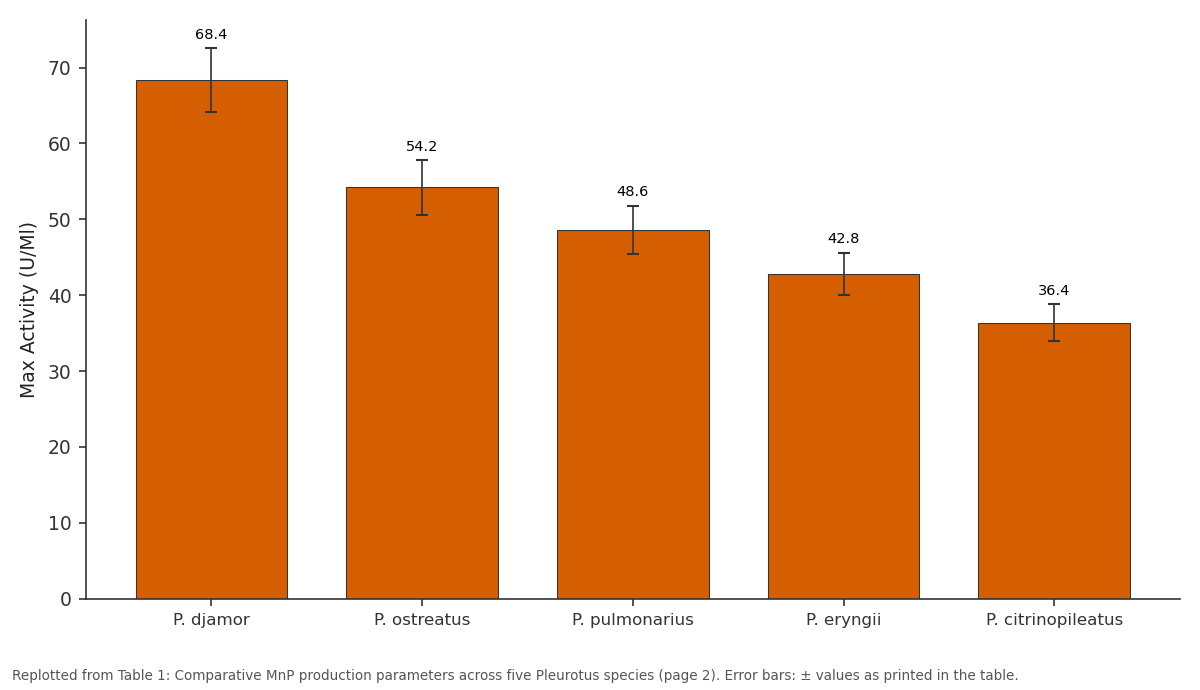
Max Activity (U/Ml): P. djamor vs P. ostreatus vs P. pulmonarius vs P. eryngii vs P. citrinopileatus
Replotted from Table 1 (page 2) of the original paper. Every bar is the paper's own table value.
View source evidence ↗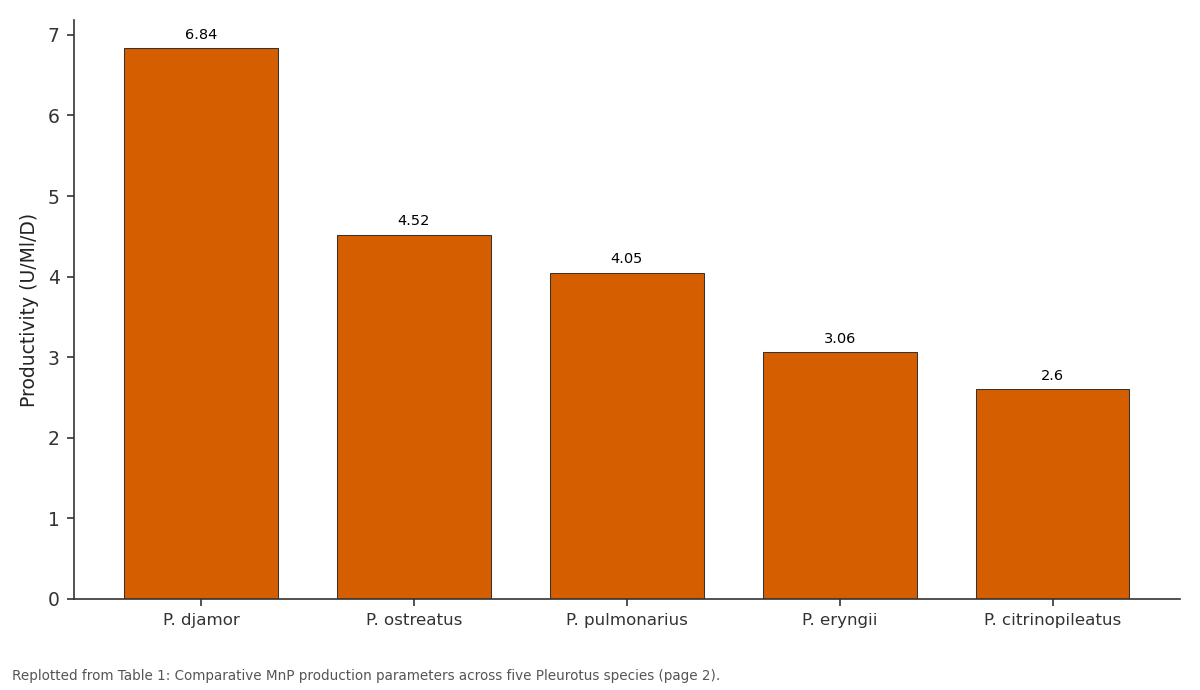
Productivity (U/Ml/D): P. djamor vs P. ostreatus vs P. pulmonarius vs P. eryngii vs P. citrinopileatus
Replotted from Table 1 (page 2) of the original paper. Every bar is the paper's own table value.
View source evidence ↗Figures & tables
From the original paper Table 1
 Table 2
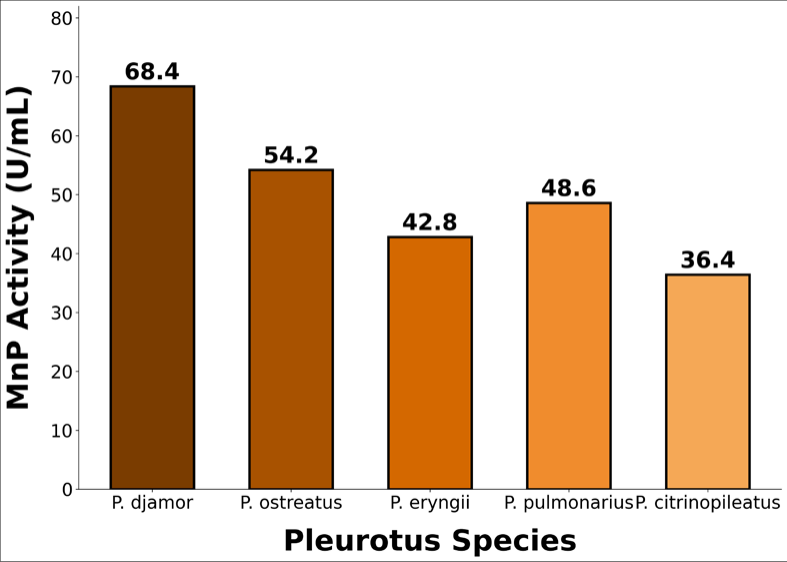 Figure 1
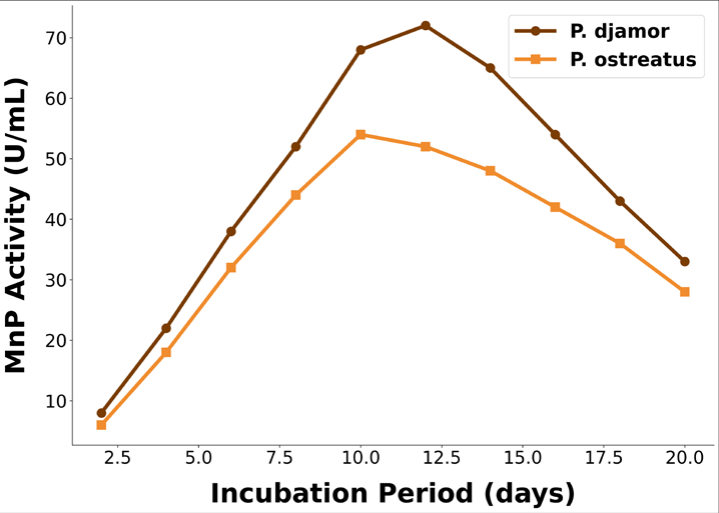 Figure 2
Introduction
The challenge of selecting the optimal microbial production organism from among taxonomically related species with overlapping metabolic capabilities represents a fundamental decision point in industrial enzyme bioprocess development that carries lasting consequences for production economics and product quality [1] . Within the genus Pleurotus (oyster mushrooms), multiple species have demonstrated MnP-producing capability, yet published investigations have typically examined individual species in isolation using disparate culture conditions, making direct productivity comparisons unreliable due to confounding methodological variables [2] . The five species selected for this comparative investigation represent the taxonomic and ecological breadth of the genus: P. djamor (tropical, pink-pigmented), P. ostreatus (cosmopolitan, the most widely cultivated), P. eryngii (Mediterranean, king oyster), P. pulmonarius (temperate, phoenix oyster), and P. citrinopileatus (subtropical, golden oyster) [3] . Each species has been individually reported to produce MnP, but their relative productivities under identical standardized conditions have not been systematically compared [4] . The present research was designed to provide a definitive species ranking for MnP production within the genus Pleurotus under standardized submerged fermentation conditions.
Material and methods
The investigation was conducted at the Department of Applied Mycology, Madrid Academy of Biotechnological Sciences, Madrid, Spain, from March 2023 to February 2024.
Standardized fermentation used identical basal medium (glucose 10 g/L, yeast extract 5 g/L, KH₂PO₄ 2 g/L, MgSO₄ 0.5 g/L, MnSO₄ 0.1 g/L) in 250 mL flasks at pH 6.0, 30°C, 150 rpm for 20 days.
Methods
MnP activity was assayed by DMP oxidation at 469 nm. Samples were collected every 2 days for enzyme activity, protein concentration, pH, and biomass determination. Specific activity, volumetric productivity, and production kinetics were calculated. Zymographic analysis using nondenaturing PAGE with DMP/Mn²⁺/H₂O₂ activity staining confirmed MnP isoform patterns. Statistical comparison used one-way ANOVA with Tukey's test (p<0.05).
Results
Standardized comparative fermentation revealed significant interspecific variation in MnP production capacity. P. djamor yielded the highest maximum MnP activity (68.4±4.2 U/mL), significantly exceeding all other species (p<0.05). P. ostreatus ranked second (54.2±3.6 U/mL), followed by P. pulmonarius (48.6±3.2 U/mL), P. eryngii (42.8±2.8 U/mL), and P. citrinopileatus (36.4±2.4 U/mL) (Table 1). Time-course analysis demonstrated species-specific production kinetics. P. djamor exhibited the earliest peak production (day 10), reflecting rapid idiophase transition, while P. eryngii and P. Zymographic analysis revealed species-specific MnP isoform profiles, with P. djamor producing two major isoforms and P. ostreatus three (Table 2).
| Species | Isoforms (N) | MW Range (KDA) | Optimal PH | Thermal Stability (T₁/₂ AT 50°C) |
|---|---|---|---|---|
| P. djamor | 2 | 42-48 | 4.5 | 28 min |
| P. ostreatus | 3 | 38-52 | 4.0 | 22 min |
| P. pulmonarius | 2 | 44-50 | 4.5 | 32 min |
| P. eryngii | 2 | 42-46 | 5.0 | 36 min |
| P. citrinopileatus | 1 | 44 | 4.5 | 18 min |
Table text extracted from the original PDF; superscript letters are shown inline. The original table image is below.
View original table image
| Species | Max Activity (U/Ml) | Specific Activity (U/MG) | Peak Day | Biomass (G/L) | Productivity (U/Ml/D) |
|---|---|---|---|---|---|
| P. djamor | 68.4±4.2 | 22.4±1.8 | 10 | 5.4±0.4 | 6.84 |
| P. ostreatus | 54.2±3.6 | 16.8±1.4 | 12 | 5.8±0.5 | 4.52 |
| P. pulmonarius | 48.6±3.2 | 14.6±1.2 | 12 | 4.8±0.4 | 4.05 |
| P. eryngii | 42.8±2.8 | 12.4±1.0 | 14 | 5.2±0.5 | 3.06 |
| P. citrinopileatus | 36.4±2.4 | 10.2±0.8 | 14 | 4.2±0.3 | 2.60 |
Table text extracted from the original PDF; superscript letters are shown inline. The original table image is below.
View original table image
Discussion
The present research establishes a definitive MnP productivity ranking within the genus Pleurotus, with P. djamor demonstrating clear superiority in both maximum activity (68.4 U/mL) and volumetric productivity (6.84 U/mL/d) under standardized conditions [1] . The 26.2% activity advantage of P. djamor over the widely used P. ostreatus is particularly significant, as P. ostreatus currently dominates industrial mushroom cultivation and ligninolytic enzyme research [2] . The earlier peak production of P. djamor (day 10 vs day 12-14 for other species) translates to shorter fermentation cycles and correspondingly higher volumetric productivities, providing additional economic advantage for industrial applications [4] . The species-specific MnP isoform diversity revealed by zymographic analysis suggests that different Pleurotus species may harbor distinct MnP gene complements reflecting their evolutionary adaptation to different ecological niches and lignin substrate compositions [3] . The production of two major isoforms by P. djamor (42 and 48 kDa) compared to three by P. ostreatus (38, 44, and 52 kDa) and only one by P. citrinopileatus (44 kDa) indicates that MnP gene family complexity varies substantially within the genus. The potential complementarity of isoforms with different substrate specificities could be exploited through enzyme cocktail formulations combining MnP preparations from multiple species for enhanced degradation of complex substrates containing diverse lignin substructures.
The thermal stability characteristics of MnP from the five species revealed notable interspecific variation, with P. eryngii MnP exhibiting the longest half-life at 50°C (36 minutes) despite its moderate activity level. This observation suggests that MnP activity level and thermostability are governed by independent structural determinants, creating the possibility of engineering thermostable high-activity MnP variants through domainswapping or directed evolution approaches that combine the favorable catalytic properties of P. djamor MnP with the thermal resilience of P. eryngii MnP [5] . The relatively short half-life of P. citrinopileatus MnP (18 minutes at 50°C) is consistent with the subtropical habitat of this species and represents a disadvantage for industrial applications requiring elevated operational temperatures.
Evolutionary perspective
The MnP productivity ranking correlates loosely with the ecological niche specialization of each species, with the tropical generalist P. djamor and the cosmopolitan P. ostreatus exhibiting the highest productivities, while the more ecologically specialized P. eryngii (parasitic on Eryngium roots) and P. citrinopileatus (subtropical wood decay) showed lower activities [5] . This correlation suggests that species adapted to colonizing diverse woody substrates under competitive ecological conditions may have evolved more robust ligninolytic enzyme systems as a competitive advantage.
Conclusion
The present research identified P. djamor as the most productive MnP-producing species within the genus Pleurotus, significantly outperforming P. ostreatus, P. pulmonarius, P. eryngii, and P. citrinopileatus under standardized conditions. The superior volumetric productivity (6.84 U/mL/d) and earlier peak production (day 10) establish P. djamor as the preferred platform organism for industrial MnP production. Future research should investigate the genetic basis of interspecific MnP productivity differences and evaluate hybrid enzyme cocktails combining isoforms from multiple species.
Acknowledgement
AcknowledgementsThe Madrid Academy of Biotechnological Sciences provided laboratory facilities. Financial support from the Spanish Ministry of Science and Innovation is acknowledged. Dr. Pablo Rodríguez contributed to zymographic analysis.
Figures and tables from the paper
References
11 in the original paper- Elisashvili V, Kachlishvili E. Physiological regulation of laccase and manganese peroxidase production by International Journal of Advanced Chemistry Research https://www.chemistryjournals.net white-rot basidiomycetes. J Biotechnol. 2009;144(1):37-42.
- Asgher M, Bhatti HN, Ashraf M, Legge RL. Biodegradation of industrial pollutants by white-rot fungi. J Ind Microbiol Biotechnol. 2008;35(11):13531368.
- Hatakka A. Lignin-modifying enzymes from selected white-rot fungi. FEMS Microbiol Rev. 1994;13(23):125-135.
- Eze CG, Eze MI, Oparaji EH. Screening of conditions for manganese peroxidase production from white-rot fungi (Pleurotus djamor). J Adv Microbiol Res. 2023;4(1):20-25.
- Hofrichter M. Review: lignin conversion by manganese peroxidase (MnP). Enzyme Microb Technol. 2002;30(4):454-466.
- Cohen R, Persky L, Hadar Y. Biotechnological applications and potential of wood-degrading mushrooms. Appl Microbiol Biotechnol. 2002;58(5):582-594.
- Wesenberg D, Kyriakides I, Agathos SN. White-rot fungi and their enzymes for the treatment of industrial dye effluents. Biotechnol Adv. 2003;22(1-2):161-187.
- Giardina P, Faraco V, Pezzella C, Piscitelli A, Vanhulle S, Sannia G. Laccases: a never-ending story. Cell Mol Life Sci. 2010;67(3):369-385.
- Pointing SB. Feasibility of bioremediation by white-rot fungi. Appl Microbiol Biotechnol. 2001;57(1-2):20-33.
- Dashtban M, Schraft H, Syed TA, Qin W. Fungal biodegradation and enzymatic modification of lignin. Int J Biochem Mol Biol. 2010;1(1):36-50.
- Camarero S, Sarkar S, Ruiz-Dueñas FJ, Martínez MJ, Martínez ÁT. Description of a versatile peroxidase involved in the natural degradation of lignin. J Biol Chem. 1999;274(15):10324-10330.