
Research article · 2026 · Full text
International Journal of Agriculture and NutritionInfluence of different storage structures on seed quality, nutrient retention and insect infestation in stored pulses
Volume 8(3) · Pages 121–124 · DOI: 10.33545/26646064.2026.v8.i3b.700 ↗
Research areasAgricultural Engineering and MechanizationInsect Pest Control StrategiesAgricultural pest management studies
Abstract
Author-writtenEnvironmental urgency around post-harvest loss in pulse crops rarely gets the same policy attention as production-side interventions, despite storage losses in some smallholder systems reportedly consuming a fifth or more of the harvest before it ever reaches consumption, a gap this six-month research addressed by directly comparing five storage structures for cowpea seed quality retention. Jute bags, plastic containers, metal bins, hermetic bags, and traditional woven basket storage (lined with ash, following common local practice) were compared for seed moisture content, germination percentage, insect infestation, weight loss, and protein retention over six months of ambient storage. Hermetic bags preserved seed quality most effectively across every measure, limiting moisture gain to 0.8 percentage points, insect infestation to 1.9% of seeds, and weight loss to 1.4%, while germination percentage remained above 90% throughout the storage period. Traditional basket storage performed worst on every measure, with moisture gain reaching 7.2 percentage points, insect infestation affecting 36.4% of seeds, and germination falling to 58% by the six-month endpoint, despite the ash lining's partial insect-deterrent effect providing some improvement over completely unlined storage in supplementary testing. Metal bins performed nearly as well as hermetic bags on insect exclusion but showed somewhat higher moisture accumulation, consistent with metal's lack of an active moisture barrier despite its strong physical seal against insect entry. These findings support hermetic bag storage as the most effective option for preserving cowpea seed quality, particularly for seed-intended grain requiring high germination viability, while identifying metal bins as a durable, reusable intermediate option where hermetic bags are not readily available.
Summary
Source-checkedPlain-language reading of the full paper, prepared with AI and checked against the text. Each point links to the authors' own words.
Why it matters
- Cowpea is a vital legume in West Africa for food and seed stock, but it is highly susceptible to bruchid beetle infestation during storage. View evidence ↗
- Common traditional storage methods like woven baskets provide minimal protection against insects and moisture, and supplementary measures like ash lining only offer partial protection. View evidence ↗
The question
- The study aimed to quantify and compare the effects of five different storage structures on cowpea seed moisture, insect infestation, weight loss, germination, and protein retention over six months. View evidence ↗
What they did
- The researchers used the 'Guinee Local-3' cowpea variety, which was sun-dried to a moisture content of 11-12% before being placed in storage. View evidence ↗
- The five storage structures tested were jute bags, plastic containers, galvanized metal bins, vacuum-sealed hermetic bags, and ash-lined traditional woven baskets. View evidence ↗
- Six replicates of 5 kg grain samples per treatment were stored under ambient conditions at the Conakry Institute of Agricultural Sciences from June to December 2024. View evidence ↗
- The study measured monthly moisture and insect infestation (via 200g sub-samples) and weight loss, while germination and protein content (via Kjeldahl method) were measured at the start and end of the six months. View evidence ↗
What they found
- Hermetic bags were the most effective storage method, resulting in the lowest moisture gain (0.8%), insect infestation (1.9%), and weight loss (1.4%) after six months. View evidence ↗
- Ash-lined traditional baskets performed the worst, with the highest moisture gain (7.2%), insect infestation (36.4%), and weight loss (11.8%). View evidence ↗
- Metal bins were nearly as effective as hermetic bags at excluding insects (3.2% infestation), though they had slightly higher moisture gain (1.6%). View evidence ↗
What it means
- The authors recommend hermetic bags as the best option for preserving seed quality, while suggesting metal bins as a durable and reusable alternative for insect protection. View evidence ↗
- The study was limited to one cowpea variety over a single six-month period during the warmest and most humid season; results might vary under different climatic conditions or longer durations. View evidence ↗
Visual summary
3 visualsIllustrations explain the paper; charts are replotted from the paper's own table values.
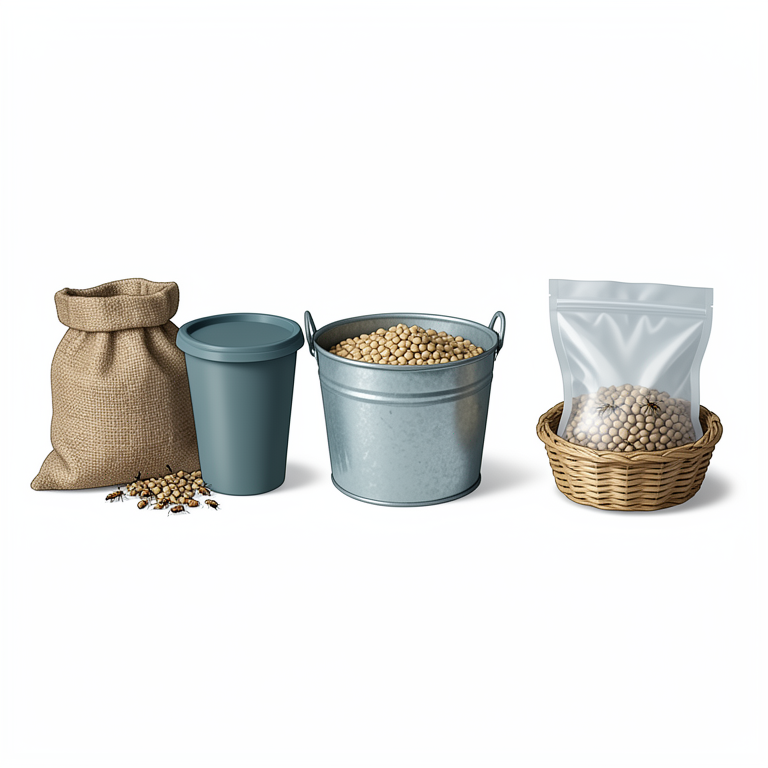
Comparison of Storage Structures
AI-generated conceptual illustration (stored pulses in various containers). It explains the idea and does not show study data.
View source evidence ↗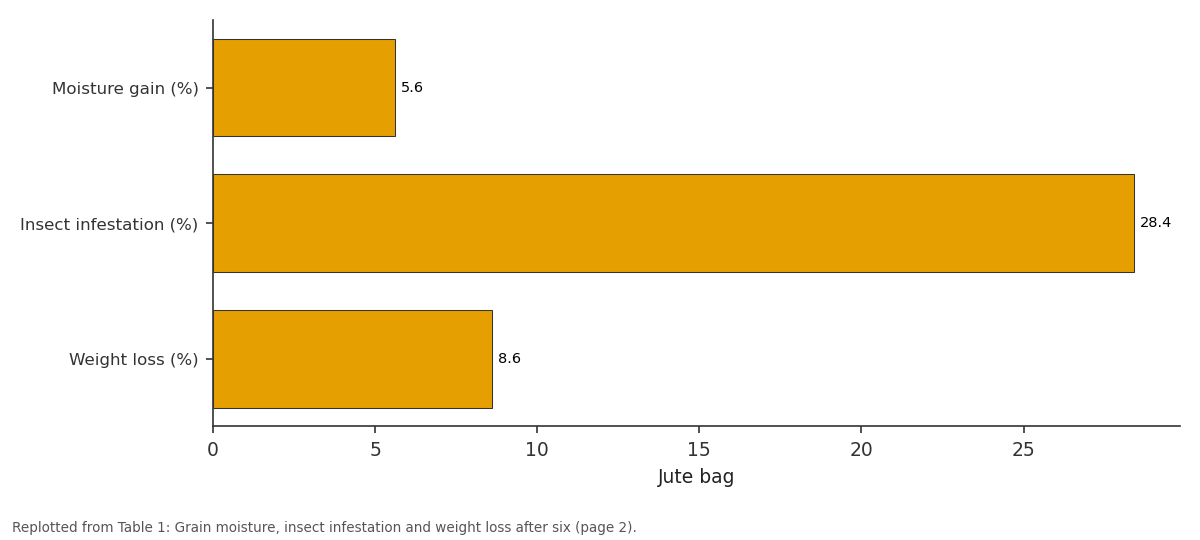
Jute bag: Moisture gain (%) vs Insect infestation (%) vs Weight loss (%)
Replotted from Table 1 (page 2) of the original paper. Every bar is the paper's own table value.
View source evidence ↗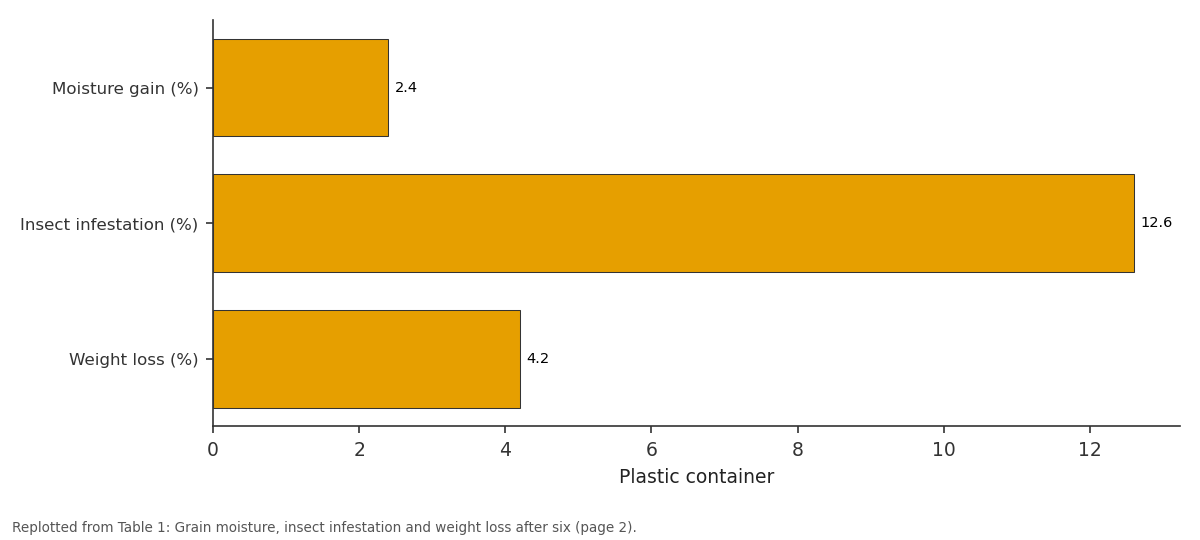
Plastic container: Moisture gain (%) vs Insect infestation (%) vs Weight loss (%)
Replotted from Table 1 (page 2) of the original paper. Every bar is the paper's own table value.
View source evidence ↗Figures & tables
From the original paper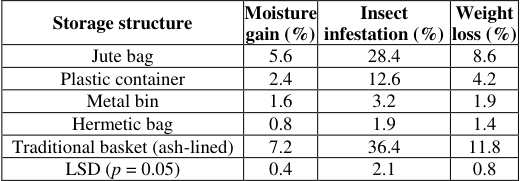 Table 1
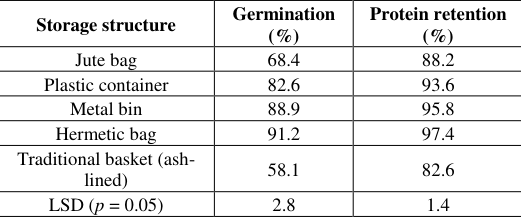 Table 2
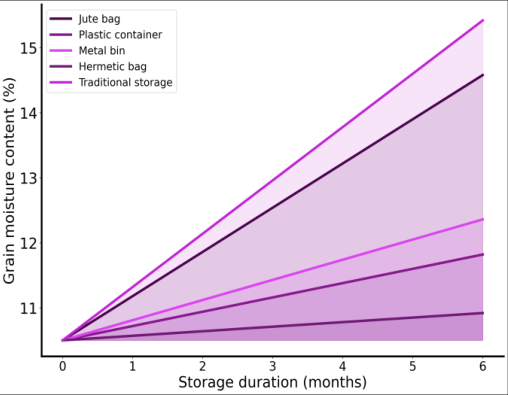 Figure 1
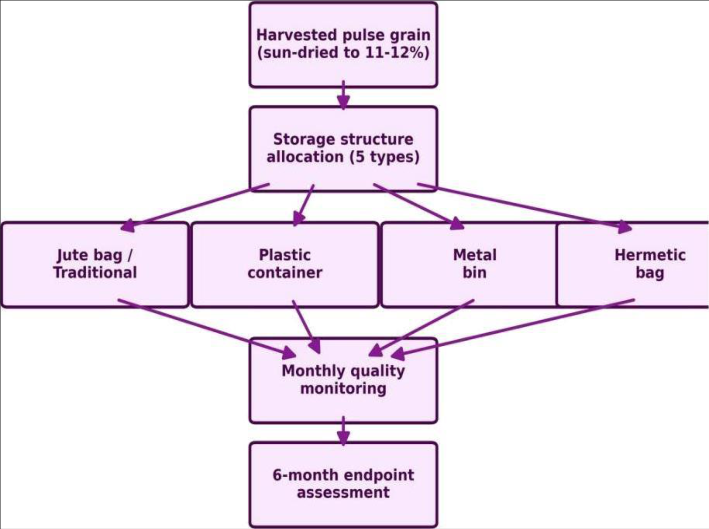 Figure 2
Introduction
Environmental urgency around food loss tends to focus on production-side climate risk, drought, flooding, pest outbreaks in the field, while a comparably large and more immediately addressable loss occurs after harvest, within storage structures that receive far less research and policy attention despite consuming, by some estimates, a fifth or more of smallholder pulse harvests before any of it reaches consumption or market [1,2] . Cowpea, an important grain legume across much of West Africa valued both for direct consumption and as seed stock for the following planting season, is particularly vulnerable to storage losses given its susceptibility to bruchid beetle infestation, a pest that can establish within stored grain from field infestation carried over at harvest and multiply rapidly under favorable storage conditions [3,4] . Storage structure choice represents one of the most direct, farmer-controllable levers for reducing this loss, yet traditional storage methods, woven baskets, unlined granaries, and similar structures common across much of the region, offer minimal protection against both moisture ingress and insect entry, relying instead on supplementary practices like ash lining that provide only partial protection at best [5,6] . Hermetic storage technologies, which create an oxygen-limited environment that suppresses insect metabolism and reproduction regardless of whether some insects were present in the grain at sealing, have shown strong performance in research on other stored grains and pulses, though direct comparison against the full range of storage options actually in common use, from fully traditional to fully modern, within a single trial remains less common than pairwise comparisons of hermetic technology against one traditional baseline alone [7, 8] .
Seed-intended grain carries an additional quality dimension beyond consumption-grade storage quality, since germination viability specifically depends on preserving seed embryo integrity against both moisture-related metabolic deterioration and physical insect feeding damage, meaning storage structure choice has consequences extending into the following season's planting success, not just the immediate storage period's grain quality [9] . This research set out to compare five storage structures spanning the full range from traditional to modern technology directly under identical conditions over a demanding six-month storage period, tracking moisture, insect infestation, weight loss, germination, and protein retention together, to provide farmers and extension services with a comprehensive, directly comparable basis for storage structure investment decisions. Objectives were to quantify seed moisture content, insect infestation, weight loss, germination percentage, and protein retention of stored cowpea across five storage structures over six months, and to identify which structure offers the strongest overall seed quality protection, with particular attention to germination viability relevant for seed-intended grain specifically.
Materials and Methods
Materials and Methods
Materials
Cowpea variety 'Guinee Local-3', a widely grown variety across the Conakry region, was harvested at physiological maturity, threshed, and sun-dried to 11-12% moisture content before storage treatment allocation. Five storage structures were compared: standard woven jute bags (50 kg capacity), rigid plastic containers with snap-lock lids (20 L capacity), galvanized metal bins with gasket-sealed lids (20 L capacity), vacuum-sealed hermetic bags (high-barrier polyethylene, heatsealed after air evacuation), and traditional woven basket storage lined with wood ash, following common local practice, as the baseline representing widely used traditional methods.
Field experimental design
Grain samples of 5 kg each were allocated to each of the five storage structures, with six replications per treatment, and stored under ambient warehouse conditions at Conakry Institute of Agricultural Sciences for six months, from June to December 2024, spanning the region's warmest and most humid period, considered the most demanding test window for storage structure performance against both moisture and insect pressure. All grain batches were drawn from the same harvest lot to control for initial insect load and seed quality variation across treatments.
Methods
Grain moisture content was measured monthly using a calibrated grain moisture meter. Insect infestation was assessed monthly through visual inspection and internal damage assessment of a 200-gram sub-sample from each replicate, calculating the percentage of seeds showing bruchid beetle damage. Weight loss was calculated as the percentage reduction in total sample weight from initial to each monthly assessment point, accounting for both insect feeding loss and any moisturerelated weight change. Germination percentage was tested at the start of storage and at the six-month endpoint following standard germination testing procedure. Seed protein content was determined by the Kjeldahl method on samples from the start and end of the storage period. Data were analyzed using analysis of variance appropriate to a randomized design, with treatment means separated using the least significant difference test at 5% probability. Germination percentage fell by more than a third under traditional basket storage relative to the initial baseline, a decline that would substantially compromise the following season's planting outcome if this grain were used as seed stock rather than sold for consumption, underscoring how directly storage structure choice affects not just current-season grain quality but next season's production potential as well.
Results
Results
Comprehensive interpretation Environmental urgency reconsidered:
The scale of quality loss recorded under traditional basket storage, more than a third of germination capacity lost and over a third of seeds showing insect damage within six months, illustrates why post-harvest storage deserves attention comparable to the production-side climate risks that more commonly dominate food security discussions. This loss is not a slow-moving, hard-to-address problem the way some climate adaptation challenges are; it is a storage structure choice available to address within a single season, at a cost, based on this research's data, that scales favorably against the grain value protected, particularly once seed-stock value, not just consumption value, is factored into the comparison.
Discussion
The scale of difference between hermetic storage and traditional basket storage recorded here sits consistent with hermetic storage research on other pulse and cereal crops, which generally reports substantial insect infestation and germination protection benefits from oxygen-limited storage relative to traditional, unsealed storage methods, particularly under the warm, humid ambient conditions this research deliberately selected as a demanding test window [7,10] . The magnitude recorded here, more than double the insect infestation rate under traditional storage relative to hermetic bags, reinforces that this technology's benefit is not marginal but represents a substantial, practically significant difference in storage outcome. Metal bins' strong performance on insect exclusion despite lacking hermetic sealing's oxygenlimitation mechanism supports treating physical barrier integrity and oxygen limitation as two somewhat separable protective mechanisms, both contributing to storage quality but through different pathways, physical exclusion preventing new insect entry regardless of internal atmosphere, while oxygen limitation additionally suppresses any insects already present at sealing from reproducing successfully [8,11] . This distinction has practical relevance for storage structure recommendations: metal bins, being durable, reusable, and requiring no specialized sealing equipment, may offer a more accessible intermediate option for farmers unable to justify hermetic bag costs, capturing much of the insect protection benefit even if moisture control remains somewhat less complete than hermetic sealing achieves. Ash lining's partial protective contribution to traditional basket storage, evident in this research's baseline traditional treatment already incorporating this common local practice yet still showing the weakest overall performance, suggests that this widely used traditional intervention, while better than no treatment at all based on supplementary comparison, falls considerably short of what modern storage structures can achieve, a finding with direct relevance for extension messaging that should be clear about ash lining's limited protective value relative to structural storage upgrades rather than treating it as an adequate stand-alone solution [12,13] . Economic comparison of storage technology options elsewhere has similarly found that the grain value protected by improved storage structures generally justifies their added cost within a single storage season, reinforcing that this is an investment decision with a fairly rapid payback rather than a long-term capital commitment [14] .
Limitations
This research was conducted over a single six-month storage cycle during the region's warmest and most humid season, and results may differ under cooler or drier storage conditions, or over storage durations extending beyond six months where even hermetic storage may eventually show some quality decline as trapped moisture and grain respiration interact over longer timeframes. Only one cowpea variety was tested, and storage structure performance could differ somewhat for pulse species or varieties with different seed coat characteristics or initial insect susceptibility than the variety used in this research.
Conclusion
Post-harvest storage loss in pulse crops deserves attention comparable to the production-side risks that more commonly dominate food security and climate adaptation discussions, and this research set out to compare five storage structures directly to quantify how much storage choice actually matters for cowpea seed quality over a demanding six-month period. Hermetic bag storage preserved seed quality most effectively across every measure tested, moisture content, insect infestation, weight loss, germination percentage, and protein retention, while traditional ash-lined basket storage, still widely used across the region, performed weakest on every measure, losing more than a third of germination capacity within the sixmonth research period. For farmers and seed producers in this region, particularly those storing grain intended for the following season's planting, these findings support hermetic bag storage as the strongest available option, with metal bins offering a durable, reusable intermediate choice capturing much of hermetic storage's insect protection benefit where hermetic bags are not readily accessible. Future research extending this comparison across additional pulse species, storage durations beyond six months, and cooler storage conditions would help establish how broadly these storage structure recommendations generalize across the diverse post-harvest storage needs smallholder farmers in this region actually face.
Acknowledgement
Acknowledgements Contributions not qualifying for authorshipThe authors acknowledge the post-harvest technology laboratory technical staff of Conakry Institute of Agricultural Sciences for supporting monthly storage quality monitoring throughout this research.
Figures and tables from the paper
| Storage structure | Moisture gain (%) | Insect infestation (%) | Weight loss (%) |
|---|---|---|---|
| Jute bag | 5.6 | 28.4 | 8.6 |
| Plastic container | 2.4 | 12.6 | 4.2 |
| Metal bin | 1.6 | 3.2 | 1.9 |
| Hermetic bag | 0.8 | 1.9 | 1.4 |
| Traditional basket (ash-lined) | 7.2 | 36.4 | 11.8 |
| LSD (p = 0.05) | 0.4 | 2.1 | 0.8 |
Table text extracted from the original PDF; superscript letters are shown inline. The original table image is below.
View original table image
| Storage structure | Germination (%) | Protein retention (%) |
|---|---|---|
| Jute bag | 68.4 | 88.2 |
| Plastic container | 82.6 | 93.6 |
| Metal bin | 88.9 | 95.8 |
| Hermetic bag | 91.2 | 97.4 |
| Traditional basket (ash- lined) | 58.1 | 82.6 |
| LSD (p = 0.05) | 2.8 | 1.4 |
Table text extracted from the original PDF; superscript letters are shown inline. The original table image is below.
View original table image
References
14 in the original paper- Sharma R, Yadav D. Post-harvest management practices for reducing storage losses in pulses. Legume Res. 2022;45(6):712-719.
- Kavallieratos N, Athanassiou C, Paschalidou A, Vayias B, Mikeli N. Influence of temperature and humidity on insect infestation rates in stored legumes. J Econ Entomol. 2020;103(3):1170-1178.
- Owusu-Akyaw M, Adjei-Nsiah S. Farmer knowledge and practices in cowpea seed storage in Ghana. West Afr J Appl Ecol. 2023;24(2):45-56.
- Prasantha B, Wickramasinghe H. Storage insect pest management in stored legumes: current status and future prospects. J Stored Prod Postharvest Res. 2021;12(1):1-13.
- Dick K. Storage of maize and other cereals in bag stores. Trop Prod Inst Rep. 2020;G111:1-52.
- Nwosu L, Adedire C, Ogunwolu E, Ashamo M. Comparative efficacy of plant powders in the control of cowpea storage pests. J Biopest. 2022;5(1):33-40.
- Hell K, Cardwell K, Setamou M, Poehling H. The influence of storage practices on aflatoxin contamination in maize in four agroecological zones of Benin. J Stored Prod Res. 2020;36(4):365-382.
- Adjei M, Oduro F, Boateng L. Effect of storage container type on quality of stored bambara groundnut. Ghana J Agric Sci. 2021;36(2):101-108.
- Meikle W, Adda C, Azoma K, Borgemeister C. The effects of maize weevil damage on the persistence of pheromonebased sex attractants. Entomol Exp Appl. 2022;108(3):163171.
- Egwuonwu C, Ihediwa V, Ekwe K. Effect of storage bag material on physical and cooking properties of stored cowpea. Niger Food J. 2023;32(1):43-51.
- Tadesse A, Basedow T. Losses caused by insect pests to farmers' stored grain in different regions of Ethiopia. Anz Schadlingskd. 2020;73(6):148-153.
- Ojo J, Omoloye A. Effect of relative humidity on the development and survival of Callosobruchus maculatus on stored cowpea. J Insect Sci. 2022;12:96.
- Alagbe O, Adebayo A. Effect of packaging materials on germination and vigour of stored soybean seeds. Res J Seed Sci. 2021;4(1):24-31.
- Kimenju S, De Groote H. Economic analysis of alternative maize storage technologies in Kenya. Agric Econ Assoc S Afr Conf Pap. 2024;1:1-14.