
Research article · 2026 · Full text
International Journal of Advanced Chemistry ResearchEvaluating the effectiveness of different types of chemical pesticides in controlling the wheat insect
Volume 8(7) · Pages 29–33 · DOI: 10.33545/26646781.2026.v8.i7a.705 ↗
Research areasInsect-Plant Interactions and ControlInsect Pest Control StrategiesHemiptera Insect Studies
Abstract
Author-writtenThis study was conducted on the aphid insect on wheat crops through a diagnostic study and a field study. The triple treatment (Sefanto Prime + Chlorpyrifos + Potassium Silicate) demonstrated high and sustained efficacy in reducing aphid nymph populations on wheat plants. Nymph counts decreased to 26.24, 24.43, and 26.08 one day after spraying, and to 26.08 after one week, two weeks, and one month, respectively. Furthermore, interactions between treatments and varieties showed significant differences. The interaction between the triple treatment and the 'Boro' variety consistently yielded the best results, registering the lowest nymph counts at different time points. Conversely, the interaction between the control treatment and the 'Malika' variety showed the lowest results, recording the highest insect density of nymphs. It is also worth noting that nymph density began to rise again two weeks after treatment compared to one weeks prior.
Summary
Source-checkedPlain-language reading of the full paper, prepared with AI and checked against the text. Each point links to the authors' own words.
Why it matters
- Aphids damage wheat crops by sucking sap from leaf phloem cells and secreting toxins, which causes leaves to yellow, weakens the plants, and significantly reduces crop yield. View evidence ↗
- Beyond direct feeding, aphids cause indirect damage to wheat by transmitting viral diseases such as barley yellow dwarf virus. View evidence ↗
- The frequent application of pesticides for aphid control has resulted in the insects developing genetic resistance. View evidence ↗
The question
- The study aimed to evaluate how effective different types of chemical pesticides are at controlling aphids in wheat crops. View evidence ↗
What they did
- The research was a field experiment conducted at Baghdad University's College of Agriculture during the 2025-2026 growing season. View evidence ↗
- The experimental area consisted of three sections, with each section containing 21 plots of 2.5 by 2.5 meters. View evidence ↗
- Researchers measured aphid populations by counting live insects on five leaves per plant using a 10x magnifying glass. View evidence ↗
- Statistical analysis was performed using GraphPad Prism (v10.6) employing t-tests and one-way ANOVA. View evidence ↗
What they found
- Before treatment, the Boro wheat variety was the most susceptible to aphids, with 33.5 nymphs per plant, compared to 23.5 for Wafia and 19.3 for Malika. View evidence ↗
- One month after spraying, nymph counts began to rise again, averaging 3.12 per plant for Sevanto Prime and 3.18 per plant for Chlorpyrifos. View evidence ↗
- The combination of the triple treatment and the Boro wheat variety consistently produced the lowest aphid nymph counts. View evidence ↗
What it means
- The authors conclude that a triple treatment of Sevanto Prime, Chlorpyrifos, and Potassium Silicate is the most efficient method for reducing aphid populations due to a synergistic effect. View evidence ↗
- The authors note that pesticide effectiveness diminishes over time due to environmental degradation, causing nymph populations to rise again after one month. View evidence ↗
Visual summary
3 visualsIllustrations explain the paper; charts are replotted from the paper's own table values.
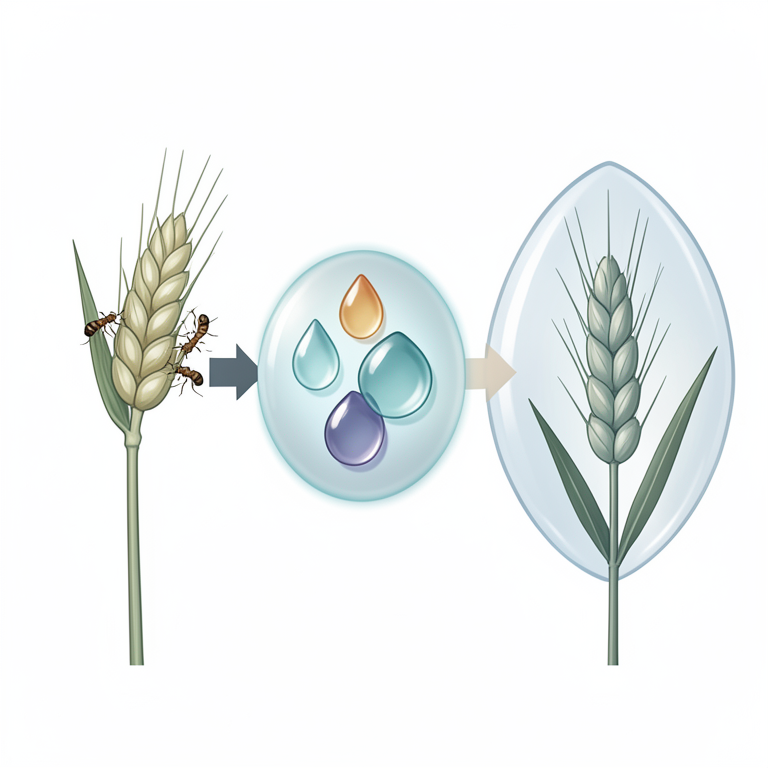
Synergistic Pesticide Action
AI-generated conceptual illustration (wheat plants and aphids). It explains the idea and does not show study data.
View source evidence ↗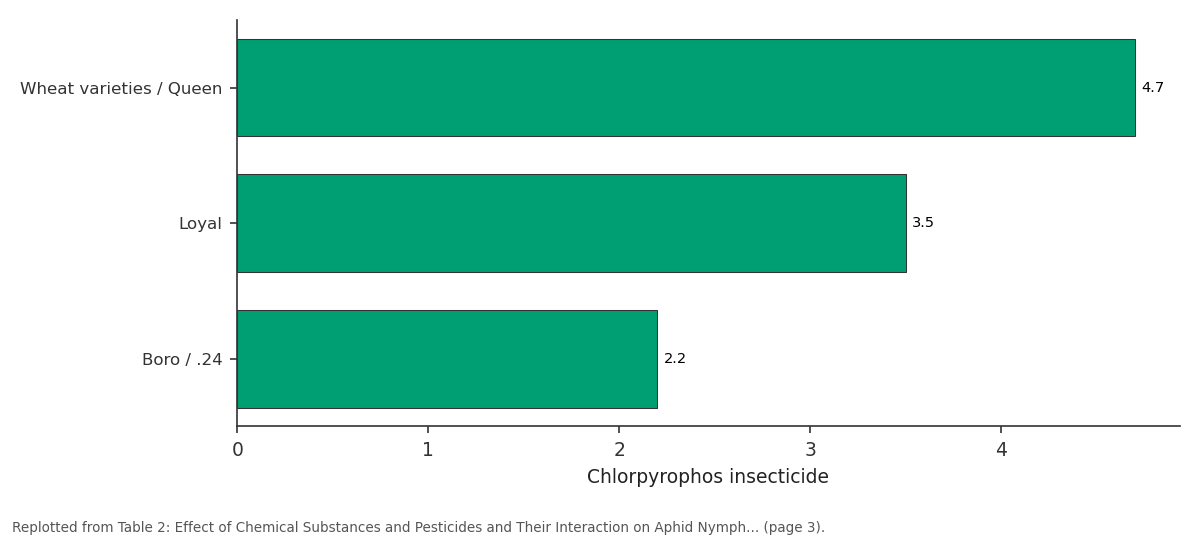
Chlorpyrophos insecticide: Wheat varieties / Queen vs Loyal vs Boro / .24
Replotted from Table 2 (page 3) of the original paper. Every bar is the paper's own table value.
View source evidence ↗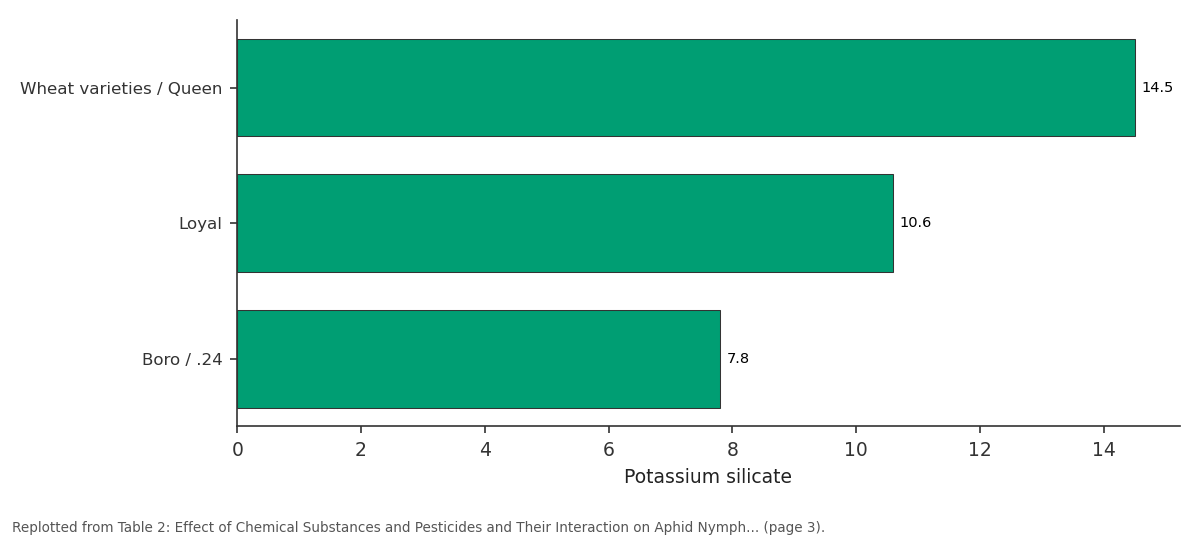
Potassium silicate: Wheat varieties / Queen vs Loyal vs Boro / .24
Replotted from Table 2 (page 3) of the original paper. Every bar is the paper's own table value.
View source evidence ↗Figures & tables
From the original paper Table 1
 Table 2
 Table 3
 Table 4
Introduction
Wheat (Triticum aestivum L.) belongs to the grass family (Poaceae), specifically the flowering plants (Anthophyta) within the angiospermae (flowering plants) and the monocotyledonous class (Monoctyledoneae). It produces grains arranged in spikes. It is typically cultivated once a year, though twice a year in some countries. Modern scientific methods have been adopted for classifying wheat and determining its quality [1] . These methods have provided an alternative to manual inspection of biological characteristics, utilizing digital images stored on a computer for classification based on specific traits and patterns [2] . The last sentence appears to be a separate, unrelated statement about wheat classification and has been omitted from the translation. Schizaphis graminum is one of the largest and most diverse families worldwide, comprising two subfamilies with 2000 species belonging to 74 genera [3] . Its characteristics include six-segmented tentacles (rarely five), long, cylindrical stamens, and a triangular, striated, sword-shaped, or rounded rump. It is found in many plant hosts and is widespread throughout most of the world. Its most important genera include: Rhopalosiphum, Myzus, Aphis, Aulacorthum, Nasonovia, Metopolophium, Macrosiphum, and Uroleucon [4] . Aphids affect wheat crops in various ways. They feed directly by sucking sap from leaf phloem cells and secreting toxins from their saliva into the tissue, disrupting its function. This type of feeding causes the leaves to turn yellow [5] , resulting in weak plants and a significant decrease in yield. Indirect damage includes the transmission of viral diseases, most notably barley yellow dwarf virus (BYDV), maize dwarf mosaic virus (MDMV), and sugarcane mosaic virus (SCMV). The presence of honeydew on plants also causes damage such as the growth of sooty mold and other fungi. This occurs in cases of severe infestation due to the large numbers of nymphs and adults, which contribute to the accumulation of dust and dirt, thus reducing photosynthesis [6] . Sooty fungi appear, leading to the drying and falling of leaves and buds, which negatively impacts crop quality. This insect has many host plants, including all grasses such as wheat, barley, oats, rice, and turf, as well as some wild grasses.
Interna tional Jo urna l o f Adva nced Chemistry Research 2026 ; 8(7 ): 29-33
A study by Jabbar and Mohammed [7] identified three types of aphids that infest wheat crops: Rhopalosiphium padi L. (orange-spotted wheat), S. graminum (grain), and Sitobion avenae (English wheat) in southern Iraq [8] . The repeated use of pesticides to control aphids has led to the development of resistance. Aphids are typically controlled using chemical pesticides belonging to various chemical groups. Due to the environmental risks and negative consequences associated with the use of these substances, and given their intensive and irrational application, which has led to environmental and health problems, as well as the emergence of genetic resistance in aphids to these pesticides, researchers have turned to searching for alternative methods that are safer for the environment, humans, and animals [9] . One such method is the introduction of modern pesticides that are characterized by lower application rates, greater specificity, safety, and environmental friendliness, and which do not cause pollution. These methods are considered part of integrated pest management [10] . The active ingredient in the insecticide is Buprofezin 25%, produced by the Japanese company Nihon. It is an insecticide from the insect growth regulator group, available as a wettable powder (WP) [11] . It is a long-lasting insecticide that affects successive generations and is used to control aphids, whiteflies, mealybugs, and scale insects. Its mode of action differs from other insecticides because, as a growth regulator, it prevents insect development during molting, resulting in incomplete development, deformity, and death. The nymphs change color from yellowish-white to brown, and a significant decrease in the adult insect population is observed after treatment. When adult insects are exposed to the fumes of the insecticide, they become sterile and lay unfertilized eggs [12] . Therefore, the strong fumigant action of the insecticide is an important characteristic in insect control, as these fumes can reach areas that the spray solution on the plant cannot [13] . Resistant plants may be tolerant and can survive under resistance levels and withstand damage. The persistence of resistant strains, which can kill other susceptible varieties, is often found in exotic wild plants. Therefore, gene transfer techniques have been developed to create desirable resistant varieties with good agricultural characteristics in terms of yield and quality [14] . The aim of this study was to evaluate the efficacy of different types of chemical pesticides in controlling the insect in wheat.
Methodology Field Preparation and Agricultural Operations
A field experiment was conducted at the Plant Protection Department station, College of Agriculture, Baghdad University, during the 2025-2026 growing season to study the limiting factors. The experimental plot was selected and plowed using a moldboard plow, followed by harrowing and leveling using disc harrows. The field was divided into three sections, each containing 21 experimental plots measuring 2.5 × 2.5 meters, with a spacing of 1.5 meters between plots and 2 meters between sections to ensure ease of movement and organized work within the field. Triple superphosphate (TSP) fertilizer, containing 20% phosphorus and applied at a rate of 110 kg P ha⁻¹, was added in a single application one month before planting. Wheat seeds were sown on December 3, 2025, at a seeding rate of 135 kg ha⁻¹ in rows spaced 20 cm apart, using a handoperated machine designed for this spacing. Treatments were randomly distributed, and the experiment was designed as a completely randomized block design. Irrigation was carried out as needed using a strip irrigation method. Urea fertilizer (45% nitrogen) was applied at a rate of 200 kg N ha⁻¹ in two applications: the first at planting and the second 45 days after germination. Potassium sulfate (K₂SO₄) was also applied at a rate of 165 kg K ha⁻¹ [15] . Weeding was carried out manually, and regular cultivation and irrigation continued until the end of the season. The wheat was harvested on April 18, 2026. Study Characteristics Evaluating the effect of wheat varieties and some safe and modern pesticides and chemical compounds on aphid control. This was done using the following indicators: Number of live insects: This was collected during the first and second sprayings. For each spraying, the number of insects was counted at specific times (one day before, one day after, one week after, two weeks after, three weeks after, and one month after). The number of live aphids on five leaves per plant in the experimental unit was counted directly in the field using a 10× magnifying glass. Calculating the aphid infestation rate on wheat varieties: The number of healthy and infested plants was calculated to determine the infestation rate using the following equation: Infestation rate = Number of infested plants / Total number of plants ×100
Statistical analysis
Data were analyzed by GraphPad Prism (v10.6). Differences were evaluated via t-tests and one-way ANOVA.
Results
Results
Effect of Chemicals and Pesticides and Their Interactions on
Aphid Nymph Counts on Three Wheat Varieties One Day Before Spraying (Nymph-1) The results in Table (1) show significant differences between the chemical control treatments using the pesticide Sevanto Prime, or the interactions between them. The wheat varieties also showed clear and significant differences in aphid nymph counts one day before spraying. The Boro variety recorded the highest number of nymphs before spraying, reaching 33.5 nymph-1, significantly exceeding both the Wafia (23.5 nymph-1) and Malika (19.3 nymph-1) varieties, which also showed significant differences. This indicates that variety variation plays an important role in susceptibility to aphid infestation even before control intervention, at the level of Sevanto Prime control treatments. The average number of nymphs across all treatments, including the control treatment, was 26.24 nymph-1. Regarding the control treatments using chlorpyrifos, significant differences were observed, with the average number of nymphs ranging from 24.43 nymphs per plant (n1) across all treatments, including the control. Similarly, significant differences were observed with the control treatments using potassium silicate, with the average number of nymphs ranging from 26.08 nymphs per plant (n1) across all treatments, including the control. The results in Table (2) show significant differences in the number of nymphs after one week of spraying with the pesticide Sevanto Prime. The average number of nymphs was 3.55 nymph-1 across all treatments, including the control. Similarly, significant differences were observed with the pesticide Chlorpyrifos, with the average number of nymphs being 3.45 nymph-1 across all treatments, including the control. However, significant differences were also observed with the pesticide Potassium Silicate, with the average number of nymphs being 10.78 nymph-1 across all treatments, including the control . The results in Table 3 show significant differences in the number of nymphs after two weeks of spraying with the pesticide Sevanto Prime. The average number of nymphs was 1.87 nymph-1 across all treatments, including the control. Similarly, significant differences were observed with the pesticide Chlorpyrifos after two weeks of spraying.
| insecticide | Average | Wheat varieties | — | — | P-Value |
|---|---|---|---|---|---|
| Queen | Loyal | Boro | |||
| Sevanto Prime insecticide | 1.87 | 2.8 | 1.8 | 1.2 | 0.01 |
| Chlorpyrophos insecticide | 2.13 | 2.9 | 2.1 | 1.2 | 0.01 |
| Potassium silicate | 7.64 | 10.7 | 7.3 | 5.6 | 0.01 |
Table text extracted from the original PDF; superscript letters are shown inline. The original table image is below.
View original table image
The average number of nymphs was 2.13 nymph-1 across all treatments, including the control . Similarly, significant differences were observed with the pesticide Potassium Silicate after two weeks of spraying. The average number of nymphs was 7.64 nymph-1 across all treatments, including the control . The results in Table (4) show significant differences in the number of nymphs after one month of spraying with the pesticide Sevanto Prime. The average number of nymphs was 3.12 nymph-1 across all treatments, including the control. Similarly, significant differences were observed after two weeks of spraying with the pesticide Chlorpyrifos.
The average number of nymphs was 3.18 nymph-1 across all treatments, including the control. Similarly, significant differences were observed after two weeks of spraying with the pesticide Potassium Silicate. The average number of nymphs was 9.83 nymph-1 across all treatments, including the control.
Discussion
The results obtained from the tables show that the triple treatment (Sivanto Prime + Chlorpyrophos + Potassium Silicate) demonstrated high and sustained efficacy in reducing aphid nymph populations on wheat plants. The number of nymphs decreased significantly one day after spraying, with an average of 26.24 nymphs per plant (N⁻¹) across all treatments, including the control. Significant differences were observed with the Chlorpyrophos treatment, with an average of 24.43 N⁻¹ across all treatments, including the control. Similarly, significant differences were observed with the Potassium Silicate treatment, with an average of 26.08 N⁻¹ across all treatments, including the control. Plant nymph⁻¹ after one week, two weeks, and one month, respectively. These results are consistent with those reported by Wang et al. [15] , who demonstrated that sulfoxaflor (the active ingredient in Sevanto Prime) acts on insect nicotinic acetylcholine receptors (nAChRs) in a manner distinct from other neonicotinoids, making it highly effective against sapsucking insects. Sparks et al. [16] confirmed that sulfoxaflor outperforms pesticides such as imidacloprid and thiamethoxam, enhancing its effectiveness against aphids and supporting our findings. Furthermore, the other pesticide in this formulation, chlorpyrifos, inhibits the enzyme cholinesterase, further increasing insect paralysis and death, and its interaction with sulfoxaflor results in a clear synergistic effect in reducing infestation. As for potassium silicate, it has also shown a significant role in reducing nymph populations. This is attributed to its ability to enhance plant resistance by increasing the rigidity of cell walls and forming a protective silica layer on the leaf surface, which hinders insect feeding and reduces its penetration, as noted by Sun et al. [17] . Elakiya et al. [18] supported this mechanism, confirming that early applications of potassium silicate form a natural barrier that prevents plant infestation by the pest. On the other hand, the interactions between treatments and varieties showed significant differences. The interaction between the triple treatment and the 'Boro' variety consistently showed the best results, recording the lowest nymph counts. Significant differences were observed for the control treatments using Sevanto Prime one week after application, with the average nymph count averaging 3.55 nymphs per plant for all treatments, including the control. Similarly, significant differences were observed for the control treatment using Chlorpyrifos, with the average nymph count averaging 3.45 nymphs per plant for all treatments, including the control. However, significant differences were observed for the control treatment using Potassium Silicate, with the average nymph count averaging 10.78 nymphs per plant for all treatments, including the control. At various time points one week after spraying, the control treatment with the 'Malika' variety showed the lowest insect density, reaching 58.8 nymphs per plant⁻¹ [19] . This reflects the genetic variation in susceptibility between varieties and confirms that using a less favored variety in conjunction with an effective treatment contributes to optimal control efficiency. It is worth noting that the nymph density began to rise again one month after treatment compared to three weeks prior. This is attributed to the gradual decrease in pesticide effectiveness due to degradation or environmental conditions, which aligns with [20] finding that the effect of chemical pesticides often begins to diminish 21-28 days after spraying. Therefore, repeating the treatment or combining it with additional control strategies may be necessary to ensure sustained crop protection.
Conclusions
The treatment (Sefanto Prime + Chlorpyrifos + Potassium Silicate) demonstrated the highest efficiency in continuously reducing aphid nymph populations from the first day after spraying until one month later, indicating a strong synergistic effect between its components. The Boro variety showed the lowest aphid nymph infestation rates at all times, while the Malak variety was the most susceptible.
Figures and tables from the paper
| Insecticide | Average | Wheat varieties | — | — | P-Value |
|---|---|---|---|---|---|
| Queen | Loyal | Boro | |||
| Sevanto Prime insecticide | 26.24 | 19.3 | 23.5 | 33.5 | 0.01 |
| Chlorpyrophos insecticide | 24.43 | 17.9 | 25.18 | 32.7 | 0.01 |
| Potassium silicate | 26.08 | 18.1 | 24.8 | 32.3 | 0.01 |
Table text extracted from the original PDF; superscript letters are shown inline. The original table image is below.
View original table image
| Insecticide | Average | Wheat varieties | — | — | P-Value |
|---|---|---|---|---|---|
| Queen | Loyal | Boro | |||
| Sevanto Prime insecticide | 3.55 | 5.5 | 3.6 | .24 | 0.01 |
| Chlorpyrophos insecticide | 3.45 | 4.7 | 3.5 | 2.2 | 0.01 |
| Potassium silicate | 10.78 | 14.5 | 10.6 | 7.8 | 0.01 |
Table text extracted from the original PDF; superscript letters are shown inline. The original table image is below.
View original table image
| Insecticide | Average | Wheat varieties | — | — | P-Value |
|---|---|---|---|---|---|
| Queen | Loyal | Boro | |||
| Sevanto Prime insecticide | 3.12 | 4.5 | 2.6 | 1.8 | 0.01 |
| Chlorpyrophos insecticide | 3.18 | 4.7 | 3.4 | 1.7 | 0.01 |
| Potassium silicate | 9.83 | 12.7 | 9.8 | 7.6 | 0.01 |
Table text extracted from the original PDF; superscript letters are shown inline. The original table image is below.
View original table image
References
20 in the original paper- Ouasti M, Elachouri M, Bussmann RW. Triticum aestivum L. Triticum durum Desf. Triticum monococcum L. Poaceae. In: Ethnobotany of Northern Africa and Levant. Cham: Springer Nature Switzerland; 2024. p. 2071-2090.
- Akbar M, et al. A mini review on insect pests of wheat and their management strategies. 2023:110-115.
- Chidambaram K, et al. Medicinal plants of Solanum species: the promising sources of phyto-insecticidal compounds. Journal of Tropical Medicine. 2022;2022:4952221.
- Guiré R, et al. Insecticidal activities of Securidaca longepedunculata Fresen extracts and feeding behavior of Schizaphis graminum Rondani: electropenetrography approach. ACS Omega. 2024;9(30):32799-32806.
- Gebreegziabiher KG, et al. Plant-aphid interactions: recent trends in plant resistance to aphids. Stress Biology. 2025;5(1):28.
- Jakobs R, Schweiger R, Müller C. Aphid infestation leads to plant part-specific changes in phloem sap chemistry, which may indicate niche construction. New Phytologist. 2019;221(1):503-514.
- Jabbar AS, Mohammed JM. A study of the presence of aphid species and the susceptibility of some wheat varieties to infestation and their biological control in the governorates of Maysan and Basra. Maysan Journal of Academic Studies. 2019;(35):1-24.
- Basra: College of Agriculture, University of Basra; 2017.
- Abd EL-Ghany TM. Entomopathogenic fungi and their role in biological control. Foster City (USA): Comics Group eBooks; 2015. 42 p.
- Samada LH, Tambunan USF. Biopesticides as promising alternatives to chemical pesticides: a review of their current and future status. Journal of Biological Sciences. 2020;20(2):66-76.
- Shahzad M, Ghani WH, Ayyub M, Ali Q, Ahmad HM, Faisal M, et al. Performance of some wheat cultivars against aphid and its damage on yield and photosynthesis. Journal of Global Innovation in Agricultural and Social Sciences. 2019;7(3):105-109.
- Salim KU, et al. Sterile insect technique and incompatible insect technique, emerging alternatives to insecticides for adult mosquito control. Journal of Integrated Pest Management. 2025;16(1):10.
- Rezk M, Hassan AN, El-Deeb MF, Shaarawy N, Dewer Y. The impact of insecticides on the cotton mealybug, Phenacoccus solenopsis (Tinsley): efficacy on potato, a new record of host plant in Egypt. Journal of Plant Protection Research. 2019;59(1).
- Mitchell C, Brennan RM, Graham J, Karley AJ. Plant defense against herbivorous pests: exploiting resistance and tolerance traits for sustainable crop protection. Frontiers in Plant Science. 2016;7:1132.
- Wang X, et al. Sulfoxaflor interaction with nicotinic acetylcholine receptors. 2016.
- Sparks TC, et al. Sulfoximines: Sulfoxaflor. In: Modern Crop Protection Compounds. Vol. 3. 2026. p. 15661597.
- Sun Q, et al. Silicon-induced resistance to insect pests. 2010.
- Elakiya A, et al. Exploring crop stress alleviation: a potassium silicate perspective. Journal of Soil Science and Plant Nutrition. 2025;25(2):4687-4705.
- Ahmad S, et al. Evaluation of certain synthetic and natural pesticides against whitefly Bemisia tabaci (Genn.) on green bean and effect on honeybee Apis mellifera L. Arab Universities Journal of Agricultural Sciences. 2023;31(2):305-314.
- Ahmed MAI, et al. Toxicological evaluation of certain pesticides on the two-spotted spider mite, Tetranychus urticae Koch (Acari: Tetranychidae) on cucumber plants under field conditions. Assiut Journal of Agricultural Sciences. 2024;55(3):154-167.