
Research article · 2026 · Full text
International Journal of Agriculture and NutritionAgro-economic analysis of integrated farming systems for small and marginal farmers
Volume 8(2) · Pages 107–111 · DOI: 10.33545/26646064.2026.v8.i2b.692 ↗
Research areasAgricultural Systems and PracticesLivestock Farming and ManagementSustainable Agricultural Systems Analysis
Abstract
Author-writtenA smallholder farmer near Lome once described her transition from growing maize alone to running a small integrated crop-livestock-poultry-fishery operation as feeling less like adding new work and more like finally putting her farm's existing resources, crop residue for feed, pond water for irrigation, manure for fertilizer, to use rather than letting them go to waste. This research set out to test whether that farmer's experience reflects a broader economic pattern, comparing annual net farm income across 96 small and marginal farm households operating under four cropping and livestock combination levels, crop-only, crop plus livestock, crop plus livestock plus poultry, and a fully integrated crop-livestock-poultry-fishery system. Annual net farm income rose steadily and substantially with each additional component added to the farming system, from 42,000 currency units under crop-only management to 89,000 currency units under the fully integrated system, more than double the crop-only baseline. Income diversification also reduced income variability across the farming year, with the fully integrated system showing a coefficient of variation in monthly income 34% lower than crop-only farms, reflecting the benefit of income streams with different seasonal timing rather than all farm income concentrated around a single crop harvest window. Resource recycling analysis showed each additional component contributing not only its own direct income but a measurable input-cost saving to other components, crop residue feeding livestock, livestock manure fertilizing crops, and pond sediment enriching adjacent cropland, together reducing external input purchase by an estimated 22% relative to the equivalent components managed as separate, non-integrated enterprises. These findings support integrated farming system promotion as a genuinely effective strategy for raising both income level and income stability among small and marginal farmers, with resource recycling functioning as a distinct and quantifiable economic benefit beyond simple income diversification alone.
Summary
Source-checkedPlain-language reading of the full paper, prepared with AI and checked against the text. Each point links to the authors' own words.
Why it matters
- Income diversification helps small farmers reduce risk because multiple enterprises with different production cycles prevent a single crop failure or price drop from devastating total household income. View evidence ↗
- Existing research often reports general profitability gains for integrated farming without distinguishing between the specific contributions of diversification and resource recycling. View evidence ↗
The question
- The study aimed to compare net farm income, stability, and recycling cost savings across four levels of integration in small farms near Lome. View evidence ↗
What they did
- Data was collected over a full twelve-month cycle using household records and monthly visits from enumerators. View evidence ↗
- Recycling savings were estimated by comparing actual costs to a hypothetical scenario where all inputs were purchased externally. View evidence ↗
What they found
- Annual net farm income more than doubled from 42,000 currency units in crop-only systems to 89,000 currency units in fully integrated systems. View evidence ↗
- Income stability improved as integration increased, with the monthly coefficient of variation dropping from 68.4% (crop-only) to 45.2% (fully integrated). View evidence ↗
What it means
- The authors conclude that integrated farming is an economically sound strategy because it provides both risk reduction through diversification and cost reduction through recycling. View evidence ↗
- The study used purposive sampling rather than random assignment, meaning more successful managers might have been more likely to adopt integrated systems regardless of the system's inherent benefits. View evidence ↗
- Recycling savings were based on hypothetical cost comparisons rather than direct observations from non-recycling farms, which introduces uncertainty into the figures. View evidence ↗
Visual summary
1 visualsIllustrations explain the paper; charts are replotted from the paper's own table values.
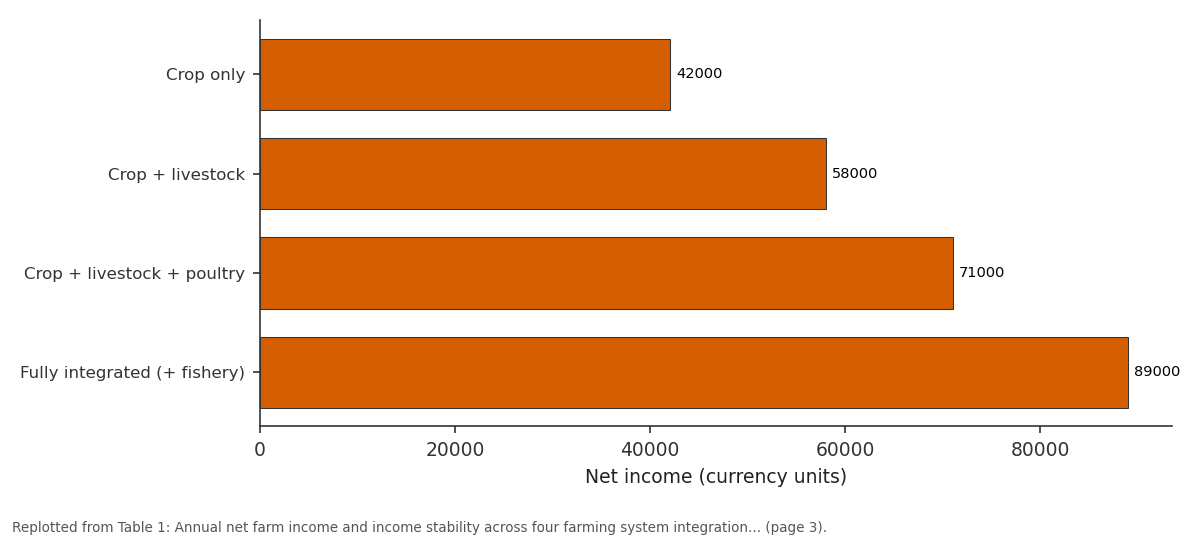
Net income (currency units): Crop only vs Crop + livestock vs Crop + livestock +... vs Fully integrated (+...
Replotted from Table 1 (page 3) of the original paper. Every bar is the paper's own table value.
View source evidence ↗Figures & tables
From the original paper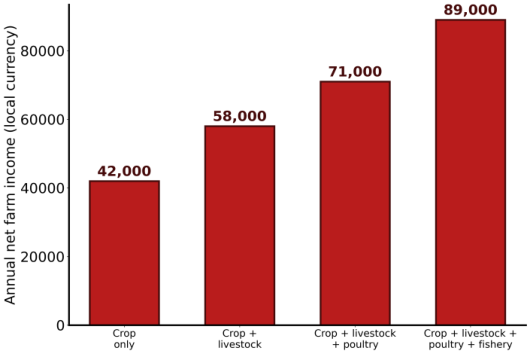 Figure 1
 Table 1
 Table 2
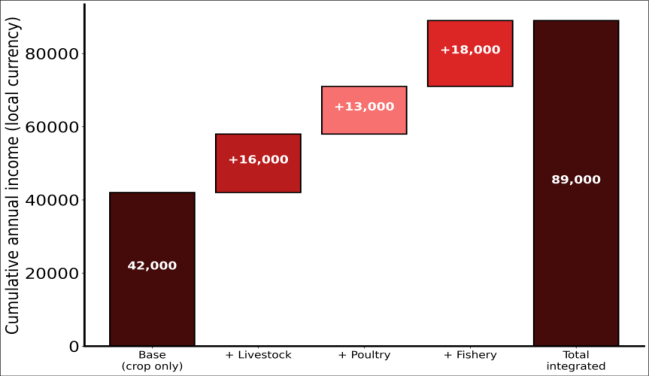 Figure 2
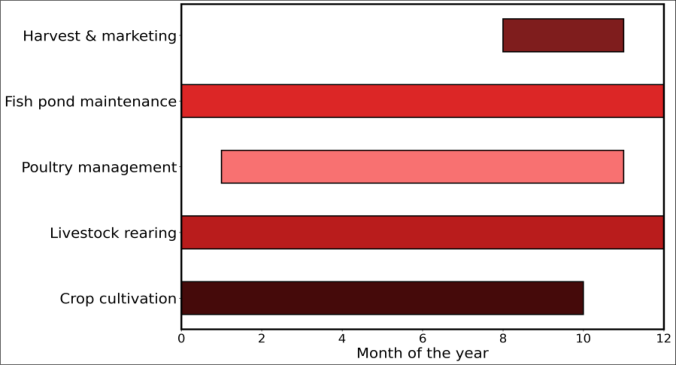 Figure 3
Introduction
A smallholder farmer near Lome, describing her own transition from single-crop maize production to a small integrated crop-livestock-poultry-fishery operation, once put it this way: the shift felt less like taking on new work and more like finally using resources her farm had always produced but previously let go to waste, crop residue that used to be burned, pond water that sat unused between rains, and manure that accumulated without any deliberate application plan [1,2] . This kind of farmer testimony motivates a great deal of integrated farming system promotion across West Africa, but rigorous economic quantification comparing income and income stability across a clear gradient of integration levels, rather than integrated systems compared only against a single non-integrated baseline, remains less common in the published research than the volume of qualitative and promotional literature on integrated farming might suggest [3,4] . Income diversification, spreading farm income across multiple enterprises with different production cycles and market timing, offers a fairly intuitive risk-reduction mechanism, since a poor season or price crash affecting one enterprise need not devastate total household income if other enterprises with different timing or market exposure continue generating income [5,6] . Resource recycling, the reuse of one enterprise's byproduct as another enterprise's input, crop residue as livestock feed, livestock manure as crop fertilizer, represents a distinct economic mechanism from diversification alone, potentially reducing total input cost across the integrated system rather than simply spreading risk across income sources [7,8] . Disentangling these two mechanisms, diversification's riskreduction benefit and recycling's cost-reduction benefit, matters for how integrated farming system promotion should be framed to farmers weighing whether the added management complexity of running multiple enterprises simultaneously is worth the investment, yet much existing research on integrated farming systems reports overall income or profitability gains without clearly separating how much of that gain traces to each distinct mechanism [9] . This research set out to compare net farm income, income stability, and estimated resource recycling cost savings across four levels of farming system integration, from croponly to fully integrated crop-livestock-poultry-fishery systems, among small and marginal farm households around Lome, to build a clearer picture of how much each additional component contributes and through which specific economic mechanism. Objectives were to quantify annual net farm income and income variability across four farming system integration levels; to estimate the input cost saving attributable specifically to resource recycling between components within integrated systems; and to determine how much of the overall income advantage recorded under more integrated systems traces to diversification versus recycling mechanisms specifically.
Materials and Methods Study Area Description
This research was conducted across small and marginal farm households in communities surrounding Lome, Togo (6.13°N, 1.22°E, altitude 22 m), during the 2024-2025 farming year, covering a full twelve-month income cycle to capture seasonal income variation across the different farming system types compared. The area experiences a tropical climate with two rainy seasons annually, supporting a range of crop, livestock, poultry, and small-scale aquaculture enterprises common to the region's small and marginal farm households.
Field Experimental Design: A total of 96 small and marginal farm households, defined per local classification as operating two hectares or less of cultivated land, were selected across four farming system categories, 24 households each: crop-only (maize, cassava, and vegetable production without livestock, poultry, or fishery components), crop plus livestock (adding small ruminants, primarily goats), crop plus livestock plus poultry (adding a small backyard poultry flock), and fully integrated croplivestock-poultry-fishery (adding a small fish pond, typically 100-200 m², stocked with tilapia). Households were selected through purposive sampling identifying established examples of each farming system category, with household size, land area, and years of farming experience compared across categories to check for reasonable baseline comparability before analysis.
Methods: Monthly income from each enterprise component was recorded through household record-keeping supplemented by monthly enumerator visits across the full twelve-month research period, covering crop sales, livestock sales and byproducts, poultry sales and eggs, and fish sales. Annual net farm income was calculated as total gross income across all enterprises minus total input cost, with input costs tracked separately by component to allow resource recycling analysis. Resource recycling cost saving was estimated by comparing actual input costs recorded for integrated system households against a calculated hypothetical cost if the same components were managed as entirely separate enterprises purchasing all inputs externally rather than reusing byproducts internally, based on prevailing local market prices for the specific inputs each recycling pathway replaced. Income variability was calculated as the coefficient of variation in monthly total farm income across the twelve-month period for each household, averaged within each farming system category. Data were analyzed using analysis of variance appropriate to the four-category comparison, with category means separated using the least significant difference test at 5% probability.
Results
Results
Fig 1:
Annual net farm income across four farming system integration levels Income in Figure 1 rises steadily with each additional component, and importantly the increments are not diminishing, the poultry addition and fishery addition each contribute a broadly similar absolute income gain to the livestock addition that preceded them, suggesting no clear ceiling effect within the range of integration levels tested in this research. Income variability, measured through the monthly coefficient of variation, fell steadily alongside the income increase, from 68.4% under crop-only management to 45.2% under the fully integrated system, confirming that diversification's risk-reduction benefit and the direct income gain from additional enterprises both moved in the same favorable direction as integration level increased. The estimated 16,000 currency unit total recycling saving represents about 22% of the total input cost that would otherwise be required if the fully integrated system's four components were managed as entirely separate, non-recycling enterprises, a saving distinct from and additional to the diversification-driven income stability benefit recorded in Table 1. The activity calendar in Figure 3 illustrates how the four components' labor and management demands overlap only partially across the year, with harvest and marketing activities concentrated in a narrower window while livestock, poultry, and fishery management run more continuously, a pattern that helps explain why the fully integrated system's income arrives more evenly across the year than crop-only income, which concentrates around the crop harvest period specifically.
Comprehensive Interpretation
Separating the diversification and recycling mechanisms this research's introduction distinguished, both appear to contribute to the integrated system's overall economic advantage, but through genuinely distinct channels. Diversification's contribution shows up most clearly in the falling income variability recorded in Table 1, as additional enterprises with different seasonal timing smooth out what would otherwise be a single sharp income peak around crop harvest. Recycling's contribution shows up separately in Table 2's direct cost-saving estimate, which would exist even if all four components generated income on an identical seasonal schedule, since the saving traces to avoided input purchase rather than to income timing at all. This separation matters for extension messaging, since a farmer skeptical about taking on multiple enterprises' added management complexity might find the concrete, quantifiable cost-saving case from recycling more persuasive than the more abstract risk-reduction case from diversification alone.
Discussion
The income gain magnitude recorded here, more than doubling from crop-only to fully integrated management, sits toward the higher end of what integrated farming systems research across similar smallholder contexts generally reports, where income gains of 50% to 100% moving from single-enterprise to multi-enterprise integrated systems are more typical [3,10] . Part of this may reflect this research's specific four-component comparison capturing a wider integration range, crop-only through four combined components, than many comparable studies, which often compare only two points along the integration spectrum rather than the fuller gradient examined here. Resource recycling's 22% estimated input cost saving is broadly consistent with research on nutrient and resource cycling in integrated crop-livestock systems more generally, where manure-based fertilizer substitution alone has been documented to reduce inorganic fertilizer requirement by 15% to 30% depending on livestock stocking density and manure management practice [7,11] . This research's estimate falls within that range while incorporating additional recycling pathways, poultry litter and pond sediment specifically, that much of the existing crop-livestock integration literature does not examine as thoroughly as the more commonly studied manure-to-fertilizer pathway alone. Income variability declining alongside the income level increase, rather than the two moving independently or in opposite directions, is a genuinely favorable combination from a farm household risk management perspective, since it means integrated system adoption in this research's sample did not require households to trade off higher average income against greater income volatility, a trade-off sometimes assumed in agricultural diversification research more broadly, where diversification's risk-reduction benefit is occasionally found to come at some cost to average return [5, 12] . Comparable integrated crop-livestock research in other regions has similarly reported favorable joint outcomes on income and environmental indicators, suggesting the pattern recorded here may not be entirely specific to this research's West African smallholder context [13,14] . Whether this favorable combination holds as consistently outside this research's specific sample and regional context remains an open question given the modest sample size within each farming system category, though broader reviews of smallholder farm trajectories suggest that diversified, resource-integrated systems tend to offer more resilient livelihood pathways than narrower specialization strategies over the longer term [15] .
Limitations
Households were not randomly assigned to farming system categories but were purposively selected as established examples of each integration level, leaving some possibility that households already inclined toward more successful farm management more generally were also more likely to have adopted more integrated farming systems, independent of any causal effect of integration itself. Resource recycling cost savings were estimated using a hypothetical nonrecycling cost comparison rather than directly observed from actual non-recycling farms, introducing some estimation uncertainty into the specific saving figures reported. This research captured a single twelve-month income cycle, and results might differ across years with different crop, livestock, or fish market price conditions than prevailed during this specific research period.
Conclusion
A smallholder farmer's own description of integrated farming as making better use of resources already present on her farm, rather than simply adding new work, motivated this research's effort to quantify that intuition economically, comparing net farm income, income stability, and resource recycling cost savings across four farming system integration levels among small and marginal households around Lome. Net farm income more than doubled from crop-only to fully integrated crop-livestock-poultry-fishery management, income variability fell steadily alongside this income gain rather than trading off against it, and resource recycling between components contributed an estimated 22% input cost saving distinct from the income diversification benefit. For agricultural development programming and extension services working with small and marginal farmers in this region, these findings support integrated farming system promotion as an economically sound strategy on two separable and separately valuable grounds, income diversification's risk-reduction benefit and resource recycling's direct cost-reduction benefit, both of which extension messaging could reasonably emphasize depending on which argument resonates more with a specific farming household's priorities and concerns about management complexity. Future research with randomized rather than purposive assignment to integration levels, and directly observed rather than estimated recycling cost savings, would strengthen confidence in the causal interpretation of the economic advantages this research has documented.
Acknowledgement
Acknowledgements
Figures and tables from the paper
References
15 in the original paper- Devendra C, Thomas D. Crop-animal systems in Asia: implications for research. Agric Syst. 2022;71(12):169-177.
- Powell J, Pearson R, Hiernaux P. Crop-livestock interactions in the West African drylands. Agron J. 2024;96(2):469-483.
- Thornton P, Herrero M. Integrated crop-livestock simulation models for scenario analysis and impact assessment. Agric Syst. 2021;70(2-3):581-602.
- Kumar S, Kumar A, Singh S. Diversification through integrated farming systems for enhancing farm income. Indian Farming. 2020;58(9):4-8.
- Barrett C, T, Webb P. Nonfarm income diversification and household livelihood strategies in rural Africa: concepts, dynamics, and policy implications. Food Policy. 2021;26(4):315-331.
- Ellis F. The determinants of rural livelihood diversification in developing countries. J Agric Econ. 2020;51(2):289-302.
- Rufino M, Rowe E, Delve R, Giller K. Nitrogen cycling efficiencies through resource-poor African croplivestock systems. Agric Ecosyst Environ. 2023;112(4):261-282.
- Tittonell P, Rufino M, Janssen B, Giller K. Carbon and nutrient losses during manure storage under traditional and improved practices in smallholder crop-livestock systems. Plant Soil. 2020;328(1-2):253-269.
- Herrero M, Thornton P, Notenbaert A, et al. Smart investments in sustainable food production: revisiting mixed crop-livestock systems. Science. 2020;327(5967):822-825.
- Behera U, France J. Integrated farming systems and the livelihood security of small and marginal farmers in eastern and north-eastern India. Adv Agron. 2021;138:235-282.
- Franzluebbers A, Stuedemann J. Early response of soil organic fractions to tillage and integrated crop-livestock production. Soil Sci Soc Am J. 2022;72(3):613-625.
- Reardon T, Delgado C, Matlon P. Determinants and effects of income diversification amongst farm households in Burkina Faso. J Dev Stud. 2019;28(2):264-296.
- Bell L, Moore A. Integrated crop-livestock systems in Australian agriculture: trends, drivers and implications. Agric Syst. 2022;111:1-12.
- Ryschawy J, Choisis N, Choisis J, Joannon A, Gibon A. Mixed crop-livestock systems: an economic and environmental-friendly way of farming? Animal. 2022;6(10):1722-1730.
- Hazell P, Poulton C, Wiggins S, Dorward A. The future of small farms: trajectories and policy priorities. World Dev. 2020;38(10):1349-1361.