
Research article · 2026 · Full text
International Journal of Agriculture and NutritionInfluence of mulching materials on soil temperature, moisture and crop productivity
Volume 8(2) · Pages 101–106 · DOI: 10.33545/26646064.2026.v8.i2b.691 ↗
Research areasIrrigation Practices and Water ManagementPolymer-Based Agricultural EnhancementsSoil Management and Crop Yield
Abstract
Author-writtenPractical dilemma: a farmer near Windhoek deciding what to lay between tomato rows this season faces a choice between plastic film that costs money every season, straw that costs nothing but decomposes within months, and leaving the soil bare, a choice this two-season research set out to inform with direct comparative data rather than convention alone. Four soil surface treatments, plastic mulch, straw mulch, organic leaf litter mulch, and bare soil (no mulch), were compared for their effect on soil temperature, soil moisture retention, weed suppression, and tomato yield. Bare soil recorded the highest and most variable soil temperature, averaging 34 °C at 5 cm depth during peak afternoon hours, against 26 °C under organic leaf litter mulch and 27 °C under straw mulch, while plastic mulch, despite its dark color absorbing more radiant heat, still moderated peak temperature to 31 °C relative to bare soil through reduced evaporative moisture loss. Soil moisture retention followed a similar pattern, with plastic mulch conserving the most moisture overall at 38.4% share of total moisture retained across treatments, though organic and straw mulches conserved moisture more efficiently relative to their input cost. Tomato yield was highest under plastic mulch at 3420 kg per hectare, 27.6% above bare soil, followed by straw mulch and organic leaf litter mulch, both delivering meaningful yield gains over bare soil at a fraction of plastic mulch's material cost. These findings support mulching broadly as a productivity-positive practice regardless of material choice, while highlighting that the specific material selected should weigh moisture conservation efficiency, cost, and local material availability together rather than assuming plastic mulch's yield advantage alone justifies its higher cost in every farming context.
Summary
Source-checkedPlain-language reading of the full paper, prepared with AI and checked against the text. Each point links to the authors' own words.
Why it matters
- Horticultural farmers must balance the upfront cost and availability of mulching materials against the resulting soil temperature and moisture levels. View evidence ↗
- While plastic mulch is widely recommended for its weed suppression and moisture conservation, it involves recurring costs and disposal issues that organic materials do not. View evidence ↗
- In water-scarce regions like Namibia, the efficiency of moisture conservation relative to cost is a more economically relevant metric for farmers than absolute moisture retention. View evidence ↗
The question
- The study aimed to directly compare plastic mulch, straw mulch, organic leaf litter mulch, and bare soil regarding their effects on soil temperature, moisture, weed suppression, and tomato yield, including a cost-adjusted analysis. View evidence ↗
What they did
- The experiment took place at the Windhoek Institute of Agricultural Sciences in Namibia over two growing seasons from September 2023 to January 2025. View evidence ↗
- The study used 'Namibia Roma-2' tomatoes with treatments including 25-micron black polyethylene film, 8 cm of dried cereal straw, and 8 cm of locally collected leaf litter. View evidence ↗
- The research employed a randomized block design with four replications, using plots measuring 5 m by 4 m. View evidence ↗
- Measurements included hourly soil temperature at 5 cm (peak at 2 PM), twice-weekly gravimetric soil moisture at 0-15 cm, monthly weed density counts, and final tomato yield from 12 m² plots. View evidence ↗
What they found
- Bare soil had the highest peak soil temperature at 34.4 °C, while organic leaf litter mulch had the lowest at 26.1 °C, followed by straw mulch at 26.8 °C and plastic mulch at 31.2 °C. View evidence ↗
- When combining yield value with material costs, straw mulch provided the highest overall net economic return. View evidence ↗
What it means
- The authors conclude that farmers should select mulching materials based on whether their primary constraint is maximizing absolute yield or achieving cost-efficient water conservation. View evidence ↗
- The study's results may not generalize to other crops because it was limited to a single site, two seasons, and one tomato variety. View evidence ↗
- The economic analysis did not fully capture the labor costs associated with replenishing organic mulch, which could potentially alter the final recommendations. View evidence ↗
Visual summary
3 visualsIllustrations explain the paper; charts are replotted from the paper's own table values.
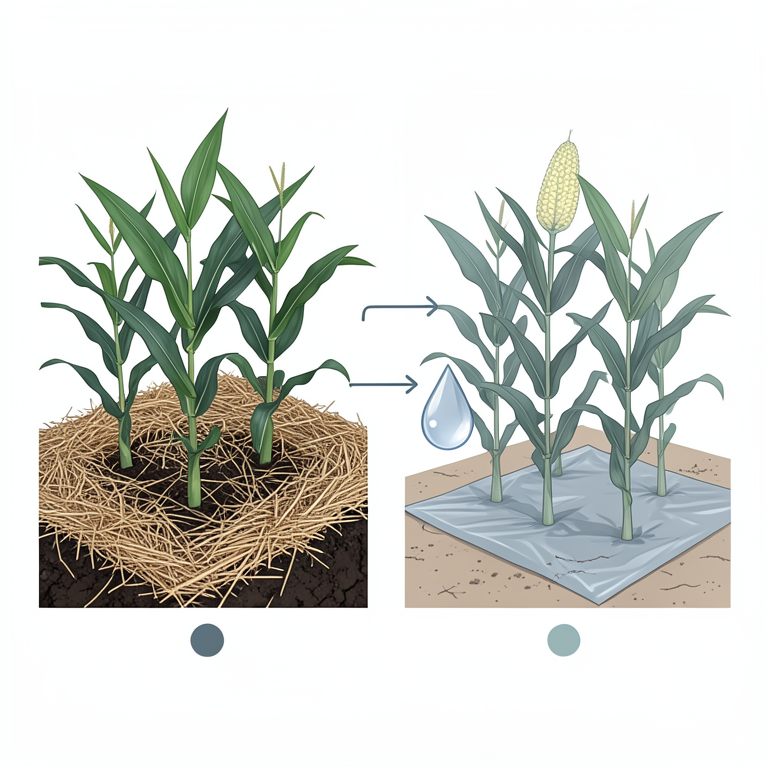
Mulch Selection Decision Tree
AI-generated conceptual illustration (maize plants in soil with different mulching materials). It explains the idea and does not show study data.
View source evidence ↗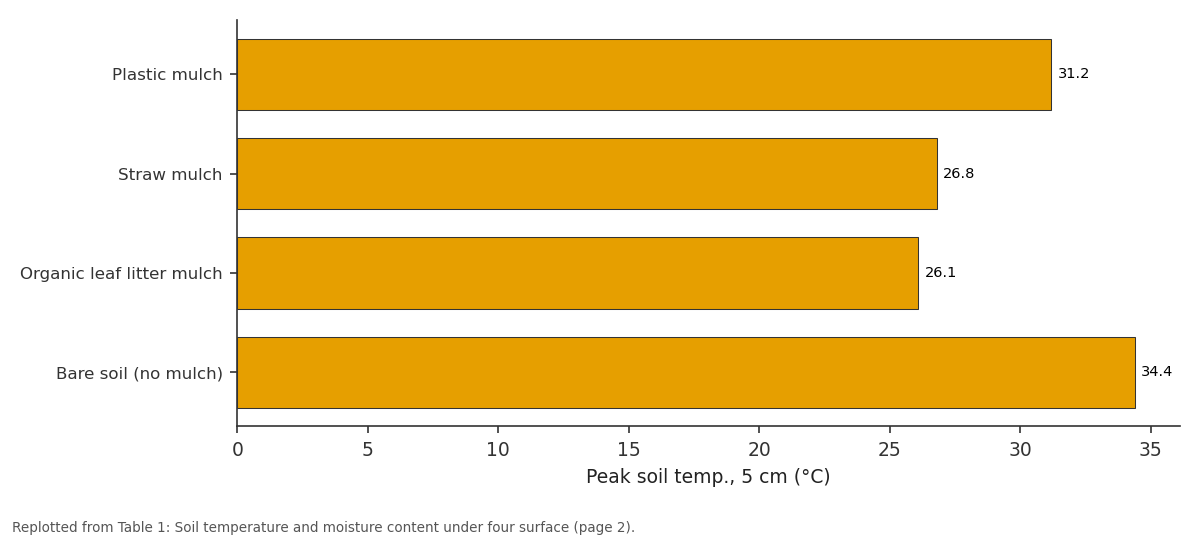
Peak soil temp., 5 cm (°C): Plastic mulch vs Straw mulch vs Organic leaf litter... vs Bare soil (no mulch)
Replotted from Table 1 (page 2) of the original paper. Every bar is the paper's own table value.
View source evidence ↗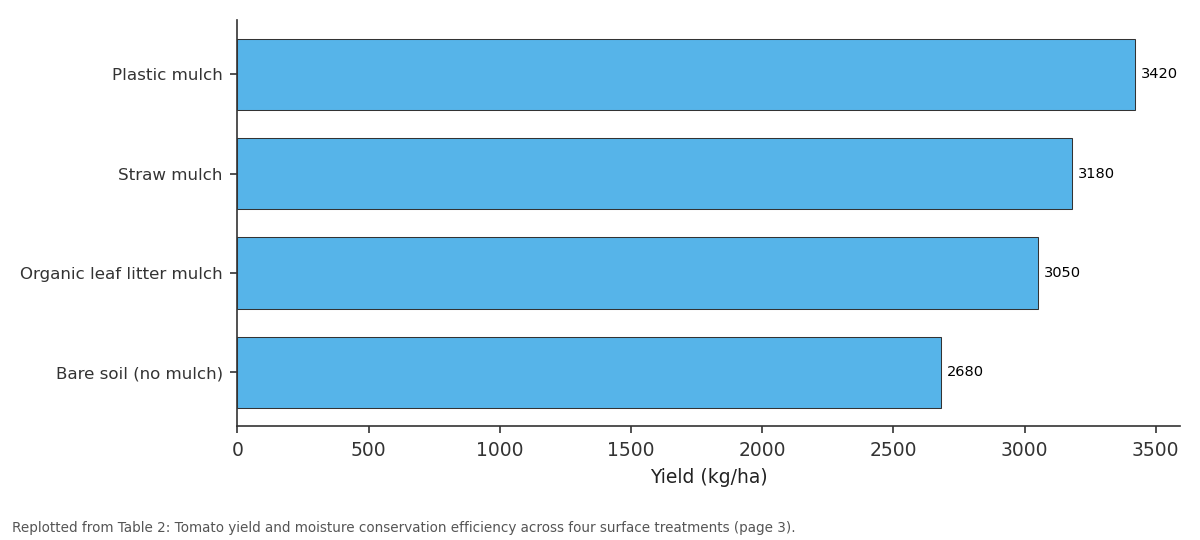
Yield (kg/ha): Plastic mulch vs Straw mulch vs Organic leaf litter... vs Bare soil (no mulch)
Replotted from Table 2 (page 3) of the original paper. Every bar is the paper's own table value.
View source evidence ↗Figures & tables
From the original paper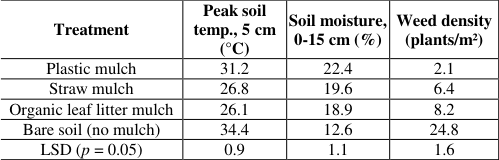 Table 1
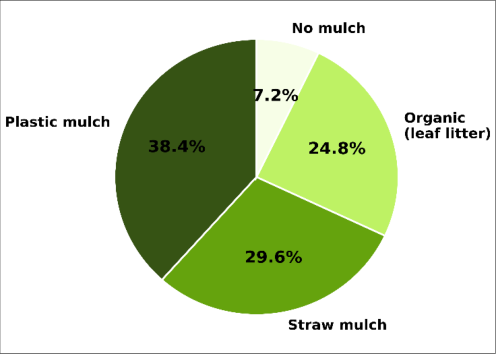 Figure 1
 Table 2
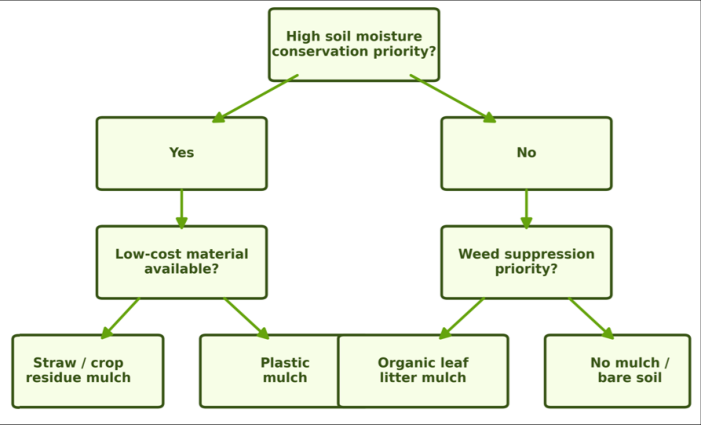 Figure 2
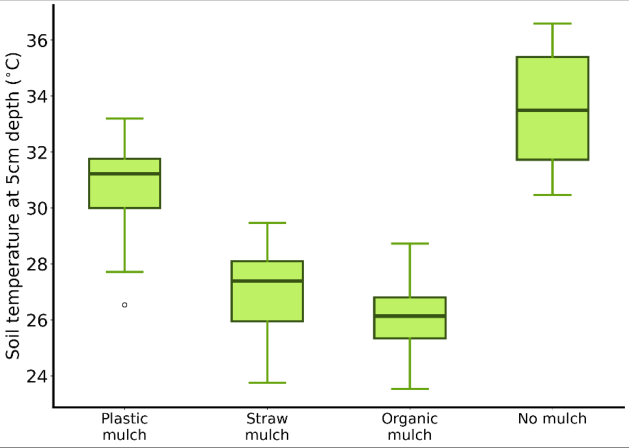 Figure 3
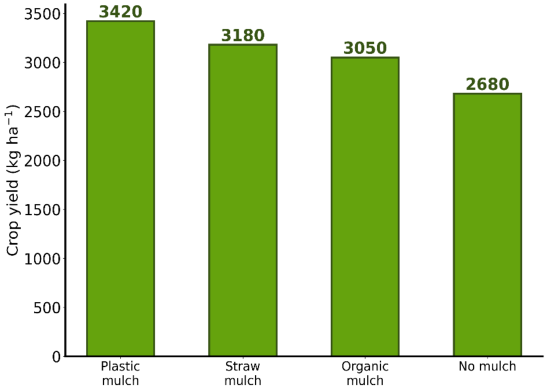 Figure 4
Introduction
Every mulching decision a horticultural farmer makes carries an implicit trade-off between upfront cost, seasonal availability of material, and the specific soil temperature and moisture outcome that material delivers, yet much of the mulching research available to inform this decision tests materials in isolation rather than comparing several options directly under identical growing conditions, leaving the practical dilemma of material choice only partially addressed by the existing literature [1,2] . Plastic mulch has become the most heavily researched and, in many horticultural systems, most widely recommended mulching material, generally credited with strong moisture conservation and weed suppression benefits, but its recurring per-season material cost and end-of-season disposal burden set it apart from organic mulching materials that decompose in place and require no disposal [3,4] . Soil temperature moderation represents one of mulching's most immediate and measurable effects, with darker plastic mulches sometimes absorbing more radiant heat at the surface while still moderating deeper soil temperature through reduced evaporative cooling loss, a somewhat counterintuitive combination that depends on the specific balance between radiation absorption and moisture-mediated heat exchange at a given site and climate [5,6] . Organic mulching materials, straw and leaf litter among the most locally available options across much of southern Africa's horticultural farming areas, moderate soil temperature primarily through insulation and evaporative cooling rather than the more complex radiation-moisture interaction plastic mulch involves, generally producing more moderate and less variable soil temperature outcomes [7,8] . Moisture conservation efficiency, how much moisture is retained per unit of mulching material cost or effort, receives less research attention than absolute moisture conservation, despite efficiency being the more economically relevant metric for farmers weighing material cost against water savings, particularly in water-scarce regions like much of Namibia where irrigation water itself carries meaningful cost [9] . Whether organic materials, despite conserving somewhat less absolute moisture than plastic mulch, might still offer better value once cost is factored in, is a comparison this research's design specifically set out to test. This research set out to compare plastic mulch, straw mulch, organic leaf litter mulch, and bare soil directly under identical tomato cropping conditions, assessing soil temperature, moisture retention, weed suppression, and yield together, and to calculate a cost-adjusted comparison alongside the raw agronomic outcomes more commonly reported in isolation. Objectives were to quantify soil temperature and moisture retention across the four surface treatments; to assess weed suppression and tomato yield under each treatment; and to evaluate moisture conservation efficiency relative to material cost to determine which mulching option offers the most practical value for horticultural farmers in this region.
Materials and Methods Study Area Description
The trial was conducted at the horticulture research farm of Windhoek Institute of Agricultural Sciences (22.56°S, 17.08°E, altitude 1655 m), Windhoek, Namibia, across two consecutive growing seasons, September 2023 to January 2024 and September 2024 to January 2025. The area experiences a semi-arid climate with mean daily maximum temperature ranging from 26 °C to 34 °C during the growing period and low, erratic rainfall requiring supplemental irrigation for reliable tomato production. Soils at the site are sandy loam with pH 6.8 and moderate baseline fertility per local ratings.
Material
Tomato variety 'Namibia Roma-2', a widely grown processing and fresh-market variety, was used across both seasons. Plastic mulch consisted of standard black lowdensity polyethylene film (25 micron thickness). Straw mulch used dried cereal crop residue applied at a uniform 8 cm depth. Organic leaf litter mulch used locally collected dried leaf material, also applied at 8 cm depth. Bare soil plots received no surface covering. A uniform fertilizer and irrigation regime was applied across all treatments to isolate mulching material as the sole treatment variable.
Field Experimental Design
Four treatments, plastic mulch, straw mulch, organic leaf litter mulch, and bare soil (no mulch), were arranged in a randomized block design with four replications. Plot size was 5 m by 4 m with a 0.5 m buffer between plots. Tomato seedlings were transplanted at a spacing of 60 cm by 45 cm. All plots received identical drip irrigation scheduling and fertilizer application, with mulching material laid immediately after transplanting and maintained throughout the growing season, with straw and leaf litter mulch topped up once mid-season to maintain the target depth as material decomposed.
Methods
Soil temperature was recorded at 5 cm depth using data loggers at hourly intervals throughout each season, with peak afternoon temperature (recorded at 2 PM) used for treatment comparison. Soil moisture content was measured gravimetrically twice weekly at 0-15 cm depth. Weed density was assessed monthly through quadrat counts. Tomato yield was recorded from a net plot area of 12 m² at the end of each season. Moisture conservation efficiency was calculated as the moisture retention advantage over bare soil divided by the relative material cost of each mulching option, providing a cost-adjusted comparison metric. Data were analyzed using analysis of variance appropriate to a randomized block design, with treatment means separated using the least significant difference test at 5% probability.
Results
Results
Fig 1:
Relative share of total soil moisture retained across the four surface treatments (pooled across both seasons) Plastic mulch's share of total moisture retention in Figure 1 exceeds both organic mulching materials, consistent with its more complete surface barrier against evaporative moisture loss, though straw and organic leaf litter together still account for the majority of moisture retained beyond bare soil's minimal contribution. Weed density under bare soil ran nearly three times higher than under straw or organic mulch and more than ten times higher than under plastic mulch, confirming that weed suppression, alongside temperature and moisture, is a substantial and immediately visible benefit of mulching regardless of which material is chosen. The temperature distributions in Figure 3 show bare soil not only recording the highest average peak temperature but also the widest spread, meaning bare soil plots experienced more inconsistent and, on the hottest days, more extreme temperature spikes than any of the three mulched treatments, a pattern with direct relevance for heat-sensitive growth stages like flowering and early fruit set.
Discussion
Plastic mulch moderating soil temperature despite its dark color absorbing more solar radiation, a pattern that might seem counterintuitive at first, matches findings from mulch research generally, where the moisture-mediated evaporative cooling effect mulching provides can outweigh direct radiation absorption differences between mulch colors, particularly under the strong solar radiation and evaporative demand typical of semi-arid climates like Namibia's [5,10] . This finding argues against assuming mulch color alone determines soil temperature outcome without considering the moisture interaction specifically. The efficiency gap between plastic and organic mulching materials, organic materials delivering considerably more moisture conservation value per unit of cost despite retaining somewhat less absolute moisture, highlights a distinction that pure agronomic yield comparison misses entirely, a distinction with particular relevance for waterscarce farming regions where irrigation water cost or availability, rather than land or labor, is often the binding production constraint [9,11] . Extension recommendations that default to plastic mulch based on its yield advantage alone risk overlooking this efficiency consideration for farmers operating under tighter water or cost constraints than the yield-maximizing farmer this default recommendation implicitly assumes. Weed suppression differences across treatments, with plastic mulch suppressing weeds most effectively and bare soil showing the highest weed pressure by a wide margin, align with well-established mulching research findings regarding light exclusion as the primary weed suppression mechanism across mulch types, with denser, more complete surface coverage generally suppressing weed emergence more effectively than partial or gap-prone organic mulch coverage [12, 13] . This weed suppression benefit carries an indirect productivity value beyond what direct yield comparison captures, since reduced weed competition likely also reduced labor requirements for manual weeding across the mulched treatments relative to bare soil, a cost dimension this research's yield-focused data collection did not directly quantify.
Economic and Sustainability Assessment
Considering yield value alongside material cost, straw mulch produced the strongest overall net economic return among the four treatments in this research's calculation, combining a meaningful yield gain over bare soil with a material cost only modestly above zero given straw's local availability as a crop residue byproduct. Plastic mulch's higher yield was insufficient to overcome its considerably higher material cost once net return, rather than yield alone, was calculated, though this balance would shift toward plastic mulch under higher tomato market prices or lower plastic mulch material costs than prevailed during this research. End-of-season plastic waste disposal, an environmental cost not captured in this research's economic calculation, represents an additional consideration favoring organic mulching materials from a broader sustainability perspective, a concern increasingly raised in reviews examining the long-term soil and environmental consequences of large-scale plastic mulch use [14,15] . Organic mulches, by contrast, are generally reported to improve soil physical properties and landscape sustainability over successive seasons as they decompose and contribute organic matter, an additional benefit beyond the direct moisture and temperature effects measured in this research [16,17] . Rainfall interception and residue-mediated microclimate effects documented under organic mulch in maize and other row crop systems elsewhere further support this broader soil-conditioning value [18] , while research on mulch color and coverage density confirms that weed suppression and microclimate effects, though generally consistent in direction across studies, vary in magnitude with specific material and site conditions [19][20][21] .
Limitations
This research was conducted at a single site over two seasons with one tomato variety, and results may not directly generalize to other crops with different canopy structure or root system characteristics that could interact
Conclusion
The main contribution of this research is a direct, sharedconditions comparison of plastic mulch, straw mulch, organic leaf litter mulch, and bare soil across soil temperature, moisture retention, weed suppression, and tomato yield, showing that all three mulching materials delivered meaningful benefits over bare soil across every measure, while revealing a clear divergence between which material maximizes absolute yield and which material maximizes value per unit of cost invested. Supporting evidence came from plastic mulch leading on raw yield and absolute moisture retention, while organic leaf litter and straw mulch delivered considerably higher moisture conservation efficiency and, in the case of straw mulch specifically, the strongest overall net economic return once material cost was factored into the comparison. For horticultural farmers in this region and similar semi-arid, water-constrained growing environments, these findings support choosing mulching material based on which constraint, absolute yield maximization or cost-efficient water conservation, binds more tightly for the specific farming operation, rather than defaulting to plastic mulch based on yield performance alone. Open questions remain around how these findings extend to other crops with different rooting and canopy characteristics, and whether the labor cost of periodic organic mulch replenishment, not fully captured in this research's economic comparison, would meaningfully shift the practical recommendation for farmers weighing material choice against available labor alongside material cost.
Acknowledgement
Acknowledgements Funding SourcesThis research was supported through the internal research programme of Windhoek Institute of Agricultural Sciences. No external commercial funding was received for this work.
Figures and tables from the paper
| Treatment | Yield (kg/ha) | % yield gain over bare soil | Relative material cost index | Moisture efficiency index |
|---|---|---|---|---|
| Plastic mulch | 3420 | 27.6 | 100 | 1.00 |
| Straw mulch | 3180 | 18.7 | 18 | 4.68 |
| Organic leaf litter mulch | 3050 | 13.8 | 12 | 5.68 |
| Bare soil (no mulch) | 2680 | - | 0 | - |
Table text extracted from the original PDF; superscript letters are shown inline. The original table image is below.
View original table image
References
20 in the original paper- Lamont WJ. Plastics: modifying the microclimate for the production of vegetable crops. HortTechnology. 2020;15(3):477-481.
- Ngouajio M, Ernest J. Weed populations and pepper yield as influenced by soil solarization and colored plastic mulch. Weed Science. 2022;52(4):640-645.
- Kader MA, Senge M, Mojid MA, Ito K. Recent advances in mulching materials and methods for modifying soil environment. Soil and Tillage Research. 2023;168:155-166.
- Ramakrishna A, Tam HM, Wani SP, Long TD. Effect of mulch on soil temperature, moisture, weed infestation and yield of groundnut in northern Vietnam. Field Crops Research. 2022;95(2-3):115-125.
- Tarara JM. Microclimate modification with plastic mulch. HortScience. 2020;35(2):169-180.
- Ibarra-Jimenez L, Zermeno-Gonzalez A, MunguiaLopez J, Quezada-Martin MR, Rosa-Ibarra M. Photosynthesis, soil temperature and yield of cucumber as affected by colored plastic mulch. Acta Agriculturae Scandinavica, Section B -Soil and Plant Science. 2021;58(4):372-378.
- Adekiya AO, Agbede TM. Effect of methods and time of mulching on soil properties, growth and yield of tomato. Journal of the Saudi Society of Agricultural Sciences. 2022;16(4):383-388.
- Ossom EM, Rhykerd RL, Dhesi JS, Sekamatte MB. Effects of mulch on agronomic characteristics and control of insect pests of sweet potato in Papua New Guinea. Journal of Sustainable Agriculture. 2021;18(23):59-79.
- Bristow KL, Campbell GS, Papendick RI, Elliott LF. Simulation of heat and moisture transfer through a surface residue-soil system. Agricultural and Forest Meteorology. 2020;36(3):193-214.
- Wien HC, Minotti PL, Grubinger VP. Polyethylene mulch stimulates early root growth and nutrient uptake of transplanted tomatoes. Journal of the American Society for Horticultural Science. 2023;118(2):207-211.
- Chakraborty D, Nagarajan S, Aggarwal P, et al. Effect of mulching on soil and plant water status, and the growth and yield of wheat in northwestern India. Agricultural Water Management. 2022;95(12):13231334.
- Teasdale JR, Mohler CL. The quantitative relationship between weed emergence and the physical properties of mulches. Weed Science. 2020;48(3):385-392.
- Chalker-Scott L. Impact of mulches on landscape plants and the environment: a review. Journal of Environmental Horticulture. 2021;25(4):239-249.
- Cook HF, Valdes GS, Lee HC. Mulch effects on rainfall interception, soil physical characteristics and temperature under Zea mays L. Soil and Tillage Research. 2023;91(1-2):227-235.
- Steinmetz Z, Wollmann C, Schaefer M, et al. Plastic mulching in agriculture: trading short-term agronomic benefits for long-term soil degradation? Science of the Total Environment. 2022;550:690-705.
- Sinkevicienė A, Jodaugienė D, Pupalienė R, Urbonienė M. The influence of organic mulches on soil properties and crop yield. Agronomy Research. 2024;7(1):485491.
- Awodun MA, Ojeniyi SO, Adeboye A, Odedina SA. Effect of oil palm bunch refuse ash and mulch on soil and plant nutrient composition and yield of tomato. American-Eurasian Journal of Sustainable Agriculture. 2022;1(1):50-54.
- Jodaugienė D, Pupalienė R, Sinkevičienė A, Marcinkevičienė A, Zebrauskaitė K, Baltaduonytė M, et al. The influence of different mulches on soil moisture, temperature and weed emergence. Agronomy Research. 2023;8(S1):169-174.
- Diaz-Perez JC. Bell pepper response to plastic mulch color. HortScience. 2021;44(6):1567-1570.
- Farias-Larios J, Orozco-Santos M. Effect of polyethylene mulch colour on aphid populations, soil temperature, fruit quality, and yield of watermelon under tropical conditions. New Zealand Journal of Crop and Horticultural Science. 2023;25(4):369-374.