
Research article · 2026 · Full text
International Journal of Biology SciencesDiversity and feeding guild structure of avifauna across Sendh Lake, Jhanjh, Khandwa and Pounta Ponds and Their surrounding wetlands in New Raipur, Chhattisgarh, India
Volume 8(7) · Pages 52–57 · DOI: 10.33545/26649926.2026.v8.i7a.909 ↗
Research areasAvian ecology and behaviorBird parasitology and diseasesSpecies Distribution and Climate Change
Abstract
Author-writtenWetlands are believed to play a vital role in maintaining biodiversity. This study aimed at investigating the diversity of birds and their feeding guilds from observations of birds at Sendh Lake, Jhanjh, Khandwa and Pounta Ponds and surrounding wetland habitats in New Raipur, Chhattisgarh in India. Researchers identified 57 different species belonging to 14 orders and 28 families. Birds that belong to the order Passeriformes made up the majority of species found in this study area at 42.10% (24 species); followed by Pelecaniformes with 7 species and Charadriiformes with 6 species. Based upon the feeding guilds of the birds, the greatest number of birds belong to the insectivore feeding guild (29.82%) followed by omnivores, carnivores and granivores, herbivores/frugivores then piscivores. A Shannon-Wiener diversity index was calculated and obtained an index value of 3.89 indicating high levels of diversity. This wetland ecosystem is an essential habitat because it contains a large number of waterbirds; such as herons, egrets, cormorants, and ibises. This study also indicates that this area can be considered as an opportunity for conservation of avifaunal diversity within urban Chhattisgarh.
Summary
Source-checkedPlain-language reading of the full paper, prepared with AI and checked against the text. Each point links to the authors' own words.
Why it matters
- Wetlands are highly productive ecosystems that serve as critical habitats for many bird species, particularly migratory and coastal birds. View evidence ↗
- The variety and abundance of birds in these ecosystems act as strong indicators of the overall ecological health of the environment. View evidence ↗
- New Raipur (Atal Nagar), the capital of Chhattisgarh, is undergoing rapid urbanization, which may impact its local wetlands. View evidence ↗
The question
- The study aimed to determine the total species richness and observe the feeding behaviors of birds at Sendh Lake, Jhanjh, Khandwa, and Pounta Ponds in New Raipur. View evidence ↗
What they did
- The research was conducted in New Raipur, Chhattisgarh, focusing on wetlands comprising open water, marshy vegetation, farmland, and tree/shrub cover. View evidence ↗
- Birds were identified using direct visual observations with binoculars during peak activity periods (morning and evening), supported by taxonomic literature and field guides. View evidence ↗
- The researchers analyzed species diversity using standard ecological indices, including species richness, the Shannon-Wiener Diversity Index, and the Evenness Index. View evidence ↗
What they found
- The survey recorded a total of 57 bird species, which were categorized into 28 families and 14 orders. View evidence ↗
- The Ardeidae family, consisting of egrets and herons, had the highest family-level representation with six species. View evidence ↗
- Insectivorous birds were the most common feeding guild (17 species, 29.82%), followed by omnivores and carnivores (both 15 species, 26.31%). View evidence ↗
- The Shannon-Wiener Diversity Index was 3.89, which the authors interpret as indicating high species diversity and ecological stability. View evidence ↗
- An Evenness Index of 0.96 suggests a very even distribution of bird species across the study area. View evidence ↗
- The Simpson's Dominance Index was 0.03, indicating that no single bird species dominates the community. View evidence ↗
What it means
- The authors conclude that managing and conserving these urban wetlands is necessary to maintain ecological balance and preserve bird diversity. View evidence ↗
- The authors state that further research is needed to investigate migratory bird patterns and seasonal fluctuations within the ecosystem. View evidence ↗
Visual summary
3 visualsIllustrations explain the paper; charts are replotted from the paper's own table values.
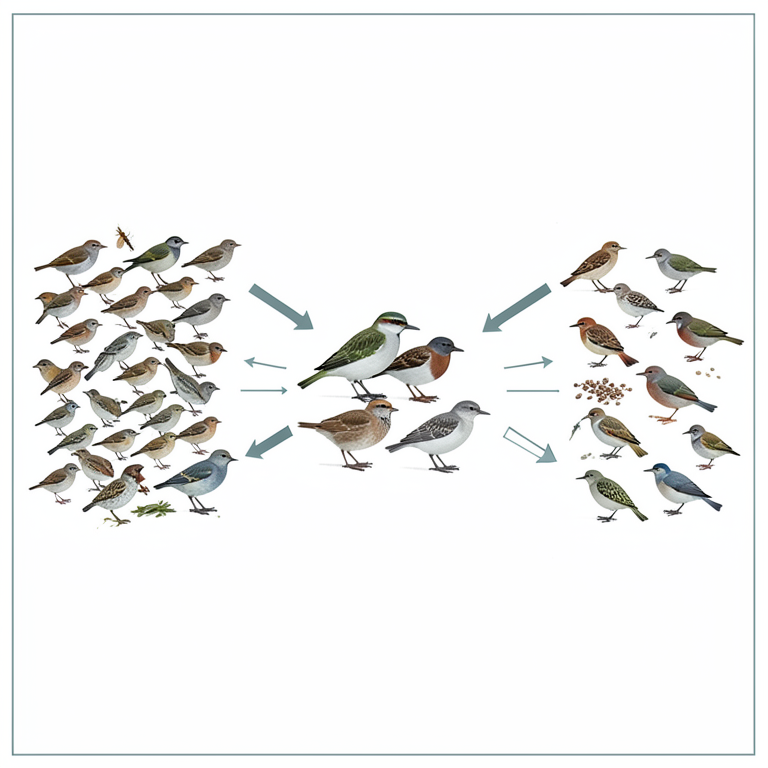
Feeding Guild Distribution
AI-generated conceptual illustration (Various bird species of Chhattisgarh wetlands (insectivores, omnivores, carnivores, granivores, herbivores, and piscivor). It explains the idea and does not show study data.
View source evidence ↗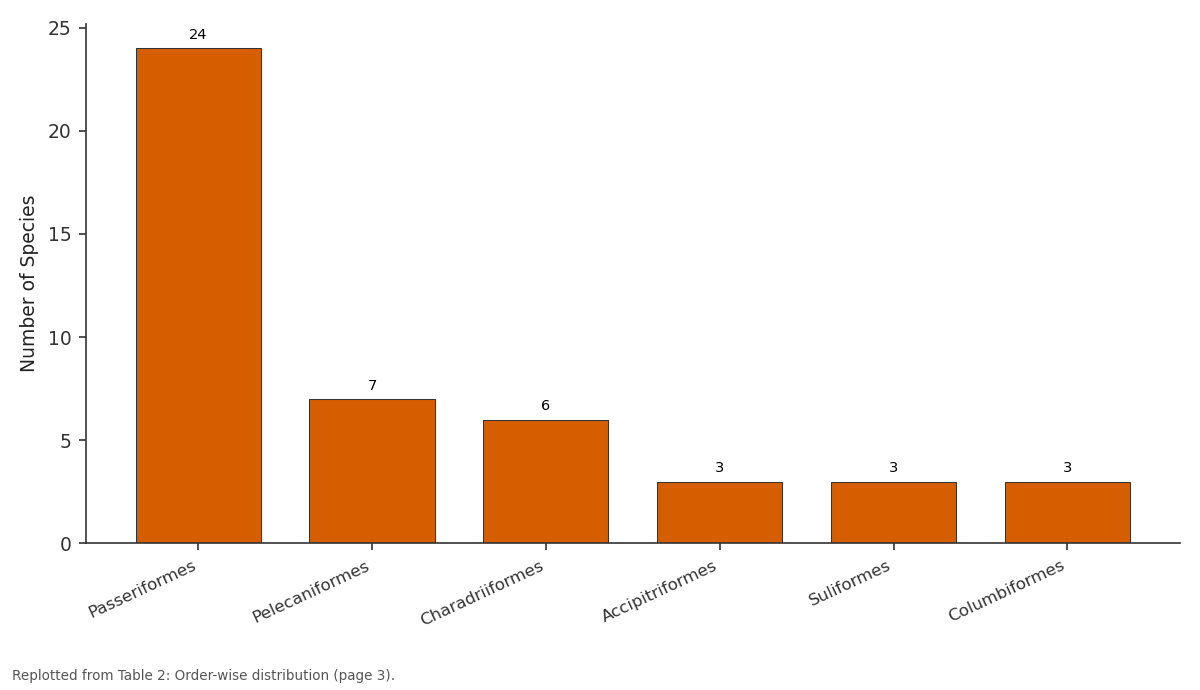
Number of Species: Passeriformes vs Pelecaniformes vs Charadriiformes vs Accipitriformes vs Suliformes
Replotted from Table 2 (page 3) of the original paper. Every bar is the paper's own table value.
View source evidence ↗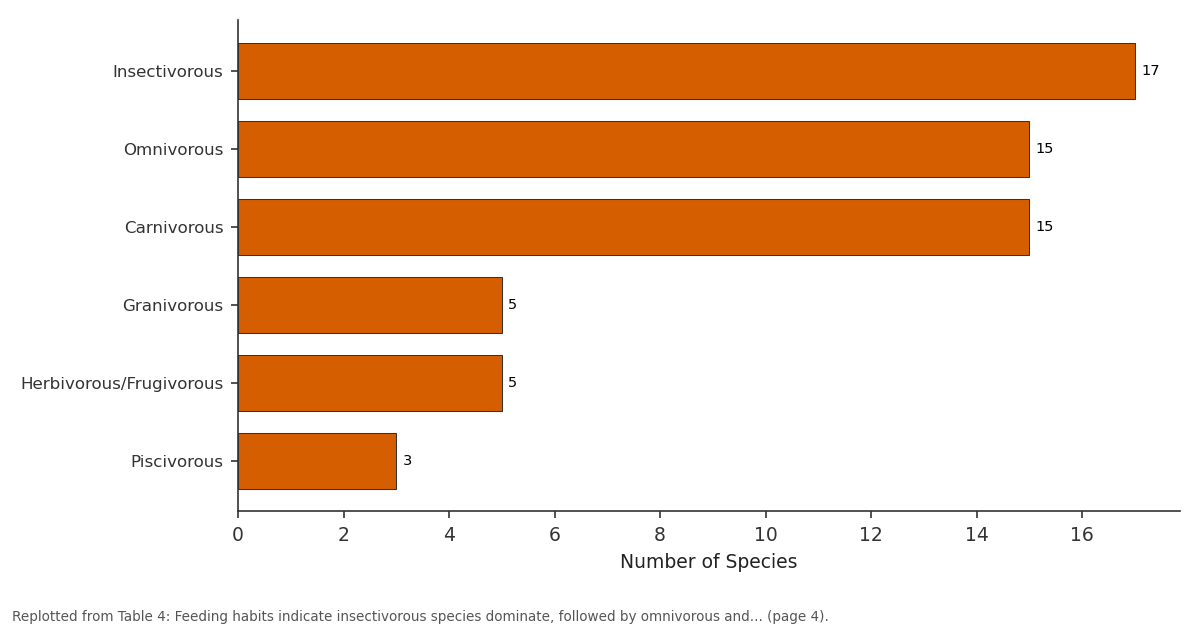
Number of Species: Insectivorous vs Omnivorous vs Carnivorous vs Granivorous vs Herbivorous/Frugivorous
Replotted from Table 4 (page 4) of the original paper. Every bar is the paper's own table value.
View source evidence ↗Figures & tables
From the original paper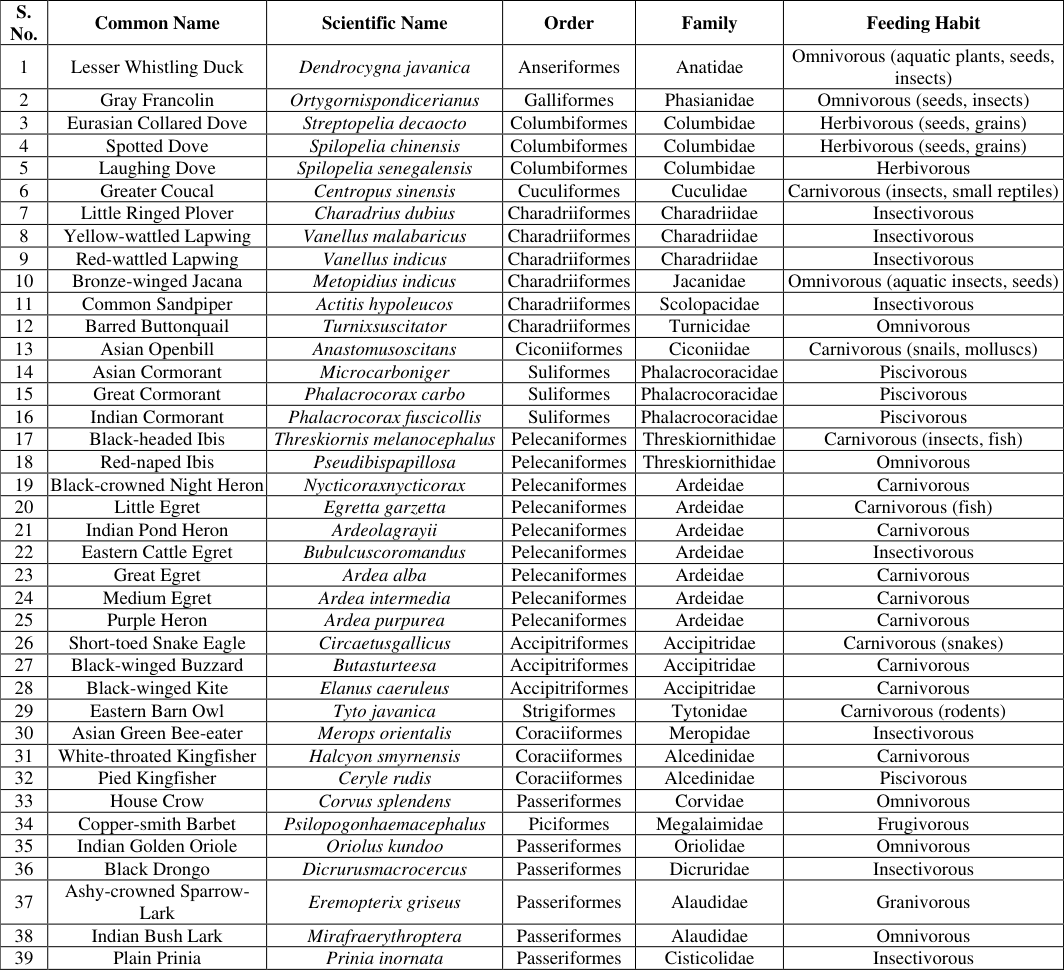 Table 1
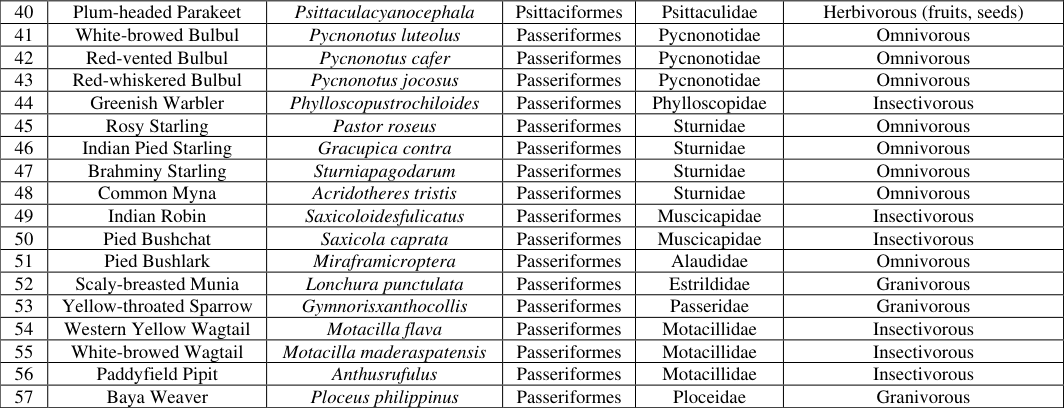 Table 2
 Table 2
 Table 3
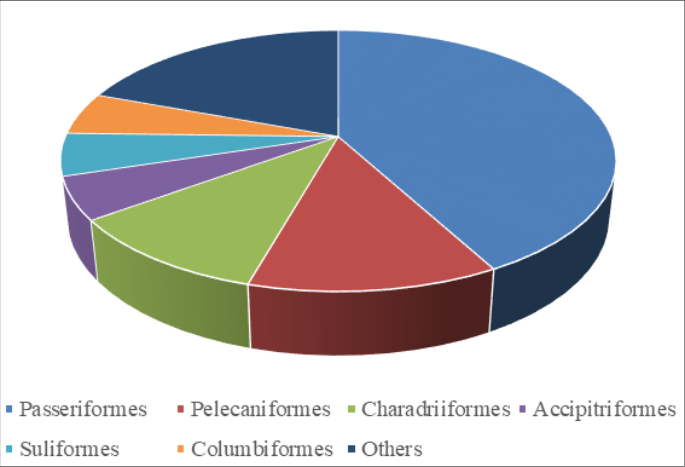 Figure 1
 Table 4
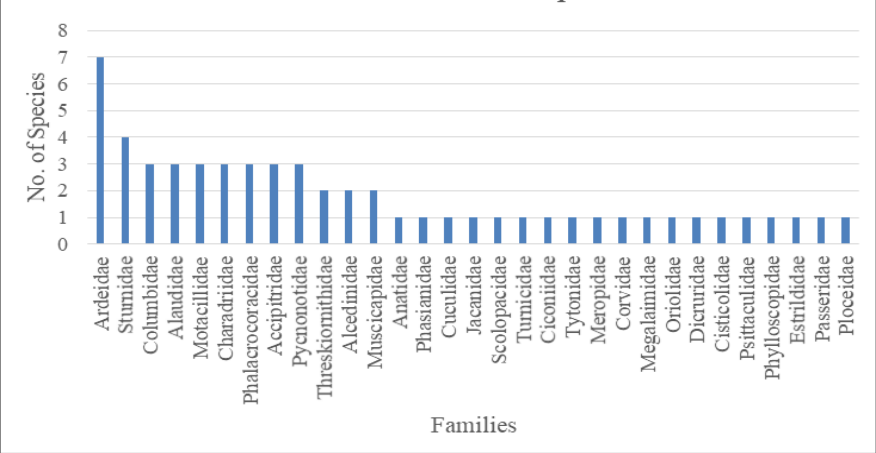 Figure 2
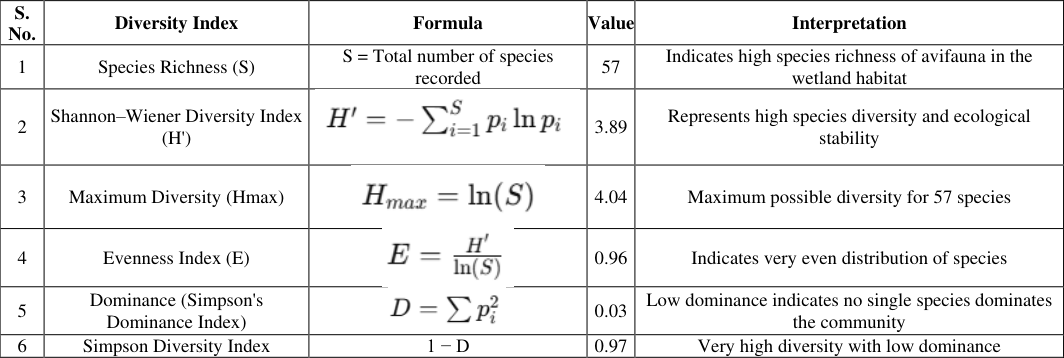 Table 5
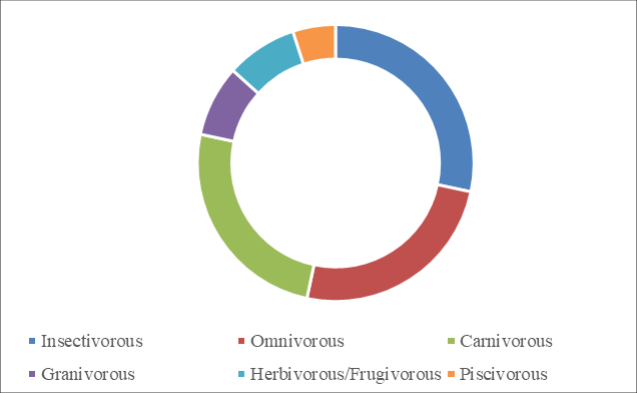 Figure 3
Introduction
Wetlands are one of the most productive ecosystem types and are critical habitats for numerous birds, especially those that migrate or inhabit coastal areas. By providing food, breeding, and roosting locations, wetland areas support many different bird communities (Datta, 2011) [7] . The abundance and variety of birds inhabiting wetland ecosystems are good indicators of the overall health of those environments. Birds respond rapidly to changes in the environment and habitat, making them very strong indicators of ecological health (Kumar & Sharma, 2019; Boora & Kumar, 2022) [4,9] . Many researchers report that aquatic vegetation, fish, insects, and other types of feeding resources found in wetland environments support large numbers and types of bird communities (Barik & al., 2022) [1] . Bird communities in these environments have been shown to be sensitive to human activity and changes in land use (Barik et al., 2022) [1] . Many different researchers over the past few decades have studied the diversity of bird species in India's wetlands. This illustrates the importance of wetland habitats for conserving different types of living things. For example, in Chhattisgarh, scientists have identified many bird species using the wetlands that have water and marshes (Bharos et al., 2022; Shrimali et al., 2025) [3,12] . In addition, researchers have also analysed how the wetlands in Karnataka, Haryana and Nepal conserve the avifauna of these wetlands (Neelgund&Kadadevaru, 2020; Pant et al., 2024) [10,11] . Atal Nagar is the capital city of the Chhattisgarh State and is the new Raipur that is rapidly urbanising. Some of the wetlands, like the Sendh Lake, Jhanjh, Khandwa and Pounta Ponds, are important to help conserve the avifauna despite the urbanisation of these wetland ecosystems. Wetland ecosystems provide bird habitat due to the presence of water plants, field agriculture and open water areas.
Although avian diversity has been studied in other parts of the state of Chhattisgarh (Bharos et al., 2023) [2] , there is currently no information available on the types of birds or feeding guilds present in Bendri Pond. In light of this, the objective of this study is to identify how many unique types of birds (total species richness) live at Sendh Lake, Jhanjh, Khandwa and Pounta Ponds and observe their feeding behaviours throughout New Raipur's wetland area surrounding the pond.
Materials and Methods
Materials and Methods
Study Area
The study was done at the Sendh Lake, Jhanjh, Khandwa and Pounta Ponds which is a Wetland located in New Raipur (Atal Nagar), Chhattisgarh (India) that contains areas of Open Water Body & Marshy Vegetation plus farmland & tree/shrub cover. Wetlands provide critical breeding ground & feeding area for both resident & migratory birds throughout Central India.
Bird Survey Method
Birds were surveyed by direct (visual) observation (e.g. with binoculars) during the morning & evening period when they are active, followed by identifying them through common field guides and taxonomic literature. The Sendh Lake, Jhanjh, Khandwa and Pounta Ponds Physical Characteristics & Behavioural Characteristics were used to identify them.
Data Analysis
Species diversity was analyzed using standard ecological indices. Species Richness Total number of species recorded = 57 Shannon-Wiener Diversity Index The Shannon-Wiener index was used to estimate species diversity. Evenness Index
Results
Results
Avifaunal Diversity
A total of 57 bird species belonging to 14 orders and 28 families were recorded during the study. The order Passeriformes had the largest representation among wetlands in India, accounting for twenty-four species (42.10%), followed by Pelecaniformes (12.28%) and Charadriiformes (10.52%). The dominance of passerine birds among birds in wetland habitats in India is further supported through other wetland studies in India as passerines were found to represent a major part of the bird populations (Neelgund&Kadadevaru 2020) [10] .
Family-wise Diversity
The family Ardeidae, which consist of herons and egrets, had the highest number of species with a total of six species. These five species are: Indian Pond-Dove, Little Egret, Purple Heron, and Great Egret.
Feeding Guild Analysis
Birds that belong to the same feeding guild are characterised as belonging to one of five primary alphabetic dietary groups: Granivores, Folivores, Nectar feeders, Frugivores, and Insectivores. With regard to birds that fall into an Insectivore (that is, feeding primarily on insects), this indicates that there are insects found within the wetlands of this specific habitat or environment. The analysis of the biodiversity at Sendh Lake, Jhanjh, Khandwa and Pounta Ponds showed that there are 57 different bird species. This demonstrates how important wetlands are for supporting biodiversity. The Shannon-Wiener Index for the biodiversity at Sendh Lake, Jhanjh, Khandwa and Pounta Ponds was 3.89, meaning that there is high biodiversity for the birds at Sendh Lake, Jhanjh, Khandwa and Pounta Ponds. The hydrology and types of plants in the area provide suitable habitat for many different bird species and provide access to multiple food sources. The evenness value for the 57 species at Ponds was also calculated to be 0.96; therefore, there are many individual bird species, and no one species has an overwhelming dominance. The Simpson's Index for the biodiversity at respective Ponds was calculated to be 0.97, indicating that a high probability exists that if two randomly selected individuals are sampled that they would belong to different bird species. The Dominance Index for the Sendh Lake, Jhanjh, Khandwa and Pounta Ponds ecosystem was calculated to be 0.03; this further supports this Ponds have a highly diverse and unique ecosystem.
Discussion
According to this research study, Sendh Lake, Jhanjh, Khandwa and Pounta Ponds are a significant locale regarding the variety of birds. A total of 57 bird species reported from this location indicates sufficient ecological conditions exist for various bird species to thrive here. Numerous studies have shown that wetlands provide suitable habitats for a high number of birds because wetlands' habitat structure allows for food sources for these birds. Other studies on Indian wetlands have found similar patterns of bird diversity associated with the combination of vegetation and water bodies (Boora & Kumar, 2022; Chavan, 2023) [4,5] . The present study's finding of a significant density of passerine birds is analogous to the findings from other Indian wetlands with regards to density of birds (Neelgund&Kadadevaru, 2020) [10] , which use vegetation, grassland, and agricultural areas as habitat for feeding and nesting. Based on the conclusions drawn from the analysis of feeding guilds, it can be stated that birds that forage on insects comprised the most significant portion of the bird community, indicating high insect density in this wetland ecosystem. [12] . Wetlands near urban areas are also being negatively impacted by pollution, destruction of habitat from human development, and other human caused disruptions to wetland habitats. Studies conducted have shown that anthropogenic actions impact both the distribution and diversity of birds found in wetland ecosystems (Datta, 2011; Barik e.t al., 2022) [1,7] . The pace at which New Raipur is urbanized is increasing, yet all this ponds are able to support a still diverse grouping bird species. Therefore, the ecology of the wetland must continue to be preserved and protected so that the multiple species of birds found within the wetland can continue to exist.
Conclusion
A survey was conducted on wetlands of Sendh Lake, Jhanjh, Khandwa and Pounta Ponds and New Raipur, which yielded 57 species of birds distributed among 14 orders, 28 families. The predominance of passerine birds, as well as insectivorous feeding guilds, highlights the high diversity of wetland habitats. This study reaffirms that urban wetlands are important for ecological balance and conserving bird species diversity. The wetlands and ponds are critical for the maintenance of both terrestrial and aquatic birds. Therefore, the conservation and management of this habitat are necessary for the maintenance of ecological balance and conservation of bird species diversity. Additional studies of the ecosystem in this area are necessary to examine seasonal fluctuations in the ecosystem and patterns of migratory birds.
Figures and tables from the paper
| S. No. | Common Name | Scientific Name | Order | Family | Feeding Habit |
|---|---|---|---|---|---|
| 1 | Lesser Whistling Duck | Dendrocygna javanica | Anseriformes | Anatidae | Omnivorous (aquatic plants, seeds, insects) |
| 2 | Gray Francolin | Ortygornispondicerianus | Galliformes | Phasianidae | Omnivorous (seeds, insects) |
| 3 | Eurasian Collared Dove | Streptopelia decaocto | Columbiformes | Columbidae | Herbivorous (seeds, grains) |
| 4 | Spotted Dove | Spilopelia chinensis | Columbiformes | Columbidae | Herbivorous (seeds, grains) |
| 5 | Laughing Dove | Spilopelia senegalensis | Columbiformes | Columbidae | Herbivorous |
| 6 | Greater Coucal | Centropus sinensis | Cuculiformes | Cuculidae | Carnivorous (insects, small reptiles) |
| 7 | Little Ringed Plover | Charadrius dubius | Charadriiformes | Charadriidae | Insectivorous |
| 8 | Yellow-wattled Lapwing | Vanellus malabaricus | Charadriiformes | Charadriidae | Insectivorous |
| 9 | Red-wattled Lapwing | Vanellus indicus | Charadriiformes | Charadriidae | Insectivorous |
| 10 | Bronze-winged Jacana | Metopidius indicus | Charadriiformes | Jacanidae | Omnivorous (aquatic insects, seeds) |
| 11 | Common Sandpiper | Actitis hypoleucos | Charadriiformes | Scolopacidae | Insectivorous |
| 12 | Barred Buttonquail | Turnixsuscitator | Charadriiformes | Turnicidae | Omnivorous |
| 13 | Asian Openbill | Anastomusoscitans | Ciconiiformes | Ciconiidae | Carnivorous (snails, molluscs) |
| 14 | Asian Cormorant | Microcarboniger | Suliformes | Phalacrocoracidae | Piscivorous |
| 15 | Great Cormorant | Phalacrocorax carbo | Suliformes | Phalacrocoracidae | Piscivorous |
| 16 | Indian Cormorant | Phalacrocorax fuscicollis | Suliformes | Phalacrocoracidae | Piscivorous |
| 17 | Black-headed Ibis | Threskiornis melanocephalus | Pelecaniformes | Threskiornithidae | Carnivorous (insects, fish) |
| 18 | Red-naped Ibis | Pseudibispapillosa | Pelecaniformes | Threskiornithidae | Omnivorous |
| 19 | Black-crowned Night Heron | Nycticoraxnycticorax | Pelecaniformes | Ardeidae | Carnivorous |
| 20 | Little Egret | Egretta garzetta | Pelecaniformes | Ardeidae | Carnivorous (fish) |
| 21 | Indian Pond Heron | Ardeolagrayii | Pelecaniformes | Ardeidae | Carnivorous |
| 22 | Eastern Cattle Egret | Bubulcuscoromandus | Pelecaniformes | Ardeidae | Insectivorous |
| 23 | Great Egret | Ardea alba | Pelecaniformes | Ardeidae | Carnivorous |
| 24 | Medium Egret | Ardea intermedia | Pelecaniformes | Ardeidae | Carnivorous |
| 25 | Purple Heron | Ardea purpurea | Pelecaniformes | Ardeidae | Carnivorous |
| 26 | Short-toed Snake Eagle | Circaetusgallicus | Accipitriformes | Accipitridae | Carnivorous (snakes) |
| 27 | Black-winged Buzzard | Butasturteesa | Accipitriformes | Accipitridae | Carnivorous |
| 28 | Black-winged Kite | Elanus caeruleus | Accipitriformes | Accipitridae | Carnivorous |
| 29 | Eastern Barn Owl | Tyto javanica | Strigiformes | Tytonidae | Carnivorous (rodents) |
| 30 | Asian Green Bee-eater | Merops orientalis | Coraciiformes | Meropidae | Insectivorous |
| 31 | White-throated Kingfisher | Halcyon smyrnensis | Coraciiformes | Alcedinidae | Carnivorous |
| 32 | Pied Kingfisher | Ceryle rudis | Coraciiformes | Alcedinidae | Piscivorous |
| 33 | House Crow | Corvus splendens | Passeriformes | Corvidae | Omnivorous |
| 34 | Copper-smith Barbet | Psilopogonhaemacephalus | Piciformes | Megalaimidae | Frugivorous |
| 35 | Indian Golden Oriole | Oriolus kundoo | Passeriformes | Oriolidae | Omnivorous |
| 36 | Black Drongo | Dicrurusmacrocercus | Passeriformes | Dicruridae | Insectivorous |
| 37 | Ashy-crowned Sparrow- Lark | Eremopterix griseus | Passeriformes | Alaudidae | Granivorous |
| 38 | Indian Bush Lark | Mirafraerythroptera | Passeriformes | Alaudidae | Omnivorous |
| 39 | Plain Prinia | Prinia inornata | Passeriformes | Cisticolidae | Insectivorous |
Table text extracted from the original PDF; superscript letters are shown inline. The original table image is below.
View original table image
| 40 | Plum-headed Parakeet | Psittaculacyanocephala | Psittaciformes | Psittaculidae | Herbivorous (fruits, seeds) |
|---|---|---|---|---|---|
| 41 | White-browed Bulbul | Pycnonotus luteolus | Passeriformes | Pycnonotidae | Omnivorous |
| 42 | Red-vented Bulbul | Pycnonotus cafer | Passeriformes | Pycnonotidae | Omnivorous |
| 43 | Red-whiskered Bulbul | Pycnonotus jocosus | Passeriformes | Pycnonotidae | Omnivorous |
| 44 | Greenish Warbler | Phylloscopustrochiloides | Passeriformes | Phylloscopidae | Insectivorous |
| 45 | Rosy Starling | Pastor roseus | Passeriformes | Sturnidae | Omnivorous |
| 46 | Indian Pied Starling | Gracupica contra | Passeriformes | Sturnidae | Omnivorous |
| 47 | Brahminy Starling | Sturniapagodarum | Passeriformes | Sturnidae | Omnivorous |
| 48 | Common Myna | Acridotheres tristis | Passeriformes | Sturnidae | Omnivorous |
| 49 | Indian Robin | Saxicoloidesfulicatus | Passeriformes | Muscicapidae | Insectivorous |
| 50 | Pied Bushchat | Saxicola caprata | Passeriformes | Muscicapidae | Insectivorous |
| 51 | Pied Bushlark | Miraframicroptera | Passeriformes | Alaudidae | Omnivorous |
| 52 | Scaly-breasted Munia | Lonchura punctulata | Passeriformes | Estrildidae | Granivorous |
| 53 | Yellow-throated Sparrow | Gymnorisxanthocollis | Passeriformes | Passeridae | Granivorous |
| 54 | Western Yellow Wagtail | Motacilla flava | Passeriformes | Motacillidae | Insectivorous |
| 55 | White-browed Wagtail | Motacilla maderaspatensis | Passeriformes | Motacillidae | Insectivorous |
| 56 | Paddyfield Pipit | Anthusrufulus | Passeriformes | Motacillidae | Insectivorous |
| 57 | Baya Weaver | Ploceus philippinus | Passeriformes | Ploceidae | Granivorous |
Table text extracted from the original PDF; superscript letters are shown inline. The original table image is below.
View original table image
| Order | Number of Species | Percentage |
|---|---|---|
| Passeriformes | 24 | 42.10% |
| Pelecaniformes | 7 | 12.28% |
| Charadriiformes | 6 | 10.52% |
| Accipitriformes | 3 | 5.26% |
| Suliformes | 3 | 5.26% |
| Columbiformes | 3 | 5.26% |
| Others | 11 | 19.32% |
Table text extracted from the original PDF; superscript letters are shown inline. The original table image is below.
View original table image
| S. No. | Family | Number of Species |
|---|---|---|
| 1 | Ardeidae | 7 |
| 2 | Sturnidae | 4 |
Table text extracted from the original PDF; superscript letters are shown inline. The original table image is below.
View original table image
| Feeding Habit | Number of Species | Percentage |
|---|---|---|
| Insectivorous | 17 | 29.82% |
| Omnivorous | 15 | 26.31% |
| Carnivorous | 15 | 26.31% |
| Granivorous | 5 | 8.77% |
| Herbivorous/Frugivorous | 5 | 8.77% |
| Piscivorous | 3 | 5.26% |
Table text extracted from the original PDF; superscript letters are shown inline. The original table image is below.
View original table image
| S. No. | Diversity Index | Formula | Value | Interpretation |
|---|---|---|---|---|
| 1 | Species Richness (S) | S = Total number of species recorded | 57 | Indicates high species richness of avifauna in the wetland habitat |
| 2 | Shannon–Wiener Diversity Index (H') | 3.89 | Represents high species diversity and ecological stability | |
| 3 | Maximum Diversity (Hmax) | 4.04 | Maximum possible diversity for 57 species | |
| 4 | Evenness Index (E) | 0.96 | Indicates very even distribution of species | |
| 5 | Dominance (Simpson's Dominance Index) | 0.03 | Low dominance indicates no single species dominates the community | |
| 6 | Simpson Diversity Index | 1 − D | 0.97 | Very high diversity with low dominance |
Table text extracted from the original PDF; superscript letters are shown inline. The original table image is below.
View original table image
References
14 in the original paper- Barik S, Saha G, Mazumdar S. Influence of land cover features on avian community and potential conservation priority areas for biodiversity at a Ramsar site in India. Ecol Process. 2022;11:1-15. DOI: 10.1186/s13717-02200369-x.
- Bharos A, Vishwakarma A, Bharos A, Naidu R. Diversity and conservation status of avifauna in the Surguja region, Chhattisgarh, India. J Threat Taxa. 2023;15(8):23710-23728. DOI: 10.11609/jott.7314.15.8.23710-23728.
- Bharos A, Vishwakarma A, Verma J, Bharos A, Verma D. Significance of wetland and its dependent avifauna in Bangoli Wetland Complex, Raipur District, Chhattisgarh, India. J Biol Stud. 2022;4(4):1-11. DOI: 10.62400/jbs.v4i4.6345.
- Boora V, Kumar P. Diversity, status and seasonality of wetland birds in rural ponds of District Kurukshetra, Haryana, India. Int J Ecol Environ Sci. 2023;49(1):113. DOI: 10.55863/ijees.2023.2671.
- Chavan G. Wetland bird diversity of Pandav Talav, Nagbhid (Maharashtra), India. Int J Res Biosci Agric Technol. 2023;2(1):13-20. DOI: 10.29369/ijrbat.2023.02.1.0013.
- Choudhary A, Kumar S, Kumari P. Ecological study of Indian Pond Heron and Gray Heron in wetlands of Udaipur and Chittorgarh districts of Rajasthan, India. Ecol Environ Conserv. 2025;31(Suppl 2):S18-S24. DOI: 10.53550/eec.2025.v31i02s.018.
- Datta T. Human interference and avifaunal diversity of two wetlands of Jalpaiguri, West Bengal, India. J Threat Taxa. 2011;3:2253-2262. DOI: 10.11609/jott.o2739.2253-2262.
- Jamakhandi H, Kadadevaru G. Assessment of avifaunal status, diversity, and conservation implications in and around the wetlands of Dharwad, Karnataka, India. Uttar Pradesh J Zool. 2024;45(19):1-15. DOI: 10.56557/upjoz/2024/v45i194526.
- Kumar P, Sharma A. Wetland bird assemblages in manmade sacred ponds of Kurukshetra, India. Proc Zool Soc. 2019;72(1):61-73. DOI: 10.1007/s12595-0180259-x.
- Neelgund H, Kadadevaru G. Avifaunal diversity of selected water bodies of Khanapur Taluka, Belagavi District, Karnataka, India. J Threat Taxa. 2020;12(5):15572-15586. DOI: 10.11609/jott.5044.12.5.15572-15586.
- Pant S, Bhattarai B, Baral H, Thapa T. Diversity, species richness, and community composition of wetland birds in the lowlands of western Nepal. Ecol Evol. 2024;14:e70538. DOI: 10.1002/ece3.70538.
- Shrimali C, Tandan H, Patel M, Sahu B, et al. Ecological significance of Typha angustifoliadominated wetlands: a case study of avian biodiversity in Chhattisgarh, India. Uttar Pradesh J Zool. 2025;46(24):1-14. DOI: 10.56557/upjoz/2025/v46i24767.
- Sidhu S. Prioritizing sustenance of village ponds for avian conservation: a case study from Punjab, India. Pak J Zool. 2020;52(6):2263-2272. DOI: 10.17582/journal.pjz/20190918070927.
- Sidhu S. Diversity of insectivorous avian species and their foraging activities at ponds in agricultural habitats in Punjab, India. Pak J Zool. 2022;54(6):2773-2782. DOI: 10.17582/journal.pjz/20220211020232.