
Research article · 2026 · Full text
International Journal of Agriculture and NutritionImpact of precision nutrient management on yield, quality and economics of rice-based cropping systems
Volume 8(2) · Pages 121–126 · DOI: 10.33545/26646064.2026.v8.i2b.695 ↗
Research areasRice Cultivation and Yield ImprovementAgricultural Science and FertilizationCrop Yield and Soil Fertility
Abstract
Author-writtenPolicy statement: national fertilizer subsidy programmes across much of Angola and comparable rice-growing regions continue to promote a single blanket recommended dose regardless of field-specific soil status, a policy this two-season research set out to test against four precision nutrient management approaches that adjust fertilizer application to actual crop and soil need. Five nutrient management strategies, farmer practice (no formal recommendation), blanket recommended dose of fertilizer (RDF), soil test crop response (STCR)-based recommendation, Leaf Color Chart (LCC)-guided nitrogen management, and Nutrient Expert decision-support tool recommendation, were compared for rice grain yield, nitrogen use efficiency, grain quality, and net economic return. The Nutrient Expert-guided treatment produced the highest grain yield at 6.9 t per hectare, exceeding farmer practice by 41% and blanket RDF by 18%, while also delivering the highest nitrogen use efficiency and net economic return among the five approaches tested. Leaf Color Chart-guided management, a considerably simpler and lower-cost precision approach than either STCR or Nutrient Expert, still captured most of the yield and efficiency benefit, reaching 94% of Nutrient Expert's yield and 91% of its net return, suggesting this simpler tool offers a strong practical entry point for precision nutrient management where more sophisticated decision-support tools are not readily accessible. Yield response to nitrogen status, measured through Leaf Color Chart readings, followed a curvilinear rather than linear pattern, with yield gains diminishing and eventually reversing at the highest chart readings, confirming that nitrogen application beyond crop need reduces rather than continues raising yield. These findings challenge blanket fertilizer recommendation policy and support precision nutrient management, even in its simpler and more accessible forms, as a genuinely superior alternative on yield, efficiency, and economic grounds simultaneously.
Summary
Source-checkedPlain-language reading of the full paper, prepared with AI and checked against the text. Each point links to the authors' own words.
Why it matters
- In Angola and similar rice-growing areas, the dominant policy is to use blanket fertilizer recommendations, which apply a single dose regardless of the specific soil fertility or crop variety. View evidence ↗
- Blanket recommendations are problematic because soil fertility varies significantly even within the same farm or region. View evidence ↗
- Rice yield responds to nitrogen in a curvilinear pattern, meaning that after a certain point, adding more nitrogen can cause yields to plateau or even decline. View evidence ↗
The question
- The study aimed to compare five different nutrient management strategies, farmer practice, blanket recommended dose (RDF), and three precision methods (STCR, LCC, and Nutrient Expert), to evaluate their impact on yield, efficiency, quality, and economics. View evidence ↗
What they did
- The research was conducted in Luanda, Angola, at the Luanda Institute of Agricultural Sciences over two irrigated rice seasons from March to August in 2024 and 2025. View evidence ↗
- The study used the 'Angola Irrigated-5' rice variety, which has a growth duration of approximately 130 days. View evidence ↗
- Researchers measured grain yield from 18 m² plots, calculated nitrogen use efficiency (NUE), and assessed grain quality via protein content and head rice recovery. View evidence ↗
What they found
- Nutrient Expert-guided management achieved the highest grain yield of 6.9 t/ha, which was 41% higher than farmer practice and 18% higher than the blanket RDF. View evidence ↗
- The Nutrient Expert-guided approach led in all quality and efficiency metrics, with a nitrogen use efficiency of 64.7 kg grain/kg N, 71.2% head rice recovery, and 9.0% grain protein. View evidence ↗
- The simpler Leaf Color Chart (LCC) approach was highly effective, capturing 94% of the yield advantage and 91% of the net return advantage provided by the more complex Nutrient Expert tool. View evidence ↗
- LCC-guided management had the lowest fertilizer cost among precision approaches (11,800 currency/ha) and a net return of 58,600 currency/ha. View evidence ↗
- The study confirmed a curvilinear response where yield increased with LCC readings up to approximately 4.2, then flattened and slightly declined. View evidence ↗
What it means
- The authors recommend replacing blanket fertilizer recommendations with precision nutrient management, specifically suggesting the Leaf Color Chart as an accessible starting point for farmers. View evidence ↗
- The study was limited to a single site, two seasons, and one rice variety, meaning results may vary across different climates, soil types, or varieties. View evidence ↗
- Because the LCC results were achieved under controlled research station conditions, actual farmer implementation may vary in consistency and outcome. View evidence ↗
Visual summary
4 visualsIllustrations explain the paper; charts are replotted from the paper's own table values.

Curvilinear Nitrogen Response
AI-generated conceptual illustration (rice plants in a paddy field). It explains the idea and does not show study data.
View source evidence ↗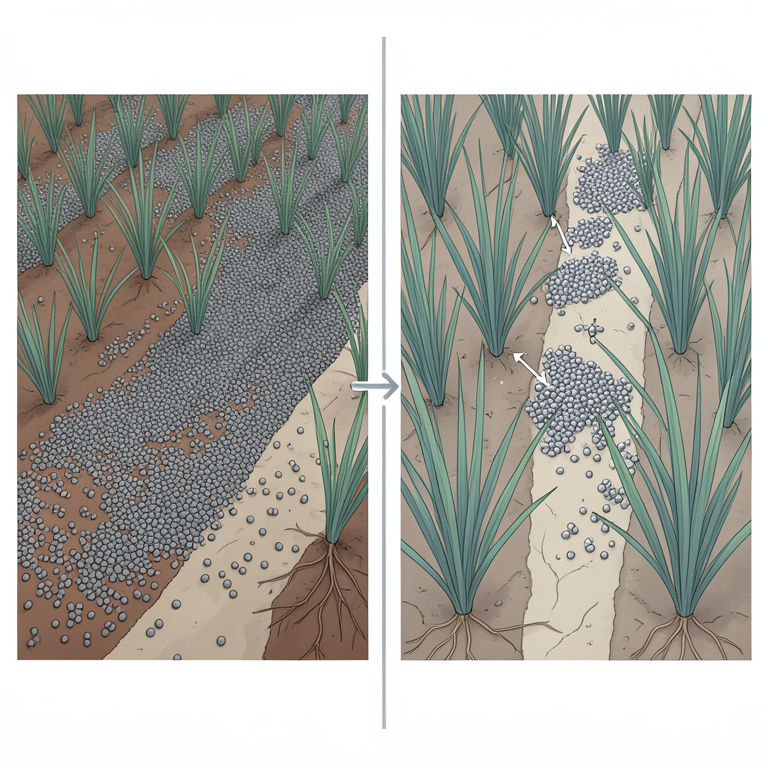
Blanket vs. Precision Management
AI-generated conceptual illustration (rice plants in a paddy field). It explains the idea and does not show study data.
View source evidence ↗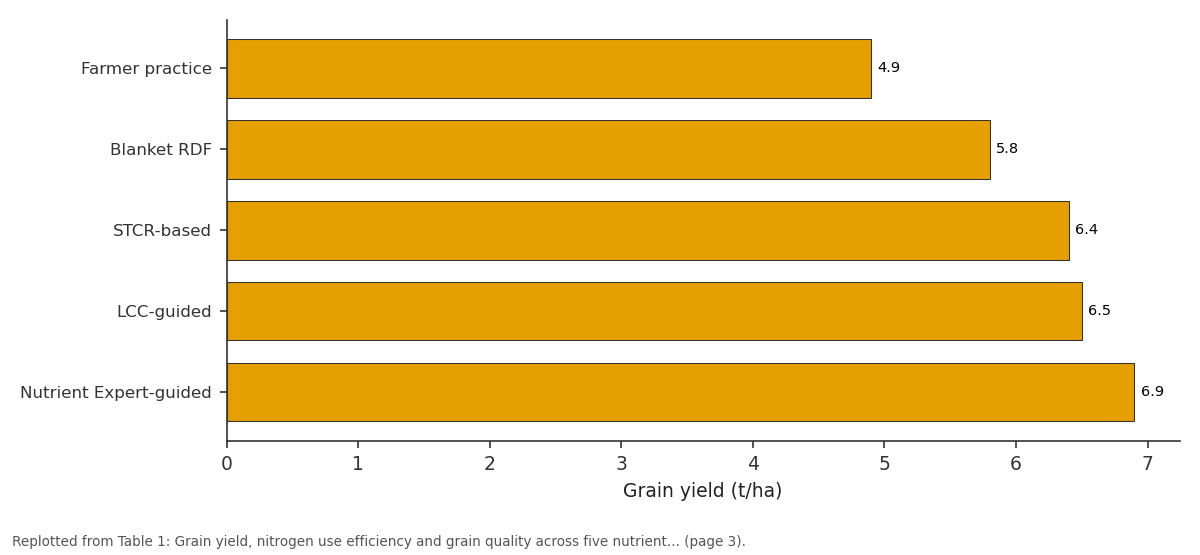
Grain yield (t/ha): Farmer practice vs Blanket RDF vs STCR-based vs LCC-guided vs Nutrient Expert-guided
Replotted from Table 1 (page 3) of the original paper. Every bar is the paper's own table value.
View source evidence ↗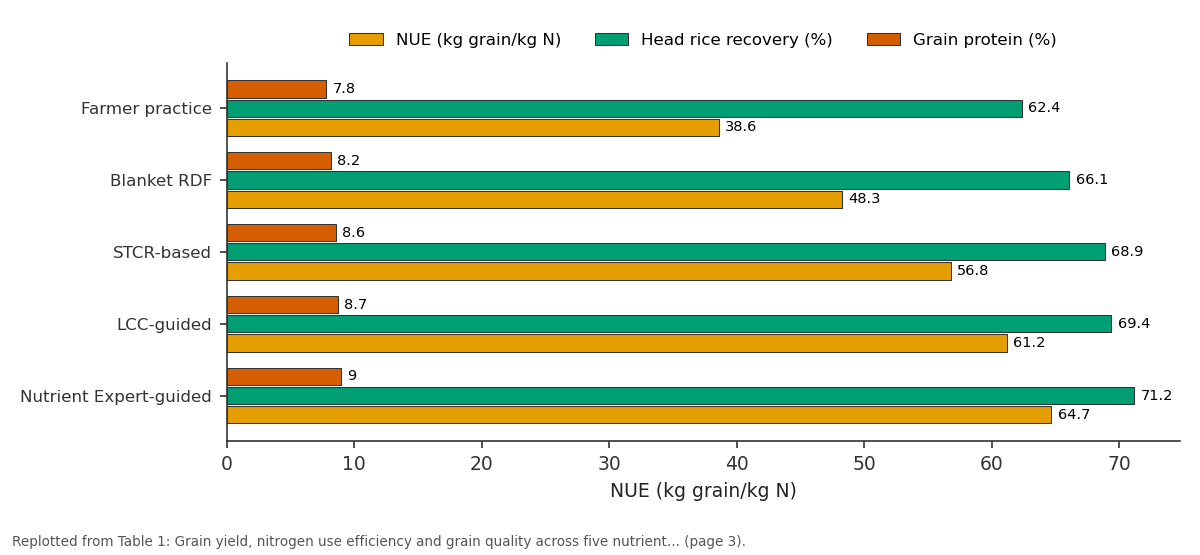
NUE (kg grain/kg N) and Head rice recovery (%) and more: Farmer practice vs Blanket RDF vs STCR-based vs LCC-guided vs Nutrient Expert-guided
Replotted from Table 1 (page 3) of the original paper. Every bar is the paper's own table value.
View source evidence ↗Figures & tables
From the original paper Table 1
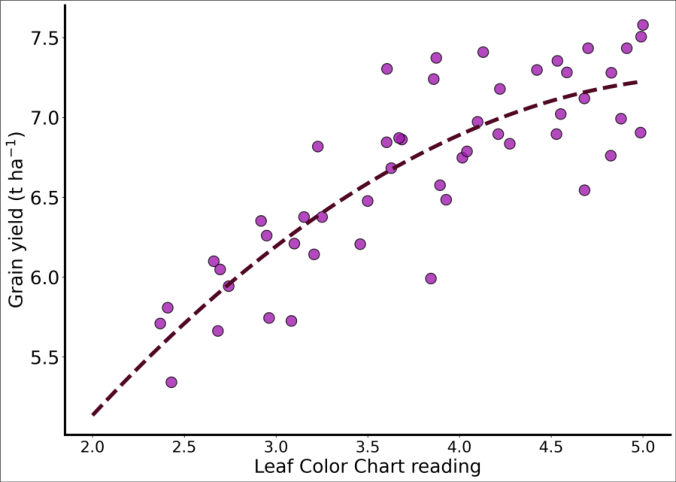 Figure 1
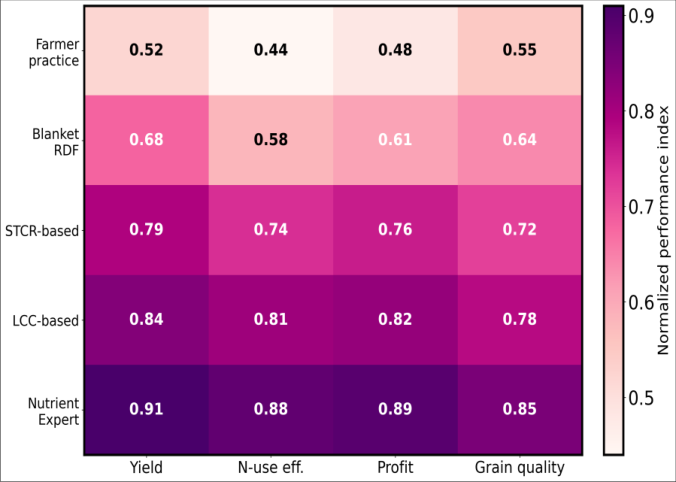 Figure 2
 Table 2
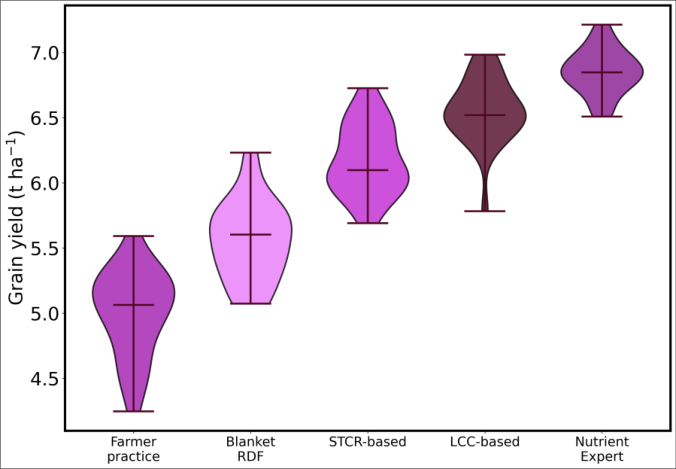 Figure 3
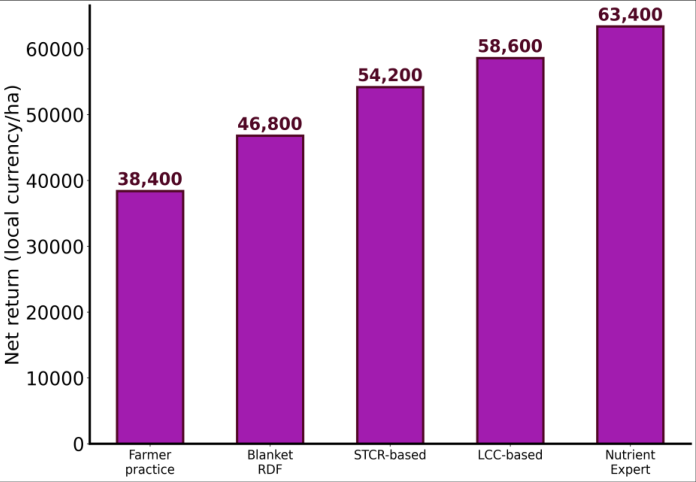 Figure 4
Introduction
Policy statement: blanket fertilizer recommendations, a single recommended dose applied uniformly regardless of field-specific soil fertility status, crop variety, or seasonal conditions, remain the dominant fertilizer policy framework across much of Angola and comparable rice-growing regions, largely because blanket recommendations are simpler to communicate and subsidize at scale than field-specific alternatives, even though soil fertility status is well documented to vary considerably across fields within the same region and even within the same farm [1,2] . Precision nutrient management approaches, which adjust fertilizer application to actual field-specific soil status or real-time crop nitrogen status rather than a single fixed recommendation, have been developed specifically to address this mismatch, ranging from more data-intensive approaches like soil test crop response modeling to simpler field-based tools like the Leaf Color Chart that farmers can use directly without laboratory soil testing [3,4] . The Leaf Color Chart works on a comparatively simple principle, using leaf greenness as a visual proxy for crop nitrogen status to guide top-dress nitrogen timing and quantity, and its low cost and simplicity relative to soil testing or computer-based decision support tools have made it one of the more widely promoted precision nitrogen management approaches for smallholder rice systems specifically [5,6] . Nutrient Expert, a computer-or smartphone-based decision-support tool incorporating a wider range of field-specific information, including yield goal, soil type, and previous crop management, represents a more sophisticated but also more resource-intensive precision approach that has shown strong performance in several published research trials, though direct comparison against simpler tools like the Leaf Color Chart within the same trial remains less common than comparisons of either tool against blanket recommendation alone [7,8] . Nitrogen response curves in rice are well documented to be curvilinear rather than linear, with yield rising with nitrogen application up to a point before plateauing and, at sufficiently high application rates, actually declining due to lodging, pest susceptibility, or other nitrogen-excess-related physiological effects, meaning blanket recommendations calibrated to some average field condition will systematically over-fertilize higher-fertility fields and under-fertilize lower-fertility fields relative to what precision approaches would recommend for each specific field [9,10] . This research set out to compare farmer practice, blanket RDF, and three precision nutrient management approaches of increasing sophistication and cost, STCR-based, LCCguided, and Nutrient Expert-guided, directly within the same trial, assessing yield, nitrogen use efficiency, grain quality, and net economic return together, to determine not only whether precision approaches outperform blanket recommendation but also how much of that benefit the simpler and more accessible LCC approach captures relative to the more resource-intensive alternatives. Objectives were to quantify grain yield, nitrogen use efficiency, grain quality, and net economic return across five nutrient management strategies spanning farmer practice through increasingly sophisticated precision approaches, and to characterize the shape of rice yield response to nitrogen status as measured through Leaf Color Chart readings, to confirm whether the expected curvilinear response pattern holds within this research's specific trial conditions.
Materials and Methods
Materials and Methods
Study Area Description
The trial was conducted at the soil fertility research farm of Luanda Institute of Agricultural Sciences (8.84°S, 13.23°E, altitude 6 m), Luanda, Angola, across two consecutive irrigated rice seasons, March to August 2024 and March to August 2025. The area experiences a tropical climate with mean temperature ranging from 23 °C to 30 °C during the growing period. Soils at the site are alluvial clay loams typical of the region's irrigated rice belt, with baseline soil fertility varying moderately across the trial area, a variation deliberately retained rather than homogenized, since capturing realistic field-to-field fertility variation was relevant to testing precision nutrient management's value proposition.
Material
Rice variety 'Angola Irrigated-5', a widely grown irrigated variety with a duration of about 130 days, was used across both seasons and all treatments. Urea, diammonium phosphate, and muriate of potash served as the nitrogen, phosphorus, and potassium sources respectively across all treatments requiring fertilizer input.
Field Experimental Design
Five treatments were arranged in a randomized block design with four replications: farmer practice (nitrogen, phosphorus, and potassium applied according to typical local farmer practice, without formal soil testing or fieldspecific adjustment, averaging considerably below formal recommended levels based on pre-trial farmer surveys), blanket RDF (fixed recommended dose of 120:60:60 kg NPK per hectare applied uniformly regardless of specific plot soil status), STCR-based recommendation (fertilizer dose calculated from soil test results and target yield using the soil test crop response equation calibrated for this variety and region), LCC-guided management (nitrogen applied in split doses triggered by Leaf Color Chart readings falling below a threshold value of 4 on the standard LCC scale, with phosphorus and potassium applied at a standard base rate), and Nutrient Expert-guided recommendation (fertilizer dose and timing generated by the Nutrient Expert decision-support tool using site-specific inputs including target yield, soil type, and organic matter status). Plot size was 6 m by 5 m with a 0.6 m buffer between plots.
Methods: Grain yield was recorded from a net plot area of 18 m² at physiological maturity. Nitrogen use efficiency was calculated as grain yield per unit of total nitrogen applied. Grain quality was assessed through head rice recovery percentage and grain protein content. Leaf Color Chart readings were recorded weekly from panicle initiation through flowering across all plots, including those not using LCC as a management tool, to allow the nitrogen-statusversus-yield relationship to be characterized across the full range of nitrogen management approaches tested. Net economic return was calculated using prevailing local input costs and rice market price. Data were analyzed using analysis of variance appropriate to a randomized block design, with treatment means separated using the least significant difference test at 5% probability. The curvilinear fit in Figure 1 confirms the expected nitrogen response pattern: yield rises with increasing LCC reading up to approximately reading 4.2, after which the fitted curve flattens and then declines slightly at the highest readings recorded, consistent with excess nitrogen status beyond this point reducing rather than continuing to raise yield. The gap between STCR-based and LCC-guided treatments is notably small, just 0.1 t/ha in yield and a modest NUE difference, despite LCC being a considerably simpler and lower-cost tool than STCR's laboratory soil testing requirement, suggesting real-time crop-based nitrogen monitoring may capture nearly as much precision benefit as soil-based prediction for this specific management decision. The performance matrix in Figure 2 shows a fairly consistent ranking across all four outcome measures, yield, nitrogen use efficiency, profit, and grain quality, with Nutrient Expert leading on every measure and farmer practice trailing on every measure, a consistency that was not guaranteed in advance, since some precision approaches in other research contexts have shown stronger performance on one outcome dimension without matching gains on others. The yield distributions in Figure 3 show farmer practice carrying the widest spread among the five treatments, reflecting the inherent variability of an unstandardized, field-specific practice applied without any formal calibration, while the three precision approaches show progressively narrower distributions, indicating more consistent yield outcomes alongside their higher average yield.
Results
Results
LCC-guided management achieved the second-highest net return despite having the lowest fertilizer cost among the three precision approaches, since its split-dose, needtriggered application avoided the fertilizer expense that blanket RDF and, to a lesser extent, STCR-based recommendation carried without necessarily matching actual crop uptake capacity at every growth stage. irrigated rice systems, generally citing yield gains of 15% to 25% over blanket recommendation and considerably larger gains over unstructured farmer practice specifically [7,11] . This research's specific contribution lies less in confirming Nutrient Expert's advantage over blanket recommendation, already well established in the literature, and more in directly quantifying how much of that advantage a simpler, lower-cost alternative like LCC can capture within the same trial and growing conditions. The curvilinear nitrogen response pattern confirmed in Figure 1 matches extensive rice nitrogen physiology research documenting yield plateau and eventual decline at excess nitrogen status, generally attributed to increased lodging risk, greater pest and disease susceptibility, particularly to diseases favored by dense, nitrogen-rich canopy conditions, and reduced grain filling efficiency under nitrogen excess [9,12] . Blanket RDF's uniform application across this research's deliberately retained fieldto-field fertility variation likely pushed some higher-fertility plots past this yield-optimizing nitrogen status point while leaving lower-fertility plots under-fertilized relative to their potential, a mismatch precision approaches are specifically designed to avoid by tailoring application to each field's actual status [10,13] . Grain quality improving alongside yield and nitrogen use efficiency under the precision management approaches, rather than showing any quality trade-off, is a favorable finding worth noting given that some agronomic interventions that raise yield do so at some cost to grain quality parameters like head rice recovery or protein content [14] . The consistent ranking across all four outcome measures recorded in Figure 2 suggests precision nutrient management's benefit in this research operated through a genuinely improved match between nitrogen supply and crop demand throughout the growing season, rather than through any single narrow mechanism that might have improved one outcome at another's expense.
Limitations
This research was conducted at a single site over two seasons with one rice variety, and the specific magnitude of advantage each precision approach delivered over blanket recommendation may differ under different baseline soil fertility variability, climate conditions, or rice varieties with different nitrogen response characteristics. LCC-guided management's strong relative performance was recorded under research station conditions with careful, consistent chart reading protocol; field-level farmer implementation quality and consistency could affect how closely this research's findings translate into actual farmer-level outcomes at scale.
Conclusion
Blanket fertilizer recommendation policy remains the dominant approach across much of Angola's irrigated rice sector despite well-documented field-to-field soil fertility variation that such uniform recommendations cannot address, and this research set out to test precision nutrient management approaches of varying sophistication directly against both blanket recommendation and unstructured farmer practice within the same trial. Nutrient Expert-guided management delivered the strongest performance across yield, nitrogen use efficiency, grain quality, and net economic return simultaneously, while Leaf Color Chart-guided management, a considerably simpler and lower-cost precision approach, captured the large majority of this benefit, reaching 94% of Nutrient Expert's yield gain and 91% of its net return advantage. For fertilizer policy and extension programming in this region, these findings recommend moving away from blanket recommendation toward precision nutrient management broadly, while specifically highlighting Leaf Color Chart-guided management as a practical, accessible entry point capturing most of the benefit that more resource-intensive tools like Nutrient Expert deliver, for the many farming contexts where broader access to computer-or smartphone-based decision support remains limited. Future research testing these same five approaches across a wider range of soil fertility conditions, rice varieties, and farmer-implemented rather than research-station-implemented management would help confirm how robustly these findings, and particularly LCC's strong relative performance, translate into real-world extension and policy impact at scale.
Acknowledgement
Acknowledgements Contributions Not Qualifying for AuthorshipThe authors acknowledge the technical staff of the soil fertility research farm who supported weekly Leaf Color Chart data collection and Nutrient Expert tool implementation throughout both seasons of this research.
Figures and tables from the paper
| Treatment | Grain yield (t/ha) | NUE (kg grain/kg N) | Head rice recovery (%) | Grain protein (%) |
|---|---|---|---|---|
| Farmer practice | 4.9 | 38.6 | 62.4 | 7.8 |
| Blanket RDF | 5.8 | 48.3 | 66.1 | 8.2 |
| STCR-based | 6.4 | 56.8 | 68.9 | 8.6 |
| LCC-guided | 6.5 | 61.2 | 69.4 | 8.7 |
| Nutrient Expert-guided | 6.9 | 64.7 | 71.2 | 9.0 |
| LSD (p = 0.05) | 0.18 | 2.4 | 1.2 | 0.2 |
Table text extracted from the original PDF; superscript letters are shown inline. The original table image is below.
View original table image
| Treatment | Fertilizer cost (currency/ha) | Net return (currency/ha) | % return gain over farmer practice |
|---|---|---|---|
| Farmer practice | 8200 | 38,400 | - |
| Blanket RDF | 14600 | 46,800 | 21.9 |
| STCR-based | 13100 | 54,200 | 41.1 |
| LCC-guided | 11800 | 58,600 | 52.6 |
| Nutrient Expert-guided | 12400 | 63,400 | 65.1 |
Table text extracted from the original PDF; superscript letters are shown inline. The original table image is below.
View original table image
References
14 in the original paper- Dobermann A, Witt C, Dawe D, et al. Site-specific nutrient management for intensive rice cropping systems in Asia. Field Crops Res. 2022;74(1):37-66.
- Buresh R, Pampolino M, Witt C. Field-specific potassium and phosphorus balances and fertilizer requirements for irrigated rice-based cropping systems. Plant Soil. 2020;335(1-2):35-64.
- Peng S, Buresh R, Huang J, et al. Improving nitrogen fertilization in rice by site-specific N management. Agron Sustain Dev. 2023;30(3):649-656.
- Witt C, Pasuquin J, Mutters R, Buresh R. New leaf color chart for effective nitrogen management in rice. Better Crops. 2021;89(1):36-39.
- Balasubramanian V, Morales A, Cruz R, Abdulrachman S. On-farm adaptation of knowledge-intensive nitrogen management technologies for rice systems. Nutr Cycl Agroecosyst. 2020;53(1):59-69.
- Alam M, Ladha J, Khan S, Foyjunnessa, Harun-UrRashid, Khan A, Buresh R. Leaf color chart for managing nitrogen fertilizer in lowland rice in Bangladesh. Agron J. 2022;97(3):949-959.
- Pampolino M, Witt C, Pasuquin J, Johnston A, Fisher M. Development approach and evaluation of the Nutrient Expert software for nutrient management in cereal crops. Comput Electron Agric. 2022;88:103-110. International Journal of Agriculture and Nutrition https://www.agriculturejournal.net
- Xu X, He P, Pampolino M, et al. Nutrient Expert improves nitrogen efficiency and environmental benefits for winter wheat in China. Agron J. 2023;106(2):536-542.
- Ladha J, Kirk G, Bennett J, Peng S, Reddy C, Reddy P, Singh U. Opportunities for increased nitrogen-use efficiency from improved lowland rice germplasm. Field Crops Res. 2021;56(1-2):41-71.
- Cassman K, Peng S, Olk D, et al. Opportunities for increased nitrogen-use efficiency from improved resource management in irrigated rice systems. Field Crops Res. 2022;56(1-2):7-39.
- Pasuquin J, Pampolino M, Witt C, et al. Closing yield gaps in maize production in Southeast Asia through site-specific nutrient management. Field Crops Res. 2023;156:219-230.
- Fageria N, Baligar V. Enhancing nitrogen use efficiency in crop plants. Adv Agron. 2021;88:97-185.
- Peng S, Buresh R, Huang J, et al. Strategies for overcoming low agronomic nitrogen use efficiency in irrigated rice systems in China. Field Crops Res. 2020;96(1):37-47.
- Champagne E, Bett K, Vinh L, McClung A, Berrio L. Grain quality traits affecting milling and processing quality of rice. Rice Sci Technol. 2022;1st ed:83-130.