
Research article · 2026 · Full text
International Journal of Horticulture and Food ScienceBio-efficacy of new generation insecticides against fall armyworm, Spodoptera frugiperda (J.E. Smith) in terms of per cent plant damage in maize (Zea mays L.) during spring
Volume 8(7) · Pages 27–30 · DOI: 10.33545/26631067.2026.v8.i7a.780 ↗
Research areasInsect Pest Control StrategiesInsect-Plant Interactions and ControlInsect Resistance and Genetics
Abstract
Author-writtenA field experiment was conducted at the Agronomy Instructional Farm, Rajasthan College of Agriculture, Maharana Pratap University of Agriculture and Technology (MPUAT), Udaipur, Rajasthan during Spring 2025. The study was conducted to evaluate the bio-efficacy of selected new-generation insecticides against fall armyworm (Spodoptera frugiperda) in spring maize. The experiment was laid out in a Randomized Block Design (RBD) with seven treatments and three replications. Treatments included Spinetoram 11.7 SC, Chlorantraniliprole 18.5 SC, Flubendiamide 480 SC, Emamectin benzoate 5 SG, Novaluron 10 EC, Profenofos 50 EC and an untreated control. Observations on per cent plant damage were recorded before spraying and at 3, 7 and 14 days after spraying (DAS) following two consecutive applications. The results revealed significant differences among treatments. Chlorantraniliprole 18.5 SC recorded the lowest overall plant damage (24.53%), followed by Flubendiamide 480 SC (24.58%) and Emamectin benzoate 5 SG (27.93%). The untreated control exhibited the highest plant damage (42.98%). The results demonstrated that Chlorantraniliprole 18.5 SC and Flubendiamide 480 SC were highly effective against fall armyworm under the agro-climatic conditions of southern Rajasthan.
Summary
Source-checkedPlain-language reading of the full paper, prepared with AI and checked against the text. Each point links to the authors' own words.
Why it matters
- Maize is a critical global crop used for food, feed, and industrial materials due to its high genetic yield potential. View evidence ↗
- Spring maize is particularly productive in India, contributing over 30% of total production with yields between 4.5-6.0 t/ha. View evidence ↗
- The fall armyworm (FAW), first detected in India in August 2018, has become a significant threat to spring maize cultivation. View evidence ↗
The question
- The researchers aimed to evaluate how effective several new-generation insecticides are at controlling fall armyworm in spring maize. View evidence ↗
What they did
- The field experiment took place during Spring 2025 at the Rajasthan College of Agriculture in Udaipur, Rajasthan. View evidence ↗
- The study used a Randomized Block Design consisting of seven different treatments and three replications. View evidence ↗
- The tested insecticides were Spinetoram 11.7 SC, Chlorantraniliprole 18.5 SC, Flubendiamide 480 SC, Emamectin benzoate 5 SG, Novaluron 10 EC, and Profenofos 50 EC, compared against an untreated control. View evidence ↗
- Plant damage percentages were measured from 10 randomly tagged plants per treatment before spraying and at 3, 7, and 14 days after two consecutive spray applications. View evidence ↗
What they found
- After the first spray, Chlorantraniliprole 18.5 SC (16.36%) and Flubendiamide 480 SC (16.40%) were the most effective, showing the lowest plant damage. View evidence ↗
- Following the second spray, Chlorantraniliprole 18.5 SC (32.70%) and Flubendiamide 480 SC (32.77%) again recorded the lowest plant damage. View evidence ↗
- Overall, Chlorantraniliprole 18.5 SC (24.53%) and Flubendiamide 480 SC (24.58%) were the most effective treatments across both sprays. View evidence ↗
- Emamectin Benzoate 5 SG (27.93%) and Spinetoram 11.7 SC (28.04%) were moderately effective, ranking behind the top two insecticides. View evidence ↗
- Novaluron 10 EC (31.58%) and Profenofos 50 EC (31.66%) were the least effective insecticide treatments. View evidence ↗
- The untreated control group suffered the highest overall plant damage at 42.98%. View evidence ↗
What it means
- The authors conclude that Chlorantraniliprole 18.5 SC and Flubendiamide 480 SC are recommended for managing fall armyworm in spring maize. View evidence ↗
Visual summary
1 visualsIllustrations explain the paper; they do not show study data.
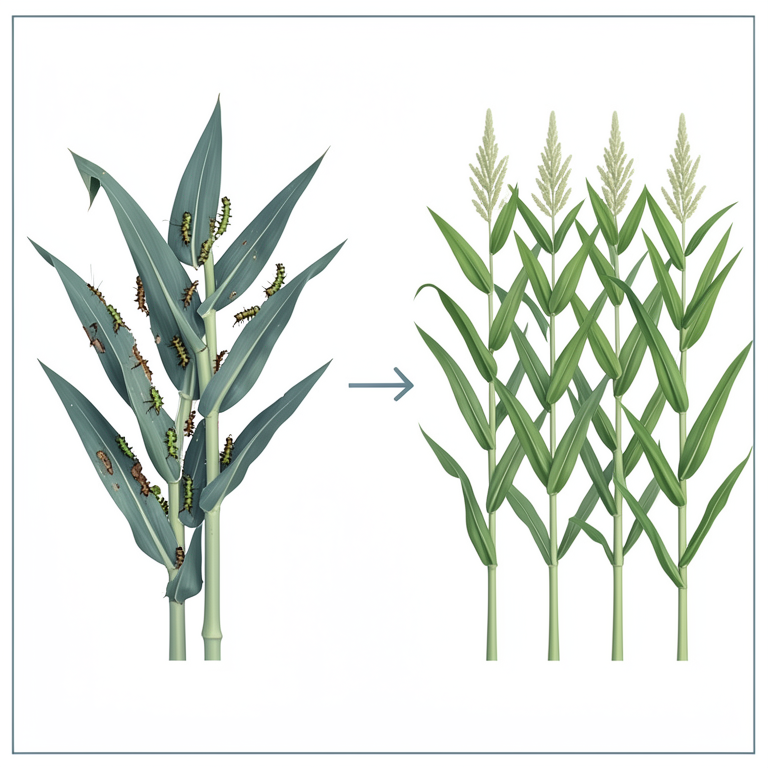
Experimental Setup
AI-generated conceptual illustration (maize plants and fall armyworm larvae). It explains the idea and does not show study data.
View source evidence ↗Figures & tables
From the original paper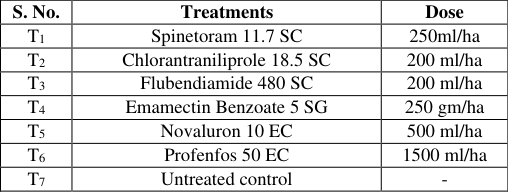 Table 1
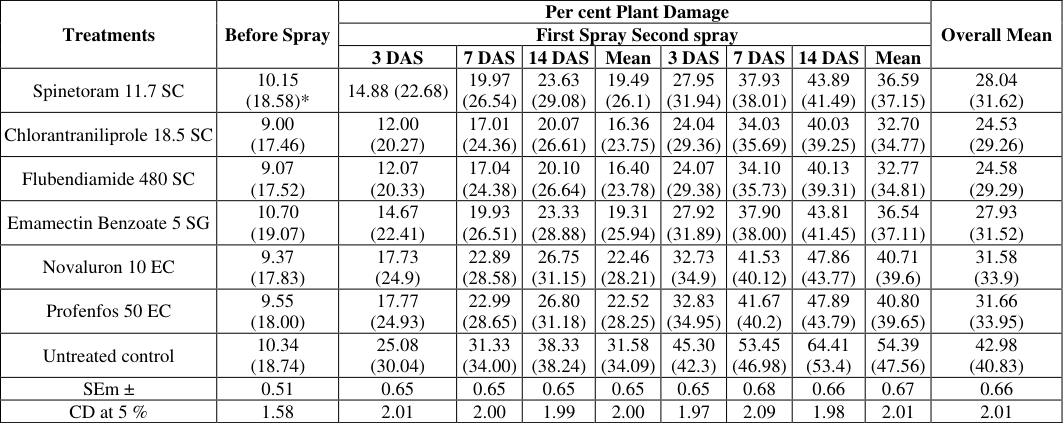 Table 2
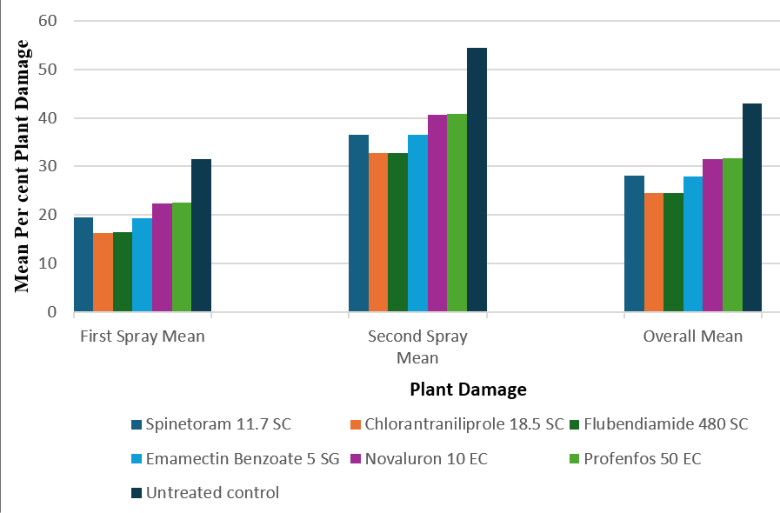 Figure 1
Introduction
Maize (Zea mays L.), commonly called the "Queen of Cereals," is recognized for its superior genetic yield potential among cereal crops and serves as a major source of food, feed and industrial raw material. In India, maize contributes substantially to agricultural production and rural livelihoods. Globally, maize is cultivated on more than 200 million hectares, with an annual production exceeding 1.2 billion tonnes, making it the most widely produced cereal crop (FAOSTAT, 2025) [4] . The average global productivity is about 6 t/ha, although yields vary widely from over 10 t/ha in the United States to below 3 t/ha in certain lowincome regions (Cairns and Prasanna, 2018) [1] . In India, maize ranks third after rice and wheat in both area and production. During 2024-25, it was grown on approximately 10.5 million hectares, producing around 34.6 million tonnes with an average yield of 3.2 t/ha (DES, 2025) [3] . Maize is cultivated in all seasons viz. Kharif, Rabi and spring in India (Parkash and Peshin, 2020) [12] . The predominant maize growing states that contributes more than 80 per cent of the total maize production are Andhra Pradesh (20.9 %), Karnataka (16.5 %), Rajasthan (9.9 %), Maharashtra (9.1 %), Bihar (8.9 %), Uttar Pradesh (6.1 %), Madhya Pradesh (5.7 %), Himachal Pradesh (4.4 %). Rajasthan alone contributes significantly, with about 1.1 million hectares under maize, producing approximately 4.5 Mt and yielding around 4.1 t/ha (Government of Rajasthan, 2025) [6] . In recent years, Spring maize accounts for about 20-25 per cent of India's total maize area and contributes over 30 per cent of total production, with productivity ranged between 4.5-6.0 t/ha, significantly higher than the Kharif season maize (ICAR-IIMR, 2025) [7] . The cultivation of spring maize has been increasingly threatened by insect pests such as fall armyworm (Spodoptera frugiperda), Maize Stem borer (Chilo partellus) and maize cob worm (Helicoverpa armigera), which cause significant yield losses. In India, FAW was first detected in August 2018 on maize near Shivamogga, Karnataka (Ganiger et al., 2018) [5] and later spread to other maize-growing states including Tamil Nadu, Andhra Pradesh, Telangana, Maharashtra, Gujarat and several North-Eastern states (Chormule et al., 2019) [2] .
Materials and Methods
The field experiment was conducted at the Agronomy Instructional Farm, Rajasthan College of Agriculture, MPUAT, Udaipur during spring 2025. The experiment was laid out in a Randomized Block Design (RBD) with three replications, seven treatments consisting of different insecticides and one untreated control were evaluated.
Observations recorded
The bio-efficacy of seven different treatments on Fall Armyworm will be evaluated by recording the observations on the infestation of pests before and 3, 7 and 14 days after the two sprays. The observations were recorded from the 10 randomly selected tagged plants for each treatment in the three replications as describe below -Per cent plant infestation: The observation will be recorded and data will be express in percentage by using the following formula.
Results
Results
Effect of insecticides on plant damage percentage
The data pertaining to per cent plant damage caused by fall armyworm are presented in Table 2.
| Treatments | Before Spray | Per cent Plant Damage | — | — | — | — | — | — | — | Overall Mean |
|---|---|---|---|---|---|---|---|---|---|---|
| First Spray Second spray | ||||||||||
| 3 DAS | 7 DAS | 14 DAS | Mean | 3 DAS | 7 DAS | 14 DAS | Mean | |||
| Spinetoram 11.7 SC | 10.15 (18.58)* | 14.88 (22.68) | 19.97 (26.54) | 23.63 (29.08) | 19.49 (26.1) | 27.95 (31.94) | 37.93 (38.01) | 43.89 (41.49) | 36.59 (37.15) | 28.04 (31.62) |
| Chlorantraniliprole 18.5 SC | 9.00 (17.46) | 12.00 (20.27) | 17.01 (24.36) | 20.07 (26.61) | 16.36 (23.75) | 24.04 (29.36) | 34.03 (35.69) | 40.03 (39.25) | 32.70 (34.77) | 24.53 (29.26) |
| Flubendiamide 480 SC | 9.07 (17.52) | 12.07 (20.33) | 17.04 (24.38) | 20.10 (26.64) | 16.40 (23.78) | 24.07 (29.38) | 34.10 (35.73) | 40.13 (39.31) | 32.77 (34.81) | 24.58 (29.29) |
| Emamectin Benzoate 5 SG | 10.70 (19.07) | 14.67 (22.41) | 19.93 (26.51) | 23.33 (28.88) | 19.31 (25.94) | 27.92 (31.89) | 37.90 (38.00) | 43.81 (41.45) | 36.54 (37.11) | 27.93 (31.52) |
| Novaluron 10 EC | 9.37 (17.83) | 17.73 (24.9) | 22.89 (28.58) | 26.75 (31.15) | 22.46 (28.21) | 32.73 (34.9) | 41.53 (40.12) | 47.86 (43.77) | 40.71 (39.6) | 31.58 (33.9) |
| Profenfos 50 EC | 9.55 (18.00) | 17.77 (24.93) | 22.99 (28.65) | 26.80 (31.18) | 22.52 (28.25) | 32.83 (34.95) | 41.67 (40.2) | 47.89 (43.79) | 40.80 (39.65) | 31.66 (33.95) |
| Untreated control | 10.34 (18.74) | 25.08 (30.04) | 31.33 (34.00) | 38.33 (38.24) | 31.58 (34.09) | 45.30 (42.3) | 53.45 (46.98) | 64.41 (53.4) | 54.39 (47.56) | 42.98 (40.83) |
| SEm ± | 0.51 | 0.65 | 0.65 | 0.65 | 0.65 | 0.65 | 0.68 | 0.66 | 0.67 | 0.66 |
| CD at 5 % | 1.58 | 2.01 | 2.00 | 1.99 | 2.00 | 1.97 | 2.09 | 1.98 | 2.01 | 2.01 |
Table text extracted from the original PDF; superscript letters are shown inline. The original table image is below.
View original table image
First Spray
The data recorded on the mean per cent plant damage of fall armyworm revealed that the mean per cent plant damage of 16.
Discussion
The present findings clearly indicate that the diamide insecticides, particularly Chlorantraniliprole and Flubendiamide, were highly effective in suppressing fall armyworm damage in maize. The treatment comprising the Novaluron 10 EC and Profenfos 50 EC proved to be least effective with the mean plant damage after the first and second spray, respectively during spring, 2025.The present findings on per cent plant damage caused by fall armyworm are in agreement with reports of Janarthanan et al. (2022) [8] observed that spinetoram, either alone or in combination with novaluron and emamectin benzoate, effectively reduced fall armyworm infestation and plant injury in maize. Karki et al. (2023) [10] reported that chlorantraniliprole 18.5 SC provided excellent control of fall armyworm and significantly reduced crop damage under field conditions. Kalisetti et al. (2024) [9] also found that chlorantraniliprole, spinetoram and emamectin benzoate significantly lowered Davis damage scores and foliar injury compared with the untreated control. Similarly, Marella et al. (2024) [11] reported that spinetoram recorded the highest reduction in leaf damage, followed by chlorantraniliprole and emamectin benzoate, resulting in lower cob damage and improved grain yield.
Conclusion
The study revealed significant differences among insecticidal treatments against fall armyworm infestation in spring maize. Chlorantraniliprole 18.5 SC was found to be the most effective treatment, recording the lowest per cent plant damage (24.53%), followed closely by Flubendiamide 480 SC (24.58%). Therefore, these insecticides can be recommended for effective management of fall armyworm in spring maize as part of an integrated pest management
Figures and tables from the paper
| S. No. | Treatments | Dose |
|---|---|---|
| T1 | Spinetoram 11.7 SC | 250ml/ha |
| T2 | Chlorantraniliprole 18.5 SC | 200 ml/ha |
| T3 | Flubendiamide 480 SC | 200 ml/ha |
| T4 | Emamectin Benzoate 5 SG | 250 gm/ha |
| T5 | Novaluron 10 EC | 500 ml/ha |
| T6 | Profenfos 50 EC | 1500 ml/ha |
| T7 | Untreated control | - |
Table text extracted from the original PDF; superscript letters are shown inline. The original table image is below.
View original table image
References
12 in the original paper- Cairns JE, Prasanna BM. Developing and deploying climate-resilient maize varieties in the developing world. Current Opinion in Plant Biology. 2018;45(Pt B):226-230.
- Chormule A, Shejawal N, Sharanabasappa, Kalleshwaraswamy CM, Asokan R, Swamy HMM, et al. First report of the fall armyworm, Spodoptera frugiperda (J.E. Smith), infesting maize in Maharashtra, India. Journal of Entomology and Zoology Studies. 2019;7(4):114-117.
- Directorate of Economics and Statistics. Agricultural Statistics at a Glance 2024-25. New Delhi: Department of Agriculture and Farmers Welfare, Ministry of Agriculture and Farmers Welfare, Government of India; 2025.
- Food and Agriculture Organization of the United Nations. FAOSTAT Statistical Database. Rome: FAO; 2025.
- Ganiger PC, Yeshwanth HM, Muralimohan K, Vinay N, Kumar ARV, Chandrashekara K. Occurrence of the new invasive pest, Spodoptera frugiperda (J.E. Smith) (Lepidoptera: Noctuidae), in the maize fields of Karnataka. Current Science. 2018;115(4):621-623.
- Government of Rajasthan, Directorate of Economics and Statistics. Rajasthan Agriculture Statistics 2024-25. Jaipur: Directorate of Economics and Statistics, Government of Rajasthan; 2025.
- ICAR-Indian Institute of Maize Research. Director's Message. Ludhiana: Indian Council of Agricultural Research; 2025.
- Janarthanan R, Arivudainambi S, Ikram M. Evaluation of chlorantraniliprole, spinetoram solo and its tank mixtures against Spodoptera frugiperda (J.E. Smith) in maize in India. International Journal of Entomology Research. 2022;7(5):97-102.
- Kalisetti VS, Reddy ML, Mallaiah B, Sreelatha D, Bhadru D, Kumar MVN, et al. Assessment of newer molecules for the management of fall armyworm, Spodoptera frugiperda (J.E. Smith) (Lepidoptera: Noctuidae) on maize in India. International Journal of Tropical Insect Science. 2024;44:1853-1864.
- Karki N, Soti A, Katel S, Bhandari R, Thapa N, Yadav SPS. Field efficacy of different insecticides against fall armyworm (Spodoptera frugiperda J.E. Smith) in spring maize (Zea mays L.). Agro Environmental Sustainability. 2023;1(2):93-104.
- Marella SM, Sharma KC, Baskaran RKM. Field evaluation of insecticides against the fall armyworm, Spodoptera frugiperda, in maize. International Journal of Advanced Biochemistry Research. 2024;8(9):641648.
- Parkash S, Peshin R. Growers' knowledge of improved maize production technologies in Jammu region of Jammu and Kashmir. Indian Journal of Extension Education. 2020;56(3):41-47.