
Research article · 2026 · Full text
International Journal of Biology SciencesGenetic diversity and evolutionary relationships of thrips species attacking vegetable crops
Volume 8(4) · Pages 164–168 · DOI: 10.33545/26649926.2026.v8.i4b.902 ↗
Research areasHemiptera Insect StudiesInvertebrate Taxonomy and EcologyInsect-Plant Interactions and Control
Abstract
Author-writtenSince the pioneering morphological surveys of Philippine Thysanoptera in the 1930s, the taxonomic composition of thrips pest assemblages on vegetable crops has undergone considerable change driven by species introductions and shifting agricultural practices. This research investigated the genetic diversity and phylogenetic relationships of thrips species attacking vegetable crops in Laguna Province, Philippines, using Cytochrome c Oxidase subunit I (COI) gene barcoding. A total of 276 thrips specimens were collected from eggplant, string bean, bitter gourd, and pepper fields across five municipalities between February and September 2024. Molecular analysis identified five thrips species: Thrips palmi (27.4%), Thrips tabaci (24.1%), Frankliniella schultzei (19.8%), Megalurothrips usitatus (16.2%), and Scirtothrips dorsalis (12.5%). Intraspecific K2P genetic distances ranged from 0.1% to 2.4%, while interspecific distances ranged from 7.8% to 20.3%. Neighbor-joining phylogenetic analysis produced well-resolved species-level clades with bootstrap support exceeding 94%. Haplotype analysis revealed moderate genetic diversity within Thrips palmi populations, suggesting multiple introduction events. These findings establish a comprehensive molecular reference framework for thrips pest identification in Philippine vegetable agroecosystems and inform the development of species-specific management interventions.
Summary
Source-checkedPlain-language reading of the full paper, prepared with AI and checked against the text. Each point links to the authors' own words.
Why it matters
- Thrips are economically critical pests in tropical vegetable farming because they cause direct damage by puncturing cells and indirect damage by spreading tospoviruses. View evidence ↗
- In the Laguna Province of the Philippines, thrips epidemics can lead to yield losses between 20% and 40% for cucurbitaceous and solanaceous crops. View evidence ↗
- Identifying thrips by their physical appearance is difficult because they are very small (1-2 mm) and have limited distinct features. View evidence ↗
The question
- The study aimed to use COI gene barcoding to determine the evolutionary relationships and genetic diversity of thrips attacking vegetable crops in Laguna Province, Philippines. View evidence ↗
What they did
- Specimens were collected from February to September 2024 across five municipalities in Laguna Province: Los Baños, Bay, Calauan, Victoria, and Pila. View evidence ↗
- The researchers targeted thrips from four specific host crops: pepper, bitter gourd, string bean, and eggplant. View evidence ↗
- The study analyzed 276 collected specimens by amplifying a ~658 bp region of the COI gene. View evidence ↗
What they found
- Out of 276 specimens, 248 (89.9%) provided high-quality sequences, leading to the identification of five species from the Aeolothripidae and Thripidae families. View evidence ↗
- The most abundant species identified was Thrips palmi (27.4%), followed by T. tabaci (24.1%), F. schultzei (19.8%), M. usitatus (16.2%), and S. dorsalis (12.5%). View evidence ↗
- The greatest genetic distance between different species (20.3%) occurred between S. dorsalis and F. schultzei. View evidence ↗
- Phylogenetic analysis successfully grouped the five species into distinct clades with high confidence (bootstrap values > 94%). View evidence ↗
- For T. palmi, 68 specimens revealed seven haplotypes with a diversity (Hd) of 0.74 and nucleotide diversity (π) of 0.0058. View evidence ↗
- T. palmi showed a star-like haplotype network where one haplotype accounted for 42% of specimens, suggesting a recent population expansion. View evidence ↗
What it means
- The authors conclude that this molecular framework allows for species-specific management in the Philippines, which is necessary because different species have different insecticide susceptibilities and virus-carrying capacities. View evidence ↗
- The authors state that future work should include more provinces, use nuclear markers for better genetic detail, and directly test thrips for tospovirus infections. View evidence ↗
Visual summary
1 visualsIllustrations explain the paper; charts are replotted from the paper's own table values.
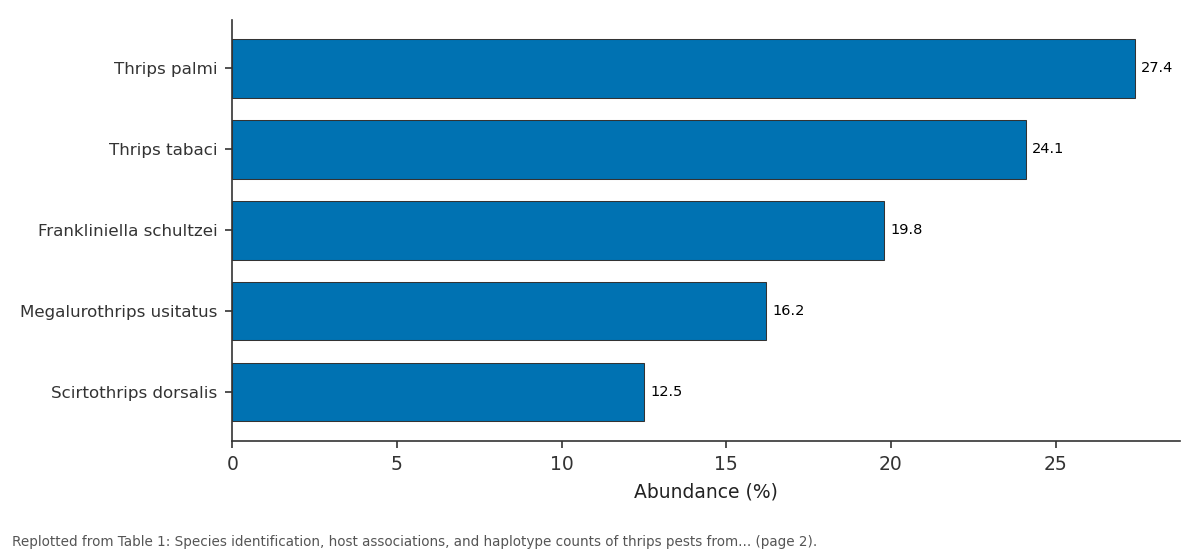
Abundance (%): Thrips palmi vs Thrips tabaci vs Frankliniella schultzei vs Megalurothrips usitatus vs Scirtothrips dorsalis
Replotted from Table 1 (page 2) of the original paper. Every bar is the paper's own table value.
View source evidence ↗Figures & tables
From the original paper Table 1
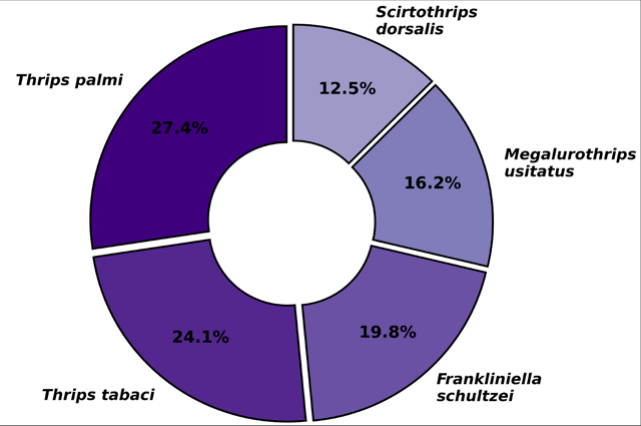 Figure 1
 Table 2
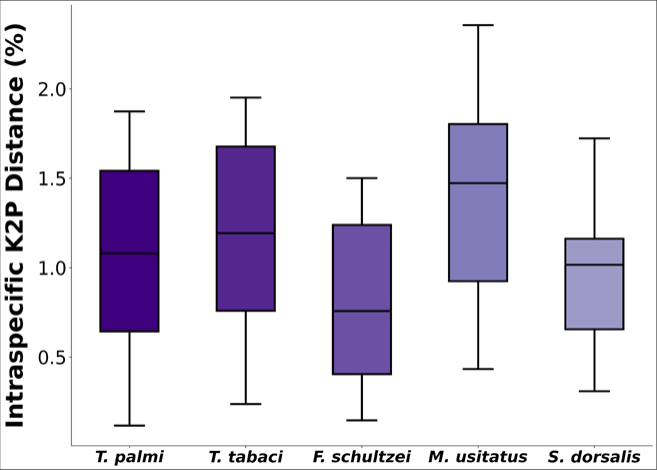 Figure 2
Introduction
The taxonomic investigation of thrips pests in Philippine agriculture traces its origins to the foundational morphological surveys conducted by Karny in the 1930s, which first catalogued the Thysanoptera fauna associated with tropical crop systems in the archipelago. Nearly a century later, the thrips pest complex on vegetable crops in the Philippines has expanded considerably, driven by the introduction of invasive species, intensification of vegetable production, and the expansion of international trade in planting material [1,2] . Thrips (Order Thysanoptera) constitute one of the most economically significant pest groups in tropical vegetable production, causing direct feeding damage through cell puncturing and indirect losses through the transmission of tospoviruses, including Tomato spotted wilt virus and Capsicum chlorosis virus [3] . In Laguna Province, one of the primary vegetable-producing regions in the Philippines, thrips infestations have been reported to cause yield losses of 20-40% in solanaceous and cucurbitaceous crops during epidemic years [4] . The accurate identification of thrips species is essential for targeted pest management, as different species exhibit varying host preferences, insecticide susceptibility profiles, and virus transmission capabilities [2,5] . However, morphological identification of thrips is notoriously challenging due to their minute body size (typically 1-2 mm), limited diagnostic features, and extensive intraspecific morphological variation [6] . DNA barcoding utilizing the mitochondrial COI gene has emerged as a powerful tool for thrips species identification and has been successfully applied to resolve taxonomic ambiguities across diverse Thysanoptera assemblages worldwide [7] . The COI barcode region provides sufficient phylogenetic resolution to discriminate among closely related thrips species and can detect cryptic species complexes that are indistinguishable through morphological examination alone [8] . Additionally, population-level genetic analyses based On COI haplotype diversity can provide insights into the introduction history and dispersal patterns of invasive thrips species [6,9] . This research aimed to characterize the genetic diversity and evolutionary relationships of thrips species attacking vegetable crops in Laguna Province, Philippines, using COI gene barcoding.
The specific objectives were to 1. Identify thrips pest species through molecular barcoding; 2. Assess intraspecific and interspecific genetic divergence; 3. Reconstruct phylogenetic relationships; and 4. Evaluate haplotype diversity within the dominant thrips species to infer population genetic structure.
Material and Methods Material
Thrips specimens were collected from vegetable fields in five municipalities of Laguna Province, Philippines, between February and September 2024: Los Baños (14.1667°N, 121.2417°E), Bay (14.1833°N, 121.2833°E), Calauan (14.1500°N, 121.3167°E), Victoria (14.2333°N, 121.3333°E), and Pila (14.2167°N, 121.3000°E). Target crop hosts included eggplant (Solanum melongena), string bean (Vigna unguiculata subsp. sesquipedalis), bitter gourd (Momordica charantia), and pepper (Capsicum annuum). Collection was performed using flower-washing, leafbeating, and direct aspiration methods at biweekly intervals. Ethical approval was obtained from the Laguna Academy of Agricultural Sciences Research Ethics Board (Protocol No.
LAAS/ENT/2024-011). Specimens were preserved in 95% ethanol at -20 °C.
Methods
Genomic DNA was extracted from individual thrips using the DNeasy Blood and Tissue Kit (Qiagen, Germany) with extended overnight proteinase K digestion to maximize DNA yield from these minute insects. The COI barcode region (approximately 658 bp) was amplified using primers LCO1490 and HCO2198 [10] . PCR was performed in 25 μL volumes containing 12.5 μL DreamTaq PCR Master Mix (Thermo Fisher Scientific), 1 μL each primer (10 μM), 3 μL template DNA, and 7.5 μL nuclease-free water. Thermal cycling comprised 94 °C for 5 min, 35 cycles of 94 °C for 30 s, 49 °C for 45 s, and 72 °C for 1 min, with final extension at 72 °C for 10 min. Products were sequenced bidirectionally on an ABI 3730xl analyzer, edited in BioEdit v7.2.5, and compared against BOLD and GenBank databases [11] . Genetic distances were calculated using the K2P model [12] , and neighbor-joining trees were constructed with 1,000 bootstrap replicates in MEGA 11 [13] . Haplotype analysis was performed using DnaSP v6.12, and haplotype networks were generated using TCS statistical parsimony.
Results
Of 276 thrips specimens collected across the five municipalities and four host crops, 248 yielded high-quality COI sequences (89.9% success rate). Five thrips species belonging to two families (Thripidae and Aeolothripidae) were identified through BOLD and GenBank comparisons. Neighbor-joining phylogenetic analysis resolved all five species into strongly supported monophyletic clades with bootstrap values exceeding 94%. The two congeneric species, T. palmi and T. tabaci, formed a well-supported sister group (bootstrap = 97%), consistent with their shared placement within the genus Thrips. Frankliniella schultzei clustered as sister to the Thrips clade, reflecting their shared family-level classification within the Thripidae. Haplotype analysis of T. palmi, the most abundant and economically significant species, revealed seven distinct COI haplotypes among 68 sequenced specimens. Haplotype diversity (Hd) was 0.74, and nucleotide diversity (π) was 0.0058. The haplotype network exhibited a star-like topology with one dominant haplotype representing 42% of specimens, surrounded by six satellite haplotypes differing by 1-4 mutational steps. This pattern is consistent with a recent population expansion from a limited number of founding lineages, potentially reflecting multiple introduction events from different source populations across Southeast Asia [6,9] . The geographic distribution of haplotypes showed partial structuring across municipalities, with two haplotypes restricted to the Los Baños and Bay sites, suggesting limited local dispersal among subpopulations.
Discussion
This research provides a comprehensive molecular characterization of the thrips pest assemblage on vegetable crops in Laguna Province, documenting five species through COI barcoding and revealing moderate haplotype diversity within the dominant pest species, Thrips palmi. The species composition identified in this research is consistent with regional surveys of thrips on vegetable crops across Southeast Asia, where T. palmi and T. tabaci typically dominate solanaceous and allium crop systems, respectively [1,2,4] . The relative abundance of F. schultzei (19.8%) is notable given this species' recognized importance as a vector of Capsicum chlorosis virus in the Philippines [3,5] .
In contrast to the clear dominance patterns reported from irrigated lowland systems in Central Luzon, the more even species distribution observed in Laguna may reflect the diverse cropping patterns and fragmented agricultural landscape characteristic of the province [4] . The detection of Scirtothrips dorsalis, a polyphagous species with a broad host range, extends the documented pest complex beyond the traditionally recognized thrips fauna on Philippine vegetables.
The moderate haplotype diversity (Hd = 0.74) within T. palmi suggests that Philippine populations maintain reasonable genetic variation despite the presumed recent introduction of this species to the archipelago. The star-like haplotype network topology, with one dominant haplotype and several low-frequency derivatives, is characteristic of populations that have undergone recent demographic expansion following a founder event [6,9] . The broader implications extend to biosecurity planning, as the genetic diversity patterns indicate ongoing connectivity between Philippine thrips populations and regional source populations through trade-mediated pathways.
The phylogenetic placement of the five identified species within the broader Thysanoptera is consistent with current systematic treatments based on multi-gene analyses. The sister relationship between T. palmi and T. tabaci within the genus Thrips reflects their morphological similarity and shared evolutionary history within the subfamily Thripinae [1, 7] . The basal position of S. dorsalis relative to the other thripid species is in agreement with molecular phylogenies that place the genus Scirtothrips as an early-diverging lineage within the family. These phylogenetic patterns have practical relevance for understanding the evolution of host plant associations and tospovirus transmission capabilities across thrips lineages [3,5] .
Tospovirus transmission risk assessment
The co-occurrence of three confirmed tospovirus vector species (T. palmi, T. tabaci, and F. schultzei) in Laguna vegetable fields elevates the risk profile for viral epidemics. Species-specific molecular identification through COI barcoding enables precise vector surveillance that is essential for predicting tospovirus transmission dynamics and implementing timely management interventions [3,5] .
Implications for resistance management
The identification of five thrips species with potentially different insecticide susceptibility profiles underscores the need for species-level diagnostics in resistance management programmes. Indiscriminate insecticide application targeting a generalized thrips complex may accelerate resistance development in specific populations while failing to adequately control less susceptible species [1,2] . Molecular identification enables the tracking of resistance allele frequencies within individual species populations, facilitating the design of rotation strategies that account for species-specific susceptibility patterns across different active ingredient classes.
Conservation of predatory arthropods
The molecular pest identification framework established in this research complements biological control approaches by enabling precise monitoring of thrips populations without disrupting natural enemy communities. Predatory mites (Amblyseius spp.), minute pirate bugs (Orius spp.), and parasitic wasps are important biological control agents of thrips in Philippine vegetable systems. Species-level identification of thrips populations allows targeted intervention decisions that preserve these beneficial arthropods while managing pest populations below economic threshold levels [1,4] .
Conclusion
This research aimed to characterize the genetic diversity and phylogenetic relationships of thrips species attacking vegetable crops in Laguna Province, Philippines, through COI gene barcoding. Five thrips species were identified with strong molecular support: Thrips palmi, Thrips tabaci, Frankliniella schultzei, Megalurothrips usitatus, and Scirtothrips dorsalis. Clear barcoding gaps between intraspecific (maximum 2.4%) and interspecific (minimum 7.8%) distances confirmed reliable species discrimination. Haplotype analysis of T. palmi revealed moderate genetic diversity with evidence of recent population expansion from limited founding lineages. These findings provide a practical molecular identification framework that can be integrated into existing thrips monitoring programmes in Philippine vegetable production systems, enabling species-specific management decisions that account for differential virus vectoring capacity and insecticide susceptibility. Future research should extend molecular surveillance to additional vegetable-producing provinces, incorporate nuclear markers for fine-scale population genetic analyses, and investigate the tospovirus infection status of thrips populations across Laguna to directly link vector species identity with disease transmission risk.
Acknowledgement
AcknowledgementsThe authors acknowledge the Laguna Academy of Agricultural Sciences for providing research facilities and access to molecular laboratory equipment. M.C.S.-R. designed the research and wrote the manuscript; J.A.C.-M. Conducted field sampling; A.P.V.-R. Performed molecular laboratory procedures; R.E.A.-T. Conducted bioinformatic analyses. This research was funded by the Philippine Council for Agriculture, Aquatic, and Natural Resources Research and Development.
Figures and tables from the paper
| Species | Primary Host | Secondary Host(s) | N | Abundance (%) | Haplotypes |
|---|---|---|---|---|---|
| Thrips palmi | Eggplant | Bitter gourd, Pepper | 68 | 27.4 | 7 |
| Thrips tabaci | String bean | Eggplant | 60 | 24.1 | 5 |
| Frankliniella schultzei | Pepper | Eggplant, Bitter gourd | 49 | 19.8 | 4 |
| Megalurothrips usitatus | String bean | Bitter gourd | 40 | 16.2 | 3 |
| Scirtothrips dorsalis | Pepper | Eggplant | 31 | 12.5 | 3 |
Table text extracted from the original PDF; superscript letters are shown inline. The original table image is below.
View original table image
| Species | T. palmi | T. tabaci | F. schultzei | M. usitatus | S. dorsalis |
|---|---|---|---|---|---|
| T. palmi | - | - | - | - | - |
| T. tabaci | 7.8 | - | - | - | - |
| F. schultzei | 12.4 | 11.9 | - | - | - |
| M. usitatus | 15.6 | 14.3 | 13.1 | - | - |
| S. dorsalis | 18.7 | 17.2 | 20.3 | 16.8 | - |
Table text extracted from the original PDF; superscript letters are shown inline. The original table image is below.
View original table image
References
15 in the original paper- Mound LA, Morris DC. The insect order Thysanoptera: classification versus systematics. Zootaxa. 2007;1668:395-411.
- Mound LA, Azidah AA. Species of the genus Thrips (Thysanoptera) from the Philippines. Zootaxa. 2009;2150:47-56.
- Riley DG, Joseph SV, Srinivasan R, Diffie S. Thrips vectors of tospoviruses. J Integr Pest Manag. 2011;2(1):1-10.
- Nuñez CA, Navasero MV, Navasero MM. Thrips species infesting vegetables in Laguna, Philippines. Philipp Entomol. 2018;32(1):42-56.
- Jones DR. Plant viruses transmitted by thrips. Eur J Plant Pathol. 2005;113(2):119-157.
- Brunner PC, Fleming C, Frey JE. A molecular identification key for economically important thrips species using direct sequencing and a PCR-RFLP approach. Mol Ecol Notes. 2002;2(1):69-71.
- Hebert PDN, Cywinska A, Ball SL, deWaard JR. Biological identifications through DNA barcodes. Proc R Soc Lond B Biol Sci. 2003;270(1512):313-321.
- Iftikhar R, Ashfaq M, Rasool A, Hebert PDN. DNA barcode analysis of thrips (Thysanoptera) diversity in Pakistan reveals cryptic species complexes. PLoS One. 2016;11(1):e0146014.
- Kadirvel P, Srinivasan R, Riley DG, Hsu YC. Genetic structure and diversity of Thrips palmi populations across Asia. Bull Entomol Res. 2013;103(4):478-490.
- Folmer O, Black M, Hoeh W, Lutz R, Vrijenhoek R. DNA primers for amplification of mitochondrial cytochrome c oxidase subunit I from diverse metazoan invertebrates. Mol Mar Biol Biotechnol. 1994;3(5):294299.
- Sokefun OB, Benson GAS. DNA barcoding for deciphering the evolutionary lineages of five insect pests of horticultural crops in Ikorodu local government area of Lagos State, Nigeria. J Zool Entomol Lett. 2022;2(2):31-35.
- Kimura M. A simple method for estimating evolutionary rates of base substitutions through comparative studies of nucleotide sequences. J Mol Evol. 1980;16(2):111-120.
- Tamura K, Stecher G, Kumar S. MEGA11: Molecular Evolutionary Genetics Analysis version 11. Mol Biol Evol. 2021;38(7):3022-3027.
- Saitou N, Nei M. The neighbor-joining method: a new method for reconstructing phylogenetic trees. Mol Biol Evol. 1987;4(4):406-425.
- Ratnasingham S, Hebert PDN. BOLD: The Barcode of Life Data System. Mol Ecol Notes. 2007;7(3):355-364.