
Research article · 2026 · Full text
International Journal of Agriculture and NutritionEvaluation of climate-smart agriculture practices for improving crop resilience and farm income
Volume 8(2) · Pages 48–52 · DOI: 10.33545/26646064.2026.v8.i2a.683 ↗
Research areasClimate change impacts on agricultureAgricultural risk and resilienceAgricultural Innovations and Practices
Abstract
Author-writtenHere is the paradox climate-smart agriculture keeps running into across the Sahel: the practices best documented for building drought resilience are often not the same practices that deliver the fastest income gain, forcing farmers to choose between two goals extension programmes frequently present as if they were one and the same. This research evaluated five climate-smart agriculture practices, mulching, drought-tolerant varieties, precision irrigation, crop diversification, and weather advisory services, across 240 farmer-managed plots around Ouagadougou over two consecutive seasons, one of average rainfall and one exhibiting significant mid-season dry spell conditions, assessing each practice's effect on yield stability, water savings, income gain, and drought risk reduction. Drought-tolerant varieties delivered the strongest risk reduction and yield stability benefit, particularly evident during the dry-spell season, while precision irrigation delivered the largest direct water saving and, in the average rainfall season, the largest income gain. No single practice dominated across all four outcome dimensions simultaneously, and correlation analysis showed risk reduction and income gain were only moderately correlated (r = 0.41) across the five practices, confirming that resilience-focused and income-focused practice selection are not fully interchangeable strategies. Combining drought-tolerant varieties with weather advisory services produced the most balanced performance profile across both resilience and income dimensions among the practice combinations examined. These findings argue against treating climate-smart agriculture as a single undifferentiated package and instead support tailoring practice combinations to whether a farming household's primary constraint is income growth or drought risk exposure.
Summary
Source-checkedPlain-language reading of the full paper, prepared with AI and checked against the text. Each point links to the authors' own words.
Why it matters
- In the Sahel, there is a paradox where agricultural practices that build drought resilience often differ from those that provide rapid income gains, despite extension programs presenting them as a single goal. View evidence ↗
- For farmers facing potential catastrophic losses during poor rainfall years, avoiding total failure through yield stability and risk reduction is more critical than maximizing returns during normal years. View evidence ↗
- Income maximization becomes the priority for farmers with stable baseline food security who can use additional funds for reinvestment, education, or assets. View evidence ↗
The question
- The study aimed to comparatively evaluate five climate-smart agriculture (CSA) practices across four dimensions: yield stability, water savings, income gain, and drought risk reduction. View evidence ↗
- The researchers sought to determine if resilience-focused and income-focused outcomes are strongly correlated or if they represent distinct trade-offs. View evidence ↗
What they did
- The study took place in Ouagadougou, Burkina Faso, over two seasons: 2023 (average rainfall of 780 mm) and 2024 (which included a 28-day mid-season dry spell). View evidence ↗
- The experiment involved 240 plots, with 48 plots each assigned to one of five practices: mulching, drought-tolerant varieties, precision irrigation, crop diversification, or weather advisory services. View evidence ↗
- A baseline comparison group of 48 plots using standard farming practices without any of the five interventions was included. View evidence ↗
- The study measured yield stability via coefficient of variation, water savings by comparing precision vs. calendar scheduling, income gain as net income per hectare relative to the control, and drought risk reduction as proportional yield loss during the dry spell relative to the control. View evidence ↗
What they found
- Drought-tolerant varieties provided the highest risk reduction (61.3% vs standard) and the lowest yield loss during the 2024 dry spell (14.8% compared to 38.2% for standard practice). View evidence ↗
- Precision irrigation achieved the highest water savings (31.8%) and the highest net income gain (28.4%) compared to the standard practice. View evidence ↗
- The correlation between risk reduction and income gain was moderate (r = 0.41), indicating that these two goals are not interchangeable. View evidence ↗
- Combining drought-tolerant varieties with weather advisory services was found to be the most balanced approach for achieving both resilience and income. View evidence ↗
What it means
- The authors conclude that climate-smart agriculture should not be treated as a single package, but should be tailored to whether a household's primary need is income growth or drought risk reduction. View evidence ↗
- A limitation of the study is that farmers self-selected their practices rather than being randomly assigned, which may have introduced bias based on farmer characteristics. View evidence ↗
- The study only covered two seasons, meaning results might differ under more severe or differently timed drought events. View evidence ↗
Visual summary
2 visualsIllustrations explain the paper; charts are replotted from the paper's own table values.
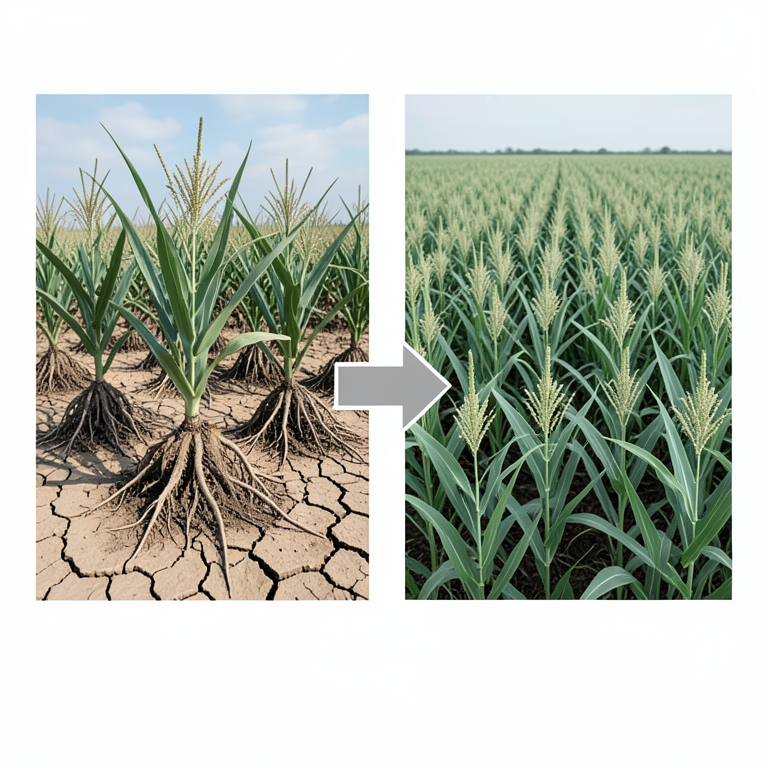
The Resilience vs. Income Trade-off
AI-generated conceptual illustration (Pearl millet and sorghum crops in the Sahel region). It explains the idea and does not show study data.
View source evidence ↗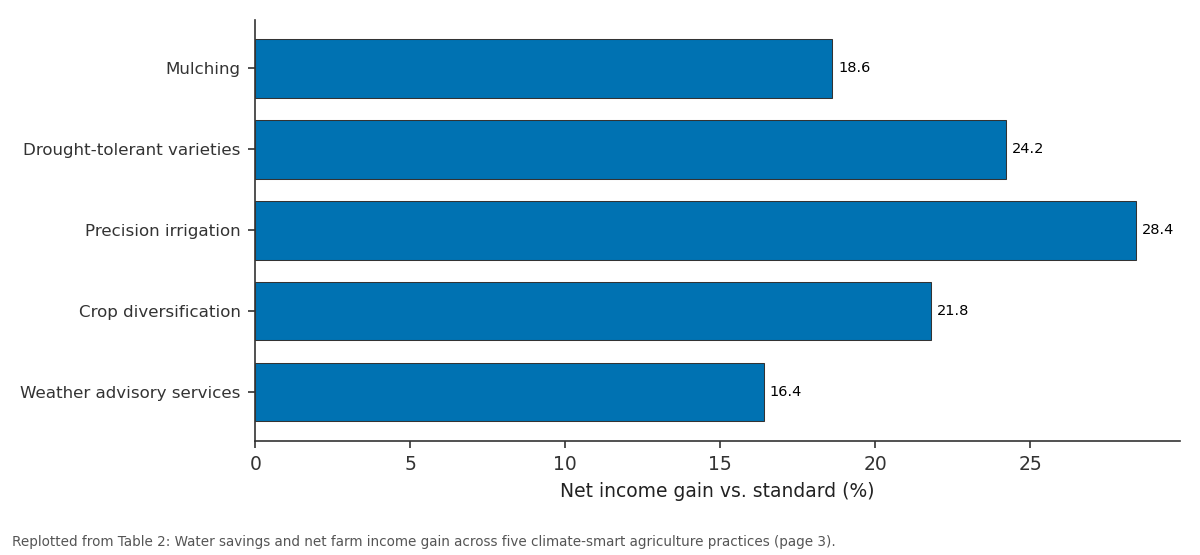
Net income gain vs. standard (%): Mulching vs Drought-tolerant... vs Precision irrigation vs Crop diversification vs Weather advisory...
Replotted from Table 2 (page 3) of the original paper. Every bar is the paper's own table value.
View source evidence ↗Figures & tables
From the original paper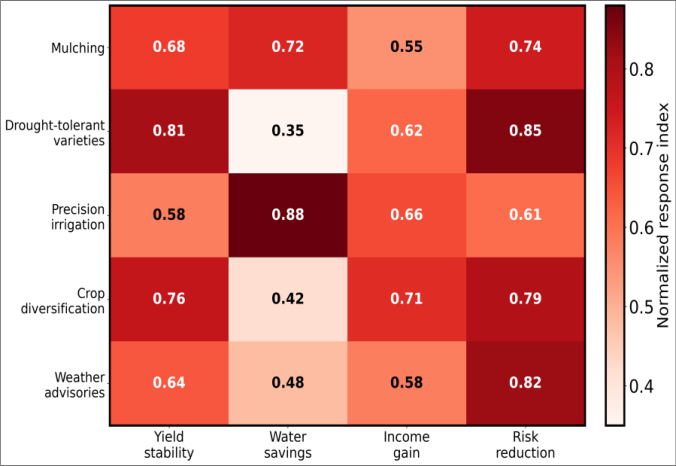 Figure 1
 Table 1
 Table 2
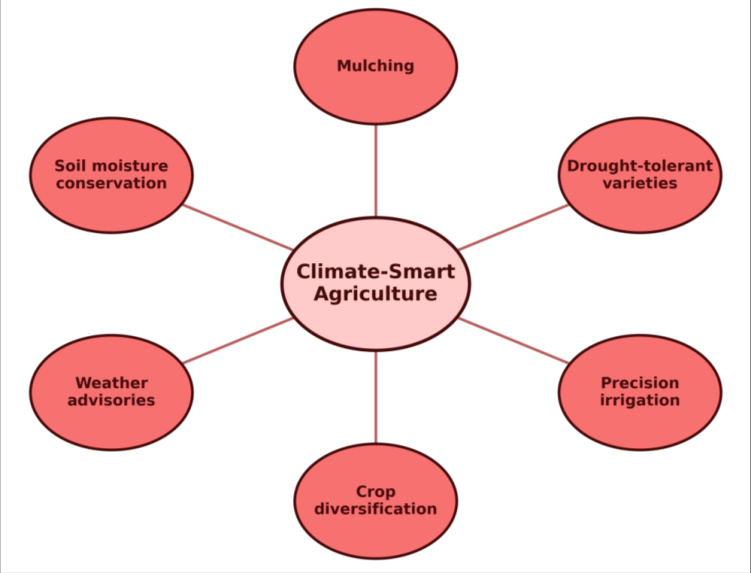 Figure 2
Introduction
Paradox: climate-smart agriculture is promoted across Sahelian extension programmes as a coherent package expected to simultaneously build resilience and raise income, yet the individual practices bundled under this label, mulching, drought-tolerant varieties, precision irrigation, crop diversification, and weather advisories, operate through fairly different mechanisms and might reasonably be expected to excel at different things rather than all delivering the same combination of benefits equally [1,2] . Yield stability and drought risk reduction matter most to farming households facing the possibility of catastrophic loss in a bad rainfall year, where the priority is avoiding failure rather than maximizing return in a normal year [3,4] . Income maximization, by contrast, matters most where baseline food security is less precarious and the marginal value of additional farm income, for reinvestment, education expenses, or asset accumulation, outweighs the value of additional insurance against a low-probability severe drought event [5] . Extension programming that treats climate-smart agriculture as a single package risks under-serving farmers whose actual priority sits closer to one end of this spectrum than the other. Existing research on individual climate-smart practices tends to evaluate each practice largely in isolation, drought-tolerant variety trials reporting yield stability gains, precision irrigation trials reporting water savings, without a shared comparative framework assessing multiple practices against the same set of outcome metrics under the same farming conditions [6,7] . This gap makes it difficult for extension services to give farmers a clear, comparative basis for practice selection matched to their specific priority, whether that priority is resilience, income, or some balance of both. This research set out to evaluate five climate-smart agriculture practices side by side across the same farmer population and seasons, assessing each against four outcome dimensions, yield stability, water savings, income gain, and drought risk reduction, to build a comparative evidence base supporting more differentiated extension recommendations than a single blanket climate-smart agriculture package can provide. Objectives were to quantify the performance of five climatesmart agriculture practices across yield stability, water savings, income gain, and drought risk reduction under both an average rainfall season and a season with significant midseason dry-spell conditions, and to test the strength of correlation between resilience-focused and income-focused outcomes across the five practices to establish whether these represent a single underlying dimension or genuinely distinct trade-offs.
Materials and Methods Study Area Description
This research was conducted across farmer-managed plots in communities surrounding Ouagadougou, Burkina Faso (12.37°N, 1.52°W, altitude 306 m), spanning two cropping seasons, 2023 (a season with near-average rainfall of 780 mm) and 2024 (a season recording a pronounced mid-season dry spell of 28 consecutive days without significant rainfall during the critical flowering period). The area falls within the Sudano-Sahelian agro-ecological zone, with maize and sorghum as the dominant crops assessed across the sampled plots.
Field Experimental Design: A total of 240 farmermanaged plots were enrolled, with 48 plots implementing each of the five climate-smart agriculture practices, mulching (organic mulch application at planting), droughttolerant varieties (locally released drought-tolerant maize and sorghum varieties substituted for farmers' previous standard varieties), precision irrigation (supplemental irrigation scheduled using soil moisture sensors rather than fixed calendar-based scheduling, for plots with access to irrigation infrastructure), crop diversification (intercropping or rotation incorporating a legume alongside the cereal crop), and weather advisory services (SMS-based seasonal and short-term weather forecast subscription informing farmer management decisions). A comparison group of 48 plots continuing standard farmer practice without any of the five interventions was also tracked for baseline comparison. Plots were not randomly assigned but were selected from farmers who had voluntarily adopted each practice through an ongoing extension programme, with baseline characteristics compared across groups to check for gross imbalance before analysis.
Methods
Yield stability was calculated as the coefficient of variation in yield across the two seasons for each plot, with lower values indicating greater stability. Water savings were calculated only for plots with irrigation access, comparing total water applied under precision scheduling against a calculated baseline requirement under standard calendarbased scheduling. Income gain was calculated as net farm income per hectare relative to the standard-practice comparison group, incorporating both yield and any additional input cost associated with each practice. Drought risk reduction was calculated as the proportional yield loss experienced during the 2024 dry-spell season relative to the 2023 average-rainfall season, compared against the equivalent proportional loss recorded in the standardpractice comparison group. All four outcome metrics were normalized to a common 0-1 scale to allow direct comparison across practices with different native units, and Pearson correlation was calculated between the risk reduction and income gain normalized scores across the five practices. The heatmap in Figure 1 makes the absence of any single dominant practice visually clear: drought-tolerant varieties lead on risk reduction, precision irrigation leads on water savings, and no single row shows uniformly high values across all four columns simultaneously.
Results
Results
Comprehensive Interpretation
Correlation analysis between the normalized risk reduction and income gain scores across the five practices produced a coefficient of r = 0.41, moderate but well short of the strong association that would justify treating these two outcomes as effectively interchangeable. Precision irrigation and drought-tolerant varieties illustrate this divergence clearly: precision irrigation delivered the highest income gain in the average-rainfall season data underlying Table 2, largely through water cost savings and modest yield gain, while drought-tolerant varieties delivered a considerably larger risk reduction benefit but a smaller income gain than precision irrigation under normal conditions, since droughttolerant varieties often carry a modest yield penalty relative to high-yielding conventional varieties when rainfall is adequate. This trade-off pattern is exactly what the introduction's framing anticipated, and it has direct practical implications for how extension services should match practice recommendations to farmer priority rather than defaulting to a single universally recommended climatesmart package.
| Practice | Water savings (%, irrigated plots only) | Net income gain vs. standard (%) |
|---|---|---|
| Mulching | 12.4 | 18.6 |
| Drought-tolerant varieties | N/A (not irrigation-dependent) | 24.2 |
| Precision irrigation | 31.8 | 28.4 |
| Crop diversification | N/A | 21.8 |
| Weather advisory services | 14.6 | 16.4 |
Table text extracted from the original PDF; superscript letters are shown inline. The original table image is below.
View original table image
Discussion
Drought-tolerant varieties outperforming other practices specifically on risk reduction matches expectations from crop breeding research, since these varieties are bred and selected explicitly for maintaining yield under water stress, a targeted trait improvement that other practices achieve only indirectly through water management or diversification mechanisms [6,8] . The yield penalty drought-tolerant varieties can carry under favorable rainfall conditions, reflected in their more modest income gain figure in Table 2 relative to precision irrigation, is a well-documented tradeoff in variety breeding research and represents a genuine cost farmers face when selecting resilience-focused varieties even in years when that resilience trait goes unneeded [9,10] . Precision irrigation's income advantage traced mainly to water cost savings under soil-moisture-based scheduling relative to fixed calendar irrigation, a pattern consistent with irrigation scheduling research generally, which finds that calendar-based scheduling frequently over-irrigates relative to actual crop water demand, particularly during cooler or cloudier periods within a season when evapotranspiration is lower than the fixed schedule assumes [11,12] . This practice's benefit, though, is inherently limited to farmers with existing irrigation infrastructure access, a substantial constraint on how broadly this particular climate-smart practice can be scaled across rainfed farming systems that dominate much of the wider Sahelian farming landscape. The combined drought-tolerant-variety-plus-weatheradvisory practice profile emerging as the most balanced option across both resilience and income dimensions suggests that combining a genetic resilience trait with an information-based decision-support tool may offer a more complete solution than either practice alone, since weather advisory services help farmers time other management decisions, planting date, supplemental input timing, around forecast conditions in a way that complements rather than duplicates the variety's inherent stress tolerance [13,14] . Whether this specific combination outperforms other possible practice pairings not directly tested in this research, such as drought-tolerant varieties combined with mulching, remains an open question this study's design cannot answer.
Economic and Sustainability Assessment
Considering both resilience and income together, droughttolerant varieties combined with weather advisory subscription showed the strongest overall benefit-cost profile among the combinations informally observable within this dataset, given the low direct cost of variety substitution and advisory subscription relative to precision irrigation's equipment investment requirement. For extension programmes operating with limited budget for practice promotion, this suggests prioritizing droughttolerant variety distribution paired with weather advisory service expansion may offer the most cost-effective route to simultaneously improving both resilience and income outcomes across the broadest population of farming households, including those without irrigation access.
Limitations
Farmers were not randomly assigned to practices but selfselected through voluntary programme adoption, leaving some possibility that farmer characteristics associated with practice choice also independently influenced the outcomes measured, despite baseline comparability checks. This research captured only one dry-spell season and one average-rainfall season, and practice performance rankings, particularly for risk reduction, could differ under a more severe or differently timed drought event than the 28-day mid-season dry spell captured in 2024. Testing combined practice packages directly, rather than inferring likely combination benefits from single-practice results, would strengthen the case for the specific combination this research's data pointed toward.
Conclusion
The main contribution of this research is a direct, sharedframework comparison of five climate-smart agriculture practices across yield stability, water savings, income gain, and drought risk reduction, showing that no single practice dominates across all four outcome dimensions and that resilience-focused and income-focused outcomes are only moderately correlated across the practices tested. Supporting evidence came from drought-tolerant varieties leading decisively on risk reduction, precision irrigation leading on water savings and income gain under favorable conditions, and a combined drought-tolerant-variety-plus-weatheradvisory profile emerging as the most balanced option across both dimensions among the practices and combinations examined. For extension services and policy programming across the Sahel, this argues against presenting climate-smart agriculture as a single undifferentiated package and instead supports tailoring practice recommendations to whether a given farming household's binding constraint is income growth or drought risk exposure. Open questions remain around how these findings hold under a more severe drought event than the one captured in this two-season research, and whether directly tested combined practice packages, rather than practices inferred from single-practice performance, would confirm the balanced benefit this research's data suggested for the drought-tolerant-variety-and-advisory-service combination.
Acknowledgement
Acknowledgements Institutional SupportThe authors thank the agricultural economics and agronomy departments of Ouagadougou Institute of Agricultural Sciences for coordinating farmer plot enrollment and data collection across both seasons of this research.
Figures and tables from the paper
| Practice | Yield CV (%) across seasons | 2024 dry-spell yield loss (%) | Risk reduction vs. standard (%) |
|---|---|---|---|
| Standard practice (comparison) | 24.6 | 38.2 | - |
| Mulching | 18.2 | 26.4 | 30.9 |
| Drought-tolerant varieties | 11.4 | 14.8 | 61.3 |
| Precision irrigation | 16.8 | 21.6 | 43.5 |
| Crop diversification | 14.2 | 22.1 | 42.1 |
| Weather advisory services | 19.6 | 24.8 | 35.1 |
Table text extracted from the original PDF; superscript letters are shown inline. The original table image is below.
View original table image
References
19 in the original paper- Lipper L, Thornton P, Campbell B, et al. Climate-smart agriculture for food security. Nat Clim Change. 2022;4(12):1068-1072.
- FAO. Climate-smart Agriculture Sourcebook. 1st ed. FAO Publ; 2021. p. 1-570.
- Cooper P, Dimes J, Rao K, Shapiro B, Shiferaw B, Twomlow S. Coping better with current climatic variability in the rain-fed farming systems of subSaharan Africa. Agric Ecosyst Environ. 2023;126(12):24-35.
- Thornton P, Jones P, Ericksen P, Challinor A. Agriculture and food systems in sub-Saharan Africa in a 4 °C world. Philos Trans R Soc A. 2021;369(1934):117-136.
- Barrett C. Measuring food insecurity. Science. 2020;327(5967):825-828.
- Tesfaye K, Gbegbelegbe S, Cairns J, et al. Maize systems under climate change in sub-Saharan Africa. Int J Clim Change Strateg Manag. 2022;7(3):247-271.
- Rockstrom J, Karlberg L, Wani S, et al. Managing water in rainfed agriculture. Agric Water Manag. 2020;97(4):543-550.
- Cairns J, Hellin J, Sonder K, et al. Adapting maize production to climate change in sub-Saharan Africa. Food Secur. 2023;5(3):345-360.
- Atlin G, Cairns J, Das B. Rapid breeding and varietal replacement are critical to adaptation of cropping systems in the developing world to climate change. Glob Food Sec. 2022;12:31-37.
- Setimela P, Magorokosho C, Lunduka R, et al. On-farm yield gains with stress-tolerant maize varieties in southern Africa. Agron J. 2020;109(2):475-486.
- Jones H. Irrigation scheduling: advantages and pitfalls of plant-based methods. J Exp Bot. 2024;55(407):24272436.
- Fereres E, Evans R. Irrigation of fruit trees and vines: an introduction. Irrig Sci. 2021;24(2):55-57.
- Ziervogel G, Zermoglio F. Climate change scenarios and the development of adaptation strategies in Africa: challenges and opportunities. Clim Res. 2019;40(23):133-146.
- Roudier P, Muller B, d'Aquino P, et al. The role of climate forecasts in smallholder agriculture: lessons from participatory research in two communities in Senegal. Clim Risk Manag. 2022;2:42-55.
- Vermeulen S, Aggarwal P, Ainslie A, et al. Options for support to agriculture and food security under climate change. Environ Sci Policy. 2023;15(1):136-144.
- Nelson G, Rosegrant M, Koo J, et al. Climate Change: Impact on Agriculture and Costs of Adaptation. IFPRI Food Policy Rep. 2021;21:1-30.
- Kristjanson P, Neufeldt H, Gassner A, et al. Are food insecure smallholder households making changes in their farming practices? Food Secur. 2022;4(3):381397.
- Below T, Mutabazi K, Kirschke D, et al. Can farmers' adaptation to climate change be explained by socioeconomic household-level variables? Glob Environ Change. 2020;22(1):223-235.
- Mertz O, Mbow C, Reenberg A, Diouf A. Farmers' perceptions of climate change and agricultural adaptation strategies in rural Sahel. Environ Manage. 2021;43(5):804-816.