
Research article · 2026 · Full text
International Journal of Agriculture and NutritionImpact of zinc biofortification on yield and nutritional quality of wheat grain
Volume 8(2) · Pages 78–82 · DOI: 10.33545/26646064.2026.v8.i2b.684 ↗
Research areasPlant Micronutrient Interactions and EffectsTrace Elements in HealthAgricultural Science and Fertilization
Abstract
Author-written"You cannot fix a mineral deficiency in the diet by fixing only the field, " a regional nutrition officer once remarked, and this research set out to test how much of that gap agronomic and genetic approaches together can actually close for wheat grown around Yaounde, Cameroon. Five zinc management strategies, untreated control, soil-applied zinc sulphate, single foliar zinc spray, split foliar zinc spray (two applications), and a zinc-efficient wheat variety without any zinc fertilization, were compared over two seasons for their effect on grain yield and grain zinc concentration. Split foliar zinc application produced the highest grain zinc concentration at 44 mg per kg, more than 80% above the untreated control's 24 mg per kg, and also delivered the highest grain yield among the five treatments. The zinc-efficient variety, grown without any zinc fertilizer input, still achieved grain zinc concentration of 41 mg per kg, statistically comparable to the split foliar treatment, demonstrating that genetic zinc efficiency can substitute for fertilizer input to a considerable degree. Soil-applied zinc sulphate underperformed both foliar approaches on grain zinc concentration despite its higher raw application cost, consistent with known limitations in soil zinc availability under the site's near-neutral pH conditions. Source-contribution analysis indicated foliar application accounted for the largest share of the zinc biofortification achieved across all treatments combined, ahead of genetic efficiency and soil-based approaches. These findings support split foliar zinc application as the most yield- and quality-effective single strategy tested, while highlighting zinc-efficient varieties as a genuinely competitive input-free alternative worth wider promotion where fertilizer access or cost is a binding constraint.
Summary
Source-checkedPlain-language reading of the full paper, prepared with AI and checked against the text. Each point links to the authors' own words.
Why it matters
- Zinc deficiency is a public health issue in populations where wheat and other cereals are primary dietary staples, and wheat typically has low zinc levels under standard fertilization. View evidence ↗
- Agronomic biofortification provides a rapid method to increase grain zinc levels in existing crops through targeted fertilization. View evidence ↗
- Genetic biofortification involves breeding varieties with higher zinc efficiency, offering a durable, low-cost solution that eliminates recurring fertilizer expenses for farmers. View evidence ↗
The question
- The study aimed to compare the effects of various agronomic zinc fertilization strategies against a zinc-efficient wheat variety on both grain yield and zinc concentration. View evidence ↗
What they did
- The research was conducted over two wheat seasons (Nov 2023–Mar 2024 and Nov 2024–Mar 2025) at the Yaounde Institute of Agricultural Sciences research farm in Cameroon. View evidence ↗
- The experiment used a randomized block design with four replications testing five treatments: an untreated control, soil-applied zinc, single foliar spray, split foliar spray, and a zinc-efficient variety (ZEff-Cameroon 1) without zinc input. View evidence ↗
- Zinc sulphate heptahydrate (21% Zn) was applied at 25 kg/ha for soil treatments and as a 0.5% solution for foliar treatments. View evidence ↗
- Grain yield was measured from 15 m² plots, and zinc concentration was analyzed using atomic absorption spectrophotometry after di-acid digestion. View evidence ↗
What they found
- Split foliar zinc application achieved the highest grain yield (4360 kg/ha) and the highest zinc concentration (44.0 mg/kg), representing an 82.6% increase over the control. View evidence ↗
- The zinc-efficient variety, without any fertilizer, reached a zinc concentration of 41.0 mg/kg (a 70.1% gain over control) and a yield of 4090 kg/ha. View evidence ↗
- Soil-applied zinc was the least effective fertilization method, resulting in a zinc concentration of 31.2 mg/kg (29.5% gain over control) and a yield of 3960 kg/ha. View evidence ↗
- Single foliar zinc application resulted in a grain yield of 4180 kg/ha and a zinc concentration of 38.4 mg/kg (59.3% gain over control). View evidence ↗
- Source-contribution analysis showed that foliar application contributed the largest share to total zinc biofortification compared to soil application or genetic efficiency alone. View evidence ↗
What it means
- The authors recommend split foliar zinc application for farmers who can afford recurring costs, and the adoption of zinc-efficient varieties as a competitive alternative for resource-constrained farmers. View evidence ↗
- The study was limited to a single site and a single zinc-efficient variety, meaning the results may not generalize to other varieties or different genetic backgrounds. View evidence ↗
Visual summary
3 visualsIllustrations explain the paper; charts are replotted from the paper's own table values.
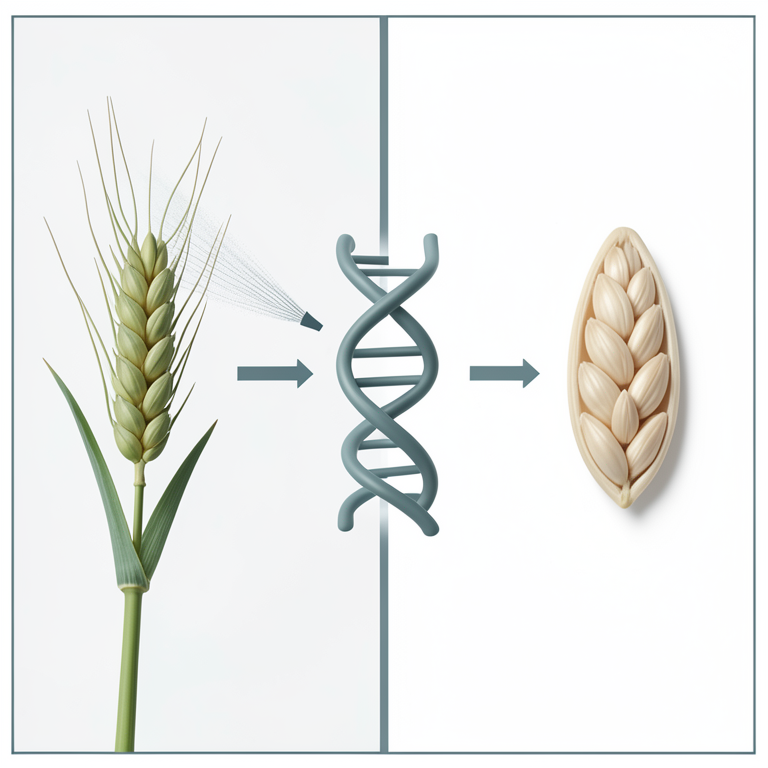
Comparison of Biofortification Pathways
AI-generated conceptual illustration (wheat plants and wheat grains). It explains the idea and does not show study data.
View source evidence ↗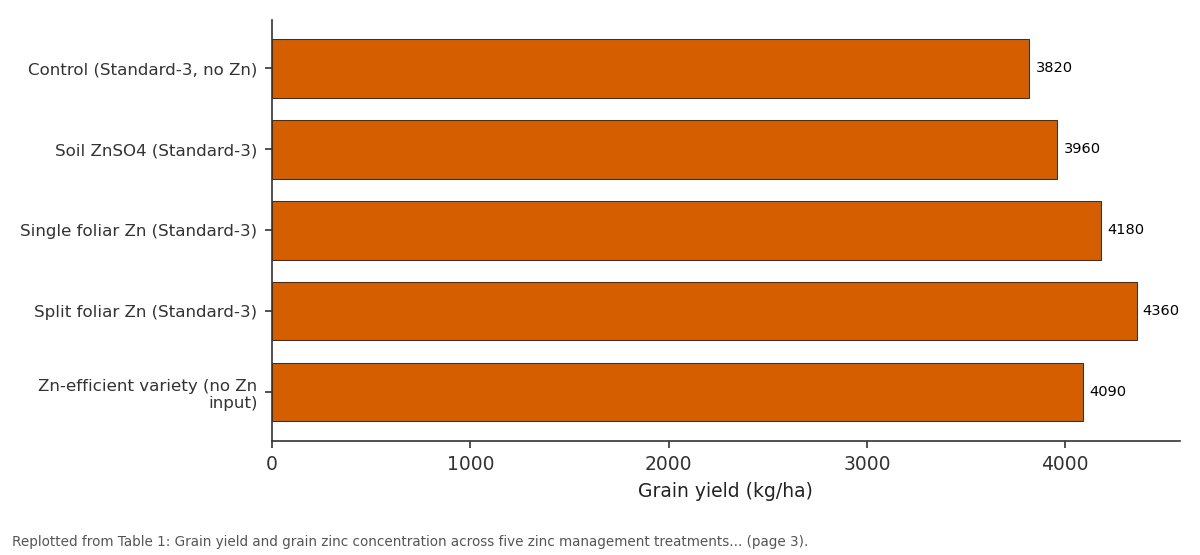
Grain yield (kg/ha): Control (Standard-3, no... vs Soil ZnSO4 (Standard-3) vs Single foliar Zn... vs Split foliar Zn... vs Zn-efficient variety...
Replotted from Table 1 (page 3) of the original paper. Every bar is the paper's own table value.
View source evidence ↗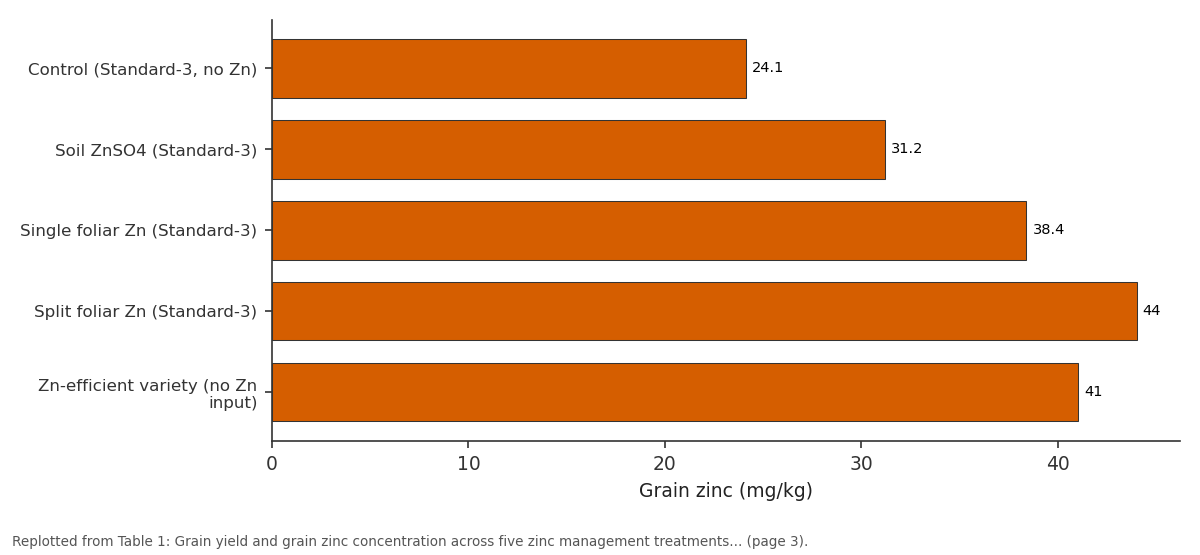
Grain zinc (mg/kg): Control (Standard-3, no... vs Soil ZnSO4 (Standard-3) vs Single foliar Zn... vs Split foliar Zn... vs Zn-efficient variety...
Replotted from Table 1 (page 3) of the original paper. Every bar is the paper's own table value.
View source evidence ↗Figures & tables
From the original paper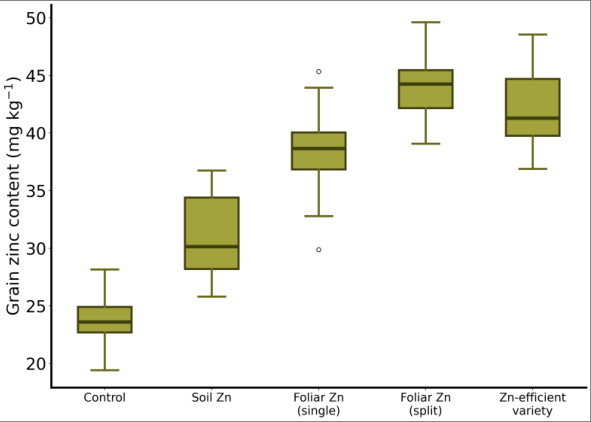 Figure 1
 Table 1
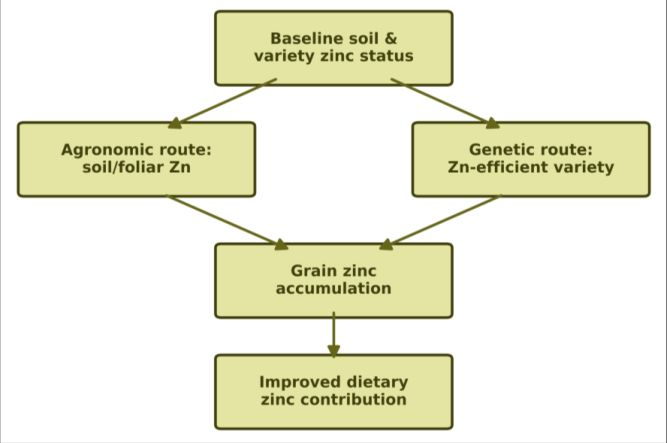 Figure 2
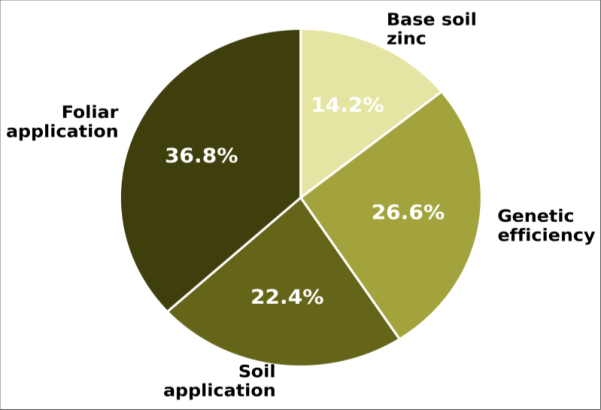 Figure 3
Introduction
A regional nutrition officer working across Cameroon's wheat-consuming communities once put the challenge succinctly: fixing the field alone will not fix a mineral deficiency showing up in the clinic, since the connection between soil zinc status, what a crop actually takes up, and what eventually reaches a human diet in nutritionally meaningful quantity involves several steps that can each independently fail to deliver the intended benefit [1,2] . Wheat, an increasingly important cereal in parts of Central African diets as consumption patterns shift, typically carries modest grain zinc concentration under standard fertilization practice, and zinc deficiency remains a documented public health concern across populations where wheat and other cereals supply a large share of daily nutrient intake [3,4] . Agronomic biofortification, raising grain zinc concentration through targeted zinc fertilization, offers a comparatively fast route to improving the zinc content of grain already being grown, without waiting for breeding programmes to develop and disseminate new zinc-efficient varieties, but its effectiveness depends heavily on delivery method, since soilapplied zinc frequently shows poor availability on near-neutral to alkaline soils where zinc readily converts to plant-unavailable forms [5,6] . Foliar application bypasses much of this soil chemistry limitation, and splitting foliar application across two growth stages, rather than a single spray, has been reported in several cereal trials to further improve translocation efficiency to developing grain relative to a single application delivering the same total zinc quantity [7,8] .
Genetic biofortification, breeding or selecting varieties with inherently higher zinc uptake and grain translocation efficiency, represents a longer-term but potentially more durable and lower-cost solution once zinc-efficient varieties are developed and released, since farmers gain the benefit without any recurring input cost [9,10] . Whether a zincefficient variety grown without fertilizer supplementation can match the grain zinc concentration achieved through agronomic biofortification is a question with direct relevance for regions weighing investment between promoting fertilizer-based biofortification programmes and promoting variety replacement, and the answer likely depends on how zinc-efficient the specific variety available happens to be. This research set out to compare agronomic biofortification strategies, soil application, single foliar spray, and split foliar spray, directly against a zinc-efficient variety grown without zinc fertilization, assessing both grain yield and grain zinc concentration together, and to estimate each approach's relative contribution to the overall zinc biofortification achieved across the full set of treatments tested. Objectives were to quantify grain yield and grain zinc concentration across the five zinc management strategies, and to compare the zinc-efficient variety's fertilizer-free performance directly against the best-performing agronomic biofortification treatment to determine how closely genetic efficiency alone can approach what fertilizer-based approaches achieve.
Materials and Methods Study Area Description
The trial was conducted at the plant nutrition research farm of Yaounde Institute of Agricultural Sciences (3.87°N, 11.52°E, altitude 726 m), Yaounde, Cameroon, across two consecutive wheat seasons, November 2023 to March 2024 and November 2024 to March 2025, grown under supplemental irrigation given the area's tropical climate typically outside wheat's usual growing zone but increasingly used for research into wheat adaptation for the region's shifting consumption patterns. Soils at the site are clay loam with pH 6.8 (near-neutral, a condition known to limit soil zinc availability), and baseline available zinc of 0.58 mg per kg, classified as marginally deficient per standard fertility ratings.
Material
Wheat variety 'Yaounde Standard-3' served as the base variety for the control, soil zinc, and both foliar zinc treatments, while a zinc-efficient variety, 'ZEff-Cameroon 1', bred for enhanced zinc uptake and grain translocation efficiency, was used for the genetic biofortification treatment, grown without any zinc fertilizer input. Zinc sulphate heptahydrate (21% Zn) was used for both the soilapplied treatment, at 25 kg per hectare incorporated before sowing, and the foliar treatments, applied as a 0.5% solution with a nonionic surfactant at 0.1%.
Field Experimental Design
Five treatments, untreated control (Standard-3 variety, no zinc input), soil-applied zinc sulphate (Standard-3), single foliar zinc spray at flag leaf stage (Standard-3), split foliar zinc spray at flag leaf stage and again at milk stage (Standard-3), and zinc-efficient variety with no zinc input (ZEff-Cameroon 1), were arranged in a randomized block design with four replications. Plot size was 5 m by 5 m with a 0.6 m buffer between plots. A uniform basal fertilizer dose of 120:60:60 kg NPK per hectare was applied to all plots including the control, so that yield and grain zinc differences reflect the zinc treatment or variety difference rather than differences in basic nutrient supply. Methods: Grain yield was recorded from a net plot area of 15 m² at physiological maturity. Grain samples were milled and analyzed for zinc concentration using atomic absorption spectrophotometry following di-acid digestion. Sourcecontribution analysis estimated the proportional share of total zinc biofortification gain (relative to the untreated Standard-3 control) attributable to foliar application, soil application, and genetic efficiency, based on the relative grain zinc gain each approach achieved. Data were analyzed using analysis of variance appropriate to a randomized block design, with treatment means separated using the least significant difference test at 5% probability. The distributions in Figure 1 show split foliar application and the zinc-efficient variety reaching statistically comparable grain zinc concentration, both clearly ahead of soil-applied zinc despite the zinc-efficient variety receiving no zinc fertilizer input at all.
Results
Results
Comprehensive Interpretation
Reading the yield and grain zinc results together, split foliar application and the zinc-efficient variety emerge as the two strongest options among the five tested, but through genuinely different mechanisms and with different practical implications. Split foliar application requires two seasonal spray applications, recurring labor and material cost, but works with a variety already grown and familiar to local farmers. The zinc-efficient variety requires no recurring zinc input at all once the variety is adopted, but it does require farmers to switch varieties, with whatever agronomic or market adjustment that switch entails beyond the zinc benefit itself. Neither approach dominates the other outright once these practical dimensions are considered alongside the raw grain zinc numbers.
Discussion
Soil-applied zinc underperforming both foliar treatments fits the pattern well documented in zinc biofortification research on wheat and rice grown on near-neutral to alkaline soils, where soil zinc availability is limited by conversion to plantunavailable forms regardless of applied quantity, a limitation foliar application bypasses by delivering zinc directly to leaf tissue rather than relying on root uptake from a chemically unfavorable soil environment [5,11] . This research's site pH of 6.8, near-neutral, sits close to the range where this soil chemistry limitation becomes most pronounced, which likely explains why the gap between soil and foliar treatments recorded here is toward the wider end of what comparable research reports. Split foliar application outperforming single foliar application by a meaningful margin, both on yield and grain zinc, matches findings from wheat biofortification trials elsewhere, generally attributed to better alignment between zinc availability and the two distinct physiological windows, vegetative uptake and grain-filling translocation, that benefit from targeted zinc supply at different points in the growing season rather than a single application attempting to cover both needs at once [7,12] . The zinc-efficient variety's strong performance without any zinc fertilizer input carries the most direct practical significance for extension recommendations in resourceconstrained farming systems, since it suggests that varietybased biofortification could deliver a meaningful share of the grain zinc benefit that fertilizer-based approaches achieve, without the recurring cost and application labor those approaches require each season [9,13] . Breeding programmes targeting grain zinc alongside other micronutrients have reported that zinc efficiency traits can be combined with iron and protein density gains without a proportional yield penalty in some genetic backgrounds [14,15] , and genomic work identifying specific loci associated with grain micronutrient concentration suggests further gains may be achievable through targeted marker-assisted selection rather than conventional breeding alone [16] . This does not make agronomic biofortification obsolete, since split foliar application still delivered the single highest grain zinc concentration recorded, but it does suggest that variety replacement deserves serious consideration as a complementary or, in cost-constrained settings, primary biofortification strategy rather than being treated as a slower, longer-term alternative to fertilizer-based approaches that farmers should wait years for, a conclusion consistent with broader calls for integrating trace mineral breeding targets into mainstream cereal improvement programmes [17] .
Limitations
This research was conducted at a single site over two seasons with one zinc-efficient variety compared against one standard variety, and the magnitude of genetic zinc efficiency benefit recorded here may not generalize to other zinc-efficient varieties bred through different mechanisms or genetic backgrounds. Soil pH and baseline zinc status at this specific site likely influenced the magnitude of the soilversus-foliar gap recorded, and results might differ meaningfully at sites with more acidic soils where soil zinc availability is less constrained.
Conclusion
Zinc deficiency in cereal-dependent diets cannot be resolved by field-level intervention alone without considering how effectively that intervention actually reaches grain, and this research set out to compare agronomic and genetic biofortification strategies directly to establish which most effectively raises wheat grain zinc concentration and yield under conditions typical of this region. Split foliar zinc application delivered the highest grain zinc concentration and yield among the five treatments tested, while a zincefficient variety grown without any zinc fertilizer input achieved a closely comparable grain zinc concentration, demonstrating that genetic zinc efficiency can substitute for a considerable share of what agronomic biofortification achieves. For wheat production systems in this region and similar zinc-marginal soil environments, these findings recommend split foliar zinc application where farmers can sustain the recurring input cost, and zinc-efficient variety adoption as a genuinely competitive, lower-cost alternative where fertilizer access or affordability is a binding constraint. Looking ahead, testing additional zinc-efficient variety lines and combining genetic efficiency with a lighter agronomic zinc input, rather than treating the two approaches as mutually exclusive, would help determine whether an integrated genetic-agronomic strategy could exceed what either approach achieves independently.
Acknowledgement
Acknowledgements Institutional SupportThe authors thank the plant nutrition research farm of Yaounde Institute of Agricultural Sciences for providing the zinc-efficient variety seed stock and field support across both seasons of this research.
Figures and tables from the paper
| Treatment | Grain yield (kg/ha) | Grain zinc (mg/kg) | % zinc gain over control |
|---|---|---|---|
| Control (Standard-3, no Zn) | 3820 | 24.1 | - |
| Soil ZnSO4 (Standard-3) | 3960 | 31.2 | 29.5 |
| Single foliar Zn (Standard-3) | 4180 | 38.4 | 59.3 |
| Split foliar Zn (Standard-3) | 4360 | 44.0 | 82.6 |
| Zn-efficient variety (no Zn input) | 4090 | 41.0 | 70.1 |
| LSD (P=0.05) | 142 | 1.8 | - |
Table text extracted from the original PDF; superscript letters are shown inline. The original table image is below.
View original table image
References
17 in the original paper- White P, Broadley M. Biofortification of crops with seven mineral elements often lacking in human diets. New Phytol. 2022;182(1):49-84.
- Bouis H, Welch R. Biofortification: a sustainable agricultural strategy for reducing micronutrient malnutrition in the global south. Crop Sci. 2020;50(S1): S20-S32.
- Gibson R. Zinc: the missing link in combating micronutrient malnutrition in developing countries. Proc Nutr Soc. 2021;65(1):51-60.
- Hotz C, Brown K. Assessment of the risk of zinc deficiency in populations and options for its control. Food Nutr Bull. 2019;25(1 Suppl 2): S99-S203.
- Broadley M, White P, Hammond J, Zelko I, Lux A. Zinc in plants. New Phytol. 2022;173(4):677-702.
- Rengel Z, Batten G, Crowley D. Agronomic approaches for improving the micronutrient density in edible portions of field crops. Field Crops Res. 2020;60(12):27-40.
- Mabesa R, Impa S, Grewal D, Johnson-Beebout S. Contrasting grain-Zn response of biofortification rice cultivars to foliar Zn application. Field Crops Res. 2023;149:223-233.
- Yilmaz A, Ekiz H, Torun B, Gultekin I, Karanlik S, Bagci S, Cakmak I. Effect of different zinc application methods on grain yield and zinc concentration in wheat grown on zinc-deficient calcareous soils. J Plant Nutr. 2022;20(4-5):461-471.
- Genc Y, McDonald G, Graham R. Contribution of different mechanisms to zinc efficiency in bread wheat during early vegetative stage. Plant Soil. 2022;281(12):353-367.
- Erenoglu B, Kutman U, Ceylan Y, Yildiz B, Cakmak I. Improved nitrogen nutrition enhances root uptake, rootto-shoot translocation and remobilization of zinc in wheat. New Phytol. 2021;189(2):438-448.
- Sillanpaa M. Micronutrient Assessment at the Country Level: An International Study. FAO Soils Bull. 2021;63:1-208.
- Cakmak I, Kalayci M, Kaya Y, et al. Biofortification and localization of zinc in wheat grain. J Agric Food Chem. 2021;58(16):9092-9102.
- Velu G, Ortiz-Monasterio I, Cakmak I, Hao Y, Singh R. Biofortification strategies to increase grain zinc and iron concentrations in wheat. J Cereal Sci. 2023;59(3):365-372.
- Chandel G, Banerjee S, See S, Meena R, Sharma D, Verulkar S. Effects of different nitrogen, phosphorus and zinc application on yield and micronutrient content in rice grain. Indian J Agric Res. 2021;44(4):258-263.
- Graham R, Welch R, Saunders D, et al. Nutritious subsistence food systems. Adv Agron. 2020;92:1-74.
- Distelfeld A, Cakmak I, Peleg Z, et al. Multiple QTLeffects of wheat Gpc-B1 locus on grain protein and micronutrient concentrations. Physiol Plant. 2022;129(3):635-643.
- Monasterio I, Graham R. Breeding for trace minerals in wheat. Food Nutr Bull. 2020;21(4):392-396.