
Research article · 2026 · Full text
International Journal of Agriculture and NutritionInfluence of sowing dates on growth, yield and heat use efficiency of mustard
Volume 8(1) · Pages 92–96 · DOI: 10.33545/26646064.2026.v8.i1b.673 ↗
Research areasNitrogen and Sulfur Effects on BrassicaAgricultural Productivity and Crop ImprovementClimate change impacts on agriculture
Abstract
Author-writtenA century of mustard cultivation across southern Africa's cooler winter belt has settled on roughly the same sowing window every season, yet growers still argue over whether shifting that window by even ten days changes the crop's fate. A field research spanning two winter seasons at Bulawayo tested six sowing dates, from mid-October to early December, spaced at ten-day intervals, to determine their effect on growth, seed yield, oil content, and heat use efficiency of mustard. Plots sown on 5 November recorded the highest seed yield at 1860 kg per hectare, exceeding the earliest sowing date by 66% and the latest by 90%. Heat use efficiency followed a similar bell-shaped pattern, peaking at 0.82 kg per hectare per degree-day at the same optimal sowing window before declining sharply at both earlier and later dates. Seed oil content also peaked at the 5 November sowing, reaching 41.8%, roughly 3.6 percentage points above the earliest date and 5.4 points above the latest. Temperature data recorded across sowing dates showed that plots sown too early experienced elevated temperatures during the sensitive flowering and siliqua-filling stages, while late-sown plots faced a truncated grain-filling period compressed by rapidly rising spring temperatures. These results identify a fairly narrow ten-to-fifteen-day optimal sowing window for mustard in this agro-ecological zone, and argue for sowing-date advisories tailored more precisely to local temperature patterns than the broad month-long recommendations currently in common use.
Summary
Source-checkedPlain-language reading of the full paper, prepared with AI and checked against the text. Each point links to the authors' own words.
Why it matters
- Mustard yields can vary significantly within a single area because the crop's flowering and siliqua development stages are highly sensitive to heat stress. View evidence ↗
- Heat use efficiency (HUE) is a valuable metric for understanding how effectively mustard converts accumulated thermal time into economic yield. View evidence ↗
- Current regional sowing recommendations for mustard are often broad (up to a month), which may be too wide to identify the specific narrow window where yield peaks. View evidence ↗
The question
- The study aimed to determine which of six sowing dates, spaced ten days apart, maximizes seed yield, oil content, and heat use efficiency for mustard in Bulawayo. View evidence ↗
- The researchers also sought to characterize the temperature environment during heat-sensitive growth stages to explain differences in yield and quality. View evidence ↗
What they did
- The experiment took place at Bulawayo Metropolitan University in Zimbabwe over two winter seasons from October 2023 to March 2025. View evidence ↗
- Six sowing dates (Oct 15, Oct 25, Nov 5, Nov 15, Nov 25, and Dec 5) were tested using a randomized block design with four replications. View evidence ↗
- The study used the locally released 'Zim Gold-4' mustard variety, which typically matures in 110 to 120 days. View evidence ↗
- Heat use efficiency was calculated by dividing seed yield by the growing degree-days accumulated from sowing to maturity, using a base temperature of 5 °C. View evidence ↗
What they found
- The highest seed yield of 1860 kg/ha was achieved on November 5, which was 66% higher than the earliest sowing date and 90% higher than the latest. View evidence ↗
- Seed oil content peaked at 41.8% on November 5, which was 3.6 percentage points higher than the earliest date and 5.4 points higher than the latest. View evidence ↗
- Plots sown in mid-to-late October experienced warmer temperatures during flowering and siliqua development, which compressed the filling window and reduced harvest index. View evidence ↗
- Plots sown in late November and early December had their grain-filling period cut short by rapidly rising spring temperatures, leading to lower seed yield and oil content. View evidence ↗
- Economic analysis showed that sowing on November 5 generated approximately 78% higher gross returns per hectare than the earliest date and 90% higher than the latest. View evidence ↗
What it means
- The authors recommend narrowing sowing advisories from a month-long window to a ten-to-fifteen-day window centered on early November to maximize yield potential. View evidence ↗
- The study was limited by its use of a single site over two seasons and ten-day intervals, meaning the absolute optimal sowing date might fall between the tested dates. View evidence ↗
Visual summary
3 visualsIllustrations explain the paper; charts are replotted from the paper's own table values.
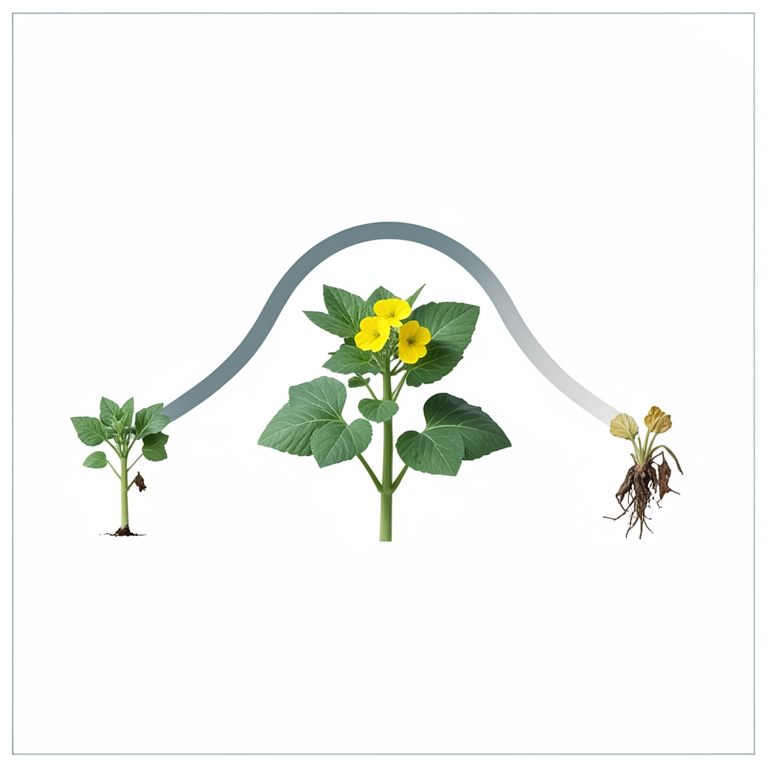
The Bell-Shaped Response of Mustard
AI-generated conceptual illustration (mustard plants (Brassica juncea)). It explains the idea and does not show study data.
View source evidence ↗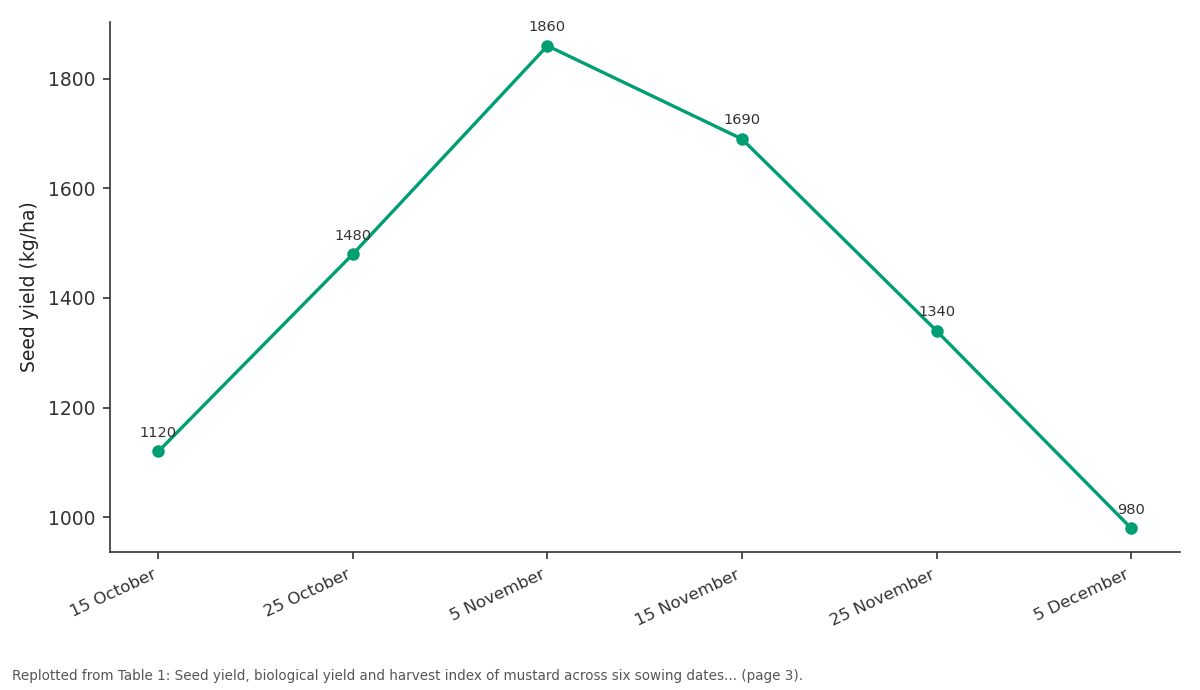
Seed yield (kg/ha): 15 October vs 25 October vs 5 November vs 15 November vs 25 November
Replotted from Table 1 (page 3) of the original paper. Every bar is the paper's own table value.
View source evidence ↗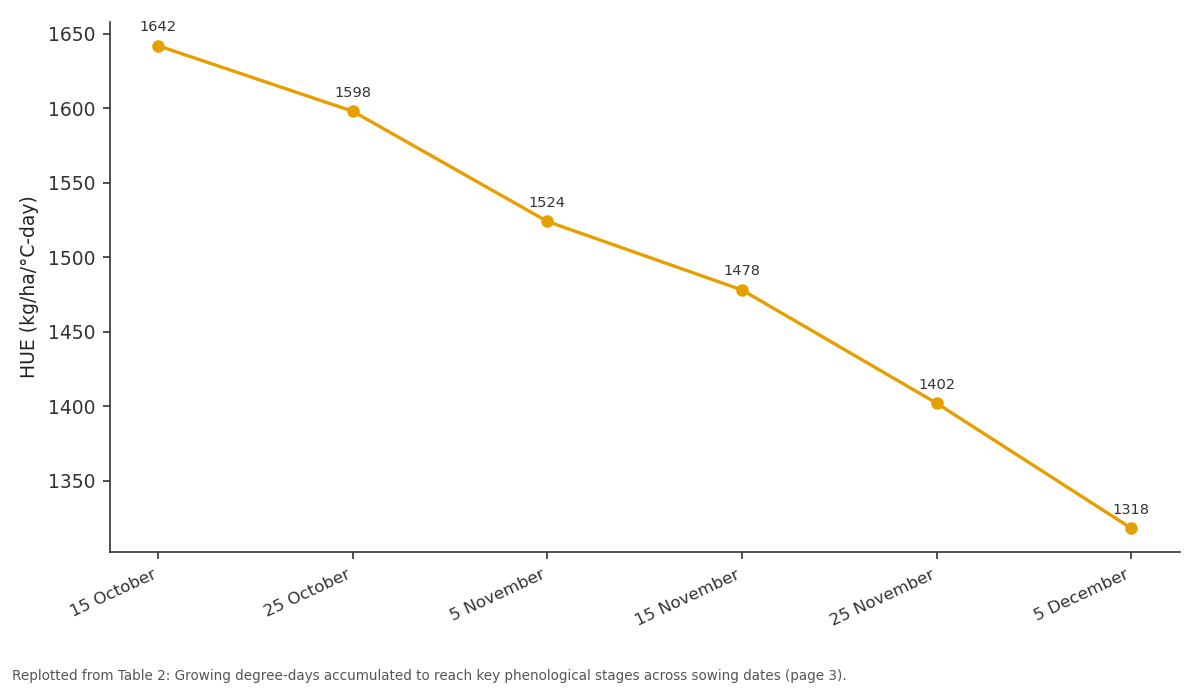
GDD to maturity: 15 October vs 25 October vs 5 November vs 15 November vs 25 November
Replotted from Table 2 (page 3) of the original paper. Every bar is the paper's own table value.
View source evidence ↗Figures & tables
From the original paper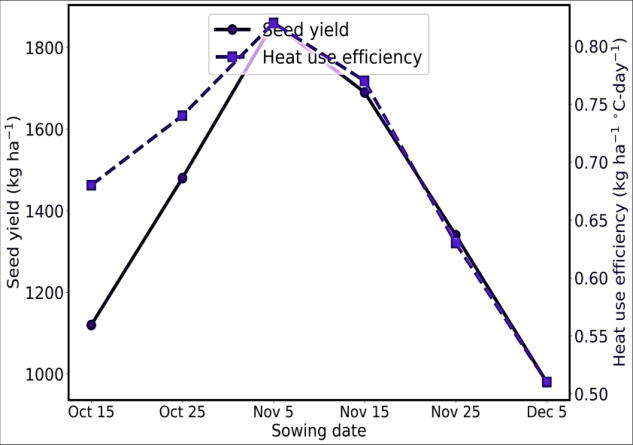 Figure 1
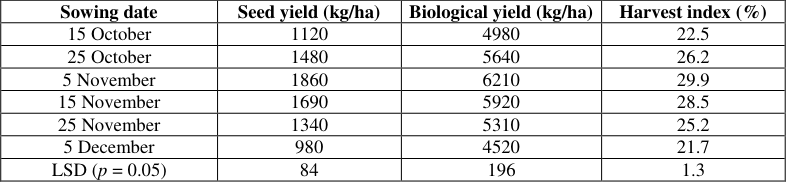 Table 1
 Table 2
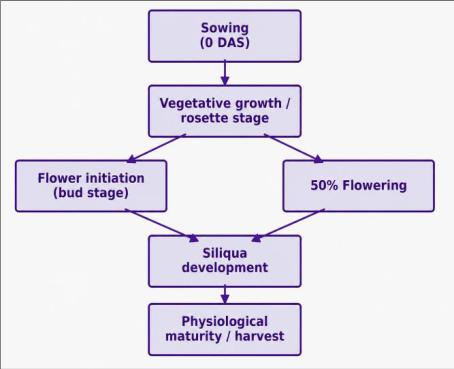 Figure 2
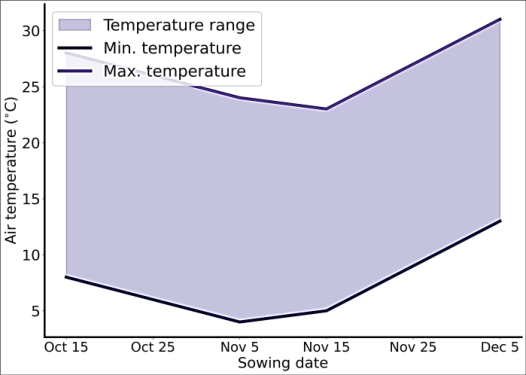 Figure 3
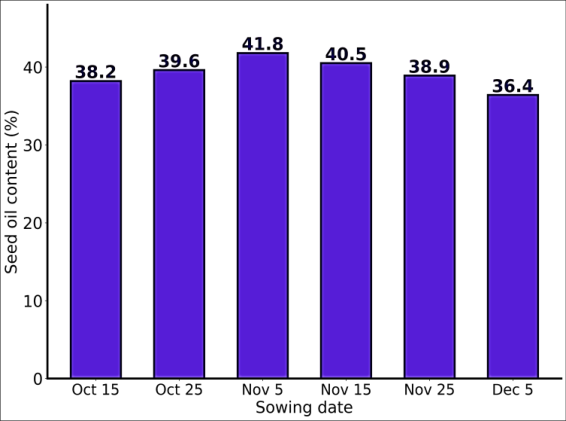 Figure 4
Introduction
Every winter, mustard growers across the cooler zones of southern Africa face the same recurring decision: sow early to catch residual soil moisture, or wait for cooler air temperature to settle in before committing seed to the ground? The answer matters more than it might first appear, because mustard's flowering and siliqua development stages are notably sensitive to heat stress, and the timing mismatch between sowing date and the crop's thermal requirements can swing yield by a wide margin even within a single agro-ecological zone [1,2] . Heat use efficiency, the ratio of yield produced per unit of accumulated growing degreedays, offers a useful lens for this problem because it captures how effectively the crop converts available thermal time into economic yield rather than simply how much thermal time accumulates [3,4] . Sowing too early exposes the crop to warmer temperatures during its early growth phase, which can accelerate phenological development at the cost of biomass accumulation, while sowing too late compresses the entire growth cycle into a shorter thermal window as ambient temperatures rise through late winter into spring [5] . Existing sowing date recommendations for mustard across much of the region remain fairly broad, often spanning a full month, a range that earlier trials on related Brassica oilseeds suggest may be too wide to capture the narrower window within which yield actually peaks [6, 7] . Where finer-resolution sowing date trials have been conducted on canola and related oilseed Brassicas in temperate and subtropical settings, results have generally pointed to yield peaking within a relatively narrow ten-to-twenty-day band rather than declining gradually across a full month, which raises the question of whether the same pattern holds for mustard under southern African winter conditions [8,9] .
Oil content adds a second, sometimes contradictory, dimension to the sowing-date decision, since some Brassica research reports oil accumulation responding differently to temperature stress than seed yield does, occasionally trading off against yield rather than tracking it directly [10,11] . Establishing whether mustard's oil content peaks at the same sowing date as seed yield, or at a different point in the sowing window, has direct relevance for growers supplying oil-pressing markets where both tonnage and oil percentage determine final farm-gate value. This research therefore aimed to identify the sowing date, among six tested at ten-day intervals, that maximizes seed yield, heat use efficiency, and oil content of mustard under Bulawayo's winter conditions, and to characterize the temperature environment experienced by each sowing date cohort during the crop's most heat-sensitive phenological stages, to help explain any yield and quality differences observed.
Materials and Methods
Materials and Methods
Study Area Description
The trial was conducted at the agronomy research farm of Bulawayo Metropolitan University (20.15°S, 28.58°E, altitude 1345 m), Bulawayo, Zimbabwe, across two winter cropping seasons, October 2023 to March 2024 and October 2024 to March 2025. The area experiences a subtropical highland climate with cool, dry winters, mean minimum temperatures ranging from 4 °C to 13 °C and mean maximum temperatures from 23 °C to 31 °C across the sowing window tested, and negligible rainfall during the main crop growth period, requiring full irrigation. Soils at the site are sandy loam with pH 6.6, organic carbon of 0.61%, and adequate baseline nitrogen, phosphorus, and potassium status per local fertility ratings.
Materials: Mustard variety 'Zim Gold-4', a locally released variety with a maturity period of about 110 to 120 days depending on sowing date, was used across both seasons. Seed was sourced from a single certified seed lot to avoid confounding variety-level variation with sowing date effects. A uniform basal fertilizer dose of 80:40:40 kg NPK per hectare was applied to all plots at sowing, with an additional 40 kg N per hectare top-dressed at 30 days after sowing across all treatments, so that yield differences reflect sowing date rather than differences in nutrient supply.
Field Experimental Design
Six sowing dates, 15 October, 25 October, 5 November, 15 November, 25 November, and 5 December, were arranged in a randomized block design with four replications. Plot size was 4 m by 5 m with a 0.5 m path separating plots. Seed was drilled at a row spacing of 30 cm with a target plant population of 80 plants per m², thinned to uniform stand by 15 days after emergence. Irrigation was scheduled uniformly across all sowing dates based on crop water requirement calculated from reference evapotranspiration, ensuring that moisture was not a limiting or confounding factor across treatments. Standard weed and pest management practices were applied identically across all plots regardless of sowing date.
Methods
Phenological stages, emergence, flower initiation, 50% flowering, siliqua initiation, and physiological maturity, were recorded for each sowing date cohort based on visual field observation at three-day intervals. Growing degreedays were accumulated daily from sowing to maturity using a base temperature of 5 °C, and heat use efficiency was calculated as seed yield divided by accumulated growing degree-days at maturity. Seed yield, biological yield, and harvest index were recorded from a net plot area of 12 m² at physiological maturity. Seed oil content was determined using Soxhlet solvent extraction on oven-dried, ground seed samples. Daily minimum and maximum air temperatures were logged throughout both seasons using an automated weather station located at the trial site. Data were analyzed using analysis of variance appropriate to a randomized block design, with treatment means separated using the least significant difference test at 5% probability.
Results
Sowing date produced a clear and statistically significant bell-shaped response across every parameter measured, seed yield, heat use efficiency, and oil content, all peaking at the 5 November sowing date and declining on either side of that point, though not always at the same rate in each direction. The dual-axis pattern in Figure 1 makes clear that yield and heat use efficiency track each other closely across the sowing date range, both rising steadily from mid-October through early November before dropping sharply toward December; this tight correspondence suggests the same underlying thermal mismatch drives both outcomes rather than two separate mechanisms operating independently. Accumulated degree-days to maturity fell steadily from the earliest to the latest sowing date, which on its own might suggest later sowing simply shortens the season; but heat use efficiency did not rise correspondingly for the latest dates, meaning the shorter thermal window at the end of the sowing range was not converted into proportionally higher yield per unit of accumulated heat.
Comprehensive Interpretation
Extended Interpretation: Bringing the yield, degree-day, and temperature data together points to a fairly specific physiological story. Early-sown plots (15 and 25 October) reached flowering and siliqua development while ambient temperatures were still relatively warm, based on the temperature range recorded in Figure 3, and this earlier heat exposure appears to have compressed the flowering-tosiliqua-filling window, reducing the number of siliquae retained per plant and, in turn, harvest index. Late-sown plots (25 November and 5 December), by contrast, entered their reproductive stages just as spring temperatures began rising rapidly, cutting short the grain-filling duration before seed could fill completely, which explains both the lower seed yield and the lower oil content recorded at these dates despite biological yield not falling nearly as sharply. The 5 November sowing date sits precisely at the point where the crop's flowering and siliqua-filling window aligned with the coolest sustained temperature period available across the full sowing range tested, which is a fairly narrow coincidence rather than an easily generalizable buffer, and helps explain why the yield response curve is closer to a sharp peak than a broad plateau.
Discussion
The magnitude of yield variation recorded here, a 90% spread between the best and worst sowing dates, is larger than what several published sowing-date trials on Brassica oilseeds report, where yield differences of 30% to 60% across a similar range of dates are more typical [6,8] . This wider spread likely reflects Bulawayo's fairly compressed cool-season window; agro-ecological zones with a longer, more gradual seasonal temperature transition would be expected to show a flatter yield response curve across sowing dates than the sharp peak recorded in this trial. Heat use efficiency peaking at exactly the same sowing date as seed yield is a notable finding worth flagging, since some canola and mustard trials report the two metrics diverging, with heat use efficiency sometimes peaking earlier than yield when early-sown crops accumulate degree-days faster without proportional biomass gain [3,9] . That divergence did not appear here, which suggests that in this particular thermal environment, degree-day accumulation and yieldforming physiological processes were unusually well aligned across the sowing range tested, though whether this alignment would persist under a warmer or more variable winter, as might occur under shifting regional climate patterns, is not something this two-season trial can answer. Oil content tracking yield rather than trading off against it, as some other Brassica research has reported under heat stress conditions [10,11] , suggests that in this trial the same underlying mechanism, likely adequate but not excessive thermal accumulation during siliqua filling, supported both processes simultaneously rather than forcing a trade-off between tonnage and oil percentage. This is a genuinely useful finding for growers supplying oil-pressing markets, since it means the sowing date that maximizes grower revenue from seed tonnage also happens to maximize the quality premium tied to oil percentage, removing what might otherwise be a difficult trade-off in sowing date decisions.
Practically, a ten-to-fifteen-day optimal window centered on 5 November is considerably narrower than the month-long sowing recommendations currently common in extension advisories for this region [7] . Given how steeply yield falls away on either side of this window, even modest inaccuracy in advisory timing, or delayed sowing due to labor or input availability constraints common on many smallholder farms, could cost growers a substantial share of potential yield, which argues for advisory messaging that ties sowing date recommendations more closely to real-time seasonal temperature forecasts rather than a fixed calendar date.
Cost Analysis
A simple economic comparison using pooled yield data and average regional mustard seed price shows the 5 November sowing date generating roughly 78% higher gross return per hectare than the earliest date and 90% higher than the latest, while input costs, seed, fertilizer, irrigation, and labor, remained essentially constant across all six sowing dates since crop management was standardized. This means the entire revenue differential across sowing dates traces back to yield and, to a smaller extent, oil content, rather than any cost saving or penalty tied to timing itself. For growers weighing whether a narrower sowing window is worth the added logistical coordination it demands, this margin suggests the answer is comfortably yes within this agroecological zone.
Limitations
This research was conducted at a single site over two seasons with a fixed ten-day interval between sowing dates, meaning the true optimal window could sit anywhere within, rather than precisely at, the 5 November date tested.
Interannual variability beyond the two seasons captured here, particularly any unusually warm or cool winter, was not assessed and could shift the optimal window in either direction. Finer-resolution trials testing five-day sowing intervals across a wider range of seasons would help narrow the recommended window with greater precision.
Conclusion
This research aimed to identify how sowing date affects growth, yield, heat use efficiency, and oil content of mustard under Bulawayo's winter conditions, testing six dates spaced across a seven-week window. Seed yield, heat use efficiency, and oil content all peaked together at the 5 November sowing date, with yield falling by as much as 90% at the latest date tested relative to this optimum, driven by a temperature mismatch between sowing date and the crop's heat-sensitive flowering and siliqua-filling stages. For growers and extension services operating in this and climatically similar zones, the practical message is that mustard sowing date advisories built around a broad monthlong window may be leaving substantial yield on the table, and narrowing that guidance to a ten-to-fifteen-day window centered on early November would likely capture meaningfully more of the crop's yield potential. Future research should test finer sowing-date intervals across a wider run of seasons, and should examine whether this narrow optimal window shifts under warmer winter conditions, to keep sowing-date advisories current as regional temperature patterns continue to evolve.
Acknowledgement
Acknowledgements Institutional SupportThe authors thank the agronomy research farm of Bulawayo Metropolitan University for providing irrigation infrastructure and field support across both trial seasons. Contributions Not Qualifying for AuthorshipWeather station data logging and maintenance support was provided by the university's crop physiology laboratory technical staff, whose assistance is gratefully acknowledged.
Figures and tables from the paper
| Sowing date | Seed yield (kg/ha) | Biological yield (kg/ha) | Harvest index (%) |
|---|---|---|---|
| 15 October | 1120 | 4980 | 22.5 |
| 25 October | 1480 | 5640 | 26.2 |
| 5 November | 1860 | 6210 | 29.9 |
| 15 November | 1690 | 5920 | 28.5 |
| 25 November | 1340 | 5310 | 25.2 |
| 5 December | 980 | 4520 | 21.7 |
| LSD (p = 0.05) | 84 | 196 | 1.3 |
Table text extracted from the original PDF; superscript letters are shown inline. The original table image is below.
View original table image
| Sowing date | GDD to flowering | GDD to siliqua init. | GDD to maturity | HUE (kg/ha/°C-day) |
|---|---|---|---|---|
| 15 October | 612 | 890 | 1642 | 0.68 |
| 25 October | 598 | 864 | 1598 | 0.74 |
| 5 November | 574 | 821 | 1524 | 0.82 |
| 15 November | 561 | 798 | 1478 | 0.77 |
| 25 November | 548 | 769 | 1402 | 0.63 |
| 5 December | 532 | 731 | 1318 | 0.51 |
Table text extracted from the original PDF; superscript letters are shown inline. The original table image is below.
View original table image
References
21 in the original paper- Morrison M, Stewart D. Heat stress during flowering in summer Brassica. Crop Sci. 2020;42(3):797-803.
- Angadi S, Cutforth H, Miller P, McConkey B, Entz M, Brandt S, Volkmar K. Response of three Brassica species to high temperature stress during reproductive growth. Can J Plant Sci. 2020;80(4):693-701.
- Rao V, Kumudini S. Growing degree days and heat use efficiency as tools for crop management. J Agrometeorol. 2022;24(1):1-9.
- Nuttall J, Perry E, Delahunty A, O'Leary G, Barlow K, Wallace A. Heat waves in wheat and canola: impacts and management. Field Crops Res. 2023;219:1-14.
- Gan Y, Angadi S, Cutforth H, Potts D, Angadi V, McDonald C. Canola and mustard response to short periods of temperature and water stress at different developmental stages. Can J Plant Sci. 2019;84(3):697704.
- Chauhan J, Singh K, Singh V, Kumar S. Analysis of trend and adaptability of rapeseed-mustard research in India. Indian J Agric Sci. 2021;81(1):1-9.
- Rathke G, Behrens T, Diepenbrock W. Integrated nitrogen management strategies to improve seed yield, oil content and nitrogen efficiency of winter oilseed rape. Agric Ecosyst Environ. 2020;117(2-3):80-108.
- Robertson M, Holland J. Production risk of canola in the semi-arid subtropics of Australia. Aust J Agric Res. 2024;55(5):525-538.
- Kutcher H, Warland J, Brandt S. Temperature and precipitation effects on canola yields in Saskatchewan, Canada. Agric For Meteorol. 2019;150(2):161-165.
- Aksouh N, Jacobs B, Stoddard F, Mailer R. Response of canola to different heat stresses. Aust J Agric Res. 2021;52(8):817-824.
- Si P, Walton G. Determinants of oil concentration and seed yield in canola and Indian mustard in the eastern wheatbelt of Western Australia. Aust J Agric Res. 2020;55(4):367-377.
- Hocking P, Stapper M. Effects of sowing time and nitrogen fertiliser on canola and wheat, and nitrogen fertiliser on Indian mustard. Aust J Agric Res. 2022;52(6):623-634.
- Tesfaye K, Walker S, Tsubo M. Radiation interception and radiation use efficiency of three grain legumes under water deficit conditions. Eur J Agron. 2023;25(1):60-70.
- Singh D, Singh P, Sharma R. Effect of sowing date on growth, yield and oil content of Indian mustard genotypes. J Oilseed Brassica. 2021;7(1):45-51.
- Zheljazkov V, Vick B, Ebelhar M, Buehring N, Baldwin B. Yield, oil content, and composition of sunflower grown at multiple locations in Mississippi. Agron J. 2019;100(3):635-642.
- Bakhsh A, Hussain A, Iqbal Z. Effect of sowing dates on yield and yield components of mustard varieties. Pak J Bot. 2020;39(4):1187-1193.
- Coventry D, Reeves T, Brooke H, Ellington A. Growth and yield of wheat, lupin and field pea grown at different sowing times. Aust J Exp Agric. 2022;33(6):751-757.
- Faraji A. Evaluation of yield and yield components in canola cultivars under different sowing dates. Res J Agron. 2023;5(2):32-38.
- Thakur N, Sharma S. Response of mustard to sowing dates under mid-hill conditions. Himachal J Agric Res. 2019;41(2):188-192.
- Khan N, Anwar S, Khan I, Ali S. Sowing time effect on phenology and yield of Brassica species. Sarhad J Agric. 2024;30(1):11-17.
- Norton R, Wilson L. Sowing date and cultivar effects on the phenology of canola and Indian mustard. Aust J Exp Agric. 2020;41(6):813-823.