
Research article · 2026 · Full text
International Journal of Agriculture and NutritionRole of kitchen gardening in enhancing household nutrition security among rural families
Volume 8(1) · Pages 118–122 · DOI: 10.33545/26646064.2026.v8.i1b.678 ↗
Research areasChild Nutrition and Water AccessFood Security and Socioeconomic DynamicsAgricultural Innovations and Practices
Abstract
Author-writtenAsk any extension officer working in rural Malawi which single intervention delivers the most visible household-level nutrition change for the least investment, and kitchen gardening is likely to come up quickly, yet the evidence base quantifying that change with any rigor remains thinner than the intervention's popularity would suggest. This research followed 180 rural households across three districts around Lilongwe over a twelve-month period, comparing 90 households that established a kitchen garden with 90 matched households that did not, to assess the effect of kitchen gardening on household dietary diversity, vegetable consumption frequency, and household income allocated to vegetable purchase. Households with kitchen gardens recorded a Household Dietary Diversity Score rising from a baseline of 4.2 to 7.1 after twelve months, compared with a change from 4.1 to only 4.4 among households without gardens over the same period. Kitchen garden households also reported a 42% reduction in weekly expenditure on purchased vegetables, redirecting an estimated equivalent value toward other household needs. Vegetable consumption frequency rose from an average of three days per week to six days per week among garden households, with leafy green vegetables showing the largest gain in both variety and frequency. These findings support kitchen gardening as a measurably effective, low-cost household-level intervention for improving dietary diversity and food security in rural farming communities, and argue for its continued and expanded promotion within nutrition-sensitive agriculture programming in this region.
Summary
Source-checkedPlain-language reading of the full paper, prepared with AI and checked against the text. Each point links to the authors' own words.
Why it matters
- In rural Malawi, while staple grains are reliably grown, access to diversifying vegetables is often unpredictable and costly because it depends on markets or foraging. View evidence ↗
- Kitchen gardening is promoted as a way to provide households with a direct source of dietary diversity that bypasses the need for market access or money. View evidence ↗
- Previous evidence on kitchen gardening often lacks longitudinal data, making it unclear if gardens cause better diets or if health-conscious people are simply more likely to start gardens. View evidence ↗
The question
- The study aimed to rigorously measure how kitchen gardening affects household dietary diversity, how often vegetables are eaten, and how much money is spent on purchasing vegetables over one year. View evidence ↗
What they did
- The study involved 180 households near Lilongwe, Malawi: 90 received gardening support (seeds, tools, training) and 90 were matched controls based on size, income, and initial dietary diversity. View evidence ↗
- Data were collected at the start (month 1) and after one full seasonal cycle (month 13). View evidence ↗
What they found
- Garden households saw their dietary diversity score increase from 4.2 to 7.1, while non-garden households only moved from 4.1 to 4.4. View evidence ↗
- The frequency of vegetable consumption in garden households increased from an average of three days per week to six days per week. View evidence ↗
- Households with gardens reduced their weekly spending on purchased vegetables by 42%. View evidence ↗
- Dark green leafy vegetables showed the most significant increase in consumption, with a 45.5 percentage point gain. View evidence ↗
- Estimated daily micronutrient contributions from vegetables increased for garden households: Vitamin A rose by 124%, Folate by 90%, and plant-sourced Iron by 74%. View evidence ↗
- The study suggests that money saved from not buying vegetables was likely used to buy other foods, contributing to increases in fruit, legume, and egg consumption. View evidence ↗
What it means
- The authors conclude that kitchen gardening is a low-cost and effective way to improve food security and dietary diversity, recommending its expanded use in nutrition programs. View evidence ↗
- A limitation of the study is the reliance on self-reported dietary recall, which does not measure absolute nutrient intake or biochemical status. View evidence ↗
- Because households were matched rather than randomly assigned, unmeasured characteristics might have influenced both the decision to garden and the resulting dietary changes. View evidence ↗
Visual summary
3 visualsIllustrations explain the paper; charts are replotted from the paper's own table values.
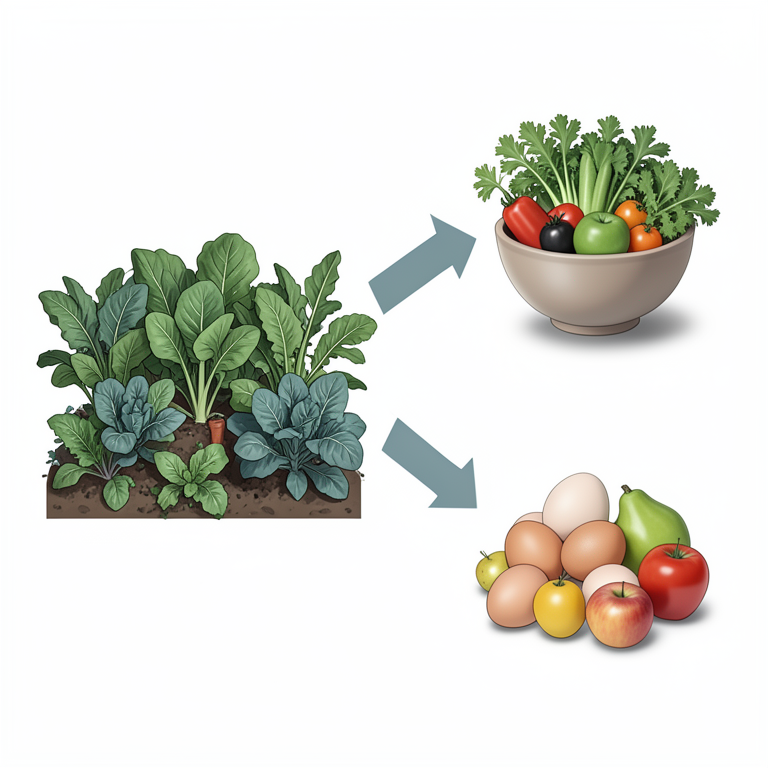
Nutrition Pathway Model
AI-generated conceptual illustration (Rural household kitchen garden and diverse food groups). It explains the idea and does not show study data.
View source evidence ↗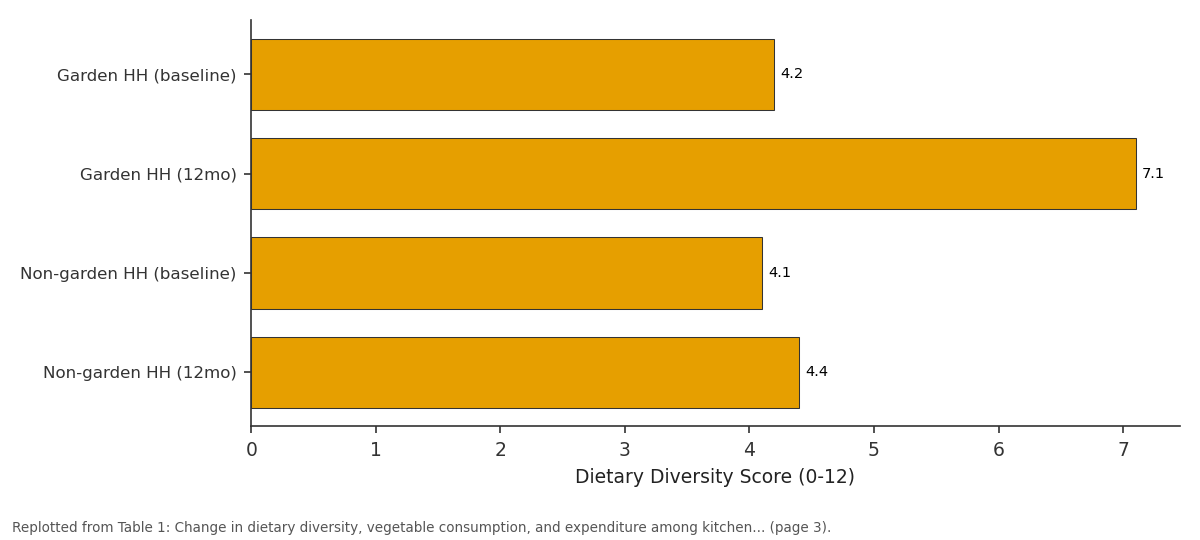
Dietary Diversity Score (0-12): Garden HH (baseline) vs Garden HH (12mo) vs Non-garden HH (baseline) vs Non-garden HH (12mo)
Replotted from Table 1 (page 3) of the original paper. Every bar is the paper's own table value.
View source evidence ↗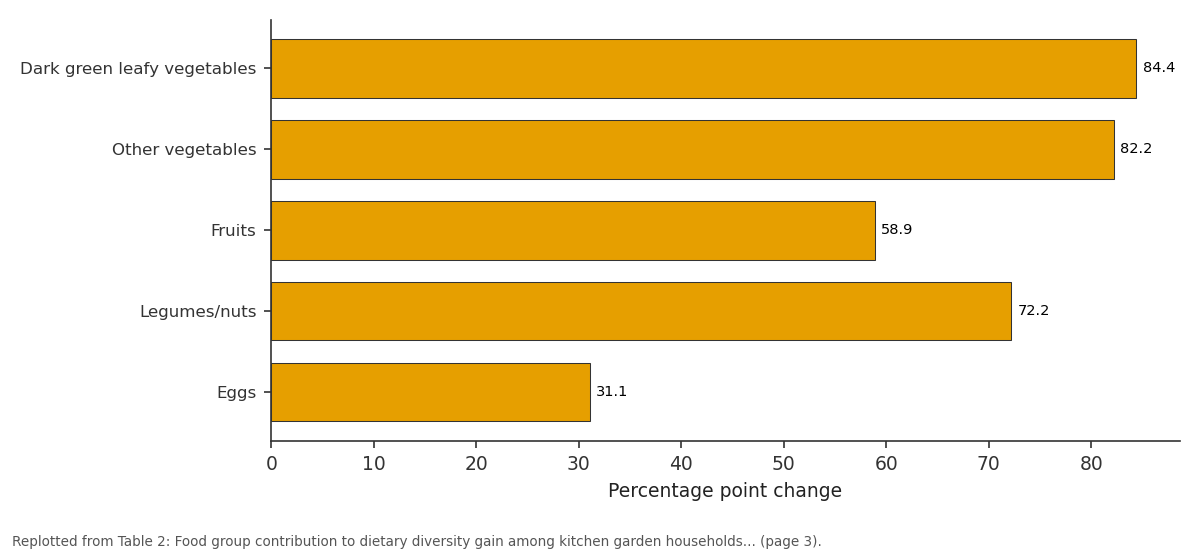
12-month consumption (%): Dark green leafy... vs Other vegetables vs Fruits vs Legumes/nuts vs Eggs
Replotted from Table 2 (page 3) of the original paper. Every bar is the paper's own table value.
View source evidence ↗Figures & tables
From the original paper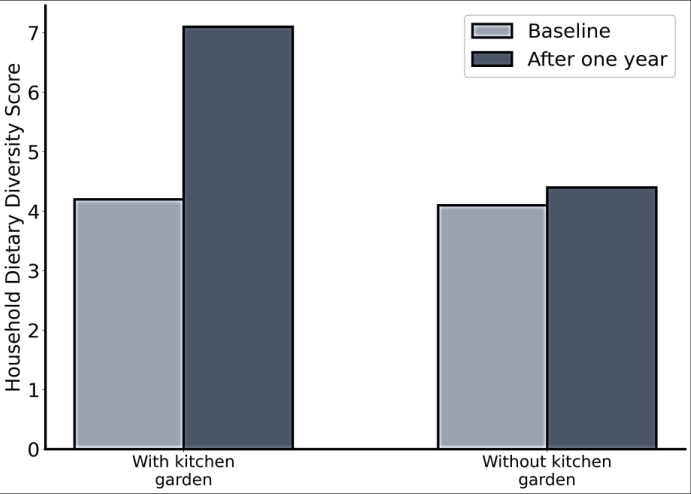 Figure 1
 Table 1
 Table 2
 Table 3
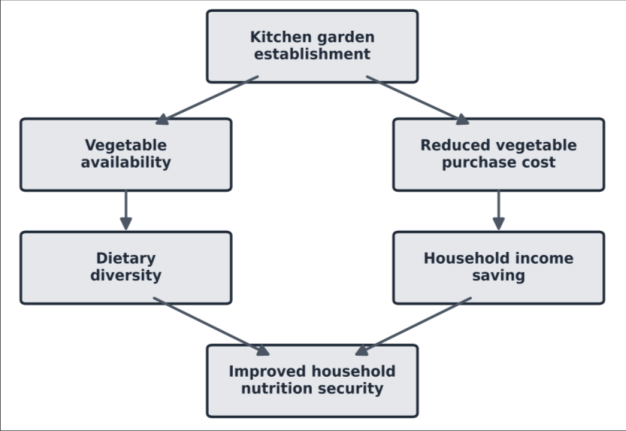 Figure 2
Introduction
Rural households across much of Malawi grow the staple grain that anchors their diet with reasonable reliability, but the vegetables and other diversifying foods that round out a nutritionally adequate diet often depend on market purchase, seasonal availability, or opportunistic foraging, all of which introduce cost and unpredictability that staple grain production does not carry to the same degree [1,2] . Kitchen gardening, small-scale vegetable cultivation within or adjacent to the homestead, has long been promoted as a partial answer to this gap, offering households a direct production pathway to dietary diversity that does not depend on market access or purchasing power in the same way [3] . Evidence supporting kitchen gardening's nutritional impact exists across multiple countries and contexts, but much of it relies on cross-sectional comparison between garden-owning and non-owning households rather than a matched, longitudinal design tracking the same households before and after garden establishment, which leaves open the possibility that households already inclined toward better dietary practices are simply more likely to establish gardens in the first place, rather than the garden itself driving the dietary change observed [4,5] . Household Dietary Diversity Score has become a widely used, validated proxy for household-level food access and nutritional adequacy, correlating reasonably well with more detailed individual dietary intake assessment while requiring far less data collection burden, making it a practical tool for evaluating intervention impact at the scale this research aimed to work at [6,7] . Whether kitchen gardening's dietary diversity benefit operates mainly through direct vegetable production, through the income saved from reduced market purchase being redirected toward other food groups, or through some combination of both pathways, is a distinction with practical relevance for how nutrition-sensitive agriculture programmes design and message kitchen gardening interventions [8] . This research set out to track a matched sample of kitchen garden and non-garden households longitudinally over a full twelve-month period, capturing both a pre-intervention baseline and a post-intervention endpoint, to establish a more rigorous estimate of kitchen gardening's effect on household dietary diversity, vegetable consumption frequency, and vegetable purchase expenditure than crosssectional comparison alone can provide. Objectives were to compare change in Household Dietary Diversity Score, vegetable consumption frequency, and weekly vegetable purchase expenditure between kitchen garden and matched non-garden households over twelve months, and to characterize which food groups contributed most to any dietary diversity gain observed among gardenowning households.
Materials and Methods Theoretical Framework
This research draws on the conceptual pathway linking agricultural production to household nutrition outcomes through three main channels: direct production for own consumption, income generation or saving that can be redirected toward food purchase, and, less directly, changes in household time allocation and intra-household decisionmaking around food. Kitchen gardening was expected to operate primarily through the first two channels, direct vegetable availability for consumption and income saved from reduced market purchase, both of which this research's data collection was designed to capture explicitly rather than treating the pathway as a single undifferentiated intervention effect.
Instrument Development and Validation
Household Dietary Diversity Score was assessed using the standard twelve food-group recall instrument, adapted with minor wording adjustments for local food terminology and validated through a pilot round with twenty households not included in the main research sample, after which two questions were reworded for clarity based on pilot feedback. Vegetable consumption frequency and expenditure were captured through a structured seven-day recall questionnaire, administered by trained enumerators at baseline and at the twelve-month endpoint.
Field Experimental Design
A total of 180 households across three districts surrounding Lilongwe, Malawi, were selected, with 90 households enrolled in a kitchen gardening support programme providing seed, basic tools, and technical training, and 90 comparison households matched on household size, baseline income category, and baseline Household Dietary Diversity Score but not receiving the gardening intervention. Matching was conducted using propensity score matching based on baseline characteristics collected during an initial household survey conducted in month one of the research, before garden establishment began. Data collection occurred at baseline (month 1) and at the twelve-month endpoint (month 13), covering one full seasonal cycle of vegetable production for the garden households.
Methods
Household Dietary Diversity Score was calculated by summing the number of food groups, out of twelve standard categories, consumed by any household member in the previous 24 hours, at both baseline and endpoint. Vegetable consumption frequency was recorded as the number of days per week vegetables were consumed by the household, averaged across a seven-day recall period. Weekly vegetable purchase expenditure was recorded in local currency and converted to a standardized unit for analysis. Data were analyzed using paired and independent-samples statistical comparison appropriate to the matched longitudinal design, testing both within-group change over time and betweengroup difference in that change. The comparison in Figure 1 shows both household groups starting from a nearly identical baseline dietary diversity score, which supports the validity of the propensity score matching approach used to select comparison households, before diverging sharply over the twelve-month research period as garden households registered a large gain that nongarden households did not come close to matching. Dark green leafy vegetables recorded by far the largest gain among the food groups tracked, consistent with these being the vegetable category most commonly and easily grown within small homestead garden plots in this setting, requiring minimal space and reaching harvestable maturity faster than most other garden vegetable options.
Results
Results
Comprehensive Interpretation
Taken together, the dietary diversity, expenditure, and micronutrient budget data point toward both pathways identified in the theoretical framework operating simultaneously among garden households. Direct vegetable production explains most of the dark green leafy vegetable consumption gain, since this food group requires no purchase at all once the garden is producing, while the substantial fall in vegetable purchase expenditure suggests some of the income freed up was likely redirected toward other food groups, plausibly contributing to the smaller but still meaningful gains recorded in fruit, legume, and egg consumption, categories not directly produced within most of the kitchen gardens established under this programme.
Discussion
The magnitude of dietary diversity gain recorded here, nearly three points on the twelve-point scale, sits toward the higher end of what kitchen gardening intervention research elsewhere has reported, where gains of one to two points are more typical over a comparable timeframe [4,9] . Part of this may reflect the specific baseline conditions in this research's study districts, where vegetable market access was relatively limited and vegetable prices comparatively high, meaning direct home production likely displaced a larger share of previously unmet or expensive vegetable consumption than would be the case in a setting with cheaper, more accessible vegetable markets. The near-flat trajectory among non-garden households over the same twelve months is itself informative, since it rules out a general regional dietary improvement trend as an explanation for the garden households' gain, strengthening the case that garden establishment specifically, rather than some shared seasonal or economic factor affecting all households in the study districts, drove the divergence recorded [5,10] . This matched longitudinal design addresses a limitation common in cross-sectional kitchen gardening research, where self-selection into gardening by already nutrition-conscious households can inflate the apparent effect size when baseline comparability is not established as carefully [4] . The scale of vitamin A contribution gain, driven mainly by increased dark green leafy vegetable consumption, carries particular relevance in a region where vitamin A deficiency remains a documented public health concern among rural populations [11,12] . Whether this estimated dietary contribution gain translates into measurable improvement in biochemical vitamin A status would require blood-based micronutrient assessment beyond this research's dietary recall methodology, but the direction and scale of the dietary shift recorded here is consistent with a meaningful nutritional contribution worth pursuing at programme scale.
Limitations
This research relied on self-reported dietary recall rather than biochemical nutrient status assessment, and while Household Dietary Diversity Score is a validated proxy, it does not capture portion size or absolute nutrient intake with the precision that direct dietary intake assessment would provide. Households were matched on baseline characteristics but not randomly assigned to the gardening intervention, leaving some residual possibility that unmeasured household characteristics influenced both the decision to participate in the gardening programme and the dietary outcomes observed, though the close baseline similarity between groups on the measured indicators offers some reassurance against this concern. Extending this research design across a second growing season, and incorporating a biochemical micronutrient status subsample, would strengthen confidence in both the magnitude and durability of the effects reported here.
Conclusion
Kitchen gardening is widely promoted across rural nutrition programming in Malawi and similar settings, yet rigorous longitudinal evidence quantifying its household-level dietary impact has remained comparatively scarce, and this research set out to address that gap using a matched, twelvemonth tracked comparison of garden and non-garden households. Kitchen garden households recorded substantially greater gains in dietary diversity, vegetable consumption frequency, and vegetable purchase expenditure savings than matched non-garden households over the same period, with dark green leafy vegetables driving the largest share of the dietary diversity improvement observed. These findings support continued and, where resources allow, expanded promotion of kitchen gardening within nutritionsensitive agriculture programming in this region, given the scale of dietary benefit recorded relative to the modest input cost, seed, basic tools, and technical training, required to establish a household garden. Looking forward, extending this tracked comparison across a second growing season and incorporating direct biochemical micronutrient status assessment would help confirm both the durability of these dietary gains and their translation into measurable improvement in nutritional status among the household members these programmes are ultimately intended to benefit.
Figures and tables from the paper
| Indicator | Garden HH (baseline) | Garden HH (12mo) | Non-garden HH (baseline) | Non-garden HH (12mo) |
|---|---|---|---|---|
| Dietary Diversity Score (0-12) | 4.2 | 7.1 | 4.1 | 4.4 |
| Vegetable consumption (days/wk) | 3.1 | 6.2 | 3.0 | 3.4 |
| Weekly vegetable spend (local units) | 820 | 476 | 805 | 842 |
Table text extracted from the original PDF; superscript letters are shown inline. The original table image is below.
View original table image
| Food group | Baseline consumption (%) | 12-month consumption (%) | Percentage point change |
|---|---|---|---|
| Dark green leafy vegetables | 38.9 | 84.4 | +45.5 |
| Other vegetables | 51.1 | 82.2 | +31.1 |
| Fruits | 42.2 | 58.9 | +16.7 |
| Legumes/nuts | 61.1 | 72.2 | +11.1 |
| Eggs | 24.4 | 31.1 | +6.7 |
Table text extracted from the original PDF; superscript letters are shown inline. The original table image is below.
View original table image
References
14 in the original paper- Faber M, Wenhold F. Nutrition in contemporary South Africa. Water SA. 2021;33(3):393-400.
- Ruel M, Alderman H. Nutrition-sensitive interventions and programmes: how can they help to accelerate progress in improving maternal and child nutrition? Lancet. 2023;382(9891):536-551.
- Galhena D, Freed R, Maredia K. Home gardens: a promising approach to enhance household food security and wellbeing. Agric Food Secur. 2022;2(1):8.
- Olney D, Talukder A, Iannotti L, Ruel M, Quinn V. Assessing impact and impact pathways of a homestead food production program on household and child nutrition in Cambodia. Food Nutr Bull. 2019;30(4):355369.
- Berti P, Krasevec J, FitzGerald S. A review of the effectiveness of agriculture interventions in improving nutrition outcomes. Public Health Nutr. 2020;7(5):599609.
- Swindale A, Bilinsky P. Household Dietary Diversity Score for Measurement of Household Food Access: Indicator Guide. Version 2. FANTA Proj; 2021. p. 113.
- Kennedy G, Ballard T, Dop M. Guidelines for Measuring Household and Individual Dietary Diversity. 1st ed. FAO Publ; 2022. p. 1-60.
- Masset E, Haddad L, Cornelius A, Isaza-Castro J. Effectiveness of agricultural interventions that aim to improve nutritional status of children. BMJ. 2019;344: d8222.
- Iannotti L, Cunningham K, Ruel M. Improving diet quality and micronutrient nutrition: homestead food production in Bangladesh. IFPRI Discuss Pap. 2020;928:1-40.
- Girard A, Self J, McAuliffe C, Olude O. The effects of household food production strategies on the nutrition and health of women and young children. Paediatr Perinat Epidemiol. 2022;26(Suppl 1):205-222.
- West K. Vitamin A deficiency disorders in children and women. Food Nutr Bull. 2023;24(4 Suppl): S78-S90.
- World Health Organization. Global Prevalence of Vitamin A Deficiency in Populations at Risk. 1st ed. WHO Global Database; 2021. p. 1-55.
- Talukder A, Kiess L, Huq N, de Pee S, Darnton-Hill I, Bloem M. Increasing the production and consumption of vitamin A-rich fruits and vegetables. Food Nutr Bull. 2020;21(2):165-172.
- Baliki G, Brueck T, Schreinemachers P. Vegetable production, women's income and household food security. Food Secur. 2019;11(6):1359-1372.