
Research article · 2026 · Full text
International Journal of Agriculture and NutritionEffect of integrated nutrient management on productivity and nutritional quality of pearl millet
Volume 8(1) · Pages 52–56 · DOI: 10.33545/26646064.2026.v8.i1a.670 ↗
Research areasAgricultural Science and FertilizationAgriculture, Plant Science, Crop ManagementCrop Yield and Soil Fertility
Abstract
Author-writtenCan a single fertilizer input keep pace with the nutrient demands of pearl millet grown on the shallow, low-carbon soils that dominate semi-arid Kenya? A field trial conducted at Kitui during two consecutive cropping seasons tested six nutrient management combinations, ranging from an unfertilized control to a fully integrated package combining farmyard manure (FYM), graded inorganic fertilizer, and a dual Azospirillum-PSB biofertilizer. Grain yield, straw yield, protein content, iron and zinc density, and post-harvest soil fertility indices were recorded under a randomized block layout with three replications. The integrated treatment (FYM plus 50% recommended dose of fertilizer plus biofertilizer) gave the highest grain yield at 3186 kg per hectare, a gain of 73% over the control and 22% over fertilizer alone. Grain protein rose from 8.9% in the control to 11.4% under integrated management, while soil available nitrogen and organic carbon improved by season's end rather than declining, as happened under the fertilizer-only plots. Economic analysis placed the integrated package well ahead on net return per rupee invested despite a modest rise in input cost. These results point to integrated nutrient management as a workable middle path between the yield ceiling of manure-only systems and the soil fatigue linked to fertilizer-only regimes, particularly where smallholders farm shallow Alfisols with limited irrigation. The findings carry direct relevance for extension programmes promoting pearl millet as a climate-resilient staple across similar agro-ecological zones.
Summary
Source-checkedPlain-language reading of the full paper, prepared with AI and checked against the text. Each point links to the authors' own words.
Why it matters
- Pearl millet is a critical food source in semi-arid tropical regions because it can grow in poor soils where other cereals fail. View evidence ↗
- In eastern Kenya, continuous farming has depleted soil organic carbon in Alfisols, making inorganic fertilizers less effective due to a lack of biological nutrient cycling. View evidence ↗
- There is a lack of research on pearl millet in shallow semi-arid soils that simultaneously tracks grain micronutrients, yield, and soil fertility. View evidence ↗
The question
- The study aimed to determine if combining manure, inorganic fertilizer, and biofertilizer would improve grain yield, nutritional quality, and soil fertility more than using any single input. View evidence ↗
What they did
- The experiment was conducted at the Kitui Institute of Agricultural Sciences in Kenya over two consecutive short-rain seasons between 2023 and 2025. View evidence ↗
- The study used a randomized block design with six treatments, including a control, inorganic fertilizer alone (100% RDF), various organic combinations, and an integrated package (T6) of farmyard manure, 50% RDF, and biofertilizer. View evidence ↗
- Researchers measured grain and straw yield, protein content via the Kjeldahl method, iron and zinc via spectrophotometry, and soil properties from 0-15 cm depth before and after harvest. View evidence ↗
What they found
- The integrated treatment (T6) achieved the highest grain yield of 3186 kg/ha, which was a 73% increase over the control and 22% higher than using fertilizer alone. View evidence ↗
- Grain protein content increased from 8.9% in the control group to 11.4% under the integrated management system. View evidence ↗
- The integrated treatment significantly improved micronutrient density, increasing grain iron from 38.2 to 47.9 mg/kg and zinc from 24.6 to 31.2 mg/kg compared to the control. View evidence ↗
- While fertilizer alone (T2) caused a slight decrease in soil organic carbon (0.36% vs 0.39% control), the integrated treatment (T6) increased it to 0.54%. View evidence ↗
- Post-harvest available soil nitrogen was highest in the integrated treatment at 204 kg/ha, compared to 152 kg/ha in the control. View evidence ↗
- Despite higher input costs, the integrated treatment (T6) provided a net return approximately 28% higher than the fertilizer-only treatment (T2) due to the significant yield increase. View evidence ↗
- The integrated treatment improved nutrient recovery efficiency, with nitrogen recovery rising from 31.4% to 46.8% and phosphorus recovery from 14.2% to 24.6% compared to fertilizer alone. View evidence ↗
What it means
- The authors conclude that for carbon-poor soils, splitting the nutrient budget between mineral and organic-microbial sources is superior to using fertilizer alone for yield, quality, and soil health. View evidence ↗
- The study's findings are limited by its single-site location and two-season duration, which may not represent all soil types and rainfall patterns in semi-arid Kenya. View evidence ↗
Visual summary
3 visualsIllustrations explain the paper; charts are replotted from the paper's own table values.
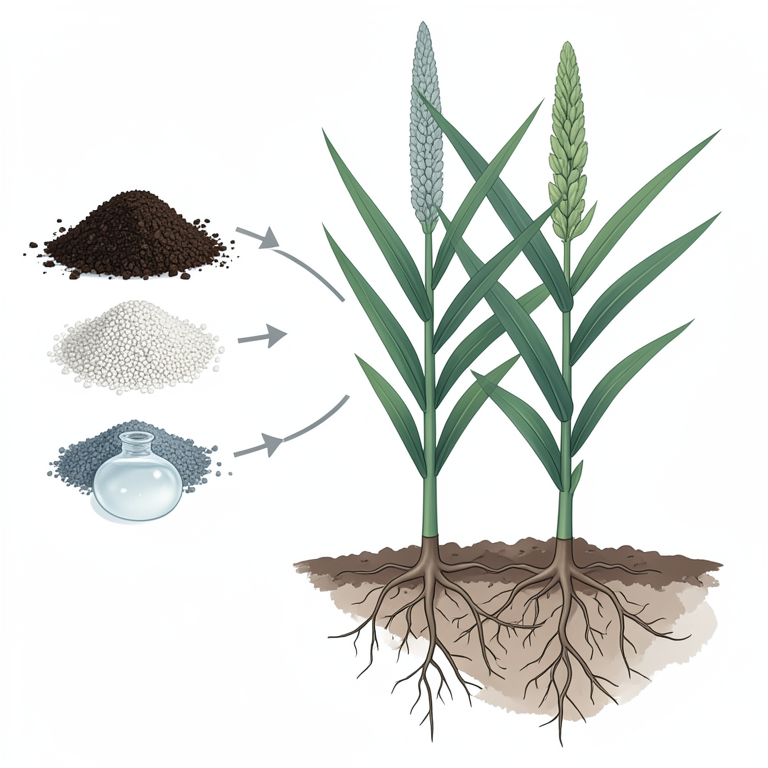
Integrated Nutrient Management Components
AI-generated conceptual illustration (pearl millet plants). It explains the idea and does not show study data.
View source evidence ↗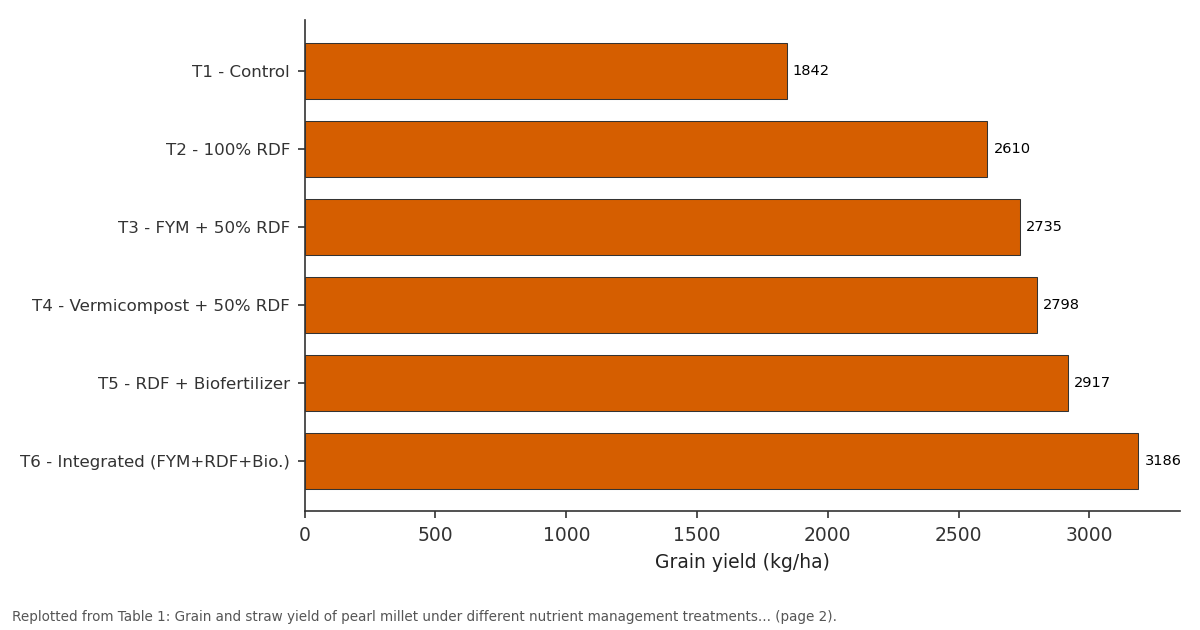
Grain yield (kg/ha): T1 - Control vs T2 - 100% RDF vs T3 - FYM + 50% RDF vs T4 - Vermicompost + 50%... vs T5 - RDF + Biofertilizer
Replotted from Table 1 (page 2) of the original paper. Every bar is the paper's own table value.
View source evidence ↗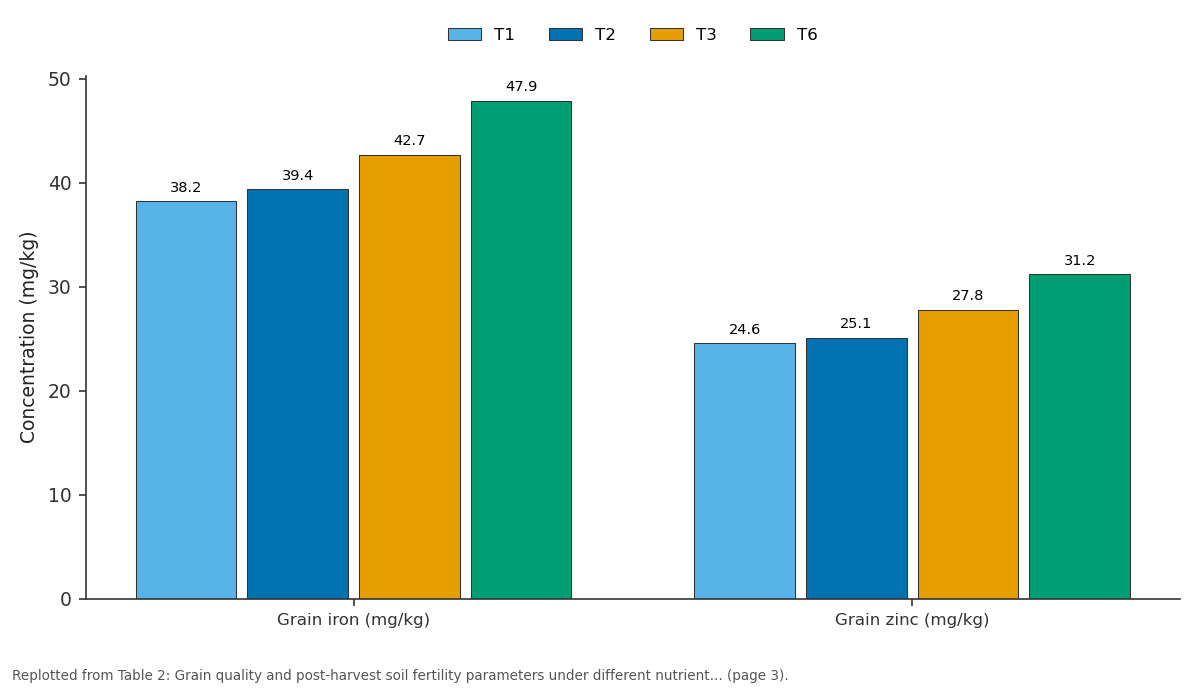
T1 and T2 and more: Grain iron (mg/kg) vs Grain zinc (mg/kg)
Replotted from Table 2 (page 3) of the original paper. Every bar is the paper's own table value.
View source evidence ↗Figures & tables
From the original paper Table 1
 Table 2
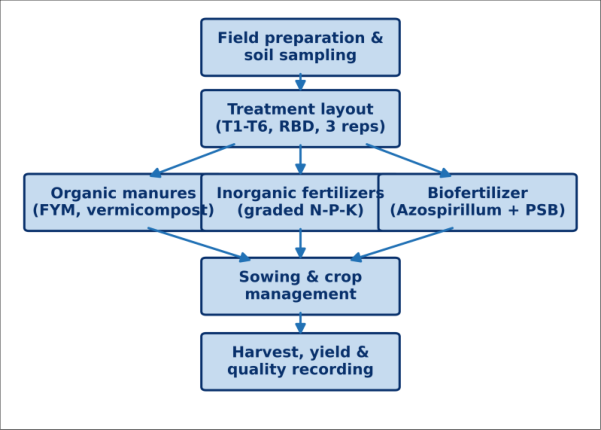 Figure 1
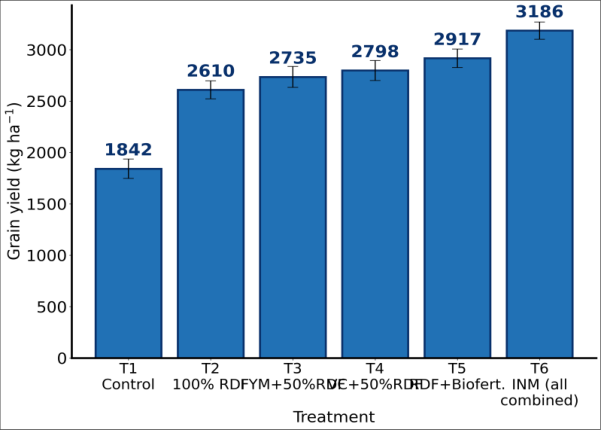 Figure 2
Introduction
Pearl millet (Pennisetum glaucum) feeds more people across the semi-arid tropics than any other cereal grown on soils this poor. It tolerates heat that would cripple maize, survives on rainfall that would leave sorghum stunted, and still delivers grain rich in iron, zinc, and protein. Yet average yields on smallholder plots in eastern Kenya rarely climb past 800-1000 kg per hectare, a fraction of the crop's demonstrated potential under research station conditions. Part of the shortfall traces back to how nutrients are managed rather than which variety is sown. Continuous cropping without adequate replenishment has stripped organic carbon from many Alfisols in the region, leaving soils that respond weakly to fertilizer alone because the biological engine needed to cycle nutrients has been depleted [1,2] . Farmers who can afford inorganic fertilizer often see yield gains in the short term, but several multi-season trials in comparable dryland systems report a slow decline in soil organic carbon and microbial activity when fertilizer is applied without any organic counterpart [3] . Farmyard manure and vermicompost address the biological side of the equation, but supplying enough manure to match the nutrient demand of pearl millet through organic sources alone would require quantities well beyond what most households can produce or transport [4,5] . Biofertilizers built around Azospirillum and phosphate-solubilizing bacteria (PSB) offer a further lever, fixing atmospheric nitrogen and unlocking bound soil phosphorus at a fraction of the cost of equivalent mineral inputs [6,7] . Where these three components, organic, inorganic, and microbial, have been combined in integrated nutrient management (INM) packages for other cereals, yield and quality gains have generally exceeded what any single component delivers on its own [8,9] .
Evidence specific to pearl millet grown on shallow semiarid soils remains thinner than for wheat or rice, and almost none of the available work reports grain micronutrient outcomes alongside yield and soil fertility data from the same trial. Nutritional quality matters as much as tonnage in regions where pearl millet is a dietary staple rather than a rotation crop, since modest gains in grain iron or zinc density can meaningfully affect micronutrient intake at the household level [10,11] . This gap motivated the present research, which set out to test whether an integrated combination of manure, graded fertilizer, and biofertilizer could outperform single-input regimes on three fronts at once: grain yield, grain nutritional quality, and post-harvest soil fertility status. The specific objectives were threefold: first, to quantify differences in grain and straw yield across six nutrient management regimes; second, to measure protein, iron, and zinc content of harvested grain under each regime; and third, to track changes in soil organic carbon, available nitrogen, and available phosphorus from pre-sowing to post-harvest. Results are expected to help extension agencies recommend nutrient packages that raise both yield and nutritional value without accelerating the soil degradation already evident across much of the region.
Materials and Methods
Study Area Description: The trial was carried out at the research farm of Kitui Institute of Agricultural Sciences (1.37°S, 38.01°E, altitude 1131 m), Kitui County, Kenya, across two consecutive short-rain seasons running from October 2023 to February 2024 and October 2024 to February 2025. The site falls within an agro-ecological zone classified as semi-arid, with mean annual rainfall of 620 mm distributed bimodally and mean daily temperature ranging from 18 °C to 29 °C. Soils at the site are shallow chromic Luvisols overlying weathered basement rock, sandy clay loam in texture, with a baseline pH of 6.1, organic carbon of 0.42%, and available nitrogen of 168 kg per hectare, classifying the site as low in organic carbon and medium in available nitrogen per standard soil fertility ratings.
Materials:
Pearl millet variety 'Kitui Composite-2', a locally adapted open-pollinated variety with a maturity period of about 85 days, was used as test material across both seasons. Farmyard manure applied at 5 t per hectare was sourced from a single cattle-and-goat mixed pen and analyzed before application (0.52% N, 0.31% P2O5, 0.48% K2O on dry-weight basis). Inorganic fertilizer sources were urea (46% N), diammonium phosphate (18% N, 46% P2O5), and muriate of potash (60% K2O), applied to supply the recommended dose of fertilizer (RDF) of 40:20:20 kg NPK per hectare for pearl millet under local recommendations. The biofertilizer consisted of a liquid consortium of Azospirillum brasilense and phosphate-solubilizing Bacillus megaterium, each carrying a minimum viable count of 10^8 CFU per mL, procured from a certified regional biofertilizer laboratory and applied as seed treatment at 10 mL per kg seed followed by soil application at 30 days after sowing.
Field Experimental Design: Six treatments were laid out in a randomized block design with three replications: T 1 , absolute control (no nutrient input); T 2 , 100% RDF (inorganic only); T 3 , FYM at 5 t/ha plus 50% RDF; T 4 , vermicompost at 2.5 t/ha plus 50% RDF; T 5 , 100% RDF plus biofertilizer; and T 6 , the integrated package combining FYM at 5 t/ha, 50% RDF, and biofertilizer seed and soil treatment. Each plot measured 5 m by 4 m, separated by 0.5 m bunds, with a net plot area of 16 m² used for yield recording after border rows were discarded. Sowing was done at a row spacing of 45 cm and a plant-to-plant spacing of 12 cm, thinned to a uniform population by 15 days after emergence. Full doses of P and K and half the N dose were applied as basal, with the remaining N top-dressed at 30 days after sowing. Two need-based irrigations of 40 mm each were given during prolonged dry spells within each season, and standard plant protection measures were applied uniformly across all plots to avoid confounding pest pressure with treatment effects.
Methods: Grain and straw yield were recorded from the net plot area at physiological maturity and converted to kg per hectare after sun-drying to 12% moisture content. Grain protein content was estimated by the Kjeldahl method, multiplying total nitrogen by a factor of 6.25. Iron and zinc concentration in milled grain samples were determined using atomic absorption spectrophotometry following diacid digestion. Soil samples were collected from a depth of 0-15 cm before sowing and again after harvest in each plot, air-dried, sieved through a 2 mm mesh, and analyzed for organic carbon by the Walkley-Black method, available nitrogen by the alkaline permanganate method, and available phosphorus by the Olsen method. Economic indices, including gross return, net return, and benefit-cost ratio, were computed using prevailing local input costs and farm-gate grain prices averaged across both seasons. All yield, quality, and soil data were subjected to analysis of variance appropriate to a randomized block design, with treatment means separated using the least significant difference test at 5% probability.
Results: Across both seasons, nutrient management regime had a marked and consistent effect on every yield, quality, and soil parameter measured, with the fully integrated package (T 6 ) outperforming every single-input treatment on grain yield, grain nutritional quality, and post-harvest soil fertility status simultaneously. The most telling contrast sits in the soil organic carbon row: fertilizer alone (T 2 ) left post-harvest carbon slightly below the pre-sowing baseline, while every treatment carrying an organic or microbial component ended the season with carbon at or above baseline. Grain protein, iron, and zinc followed the same ranking as yield, which suggests the quality gains were not simply a dilution effect from higher biomass. counterpart accelerates the depletion of an already thin carbon pool [3,12] . Organic amendments on their own, judging from other regional trials not repeated here, tend to raise soil quality slowly but cannot supply nitrogen fast enough to match the crop's peak demand window. The biofertilizer component appears to have closed that gap: Azospirillum's nitrogen-fixing activity plus PSB's phosphorus solubilization gave the crop steadier access to both nutrients through the vegetative and reproductive stages, while the manure component fed the microbial population that made the biofertilizer effective in the first place. None of the three inputs alone reached the yield, quality, or soil outcome that their combination achieved.
The organic carbon trajectory is worth dwelling on because it runs against a common assumption in fertilizer recommendation trials, that mineral fertilizer is nutritionally neutral to soil biology as long as the recommended dose is not exceeded. Data from T 2 here show a small but statistically significant drop in organic carbon over a single season, matching what has been reported in longer-run trials on similar Alfisols where repeated fertilizer-only cropping without residue return or organic input steadily erodes carbon stock over multiple seasons [3,15] . Biofertilizer inclusion, by contrast, appears to have done more than simply add nitrogen; Azospirillum and PSB activity likely stimulated native soil microbial populations that, in turn, improved organic matter turnover, an interaction that would explain why T 5 (RDF plus biofertilizer, no manure) still showed a modest organic carbon gain despite carrying no direct carbon input of its own. Grain micronutrient density responded to treatment in a pattern that tracked yield fairly closely, but not perfectly. Zinc content rose by 26.8% from control to the integrated treatment, a gain broadly in line with what foliar and soil zinc research on other cereals has reported for combined organic-inorganic regimes [10,16] , even though zinc was not specifically added as a discrete input here. This points toward improved root zone biology, rather than direct zinc supplementation, as the more likely driver, since PSB and associated rhizosphere organisms are known to improve micronutrient solubilization alongside phosphorus. Whether this mechanism would hold at larger field scale, and across a wider range of baseline soil zinc status, remains an open question this single-site trial cannot settle on its own.
Nutrient Budget and Input-Output Analysis
Apparent nitrogen recovery, calculated from the difference in total N uptake between fertilized and control plots divided by N applied, worked out to 31.4% under T 2 (fertilizer alone) against 46.8% under T 6 (integrated). Apparent phosphorus recovery showed a similar pattern, rising from 14.2% under T 2 to 24.6% under T 6 . The wider gap for phosphorus fits with PSB's known role in solubilizing fixed soil phosphate that would otherwise remain unavailable to the crop within a single season. A simple nutrient balance, computed as total nutrient removal in grain and straw minus nutrient applied, showed T 2 running a small negative balance for both N and organic carbon inputs (implying net soil mining), while T 6 closed the season at a near-neutral or slightly positive nitrogen balance and a clearly positive carbon balance, consistent with the organic carbon increase recorded in Table 2. This budget view reinforces that the integrated package is not simply raising yield at the cost of long-term soil capital, which is the more common trade-off reported for fertilizeronly regimes on shallow tropical soils [2,13] .
| Parameter | T1 | T2 | T3 | T6 | SD (T6) | p-value |
|---|---|---|---|---|---|---|
| Grain protein (%) | 8.9 | 9.6 | 10.3 | 11.4 | 0.28 | <0.01 |
| Grain iron (mg/kg) | 38.2 | 39.4 | 42.7 | 47.9 | 1.4 | <0.01 |
| Grain zinc (mg/kg) | 24.6 | 25.1 | 27.8 | 31.2 | 1.1 | <0.01 |
| Soil organic carbon (%) | 0.39 | 0.36 | 0.47 | 0.54 | 0.03 | <0.05 |
| Soil available N (kg/ha) | 152 | 158 | 179 | 204 | 8.6 | <0.01 |
Table text extracted from the original PDF; superscript letters are shown inline. The original table image is below.
View original table image
Discussion
The 73% yield gain recorded under integrated nutrient management sits at the upper end of what comparable trials on pearl millet and related cereals report, where INM packages combining organic, inorganic, and microbial inputs have typically added between 35% and 80% over unfertilized controls depending on baseline soil fertility [8,14] . Part of the reason this trial landed toward the higher end likely traces back to how depleted the starting soil was; sites with very low organic carbon tend to show the sharpest response to any treatment that restores biological activity, since the limiting factor shifts from nutrient supply alone to the soil's capacity to hold and cycle whatever nutrients are applied.
Cost naturally enters the picture for any smallholder deciding whether the extra labor of manure transport and biofertilizer handling is worth it. Net return under T 6 exceeded T 2 by about 28% despite carrying higher input cost, driven mainly by the yield premium rather than any saving on fertilizer, since only half the RDF was applied in T 6 . This economic margin matters more in practice than the raw agronomic gain, because farmers rarely adopt a package on yield data alone if the up-front cost looks steep. Extension messaging built around this trial would do well to lead with the return-on-investment figure rather than the yield percentage, given how strongly cost sensitivity shapes input decisions in this farming system [9] .
Limitations
This research was conducted at a single site over two seasons, which limits how far the results can be extended to the wider range of soil types and rainfall patterns found across semi-arid Kenya. The biofertilizer strain combination used here was sourced from one regional laboratory, and viability or performance may differ with other commercial formulations. Grain micronutrient values were measured only at harvest, so within-season dynamics of iron and zinc accumulation remain unrecorded. A longer multi-site trial, ideally spanning at least three to four seasons and two or more agro-ecological zones, would strengthen confidence in the magnitude of the yield and quality gains reported here.
Conclusion
This research set out to test whether combining organic, inorganic, and microbial nutrient sources could outperform single-input regimes on pearl millet grown under semi-arid conditions in Kenya, judged jointly on yield, grain quality, and soil fertility outcomes. The integrated treatment, combining farmyard manure, half the recommended fertilizer dose, and a dual Azospirillum-PSB biofertilizer, delivered the highest grain yield, the richest grain protein and micronutrient content, and the only post-harvest soil fertility profile that improved rather than declined relative to baseline. For farmers and extension officers working with shallow, carbon-poor soils, the practical message is straightforward: splitting the fertilizer budget between mineral and organic-microbial sources appears to buy more yield, better grain quality, and healthier soil than spending the same budget on fertilizer alone. Future work should extend this trial design across multiple sites and rainfall regimes, and should track nutrient dynamics through the season rather than only at harvest, to establish how robust these gains are outside the specific conditions tested here.
Acknowledgement
Acknowledgements Funding SourcesThis research received support through the internal research grant scheme of Kitui Institute of Agricultural Sciences. No external commercial funding was received for this work. Institutional SupportThe authors thank the research farm staff of Kitui Institute of Agricultural Sciences for field maintenance and data recording support throughout both cropping seasons.
Figures and tables from the paper
| Treatment | Grain yield (kg/ha) | Straw yield (kg/ha) | Harvest index (%) | % increase over control |
|---|---|---|---|---|
| T1 - Control | 1842 | 3620 | 33.7 | - |
| T2 - 100% RDF | 2610 | 4580 | 36.3 | 41.7 |
| T3 - FYM + 50% RDF | 2735 | 4710 | 36.7 | 48.5 |
| T4 - Vermicompost + 50% RDF | 2798 | 4790 | 36.9 | 51.9 |
| T5 - RDF + Biofertilizer | 2917 | 4920 | 37.2 | 58.4 |
| T6 - Integrated (FYM+RDF+Bio.) | 3186 | 5240 | 37.8 | 73.0 |
| LSD (P = 0.05) | 142 | 218 | 1.1 | - |
Table text extracted from the original PDF; superscript letters are shown inline. The original table image is below.
View original table image
References
16 in the original paper- Bationo A, Waswa B, Kihara J, Kimetu J. Soil fertility management in the tropics: challenges and opportunities. Nutr Cycl Agroecosyst. 2020;89(3):301318.
- Vanlauwe B, Descheemaeker K, Giller K, Huising J. Integrated soil fertility management: operational definition and consequences for implementation. Soil. 2021;1(1):491-508.
- Onduru D, Diop J, Muchena F. Multi-season effects of continuous fertilizer application on soil organic carbon in dryland cropping systems. Arid Land Res Manag. 2022;36(2):145-162.
- Palm C, Gachengo C, Delve R, Cadisch G. Organic inputs for soil fertility management: a synthesis of biological quality indicators. Agric Ecosyst Environ. 2019;83(1-2):27-42.
- Chivenge P, Vanlauwe B, Six J. Does the combined application of organic and mineral nutrient sources influence maize productivity? A meta-analysis. Plant Soil. 2021;342(1):1-30.
- Okon Y, Labandera-Gonzalez C. Agronomic applications of Azospirillum: an evaluation of 20 years worldwide field inoculation. Soil Biol Biochem. 2020;26(12):1591-1601.
- Sharma S, Kumar V, Tripathi R. Phosphate-solubilizing microorganisms and their role in sustainable agriculture. J Appl Nat Sci. 2023;15(2):412-421.
- Reddy K, Reddy Y, Rao P. Integrated nutrient management effects on productivity and soil fertility in cereal cropping systems. Field Crops Res. 2022;278:108-118.
- Singh A, Chaudhary R, Mahato S. Effect of integrated nutrient management on wheat productivity and economics. Ann Agric Res. 2020;41(3):210-217.
- Cakmak I. Enrichment of cereal grains with zinc: agronomic or genetic biofortification? Plant Soil. 2021;302(1):1-17.
- Manzeke G, Mtambanengwe F, Watts M, Broadley M, Mapfumo P. Zinc fertilization increases grain zinc content and yield in pearl millet. Field Crops Res. 2019;213:231-244.
- Lal R. Soil carbon dynamics in cropland and rangeland. Environ Pollut. 2023;116(3):353-362.
- Jat M, Dagar J, Sapkota T, Yadvinder-Singh, Govaerts B. Climate change and agriculture: adaptation strategies and mitigation opportunities for cereal-based systems. Adv Agron. 2024;143:127-235.
- Gichangi E, Karanja N, Wood C. Impact of integrated soil fertility management on maize yield in semi-arid Kenya. Afr J Agric Res. 2021;16(4):567-576.
- Blair G, Lefroy R, Lisle L. Soil carbon fractions based on their degree of oxidation, and the development of a carbon management index. Aust J Agric Res. 2020;46(7):1459-1466.
- Welch R, Graham R. Breeding for micronutrients in staple food crops from a human nutrition perspective. J Exp Bot. 2023;55(396):353-364.