
Research article · 2026 · Full text
International Journal of Agriculture and NutritionPost-harvest quality assessment of stored pulses under different packaging materials
Volume 8(1) · Pages 107–111 · DOI: 10.33545/26646064.2026.v8.i1b.676 ↗
Research areasAgricultural Engineering and MechanizationInsect Pest Control StrategiesSeed Germination and Physiology
Abstract
Author-writtenJute bags versus airtight containers is a debate that plays out every harvest season in pulse-growing communities across East Africa, usually settled by habit rather than any side-by-side comparison of what each material actually does to stored grain over time. A six-month post-harvest research compared four packaging materials, jute bag, plastic bag, vacuum pack, and airtight plastic container, for their effect on moisture content, insect infestation, germination percentage, and overall grain quality of stored common bean at Dodoma. Vacuum packing preserved grain quality most effectively, limiting moisture gain to just 0.9 percentage points and insect damage to 2.1% of grains over the six-month storage period, against 34.2% insect damage recorded in jute bags over the same duration. Germination percentage after six months fell from an initial 94% to 88% under vacuum packing but collapsed to 61% under jute bag storage, reflecting both moisture-related deterioration and physical damage from insect feeding. Airtight containers performed nearly as well as vacuum packing on insect exclusion but showed somewhat higher moisture accumulation, likely due to residual air trapped within the container at sealing. These results support vacuum packing or, where the equipment cost is prohibitive, well-sealed airtight containers as substantially superior alternatives to the jute bags still most commonly used across smallholder pulse storage systems in this region, particularly where grain is intended for seed use or extended storage beyond three months.
Summary
Source-checkedPlain-language reading of the full paper, prepared with AI and checked against the text. Each point links to the authors' own words.
Why it matters
- In East African smallholder systems, stored pulses like common beans are susceptible to moisture reabsorption, mold, and insect infestation, which reduce their market value and seed viability. View evidence ↗
- Jute bags are commonly used due to low cost, but they are permeable to moisture and insects, leaving grain exposed to environmental fluctuations. View evidence ↗
- Hermetic storage, such as vacuum packing and airtight containers, suppresses mold and insect metabolism by reducing available oxygen. View evidence ↗
The question
- The study aimed to determine which of four packaging materials best preserves the moisture, insect resistance, and germination rate of common beans over six months of storage. View evidence ↗
What they did
- The researchers used the 'Uyole 96' common bean variety, which was sun-dried to a moisture content of 12% before the experiment began. View evidence ↗
- The four tested materials were standard woven jute bags, low-density polyethylene plastic bags, vacuum-sealed polyethylene pouches, and rigid airtight plastic containers with rubber gaskets. View evidence ↗
- Six replicates of 5 kg grain samples per treatment were stored under ambient conditions at the Dodoma Institute of Agricultural Sciences from July to December 2024. View evidence ↗
- Moisture and insect damage were measured monthly, while germination percentage was tested at the start and end of the six-month period. View evidence ↗
What they found
- Vacuum packing was the most effective method, resulting in only 0.9% moisture gain and 2.1% insect damage after six months. View evidence ↗
- Jute bags performed the worst, with 34.2% insect damage and a moisture gain of 6.8%. View evidence ↗
- Airtight containers were nearly as effective as vacuum packs, showing 3.8% insect damage and 85.6% germination, though they had slightly higher moisture gain (1.6%). View evidence ↗
- Insect damage in jute bags accelerated over time, nearly doubling between the second and fourth months, suggesting active reproduction of pests. View evidence ↗
What it means
- The authors recommend that farmers storing pulses for more than three months switch from jute bags to vacuum packing or airtight containers to ensure quality. View evidence ↗
- The study is limited by its focus on a single location, a single bean variety, and the warmest storage season, meaning results may differ in other climates or longer timeframes. View evidence ↗
Visual summary
3 visualsIllustrations explain the paper; charts are replotted from the paper's own table values.
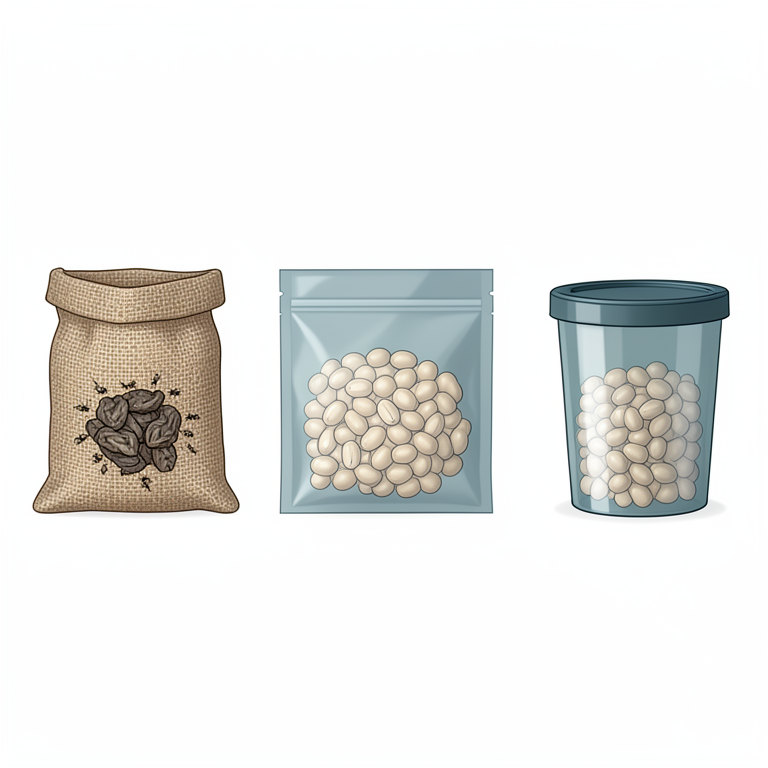
Packaging Performance Comparison
AI-generated conceptual illustration (dried mung beans in various packaging materials). It explains the idea and does not show study data.
View source evidence ↗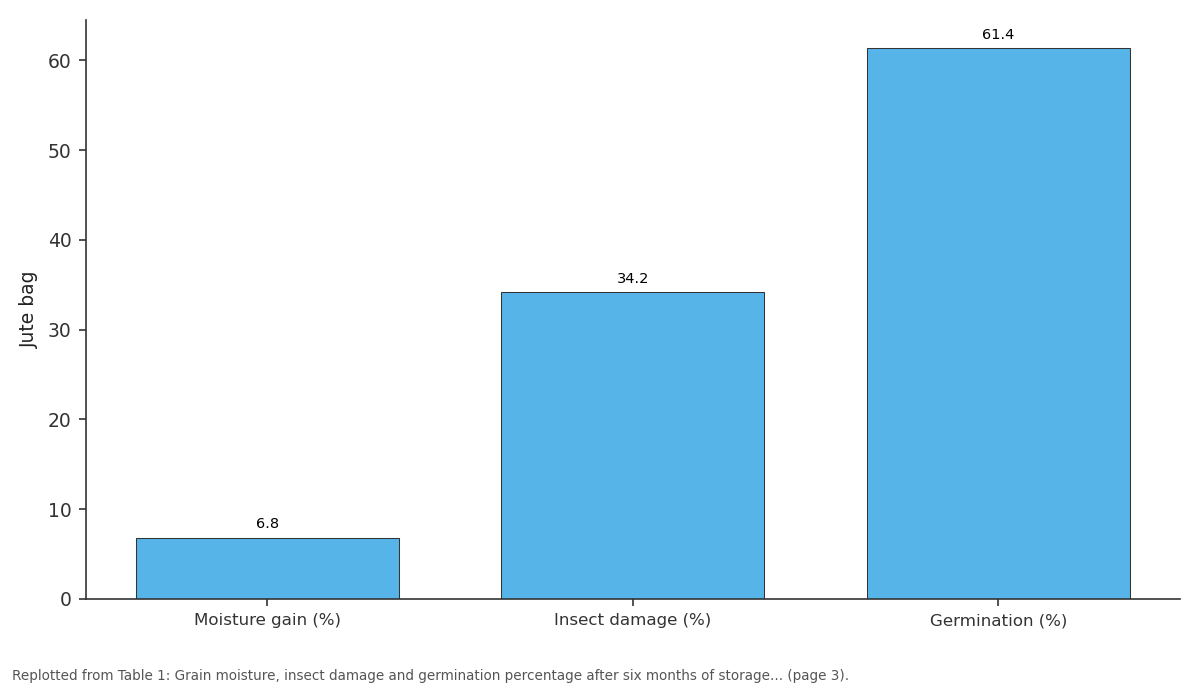
Jute bag: Moisture gain (%) vs Insect damage (%) vs Germination (%)
Replotted from Table 1 (page 3) of the original paper. Every bar is the paper's own table value.
View source evidence ↗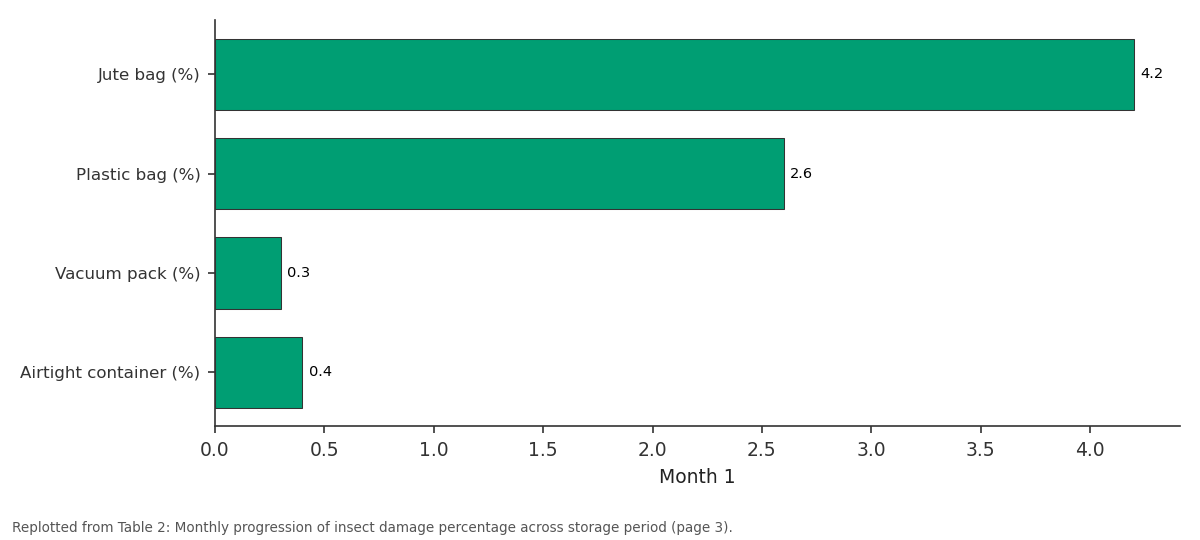
Month 1: Jute bag (%) vs Plastic bag (%) vs Vacuum pack (%) vs Airtight container (%)
Replotted from Table 2 (page 3) of the original paper. Every bar is the paper's own table value.
View source evidence ↗Figures & tables
From the original paper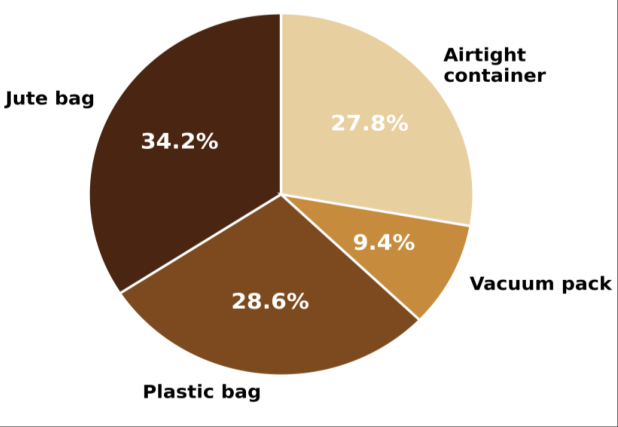 Figure 1
 Table 1
 Table 2
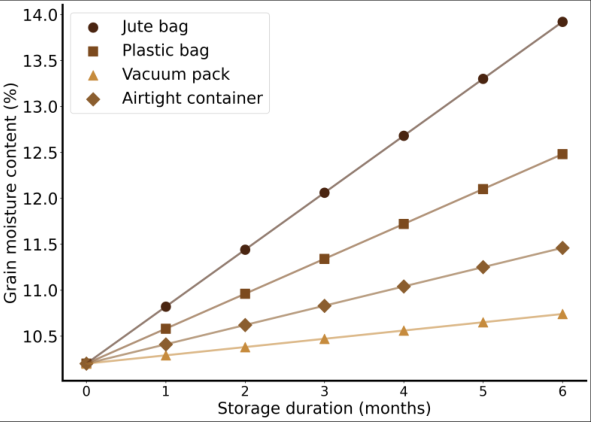 Figure 2
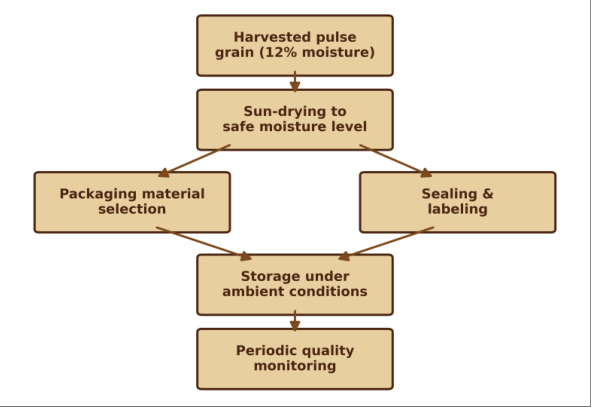 Figure 3
Introduction
Compare a farmer's grain store in the first month after harvest to the same store six months later, and the difference often has less to do with the crop's inherent storability than with the packaging material that grain sat in the whole time. Common bean and other pulses stored across East African smallholder systems typically move through several months of storage before sale or consumption, during which moisture reabsorption, insect infestation, and mold development can each independently degrade grain quality, seed viability, and market value [1, 2] . Jute bags remain the default packaging material across much of the region, valued for low cost and easy handling, but their permeability to both moisture and insects means stored grain remains exposed to ambient humidity fluctuation and insect entry throughout the storage period [3,4] . Plastic bags offer somewhat better moisture protection but rarely form a complete seal against insect entry either, particularly where bags are reused or improperly closed after partial withdrawal of grain [5] . Hermetic storage technologies, including vacuum packing and sealed airtight containers, work on a different principle entirely: rather than excluding insects and moisture through a physical barrier alone, they reduce the oxygen available within the storage environment, which suppresses both insect metabolism and mold growth even where some insects were present in the grain at the time of sealing [6,7] . Research on hermetic storage for maize and sorghum reports substantial reductions in storage losses relative to traditional bag storage, though comparable pulse-specific research, particularly research that tracks germination percentage alongside insect damage and moisture, remains less common [8,9] . This research set out to compare four packaging materials directly under identical storage conditions over a full sixmonth period, tracking moisture, insect damage, and germination percentage together rather than any single quality indicator in isolation, since seed-intended grain in particular depends on germination viability in a way that simple visual quality assessment does not capture. Objectives were to quantify moisture gain, insect infestation percentage, and germination percentage of common bean under four packaging materials over six months of ambient storage, and to determine which packaging option best preserves grain quality for both consumption and seed-use purposes given the cost differences among the materials tested.
Materials and Methods
Materials and Methods
Reagents and Chemicals
No chemical reagents were applied to any storage treatment, since the research aimed to compare packaging material effects under conditions representative of typical smallholder practice without chemical protectant confounding the comparison. Germination testing used standard distilled water and blotting paper substrate following the International Seed Testing Association protocol.
Materials
Common bean variety 'Uyole 96', a widely grown variety across central Tanzania, was harvested at physiological maturity, threshed, and sun-dried to 12% moisture content before packaging. Four packaging materials were tested: standard woven jute bags (50 kg capacity, as commonly used in local markets), low-density polyethylene plastic bags (0.05 mm thickness), vacuum-sealed high-barrier polyethylene pouches (sealed using a commercial vacuum sealing unit to remove residual air before heat-sealing), and rigid airtight plastic containers with rubber gasket seals (20 L capacity).
Field Experimental Design
Grain samples of 5 kg each were packaged into each of the four packaging materials, with six replications per treatment, and stored under ambient warehouse conditions at Dodoma Institute of Agricultural Sciences for six months, from July to December 2024, spanning the region's warmest and most humid storage period, considered the most demanding test window for packaging performance. Storage racks were arranged in a randomized layout to avoid any positional microclimate bias within the storage room, and ambient temperature and relative humidity were logged continuously throughout the storage period using a data logger placed within the storage room.
Methods
Grain moisture content was measured monthly using a calibrated grain moisture meter on a sub-sample drawn from each replicate. Insect damage was assessed monthly by visually inspecting a 200-gram sub-sample from each replicate and calculating the percentage of grains showing visible insect bore holes or internal damage upon cutting a further sub-sample. Germination percentage was tested at the start of storage and again at the six-month endpoint following standard germination testing procedure, with 100 seeds per replicate placed on moistened blotting paper and germinated seedlings counted after seven days. Data were analyzed using analysis of variance appropriate to a randomized design, with treatment means separated using the least significant difference test at 5% probability.
Results
Results
Fig 1:
Proportional share of total insect damage recorded across the four packaging materials over the six-month storage period
The proportional breakdown in Figure 1 shows jute bags accounting for the largest share of total insect damage recorded across the entire research, more than three times the share attributed to vacuum-packed grain, despite all four treatments starting from grain drawn from the same harvest lot with an identical initial insect load. Germination percentage fell across every treatment relative to the initial 94% baseline, but the magnitude of decline varied sharply: jute bag storage lost 33 percentage points of germination capacity, while vacuum packing lost less than 6 points, a difference with direct consequence for anyone intending to use stored grain as seed for the following planting season rather than only for consumption.
Comprehensive Interpretation
The monthly progression in Table 2 shows insect damage under jute bag storage accelerating rather than staying constant across the storage period, nearly doubling between month 2 and month 4 alone, which suggests an insect population actively reproducing within the stored grain rather than only the original harvest-time infestation slowly expressing itself. Vacuum-packed and airtight container treatments, by contrast, show damage percentages that barely moved past month 2, consistent with an oxygenlimited environment that suppresses insect reproduction rather than merely slowing feeding activity.
| Month | Jute bag (%) | Plastic bag (%) | Vacuum pack (%) | Airtight container (%) |
|---|---|---|---|---|
| Month 1 | 4.2 | 2.6 | 0.3 | 0.4 |
| Month 2 | 9.8 | 5.4 | 0.6 | 0.9 |
| Month 3 | 16.5 | 9.2 | 1.0 | 1.6 |
| Month 4 | 23.1 | 13.4 | 1.4 | 2.3 |
| Month 5 | 28.9 | 16.1 | 1.8 | 3.1 |
| Month 6 | 34.2 | 18.6 | 2.1 | 3.8 |
Table text extracted from the original PDF; superscript letters are shown inline. The original table image is below.
View original table image
Discussion
The scale of difference between jute bag and vacuum pack outcomes recorded here sits toward the higher end of what hermetic storage research on other grain crops has reported, though direct comparison is complicated by differences in ambient storage conditions, initial insect load, and grain type across studies [6,8] . Dodoma's storage trial period, spanning the region's warmest and most humid months, likely represents something close to a worst-case test for jute bag performance, meaning the gap recorded here may be somewhat narrower under cooler or drier storage conditions elsewhere, though the direction of the effect would be expected to hold regardless of climate. Germination percentage tracking insect damage and moisture gain fairly closely across treatments supports treating these three quality indicators as interconnected rather than independent outcomes of storage condition. Insect feeding damages the seed embryo directly in many cases, while elevated moisture accelerates seed respiration and metabolic deterioration even where insects are not directly involved, and separating out which mechanism dominates germination loss under jute bag storage would need additional research isolating moisture and insect effects independently, something this trial's design, which varied packaging material as a combined bundle of properties, cannot fully disentangle [9,10] . Airtight containers performing nearly as well as vacuum packing, despite lacking the active air removal step, suggests that for smallholder farmers unable to access or afford vacuum sealing equipment, a well-sealed rigid container represents a genuinely viable intermediate option, delivering most of the insect exclusion benefit of vacuum packing at a lower equipment cost and with reusable, durable packaging rather than single-use vacuum pouches [11,12] . This has direct relevance for extension recommendations aimed at smallholder seed producers who need reliable germination outcomes but cannot justify vacuum sealing equipment costs for modest grain quantities.
Limitations
This research was conducted over a single six-month storage cycle at one location during the warmest storage season, so results may not directly generalize to cooler or drier storage periods, or to storage durations beyond six months where even hermetic packaging methods may eventually show quality decline as trapped moisture and grain respiration interact over longer timeframes. Only one bean variety was tested, and packaging performance could differ somewhat for pulse species with different seed coat characteristics or initial insect susceptibility.
Conclusion
This research aimed to compare four packaging materials directly under identical storage conditions to determine which best preserves common bean quality over a demanding six-month storage period. Vacuum packing preserved grain quality most effectively across every measure tested, moisture gain, insect damage, and germination percentage, followed closely by airtight containers, while jute bags, still the most commonly used packaging material across smallholder pulse storage in this region, performed markedly worse on every indicator, particularly germination percentage relevant to seedintended grain. For farmers and seed producers storing pulses beyond three months, especially through warm and humid periods, switching from jute bags to vacuum packing or well-sealed airtight containers offers a substantial, measurable quality benefit at a modest equipment cost relative to the grain value protected. Future research extending this comparison across multiple pulse species, storage durations beyond six months, and cooler storage seasons would help establish how broadly these packaging recommendations apply across the wider range of conditions under which smallholder pulse storage actually takes place.
Figures and tables from the paper
| Packaging material | Moisture gain (%) | Insect damage (%) | Germination (%) | Mold incidence |
|---|---|---|---|---|
| Jute bag | 6.8 | 34.2 | 61.4 | Moderate |
| Plastic bag | 3.4 | 18.6 | 76.8 | Low |
| Vacuum pack | 0.9 | 2.1 | 88.3 | None observed |
| Airtight container | 1.6 | 3.8 | 85.6 | None observed |
| LSD (p = 0.05) | 0.4 | 2.2 | 3.1 | - |
Table text extracted from the original PDF; superscript letters are shown inline. The original table image is below.
View original table image
References
20 in the original paper- Boxall R. Post-harvest losses to insects: a world overview. Int Biodeterior Biodegradation. 2021;48(14):137-152.
- Abass A, Ndunguru G, Mamiro P, Alenkhe B, Mlingi N, Bekunda M. Post-harvest food losses in a maizebased farming system of semi-arid savannah area of Tanzania. J Stored Prod Res. 2022;57:49-57.
- Tefera T. Post-harvest losses in African maize in the face of increasing food shortage. Food Secur. 2020;4(2):267-277.
- Baoua I, Amadou L, Ousmane B, Baributsa D, Murdock L. PICS bags for post-harvest storage of cowpea seed. J Stored Prod Res. 2021;58:20-28.
- Murdock L, Margam V, Baoua I, Balfe S, Shade R. Death by desiccation: effects of hermetic storage on cowpea bruchids. J Stored Prod Res. 2022;49:166-170.
- Bailey S. Air-tight storage of grain: its effect on insect pests. J Stored Prod Res. 2019;1(1):25-33.
- Navarro S. The use of modified and controlled atmospheres for the disinfestation of stored products. J Pest Sci. 2023;85(3):301-322.
- Njoroge A, Affognon H, Mutungi C, Manono J, Lamuka P, Murdock L. Triple bag hermetic storage delivers a lethal punch to Prostephanus truncatus in stored maize. J Stored Prod Res. 2020;58:1-8.
- Villers P, De Bruin T, Navarro S. Development and applications of the hermetic storage technology. JuliusKuhn-Archiv. 2021;425:719-720.
- Copeland L, McDonald M. Principles of seed science and technology. 4 th Ed. Springer Sci; 2022. p. 181-235.
- Baributsa D, Djibo A, Lowenberg-DeBoer J, Moussa B, Baoua I. The fading appeal of insecticides for cowpea storage in the Sahel. Crop Prot. 2019;54:23-28.
- Chigoverah A, Mvumi B. Efficacy of metal silos and hermetic bags against stored maize insect pests under simulated smallholder farmer conditions. J Stored Prod Res. 2020;69:179-189.
- Costa S. Post-harvest losses in Sub-Saharan Africa and their challenges. J Stored Prod Res. 2021;60:1-8. International Journal of Agriculture and Nutrition https://www.agriculturejournal.net
- Baributsa D, Ignacio M. Developments in the use of hermetic bags for grain storage. Grain Storage Res J. 2020;5(1):1-14.
- Danho M, Gaspar C, Haubruge E. The impact of grain quantity on the biology of the maize weevil. J Stored Prod Res. 2023;38(3):259-266.
- Mutambuki K, Affognon H, Likhayo P, Baributsa D. Comparative efficacy of triple-layer hermetic bag against phosphine on storage insect pests. Insects. 2019;10(9):302.
- De Groote H, Kimenju S, Likhayo P, Kanampiu F, Tefera T, Hellin J. Effectiveness of hermetic systems in controlling maize storage pests in Kenya. J Stored Prod Res. 2021;53:27-36.
- Ileleji K, Meikle W, Baoua I, Baributsa D. Assessment of an improved storage method for reducing insect damage in stored cowpea. J Stored Prod Res. 2022;52:24-31.
- Williams S, Bulman M, Waller D. Effects of storage duration and moisture content on stored grain quality parameters. J Stored Prod Res. 2020;42(2):125-133.
- Sanon A, Ba N, Binso-Dabire C, Sanou J. Effectiveness of hermetic storage device in controlling cowpea insect pests in Burkina Faso. J Insect Sci. 2021;14:186.