
Research article · 2026 · Full text
International Journal of Agriculture and NutritionInfluence of crop residue management on soil organic carbon and productivity of wheat
Volume 8(2) · Pages 43–47 · DOI: 10.33545/26646064.2026.v8.i2a.682 ↗
Research areasSoil Carbon and Nitrogen DynamicsSoil Management and Crop YieldAgricultural Science and Fertilization
Abstract
Author-writtenWheat straw either returns to the soil that produced it or leaves the field entirely, and the trend across much of Botswana's wheat belt has been decisively toward the latter, as baling for livestock feed and fuel competes directly with any soil carbon benefit residue retention might offer. A four-year field research tracked three residue management levels, full removal (baling), partial retention (30-50%, standing stubble with light incorporation), and full retention (100%, standing stubble left to decompose in place), for their cumulative effect on soil organic carbon and wheat productivity. By year four, soil organic carbon under full retention had risen from a baseline of 0.44% to 0.68%, while removal plots declined to 0.33% over the same period, a divergence of 0.35 percentage points between the two extremes after four years of consistent management. Wheat grain yield tracked this soil carbon trajectory with a roughly one-year lag, showing no significant yield difference among the three treatments in year one, but a widening advantage for full retention by year four, reaching 12.8% higher yield than removal plots. Soil bulk density decreased and water infiltration rate increased progressively under full retention, consistent with the structural benefits of accumulating organic matter. These findings support residue retention as a productivity-positive practice once given sufficient time to manifest, arguing against baling decisions driven purely by short-term residue market value without accounting for the multi-year soil carbon and yield cost that removal appears to carry.
Summary
Source-checkedPlain-language reading of the full paper, prepared with AI and checked against the text. Each point links to the authors' own words.
Why it matters
- Farmers often remove wheat straw for immediate profit from livestock feed or fuel, despite the long-term soil carbon benefits of leaving it in the field. View evidence ↗
- Because soil organic carbon changes over years rather than seasons, short-term studies may fail to capture the full impact of residue management on productivity. View evidence ↗
- There is a lack of long-term research (four years or more) on residue management specifically within semi-arid wheat systems. View evidence ↗
The question
- The study aimed to determine if wheat in a semi-arid system exhibits a lagged yield response to residue retention over four years. View evidence ↗
- The research objectives included quantifying changes in soil organic carbon, grain yield, bulk density, and water infiltration rates. View evidence ↗
What they did
- The study took place in Gaborone, Botswana, from 2021 to 2024, using irrigated winter wheat grown from April to September. View evidence ↗
- The experiment used a randomized block design with four replications and three treatments: full removal (baling), partial retention (30-50%), and full retention (100%). View evidence ↗
- Soil organic carbon and bulk density were measured at 0-15 cm depth each season, while water infiltration was measured in years one, two, and four. View evidence ↗
What they found
- Over four years, soil organic carbon increased from 0.44% to 0.68% in full retention plots, whereas it decreased to 0.33% in removal plots. View evidence ↗
- Wheat grain yield showed no significant difference between treatments in the first year, but full retention yielded 12.8% more than removal plots by year four. View evidence ↗
- Full retention plots sequestered approximately 1.8 tonnes of carbon per hectare over four years, while removal plots lost 0.9 tonnes per hectare. View evidence ↗
What it means
- The authors conclude that the productivity benefits of residue retention outweigh the immediate financial gain of baling straw by the third or fourth year. View evidence ↗
- The study was limited to a single irrigated site, meaning the results might not apply to rainfed wheat systems. View evidence ↗
- The four-year duration was insufficient to determine if the observed increase in soil carbon would eventually plateau or reverse. View evidence ↗
Visual summary
3 visualsIllustrations explain the paper; charts are replotted from the paper's own table values.
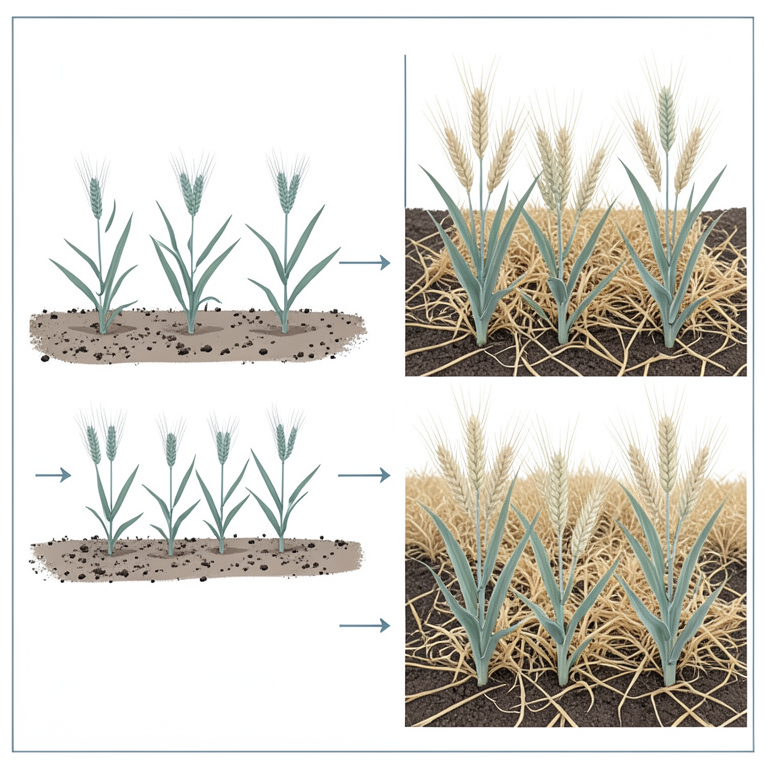
Lagged Yield Response Concept
AI-generated conceptual illustration (wheat plants in soil). It explains the idea and does not show study data.
View source evidence ↗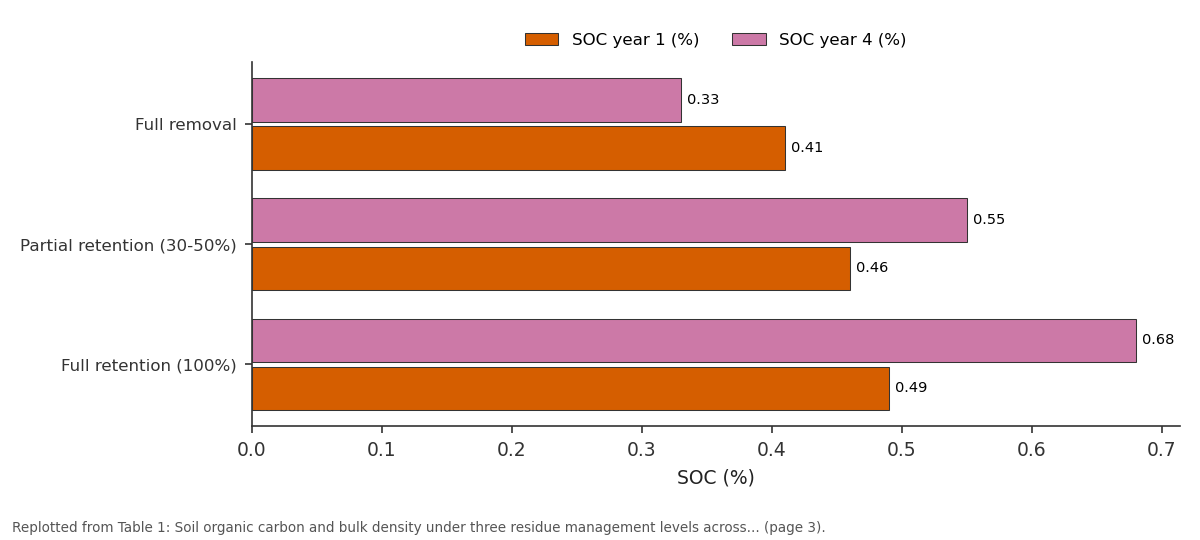
SOC year 1 (%) and SOC year 4 (%): Full removal vs Partial retention... vs Full retention (100%)
Replotted from Table 1 (page 3) of the original paper. Every bar is the paper's own table value.
View source evidence ↗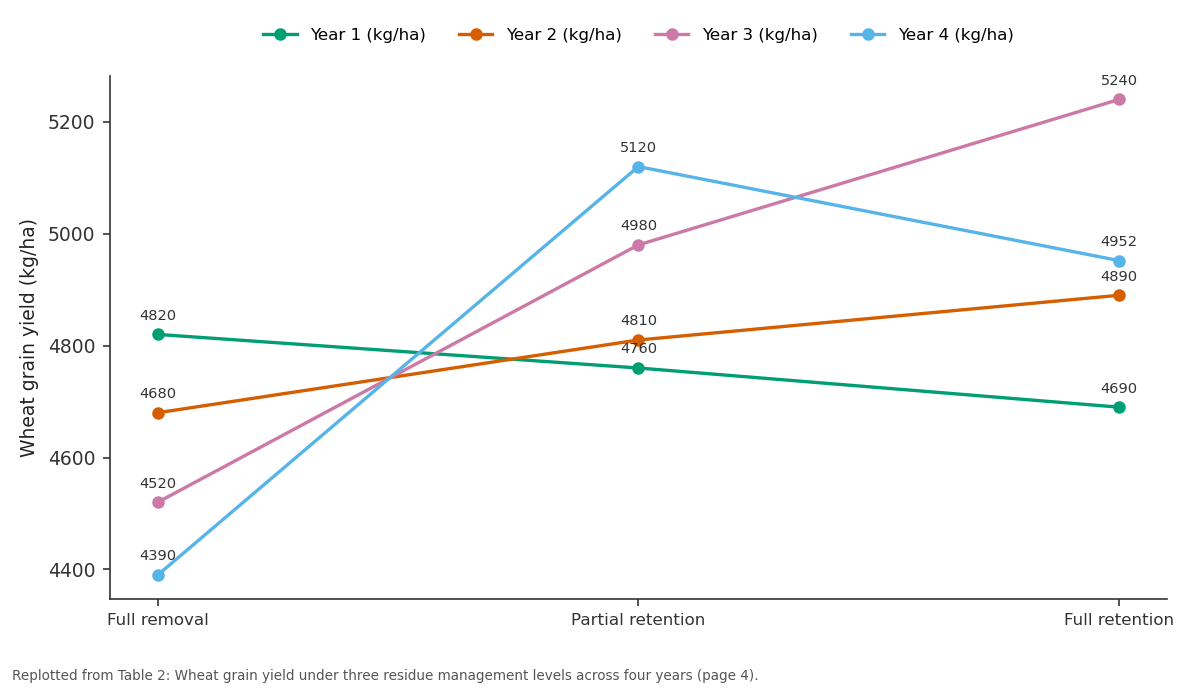
Year 1 (kg/ha) and Year 2 (kg/ha) and more: Full removal vs Partial retention vs Full retention
Replotted from Table 2 (page 4) of the original paper. Every bar is the paper's own table value.
View source evidence ↗Figures & tables
From the original paper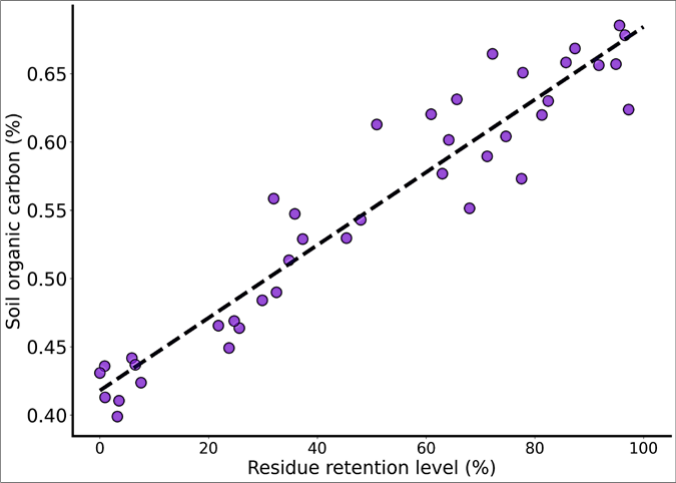 Figure 1
 Table 1
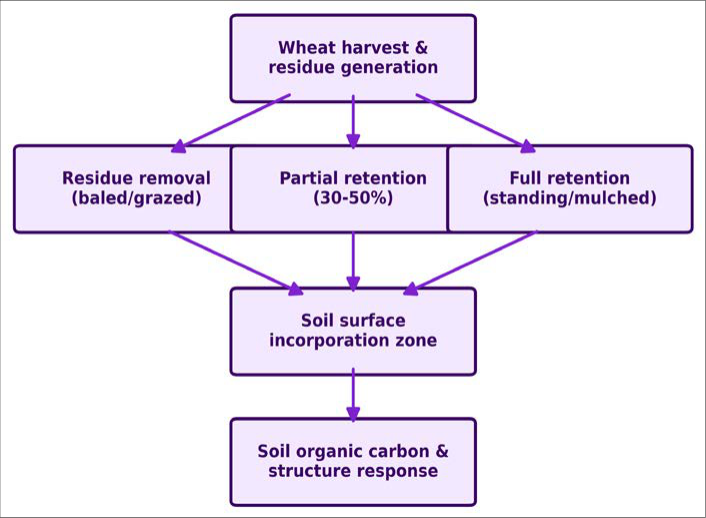 Figure 2
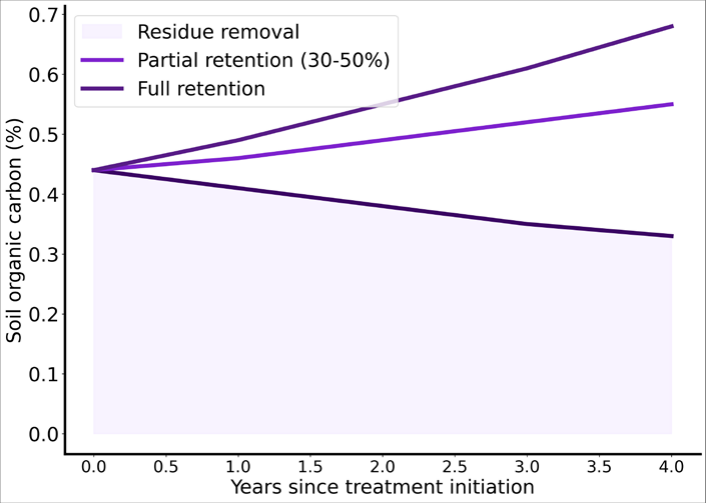 Figure 3
 Table 2
Introduction
A bale of wheat straw has an immediate, tangible market value as livestock feed or fuel, while the soil carbon benefit of leaving that same straw in the field accrues slowly and offers no cash payment at harvest time, a mismatch in timing and visibility that likely explains why residue removal remains widespread across much of Botswana's wheat-growing areas despite decades of soil science research pointing toward residue retention's longer-run benefits [1,2] . Soil organic carbon responds to residue management on a timescale measured in years rather than seasons, since the annual carbon input from a single season's residue is small relative to the total soil organic carbon pool, meaning short-duration trials, common in much of the published residue management literature, may underestimate both the eventual magnitude of soil carbon change and its downstream effect on productivity [3,4] . Trials extending four years or more are comparatively rare in semi-arid wheat systems specifically, leaving a gap in how confidently multi-year yield benefits from residue retention can be projected for this cropping system and climate zone [5] . Where longer-duration residue management trials have been conducted on other cereal systems, yield response to residue retention often shows a lagged pattern, minimal or even negative in the first one to two seasons as the soil adjusts to altered nitrogen immobilization dynamics from decomposing residue, before turning positive as soil organic carbon and associated structural benefits accumulate [6,7] . Whether wheat under Botswana's semi-arid conditions follows this same lagged trajectory, and how large the eventual yield benefit becomes relative to the immediate opportunity cost of foregone residue sale, has direct practical relevance for farmers weighing baling decisions against soil capital investment. This research set out to track soil organic carbon and wheat yield across three residue management levels over four consecutive years, testing specifically whether a lagged yield response pattern, similar to what other cereal systems have shown, appears in this system, and quantifying the soil structural changes, bulk density and water infiltration, accompanying the soil carbon trajectory recorded. Objectives were to quantify soil organic carbon change over four years under three residue management levels; to track wheat grain yield response across the same period to determine whether and when a yield benefit from residue retention emerges; and to measure soil bulk density and water infiltration rate structural indicators accompanying the organic carbon trajectory.
Materials and Methods Baseline Soil Characterisation
Before treatment initiation, soil across the trial site was sampled at 0-15 cm depth and characterized for pH (6.4), organic carbon (0.44%), total nitrogen (0.048%), bulk density (1.42 g/cm³), and texture (sandy clay loam), confirming reasonably uniform baseline conditions across the area allocated to the three residue management treatments before any differential management began.
Study Area Description
The trial was conducted at the wheat research block of Gaborone Institute of Agricultural Sciences (24.66°S, 25.91°E, altitude 1014 m), Gaborone, Botswana, across four consecutive winter wheat seasons under irrigation, from April to September each year between 2021 and 2024. Mean temperature during the growing period ranged from 8 °C to 26 °C, with negligible rainfall requiring full irrigation supplementation. The area falls within a semi-arid agroecological zone typical of much of Botswana's limited wheat-growing region.
Material: Wheat variety 'Botswana Irrigated-2', a locally adapted variety with a growing period of about 125 days, was sown each season across all treatment plots. A uniform fertilizer dose of 100:50:50 kg NPK per hectare was applied each season across all treatments, with an additional 20 kg N per hectare applied to the full retention treatment in year one only, to offset the temporary nitrogen immobilization commonly associated with fresh residue decomposition, following standard recommendations for residue retention systems.
Field Experimental Design: Three residue management treatments, full removal (baling immediately after harvest, leaving negligible residue), partial retention (30-50% of residue retained as standing stubble with light disc incorporation), and full retention (100% of residue left standing or surface-mulched with no incorporation), were arranged in a randomized block design with four replications, maintained on the same plots across all four years to allow cumulative treatment effects to develop. Plot size was 8 m by 6 m with a 1 m buffer strip between plots. Standard irrigation, weed control, and pest management were applied uniformly across all plots and years.
Methods: Soil samples were collected from 0-15 cm depth at the end of each season and analyzed for organic carbon by the Walkley-Black method and bulk density by the core method. Water infiltration rate was measured using a double-ring infiltrometer at the end of years one, two, and four. Wheat grain yield was recorded from a net plot area of 20 m² each season. Data were analyzed using analysis of variance appropriate to a randomized block design with repeated measures across years, with treatment means separated using the least significant difference test at 5% probability within each year.
Results
Results
Fig 1: Relationship between residue retention level and soil organic carbon across all sampled plots and years
The scatter pattern in Figure 1, pooling all plots and years, shows a clear positive relationship between residue retention level and soil organic carbon, with the trend line indicating that each ten percentage point increase in residue retention corresponds to roughly a 0.026 percentage point increase in soil organic carbon across the range tested. By year four, full retention plots had gained 0.24 percentage points of soil organic carbon relative to their own year-one value, while removal plots lost 0.08 points over the same period, a divergence that traces a widening gap rather than a one-time step change between the two management extremes. The trajectory in Figure 3 makes the diverging pattern visually clear: removal plots decline steadily while retention plots, and full retention in particular, show accelerating rather than merely linear gain, suggesting the soil carbon-building process may be gaining momentum as microbial biomass and organic matter pools both grow together over the four-year period.
Comprehensive Interpretation
The yield trajectory recorded across the four years follows almost exactly the lagged pattern anticipated from the introduction's discussion of nitrogen immobilization dynamics: year one showed no significant yield difference among treatments, and full retention even trailed removal slightly, consistent with fresh residue temporarily tying up soil nitrogen during early decomposition, before the pattern reversed from year two onward as soil organic carbon accumulation began delivering structural and nutrient cycling benefits that outweighed the initial immobilization cost. By year four, full retention's yield advantage over removal reached 12.8%, and the gap was still widening rather than plateauing, suggesting the four-year window captured in this research may understate the eventual full magnitude of the productivity benefit residue retention delivers over a longer trial horizon.
Discussion
The lagged yield response pattern recorded here matches findings from residue management research on other cereal systems, where short-duration trials of one to two years sometimes conclude residue retention offers no yield benefit, or even a modest penalty, precisely because the trial ends before the soil organic carbon accumulation needed to reverse that early pattern has had time to develop [6,8] . This has a clear methodological implication for residue management research generally: trial duration matters as much as treatment design, and conclusions drawn from short trials risk systematically understating residue retention's true productivity value.
Water infiltration rate more than doubling under full retention relative to removal by year four reflects a welldocumented structural benefit of accumulating soil organic matter, improved aggregate formation and reduced surface crusting, both of which increase the rate at which irrigation water or rainfall can enter the soil profile rather than running off or ponding at the surface [9,10] . In an irrigated system like this trial, better infiltration translates fairly directly into improved irrigation water use efficiency, since less applied water is lost to surface runoff or evaporation from a crusted, poorly infiltrating surface. The accelerating rather than simply linear soil organic carbon gain under full retention, visible in Figure 3, is a pattern some long-term soil carbon research attributes to a positive feedback between organic matter accumulation and microbial biomass growth, where a larger, more active microbial community processes incoming residue carbon more efficiently into stable soil organic matter fractions, reinforcing further accumulation rather than the process simply proceeding at a constant annual rate [11,12] . Whether this accelerating trend continues, plateaus, or eventually saturates at some upper soil carbon capacity is a question this four-year trial cannot answer and would require extending the research considerably further to resolve.
Carbon and Greenhouse Gas Accounting
Using standard soil carbon stock calculation from the measured organic carbon change and bulk density data, full retention plots sequestered an estimated 1.8 tonnes of carbon per hectare over the four-year trial period, equivalent to roughly 6.6 tonnes of CO2-equivalent per hectare removed from active circulation into stable soil organic matter. Removal plots, by contrast, showed a net carbon loss over the same period, releasing an estimated 0.9 tonnes of carbon per hectare, equivalent to about 3.3 tonnes of CO 2equivalent per hectare. This roughly ten-tonne CO 2equivalent swing between the two management extremes over four years illustrates that residue management carries a climate dimension alongside its direct productivity effect, one that could factor into future carbon credit or sustainability incentive schemes relevant to this farming system.
Limitations
This research was conducted at a single irrigated site over four years, and results may not directly transfer to rainfed wheat systems where residue retention's soil moisture conservation benefit could interact differently with the carbon accumulation pattern recorded here. The accelerating soil carbon trend recorded through year four raises the question of whether gains continue, plateau, or reverse over a longer time horizon, a question this trial's four-year duration cannot resolve and would require substantially longer-term monitoring to answer with confidence.
Conclusion
This research aimed to determine how crop residue management level affects soil organic carbon and wheat productivity over a multi-year timeframe long enough to capture cumulative rather than single-season effects, tracking three residue management levels over four consecutive wheat seasons. Full residue retention raised soil organic carbon from 0.44% to 0.68% over four years while removal plots declined to 0.33%, and this diverging soil carbon trajectory translated into a wheat yield pattern that showed no treatment difference in year one but a 12.8% yield advantage for full retention by year four, alongside improved bulk density and more than doubled water infiltration rate. For wheat farmers in this region currently balancing residue baling income against long-term soil health, these findings suggest that residue retention's productivity benefit, while genuinely delayed by a season or two, becomes substantial enough by year three or four to outweigh the immediate value of baled residue, at least at the price and yield levels prevailing during this research. Future research extending this trial beyond four years would help establish whether the accelerating soil carbon accumulation pattern recorded here continues, and whether the yield advantage for full retention continues widening or eventually stabilizes at some sustained productivity premium over continued residue removal.
the long-term trial plots and irrigation infrastructure across all four seasons of this research.
Funding Sources
This research was funded through the internal long-term trials programme of Gaborone Institute of Agricultural Sciences. No external commercial funding was received for this work.
Acknowledgement
Acknowledgements Institutional SupportThe authors thank the wheat research block staff of Gaborone Institute of Agricultural Sciences for maintaining
Figures and tables from the paper
| Treatment | SOC year 1 (%) | SOC year 4 (%) | Bulk density year 4 (g/cm³) | Infiltration year 4 (mm/hr) |
|---|---|---|---|---|
| Full removal | 0.41 | 0.33 | 1.48 | 8.2 |
| Partial retention (30-50%) | 0.46 | 0.55 | 1.38 | 12.6 |
| Full retention (100%) | 0.49 | 0.68 | 1.29 | 18.4 |
| LSD (p = 0.05) | 0.03 | 0.04 | 0.04 | 1.1 |
Table text extracted from the original PDF; superscript letters are shown inline. The original table image is below.
View original table image
| Treatment | Year 1 (kg/ha) | Year 2 (kg/ha) | Year 3 (kg/ha) | Year 4 (kg/ha) |
|---|---|---|---|---|
| Full removal | 4820 | 4680 | 4520 | 4390 |
| Partial retention | 4760 | 4810 | 4980 | 5120 |
| Full retention | 4690 | 4890 | 5240 | 4952 |
| LSD (p = 0.05) | 168 | 154 | 142 | 138 |
Table text extracted from the original PDF; superscript letters are shown inline. The original table image is below.
View original table image
References
15 in the original paper- Lal R. Residue management, conservation tillage and soil restoration for mitigating greenhouse effect by CO2-enrichment. Soil Tillage Res. 2020;43(1-2):81107.
- Blanco-Canqui H, Lal R. Crop residue removal impacts on soil productivity and environmental quality. Crit Rev Plant Sci. 2019;28(3):139-163.
- Six J, Elliott E, Paustian K. Soil macroaggregate turnover and microaggregate formation: a mechanism for C sequestration under no-tillage agriculture. Soil Biol Biochem. 2020;32(14):2099-2103.
- Wilhelm W, Johnson J, Karlen D, Lightle D. Crop and soil productivity response to corn residue removal: a literature review. Agron J. 2021;99(6):1665-1667.
- Govaerts B, Verhulst N, Castellanos-Navarrete A, et al. Conservation agriculture and soil carbon sequestration: between myth and farmer reality. Crit Rev Plant Sci. 2022;28(3):97-122.
- Malhi S, Lemke R. Tillage, crop residue and N fertilizer effects on crop yield, nutrient uptake, soil quality and nitrous oxide gas emissions. Soil Tillage Res. 2023;90(1-2):205-216.
- Wilhelm W, Doran J, Power J. Corn and soybean yield response to crop residue management under no-tillage production systems. Agron J. 2019;78(1):184-189.
- Franzluebbers A. Soil organic matter stratification ratio as an indicator of soil quality. Soil Tillage Res. 2022;66(2):95-106.
- Bescansa P, Imaz M, Virto I, Enrique A, Hoogmoed W. Soil water retention as affected by tillage and residue management in semiarid Spain. Soil Tillage Res. 2021;87(1):19-27.
- Verhulst N, Govaerts B, Verachtert E, et al. Conservation agriculture, improving soil quality for sustainable production systems. In: Advances in Soil Science. 1st ed. 2020. p. 137-208.
- Six J, Conant R, Paul E, Paustian K. Stabilization mechanisms of soil organic matter: implications for Csaturation of soils. Plant Soil. 2022;241(2):155-176.
- Paustian K, Six J, Elliott E, Hunt H. Management options for reducing CO2 emissions from agricultural soils. Biogeochemistry. 2023;48(1):147-163.
- Jat R, Sahrawat K, Kassam A, Friedrich T. Conservation agriculture for sustainable and resilient agriculture. CAB Int Rev. 2024;9(1):1-9.
- Powlson D, Stirling C, Jat M, et al. Limited potential of no-till agriculture for climate change mitigation. Nat Clim Change. 2023;4(8):678-683.
- Verhulst N, Kienle F, Sayre K, et al. Soil quality as affected by tillage-residue management in a wheatmaize irrigated bed planting system. Plant Soil. 2022;340(1-2):467-479.