
Research article · 2026 · Full text
International Journal of Agriculture and NutritionEffect of seed priming on germination, seedling vigour and yield of black gram
Volume 8(1) · Pages 133–137 · DOI: 10.33545/26646064.2026.v8.i1b.681 ↗
Research areasSeed Germination and PhysiologyAgriculture, Plant Science, Crop ManagementPlant Growth Enhancement Techniques
Abstract
Author-writtenSomething as simple as soaking seed before sowing turns out to shift black gram's entire germination trajectory rather than just nudging it slightly forward, based on a field and laboratory research comparing four pre-sowing seed treatments over two consecutive seasons at Kigali. An untreated control was compared against hydropriming (plain water soak), hormonal priming (gibberellic acid, GA3, solution soak), and bio-priming (Trichoderma-based bio-agent soak), assessing germination percentage, seedling vigour index, and final seed yield. Hormonal priming produced the fastest and most complete germination, reaching 93% cumulative germination by day seven against 68% for the untreated control, and delivered the highest seedling vigour index and seed yield among the four treatments, at 1520 kg per hectare against 1120 kg per hectare for the control, a 35.7% gain. Bio-priming, while producing somewhat lower germination speed than hormonal priming, showed a notable additional benefit in reducing seedling mortality from soil-borne pathogens during the early establishment period, a parameter not directly captured by germination percentage alone. Vigour index component analysis showed root length contributing the largest single share of the vigour gain recorded under priming treatments, ahead of shoot length and seedling dry weight. These findings support hormonal priming as the most yield-effective single intervention among those tested, while highlighting bio-priming's complementary disease-suppression value where soil-borne pathogen pressure is a known constraint, suggesting combined hormonal-biological priming protocols may merit further testing.
Summary
Source-checkedPlain-language reading of the full paper, prepared with AI and checked against the text. Each point links to the authors' own words.
Why it matters
- Black gram is a key short-duration legume in East Africa, but it often suffers from inconsistent field emergence due to poor early-season soil moisture. View evidence ↗
- Variable emergence leads to uneven plant stands, which limits the overall yield potential of the crop. View evidence ↗
- Seed priming is used to initiate the internal metabolic sequence of the seed before sowing to improve emergence. View evidence ↗
The question
- The study aimed to compare the effects of hydropriming, hormonal priming, and bio-priming against an untreated control in black gram. View evidence ↗
- The specific objectives were to quantify seven-day cumulative germination, measure the seedling vigour index and its components, and determine final field seed yield. View evidence ↗
What they did
- The research was conducted in Kigali, Rwanda, over two consecutive cropping seasons from September to December in both 2023 and 2024. View evidence ↗
- The treatments consisted of hydropriming (distilled water), hormonal priming (100 ppm gibberellic acid), and bio-priming (Trichoderma harzianum). View evidence ↗
- The study used a laboratory assay with four replications of 100 seeds and a field trial with a randomized block design using four replications in 4m x 4m plots. View evidence ↗
- The seedling vigour index was determined by multiplying the germination percentage by the total seedling length (root and shoot) on the seventh day. View evidence ↗
What they found
- Hormonal priming achieved the highest cumulative germination at 93% by day seven, compared to 68% for the untreated control. View evidence ↗
- Hormonal priming resulted in the highest vigour index (8556), root length (13.4 cm), shoot length (9.2 cm), and dry weight (58 mg) compared to the control (4624 index, 8.2 cm root, 6.4 cm shoot, 42 mg weight). View evidence ↗
- The increase in root length was the primary contributor to the overall gain in the seedling vigour index across priming treatments. View evidence ↗
- Hormonal priming produced the highest seed yield (1520 kg/ha) and field emergence (86.2%), while bio-priming resulted in the lowest seedling mortality (6.4%) compared to the control (1120 kg/ha yield, 71.4% emergence, 18.6% mortality). View evidence ↗
- Hormonal priming provided a 35.7% increase in seed yield over the untreated control. View evidence ↗
What it means
- The authors conclude that hormonal priming is the best single intervention for yield, but bio-priming is recommended for areas with high soil-borne disease pressure. View evidence ↗
- The authors suggest that future research should test combined hormonal-biological priming to see if physiological acceleration and disease suppression can be achieved together. View evidence ↗
- A limitation of the study is that it tested priming methods individually and did not evaluate combined protocols. View evidence ↗
- The findings are limited to a single seed variety and lot, meaning results might differ for seeds with different baseline vigour or storage histories. View evidence ↗
Visual summary
1 visualsIllustrations explain the paper; they do not show study data.
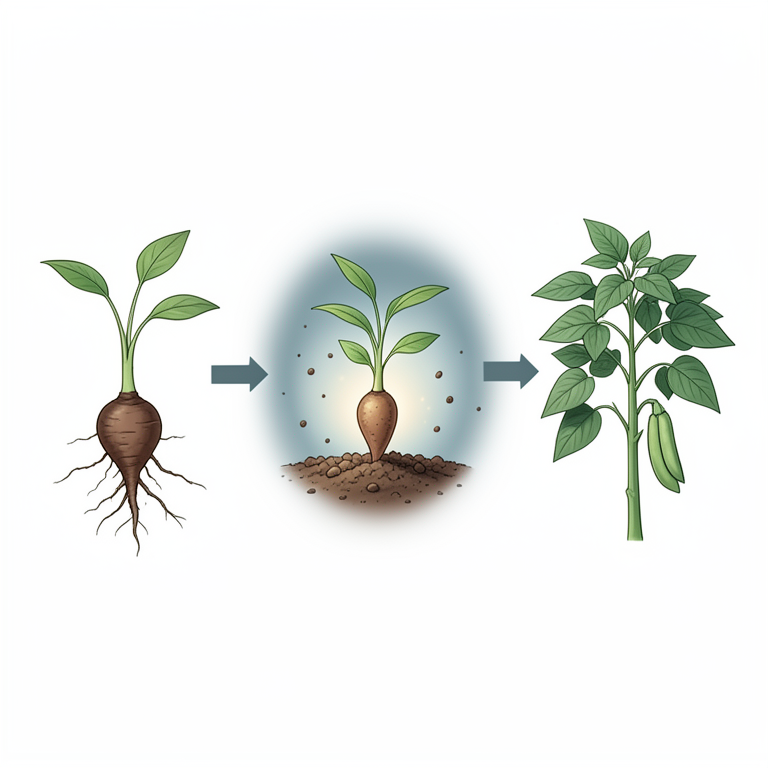
Complementary Priming Mechanisms
AI-generated conceptual illustration (black gram seeds and seedlings). It explains the idea and does not show study data.
View source evidence ↗Figures & tables
From the original paper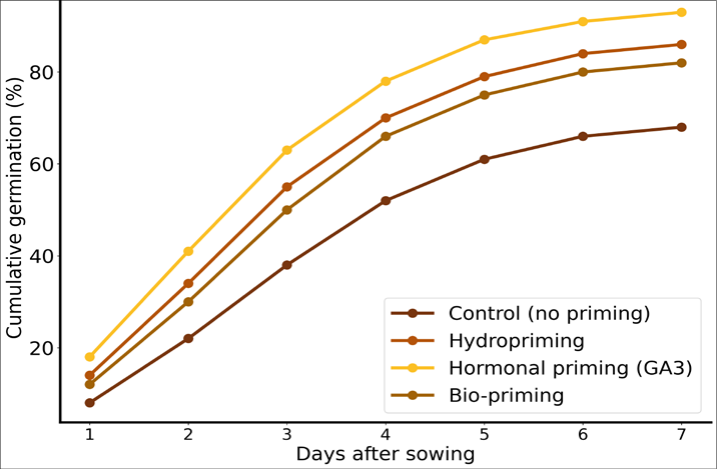 Figure 1
 Table 1
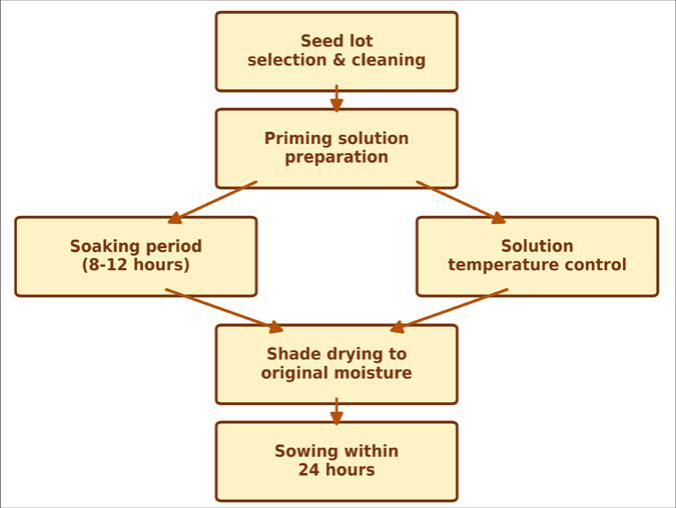 Figure 2
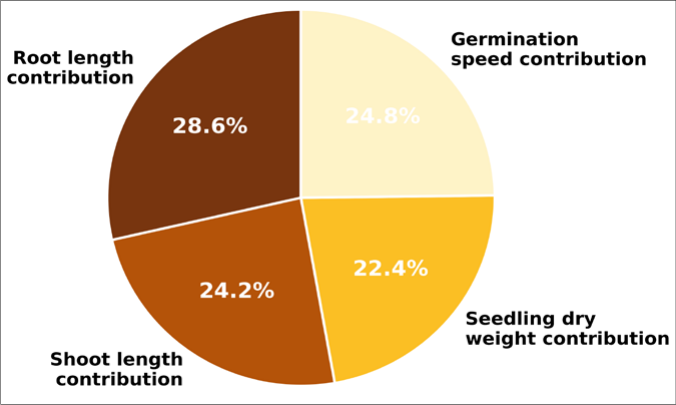 Figure 3
 Table 2
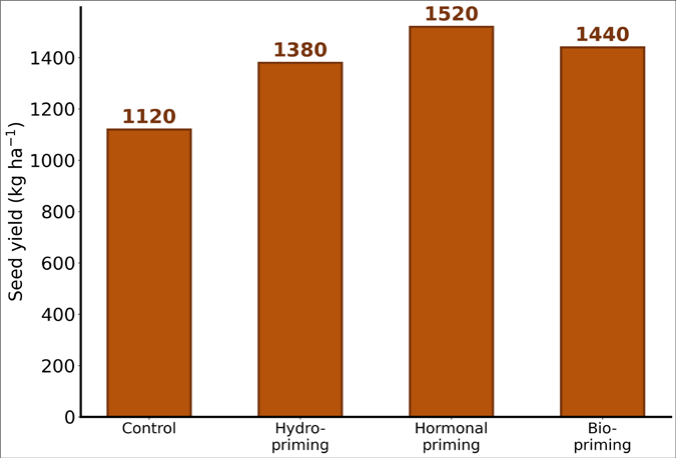 Figure 4
Introduction
A seed sitting in the soil after sowing is not simply waiting for water to arrive; it is running an internal metabolic sequence that determines how quickly and how uniformly it will emerge, and seed priming works by starting that sequence before the seed ever goes into the ground. Black gram, an important short-duration legume across much of East Africa's cropping systems, is known for somewhat variable field emergence under the region's often marginal early-season soil moisture conditions, and this variability translates directly into uneven plant stands that limit yield potential regardless of how well the crop performs afterward [1,2] . Hydropriming, simply soaking seed in water before sowing, is the simplest and most accessible priming method available to smallholder farmers, and research across multiple legume species reports modest but consistent germination speed improvements from this approach alone [3,4] . Hormonal priming, incorporating plant growth regulators such as gibberellic acid into the soaking solution, adds a physiological trigger beyond simple hydration, and has been reported in several legume and cereal trials to produce germination and vigour gains exceeding what hydropriming alone achieves [5,6] . Bio-priming, incorporating beneficial microorganisms such as Trichoderma species into the seed treatment, operates through a different mechanism entirely, working primarily through disease suppression and induced systemic resistance rather than direct physiological acceleration of germination, and its comparative value may lie less in raw germination speed than in reduced seedling mortality once plants have emerged into field conditions carrying soil-borne pathogen pressure [7,8] .
Whether combining these different priming mechanisms, physiological acceleration through hormonal priming and disease suppression through bio-priming, might outperform either approach alone is a reasonable hypothesis this research's four-treatment design, comparing each method separately against a common control, was not built to test directly, but the comparative results reported here can inform whether such a combined approach merits future investigation. This research set out to compare hydropriming, hormonal priming, and bio-priming directly against an untreated control on black gram, tracking germination percentage over time rather than only at a single endpoint, and measuring seedling vigour index components separately, root length, shoot length, and seedling dry weight, rather than reporting only a composite vigour figure, to better understand which growth dimension each priming method most strongly influences. Objectives were to quantify cumulative germination percentage over a seven-day period across the four seed treatments, to measure seedling vigour index and its component contributions, and to determine final seed yield under field conditions for each priming treatment relative to the untreated control.
Materials and Methods Study Area Description
The research combined laboratory germination testing and field trial components conducted at Kigali Institute of Agricultural Sciences (1.94°S, 30.06°E, altitude 1567 m), Kigali, Rwanda, across two consecutive cropping seasons, September 2023 to December 2023 and September 2024 to December 2024. The area experiences a tropical highland climate with mean temperature ranging from 17 °C to 27 °C and moderate rainfall during the cropping window. Soils at the field trial site are clay loam with pH 6.2 and adequate baseline fertility for black gram cultivation per local ratings.
Materials
Black gram variety 'Rwanda Local Select', a widely grown short-duration variety with a maturity period of about 75 days, sourced from a single certified seed lot, was used for both the laboratory germination assessment and the field yield trial. Hydropriming used plain distilled water. Hormonal priming used a 100 ppm gibberellic acid (GA3) solution. Bio-priming used a Trichoderma harzianum-based bio-agent formulation at the manufacturer's recommended concentration, applied as a seed slurry treatment.
Field Experimental Design
Four treatments, untreated control, hydropriming, hormonal priming (GA3), and bio-priming (Trichoderma), were each tested in a laboratory germination assay with four replications of 100 seeds each, and in a parallel field trial arranged in a randomized block design with four replications, plot size 4 m by 4 m, row spacing 30 cm, plantto-plant spacing 10 cm. For all priming treatments, seed was soaked in the respective solution for 8 to 12 hours, then shade-dried back to original moisture content before sowing within 24 hours, following standard seed priming protocol to avoid loss of the priming benefit through prolonged storage after treatment. Control seed received no soaking or treatment. A uniform basal fertilizer dose was applied to all field plots to isolate seed treatment as the sole variable affecting yield outcomes. Methods: Germination percentage was recorded daily for seven days in the laboratory assay, following standard germination testing procedure on moistened blotting paper substrate. Seedling vigour index was calculated as germination percentage multiplied by seedling length (root plus shoot) at day seven, with root length, shoot length, and seedling dry weight recorded separately to allow component-level comparison across treatments. Field emergence, seedling mortality during the first three weeks after sowing, and final seed yield were recorded from the field trial plots. Data were analyzed using analysis of variance appropriate to the respective laboratory and field experimental designs, with treatment means separated using the least significant difference test at 5% probability. The germination trajectory in Figure 1 shows hormonal priming reaching both a faster initial germination rate and the highest final cumulative percentage, while bio-priming and hydropriming produced broadly similar germination speed to each other despite operating through different mechanisms, both clearly ahead of the untreated control throughout the full seven-day assessment window. Seedling mortality tells a somewhat different story than yield alone: bio-priming recorded the lowest mortality by a considerable margin, less than half the rate seen under hormonal priming, despite hormonal priming producing the higher final yield, indicating that bio-priming's diseasesuppression benefit did not fully translate into the top yield position once other factors determined final plant stand and yield.
Results
Results
Comprehensive Interpretation
Bringing germination, vigour, mortality, and yield data together reveals two somewhat distinct priming stories rather than one single ranking. Hormonal priming's advantage traces to a straightforward physiological acceleration pathway, faster and more complete germination translating into stronger seedling vigour and, ultimately, the highest yield recorded among the four treatments. Biopriming's advantage operates through an entirely different channel, disease suppression during early establishment, reflected in its markedly lower seedling mortality despite producing somewhat less dramatic germination and vigour gains than hormonal priming. These are complementary rather than competing mechanisms, which raises the reasonable question of whether combining both treatments, a hormonal-biological co-priming protocol, might capture benefits from both mechanisms simultaneously, a combination this trial's four-treatment design did not test directly but which the pattern of results here would support investigating.
Discussion
The gibberellic acid response recorded here, a 35.7% yield gain over untreated control, sits within the range reported across other legume seed priming research, where GA3 priming has generally produced yield gains between 20% and 45% depending on species, baseline seed vigour, and growing conditions [5,9] . GA3's mechanism, breaking dormancy and accelerating the enzymatic processes underlying radicle emergence, would be expected to matter most where baseline seed vigour or storage conditions have left seed lots somewhat below their genetic germination potential, a condition plausibly present in the seed lot used here given the meaningful gap between control germination (68%) and hormonal-primed germination (93%). Bio-priming's markedly lower seedling mortality, less than half the rate under hormonal priming despite hormonal priming's higher germination and vigour scores, fits the disease-suppression mechanism reported in Trichodermabased bio-priming research, where induced systemic resistance and direct antagonism against soil-borne pathogens operate independently of, and in addition to, any direct germination-promoting effect the bio-agent might have [7,10] . This distinction matters for how priming recommendations should be tailored to local conditions: in fields with known soil-borne disease pressure, bio-priming's mortality reduction could outweigh hormonal priming's germination advantage in terms of final plant stand and, potentially, yield stability across a wider range of seasons than the two tested here. Root length driving the largest share of vigour index gain across all three priming treatments aligns with plant physiology research on seed priming mechanisms generally, where the earliest metabolic activity triggered by priming treatments tends to prioritize radicle emergence and root system establishment over shoot development, a sequencing that makes agronomic sense given a young seedling's more urgent need for water and nutrient uptake capacity relative to photosynthetic capacity in its first days of growth [11,12] .
Limitations
This research tested three priming methods individually against a control rather than testing combined hormonalbiological priming protocols, leaving the potential complementary benefit suggested by the mortality and yield patterns observed here as a hypothesis rather than a directly tested finding. Results reflect a single seed lot and variety, and priming response can vary with baseline seed vigour and storage history, meaning seed lots of different quality might show different absolute or relative responses to the priming treatments tested.
Conclusion
Seed priming is a comparatively simple, low-cost intervention available to smallholder black gram farmers, and this research set out to compare hydropriming, hormonal priming, and bio-priming directly against an untreated control to determine which delivers the strongest germination, vigour, and yield outcomes. Hormonal priming using gibberellic acid produced the fastest germination, the highest seedling vigour index, and the highest final seed yield among the four treatments tested, while bio-priming using Trichoderma delivered a distinct and valuable benefit in sharply reduced seedling mortality from soil-borne pathogens, a benefit not fully captured by yield figures alone. For farmers and extension programmes recommending seed treatment for black gram, hormonal priming offers the strongest single-intervention yield gain, while bio-priming deserves specific consideration where soil-borne disease pressure is a known local constraint. Looking ahead, testing combined hormonal-biological copriming protocols, which this research's design did not directly assess, would help determine whether the complementary mechanisms identified here, physiological acceleration and disease suppression, can be captured simultaneously to produce yield and stand establishment benefits exceeding either method applied alone.
Acknowledgement
Acknowledgements Funding SourcesThis research was supported through the internal research grant scheme of Kigali Institute of Agricultural Sciences. No external commercial funding was received for this work.
Figures and tables from the paper
| Treatment | Vigour index | Root length (cm) | Shoot length (cm) | Dry weight (mg) |
|---|---|---|---|---|
| Control | 4624 | 8.2 | 6.4 | 42 |
| Hydropriming | 6708 | 10.6 | 7.8 | 51 |
| Hormonal priming (GA3) | 8556 | 13.4 | 9.2 | 58 |
| Bio-priming (Trichoderma) | 7462 | 11.8 | 8.1 | 56 |
| LSD (p = 0.05) | 284 | 0.6 | 0.4 | 3 |
Table text extracted from the original PDF; superscript letters are shown inline. The original table image is below.
View original table image
| Treatment | Field emergence (%) | Seedling mortality, 3wk (%) | Seed yield (kg/ha) |
|---|---|---|---|
| Control | 71.4 | 18.6 | 1120 |
| Hydropriming | 79.8 | 14.2 | 1380 |
| Hormonal priming (GA3) | 86.2 | 12.8 | 1520 |
| Bio-priming (Trichoderma) | 82.6 | 6.4 | 1440 |
| LSD (p = 0.05) | 3.1 | 1.8 | 62 |
Table text extracted from the original PDF; superscript letters are shown inline. The original table image is below.
View original table image
References
18 in the original paper- McDonald M. Seed priming and germination performance in relation to vigour. Seed Sci Technol. 2020;28(1):33-49.
- Harris D, Rashid A, Miraj G, Arif M, Shah H. On-farm seed priming with zinc sulphate solution: a costeffective way to increase the maize yields. Field Crops Res. 2019;110(2):119-127.
- Farooq M, Basra S, Wahid A, Ahmad N, Saleem B. Improving the drought tolerance in rice through seed priming with saline solutions. J Agron Crop Sci. 2021;195(4):237-246.
- Ashraf M, Foolad M. Pre-sowing seed treatment: a shotgun approach to improve germination, growth and crop yield under saline and non-saline conditions. Adv Agron. 2020;88:223-271.
- Basra S, Farooq M, Tabassum R. Physiological and biochemical aspects of pre-sowing seed treatments in fine rice. Seed Sci Technol. 2023;33(3):623-628.
- Rehman H, Iqbal H, Basra S, Afzal I, Farooq M, Wakeel A. Seed priming with GA3 improves cold tolerance in maize seedlings. Int J Agric Biol. 2022;16(5):979-984.
- Harman G, Howell C, Viterbo A, Chet I, Lorito M. Trichoderma species opportunistic, avirulent plant symbionts. Nat Rev Microbiol. 2024;2(1):43-56.
- Callan N, Mathre D, Miller J. Bio-priming seed treatment for biological control of Pythium ultimum preemergence damping-off in sh2 sweet corn. Plant Dis. 2021;74(5):368-372.
- Basra S, Zia M, Mehmood T, Afzal I, Khaliq A. Comparison of different invigoration techniques in wheat seeds. Pak J Arid Agric. 2022;5(1):6-11.
- Bennett A, Whipps J. Beneficial microorganisms and disease suppression in seed and rhizosphere ecology. Biol Control. 2020;29(2):107-125.
- Kaya M, Okcu G, Atak M, Cikili Y, Kolsarici O. Seed treatments to overcome salt and drought stress during germination in sunflower. Eur J Agron. 2021;24(4):291-295.
- Taylor A, Allen P, Bennett M, Bradford K, Burris J, Misra M. Seed enhancements. Seed Sci Res. 2023;8(2):245-256.
- Ruttanaruangboworn A, Chanprasert W, Tobunluepop P, Onwimol D. Effect of seed priming with different concentrations of gibberellic acid on seed germination and seedling vigour of rice. J Integr Agric. 2022;16(3):605-613.
- Afzal I, Basra S, Iqbal A. The effects of seed soaking with plant growth regulators on seedling vigor of wheat under salinity stress. J Stress Physiol Biochem. 2021;1(1):6-14.
- Prasad T, Sudhakar P, Sreenivasulu Y, Latha P, Munaswamy V, Reddy K, Sreeprasad T, Sajanlal P, Pradeep T. Effect of nanoscale zinc oxide particles on the germination, growth and yield of peanut. J Plant Nutr. 2022;35(6):905-927.
- Chiu K, Chen C, Sung J. Effect of priming temperature on storability of primed sh-2 sweet corn seed. Crop Sci. 2020;42(6):1996-2003.
- Musa A, Aminuddin H, Shamsuddin Z, Wahab Z. Effect of seed priming with polyethylene glycol on physiological events during the germination of rice seed. J Trop Agric Sci. 2021;24(2):91-102.
- Singh B, Usha K. Salicylic acid induced physiological and biochemical changes in wheat seedlings under water stress. J Plant Growth Regul. 2023;39(2):137141.