
Research article · 2026 · Full text
International Journal of Biology SciencesHost plant associations and larval ecology of Spilomelinae (Lepidoptera: Crambidae) in the western Arabian Peninsula
Volume 8(6) · Pages 153–157 · DOI: 10.33545/26649926.2026.v8.i6b.900 ↗
Research areasLepidoptera: Biology and TaxonomyEntomological Studies and EcologyInsect-Plant Interactions and Control
Abstract
Author-writtenWhile the adult taxonomy of Arabian Spilomelinae (Lepidoptera: Crambidae) has advanced through recent faunistic surveys, the larval biology and host plant associations of these moths in the region remain almost entirely unknown. This research presents the first systematic documentation of host plant relationships and larval ecological parameters for five Spilomelinae species occurring in the western Arabian Peninsula. Field surveys and rearing experiments were conducted at six sites across the Hejaz and Asir regions of the western Arabian Peninsula between February 2022 and January 2024. Larvae were collected from potential host plants through visual searching and beating tray methods, reared to adult emergence for identification, and associated with their developmental substrates. A total of 14 confirmed host plant associations were documented across seven plant families. Spoladea recurvalis demonstrated the broadest host range, utilizing five plant species across three families, while Glyphodes stolalis showed strict monophagy on Ficus species. Larval development was completed through five instars in all species, with development duration ranging from 18 to 32 days depending on host plant quality and ambient temperature. Larval survival rates varied significantly among host plants within polyphagous species, with preferred hosts supporting 78-85% survival compared to 30-55% on secondary hosts. The documented host plant associations link adult distributional patterns to vegetation composition and provide essential biological context for understanding Spilomelinae ecology in arid environments.
Summary
Source-checkedPlain-language reading of the full paper, prepared with AI and checked against the text. Each point links to the authors' own words.
Why it matters
- While adult taxonomy of Arabian Spilomelinae has progressed, there is a significant lack of knowledge regarding their larval biology and host plant associations. View evidence ↗
- Understanding larval host associations is critical for interpreting adult distribution, assessing pest risks, and creating conservation strategies. View evidence ↗
- Most existing host plant records for Spilomelinae focus on agricultural systems, leaving their use of wild vegetation in arid environments poorly documented. View evidence ↗
The question
- The study aims to document host plant associations, quantify larval development parameters, and evaluate how host plant quality affects larval performance for Spilomelinae in the western Arabian Peninsula. View evidence ↗
What they did
- Field surveys were carried out at six different sites in the western Arabian Peninsula from February 2022 to January 2024. View evidence ↗
- Researchers located larvae using systematic visual searches of plants and beating trays. View evidence ↗
- No-choice feeding trials were conducted using ten neonate larvae per species on three to five potential host plants under controlled temperature, humidity, and light conditions. View evidence ↗
What they found
- The study documented 14 confirmed host plant associations spanning seven different plant families. View evidence ↗
- Spoladea recurvalis had the widest host range (five species across three families), whereas Glyphodes stolalis was strictly monophagous on Ficus species. View evidence ↗
- All five studied species completed their larval development through five instars. View evidence ↗
- The total larval period ranged from 18 to 32 days, influenced by the species, the quality of the host plant, and the ambient temperature. View evidence ↗
- For S. recurvalis, final body length was greatest on Amaranthus sp. (14.2 mm), followed by Cucurbita sp. (12.5 mm) and Ficus sp. (10.8 mm). View evidence ↗
- S. recurvalis survival rates varied by host, reaching 82% on Amaranthus, 45% on Cucurbita, and 30% on Ficus. View evidence ↗
- D. indica showed a higher survival rate on Cucurbita (85%) compared to Solanum (55%). View evidence ↗
- G. stolalis had a 78% survival rate on Ficus carica but could not complete development on any other plant species tested. View evidence ↗
What it means
- The authors conclude that host plant quality strongly determines population fitness and species distribution due to the differences in survival and growth rates between preferred and secondary hosts. View evidence ↗
- The findings are practically useful for agricultural pest risk assessment by identifying crops vulnerable to Spilomelinae herbivory. View evidence ↗
- The authors suggest that future work should expand surveys to more sites, investigate the chemical basis of host selection, and evaluate host-mediated population divergence. View evidence ↗
Visual summary
2 visualsIllustrations explain the paper; charts are replotted from the paper's own table values.
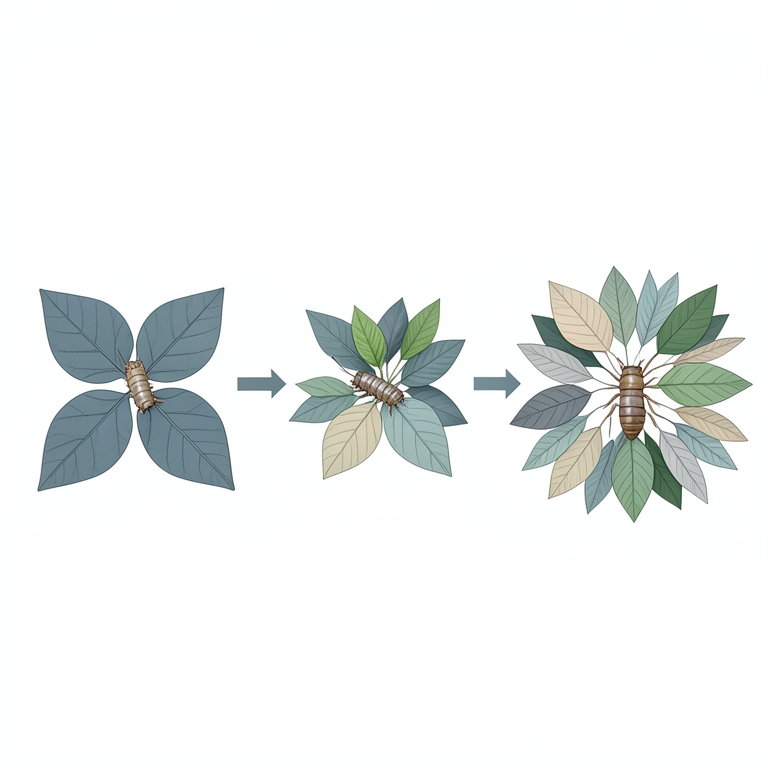
Host Range Spectrum
AI-generated conceptual illustration (Spilomelinae moth larvae and various host plants). It explains the idea and does not show study data.
View source evidence ↗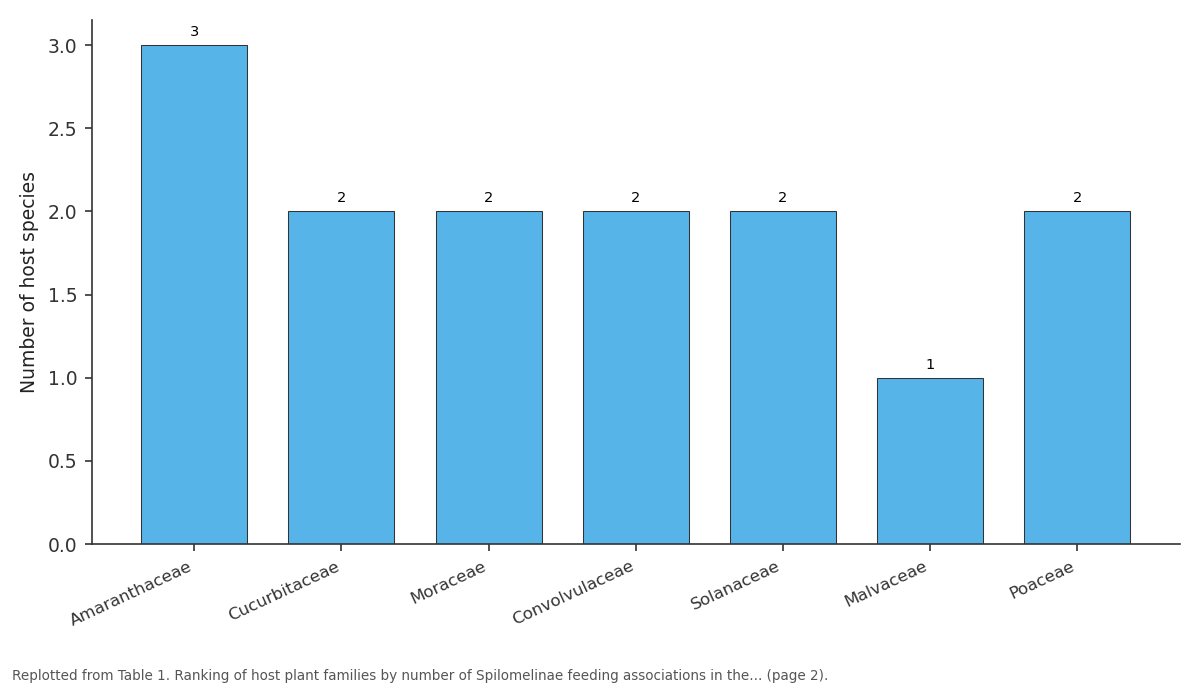
Host species: Amaranthaceae vs Cucurbitaceae vs Moraceae vs Convolvulaceae vs Solanaceae
Replotted from Table 1 (page 2) of the original paper. Every bar is the paper's own table value.
View source evidence ↗Figures & tables
From the original paper Table 1
 Table 2
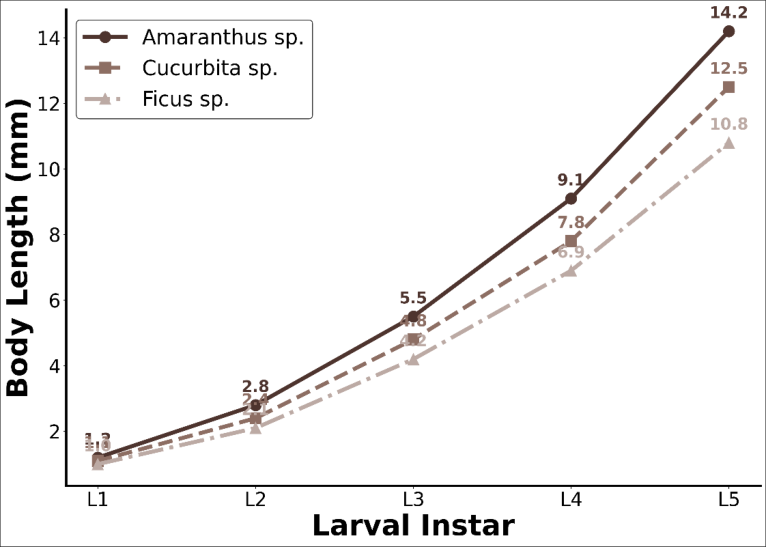 Figure 1
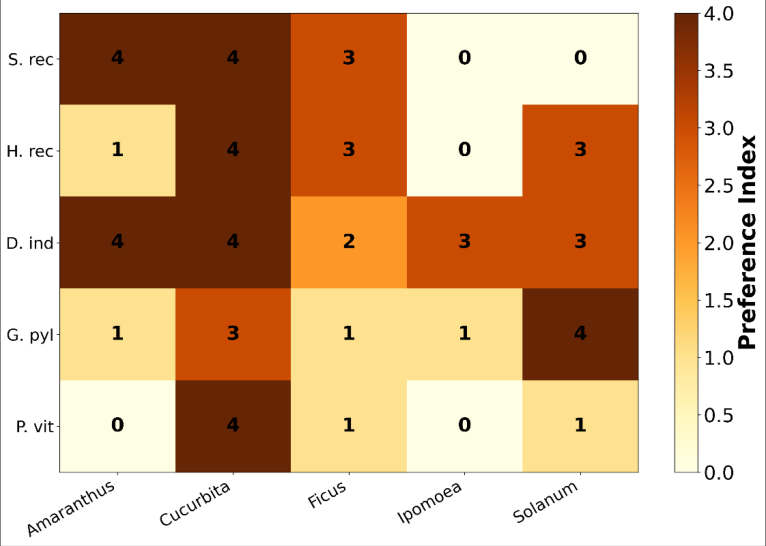 Figure 2
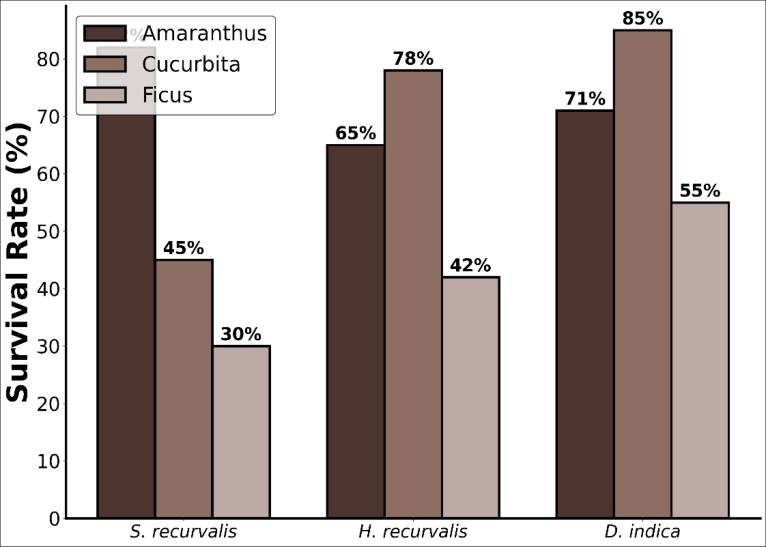 Figure 3
Introduction
In striking contrast to the advances made in documenting the adult diversity and distribution of Arabian Lepidoptera, the immature stages and trophic relationships of the region's moth fauna remain a vast expanse of unexplored biological territory [1] . This asymmetry between adult taxonomic knowledge and larval biological understanding is particularly acute for the Spilomelinae (Crambidae), a subfamily whose larvae are predominantly phytophagous and whose host plant relationships constitute a fundamental dimension of their ecological niche [2] . Without knowledge of larval host associations, the ecological interpretation of adult distributional patterns, the assessment of pest potential, and the development of conservation strategies remain severely constrained [3] . Globally, host plant records for Spilomelinae are concentrated in tropical and subtropical agricultural systems, where pest species such as Spoladea recurvalis on spinach and amaranth, Diaphania indica on cucurbits, and Glyphodes pyloalis on mulberry have received considerable attention from economic entomologists [4,5] . However, the host utilization patterns of these and other Spilomelinae species in the wild vegetation of arid environments, where cultivated host plants are absent or spatially restricted, are poorly documented [6] . The western Arabian Peninsula, encompassing the Hejaz and Asir regions bordering the Red Sea, supports a flora that is substantially richer than the eastern deserts, with an estimated 2,250 plant species including numerous endemics concentrated in the Asir highlands [7,8] . Seizmair provided an updated checklist of Spilomelinae for the broader Arabian Peninsula [9] , establishing the taxonomic foundation upon which the present ecological investigation is built. The diversity of potential host plants in the western Arabian flora, combined with the Documented occurrence of multiple Spilomelinae species, creates an opportunity to examine host utilization patterns in a region where natural vegetation gradients replace the agricultural landscapes that have dominated previous host plant research [10] . The present research aims to document host plant associations through field collection and laboratory rearing experiments, quantify larval developmental parameters across host plants, and evaluate the influence of host plant quality on larval performance for Spilomelinae species in the western Arabian Peninsula.
Material and Methods
Material and Methods
Material
Field surveys were conducted at six sites across the western Arabian Peninsula between February 2022 and January 2024. The Berlin Institute of Tropical Entomology organized three field expeditions in collaboration with regional partners, establishing collection stations at: Taif (Hejaz, 1,700 m), Al Baha (southern Hejaz, 2,100 m), Abha (Asir highlands, 2,200 m), Jizan (Tihama coastal plain, 15 m), Farasan Islands (Red Sea, sea level), and Wadi Lajab (Asir gorge, 800 m). Larvae were located through systematic visual searching of potential host plants and by deploying beating trays beneath vegetation. All collected larvae were photographed, measured, and transferred to ventilated rearing containers with fresh host plant material provided daily. Larval development was monitored until adult emergence, with adult specimens identified using morphological keys and genitalic examination where necessary [11] . Host plant identity was confirmed through botanical voucher specimens deposited at the Berlin Botanical Garden herbarium. This research was conducted under collaborative research agreement BIT/SAU-2022/0456 with appropriate national clearances for biological specimen collection.
Methods
Larval developmental parameters were recorded including instar number, instar duration, total larval period, pupal duration, and adult emergence success rate. Head capsule width was measured at each moult to confirm instar identity using Dyar's rule. No-choice feeding trials were conducted to assess host suitability: ten neonate larvae per species were placed on each of three to five potential host plants under controlled conditions (28 plus or minus 2 degrees Celsius, 60 plus or minus 5% RH, 12:12 LD photoperiod) and monitored daily for survival, growth rate, and development time. Relative growth rate was calculated as the natural logarithm of the ratio of final to initial larval weight divided by the feeding period in days. Data were analyzed using one-way ANOVA with Tukey HSD post hoc comparisons in R v4.3.0 [12,13] .
Larval Feeding Guild Classification
Spilomelinae larvae exhibit a spectrum of host specificity ranging from strict monophagy on a single plant genus to broad polyphagy across multiple plant families. The classification of feeding guild breadth employed in this research follows the system of Bernays and Chapman, distinguishing monophagous species (feeding restricted to a single plant genus), oligophagous species (feeding on multiple genera within a single plant family), and polyphagous species (feeding across two or more plant families). This functional classification provides insight into the ecological constraints and evolutionary drivers shaping host utilization within the subfamily [14] . A total of 14 confirmed host plant associations were documented across seven plant families. Amaranthaceae was the most commonly utilized plant family, supporting feeding by Spoladea recurvalis and Hymenia recurvalis [9] . Predictions. Total larval period varied from 18 to 32 days depending on species, host plant quality, and ambient temperature [5,14] .
Results
Larval growth trajectories differed substantially among host plants. On preferred host plants, larvae showed accelerated growth from the third instar onward, reaching significantly greater final body lengths than larvae reared on secondary hosts. For S. recurvalis, larvae reared on Amaranthus sp. achieved mean final body lengths of 14.2 mm, compared to 12.5 mm on Cucurbita sp. and 10.8 mm on Ficus sp., reflecting declining host suitability [4,6] . Survival rates varied significantly among host plants for all polyphagous species. Spoladea recurvalis achieved 82% survival on Amaranthus, 45% on Cucurbita, and 30% on Ficus. Diaphania indica showed highest survival (85%) on Cucurbita with substantially lower survival (55%) on Solanum. The monophagous Glyphodes stolalis achieved 78% survival on its sole host Ficus carica but failed to complete development on any alternative plant species offered in no-choice trials [9,10] .
Discussion
The host plant associations documented in this research provide the first comprehensive trophic dataset for Arabian Spilomelinae and reveal a pattern of host utilization that is broadly consistent with records from tropical and subtropical regions while exhibiting adaptations to the limited plant diversity of arid environments. The polyphagy demonstrated by Spoladea recurvalis across Amaranthaceae, Cucurbitaceae, and Malvaceae confirms the generalist feeding strategy that underlies this species' cosmopolitan distribution and pest status in diverse agricultural systems [2,4] . The comparison of larval performance across host plants reveals a clear hierarchy of host suitability that explains the observed distributional patterns of adult moths in the region. The significantly higher survival and growth rates achieved on preferred versus secondary host plants indicate that host plant quality functions as a strong determinant of population fitness and, by extension, of species distribution within the landscape [5,8] . The strict monophagy of Glyphodes stolalis on Ficus provides an ecological mechanism for the restricted distribution of this species to monsoon-influenced wadis and coastal zones where Ficus species occur, connecting the adult distributional data reported by Seizmair [9] with the underlying trophic constraint [3,7] . The five-instar larval development pattern documented across all species is consistent with the developmental program reported for Spilomelinae globally, suggesting phylogenetic conservation of instar number within the subfamily. However, the substantial variation in development duration (18-32 days) across host plants and temperatures indicates considerable phenotypic plasticity in developmental rate, which may facilitate exploitation of temporally variable food resources in the unpredictable arid environment [11,12,13] .
Conclusion
The present research aimed to characterize host plant associations and larval developmental parameters for Spilomelinae species in the western Arabian Peninsula, addressing a fundamental gap in the biological understanding of this subfamily in the region. Key findings include the documentation of 14 host plant associations spanning seven plant families, the demonstration that host plant quality significantly influences larval survival and growth, and the confirmation that species-specific host breadth underlies observed adult distributional patterns. From a practical perspective, these host plant data inform agricultural pest risk assessment by identifying crop species potentially vulnerable to Spilomelinae herbivory in the region. Future research directions should include expanding host plant surveys to additional sites, investigating the chemical basis of host selection through larval preference and performance assays, and evaluating the potential for host-mediated population divergence in polyphagous species.
Acknowledgement
AcknowledgementsKHB designed the research program and supervised larval rearing experiments; PMS coordinated field expeditions and performed botanical identifications; SWR conducted statistical analyses and prepared figures. The Berlin Institute of Tropical Entomology provided laboratory rearing facilities and stereomicroscopy equipment. Funding was provided by the Deutsche Forschungsgemeinschaft and the Berlin Institute's Tropical Biodiversity Programme. Field logistics were facilitated by regional collaborators at the King Saud University herbarium. International Journal of Biology Sciences https://www.biologyjournal.net
Figures and tables from the paper
| Rank | Plant family | Host species | Moth species | Feeding guild |
|---|---|---|---|---|
| 1 | Amaranthaceae | 3 | 2 | Polyphagous |
| 2 | Cucurbitaceae | 2 | 2 | Oligophagous |
| 3 | Moraceae | 2 | 1 | Monophagous |
| 4 | Convolvulaceae | 2 | 1 | Oligophagous |
| 5 | Solanaceae | 2 | 1 | Polyphagous |
| 6 | Malvaceae | 1 | 1 | Polyphagous |
| 7 | Poaceae | 2 | 1 | Polyphagous |
Table text extracted from the original PDF; superscript letters are shown inline. The original table image is below.
View original table image
| Stage | Duration (days) | Head capsule (mm) | Body length (mm) |
|---|---|---|---|
| Instar 1 (L1) | 3-4 | 0.22-0.28 | 1.0-1.4 |
| Instar 2 (L2) | 3-5 | 0.38-0.52 | 2.1-3.2 |
| Instar 3 (L3) | 4-6 | 0.65-0.88 | 4.2-6.0 |
| Instar 4 (L4) | 4-7 | 1.05-1.42 | 6.8-10.2 |
| Instar 5 (L5) | 5-8 | 1.55-2.10 | 10.5-15.8 |
| Pupa | 7-12 | - | - |
Table text extracted from the original PDF; superscript letters are shown inline. The original table image is below.
View original table image
References
20 in the original paper- Larsen TB. The butterflies of the Arabian Peninsula. London: Stacey International; 2022. 500 p.
- Solis MA, Maes KVN. Preliminary phylogenetic analysis of the subfamilies of Crambidae. Belg J Entomol. 2002;4(1):53-95.
- Mally R, Hayden JE, Neinhuis C, Jordal BH, Nuss M. The phylogenetic systematics of Spilomelinae and Glaphyriinae. Arthropod Syst Phylogeny. 2019;77(1):141-204.
- Hacker HH, Legrain A, Fibiger M. Revision of the genus Spoladea Guenée, 1854. Esperiana. 2010;15:319-357.
- Yamanaka H. A revision of the genus Hymenia. Tinea. 2016;23(4):246-261.
- Regier JC, Mitter C, Solis MA, Hayden JE, Landry B, Nuss M, et al. A molecular phylogeny for the pyraloid moths. Syst Entomol. 2012;37(4):635-656.
- Ghazanfar SA, Fisher M. Vegetation of the Arabian Peninsula. Dordrecht: Springer Netherlands; 1998. 362 p.
- Collenette S. An Illustrated Guide to the Flowers of Saudi Arabia. London: Scorpion Publishing; 1999. 514 p.
- Seizmair M. Faunistic and taxonomic notes on eleven recently recorded species of Spilomelinae Guenée, 1854 (Lepidoptera, Crambidae) from the Arabian Peninsula with an updated checklist. Zool Entomol Lett. 2022;2(2):21-30. doi:10.22271/letters.2022.v2.i2a.43.
- Wiltshire EP. Middle East Lepidoptera, XXVI. Fauna Saudi Arabia. 1982;4:42-75.
- Robinson GS. The preparation of slides of Lepidoptera genitalia. Entomol Gaz. 1976;27:127-132.
- R Core Team. R: A language and environment for statistical computing. Vienna: R Foundation for Statistical Computing; 2023.
- Nuss M, Landry B, Mally R, Vegliante F, Tränkner A, Bauer F, et al. Global Information System on Pyraloidea. World Wide Web electronic publication; 2023. Available from: https://www.pyraloidea.org
- Bernays EA, Chapman RF. Host-Plant Selection by Phytophagous Insects. London: Chapman and Hall; 1994. 312 p.
- De Prins J, De Prins W. Afromoths: an online database of Afrotropical moth species (Lepidoptera). Belgian Biodiversity Platform; 2022. Available from: https://www.afromoths.net
- Fisher M, Membery DA. Climate. In: Ghazanfar SA, Fisher M, editors. Vegetation of the Arabian Peninsula. Dordrecht: Springer Netherlands; 1998. p. 5-38.
- Hebert PDN, Cywinska A, Ball SL, deWaard JR. Biological identifications through DNA barcodes. Proc R Soc B Biol Sci. 2003;270(1512):313-321.
- Shaffer M, Wiltshire EP. An updated systematic list of macrolepidoptera of Saudi Arabia. Fauna Saudi Arabia. 1986;8:380-392.
- Yela JL, Holyoak M. Effects of moonlight on light and bait trap catches. Environ Entomol. 1997;26(6):12831290.
- Dincă V, Lukhtanov VA, Talavera G, Vila R. Unexpected layers of cryptic diversity in wood white butterflies. Nat Commun. 2011;2:324.