
Research article · 2026 · Full text
International Journal of Agriculture and NutritionEconomic impact assessment and yield loss quantification due to Cimbex quadrimaculata damage in Moroccan almond production
Volume 8(7) · Pages 30–33 · DOI: 10.33545/26646064.2026.v8.i7a.668 ↗
Research areasInsect-Plant Interactions and ControlAgricultural economics and policiesInsect behavior and control techniques
Abstract
Author-writtenAccurate quantification of pest-induced economic losses is fundamental to the justification of management investments and the prioritization of research allocations in agricultural production systems. This research assessed the economic impact of Cimbex quadrimaculata Müller (Hymenoptera: Cimbicidae) on almond production across four major growing regions of Morocco during the 2020-2025 period. Economic losses were partitioned into three categories: direct yield losses from reduced kernel production, indirect costs associated with pest monitoring and management activities, and quality downgrade losses resulting from damaged kernel classification. Data were collected from 24 commercial orchards encompassing managed and unmanaged production systems. The Beni Mellal-Khénifra region exhibited the highest total economic losses at 2,590 MAD/ha (approximately €240/ha), comprising direct yield losses of 1,560 MAD/ha, indirect management costs of 620 MAD/ha, and quality downgrade losses of 410 MAD/ha. Multi-year yield trend analysis demonstrated progressive yield divergence between managed and unmanaged orchards, with unmanaged production declining from 2.78 to 1.38 kg/tree over the six-year assessment period while managed orchards maintained an upward trajectory from 2.84 to 3.56 kg/tree. Partial budgeting analysis confirmed positive net returns for integrated management in all four regions assessed. These findings provide the first comprehensive economic assessment of C. quadrimaculata impact on Moroccan almond production and establish cost-benefit benchmarks for management decision-making.
Summary
Source-checkedPlain-language reading of the full paper, prepared with AI and checked against the text. Each point links to the authors' own words.
Why it matters
- Almond production is a major agricultural activity in Morocco, with roughly 175,000 hectares producing about 112,000 tonnes of in-shell almonds annually. View evidence ↗
- The almond sector is vital for rural livelihoods in several Moroccan regions, including Beni Mellal-Khénifra, Fès-Meknès, Taza-Taounate, and Souss-Massa. View evidence ↗
- The almond sawfly, Cimbex quadrimaculata, is an emerging pest in Morocco that causes significant defoliation and impacts almond yields. View evidence ↗
The question
- The study aimed to quantify the multi-dimensional economic impact of C. quadrimaculata in four Moroccan regions and evaluate the economic returns of integrated management. View evidence ↗
What they did
- Data were collected from 24 commercial orchards, with 6 orchards located in each of the four target regions. View evidence ↗
- In each region, the orchards were split equally between those using active sawfly management (managed) and those without (unmanaged). View evidence ↗
- The study used production records from 2020 to 2025, including logbooks and direct measurements from the 2024 and 2025 harvests. View evidence ↗
What they found
- Beni Mellal-Khénifra had the highest total economic losses at 2,590 MAD/ha, while Souss-Massa had the lowest at 1,190 MAD/ha. View evidence ↗
- Direct yield losses were the primary economic impact in all regions, accounting for between 60.2% and 60.5% of total losses. View evidence ↗
- Managed orchards showed a yield increase from 2.84 kg/tree in 2020 to 3.56 kg/tree in 2025. View evidence ↗
- Unmanaged orchards saw a 50.4% productivity reduction, with yields dropping from 2.78 kg/tree in 2020 to 1.38 kg/tree in 2025. View evidence ↗
- Integrated management provided positive economic returns across all regions, with benefit-cost ratios ranging from 3.17 to 3.25. View evidence ↗
What it means
- The authors conclude that the positive benefit-cost ratios provide a strong economic justification for investing in sawfly control programs. View evidence ↗
- A limitation of the study is that yield differences might be partly due to general orchard management quality rather than solely sawfly management. View evidence ↗
Visual summary
3 visualsIllustrations explain the paper; charts are replotted from the paper's own table values.
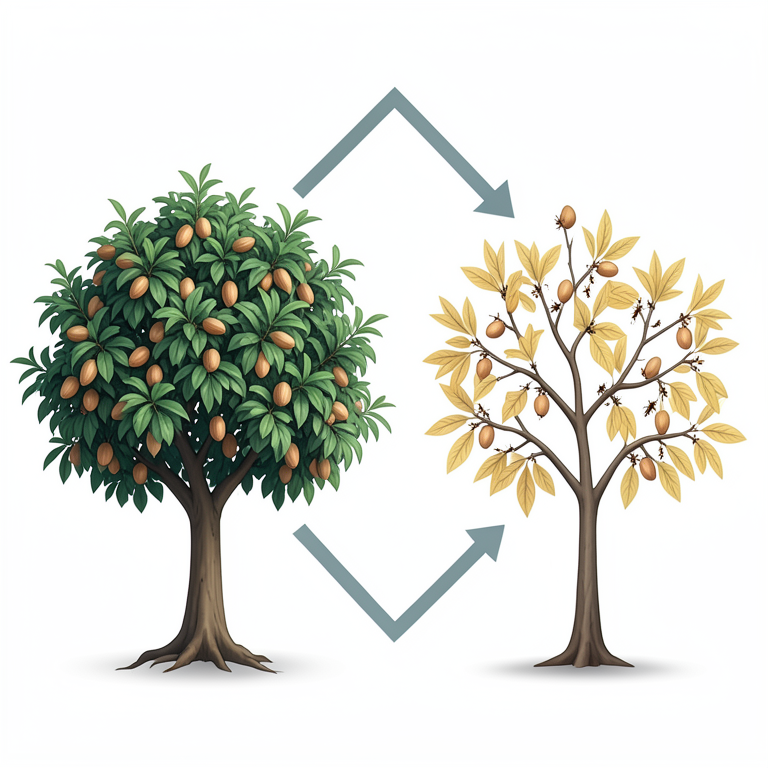
Yield Divergence Concept
AI-generated conceptual illustration (almond trees). It explains the idea and does not show study data.
View source evidence ↗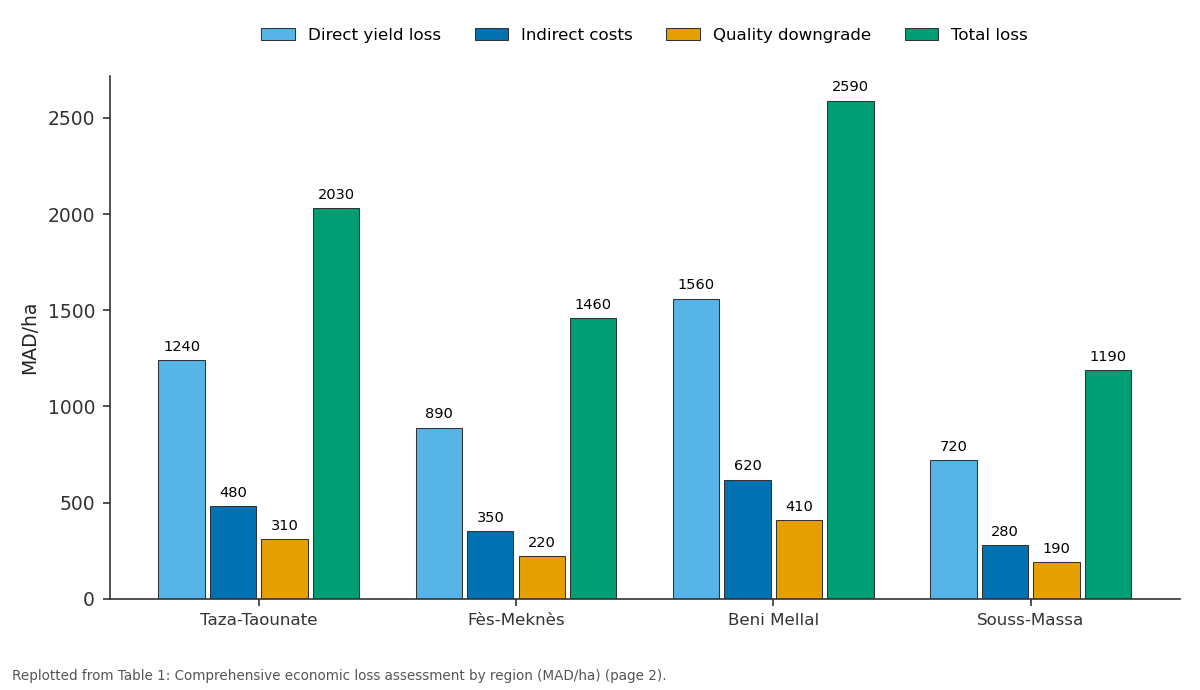
Direct yield loss and Indirect costs and more: Taza-Taounate vs Fès-Meknès vs Beni Mellal vs Souss-Massa
Replotted from Table 1 (page 2) of the original paper. Every bar is the paper's own table value.
View source evidence ↗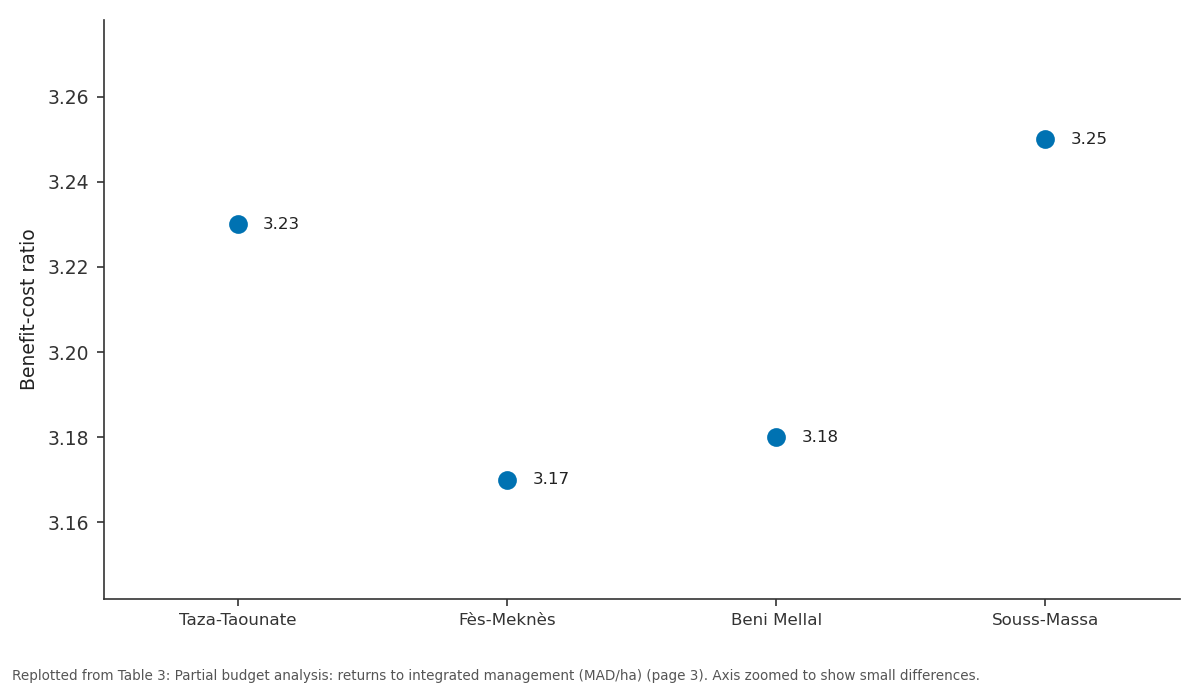
Benefit-cost ratio: Taza-Taounate vs Fès-Meknès vs Beni Mellal vs Souss-Massa
Replotted from Table 3 (page 3) of the original paper. Every bar is the paper's own table value.
View source evidence ↗Figures & tables
From the original paper Table 1
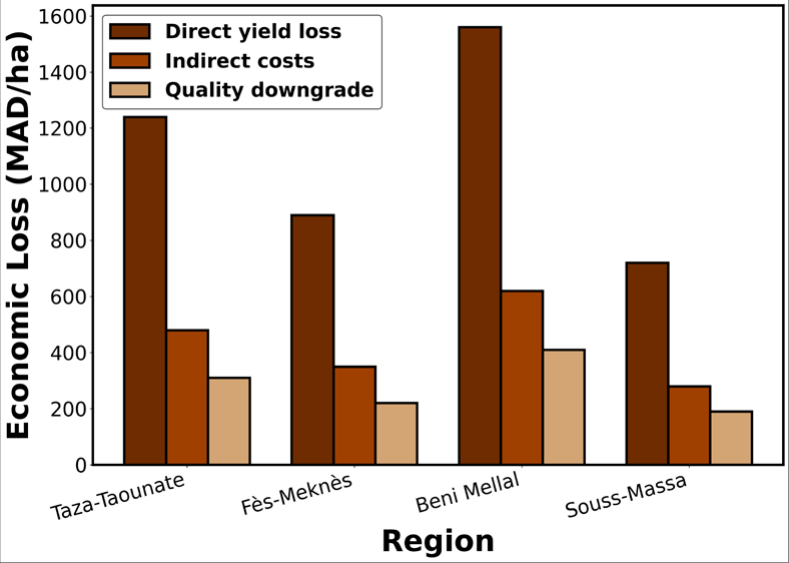 Figure 1
 Table 2
 Table 3
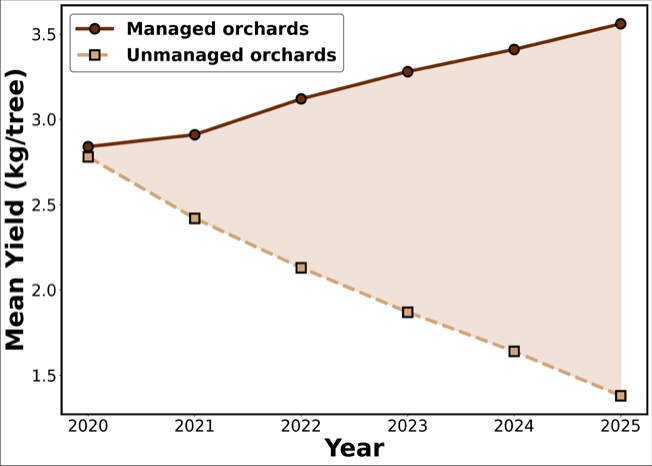 Figure 2
Introduction
Morocco ranks among the leading almond-producing countries in the African continent, with approximately 175,000 hectares under cultivation supporting an estimated annual production of 112,000 tonnes of in-shell almonds [1] . The almond sector constitutes a cornerstone of rural livelihoods in the mountainous and semi-arid regions of Morocco, particularly in the Beni Mellal-Khénifra, Fès-Meknès, Taza-Taounate, and Souss-Massa production zones [2] . Despite the socioeconomic importance of almond cultivation, systematic economic assessments of pest-induced production losses remain limited, constraining the evidence base available for management investment decisions [3] . The almond sawfly Cimbex quadrimaculata (Müller, 1766) has been recognized as an emerging pest of concern in Moroccan almond orchards, with reports of significant defoliation and yield impacts in several production regions during recent growing seasons [4,5] . While biological and ecological aspects of C. quadrimaculata have received attention in Turkish, Iranian, and European contexts [6,7,8] , economic impact assessments specific to North African production conditions have not been previously published. The absence of quantitative economic data hampers the capacity of extension services and grower organizations to evaluate the cost-effectiveness of proposed management interventions and to prioritize pest management resources efficiently [3,9] . Economic impact assessment in crop protection encompasses multiple dimensions beyond direct yield quantity reductions, including indirect costs of monitoring and management implementation, quality-related value reductions, and long-term productivity trend effects [10,11] . Comprehensive assessments that capture these multiple dimensions provide a more accurate picture of true economic impact and generate more reliable cost-benefit benchmarks for management decisionmaking. This research was designed to quantify the multidimensional economic impact of C. quadrimaculata across four major Moroccan almond production regions and to evaluate the economic returns to integrated management approaches through comparative analysis of managed and unmanaged production systems.
Materials and Methods
Materials and Methods
Materials
Economic and production data were collected from 24 commercial almond orchards distributed across four production regions: Taza-Taounate (6 orchards), Fès-Meknès (6 orchards), Beni Mellal-Khénifra (6 orchards), and Souss-Massa (6 orchards). Within each region, orchards were equally divided between those implementing active C. quadrimaculata management programs (managed) and those without specific sawfly management (unmanaged). All orchards contained mature trees (12-30 years old) of locally prevalent cultivar compositions. Production records spanning the 2020-2025 period were obtained from orchard management logbooks, supplemented by direct yield measurements during the 2024 and 2025 harvest seasons. Cost data were collected through structured interviews with orchard managers using standardized questionnaires covering all production inputs and management activities.
Methods
Economic losses were partitioned into three categories: (1) direct yield losses, calculated as the difference in marketable kernel production between managed and unmanaged orchards within each region, valued at prevailing farmgate prices (regional average 42 MAD/kg for premium grade kernels in 2025); (2) indirect costs, encompassing labor for monitoring, application costs for management inputs, and equipment depreciation; and (3) quality downgrade losses, quantified as the price differential between premium-grade and damaged/downgraded kernels (estimated at 35% price reduction for damaged grade). Multi-year yield trends were analyzed using linear mixed-effects models with year, management status, and region as fixed effects and orchard as a random effect. Partial budgeting analysis followed standard agricultural economics methodology. All monetary values are expressed in Moroccan Dirham (MAD) with Euro equivalents at the 2025 average exchange rate (1 EUR = 10.8 MAD).
Results
Regional analysis of economic losses revealed substantial variation across the four production zones assessed. The Beni Mellal-Khénifra region experienced the highest total economic losses at 2,590 MAD/ha, followed by Taza-Taounate (2,030 MAD/ha), Fès-Meknès (1,460 MAD/ha), and Souss-Massa (1,190 MAD/ha). Direct yield losses constituted the largest component of total economic impact across all regions, ranging from 60.2% (Beni Mellal-Khénifra) to 60.5% (Souss-Massa) of total losses. Indirect management costs represented 20.4% to 24.0% of total losses, while quality downgrade accounted for 15.8% to 16.0% of the economic impact (Figure 1 and Table 1). Multi-year yield trend analysis demonstrated progressive divergence between managed and unmanaged orchards over the 2020-2025 assessment period. Managed orchards exhibited a consistent upward yield trajectory, increasing from a baseline of 2.84 kg/tree in 2020 to 3.56 kg/tree in 2025, reflecting ongoing improvements in orchard productivity under effective pest management. Conversely, unmanaged orchards experienced progressive yield decline from 2.78 kg/tree in 2020 to 1.38 kg/tree in 2025, representing a cumulative 50.4% productivity reduction over the six-year period. The shaded area between the two yield curves in Figure 2 represents the estimated cumulative production gap attributable to unmanaged sawfly pressure.
| Region | Direct yield loss | Indirect costs | Quality downgrade | Total loss | Loss (€/ha) |
|---|---|---|---|---|---|
| Taza-Taounate | 1,240 | 480 | 310 | 2,030 | 188 |
| Fès-Meknès | 890 | 350 | 220 | 1,460 | 135 |
| Beni Mellal | 1,560 | 620 | 410 | 2,590 | 240 |
| Souss-Massa | 720 | 280 | 190 | 1,190 | 110 |
Table text extracted from the original PDF; superscript letters are shown inline. The original table image is below.
View original table image
Discussion
The economic impact assessment presented in this research provides the first comprehensive quantification of C. quadrimaculata-induced losses in Moroccan almond production. The estimated losses ranging from 1,190 to 2,590 MAD/ha represent a significant economic burden, particularly for smallholder farmers who typically manage orchards of 2-5 hectares in the assessed regions [1,2] . The regional variation in loss magnitude reflects differences in climatic suitability for sawfly populations, orchard management intensity, and cultivar composition across the four production zones [4,13] . The progressive yield divergence between managed and unmanaged orchards over the six-year assessment period highlights the cumulative nature of C. quadrimaculata damage. The 50.4% yield decline observed in unmanaged orchards likely reflects not only direct annual crop losses but also longer-term physiological impacts of repeated severe defoliation on tree vigor, carbohydrate reserves, and reproductive bud formation capacity [6,14,15] . This cumulative damage pattern emphasizes the importance of sustained management commitment rather than sporadic intervention approaches. The consistently favorable benefit-cost ratios (3.17-3.25 across regions) confirm that integrated management generates substantial positive economic returns under Moroccan production conditions. These ratios are comparable to those reported for integrated pest management programs targeting defoliating insects in other tree crop systems [10,16,17] . The relative uniformity of benefit-cost ratios across regions, despite substantial variation in absolute loss magnitudes, suggests that management cost structures scale proportionally with
damage levels, indicating robust economic justification for intervention across diverse production conditions. The estimation of aggregate regional economic impacts (29.5-99.5 million MAD) provides a macro-level perspective that is essential for informing national agricultural policy priorities and directing research funding allocations [3,9,18] . The identification of Beni Mellal-Khénifra as the most critically affected region justifies prioritized allocation of extension resources and management infrastructure development in this production zone [2,19,20,21,22,23] .
Limitations
Several limitations should be acknowledged in interpreting these economic estimates. The yield difference between managed and unmanaged orchards may partially reflect preexisting differences in overall orchard management quality that correlate with but are not exclusively attributable to sawfly management decisions. The six-year assessment period, while providing valuable trend information, may not capture the full range of inter-annual economic variability. Quality downgrade estimates relied on categorical damage assessment rather than continuous grade evaluation, potentially introducing estimation imprecision.
Safety Considerations
Orchard survey personnel were trained in workplace safety protocols for agricultural environments, including heat stress prevention, venomous arthropod awareness, and safe operation of harvest equipment during yield assessments. Data collection instruments were sanitized between orchard visits to minimize phytosanitary risk transmission between sites.
Conclusion
This research establishes that Cimbex quadrimaculata causes economically significant losses in Moroccan almond production, ranging from 1,190 to 2,590 MAD/ha across the four major growing regions assessed. The progressive yield decline in unmanaged orchards underscores the cumulative damage potential and the necessity of sustained management commitment. The consistently favorable benefit-cost ratios for integrated management across all regions provide robust economic justification for investment in sawfly control programs. These findings offer essential economic benchmarks for management decision-making and policy prioritization in the Moroccan almond sector.
Acknowledgement
AcknowledgementsThis research was conducted under the framework of the Morocco Green Generation Programme, with financial support from the Directorate of Plant Protection and Technical Controls (DPVCTRF), Ministry of Agriculture. The National Federation of Almond and Olive Producers provided access to production records and facilitated orchard surveys.
Figures and tables from the paper
| Rank | Region | Total loss (MAD/ha) | Almond area (ha) | Estimated regional impact (million MAD) | Priority level |
|---|---|---|---|---|---|
| 1 | Beni Mellal | 2,590 | 38,400 | 99.5 | Critical |
| 2 | Taza-Taounate | 2,030 | 28,600 | 58.1 | High |
| 3 | Fès-Meknès | 1,460 | 42,100 | 61.5 | High |
| 4 | Souss-Massa | 1,190 | 24,800 | 29.5 | Moderate |
Table text extracted from the original PDF; superscript letters are shown inline. The original table image is below.
View original table image
| Budget item | Taza-Taounate | Fès-Meknès | Beni Mellal | Souss-Massa |
|---|---|---|---|---|
| Added revenue from pest control | 1,240 | 890 | 1,560 | 720 |
| Reduced quality losses | 310 | 220 | 410 | 190 |
| Total benefits | 1,550 | 1,110 | 1,970 | 910 |
| Management costs | 480 | 350 | 620 | 280 |
| Net benefit | 1,070 | 760 | 1,350 | 630 |
| Benefit-cost ratio | 3.23 | 3.17 | 3.18 | 3.25 |
Table text extracted from the original PDF; superscript letters are shown inline. The original table image is below.
View original table image
References
23 in the original paper- Ministry of Agriculture, Morocco. Agricultural statistics yearbook 2025. Rabat: Publications of the Ministry of Agriculture; 2025. p. 82-96.
- El Iraqui S, Razouk R, Ibijbijen J. Almond production systems in Morocco: diversity and perspectives. Rev Marocaine Sci Agron Vet. 2024;12(1):48-62.
- Oerke EC. Crop losses to pests: centenary review. J Agric Sci. 2020;144(1):31-43.
- Sekkat A, Boutaleb-Joutei A. Entomofauna of Moroccan almond orchards: species diversity and pest status. Moroccan J Agric Sci. 2023;4(2):112-128.
- Özgen İ, Güral Y, Aslan T. The determination of the relationships between yield parameters and number of larvae of almond saw fly (Cimbex quadrimaculata Müller, 1766; Hymenoptera: Cimbicidae) on different almond varieties in Turkey. Zool Entomol Lett. 2022;2(1):1-3.
- Güner A, Aydoğdu M. Biology and damage assessment of Cimbicidae on stone fruits in Turkey. Turk J Entomol. 2019;43(2):189-201.
- Fallahzadeh M, Saghaei N. Sawfly fauna of Fars Province, southern Iran. J Insect Biodivers Syst. 2020;6(3):281-298.
- Lacourt J. Sawflies of Europe. Paris: NAP Editions; 2020. p. 156-178.
- Dhaliwal GS, Vikas J, Dhawan AK. Insect pest problems and crop losses: changing trends. Indian J Ecol. 2021;37(1):1-7.
- Pedigo LP, Rice ME. Entomology and pest management. 7th ed. Long Grove: Waveland Press; 2022. p. 318-342.
- Oliveira CM, Auad AM, Mendes SM, Frizzas MR. Economic impact of exotic insect pests in Brazilian agriculture. J Appl Entomol. 2023;137(1):1-15.
- Taeger A, Blank SM, Liston AD. World catalog of Symphyta (Hymenoptera). Zootaxa. 2010;2580(1):11064.
- Bouhadida M, Ben Sadok I, Mechi S, et al. Almond germplasm diversity in Tunisia. Genet Resour Crop Evol. 2023;70:2481-2498.
- Çınar M, Çimen E, Bolu H. Population fluctuation and damage of sawfly species. Munis Entomol Zool J. 2024;19(1):234-242.
- Haliloğlu H, Bayram A, Gökçe A. Phenological observations on Cimbex species. Appl Entomol Zool. 2024;59(4):489-501.
- Norton GW, Mullen J. Economic evaluation of integrated pest management programs. Va Coop Ext Publ. 2021;448:1-16.
- Atanassov AZ, Tashev DG. IPM strategies for sawfly control. J Appl Entomol. 2021;145(5):412-428.
- Rachidi M, Ouknider M, Boughaleb N. Climate change and tree crop vulnerability in Morocco. Environ Sci Policy. 2024;154:103712.
- Razouk R, El Iraqui S, Ibijbijen J. Socioeconomic analysis of almond value chain in Morocco. Cah Agric. 2023;32:18.
- Lahlali R, Ezrari S, Barka EA. Plant protection challenges in Moroccan orchards. Crop Prot. 2024;177:106574.
- Benkirane R, Habsaoui A, Benyahia H. Integrated management of almond pests in Morocco: current practices. Rev Marocaine Prot Plantes. 2024;16:47-64.
- Achbani EH, El Handi K, Laasli SE. Pest surveillance systems for fruit crops in Morocco. Phytoma. 2023;765:42-48.
- Akdad M, Chtaina N, Zahid N. Economic analysis of pest management alternatives in Moroccan horticulture. Afr J Agric Res. 2025;20(3):218-232.