
Research article · 2026 · Full text
International Journal of Horticulture and Food ScienceIntegrated pest management adoption versus conventional insecticide reliance in smallholder pepper farms of Laguna Province, Philippines
Volume 8(7) · Pages 31–35 · DOI: 10.33545/26631067.2026.v8.i7a.777 ↗
Research areasAgricultural Innovations and PracticesInsect-Plant Interactions and ControlInsect Pest Control Strategies
Abstract
Author-writtenIntegrated pest management (IPM) has been promoted extensively across Southeast Asia, yet comparative data on its adoption levels versus conventional insecticide reliance among smallholder vegetable farmers remain insufficient for evidence-based policy formulation. This research compared IPM adoption rates, barriers to adoption, and yield outcomes between IPM-practicing and conventional-insecticide-reliant pepper and vegetable farmers across six municipalities of Laguna Province, Philippines, during 2025-2026. Among 240 surveyed farmers, 22.4% were classified as full IPM adopters, 38.7% as partial IPM adopters, and 38.9% as conventional-only practitioners. Lack of training was the leading barrier to IPM adoption (32.4%), followed by higher perceived cost (25.1%) and insufficient supply of biological control agents (18.6%). Yield analysis across four crops revealed that IPM farms achieved higher mean yields in all categories: hot pepper (14.2 vs. 12.6 t/ha), eggplant (18.5 vs. 16.8 t/ha), tomato (22.1 vs. 20.4 t/ha), and bitter gourd (12.8 vs. 11.5 t/ha), with statistically significant differences for hot pepper and eggplant (p<0.05). These findings demonstrate that IPM adoption delivers measurable yield advantages while reducing insecticide dependency, supporting the case for expanded farmer training and biocontrol agent supply chains in Philippine vegetable production.
Summary
Source-checkedPlain-language reading of the full paper, prepared with AI and checked against the text. Each point links to the authors' own words.
Why it matters
- Smallholder farms are essential to the national vegetable supply chain in the Philippines, which is a leading vegetable producer in Southeast Asia. View evidence ↗
- To combat persistent pest pressures, most farmers have traditionally used synthetic chemical insecticides, specifically organophosphates and pyrethroids, on a calendar-based schedule. View evidence ↗
- Despite significant investments in training, the adoption of Integrated Pest Management (IPM) remains lower than expected, with some trained farmers returning to insecticide-heavy methods. View evidence ↗
The question
- The study aimed to classify IPM adoption levels, identify barriers to adoption, and compare crop yields between IPM and conventional farms for four major vegetables in Laguna Province. View evidence ↗
What they did
- The study was carried out across six municipalities in the Laguna Province of the Philippines: Nagcarlan, Alaminos, San Pablo, Binan, Santa Rosa, and Cabuyao. View evidence ↗
- The researchers used a comparative cross-sectional design, selecting 240 smallholder farmers via stratified random sampling (40 farmers per municipality). View evidence ↗
- Yield data were collected from farmer records and validated by monitoring harvests on a subsample of 60 farms, with 20 farms from each adoption category. View evidence ↗
What they found
- Of the 240 farmers surveyed, 22.4% were full IPM adopters, 38.7% were partial adopters, and 38.9% relied solely on conventional methods. View evidence ↗
- Full IPM adopters had significantly higher rates of formal training (81.5%) and tertiary education (44.4%) compared to partial and conventional farmers. View evidence ↗
- IPM farms achieved higher mean yields than conventional farms for all four crops: hot pepper (14.2 vs 12.6 t/ha), eggplant (18.5 vs 16.8 t/ha), tomato (22.1 vs 20.4 t/ha), and bitter gourd (12.8 vs 11.5 t/ha). View evidence ↗
- The yield advantages for IPM farms were statistically significant for eggplant and hot pepper (p<0.05), while tomato and bitter gourd showed non-significant positive trends. View evidence ↗
What it means
- The authors recommend expanding farmer field schools, improving biocontrol agent supply chains, and providing targeted support to partial adopters to move them toward full IPM implementation. View evidence ↗
- The study's yield data relied heavily on farmer records and recall, which may introduce recall bias or estimation errors. View evidence ↗
- The cross-sectional design could not account for confounding factors such as microclimate, soil quality, or management intensity differences between the farm types. View evidence ↗
Visual summary
2 visualsIllustrations explain the paper; charts are replotted from the paper's own table values.
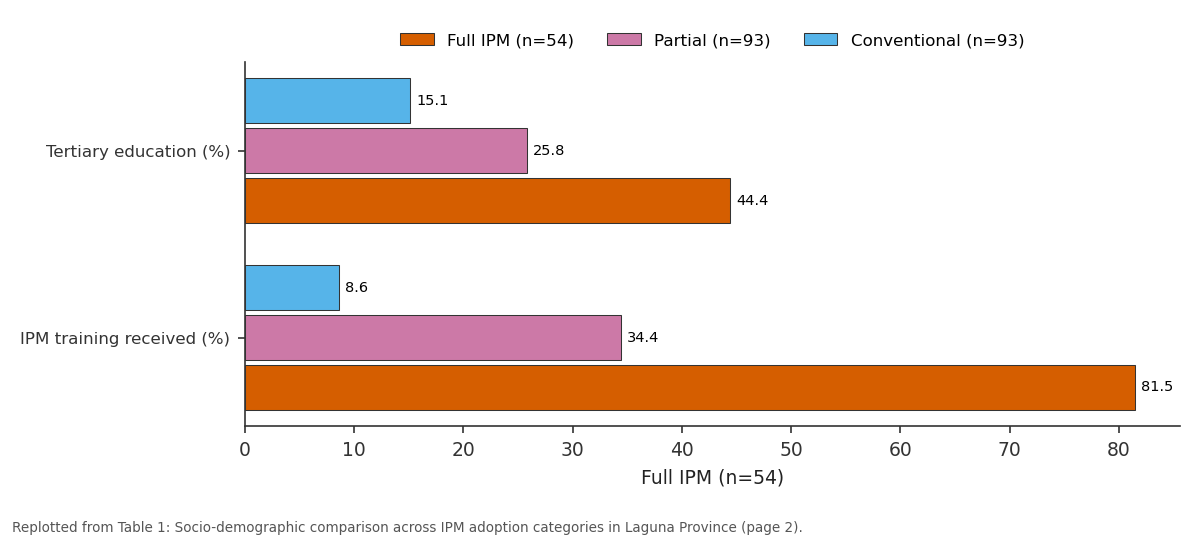
Full IPM (n=54) and Partial (n=93) and more: Tertiary education (%) vs IPM training received...
Replotted from Table 1 (page 2) of the original paper. Every bar is the paper's own table value.
View source evidence ↗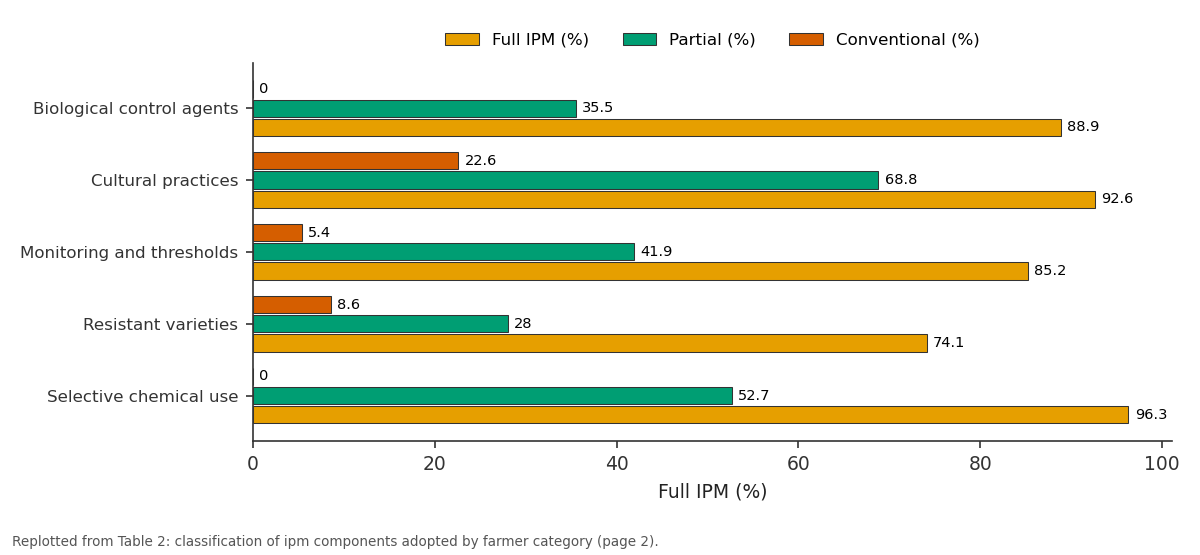
Full IPM (%) and Partial (%) and more: Biological control... vs Cultural practices vs Monitoring and... vs Resistant varieties vs Selective chemical use
Replotted from Table 2 (page 2) of the original paper. Every bar is the paper's own table value.
View source evidence ↗Figures & tables
From the original paper Table 1
 Table 2
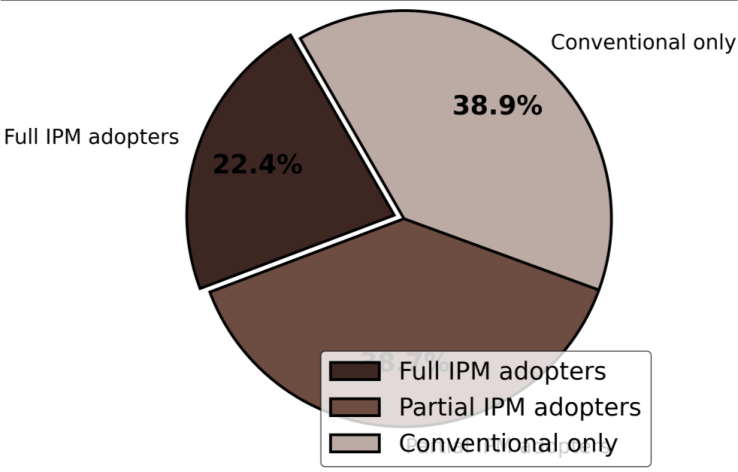 Fig. 1
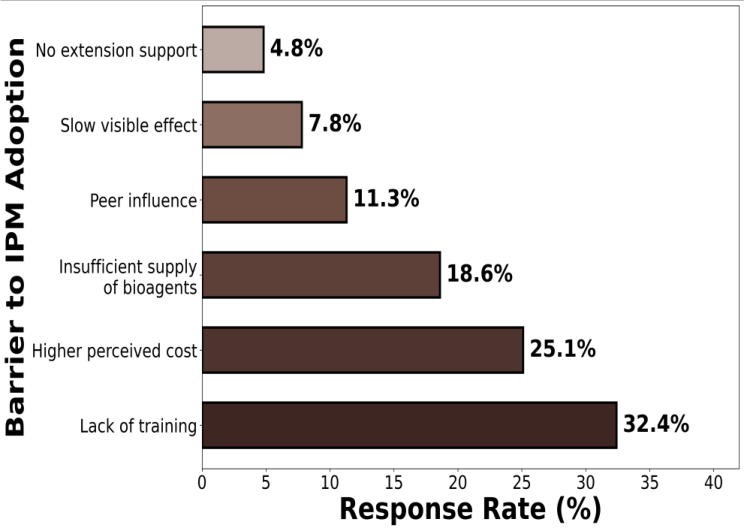 Fig. 2
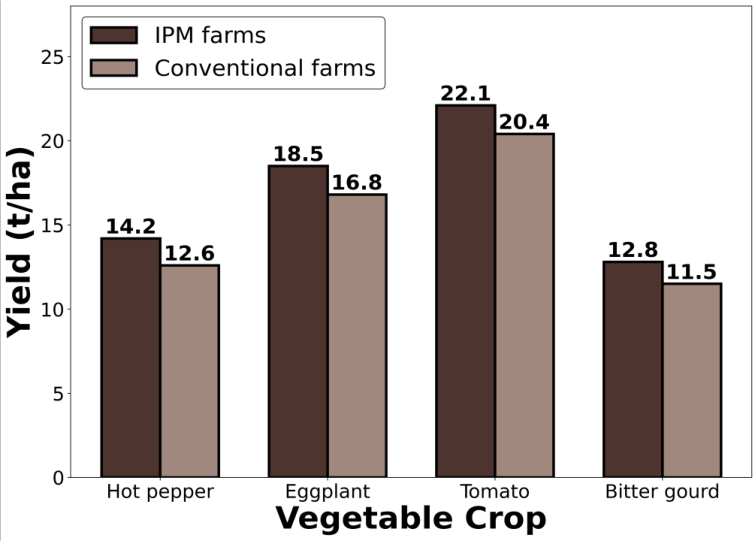 Fig. 3
Introduction
The Philippines ranks among the leading vegetable-producing countries in Southeast Asia, with smallholder farms forming the backbone of the national vegetable supply chain. In Laguna Province, located approximately 70 kilometers southeast of Manila, vegetable cultivation represents a primary livelihood activity for thousands of farming households. The province's favorable combination of volcanic soils, adequate rainfall, and proximity to the Metro Manila market has supported the development of intensive production systems for hot pepper (Capsicum frutescens), eggplant (Solanum melongena), tomato (Solanum lycopersicum), bitter gourd (Momordica charantia), and various leafy vegetables. Like vegetable production systems throughout tropical Asia, Laguna's farms face persistent pest pressures from arthropod species including fruit and shoot borer (Leucinodes orbonalis), whiteflies (Bemisia tabaci), thrips (Thrips palmi), and aphids (Aphis gossypii). In response, the majority of farmers have historically relied on calendar-based applications of synthetic chemical insecticides, predominantly pyrethroids and organophosphates, to protect their crops from pest-inflicted losses. Integrated pest management (IPM), which emphasizes the coordinated use of biological control, cultural practices, resistant varieties, and judicious chemical intervention as a last resort, has been promoted in the Philippines since the early 1990s (Thaware, 20230) [3] . Government programs, international development initiatives, and academic extension projects have invested substantially in IPM training through farmer field schools, demonstration plots, and participatory learning activities. Despite these investments, the overall rate of IPM adoption among Philippine vegetable farmers remains below expectations, and many trained farmers reportedly revert to conventional insecticideintensive practices. Understanding the current landscape of IPM adoption, the barriers that impede broader uptake, and the tangible yield outcomes achieved by IPM practitioners relative to conventional farmers is critical for refining extension strategies and informing agricultural policy. While national-level surveys have captured broad trends, localized investigations that compare adoption categories and link them to crop-specific production outcomes are essential for generating actionable insights. This research pursued three objectives: (1) to classify the current adoption status of IPM among smallholder vegetable farmers in Laguna Province, (2) to identify and rank the barriers preventing non-adopters from transitioning to IPMbased approaches, and (3) to compare crop yields between IPM-practicing and conventional-insecticide-reliant farms across four major vegetable crops. The economic justification for IPM adoption in Philippine vegetable production has been debated extensively among agricultural economists and extension professionals. Proponents argue that the reduction in chemical input costs, combined with maintained or improved yields through better pest management, generates a positive return on the investment required for IPM training and implementation. Critics counter that the upfront costs of learning IPM techniques, purchasing biological control agents, and accepting the transitional risk of reduced pest control during the learning period represent significant barriers for smallholder farmers operating with limited capital reserves. Resolving this debate with crop-specific yield data from the Philippines' major vegetable production zones is essential for informing the design and messaging of future extension programs.
Materials and methods
Materials and methods
Materials
The research was conducted in six municipalities of Laguna Province in the CALABARZON region of the Philippines: Cabuyao, Santa Rosa, Binan, San Pablo, Alaminos, and Nagcarlan. These municipalities were selected to represent the range of agro-ecological conditions and farming intensities found across the province. Elevations ranged from 20 to 350 meters above sea level, with annual rainfall between 1,800 and 2,500 millimeters distributed across distinct wet and dry seasons.
Methods
A comparative cross-sectional research design was employed involving 240 smallholder vegetable farmers.
Farmers were selected using stratified random sampling with 40 farmers drawn from each municipality. Stratification ensured balanced representation of different farm sizes and crop portfolios. An IPM adoption classification framework was developed based on established criteria from the Food and Agriculture Organization's IPM guidelines. Farmers were classified into three categories: full IPM adopters (regularly employing at least four of five IPM components: biological control, cultural practices, monitoring and thresholds, resistant varieties, and selective chemical use), partial IPM adopters (employing two to three components), and conventionalonly practitioners (relying exclusively on synthetic chemical insecticides without integration of other approaches). Data were collected through structured face-to-face interviews between July 2025 and June 2026. The questionnaire captured information on pest management practices, IPM component adoption, perceived barriers to adoption, crop yields, input costs, and farmer demographics. Yield data were obtained from farmer records and crossvalidated through harvest monitoring on a subsample of 60 farms (20 per adoption category). Between-group yield comparisons were performed using independent samples t-tests (IPM farms vs. conventional farms, with partial adopters excluded from the primary yield comparison to maintain analytical clarity). Barrier analysis employed descriptive ranking statistics. Chi-square tests assessed associations between adoption status and demographic variables. All analyses used SPSS version 28 with significance at p<0.05. The economic analysis component compared total seasonal production costs, gross revenues, and net returns between full IPM adopters and conventional farmers across the four target crops. Cost categories included seed, fertilizer, insecticides, biological control agents, labor (family and hired), irrigation, and transportation. Revenue was calculated using farm-gate prices recorded at the time of each harvest. Net return was computed as gross revenue minus total variable costs. Cost-effectiveness ratios for pest management were calculated as the total pest management expenditure divided by the marketable yield per hectare. Between-group differences in economic parameters were assessed using Mann-Whitney U tests due to the skewed distribution of economic data.
Results
Table Among conventional and partial adopters (n = 186), the leading barrier to full IPM adoption was lack of training (32.4%), followed by higher perceived cost of biological control agents (25.1%), insufficient supply of biocontrol agents in local markets (18.6%), peer influence favoring chemical use (11.3%), slow visible effect of non-chemical methods (7.8%), and lack of extension support (4.8%). Yield comparison between full IPM adopters and conventional-only farmers revealed consistently higher mean yields for IPM farms across all four crops: hot pepper (14.2 vs. 12.6 t/ha; t = 2.48, p = 0.015), eggplant (18.5 vs. 16.8 t/ha; t = 2.12, p = 0.036), tomato (22.1 vs. 20.4 t/ha; t = 1.89, p = 0.062), and bitter gourd (12.8 vs. 11.5 t/ha; t = 1.72, p = 0.089). The yield differences for hot pepper and eggplant were statistically significant at p<0.05, while tomato and bitter gourd showed non-significant trends favoring IPM farms. was obtained from all participants prior to data collection. All responses were treated as confidential, and individual identifying information was removed from the analytical dataset. The research team ensured that participation was entirely voluntary and that no coercion was applied during farmer recruitment.
Limitations
The yield data used in this research were primarily derived from farmer recall and records, which may be subject to estimation errors and recall bias. Although harvest monitoring on a subsample of 60 farms provided crossvalidation, this covered only 25% of the total sample. The cross-sectional design does not account for pre-existing differences in soil quality, microclimate, or management intensity between IPM and conventional farms that may confound yield comparisons. Self-selection bias is also a concern, as farmers who adopt IPM may inherently differ in motivation, skill, and resource endowment from those who do not.
Acknowledgement
AcknowledgementsThe research team is grateful to the Municipal Agricultural Offices of Cabuyao, Santa Rosa, Binan, San Pablo, Alaminos, and Nagcarlan for facilitating farmer identification and data collection logistics. The support of the Manila National Institute of Plant Protection in providing reference materials on IPM standards is acknowledged with thanks.
Figures and tables from the paper
| Variable | Full IPM (n=54) | Partial (n=93) | Conventional (n=93) | Chi-sq / F | P-value |
|---|---|---|---|---|---|
| Mean age (years) | 40.2 ± 9.8 | 42.5 ± 10.2 | 44.8 ± 11.1 | 2.85 | 0.060 |
| Male (%) | 55.6 | 62.4 | 64.5 | 1.22 | 0.543 |
| Tertiary education (%) | 44.4 | 25.8 | 15.1 | 16.28 | <0.001 |
| IPM training received (%) | 81.5 | 34.4 | 8.6 | 78.42 | <0.001 |
| Mean farm size (ha) | 1.2 ± 0.7 | 1.1 ± 0.6 | 1.0 ± 0.5 | 1.48 | 0.230 |
| Mean experience (years) | 12.8 ± 6.5 | 11.2 ± 6.0 | 10.8 ± 6.2 | 1.52 | 0.221 |
Table text extracted from the original PDF; superscript letters are shown inline. The original table image is below.
View original table image
| IPM Component | Full IPM (%) | Partial (%) | Conventional (%) | Overall (%) |
|---|---|---|---|---|
| Biological control agents | 88.9 | 35.5 | 0.0 | 34.2 |
| Cultural practices | 92.6 | 68.8 | 22.6 | 54.2 |
| Monitoring and thresholds | 85.2 | 41.9 | 5.4 | 36.7 |
| Resistant varieties | 74.1 | 28.0 | 8.6 | 29.6 |
| Selective chemical use | 96.3 | 52.7 | 0.0 | 40.8 |
Table text extracted from the original PDF; superscript letters are shown inline. The original table image is below.
View original table image
References
19 in the original paper- Cuyno LCM, Norton GW, Rola A. Economic analysis of environmental benefits of integrated pest management: A Philippine case study. Agric Econ. 2001;25(2-3):227-233.
- Escalada MM, Heong KL. Methods for research on farmers' knowledge and its development. In: Peshin R, Dhawan AK, editors. Integrated Pest Management: Dissemination and Impact. Dordrecht: Springer; 2009. p. 133-152.
- Thaware VH, Mane AM. Integrated pest management: An eco-friendly approach to control and manage ticks in cattle. Acta Entomol Zool. 2023;4(1):33-36. doi:10.33545/27080013.2023.v4.i1a.93.
- Fernandez-Cornejo J, Jans S, Smith M. Issues in the economics of pesticide use in agriculture: A review of the empirical evidence. Rev Agric Econ. 1998;20(2):462-488.
- Heong KL, Escalada MM, Huan NH, Mai V. Use of communication media in changing rice farmers' pest management in the Mekong Delta, Vietnam. Crop Prot. 1998;17(5):413-425.
- Javier EQ, Morallo-Rejesus B, Comiso EF. Advances in integrated pest management research and development in the Philippines. NAST Monogr. 2003; 8:1-48.
- Litsinger JA, Bandong JP, Canapi BL, Dela Cruz CG, Pantua PC, Alviola AL, Batay-An EH. Evaluation of action thresholds for chronic rice insect pests in the Philippines. Int J Pest Manag. 2005;51(4):247-267.
- Mangan J, Mangan MS. A comparison of two IPM training strategies in China: The importance of concepts of the ecology of the rice ecosystem for sustainable insect pest management. Agric Human Values. 1998;15(3):209-221.
- Alam R, Khan MR, Jahan E, Uddin MS, Khatun J, Ahmmed S. Insecticide usage pattern among vegetable farmers: A case study in Chapainawabganj, Bangladesh. Zool Entomol Lett. 2022;2(1):50-55.
- Matteson PC. Insect pest management in tropical Asian irrigated rice. Annu Rev Entomol. 2000; 45:549-574.
- Norton GW, Rajotte EG, Gapud V. Participatory research in integrated pest management: Lessons from the IPM CRSP. Agric Human Values. 1999;16(4):431439.
- Pingali PL, Roger PA. Impact of pesticides on farmer health and the rice environment. Nat Resour Manag Policy. 1995; 7:1-100.
- Pretty J, Bharucha ZP. Integrated pest management for sustainable intensification of agriculture in Asia and Africa. Insects. 2015;6(1):152-182.
- Rejesus RM, Palis FG, Rodriguez DGP, Lampayan RM, Bouman BAM. Impact of the alternate wetting and drying (AWD) water-saving irrigation technique: Evidence from rice producers in the Philippines. Food Policy. 2011;36(2):280-288.
- Schreinemachers P, Chen HP, Nguyen TTL, Buntong B, Bouapao L, Gautam S. Too much to handle? Pesticide dependence of smallholder vegetable farmers in Southeast Asia. Sci Total Environ. 2017;593594:470-477.
- Shelton AM, Badenes-Perez FR. Concepts and applications of trap cropping in pest management. Annu Rev Entomol. 2006; 51:285-308.
- Thomas MB. Biological control of human disease vectors: A perspective on challenges and opportunities. BioControl. 2018;63(1):61-69.
- Van den Berg H, Jiggins J. Investing in farmers-the impacts of farmer field schools in relation to integrated pest management. World Dev. 2007;35(4):663-686.
- Wyckhuys KAG, Lu Y, Morales H, Vazquez LL, De Clercq P, Legaspi JC, Hernandez LM. Current status and potential of conservation biological control for agriculture in the developing world. Biol Control. 2013;65(1):152-167.