
Research article · 2026 · Full text
International Journal of Horticulture and Food ScienceFactors influencing insecticide purchase and associated challenges faced by chilli farmers in Rajkot district
Volume 8(7S) · Pages 10–13 · DOI: 10.33545/26631067.2026.v8.i7sa.776 ↗
Research areasAgricultural Innovations and PracticesAgricultural Development and ManagementConsumer Behavior and Marketing Influence
Abstract
Author-writtenThe present study was undertaken to examine the factors influencing the insecticide purchasing. The study was conducted to examine the factors affecting insecticide purchase decisions of chilli farmers and the major challenges faced by them in Rajkot district of Gujarat. An ex-post facto research design was used for the study. A total of 200 chilli farmers were selected through multistage random sampling from four talukas, namely Gondal, Jam Kandorna, Dhoraji, and Upleta. Primary data were collected through personal interviews using a structured schedule, while secondary information was gathered from published sources. The findings indicated that farmers mostly relied on their past experience while purchasing insecticides (Mean = 4.00). Local retailers (Mean = 3.78) and opinions of progressive farmers (Mean = 3.67) also played an important role in purchase decisions. Advertisement and promotional activities had comparatively less influence (Mean = 3.24). Major constraints reported by farmers were inadequate knowledge about specific insecticides, fear of spurious products, and high product cost. The study highlights the need for better extension support, farmer awareness programmes, and improved quality assurance in agrochemical supply systems.
Summary
Source-checkedPlain-language reading of the full paper, prepared with AI and checked against the text. Each point links to the authors' own words.
Why it matters
- Insecticide use is vital for chilli farming because the crop is very susceptible to pests and diseases that can lower yields and profits. View evidence ↗
- Chilli cultivation is a key part of the agricultural economy in the Rajkot district of Gujarat. View evidence ↗
- Analyzing what drives insecticide purchases and the challenges farmers face helps policymakers and agencies create better strategies for sustainable pest management. View evidence ↗
The question
- The study aimed to identify the factors that influence chilli farmers' insecticide purchases and the constraints they perceive. View evidence ↗
What they did
- The researchers used multistage random sampling to select 200 chilli farmers from the Gondal, Jam Kandorna, Dhoraji, and Upleta talukas. View evidence ↗
- The sampling process involved randomly selecting four talukas, then five villages per taluka, and finally ten farmers per village. View evidence ↗
- Farmer attitudes and preferences were measured using Likert scales and ranking, while the significance of factors and constraints was assessed via the cumulative score method. View evidence ↗
What they found
- Past experience with insecticide performance was the most influential factor in purchase decisions, with a mean score of 4.00. View evidence ↗
- Local retailers were the second most influential factor (Mean = 3.78), as farmers often trust dealers due to proximity and repeated interaction. View evidence ↗
- Opinions from progressive farmers ranked third (Mean = 3.67), highlighting the importance of peer influence. View evidence ↗
- Advertising and promotional activities were the least influential factors in the decision-making process (Mean = 3.24). View evidence ↗
- The primary constraint faced by farmers was a lack of knowledge about specific insecticides, reported by 166 out of 200 participants. View evidence ↗
- Lack of knowledge about new agrochemicals and the fear of counterfeit (spurious) products were tied for the second most significant constraint. View evidence ↗
- The high cost of insecticides was the third most significant barrier, affecting 139 farmers. View evidence ↗
What it means
- The authors conclude that there is a critical need for better extension services, more reliable supply chains, and specialized training for both farmers and dealers. View evidence ↗
- Addressing these knowledge and trust gaps is essential to help farmers make safe, informed decisions that increase productivity and reduce risk. View evidence ↗
Visual summary
1 visualsIllustrations explain the paper; charts are replotted from the paper's own table values.
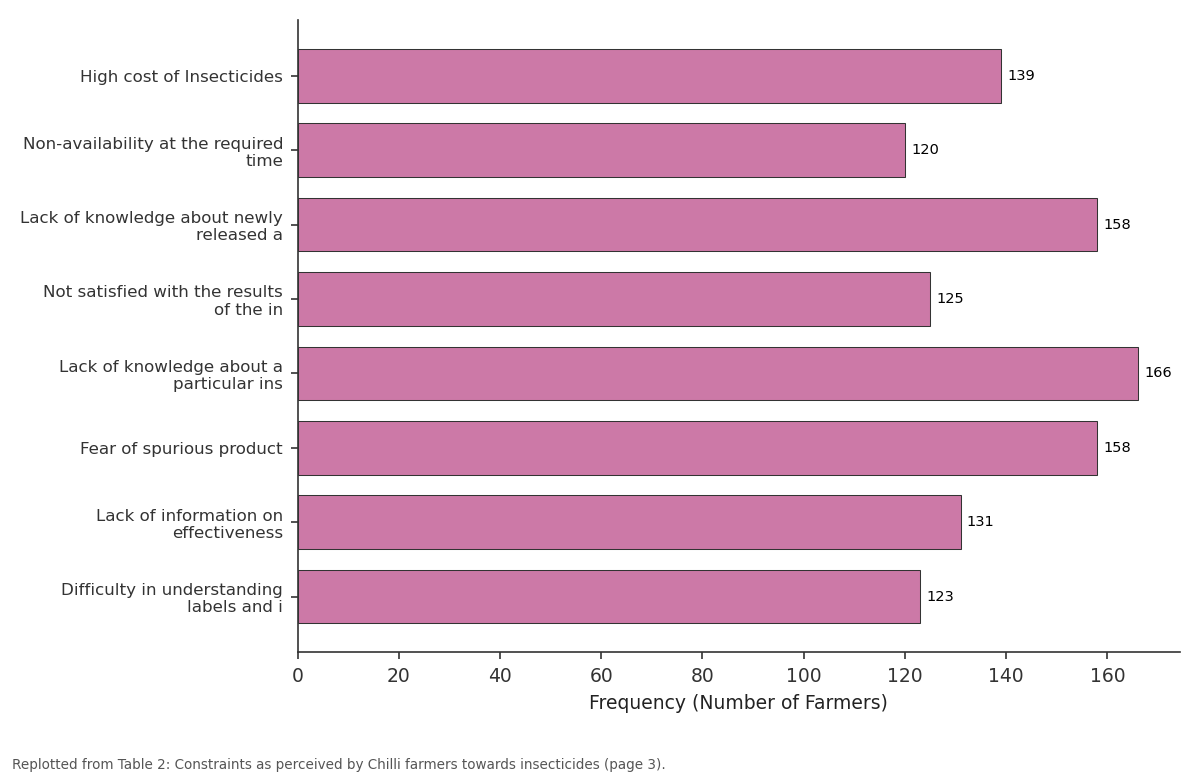
Frequency / Yes: High cost of... vs Non-availability at the... vs Lack of knowledge about... vs Not satisfied with the... vs Lack of knowledge about...
Replotted from Table 2 (page 3) of the original paper. Every bar is the paper's own table value.
View source evidence ↗Figures & tables
From the original paper Table 1
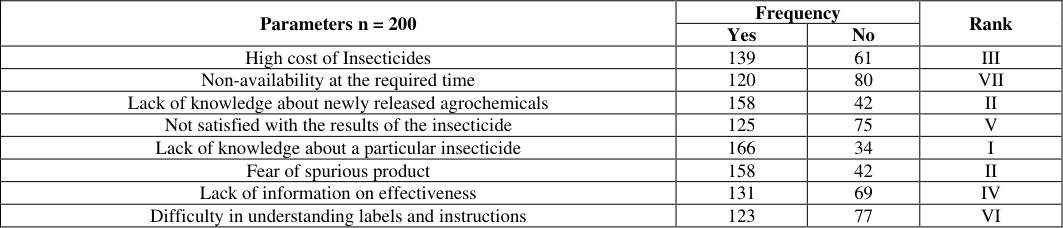 Table 2
Introduction
Insecticide application is a crucial aspect of chilli cultivation, as the crop is highly susceptible to a variety of pests and diseases that can significantly reduce yield and profitability. In India, where chilli is a major spice crop, effective pest management is central to securing farm income and ensuring food safety. Farmers' decisions regarding the purchase and use of insecticides are influenced by multiple socio-economic, psychological, and institutional factors (Kumari & Singh, 2020) [4] . These decisions are shaped not only by the efficacy and price of insecticides, but also by factors such as brand image, past experience, peer recommendations, and the advice of local retailers (Deshmukh & Patil, 2020) [2] . In the Rajkot district of Gujarat, chilli cultivation plays a vital role in the agrarian economy. However, farmers in this region often face challenges related to product availability, credit access, and limited awareness of integrated pest management (IPM) techniques. Previous studies suggest that the influence of progressive farmers and local input dealers, as well as promotional efforts by companies, significantly affect the buying patterns of farmers (Chatterjee & Ghosh, 2018; Meena, Singh, & Kumari, 2020) [1,5] . Moreover, constraints such as high costs, lack of technical knowledge, and improper usage due to inadequate training remain major barriers to optimal insecticide use (Rao, Reddy, & Prasad, 2019) [7] . Understanding both the determinants of insecticide purchasing and the constraints faced by farmers can provide critical insights for policymakers, agri-input firms, and extension agencies. It enables the development of region-specific strategies to encourage responsible pesticide use, improve farmer awareness, and promote sustainable pest management practices (Sharma & Mehta, 2018) [8] . The present study explores these dimensions by examining the factors influencing insecticide purchase and the challenges experienced by by chilli farmers in the Rajkot district of Gujarat. The objectives are as follows To identify the factors influencing the chilli farmers while buying the insecticides To identify the constraints as perceived by chilli farmers towards insecticides
Research Methodology
Participants: The study was conducted in the Rajkot district of Gujarat, which consists of 14 talukas. A multistage sampling method was employed to select the participants. In the first stage, four talukas-Gondal, Jam Kandorana, Dhoraji, and Upleta were randomly chosen. In the second stage, five villages were randomly selected from each of these talukas. In the third stage, ten chilli-growing farmers were purposively selected from each village, resulting in a total sample size of 200 farmers. The unit of analysis for the study was the individual chilli farmer.
Measures
A structured interview schedule was developed to collect data in alignment with the study's objectives. The instrument included questions focused on the socioeconomic background of chilli farmers, their buying behaviour, the factors influencing their purchase decisions, and the constraints they encountered in using insecticides. Primary data were collected directly from farmers through personal interviews, while secondary data were sourced from government reports, academic journals, research articles, and relevant company websites to complement and support the analysis.
Procedure
The study adopted a descriptive research design, suitable for examining present conditions and identifying relationships where experimental control is not feasible. An ex post facto approach was followed, wherein the variables were observed in their natural context without manipulation. The multi-stage sampling method involved three phases: selection of four talukas at random from the Rajkot district; selection of five villages from each chosen taluka; and purposive selection of ten chilli farmers from each village. Data collection was carried out through in-person interviews with the farmers in their respective locations.
Statistical Analysis
A combination of statistical tools was applied to analyze the collected data and derive meaningful insights. Percentage analysis was used to describe socio-economic traits and behavioural patterns. Tabular and graphical methods were employed to systematically present data. Ranking and Likert scale techniques were utilized to measure farmer attitudes and preferences regarding insecticide usage. Additionally, the cumulative score method was used to assess the significance of various influencing factors and constraints experienced by the farmers in their purchasing decisions. 1 presents the ranked factors that influence chilli farmers' buying behaviour towards insecticides in the Rajkot district of Gujarat. The factors were measured on a 5-point Likert scale, and the cumulative scores and mean scores were used for ranking. Past Experience with Insecticides had Mean = 4.00 and Rank I. Farmers placed the highest importance on their previous experiences with insecticide performance. This suggests a strong reliance on outcomes from past use-whether a product was effective or caused damage. Similar findings were reported by Deshmukh and Patil (2020) [2] , who observed that cotton growers in Maharashtra also depended heavily on personal experience when selecting agro-inputs. Local Retailer's Influence had Mean = 3.78 and Rank II. Local input dealers significantly impacted purchase decisions. Farmers often trust these retailers due to repeated interactions and proximity. Meena, Singh, and Kumari (2020) [5] reported that in Rajasthan, agro-input dealers were among the most influential information sources for farmers due to personalized service and immediate availability. Progressive Farmers' Opinions had Mean = 3.67 and Rank III. Advice from progressive or lead farmers within the community was highly regarded. This reflects the role of peer influence and informal social networks in the adoption of farm inputs, as discussed by Chatterjee and Ghosh (2018) [1] , who emphasized the importance of farmer-to-farmer communication in Eastern India. Competitive Price (Mean = 3.61, Rank IV). While price competitiveness was important, it ranked below experiential and social factors. This aligns with the view that farmers prioritize effectiveness and reliability over cost. According to Patel and Sharma (2020), although price was a factor in rural Gujarat, trust and product performance outweighed mere cost considerations. Timely Availability had Mean = 3.35 and Rank V. Access to products during critical crop stages mattered, but it was not the foremost concern. Similar results were noted by Rao, Reddy, and Prasad (2019) [7] in Andhra Pradesh, where farmers emphasized that delays in pesticide availability often led to crop losses. Brand Image had Mean = 3.34 and Rank VI. A product's reputation or brand image was moderately influential. Farmers preferred brands with consistent performance, a trend also observed in Kumari and Singh's (2020) [4] study on insecticide use among vegetable growers in Bihar. Credit Facility had Mean = 3.29, Rank VII. Although access to credit influenced purchases, it ranked relatively lower. This may suggest either better financial standing among the sample or higher priority given to performance over payment flexibility. Kumar and Singh (2021) [3] noted that vegetable growers in Haryana also viewed credit as secondary to product trustworthiness. Advertisement and Promotion had Mean = 3.24 and Rank VIII. Promotional efforts such as advertising had the least influence. This indicates that traditional promotional tools are less persuasive than field-level interactions and experiences. This finding is consistent with Sharma and Mehta (2018) [8] , who found limited impact of advertising on pesticide use decisions across Indian farming communities. Table 2 highlights key constraints faced by chilli farmers in Rajkot district when purchasing or using insecticides. These constraints can hinder proper pest management, leading to yield loss and higher costs. Lack of Knowledge about a Particular Insecticide was ranked I as a majority (166 out of 200) of respondents reported limited understanding of specific insecticides, suggesting a major gap in productspecific awareness. This aligns with Sharma and Mehta (2018) [8] , who emphasized that poor awareness and technical knowledge significantly affect safe pesticide use across Indian farms. Lack of Knowledge about Newly Released Agrochemicals ranked II as farmers also struggle to keep up with newly introduced products, likely due to weak extension outreach and limited literacy. Deshmukh and Patil (2020) [2] found that most smallholders depend on local dealers rather than scientific sources, leaving them uninformed about the latest agrochemical innovations. Fear of Spurious Products ranked II as tied with the above, fear of counterfeit or adulterated insecticides was also high. This indicates a trust deficit in the agri-input supply chain. Rao et al. (2019) [7] reported that fake pesticides were a major concern in Andhra Pradesh, leading to farmer losses and mistrust in retail networks. Lack of Information on Effectiveness ranked IV as a considerable number of farmers lacked sufficient data or field-level experience regarding product performance. This reflects the need for demonstration trials and experiential learning. According to Kumari and Singh (2020) [4] , pesticide use confidence increased when farmers had access to comparative performance data. Not Satisfied with Results ranked V as about 125 farmers expressed dissatisfaction with the performance of insecticides. This could as result from poor-quality products, pest resistance, or incorrect application. Chatterjee and Ghosh (2018) [1] noted that dissatisfaction is closely tied to limited diagnostic support and weak follow-up services. Difficulty in Understanding Labels and Instructions ranked VI as many respondents faced challenges in understanding dosage or safety instructions due to complex language or poor literacy. Meena et al. (2020) observed that label literacy was low among rural farmers, and that visual-based instruction or vernacular labeling was more effective. Non-Availability at Required Time ranked VII as timely access to insecticides remains a problem for 120 respondents. Delays can result in missed spraying windows and significant crop damage. This constraint was similarly emphasized by Kumar and Singh (2021) [3] in their study on vegetable growers, where supply chain inefficiencies often disrupted pest control schedules. High Cost of Insecticides ranked III as 139 farmers viewed cost as a key barrier. Farmers in resource-constrained conditions often compromise on quantity or quality. Patel and Sharma (2020) [6] also concluded that affordability strongly influenced purchasing patterns in Gujarat's tribal and marginal farming communities.
| Parameters n = 200 | Frequency | — | Rank |
|---|---|---|---|
| Yes | No | ||
| High cost of Insecticides | 139 | 61 | III |
| Non-availability at the required time | 120 | 80 | VII |
| Lack of knowledge about newly released agrochemicals | 158 | 42 | II |
| Not satisfied with the results of the insecticide | 125 | 75 | V |
| Lack of knowledge about a particular insecticide | 166 | 34 | I |
| Fear of spurious product | 158 | 42 | II |
| Lack of information on effectiveness | 131 | 69 | IV |
| Difficulty in understanding labels and instructions | 123 | 77 | VI |
Table text extracted from the original PDF; superscript letters are shown inline. The original table image is below.
View original table image
Suggestions
Suggestions
Conclusion
The present study aimed to identify factors influencing insecticide purchase and associated challenges faced by chilli farmers in Rajkot District using a structured research design and responses from 200 chilli farmers across four talukas, the study offers critical insights into the decisionmaking behaviour of these agricultural stakeholders. The findings revealed that past experience with insecticides emerged as the most influential factor (Mean = 4.00), followed by the local retailer's influence and progressive farmers' opinions. These results confirm that chilli farmers largely depend on experiential knowledge and localized networks rather than formal promotional methods or branding. This pattern aligns with similar research by Deshmukh and Patil (2020) [2] , Meena et al. (2020) [5] , and Chatterjee and Ghosh (2018) [1] , all of whom emphasized the strong role of personal experience and peer or dealer influence in agricultural input decisions. On the other hand, constraints such as a lack of knowledge about specific insecticides, fear of spurious products, and the high cost of chemicals were reported as the most significant barriers. These findings corroborate prior studies by Sharma and Mehta (2018) [8] , Rao et al. (2019) [7] , and Patel and Sharma (2020), indicating that gaps in technical knowledge, trust, and affordability remain pressing issues for farmers in India. The study underscores the need for improved extension services, trustworthy input supply systems, and customized training for dealers and farmers alike. Addressing these factors is crucial for empowering farmers to make informed and safe pest management decisions that enhance productivity while minimizing risk.
Figures and tables from the paper
References
8 in the original paper- Chatterjee S, Ghosh A. Role of information sources in pesticide usage among smallholder farmers in Eastern India. Indian Journal of Extension Education. 2018;54(4):45-52.
- Deshmukh R, Patil S. Agro-input buying behaviour of cotton growers in Maharashtra. Journal of Rural Marketing. 2020;9(1):32-38.
- Kumar R, Singh S. Adoption behavior of vegetable growers towards improved technologies in Haryana. Indian Journal of Extension Education. 2021;57(4):2327.
- Kumari P, Singh R. Insecticide usage pattern among vegetable growers: A case study of Bihar. Indian Journal of Extension Education. 2020;56(2):45-50.
- Meena BS, Singh KM, Kumari S. Role of agro-input dealers in disseminating information among farmers: A case from Rajasthan. Indian Journal of Extension Education. 2020;56(4):20-25.
- Patel M, Sharma R. Digital transaction adoption among pesticide buyers: A study in rural Gujarat. Journal of Rural and Agricultural Finance. 2020;12(2):22-29.
- Rao VS, Reddy AC, Prasad MS. Chemical pesticide usage in chilli cultivation: A study of farmer behavior in Andhra Pradesh. Journal of AgriBusiness and Rural Development. 2019;11(1):72-79.
- Sharma N, Mehta R. Impact of extension services on pesticide usage among Indian farmers. Agricultural Economics Research Review. 2018;31(Special