
Research article · 2026 · Full text
International Journal of Advanced Chemistry ResearchCrop diversification for sustainable agriculture: A review of productivity, soil health, resource use efficiency and economic sustainability
Volume 8(7) · Pages 01–04 · DOI: 10.33545/26646781.2026.v8.i7a.691 ↗
Research areasAgronomic Practices and Intercropping SystemsPlant and soil sciencesSustainable Agricultural Systems Analysis
Abstract
Author-writtenAgriculture is currently confronted with multiple challenges, including declining soil fertility, water scarcity, climate variability, environmental degradation and economic instability. Traditional monocropping systems, although successful in enhancing food grain production, have contributed to resource depletion, biodiversity loss and declining factor productivity. Crop diversification has emerged as a viable strategy to address these challenges by improving agricultural productivity, resource-use efficiency, environmental sustainability and farm profitability. This review synthesizes available literature on crop diversification and evaluates its impacts on productivity, soil health, resource conservation and economic sustainability. Evidence from diverse agroecological regions indicates that diversified cropping systems outperform conventional monocropping systems by enhancing nutrient cycling, biological nitrogen fixation, soil organic matter accumulation and efficient utilization of water and nutrients. Integration of legumes, vegetables, oilseeds, agroforestry components and other high-value crops into cereal-based systems improves resilience against climatic and market risks while increasing farm income. Crop diversification also contributes to biodiversity conservation, reduced pest incidence and enhanced ecosystem services. Despite these advantages, adoption remains constrained by infrastructural limitations, fragmented landholdings, inadequate market support and weak extension services. The review concludes that crop diversification is an essential pathway for achieving sustainable agricultural development and long-term food security.
Summary
Source-checkedPlain-language reading of the full paper, prepared with AI and checked against the text. Each point links to the authors' own words.
Why it matters
- Modern agriculture faces several critical challenges, including environmental degradation, water scarcity, and economic instability. View evidence ↗
- While traditional monocropping increased food grain production, it led to biodiversity loss and the depletion of resources. View evidence ↗
- Crop diversification is viewed as a strategy to improve farm profitability, productivity, and environmental sustainability. View evidence ↗
The question
- The aim of this review is to synthesize existing literature to evaluate how crop diversification impacts soil health, productivity, economic sustainability, and resource conservation. View evidence ↗
What they did
- The review examines various diversification methods, including crop rotation, intercropping, agroforestry, and integrated farming systems. View evidence ↗
- The literature reviewed utilizes specific indices to measure diversification, such as the Simpson, Herfindahl, and Entropy indices. View evidence ↗
What they found
- Diversified rice-based systems that include tuber crops, vegetables, and legumes often produce higher rice-equivalent yields than traditional rice-wheat systems. View evidence ↗
- A rice-fenugreek-okra system was found to have a higher sustainability yield index compared to a rice-wheat-fallow system. View evidence ↗
- Diversified systems show higher levels of total nitrogen and soil organic carbon than conventional cereal-based systems. View evidence ↗
- Pulse-based cropping systems result in significantly higher soil P2O5 and organic carbon (OC) content compared to cereal-based systems. View evidence ↗
- A cropping system of rabi onion, cluster bean, wheat, and groundnut yielded higher net returns, gross returns, and benefit-cost ratios (BCR) than other studied systems. View evidence ↗
- The rice-potato-greengram system provided higher B:C ratios, net returns, and gross returns compared to other systems. View evidence ↗
- Diversified farming systems are recognized as climate-smart strategies that balance environmental conservation with productivity. View evidence ↗
What it means
- The authors conclude that crop diversification is an economically viable and scientifically validated strategy for sustainable agricultural development. View evidence ↗
- The authors note that many studies are short-term and location-specific, with limited research on long-term carbon sequestration, biodiversity conservation, and ecosystem services. View evidence ↗
Visual summary
1 visualsIllustrations explain the paper; they do not show study data.
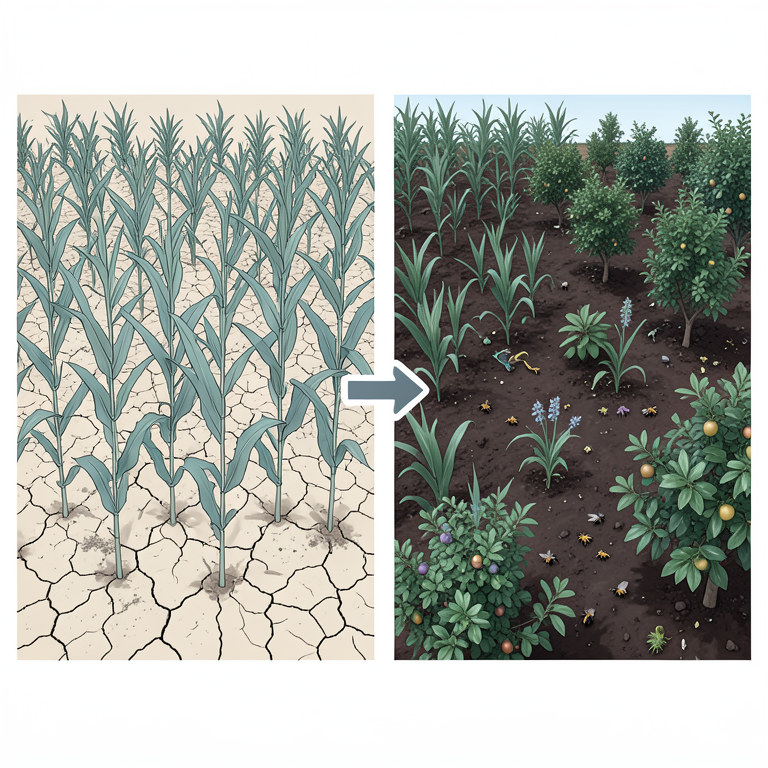
Monocropping vs. Diversification
AI-generated conceptual illustration (Agricultural fields with maize, legumes, and fruit trees). It explains the idea and does not show study data.
View source evidence ↗Figures & tables
From the original paper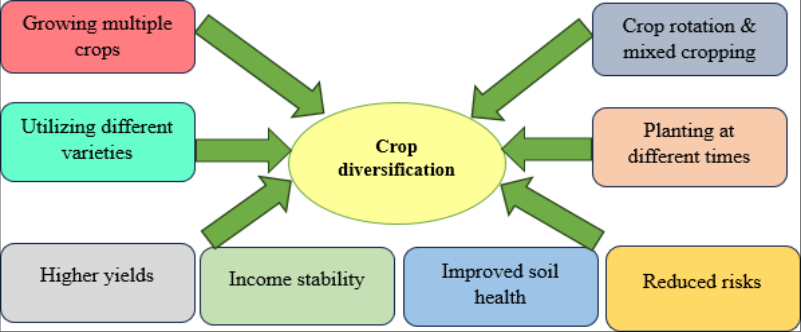 Figure 1
Introduction
Agriculture remains the foundation of food security, rural employment and economic development in many developing countries. The Green Revolution significantly enhanced agricultural production through intensive cultivation of high-yielding cereal crops, particularly rice and wheat. Although these systems contributed substantially to food selfsufficiency, continuous monocropping and excessive input use have led to several ecological and economic challenges, including soil degradation, groundwater depletion, nutrient imbalances, declining biodiversity and reduced profitability. Sustainable agricultural development requires production systems capable of maintaining productivity while conserving natural resources. Crop diversification has gained increasing attention as a strategy for addressing these concerns. Diversification involves the inclusion of a broader range of crops and enterprises within farming systems to improve productivity, profitability, resilience and environmental sustainability. It offers opportunities for farmers to reduce production risks, optimize resource utilization, improve soil health and respond to changing market demands. Crop diversification is particularly relevant under changing climatic conditions, where dependence on a limited number of crops increases vulnerability to weather extremes, pests, diseases and market fluctuations. Therefore, diversified farming systems are increasingly recognized as a cornerstone of sustainable agriculture and climate-resilient development.
Concept and need for crop diversification
Crop diversification refers to the allocation of agricultural resources among different crops and enterprises within a farming system. It may involve crop substitution, crop rotation, intercropping, relay cropping, mixed cropping, agroforestry, horticultural diversification and integrated farming systems. The major objectives of crop diversification include:
• Enhancing agricultural productivity.
• Improving food and nutritional security.
• Increasing farm income and employment.
• Conserving soil and water resources.
• Reducing production risks.
• Improving environmental quality.
• Enhancing resilience to climate variability. Growing population pressure, changing dietary preferences, urbanization and environmental concerns have increased the need for diversified agricultural systems that simultaneously address economic and ecological objectives.
Drivers of crop diversification 3.1 Resource factors
Availability of land, irrigation, rainfall distribution, temperature regimes and soil fertility significantly influence diversification decisions. Regions with reliable irrigation infrastructure often diversify toward vegetables, fruits and commercial crops, while rainfed areas commonly adopt legumes and oilseeds.
Economic factors
Market demand, output prices, production costs, access to value chains and profitability strongly influence cropping choices. Diversification toward high-value crops often provides greater economic returns than traditional cerealbased systems.
Technological factors
Advances in crop breeding, mechanization, irrigation technologies, nutrient management and post-harvest handling have expanded opportunities for diversification.
Institutional factors
Government policies, extension services, credit availability, crop insurance programs, and market infrastructure significantly affect farmers' willingness to diversify.
Household factors
Family labor availability, food consumption preferences, livestock requirements and risk-bearing capacity also shape diversification decisions.
Crop diversification in India
Indian agriculture has gradually diversified from cerealdominated systems toward pulses, oilseeds, fruits, vegetables, spices, medicinal crops, and agroforestry-based enterprises. States such as Gujarat, Karnataka, Maharashtra, Kerala, Tamil Nadu, and Andhra Pradesh have experienced substantial diversification due to favorable market opportunities and technological advancement. Government initiatives such as the Rashtriya Krishi Vikas Yojana (RKVY), National Horticulture Mission, Crop Diversification Programme and watershed development projects have encouraged farmers to adopt alternative cropping systems and reduce dependence on water-intensive crops.
Several indices are commonly used to assess diversification levels, including the Herfindahl Index, Simpson Index, Entropy Index and Modified Entropy Index.
Impact of crop diversification on agricultural productivity
Numerous studies have reported significant improvements in productivity under diversified cropping systems. Diversification enhances the efficiency of resource utilization by combining crops with complementary growth habits, rooting patterns and nutrient requirements. Rice-based diversified systems involving legumes, vegetables and tuber crops frequently achieve higher riceequivalent yields than traditional rice-wheat systems. Bohra et al. (2007) [3] reported superior productivity in rice-potatogreen gram systems, while Saha et al. (2010) [12] observed increased system productivity in diversified rice-based sequences. Walia et al. (2011) recorded the highest REY under maizepotato -onion cropping system over existing cropping system i.e. rice-wheat. Gangawar et al. (2012) [6] identified high productive cropping systems for various locations in India over prevailing cropping system. Jat et al. (2012) [7] registered the highest sustainability yield index with ricefenugreek-okra cropping system over rice -wheat -fallow cropping system. Choudhary and Kumar (2016) [4] found that 1:5 maize-groundnut system recorded significantly higher WUE, SMC, MEY while, MGY was observed higher under sole maize. Mishra et al. (2017) [8] revealed that maize intercropped with ridgegourd or cowpea or cucumber found more suitable in term of MEY than sole maize. Sammauria et al. (2020) [13] noted higher sustainable yield index with groundnut -wheat-clusterbean-rabi onion compare to others cropping system. Similarly, maize-based diversification involving legumes and oilseeds has demonstrated improved land-use efficiency and crop-equivalent yields. Enhanced productivity is attributed to biological nitrogen fixation, reduced pest incidence, improved soil fertility and better utilization of environmental resources.
Impact of crop diversification on soil health
Soil health is a fundamental component of sustainable agriculture. Diversified cropping systems contribute significantly to improvements in soil organic matter, nutrient availability, microbial activity and soil structure. Legumes play a crucial role by fixing atmospheric nitrogen and contributing organic residues to the soil. Benbi et al. (2012) [2] reported higher soil organic carbon and total nitrogen levels in diversified systems compared with conventional cereal-based systems. Jat et al. (2012) [7] observed increased availability of nitrogen, phosphorus, potassium and organic carbon in diversified rice-based systems. Prasad (2016) revealed that rice-onion-Green manure system recorded significantly the highest N & K 2 O content, while P 2 O 5 & S was found higher the result might be due to inclusion of green manure in the existing cropping system, which plays important role in addition of organic matter in the soil and improve soil health, which leads to increase in the content of NPK. Solanki (2018) [14] observed the higher value of organic carbon, N, P 2 O 5 and K 2 O content in soil under groundnut + pigeonpea -pigeonpea continuessunhemp cropping system compared to groundnut -wheatfallow cropping system. Sammauria et al. (2020) [13] recorded significantly higher OC and P 2 O 5 content in soil under pulses based cropping systems over cereals based cropping system. Agroforestry systems further enhance soil fertility through litter deposition, root turnover, and improved nutrient cycling. Long-term diversification contributes to soil conservation and sustainable nutrient management.
Resource use efficiency under diversified cropping systems
Resource-use efficiency is a critical indicator of agricultural sustainability. Diversified systems improve the utilization of land, water, nutrients, labor and energy. Water-use efficiency is enhanced through the inclusion of droughttolerant crops and species with complementary rooting depths. Nutrient-use efficiency improves through biological nitrogen fixation and diversified nutrient extraction patterns. Land-use efficiency increases because multiple crops utilize available space and growing periods more effectively. These improvements contribute to reduced production costs and greater sustainability under resource-constrained conditions.
Economic sustainability of crop diversification
Economic viability is a major factor driving diversification adoption. Numerous studies have demonstrated higher gross returns, net returns and benefit-cost ratios under diversified cropping systems.
Gangawar et al. (2005) [5] reported higher profitability in diversified cereal-legume-vegetable systems. Reddy (2010) [10] observed superior economic returns in rice-potatosunflower systems, while Prasad (2016) highlighted the profitability of vegetable-based diversification. Sammauria et al. (2020) [13] obtained higher values of gross returns, net returns and BCR from groundnut -wheat -cluster beanrabi onion cropping system than other cropping systems under study. Saha et al. (2020) [11] concluded that Ricepotato-greengram cropping system gave higher gross return net return and B:C ratio as compared to other cropping systems. Diversification reduces economic risks by distributing income sources across multiple crops and enterprises. Integration of horticultural crops, pulses, oilseeds, livestock and agroforestry further strengthens farm resilience and income stability.
Environmental and sustainability implications
Crop diversification provides substantial environmental benefits. Diverse cropping systems enhance biodiversity, improve nutrient cycling, reduce soil erosion and suppress pests and diseases naturally. Reduced dependence on synthetic fertilizers and pesticides contributes to environmental protection and ecosystem stability. Agroforestry and perennial-based systems also enhance carbon sequestration and climate change mitigation. Diversified farming systems are therefore increasingly recognized as climate-smart agricultural strategies capable of balancing productivity with environmental conservation.
Constraints in crop diversification
Despite its advantages, several challenges limit widespread adoption:
• Small and fragmented landholdings.
• Dependence on erratic rainfall.
• Limited access to quality seeds and planting materials. A critical examination of the available evidence suggests that productivity gains are primarily associated with complementary resource utilization and biological nitrogen fixation. Soil fertility improvements result from enhanced organic matter accumulation and nutrient cycling. Economic benefits arise from diversification toward high-value crops that generate greater market returns. However, relatively few studies have examined long-term ecosystem services, biodiversity conservation, carbon sequestration and climate adaptation benefits. Furthermore, many diversification studies remain location-specific and short-term. Future research should therefore adopt multidisciplinary approaches that integrate agronomic, economic, environmental and social dimensions of sustainability.
Conclusion
Crop diversification represents a scientifically validated and economically viable strategy for achieving sustainable agricultural development. Diversified cropping systems improve productivity, soil health, resource-use efficiency, profitability and environmental quality while reducing vulnerability to climatic and market risks. Integration of legumes, vegetables, horticultural crops, oilseeds and agroforestry components enhances resilience and supports long-term sustainability. Successful implementation requires supportive policies, efficient markets, technological innovations and effective extension services. Promoting diversified and climate-resilient agricultural systems will be critical for ensuring future food security and sustainable rural development.
Figures and tables from the paper
References
14 in the original paper- Barman A, Saha P, Patel S, Bera A. Crop diversification: an effective strategy for sustainable agriculture development. Agriculture Letters. 2022;3(3):2022.
- Benbi DK, Brar K, Toor AS, Singh P. Total and labile pools of soil organic carbon in cultivated and undisturbed soils in northern India. Nutrient Cycling in Agroecosystems. 2012;92(3):245-258.
- Bohra JS, Singh RK, Singh UN, Singh K. Effect of crop diversification on productivity and profitability of ricebased cropping systems. Oryza. 2007;44(4):320-324.
- Choudhary VK, Kumar PS. Productivity and resourceuse efficiency of maize-based intercropping systems under different management practices. Research on Crops. 2016;17(3):547-557.
- Gangawar B, Ravisankar N, Prasad K. Diversification of cropping systems for higher productivity and profitability. Indian Journal of Agronomy. 2005;50(2):89-92.
- Gangawar B, Ravisankar N, Prasad K. Diversification of rice-based cropping systems for sustainability. Indian Journal of Agronomy. 2012;57(2):171-181.
- Jat AR, Dungrani RA, Arvadia MK, Sahrawat KL. Diversification of rice-based cropping systems and their effect on productivity, profitability and soil fertility. Archives of Agronomy and Soil Science. 2012;58(2):561-572.
- Mishra PJ, Swain BD, Mishra A, Subudhi CR, Mishra PK. Effect of diversified cropping systems on soil conservation and productivity. Indian Journal of Soil Conservation. 2017;45(2):136-140.
- Parihar SS, Jat SL, Singh AK, Kumar B, Yadav OP. Diversification of maize-based systems for improved productivity and resource-use efficiency. Indian Journal of Agronomy. 2017;62(4):457-463.
- Reddy BN. Crop diversification with oilseed crops for maximizing productivity, profitability and resource conservation. Indian Journal of Agronomy. 2010;55(1):55-60.
- Saha B, Barik AK, Mandal N. Studies on growth, productivity and economics of rice as influenced by diversification of rice-based cropping systems in red and lateritic soil of West Bengal. International Journal of Bio-resource and Stress Management. 2020;11(2):108-113.
- Saha S, Ghosh PK, Das A. Productivity and sustainability of diversified rice-based cropping systems. Indian Journal of Agronomy. 2010;55(4):257262.
- Sammauria R, Meena OP, Gupta KC, Yadav HL. Effect of legume-based diversification on soil fertility and productivity in pearl millet systems. Legume Research. 2020;43(4):556-561.
- Solanki RM. Annual Report 2018. All India Coordinated Research Project on Integrated Farming Systems (AICRP-IFS). Junagadh: Junagadh Agricultural University; 2018.