
Research article · 2026 · Full text
International Journal of Agriculture and NutritionGenomic DNA Extraction from Sesame (Sesamum indicum L.)
Volume 8(7) · Pages 06–08 · DOI: 10.33545/26646064.2026.v8.i7a.666 ↗
Research areasSesame and Sesamin ResearchGenetic Mapping and Diversity in Plants and AnimalsPeanut Plant Research Studies
Abstract
Author-writtenSesame (Sesamum indicum L.) is an ancient oilseed crop valued for its edible oil and nutritional properties. Genetic diversity among genotypes is vital for breeding and SSR markers are widely used due to their abundance and efficiency in the sesame genome. Successful application of these markers depends on extracting high-quality genomic DNA. This study aimed to standardize an efficient DNA extraction protocol by evaluating two different methods and determining the optimal seedling stage for sesame. Three sesame genotypes (YLM-146, YLM-66, and TPTS-55) were germinated and harvested at three different intervals: seven, 10, and 12 days. Two extraction protocols were compared: a standard CTAB 2.5× Method (Method-1) and a Modified CTAB Method (Method-2). Method-1 involved overnight incubation and additional purification steps, requiring approximately two days to complete. In contrast, Method-2 utilized a higher salt concentration (5 M NaCl) and immediate RNase treatment, allowing for completion within a single day. The results demonstrated that while both methods produced DNA of sufficient quality, Method-2 was significantly faster and more convenient for routine laboratory use. Spectrophotometric analysis using a Nanodrop revealed that DNA yield and purity were consistent across all seedling stages tested. Seven-day-old seedlings were identified as the most efficient tissue source because they reduced the overall experimental timeframe without compromising DNA integrity. DNA purity, as measured by A260/A280 ratios, remained close to the ideal value of 1.8, indicating minimal contamination from polysaccharides or phenolic compounds. The high concentrations obtained (ranging from 1014.87 ng/µL to 2241.59 ng/µL) and excellent purity levels confirm that the modified CTAB protocol is highly suitable for downstream applications such as PCR amplification and SSR marker analysis in sesame.
Summary
Source-checkedPlain-language reading of the full paper, prepared with AI and checked against the text. Each point links to the authors' own words.
Why it matters
- Sesame is an ancient oilseed crop that is highly valued for its nutritional properties and edible oil. View evidence ↗
- Simple Sequence Repeat (SSR) markers are commonly used in sesame breeding because they are efficient and abundant, helping researchers understand genetic diversity. View evidence ↗
- The ability to use molecular markers effectively depends on the extraction of high-quality genomic DNA. View evidence ↗
The question
- The study aimed to find the most efficient DNA extraction protocol and the best seedling age for extracting DNA from sesame. View evidence ↗
What they did
- The study compared a standard CTAB 2.5× method (Method-1) against a modified CTAB method (Method-2). View evidence ↗
- Method-1 took two days due to overnight incubation, while Method-2 used 5 M NaCl and immediate RNase treatment to finish in one day. View evidence ↗
- DNA quality and quantity were measured using a NanoDrop spectrophotometer, with a target A260/A280 ratio of approximately 1.8 for purity. View evidence ↗
What they found
- Both methods produced quality DNA, but Method-2 was found to be significantly faster and more convenient. View evidence ↗
- Seven-day-old seedlings were the most efficient source because they shortened the experiment time without harming DNA integrity. View evidence ↗
- The A260/A280 ratios remained close to 1.8, showing that the DNA had minimal contamination from phenols or polysaccharides. View evidence ↗
- The modified CTAB protocol yielded high DNA concentrations between 1014.87 ng/µL and 2241.59 ng/µL. View evidence ↗
- The highest DNA concentrations were found in seven-day-old seedlings of YLM-66 (2241.59 ng/µL) and YLM-146 (2208.91 ng/µL). View evidence ↗
- All samples showed purity ratios between 1.88 and 2.02, aligning with the standard for pure DNA. View evidence ↗
What it means
- The authors conclude that the modified CTAB protocol is highly suitable for PCR amplification and SSR marker analysis in sesame due to its high yield and purity. View evidence ↗
Visual summary
3 visualsIllustrations explain the paper; charts are replotted from the paper's own table values.
Comparison of Extraction Methods
AI-generated conceptual illustration (Sesame (Sesamum indicum L.) leaves). It explains the idea and does not show study data.
View source evidence ↗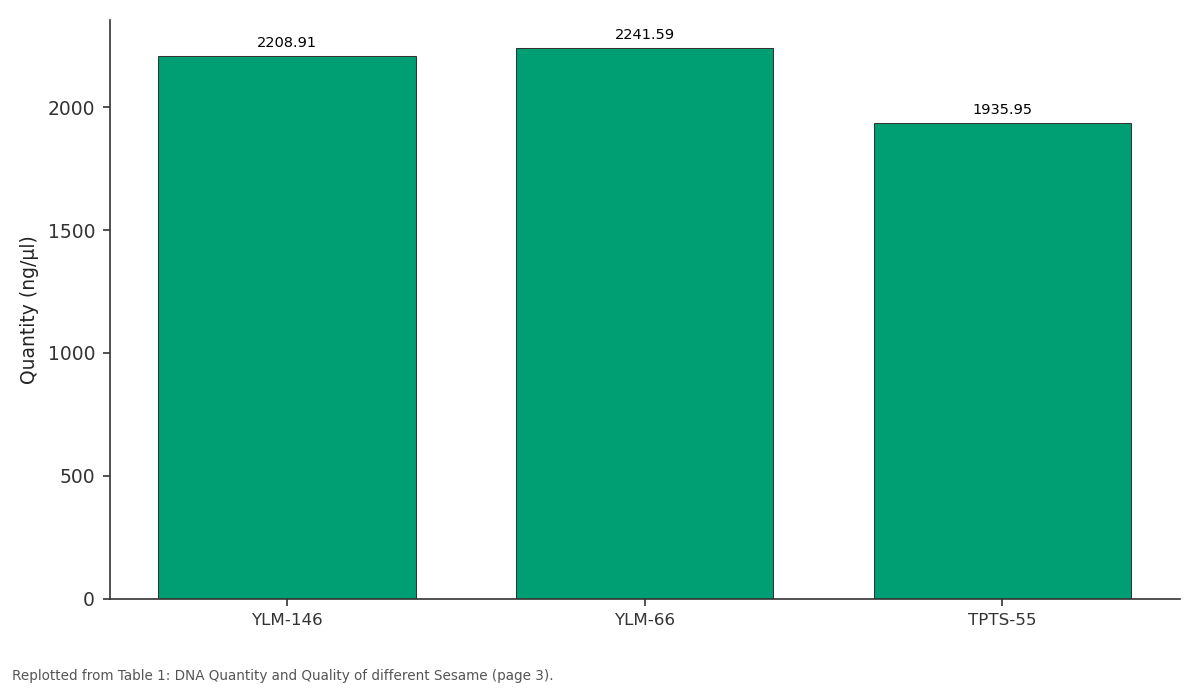
Quantity (ng/µl): YLM-146 vs YLM-66 vs TPTS-55
Replotted from Table 1 (page 3) of the original paper. Every bar is the paper's own table value.
View source evidence ↗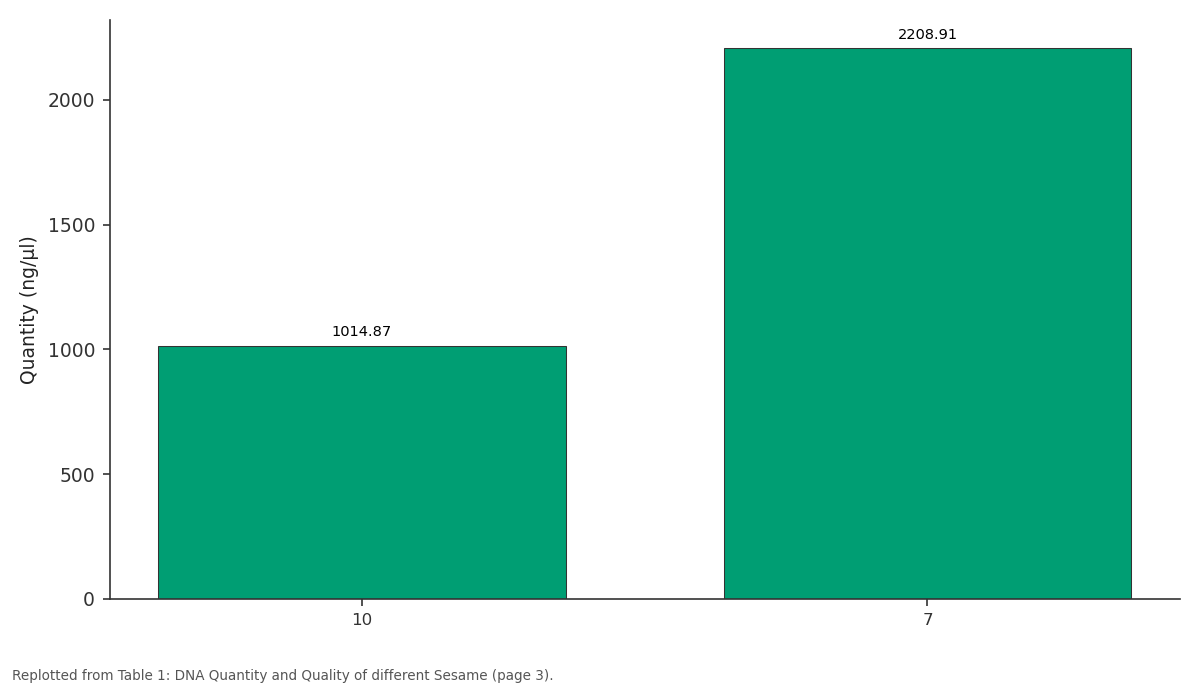
Quantity (ng/µl): 10 vs 7
Replotted from Table 1 (page 3) of the original paper. Every bar is the paper's own table value.
View source evidence ↗Figures & tables
From the original paper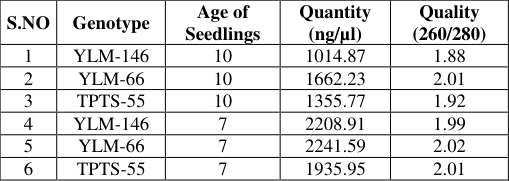 Table 1
Introduction
Sesame (Sesamum indicum L.) is premier oilseed crop valued globally for its high-quality edible oil and nutritional properties (Wei et al., 2015) [13] . Genetic diversity among genotypes is essential for crop improvement and breeding programs (Laurentin and Karlovsky, 2006) [7] . Molecular marker techniques such as Simple Sequence Repeat (SSR) markers are widely used in genetic studies because they are highly polymorphic, co-dominant, reproducible and evenly distributed across genomes (Gupta and Varshney, 2000; Kalia et al., 2011; Parida et al., 2010; Dossa et al., 2017) [5,6,9,1] . SSR markers are highly informative and suitable for genetic diversity analysis, genotype identification and molecular breeding applications (Edwards et al., 1996; Zane et al., 2002) [3,14] . Microsatellites consist of short tandem repeat sequences that exhibit high variability due to differences in the number of repeat units (Tautz, 1989) [12] . Their rapid evolution through replication slippage further contributes to their polymorphic nature (Ellegren, 2004) [4] . This variability makes SSR markers highly efficient in detecting genetic differences among genotypes (Powell et al., 1996) [11] . SSR markers developed in sesame provide a reliable and efficient system for genetic diversity analysis and breeding applications (Parida et al., 2010) [9] . Among the identified SSR types, mono-nucleotide repeats were the most abundant, followed by di-and tri-nucleotide repeats, showing the distribution pattern of microsatellites in the sesame genome (Wei et al., 2015) [13] . For validation of polymorphism, SSR markers distributed across sesame chromosomes were successfully amplified using PCR (Dossa et al., 2017) [1] .
The extraction of high-quality genomic DNA is the prerequisite for molecular analysis (Doyle and Doyle, 1990) [2] . Young leaf tissues are commonly used for DNA extraction because they contain fewer secondary metabolites that may interfere with DNA isolation (Porebski et al., 1997) [10] . The CTAB method is widely used for plant DNA extraction because it efficiently removes polysaccharides and phenolic compounds (Murray and Thompson, 1980; Porebski et al., 1997) [8,10] . Further the quality and quantity of DNA may vary depending on the type and age of plant tissue used for extraction. Seedling tissues are generally preferred for DNA extraction as they contain actively dividing cells and fewer secondary metabolites compared to mature tissues (Doyle and Doyle, 1990) [2] . Therefore, in the present study, seedlings of different ages (seven days, 10 days and 12 days) were used to evaluate their suitability for DNA extraction using the modified CTAB method. The extracted DNA was assessed for quality and quantity and used for further molecular studies involving SSR markers.
Materials and Methods Plant Material and Seed Germination
Sesame seeds of genotypes (YLM-146, YLM-66, TPTS-55) were germinated in plastic portray trays. Each tray was properly labeled for genotype identification. Seeds were sown in single rows along the length of each tray with approximately 8-10 seeds per cup. The trays were maintained with regular watering to ensure uniform germination and healthy seedling growth. Seedlings of different ages, namely seven days, 10 days and 12 days, were harvested to evaluate for genomic DNA extraction.
Reagents: Details of the reagents used in the study: CTAB, sodium chloride, ethylenediamine tetra-acetic acid (EDTA), polyvinylpyrrolidone (PVP), Tris-chloride, 2-β mercaptoethanol, chloroform: isoamyl alcohol (24:1), phenol: chloroform: isoamyl alcohol (25:24:1), Tris-EDTA, ethanol, RNase, chloroform, sodium acetate and double autoclaved water.
Extraction Buffers: Two different DNA extraction buffers (DEBs) were used to standardize the protocol for gDNA extraction from sesame seedlings.
1. CTAB 2.5× Buffer 1.5 M sodium chloride (NaCl), 1% PVP, 25mM EDTA, 100 Tris-Cl (pH-8.8), 0.2% β-mercaptoethanol, and 2.5% CTAB.
Modified CTAB Buffer
5 M sodium chloride (NaCl), 1% PVP, O.5 M EDTA (pH-8), 1M Tris-Cl (pH-8), 0.2% β-mercaptoethanol, and 2 % CTAB.
Genomic DNA Extraction
Genomic DNA extraction using CTAB method followed standard protocols with slight modifications (Doyle and Doyle, 1990; Porebski et al., 1997) [2,10] . Add an equal volume (800 µL) of chloroform: isoamyl alcohol (24:1), mix thoroughly, and centrifuge at 10,000 rpm for 15 min at room temperature. Transfer the clear aqueous phase to a fresh microcentrifuge tube. Add an equal volume of chilled isopropanol and visible DNA threads appears immediately for DNA is present and incubate at -20°C for 60 min to precipitate DNA. Centrifuge at 12,000 rpm for 10 min and discard the supernatant. Wash the DNA pellet with 500 µL of 70% ethanol and centrifuge again at 12,000 rpm for 10 min. Discard the ethanol and air-dry the pellet for 15-20 min until the ethanol odor disappears. Dissolve the DNA pellet in 50 µL of 1× TE buffer. Store the DNA at -20°C for further molecular analysis.
Method
Method
Assessment of DNA Quality and Quantity
The quality and quantity of the extracted DNA were assessed using a NanoDrop spectrophotometer, where an A260/A280 ratio of ~1.8 indicates pure DNA (Thermo Scientific 2000). Before measurement, the Nanodrop pedestal was cleaned with tissue paper. The instrument was initialized using 1 µL of distilled water, followed by blank measurement using 1 µL of Milli-Q water. Subsequently, 1 µL of DNA sample was placed on the pedestal to measure DNA concentration and purity. DNA purity was evaluated based on the A260/A280 ratio, where a value close to 1.8 indicates good quality DNA. Samples with adequate DNA concentration (above 1000 ng/µL) were diluted to a working concentration of 1:9 for PCR analysis.
Results
The study successfully standardized a protocol for extracting high-quality genomic DNA from sesame seedlings, evaluating the impact of seedling age and extraction methodology on DNA yield and purity.
Efficiency of Extraction Methods
While both the CTAB 2.5× and the Modified CTAB methods yielded good quality DNA, they differed significantly in time efficiency. Method-1 required a twoday procedure due to an essential overnight incubation at -20°C. Conversely, Method-2 (Modified CTAB) was completed within a single day, offering a more streamlined approach for high-throughput molecular breeding applications.
Optimization of Seedling Age
Comparative analysis of seedlings aged seven, 10, and 12 days indicated that DNA yield and purity were relatively uniform across all stages. However, seven-day-old seedlings were selected as the optimal stage for routine extraction. Using younger tissue facilitates a faster experimental cycle and is generally preferred in plants as they contain fewer secondary metabolites that might otherwise inhibit PCR.
Quantitative and Qualitative Analysis
The Modified CTAB method produced high concentrations of DNA across all six genotypes tested. As shown in the table 1, the DNA quantity and quality were sufficient for intensive molecular studies:
| S.NO | Genotype | Age of Seedlings | Quantity (ng/µl) | Quality (260/280) |
|---|---|---|---|---|
| 1 | YLM-146 | 10 | 1014.87 | 1.88 |
| 2 | YLM-66 | 10 | 1662.23 | 2.01 |
| 3 | TPTS-55 | 10 | 1355.77 | 1.92 |
| 4 | YLM-146 | 7 | 2208.91 | 1.99 |
| 5 | YLM-66 | 7 | 2241.59 | 2.02 |
| 6 | TPTS-55 | 7 | 1935.95 | 2.01 |
Table text extracted from the original PDF; superscript letters are shown inline. The original table image is below.
View original table image
Acknowledgement
Acknowledgement:The author sincerely thanks the chairperson and members of the committee for their continuous support and guidance. Special thanks are also extended to the Principal Investigator of the SERB-DST funded project for providing necessary facilities and support to carry out field experiments.
References
14 in the original paper- Dossa K, Wei X, Niang M, Fonceka D, Zhang Y, Wang L, et al. Near-complete genome assembly of sesame (Sesamum indicum L.) provides insights into oil biosynthesis. Genome Biol. 2017;18:152.
- Doyle JJ, Doyle JL. Isolation of plant DNA from fresh tissue. Focus. 1990;12(1):13-15.
- Edwards KJ, Barker JHA, Daly A, Jones C, Karp A. Microsatellite libraries enriched for several microsatellite sequences in plants. Biotechniques. 1996;20(5):758-60.
- Ellegren H. Microsatellites: simple sequences with complex evolution. Nat Rev Genet. 2004;5(6):435-45.
- Gupta PK, Varshney RK. The development and use of microsatellite markers for genetic analysis and plant breeding with emphasis on bread wheat. Euphytica. 2000;113:163-85.
- Kalia RK, Rai MK, Kalia S, Singh R, Dhawan AK. Microsatellite markers: an overview of the recent progress in plants. Euphytica. 2011;177:309-34.
- Laurentin H, Karlovsky P. Genetic relationship and diversity in sesame (Sesamum indicum L.) germplasm collection using AFLP markers. BMC Genet. 2006;7:10.
- Murray MG, Thompson WF. Rapid isolation of high molecular weight plant DNA. Nucleic Acids Res. 1980;8(19):4321-5.
- Parida SK, Kalia SK, Kaul S, Dalal V, Hemaprabha G, Selvi A, et al. Informative genomic microsatellite markers for efficient genotyping applications in sesame (Sesamum indicum L.). Theor Appl Genet. 2010;120:159-68.
- Porebski S, Bailey LG, Baum BR. Modification of a CTAB DNA extraction protocol for plants containing high polysaccharide and polyphenol components. Plant Mol Biol Rep. 1997;15:8-15.
- Powell W, Morgante M, Andre C, Hanafey M, Vogel J, Tingey S, et al. The comparison of RFLP, RAPD, AFLP and SSR markers for germplasm analysis. Mol Breed. 1996;2:225-38.
- Tautz D. Hypervariability of simple sequences as a general source for polymorphic DNA markers. Nucleic Acids Res. 1989;17(16):6463-71.
- Wei X, Liu K, Zhang Y, Feng Q, Wang L, Zhao Y, et al. Genome sequence of sesame provides insight into oil biosynthesis. Genome Biol. 2015;16:57.
- Zane L, Bargelloni L, Patarnello T. Strategies for microsatellite isolation: a review. Mol Ecol. 2002;11:116.