
Research article · 2026 · Full text
International Journal of Geography Geology and EnvironmentAssessment of cropping systems in Gorakhpur district: Rice-wheat dominance and prospects for diversification
Volume 8(6) · Pages 143–147 · DOI: 10.22271/27067483.2026.v8.i6b.796 ↗
Research areasAgricultural Economics and PracticesAgronomic Practices and Intercropping SystemsAgricultural Systems and Practices
Abstract
Author-writtenThe rice-wheat cropping system (RWCS) has long served as the agricultural backbone of Gorakhpur district in Eastern Uttar Pradesh, playing a pivotal role in regional food security and livelihood generation. However, mounting evidence suggests this mono-cropping pattern is approaching ecological and economic unsustainability due to deteriorating soil health, groundwater depletion, yield stagnation, and declining profitability. The comprehensive assessment examines the current status of RWCS in Gorakhpur through the lens of agricultural sustainability, evaluating both the systemic constraints and viable diversification alternatives. Evaluation of alternative cropping sequences reveals that high-value systems, such as rice-potato-cowpea and the resurgence of the Geographical Indication (GI) tagged Kalanamak rice, offer significantly higher net returns and improved benefit-cost ratio compared to the traditional cereal sequence. However, the transition is hindered by structural barriers including small and fragmented landholdings, inadequate cold storage infrastructure, and market volatility. The paper proposes a multi-pronged strategy for sustainable agricultural transition in Gorakhpur, emphasizing phased implementation, integrated policy interventions, and context-specific farmer support mechanisms. The study provides evidence-based recommendations for stakeholders seeking to balance food security objectives with the urgent need for ecological resilience.
Summary
Source-checkedPlain-language reading of the full paper, prepared with AI and checked against the text. Each point links to the authors' own words.
Why it matters
- The rice-wheat cropping system (RWCS) is the primary agricultural foundation for food security and livelihoods in the Gorakhpur district of Eastern Uttar Pradesh. View evidence ↗
- The current mono-cropping pattern is becoming unsustainable economically and ecologically because of declining profitability, stagnant yields, groundwater depletion, and worsening soil health. View evidence ↗
- The region's agrarian structure is heavily fragmented, with marginal farmers owning less than 1 hectare making up 88.10% of landholdings. View evidence ↗
The question
- The study aims to evaluate current cropping systems in Gorakhpur to understand why rice-wheat dominance persists and to identify sustainable ways to diversify crops. View evidence ↗
What they did
- The researchers used a mixed-methods approach, synthesizing empirical research and analyzing secondary data provided by the Krishi Vigyan Kendra (KVK) Gorakhpur. View evidence ↗
What they found
- The rice-wheat cropping system is a deeply ingrained monoculture that covers nearly 80% of the gross cropped area in Gorakhpur. View evidence ↗
- The rice-wheat system heavily depletes soil nutrients, removing over 600 kg of NPK annually for every 10 tonnes of grain produced per hectare. View evidence ↗
- Intensive cultivation has caused soil organic carbon (SOC) levels to drop below the critical 0.5% threshold in many plots, harming microbial activity and soil structure. View evidence ↗
- Intensive farming and peri-urban areas are experiencing annual pre-monsoon groundwater level declines of 0.5 to 1.0 meters. View evidence ↗
- The Rice-Cauliflower-Okra system is a high-performance alternative with a Rice Equivalent Yield of 18.63 t/ha/annum and net returns of approximately ₹160,443 per hectare, nearly triple those of the traditional rice-wheat system. View evidence ↗
- The Rice-Potato-Cowpea system recorded the highest profitability at ₹727/ha/day and net returns of ₹265,435/ha. View evidence ↗
- Kalanamak rice is economically superior to common paddy, commanding prices of ₹4,000-6,000 per quintal compared to the MSP of ₹2,000-2,200 for common paddy. View evidence ↗
- Poor handling and a lack of storage lead to estimated post-harvest losses of 20-30% for vegetables such as brinjal and tomato. View evidence ↗
What it means
- The authors conclude that the rice-wheat system has reached its limits and that transitioning to industrial maize, high-value vegetables, and heritage crops like Kalanamak is both viable and highly profitable. View evidence ↗
- The authors recommend shifting from a production-centric to a market-centric approach, supported by collective action through Farmer Producer Organizations (FPOs) and robust infrastructure. View evidence ↗
- Diversification is limited in approximately 20% of the district that is flood-prone, as high-value crops like pigeon pea and maize cannot survive water stagnation. View evidence ↗
Visual summary
1 visualsIllustrations explain the paper; they do not show study data.
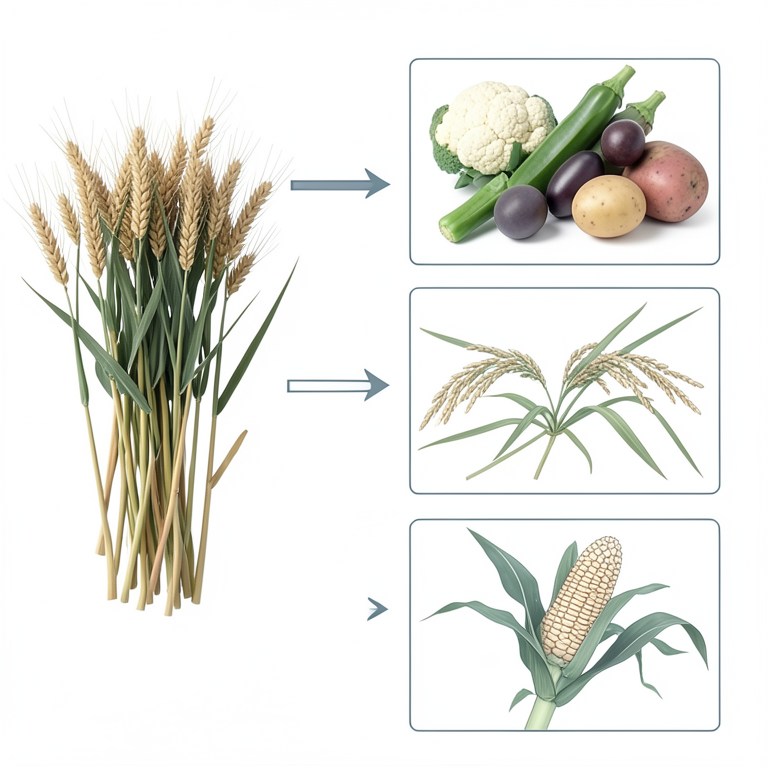
Diversification Pathways
AI-generated conceptual illustration (Rice, wheat, cauliflower, okra, potato, cowpea, and maize plants). It explains the idea and does not show study data.
View source evidence ↗Figures & tables
From the original paper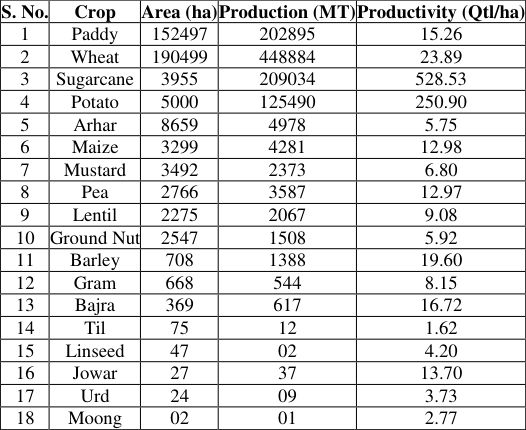 Table 1
Introduction
Agriculture remains the primary economic engine of the district, supporting the livelihoods of a majority of the population. However, the agrarian structure is heavily skewed towards marginalization. The data from the Krishi Vigyan Kendra (KVK) Gorakhpur reveals that approximately 88.10% of landholdings belong to marginal farmers (owning less than 1 hectare), while small farmers (1-2 hectares) constitute another 8.43% and large farmers (< 2 hectares) constitute 3.47%. This show fragmentation of land, limits the capacity for capital investment and mechanization, compelling farmers to adopt risk-averse strategies that favour the established Rice-Wheat Cropping System (RWCS) over more profitable but volatile. Over the past half century, the region underwent a profound transformation during the green revolution, adopting a highinput, cereal-centric model that prioritized food self-sufficiency. This model solidified the hegemony of the rice-wheat cropping system (RWCS), which now dictates the socio-economic rhythms of millions of small and marginal farmers in the district. The prevailing agricultural scenario is defined by a high cropping intensity of approximately 154.4%, driven largely by the sequential cultivation of paddy in the kharif season and wheat in the rabi season. While this system has played a pivotal role in ensuring regional food security, it is increasingly beset by stagnation in productivity, diminishing economic returns, and severe ecological consequences. The depletion of soil fertilities, and challenge of groundwater depletion in some blocks. The continuous monocropping of rice and wheat has led to a deterioration of soil structure, a buildup of resistant weeds, and reliance on chemical fertilizers that has failed to keep nutrient reserves. Furthermore, the regional climate is undergoing a shift; the studies indicate a trend of increasing maximum and minimum temperatures coupled with a reduction in total rainfall and a rise in extreme point rainfall events. These anomalies threaten the traditional sowing and harvesting cycle. The need for agricultural diversification is underscored by the shrinking size of operational land holdings, which average just 0.39 hectares in the region. For such small land holders, the traditional cereal rotation often yields marginal profits that are insufficient to meet the rising costs of living and production. Diversification into high-value horticultural crops, legumes, and specialty grains like Kalanamak rice presents an opportunity to break this cycle of subsistence. Integrated grains, oilseeds, vegetables and feed crops into agricultural practice can improve the economic conditions of small and marginal farmers and increase incomes. This diversification strategy not only contributes to economic prosperity, but also optimizes the use of resources such as irrigation water and labour in the summer. This approach improves productivity, profitability and food security. After the rainy season, not only economically, but also economically and resource-efficiently, pulses, oilseeds, vegetables and feed crops have proven to be beneficial. The efficient use of irrigation water and other inputs leads to sustainable and profitable agricultural systems. This diversification strategy promotes the general economic situation of farmers, particularly those with limited resources. As the third crop in the summer season, legumes, as a rice-wheat sequence, greatly improved the yield of the rice system. This suggests that the integration of legumes into the summer crop system can increase overall productivity.
Literature Review
The constant adoption of RWCS, especially in the Indo-Gangas Plains, has led to soil fertility declines, the emergence of several micronutrient deficiencies, excessive greenhouse gas emissions and water level declines, etc. (Mal et al. 2018, Shahane and Shivay 2019) [7,8] . Thus, sustainability of this cropping system is threatened (Nawaz et al. 2019) [9] and requires remedial measures. One of these measures could be the adoption of an entirely alternative crop system to overcome these problems. Different crops provide a source of food and income for farmers, increase the productivity of their land, and minimize unpredictable risks, such as the accumulation of insects and diseases common in rice monocultures (Saha et al. 2020) [10] . Diversification of the rice-wheat system will help to preserve India's long-term soil fertility, crop productivity, and profitability, and reduce the gap between current yields and currently used yields of cultivars (Shahane and Shivay 2019, Saha et al. 2020) [8,10] . For example, Introduction of summer legumes such as moonbeam into rice-wheat cropping systems before harvesting wheat and mustard and rice transplants, and planting corn, feed corn and wheat grain may increase the productivity of these crops (Nawaz et al. 2019) [9] . Therefore, keeping the above facts in view, a field experiment was conducted to find out the more productive and profitable cropping systems that can replace the existing rice-wheat cropping system.
Study Area
The agricultural landscape of Gorakhpur district, situated in the fertile Terai belt of North Eastern Uttar Pradesh, represents a complex interplay of ecological abundance and structural constraints. Geographically positioned between latitude 26° 13' N and 27° 29' N and 83° 05′E and 83° 56' E longitude, the district forms a critical part of Trans-Saryu plains of the middle Ganga plain. Total population of the district is 6.73 lakh with a literacy rate of 75.4%. The total geographical area is 3483.8 sq km, out of this total cultivated area is 248723 ha, forest 6031 ha, land under non agriculture 45875 ha, Pasture 211 ha and cultivable waste land 2255. Annual average rainfall is 1100 mm. Maximum temperature goes up to 43.5 °C in summer and minimum temperature 6.1 °C goes in winter. The region is characterized by sandy loam soil 70%, clay loam soil 10% and silty loam soil 20% of total areaand a riverine ecosystem dominated by the Rapti, Rohini, Ami, and Ghaghara rivers.
Objective and Methodology
The primary objective of this assessment is to conduct a comprehensive evaluation of the current cropping systems within the Gorakhpur district to identify the underlying causes of rice-wheat dominance and the potential pathways for sustainable diversification. To assess the current extent of rice-wheat cropping dominance in Gorakhpur district. To identify environmental and socio-economic constraints limiting crop diversification. To evaluate potential crops diversification systems to increase profitability and sustainability.
The assessment employs a mixed-methods approach combining secondary data analysis from Krishi Vigyan Kendra (KVK) Gorakhpur, and synthesis of empirical research in contexts of rice wheat cropping systems dominance and prospects for crop diversification in Gorakhpur districts.
Results and Discussion
The assessment of the current cropping systems in Gorakhpur and analyse the agronomic and economic drivers of the ricewheat dominance, evaluates the ecological consequences of the monoculture, and systematically explores the prospects for diversification.
The Dominance of the Rice-Wheat Cropping System (RWCS)
The Rice-Wheat Cropping System (RWCS) is the backbone of Gorakhpur's food security and rural economy. Covering nearly 80% of the gross cropped area, this system has evolved from a subsistence necessity to a structurally ingrain monoculture. Mustard: Mustard is a viable competitor to wheat in the Rabi season. Economic analysis indicates that while the cost of cultivation for Mustard is higher per quintal, the net returns per hectare are competitive due to lower irrigation needs and higher market prices. The Rice-Mustard-Green gram sequence is highlighted as a nutrient-efficient system that breaks the cereal disease cycle.
(c). Industrial Crop Potential
Maize is emerging as a strategic crop for diversification, driven by industrial demand rather than just direct human consumption.
Winter Maize: Cultivating maize in the Rabi season (Winter Maize) offers higher yield potential than Kharif maize due to the long, cool growing season and absence of waterlogging. It requires significantly less water than Boro rice and wheat, making it a water-smart industrial crop. System Efficiency: Maize-based systems like Maize-Potato-Onion have shown high system productivity. Maize residues can also be used as fodder or mulch, contributing to circular farm economy.
(d). Reviving Heritage: Kalanamak Rice
A unique diversification strategy for Gorakhpur involves valuebased rather than just volumebased agriculture through the promotion of Kalanamak Rice.
The Buddha Rice Renaissance Kalanamak, a scented rice variety indigenous to the Terai belt (including Gorakhpur, Siddharthnagar, and Basti), is renowned for its aroma and nutritional profile (high in Iron and Zinc). Historically, its cultivation declined due to low yields and lodging issues. However, recent interventions have reversed this trend. Improved Varieties: New dwarf varieties (e.g., Kalanamak 101, 102) developed by research institutions have addressed the lodging problem and reduced the crop duration, making it agronomically viable. Economic Superiority: Under the Uttar Pradesh government's One District One Product (ODOP) scheme, Kalanamak is being aggressively promoted. The economic math is compelling: while common paddy sells for 2,000-2,200 per quintal (MSP), Kalanamak ₹ paddy commands prices of 4,000-6,000 per quintal. ₹ Export Potential: The ODOP initiative has linked Kalanamak farmers to export markets (e.g., Singapore, Nepal), creating a high-value niche that decouples farmer income from land size.
(D) Constraints and Challenges to Diversification
Despite the clear economic rationale, the adoption of diversified systems is impeded by structural, market, and environmental bottlenecks.
Marketing Infrastructure and Post-Harvest Losses
Price Volatility: Diversification into vegetables exposes farmers to extreme price volatility. Unlike wheat/paddy, which have MSP protection, vegetable prices fluctuate daily. A bumper crop of cauliflower in Gorakhpur often leads to a market crash where prices drop below harvesting costs, forcing farmers to destroy their crop. Cold storage: Gorakhpur has some cold storage capacity (primarily for potatoes), there is a critical lack of multicommodity cold storages and pre-cooling facilities at the farm gate. Post-harvest losses in vegetables like tomato and brinjal are estimated to be between 20-30% due to poor handling and lack of storage. Market Intelligence: Farmers lack real-time information on demand in distant markets. They often produce based on last year's prices, leading to the "cobweb cycle" of glut and scarcity.
Socio-Economic Constraints
Small Holding Size: With 88% of farmers being marginal, the capacity to invest in the specialized machinery required for potatoes or planting materials for orchards is limited. Small plot sizes also make it difficult to achieve the economies of scale necessary for bargaining with traders.
Environmental Constraints
Environmental Constraints
Conclusion
The dominance of the Rice-Wheat system, historically significant, has reached its ecological and economic limits. The study indicates that shifting towards high-value vegetables, industrial maize, and heritage crops like Kalanamak is not just viable but highly profitable. However, this transition requires a shift from a production-centric approach to a market-centric, supported by robust infrastructure and collective action through FPOs. By leveraging its rich water resources and fertile soils with smart, diversified choices, Gorakhpur can transform into a model of resilient and remunerative agriculture for the entire Eastern Gangetic Plains. The prospects for diversification are not only viable but essential for the survival of the district's marginal farming community. The resurgence of Kalanamak rice, supported by the ODOP scheme and improved genetics, offers a high-value entry into global markets. Simultaneously, the intensification of horticulture involving potato and other can significantly enhance net returns per unit area. However, for these transitions to take place on a large scale, the technological and infrastructural gap must be bridged.
Figures and tables from the paper
| S. No. | Crop | Area (ha) | Production (MT) | Productivity (Qtl/ha) |
|---|---|---|---|---|
| 1 | Paddy | 152497 | 202895 | 15.26 |
| 2 | Wheat | 190499 | 448884 | 23.89 |
| 3 | Sugarcane | 3955 | 209034 | 528.53 |
| 4 | Potato | 5000 | 125490 | 250.90 |
| 5 | Arhar | 8659 | 4978 | 5.75 |
| 6 | Maize | 3299 | 4281 | 12.98 |
| 7 | Mustard | 3492 | 2373 | 6.80 |
| 8 | Pea | 2766 | 3587 | 12.97 |
| 9 | Lentil | 2275 | 2067 | 9.08 |
| 10 | Ground Nut | 2547 | 1508 | 5.92 |
| 11 | Barley | 708 | 1388 | 19.60 |
| 12 | Gram | 668 | 544 | 8.15 |
| 13 | Bajra | 369 | 617 | 16.72 |
| 14 | Til | 75 | 12 | 1.62 |
| 15 | Linseed | 47 | 02 | 4.20 |
| 16 | Jowar | 27 | 37 | 13.70 |
| 17 | Urd | 24 | 09 | 3.73 |
| 18 | Moong | 02 | 01 | 2.77 |
Table text extracted from the original PDF; superscript letters are shown inline. The original table image is below.
View original table image
References
10 in the original paper- Krishi Vigyan Kendra, Gorakhpur. Krishi Vigyan Kendra Gorakhpur [Internet]. Gorakhpur: Indian Council of Agricultural Research; 2024.
- Wikipedia, The Free Encyclopedia; 2025.
- Central Ground Water Board. Ground Water Overview: Gorakhpur District [Internet]. New Delhi: Ministry of Jal Shakti, Government of India; 2023.
- Government of Uttar Pradesh. One District One Product (ODOP): Kalanamak Rice [Internet]. Lucknow: Government of Uttar Pradesh; 2023.
- Kumar A, Singh R, Sharma S, et al. Diversification of ricebased cropping system for improving system productivity and soil health in Eastern Gangetic Plains of India. Agriculture. 2023.
- Singh SP, Kumar A, Singh RK, et al. Yield gap and production constraints in rice-wheat system: Scenario from Eastern Uttar Pradesh. Indian J Agric Sci. 2021.
- Mal P, Wani SP, Sahrawat KL, et al. Integrated nutrient management for improving crop productivity and soil health in rice-wheat cropping systems. Indian J Fert. 2018;14(11):42-56.
- Shahane AA, Shivay YS. Diversification of rice-based cropping systems for improving productivity, profitability and resource-use efficiency: A review. Indian J Agron. 2019;64(4):457-472.
- Nawaz A, Farooq M, Lal R, et al. Rice-wheat cropping systems in South Asia: Issues, options and opportunities for sustainability. Soil Tillage Res. 2019;191:1-15.
- Saha S, Kumar N, Hazra KK, Nath CP, Singh SS, Mina BL, et al. Crop diversification in rice-wheat cropping system improves productivity, profitability and soil health in the Eastern Gangetic Plains. Agriculture. 2020;10(11):554.