
Research article · 2026 · Full text
International Journal of Agriculture and NutritionImpact of nutrition education on awareness, attitude and practice regarding black rice among faculty members: A pre post intervention study
Volume 8(6) · Pages 135–138 · DOI: 10.33545/26646064.2026.v8.i6b.662 ↗
Research areasNutrition, Health and Food BehaviorConsumer Attitudes and Food LabelingNutrition, Health, and Society Studies
Abstract
Author-writtenBlack rice (Oryza sativa L.) is an anthocyanin-rich functional food known for its antioxidant, anti-inflammatory and health-promoting properties. Despite its nutritional benefits, awareness regarding black rice remains limited among many population groups. Nutrition education is considered an effective approach for improving awareness and encouraging healthier food choices. The present study evaluated the impact of a structured nutrition education intervention on knowledge, attitude and practice (KAP) regarding black rice among university faculty members. This pre-post intervention study was carried out among 70 faculty members of Bhagat Phool Singh Institute of Higher Learning (BPSIHL) and Bhagat Phool Singh Mahila Vishwavidyalaya (BPSMV), Haryana, India. A baseline assessment of awareness was done using a structured online KAP questionnaire. The nutrition education intervention program involved lecture, discussion, demonstration of black rice recipes and distribution of a black rice recipe booklet. Another assessment after intervention was done using the same questionnaire. Descriptive statistics and paired t-tests were employed in data analysis. Improvements were observed in all the domains of KAP after the intervention. Knowledge scores rose from 34.7% to 89.7% which corresponds to a gain of 55.0%. Scores of attitudes improved from 53.2% to 95.6% with a gain of 42.4%. There was also an improvement in practice scores which went up from 22.0% to 64.5%, indicating a gain of 42.5%. The computed t-values ranged from 10.8 to 12.3. This study revealed that nutrition education intervention can help increase the awareness, attitudes and intended practice of black rice consumption. Nutrition education interventions on traditional nutrient-rich foods could help in diversification of dietary patterns.
Summary
Source-checkedPlain-language reading of the full paper, prepared with AI and checked against the text. Each point links to the authors' own words.
Why it matters
- Black rice is a functional food rich in anthocyanins, which provide antioxidant and anti-inflammatory health benefits. View evidence ↗
- Despite the nutritional advantages of black rice, many people lack awareness of its benefits. View evidence ↗
- University faculty are key targets for nutrition education because they can help spread health information to the wider community. View evidence ↗
The question
- The study aimed to evaluate the baseline awareness of black rice among faculty at BPSIHL and BPSMV and test if a nutrition education program could improve that awareness. View evidence ↗
What they did
- Awareness was measured using a Knowledge, Attitude, and Practice (KAP) questionnaire administered online via Google Forms. View evidence ↗
- The intervention consisted of lectures, PowerPoint presentations, discussions on health benefits, recipe demonstrations, and the distribution of recipe booklets. View evidence ↗
- Data were analyzed using descriptive statistics (mean, standard error, percentages) and paired t-tests to compare pre- and post-intervention scores. View evidence ↗
What they found
- Knowledge scores significantly increased from 34.7% ± 1.2% to 89.7% ± 1.2%, representing a gain of 55.0% ± 1.3% (t=12.3). View evidence ↗
- Attitude scores improved significantly from 53.2% ± 1.0% to 95.6% ± 1.0%, with a gain of 42.4% ± 1.2% (t=10.8). View evidence ↗
- Practice scores rose significantly from 22.0% ± 1.1% to 64.5% ± 1.1%, showing a gain of 42.5% ± 1.1% (t=11.6). View evidence ↗
- Post-intervention practice scores remained lower than knowledge and attitude scores, suggesting that behavioral change takes more time and reinforcement. View evidence ↗
What it means
- The authors concluded that the nutrition education intervention was effective in significantly improving knowledge, attitude, and practice regarding black rice. View evidence ↗
- The authors recommend using nutrition education strategies to promote the acceptance of traditional nutrient-rich foods and diversify diets. View evidence ↗
Visual summary
2 visualsIllustrations explain the paper; charts are replotted from the paper's own table values.
Intervention Workflow
AI-generated conceptual illustration (black rice and educational materials). It explains the idea and does not show study data.
View source evidence ↗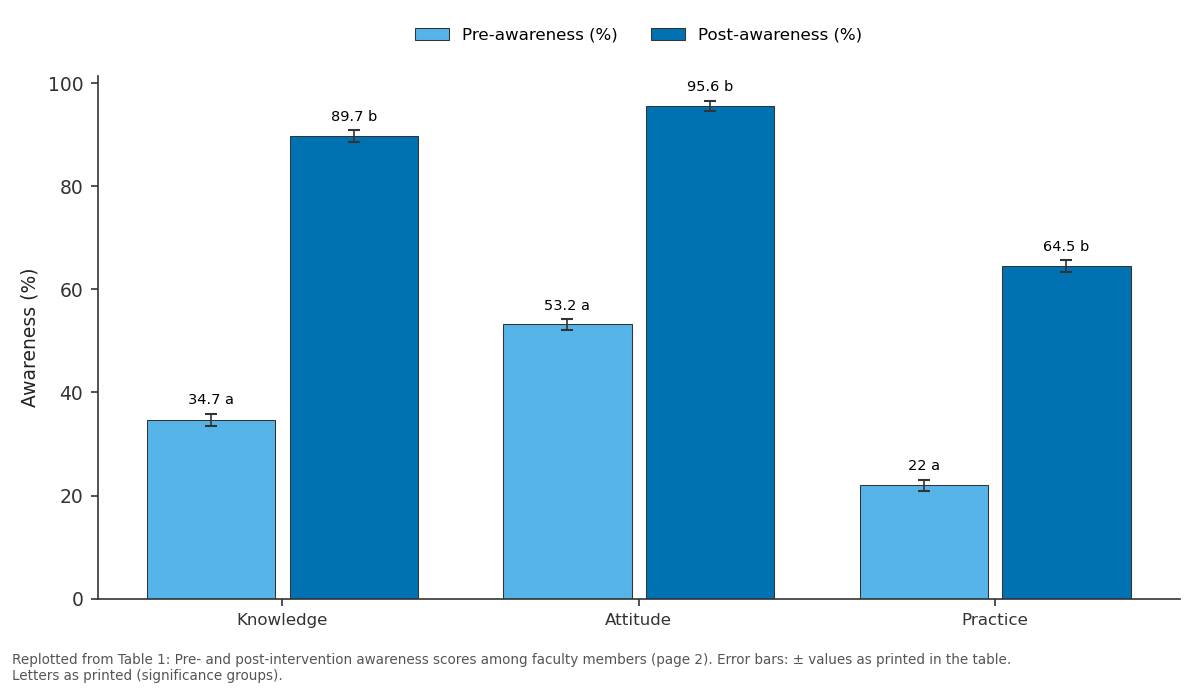
Pre-awareness (%) and Post-awareness (%): Knowledge vs Attitude vs Practice
Replotted from Table 1 (page 2) of the original paper. Every bar is the paper's own table value.
View source evidence ↗Figures & tables
From the original paper Table 1
Introduction
There has been an increased interest in dietary practices due to the growing prevalence of non-communicable diseases and their role in health and disease prevention. Functional foods which provide benefits beyond basic nutrition have become popular (Abu-Baker et al., 2021a) [1] . Black rice is regarded as a nutritionally superior cereal (Javed et al., 2025) [6] and loaded with antioxidants in the form of anthocyanins, phenolic compounds, dietary fiber, vitamins and minerals (S & Avinashilingam, 2025) [17] . Black rice is characterized by a black-purple bran layer which contains a high amount of anthocyanins which include cyanidin-3-glucoside and peonidin-3-glucoside (Liao & Yang, 2023) [9] . Anthocyanins are known for their strong antioxidant activity and their ability to protect against a number of oxidative stresses (Speer et al., 2020) [20] , improved lipid metabolism, insulin sensitivity, cardiovascular diseases (Mattioli et al., 2020) [10] , diabetes and certain cancers (Najam et al., 2023) [11] to these reasons, black rice is regarded as a functional food which has applications in disease prevention (Junuthula & Lakshmi, 2023) [7] . Though the nutritional and therapeutic value of black rice is well recognised, there is still lack of awareness among consumers (Rao et al., 2022) [14] . The absence of knowledge about the nutritional value, health benefits and culinary applications of black rice prevents individuals from consuming it. Various research has shown that awareness and nutrition education affect the consumer acceptance of the food product (Armes et al., 2025) [3] . Education intervention can help to develop knowledge about the food and bring about attitudinal and behavioural changes (Arora, 2016) [4] . Faculty members are an important group among whom to conduct nutrition education because of their education background and the role they play in disseminating knowledge (Antwi et al., 2020) [2] . Increased awareness regarding black rice consumption in the faculty members would help not only in their own dietary practices but also would help in conveying information regarding it in the community setting (Simbar et al., 2022) [19] . Therefore, the current study was aimed to assess the level of awareness regarding black rice among faculty members of BPSIHL and BPSMV and to examine the effectiveness of a nutrition education intervention on awareness regarding black rice (Reddy, 2021) [15] .
Methods
Methods
Study design and participants
This study involved a pre-and post-intervention study among faculty members of Bhagat Phool Singh Institute of Higher Learning (BPSIHL) and Bhagat Phool Singh Mahila Vishwavidyalaya (BPSMV), Haryana, India. Seventy faculty members volunteered to take part in both pre-and post-intervention assessment.
Development of the awareness questionnaire
An awareness questionnaire based on KAP framework was designed to measure awareness regarding black rice. The questionnaire included three main parts Knowledge of nutritional composition and health benefits of black rice. Attitudes towards the consumption of black rice. Practice related to consumption of black rice. The questionnaire was administered online using Google forms (Wu et al., 2019) [22] .
Pre-intervention assessment
Baseline awareness of black rice was done before nutrition education program. The respondents took the KAP questionnaire online and the scores were obtained (Nguyen et al., 2025) [125] .
Nutrition education intervention
The nutrition education intervention was developed to increase the level of awareness of black rice and involved the following: Lecture-based educational sessions. PowerPoint presentations highlighting nutritional and health benefits. Discussion of antioxidant properties and disease prevention potential. Demonstration of black rice based recipes. Distribution of educational material and recipe booklets.
Interactive question and answer sessions. The intervention emphasized practical approaches to incorporate black rice into daily diets (Seesen et al., 2020) [18] .
Post-intervention assessment
The same questionnaire was taken with the same participants after the nutrition education session (Abu-Baker et al., 2021b) [1] . The difference in the level of awareness scores was used as an indicator of the effectiveness of the nutrition education intervention program (Vasquez-Mamani et al., 2025) [21] .
Statistical analysis
The data collected were analyzed using descriptive statistics in terms of mean, standard error and percentages. The differences between pre-and post-intervention scores were determined using paired t-tests. The graph shows a marked improvement in awareness levels across all domains after the intervention. The highest awareness gain was observed in the Knowledge domain (55.0%), followed by Practice (42.5%) and Attitude (42.4%), indicating the effectiveness of the awareness program. Baseline assessment showed that the awareness regarding black rice was poor among the faculty members. Scores of knowledges were just 34.7% which showed that the participants had limited information about the nutritional value and health benefits of black rice. Practice scores were very low (22.0%) which meant that the participants rarely consumed black rice. The attitude scores were comparatively higher (53.2%) which meant that there was some openness towards consumption of healthier foods.
Results
Results
Table 1: Pre-and post-intervention awareness scores among faculty members
After the nutrition education intervention, a remarkable improvement was observed in all the domains. Scores of knowledges improved to 89.7%, showing a gain of 55.0%. The attitude scores improved to 95.6%, showing that there was a good attitude towards black rice. There was also an improvement in practice scores to 64.5%. All the above changes were statistically significant with t-values ranging from 10.8 to 12.3.
Discussion
This study revealed that the nutrition education intervention was effective in increasing the awareness regarding black rice among the university faculty members. Significant improvement in the scores of knowledges indicated that the participants had limited exposure to the knowledge regarding the nutritional value of black rice. The education intervention helped in filling up the knowledge gap.
The improvement in practice score shows that the nutritional education can bring about behavioral change. However, the practice scores were lower than those of knowledge and attitude scores indicating that the adoption of the healthy behavior requires more time, availability and reinforcement. The involvement of practical aspect in the intervention like recipes of black rice has also helped in behavioral change.
Studies have shown that the experiential learning increases the food acceptance. Faculty members are influential individuals in the community and educational institutions. Therefore, improved awareness of the faculty members may help in spreading the nutrition information and also increased acceptability of traditional nutrient-rich foods like black rice.
Conclusion
This study showed that the awareness regarding black rice was relatively low among the university faculty members before intervention. The nutrition education intervention significantly improved the scores of knowledge, attitude and practice, confirming the effectiveness of the nutrition education intervention on the awareness of functional foods. Findings support the use of nutrition education strategies to encourage dietary diversification and increase the acceptance of traditional nutrient-rich foods.
Figures and tables from the paper
| Domain | Pre-awareness (%) | Post-awareness (%) | Awareness gain (%) | t-value |
|---|---|---|---|---|
| Knowledge | 34.7 ± 1.2ᵃ | 89.7 ± 1.2ᵇ | 55.0 ± 1.3 | 12.3* |
| Attitude | 53.2 ± 1.0ᵃ | 95.6 ± 1.0ᵇ | 42.4 ± 1.2 | 10.8* |
| Practice | 22.0 ± 1.1ᵃ | 64.5 ± 1.1ᵇ | 42.5 ± 1.1 | 11.6* |
Table text extracted from the original PDF; superscript letters are shown inline. The original table image is below.
View original table image
References
23 in the original paper- Abu-Baker NN, Eyadat AM, Khamaiseh AM. The impact of nutrition education on knowledge, attitude, and practice regarding iron deficiency anemia among female adolescent students in Jordan. Heliyon. 2021;7(2):e06348.
- Antwi J, Ohemeng A, Boateng L, Quaidoo E, Bannerman B. Primary school-based nutrition education intervention on nutrition knowledge, attitude and practices among school-age children in Ghana. Glob Health Promot. 2020;27(4):114-122.
- Armes S, Sogani R, Jama H, Ezhilmaran I, Kaur H, Nyaga W, et al. Assessing the impact of nutrition workshops on nutrition knowledge, attitudes, and practices (KAP) in Uttarakhand. Food Sci Nutr Cases. 2025;fsncases20250007.
- Arora G. Impact of nutrition education on knowledge, attitude, practices and beliefs of adolescent girls belonging to rural and urban area of district Kurukshetra. Int J Nutr Food Sci. 2016;5(4):278-286.
- Cameron A, McPhail SM, Hudson K, Fleming J, Lethlean J, Finch E. A pre-post intervention study investigating the confidence and knowledge of health professionals communicating with people with aphasia in a metropolitan hospital. Aphasiology. 2017;31(3):359-374.
- Javed M, Jawid J, Zafar S, Ahmad AMR, Shah SHBU, Farooq U, et al. Black rice as the emerging functional food: bioactive compounds, therapeutic potential and industrial applications. Front Nutr. 2025;12:1705983.
- Junuthula S, Lakshmi V. Effect of nutrition education on knowledge, attitude and practice (KAP) of the tribal and urban respondents on millet consumption. Open Sci Framew. 2023.
- Kaur P, Stoltzfus J, Yellapu V. Descriptive statistics. Int J Acad Med. 2018;4(1):60-63.
- Liao Y, Yang J. Status of nutrition labeling knowledge, attitude, and practice (KAP) of residents in the community and structural equation modeling analysis. Front Nutr. 2023;10:1097562.
- Mattioli R, Francioso A, Mosca L, Silva P. Anthocyanins: a comprehensive review of their chemical properties and health effects on cardiovascular and neurodegenerative diseases. Molecules. 2020;25(17):3809.
- Najam W, Walsh C, Oldewage-Theron W. Nutrition knowledge, attitudes, beliefs and practices: a comparison of urban and rural adults in the Free State province of South Africa. S Afr J Clin Nutr. 2023;36(4):154-161.
- Nguyen MH, Ngo TV, Vu LG, Truong DC, Vu HM. Validation of an instrument to assess knowledge, attitudes, and practices regarding occupational accident prevention among rice farmers. PLoS One. 2025;20(11):e0337550.
- Panda DK, Jyotirmayee B, Mahalik G. Black rice: a review from its history to chemical makeup to health advantages, nutritional properties and dietary uses. Plant Sci Today. 2022;9(Spec Iss 3):1-15.
- Rao ES, Yadav R, Rizwana R, Lalmuanpuia C, Marwaha A, Bharti R, et al. Impact of nutrition education on whole grains consumption amongst primary and middle school children in Delhi. Food Sci Technol. 2022;10(2):23-33.
- Reddy A. Barriers and facilitators of brown rice consumption, sensory acceptability and its effect on blood glucose level among university staff [master's thesis]. Durban: Durban University of Technology; 2021. International Journal of Agriculture and Nutrition https://www.agriculturejournal.net
- Rosnow RL, Rosenthal R, Rubin DB. Contrasts and correlations in effect-size estimation. Psychol Sci. 2000;11(6):446-453.
- S K. Effects of nutrition education on the knowledge, attitudes, and practices (KAP) towards millet consumption in school-aged children (10-15 years). Int J Nutr Lifestyle. 2025;5(4):175-194.
- Seesen M, Semmarath W, Yodkeeree S, Sapbamrer R, Ayood P, Malasao R, et al. Combined black rice germ, bran supplement and exercise intervention modulate aging biomarkers and improve physical performance and lower-body muscle strength parameters in aging population. Int J Environ Res Public Health. 2020;17(8):2931.
- Simbar M, Nazarpour S, Arabi Z, Keshavarz Z, Baghestani AR. Skills-based education for promoting healthy diet among female adolescents: a randomized controlled trial study. Child Adolesc Soc Work J. 2022;39(1):87-95.
- Speer H, D'Cunha NM, Alexopoulos NI, McKune AJ, Naumovski N. Anthocyanins and human health-a focus on oxidative stress, inflammation and disease. Antioxidants (Basel). 2020;9(5):366.
- Vasquez-Mamani L, Cueva-Calizaya L, Gálvez-Díaz NDC, Saintila J, Calizaya-Milla Y. Effect of a nutrition education program on knowledge, attitudes, and dietary practices, anthropometry, and hemoglobin in Peruvian adolescents. J Multidiscip Healthc. 2025;18:1679-1693.
- Wu DCN, Corbett K, Horton S, Saleh N, Mosha Effectiveness of social marketing in improving knowledge, attitudes and practice of consumption of vitamin A-fortified oil in Tanzania. Public Health Nutr. 2019;22(3):466-475.
- Zhou S, Qin K, Gu Q, Zhang R, Wang L, Luo J, et al. Improvements in depression symptomatology in a sample of undergraduate students: a pre-post Balint group intervention study. BMC Psychol. 2025;13(1):913.