
Research article · 2026 · Full text
International Journal of Biology SciencesIn silico investigation of phytochemicals present in leaves of Pongamia pinnata as potential VEGFR-2 inhibitors: Integrated ADMET and molecular docking analysis of anti-anigiogenesis based anticancer activity
Volume 8(6) · Pages 211–216 · DOI: 10.33545/26649926.2026.v8.i6c.889 ↗
Research areasComputational Drug Discovery MethodsBioactive natural compoundsAngiogenesis and VEGF in Cancer
Abstract
Author-writtenThere is over expression of VEGFRs and their specific agonist in multitudes of human tumours like gliomas and carcinomas. Hence, VEGFRs are regarded as one of the pivotal regulators of angiogenesis and tumour growth. Pongamia pinnata belonging to the family Leguminosae and subfamily 'Papilionaceae' is widely distributed in Asia and Australia. This plant is reported to possess antioxidant, antic cancer, cytotoxic, antidiabetic, anti-inflammatory, antiparasitic, antimicrobial, anticonvulsant, antihyperammonaemia, anthelmintic, insecticidal, analgesic and anti-inflammatory properties. The leaves of P. pinnata possess many flavones and chalcone derivatives such as Pongagallone A, Pongagallone B, Pongone, Galbone and Pongalabol. This research work was taken to study the anti-angiogenic and anti cancer potential of Pongagallone A, Pongagallone B and Pongone by molecular docking against VEGFR-2 pathways. These compounds demonstrated favourable ADME parameters along with acceptable toxicity profile. Pongone exhibited the highest binding affinity of -10.1 kcal/mol, outperforming the co-crystallized ligand Axitinib (-9.2 kcal/mol). The Pongone-VEGFR-2 complex formed three hydrogen bonds with key active site residues ASP1044, CYS917, PHE916, along with additional hydrophobic interactions with other residues. Overall, the insights of binding energies obtained from molecular docking studies are suggestive of tumour related antiangiogenic properties of these ligands that acts via inhibition of VEGFR-2 pathway
Summary
Source-checkedPlain-language reading of the full paper, prepared with AI and checked against the text. Each point links to the authors' own words.
Why it matters
- Vascular endothelial growth factor receptors (VEGFRs) are key regulators of tumor growth and angiogenesis and are often overexpressed in various human carcinomas and gliomas. View evidence ↗
- Among the VEGFR family, VEGFR-2 specifically drives tumor angiogenesis, making its inhibition a viable strategy for managing malignancies that depend on new blood vessel growth. View evidence ↗
- There is a critical need for new anticancer agents that are more selective and less toxic because current treatments often cause severe adverse effects that limit patient survival. View evidence ↗
The question
- The study aimed to evaluate the anticancer and anti-angiogenic potential of three phytochemicals from Pongamia pinnata, Pongagallone A, Pongagallone B, and Pongone, using molecular docking against the VEGFR-2 pathway. View evidence ↗
What they did
- The chemical structures for Pongagallone A, Pongagallone B, and Pongone were retrieved from the PubChem database. View evidence ↗
- The study used the crystal structure of the target protein VEGFR-2, identified by PDB ID 2OH4, sourced from the RCSB PDB database. View evidence ↗
- Pharmacokinetic (ADME) properties were predicted using the Swiss ADME server, while toxicity and median lethal dose (LD50) values were predicted using the ProTox-3.0 server. View evidence ↗
- Molecular docking was performed using PyRx integrated AutoDock Vina, with ligands prepared via energy minimization in Open Babel. View evidence ↗
What they found
- All three tested phytochemicals adhered to Lipinski’s Rule of Five, suggesting they have good potential for oral bioavailability. View evidence ↗
- All ligands were predicted to have low toxicity (Class 5), with Pongone showing the safest profile and an LD50 value of 4000 mg/kg. View evidence ↗
- Pongagallone A and Pongone were predicted to be capable of crossing the blood-brain barrier, suggesting potential use in treating central nervous system cancers. View evidence ↗
- Pongone showed the strongest binding affinity to VEGFR-2 at -10.1 kcal/mol, which was superior to the reference ligand Axitinib (-9.2 kcal/mol). View evidence ↗
- The interaction between Pongone and VEGFR-2 was stabilized by three hydrogen bonds with residues ASP1044, CYS917, and PHE916, as well as hydrophobic interactions. View evidence ↗
- Pongagallone B and Pongagallone A exhibited binding energies of -8.4 kcal/mol and -7.6 kcal/mol, respectively. View evidence ↗
What it means
- The authors conclude that phytochemicals from P. pinnata, especially Pongone, could serve as potential chemotherapeutic agents by inhibiting the VEGFR-2 pathway to block tumor angiogenesis. View evidence ↗
- The authors state that the current in silico findings require further validation through in vitro and in vivo experimental studies. View evidence ↗
Visual summary
3 visualsIllustrations explain the paper; charts are replotted from the paper's own table values.
Molecular Docking Concept
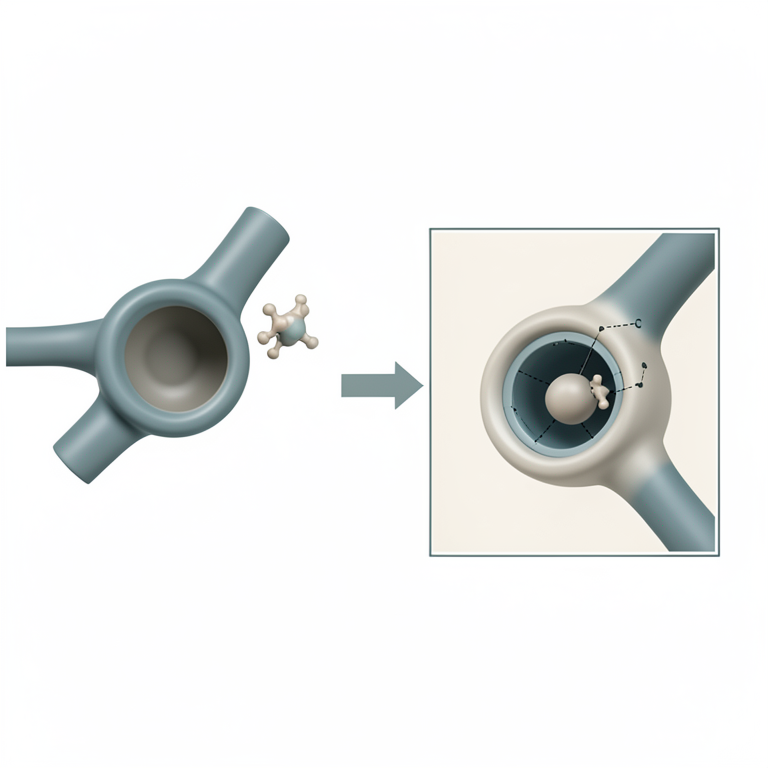
AI-generated conceptual illustration (VEGFR-2 protein receptor and Pongamia pinnata phytochemical molecules). It explains the idea and does not show study data.
View source evidence ↗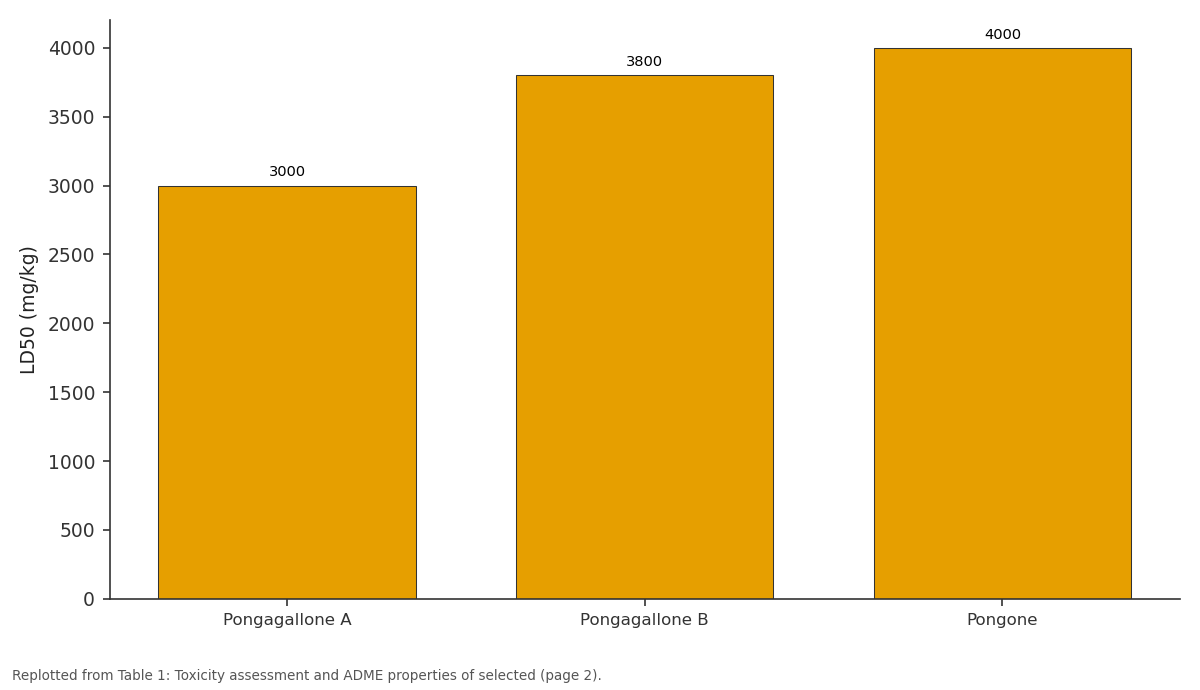
LD50 (mg/kg): Pongagallone A vs Pongagallone B vs Pongone
Replotted from Table 1 (page 2) of the original paper. Every bar is the paper's own table value.
View source evidence ↗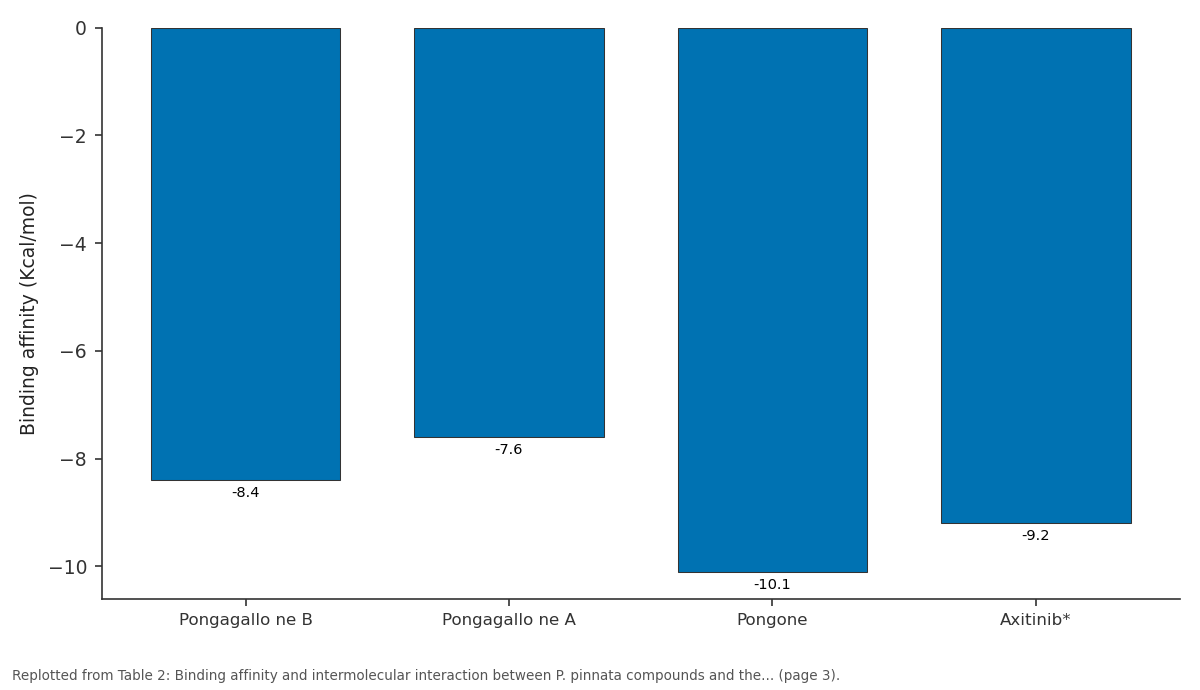
Binding affinity (Kcal/mol): Pongagallo ne B vs Pongagallo ne A vs Pongone vs Axitinib*
Replotted from Table 2 (page 3) of the original paper. Every bar is the paper's own table value.
View source evidence ↗Figures & tables
From the original paper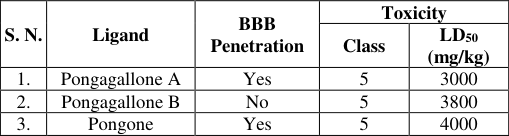 Table 1
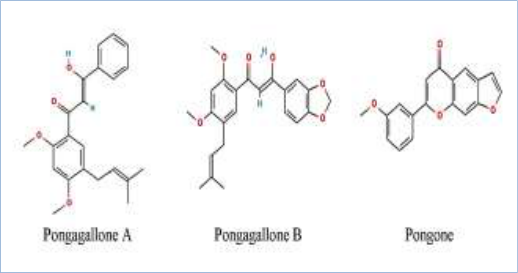 Figure 1
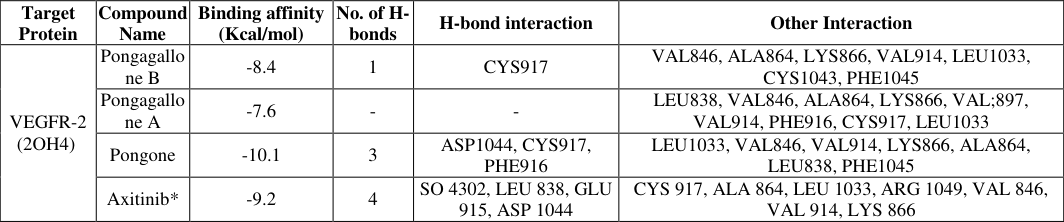 Table 2
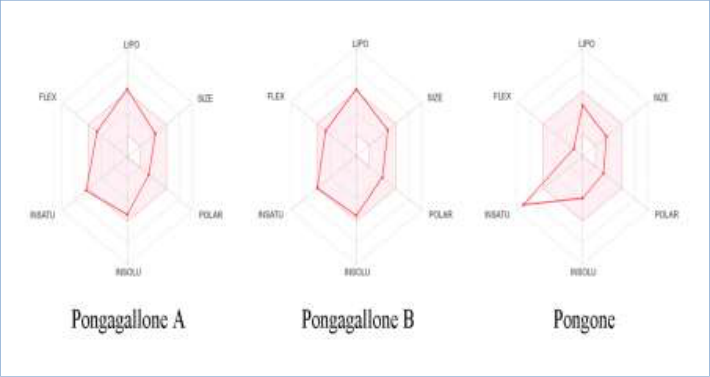 Figure 2
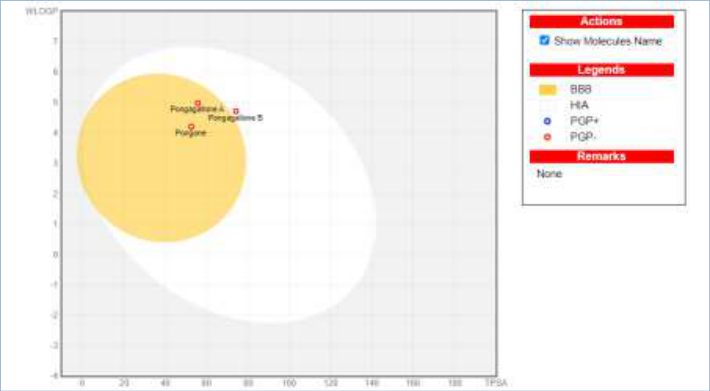 Fig. 3
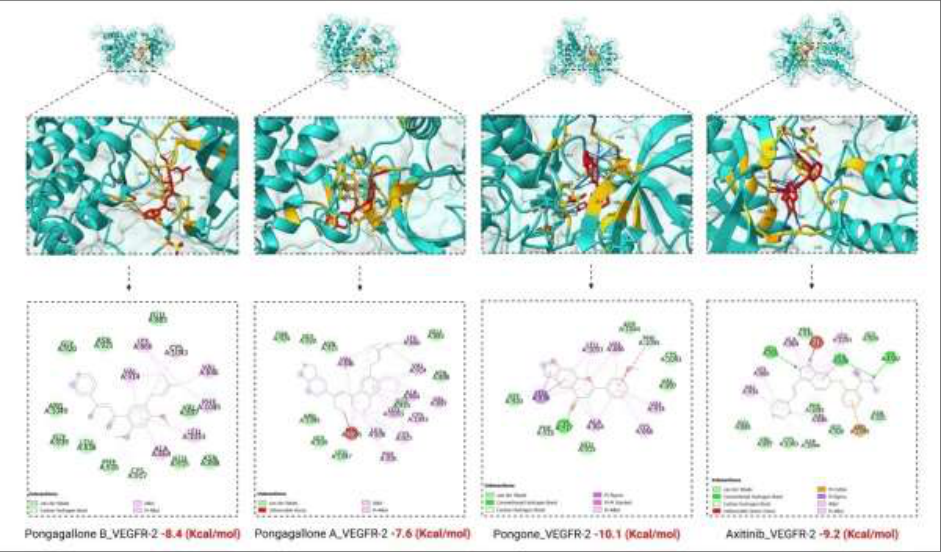 Fig. 3
Introduction
Cancer has been declared as the second leading cause of death as per the reports of World Health Organization (Bray et al., 2018) [6] . It is predicted that cancer deaths would reach thirteen million worldwide by 2030 (Barbosa et al., 2015) [5] . Angiogenesis is imperative for growth and regeneration of tissues that plays a pivotal role in preventing ischaemic necrosis and survival of the damaged tissues (Chu and Wang, 2012). Angiogenesis is regulated by a plethora of protein kinases such as EGFRs, FGFRs, and VEGFRs (Ghith et al., 2017) [10] . There are overexpression of VEGFRs and their specific agonist in multitudes of human tumours like gliomas and carcinomas (Hamerlik et al, 2012) [13] . Hence, VEGFRs are regarded as one of the pivotal regulators of angiogenesis and tumour growth (Guo et al., 2010) [12] . VEGFR-1, VEGFR-2, and VEGFR-3 constitutes the VEGFRs family, where VEGFR-1 regulates embryonic vasculogenesis and VEGFR-2 is responsible for both tumour angiogenesis as well as embryonic vasculogenesis (Takahashi, 2011) [24] . Hence, inhibition of VEGFR-2 can be useful in management of angiogenesis-dependent malignancies (Holmes, 2007) [14] . Profound suppression of progression of tumour has been demonstrated by VEGFR-2 blockers, whose primary target is the ATP binding site (Modi and Kulkarni, 2019; Alanazi et al., 2021) [17,2] .
Although cancer diagnosis and treatment is advancing rapidly, yet, the patient's survival stands unsatisfactory owing to mammoth adverse effects associated with anti cancer agents (El Newahie et al., 2016) [9] . Hence, it is the need of the hour to explore for novel, selective, less toxic and high efficacious anti cancer agents (Nam and Parang, 2003) [18] . Pongamia pinnata belonging to the family Leguminosae and subfamily 'Papilionaceae' is widely distributed in Asia and Australia. This plant also flourishes in the US, Africa and many other countries. In India this plant can be seen along rivers and streams as well as in coastal forests. In Tamil it is called as 'Ponga', 'Pongam,' 'Dalkaramacha' and 'Punku' While in Hindi and Bengal, it is referred to as 'Karanj', 'Kanji' or Papar'. In English, it is called as 'Karum Tree' or the 'Poonga Oil Tree (Tanaka et al., 1992) [25] . Folklore use of this plant has prompted scientists to investigate its pharmacological profile. This plant is reported to possess antioxidant, anticancer, cytotoxic, antidiabetic, antiparasitic, antimicrobial, anticonvulsant, antihyperammonaemia, anthelmintic, insecticidal (Rangaswami and Seshadri, 1942) [21] , analgesic and antiinflammatory properties (Rahman et al., 2025) [20] . The leaves of P. pinnata possess many flavones and chalcone derivatives such as Pongagallone A, Pongagallone B, Pongone, Galbone and Pongalabol. This research work was taken to study the anti angiogenic and anti cancer potential of Pongagallone A, Pongagallone B and Pongone by molecular docking against VEGFR-2 pathways.
Materials and Methods
Materials and Methods
Prediction of Toxicity and ADME
The ADME characteristics were predicted with Swiss ADME server available at https://www.swissadme.ch/. The toxicity and LD50 (median lethal dose) values of the phytoconstituents were predicted with ProTox-3.0 server (https://tox.charite.de/protox3/) (Banerjee et al., 2024) [4] .
Molecular Docking
In this study, molecular docking was carried out in order to assess the binding affinities of the selected phytochemicals with VEGFR-2 (PDB ID: 2OH4). For this, three dimensional structure of the protein was retrieved from RCSB Protein Data Bank. Selection of ligand candidates were done based on published literature reporting the phytochemical profile of the plant under investigation. The 3-D structures of the ligands were retrieved from the PubChem database. The protein preparation prior to docking involved removal of native lignads and co-crystallized water molecules, along with addition of atoms of polar hydrogen using Discovery Studio Visualizer (DSV), which were then converted to PDBQT from PDB format within the PyRx environment (Abdisa et al., 2026) [1] . Ligands were prepared by minimizing energy using Open Babel and then converted to PDBQT to facilitate its compatibility with PyRx integrated AutoDock Vina (Ghose et al., 2025) [11] . The coordinates of docking grid were decided on the basis of position of bound co-crystallized ligands or inhibitors with the centroid coordinates assigned for VEGF-2, i.e., x = 1.396, y = 32.317, z = 15.938. In order to validate the docking protocol, re-docking of co-crystallized ligand or inhibitor with the respective binding pocket, and the binding affinity obtained was compared to the original crystal conformation to ensure reproducibility and reliability of the parameters of docking. Subsequently, the binding affinities of the selected phytochemicals were assessed by comparing with reference co-crystallized ligand and compound-protein complexes were selected for further interaction analysis using Discovery Studio Visualizer (Pattanaik et al., 2026) [19] .
Results
Results
Prediction of Toxicity and ADME
A comprehensive assessment of pharmacokinetic and toxicity parameters was done to ensure the candidature of the phytochemicals as potential VEGFR-2 inhibitors. The drug-likeness of the selected ligands were determined as per the Lipinski's Rule of Five (RO5), that considers vital physicochemical parameters (molecular weight, partition coefficient, hydrogen bond donor, hydrogen bond acceptor and topological polar surface area) influencing oral bioavailability. All the ligands fulfil the requirements of Lipinski's Rule of Five without any violation. As per the prediction of LD50 values using ProTox 3.0 server, all the ligands belong to class 5, which is indicative of low toxicity of the selected phyto-compounds. Among all the ligands, Pongone have the safest toxicity profile with LD50 values of 4000 mg/kg (Table 1). Moreover, the ADME prediction and radar images reveal that all parameters lie within acceptable range (Fig. 2). Pongagallone A and Pongone were predicted to penetrate the blood brain barrier and thus expanding its pharmacological role in treating cancer of central nervous system (Table 1 and Fig. 3). These outcomes enhance their candidature as drugs for further experimental validation as inhibitors of VEGFR-2
| S. N. | Ligand | BBB Penetration | Toxicity | — |
|---|---|---|---|---|
| Class | LD50 (mg/kg) | |||
| 1. | Pongagallone A | Yes | 5 | 3000 |
| 2. | Pongagallone B | No | 5 | 3800 |
| 3. | Pongone | Yes | 5 | 4000 |
Table text extracted from the original PDF; superscript letters are shown inline. The original table image is below.
View original table image
Molecular Docking
Molecular docking has surfaced out as a useful tool to assess protein-ligand binding, adding new scope to drug designing (Kashaw et al., 2019). Molecular docking was carried out to investigate binding affinities involving selected 3 phytocompounds and VEGRF-2 protein (PDB ID: 2OH4) (Figure 3).Pongone exhibited the highest binding affinity of -10.1 kcal/mol, outperforming the co-crystallized ligand Axitinib (-9.2 kcal/mol). The Pongone-VEGFR-2 complex formed three hydrogen bonds with key active site residues ASP1044, CYS917, PHE916, along with additional hydrophobic interactions with LEU1033, VAL846, VAL914, LYS866, ALA864, LEU838, PHE1045 (Table 2). Also, the binding energies of Pongagallone A and B are -7.6 and -8.4 kcal/mol. The binding affinity of Pongagallone B is only slightly less than co-crystallized ligand Axitinib. The binding energies and interactions of the top docked ligands i.e., Pongone and Pongagallone B with the amino acids of the active site makes them preferable candidates as lead scaffolds in discovery of anti-cancer drugs (Kashaw et al., 2019) [15] Table 2: Binding affinity and intermolecular interaction between P. pinnata compounds and the target protein VEGFR-2 ) [26] . Multitudes of receptor tyrosine kinases, such as VEGFR2, Flt1/VEGFR1, VEGFR3, or PDGFR, play pivotal role in tumour angiogenesis. Upon activation these receptors orchestrate various signal pathways leading to neoangiogenesis. VEGFR-2 plays a critical role in survival of endothelial cell, migration as well as in proliferation of blood vessels (Baeriswyl and Christofori, 2009) [3] . As per the tumour linked angiogenesis model of canonical, VEGF is expressed by tumour cells that bind to VEGFR-2 receptor of endothelial cells (Carmeliet, 2000) [7] , and thereby signalling blood vessel formation around tumour. This transition from prevascular hyperplasia to highly vascularized tumors has been referred to as the angiogenic switch (Baeriswyl and Christofori, 2009) [3] . Hence, VEGFR-2 has emerged as an important drug target pertaining to cancer therapy. Screening of phytobiotics using molecular docking against VEGFR-2 exhibited a set of potential drug candidates, with Pongone standing out. Furthermore, these compounds demonstrated favourable ADME parameters along with acceptable toxicity profile. Also, Pongone was predicted to penetrate the blood brain barrier and thus may inhibit neoangiogenesis associated with brain tumour. Overall, the insights of binding energies obtained from molecular docking studies are suggestive of tumour related antiangiogenic properties of these ligands that acts via inhibition of VEGFR-2 pathway.
Conclusion
Phytochemicals in leaves of Pongamia pinnata, more particularly Pongone can inhibit VEGFR-2 pathway that is responsible for 'angiogenic switch' leading to tumour angiogenesis. By this mechanism, it can emerge as a potential chemotherapeutic agent, which has acceptable toxicity profile. For further validation, in vitro and in vivo studies should be conducted.
Acknowledgement
AcknowledgmentThe authors acknowledges Siksha 'O' Anusandhan, Deemed to be University for providing research facilities.
Figures and tables from the paper
References
26 in the original paper- Abdisa G, Bizualem H, Ketema B, Chaluma E, Girma S, Ahmed U, et al. In vivo and molecular docking studies of Micromeria imbricata var. imbricata extract reveal alleviation of the DSS-induced IBD phenotype via interaction with key inflammatory mediators. J Ethnopharmacol. 2026;121843.
- Alanazi MM, Eissa IH, Alsaif NA, Obaidullah AJ, Alanazi WA, Alasmari AF, et al. Design, synthesis, docking, ADMET studies, and anticancer evaluation of new 3-methylquinoxaline derivatives as VEGFR-2 inhibitors and apoptosis inducers. J Enzyme Inhib Med Chem. 2021;36(1):1760-1782.
- Baeriswyl V, Christofori G. The angiogenic switch in carcinogenesis. Semin Cancer Biol. 2009;19(5):329337.
- Banerjee P, Kemmler E, Dunkel M, Preissner R. ProTox 3.0: a webserver for the prediction of toxicity of chemicals. Nucleic Acids Res. 2024;52(W1):W513W520.
- Barbosa IR, Souza DLB, Bernal MM, Costa ICC. Cancer mortality in Brazil: temporal trends and predictions for the year 2030. Medicine (Baltimore). 2015;94:e746.
- Bray F, Ferlay J, Soerjomataram I, et al. Global cancer statistics 2018: GLOBOCAN estimates of incidence and mortality worldwide for 36 cancers in 185 countries. CA Cancer J Clin. 2018;68:394-424.
- Carmeliet P. Mechanisms of angiogenesis and arteriogenesis. Nat Med. 2000;6(4):389-395.
- Chu H, Wang Y. Therapeutic angiogenesis: controlled delivery of angiogenic factors. Ther Deliv. 2012;3:693714.
- El Newahie AM, Ismail NS, Abou El Ella DA, Abouzid KA. Quinoxaline-based scaffolds targeting tyrosine kinases and their potential anticancer activity. Arch Pharm. 2016;349:309-326.
- Ghith A, Ismail NS, Youssef K, Abouzid KA. Medicinal attributes of thienopyrimidine based scaffold targeting tyrosine kinases and their potential anticancer activities. Arch Pharm. 2017;350:1700242.
- Ghose S, Bhattacharya K, Baruah S, Singh NK, Kumar S, Prasad SK, et al. Bioactive catechins from Potentilla fulgens Wall. ex Sims roots ameliorate oral carcinogenesis through modulation of oxidative stress, inflammatory, and apoptotic pathways. J Ethnopharmacol. 2025;120446.
- Guo S, Colbert LS, Fuller M, et al. Vascular endothelial growth factor receptor-2 in breast cancer. Biochim Biophys Acta Rev Cancer. 2010;1806:108-121.
- Hamerlik P, Lathia JD, Rasmussen R, et al. Autocrine VEGF-VEGFR2-Neuropilin-1 signaling promotes glioma stem-like cell viability and tumor growth. J Exp Med. 2012;209:507-520.
- Holmes K, Roberts OL, Thomas AM, Cross MJ. Vascular endothelial growth factor receptor-2: structure, function, intracellular signalling and therapeutic inhibition. Cell Signal. 2007;19:2003-2012.
- Kashaw SK, Agarwal S, Mishra M, Sau S, Iyer AK. Molecular docking analysis of Caspase-3 activators as potential anticancer agents. Curr Comput Aided Drug Des. 2019;15:55-66.
- Kim S, Chen J, Cheng T, Gindulyte A, He J, He S, et al. PubChem 2023 update. Nucleic Acids Res. 2023;51(D1):D1373-D1380.
- Modi SJ, Kulkarni VM. Vascular endothelial growth factor receptor (VEGFR-2)/KDR inhibitors: medicinal chemistry perspective. Med Drug Discov. 2019;2:100009.
- Nam NH, Parang K. Current targets for anticancer drug discovery. Curr Drug Targets. 2003;4:159-179.
- Pattanaik SK, Mohanty D, Ray A, Jena S, Pattanaik S, Rath D. Phytotherapy for ageing-related multimorbidity: systems-level insights into Centella asiatica in diabetes and Alzheimer's disease. Phytomedicine. 2026;158026.
- Rahman F, Mohan P, Sarma J, Baruah H, Nath R, Begum SA, et al. Analgesic and anti-inflammatory property of Pongamia pinnata plant. Int J Adv Biochem Res. 2025;9(4S):428-434.
- Rangaswami S, Seshadri TR. Chemistry of pongamol. Part I. Proc Indian Acad Sci Sect A Phys Sci. 1942;15(6):417-423.
- Shibuya M. Vascular endothelial growth factor receptor-1 (VEGFR-1/Flt-1): a dual regulator for angiogenesis. Angiogenesis. 2006;9:225-230.
- Stuttfeld E, Ballmer-Hofer K. Structure and function of VEGF receptors. IUBMB Life. 2009;61:915-922.
- Takahashi S. Vascular endothelial growth factor (VEGF), VEGF receptors and their inhibitors for antiangiogenic tumor therapy. Biol Pharm Bull. 2011;34:1785-1788.
- Tanaka T, Iinuma M, Yuki K, Fujii Y, Mizuno M. Flavonoids in root bark of Pongamia pinnata. Phytochemistry. 1992;31(3):993-998.
- Van De Waterbeemd H, Gifford E. ADMET In silico modelling: towards prediction paradise? Nat Rev Drug Discov. 2003;2:192-204.