
Research article · 2026 · Full text
International Journal of Horticulture and Food ScienceImpact of three commonly used insecticides on the Haemogram of Rhynocoris longifrons Stål a promising biocontrol agent in Agricultural crops (Hemiptera, Reduviidae)
Volume 8(6) · Pages 92–96 · DOI: 10.33545/26631067.2026.v8.i6b.765 ↗
Research areasInsect-Plant Interactions and ControlHemiptera Insect StudiesInsect Resistance and Genetics
Abstract
Author-writtenRhynocoris longifrons Stål is a promising biocontrol agent of many insect pests, belongs to the family Reduviidae and order Hemiptera. The major character of this biocontrol agent is its hiding behavior and its fast attack on insect pests. It is commonly available in the cotton agroecosystem and its efficacy is proved on many cotton insect pests. The commonly used insecticides in the cotton ecosystem monocrotophos, dimethoate, and quinalphos were examined for their insecticidal effects on the differential and total haemocyte counts of the reduviid predator R. longifrons. Prohaemocyte, plasmatocyte, granular haemocyte, cystocyte, and oenocytoid were the five forms of haemocytes identified. Among the three insecticides tested, monocrotophos caused adverse effects both in the differential and total haemocyte counts followed by quinalphos. Dimethoate is considered as the insecticide which caused the least effect (safe insecticide) out of the three insecticides for the reduviid predator R. longifrons.
Summary
Source-checkedPlain-language reading of the full paper, prepared with AI and checked against the text. Each point links to the authors' own words.
Why it matters
- Rhynocoris longifrons is a predatory insect from the Reduviidae family that serves as a promising biological control agent for various agricultural pests. View evidence ↗
- Synthetic chemical pesticides often have non-target effects, harming beneficial insects and natural enemies alongside the intended pests. View evidence ↗
The question
- The study aimed to investigate how sub-lethal doses of monocrotophos, dimethoate, and quinalphos affect the haemocyte composition of R. longifrons. View evidence ↗
What they did
- Adults and nymphs of R. longifrons from Kanyakumari District, India, were maintained at 32°C with 75-80% relative humidity and fed Corcyra cephalonica. View evidence ↗
- Sub-lethal concentrations were set at 1/10th of the 48-hour LC50 values, resulting in doses of 0.0056% for monocrotophos, 0.0087% for dimethoate, and 0.0079% for quinalphos. View evidence ↗
- The experiment used 10 control insects (water treated) and 20 insects per insecticide, split into groups exposed for either 10 or 20 days. View evidence ↗
- Differential Haemocyte Counts (DHC) were performed by collecting haemolymph from amputated antennae or forelegs, fixing it in 100% methanol, and staining with 4% Giemsa stain. View evidence ↗
What they found
- Five distinct types of haemocytes were identified in R. longifrons: prohaemocytes, granular haemocytes, plasmatocytes, cystocytes, and oenocytoids. View evidence ↗
- Monocrotophos significantly reduced haemocyte percentages after 10 days, specifically decreasing prohaemocytes from 20.667±0.325% to 14.536±0.183% and plasmatocytes from 37.324±0.625% to 33.149±0.343%. View evidence ↗
- Except for quinalphos at 20 days, all tested insecticides and durations led to an increase in the number of granular haemocytes. View evidence ↗
- Total haemocyte counts increased across all treated groups; monocrotophos showed the highest increase, raising counts from a control range of 8380-12,300 to 14,850-18,300 (10 days) and 13,600-16,975 (20 days). View evidence ↗
- Dimethoate and quinalphos also increased total haemocyte counts compared to control, though to a lesser extent than monocrotophos. View evidence ↗
What it means
- The authors conclude that monocrotophos has the most severe impact on R. longifrons haemocytes, followed by quinalphos, and recommend that neither be used in IPM programs utilizing this predator. View evidence ↗
- Dimethoate is identified as a 'soft' or ecofriendly insecticide due to its minimal influence on haemocyte counts, making it suitable for IPM programs involving R. longifrons. View evidence ↗
Visual summary
3 visualsIllustrations explain the paper; charts are replotted from the paper's own table values.
Haemocyte Transformation Concept
AI-generated conceptual illustration (Rhynocoris longifrons (assassin bug) haemocytes). It explains the idea and does not show study data.
View source evidence ↗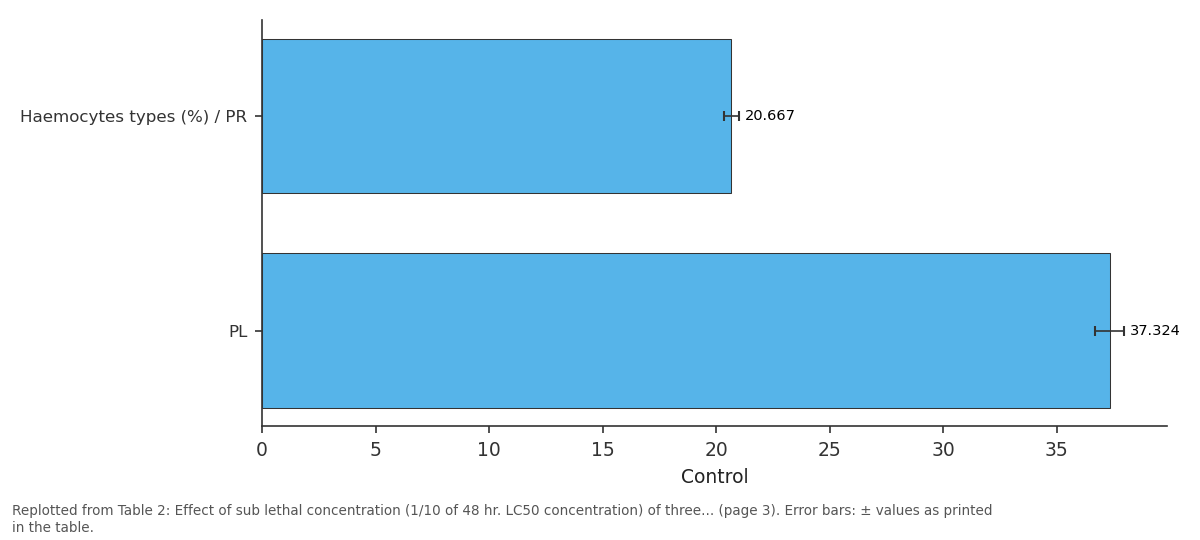
Control: Haemocytes types (%) /... vs PL
Replotted from Table 2 (page 3) of the original paper. Every bar is the paper's own table value.
View source evidence ↗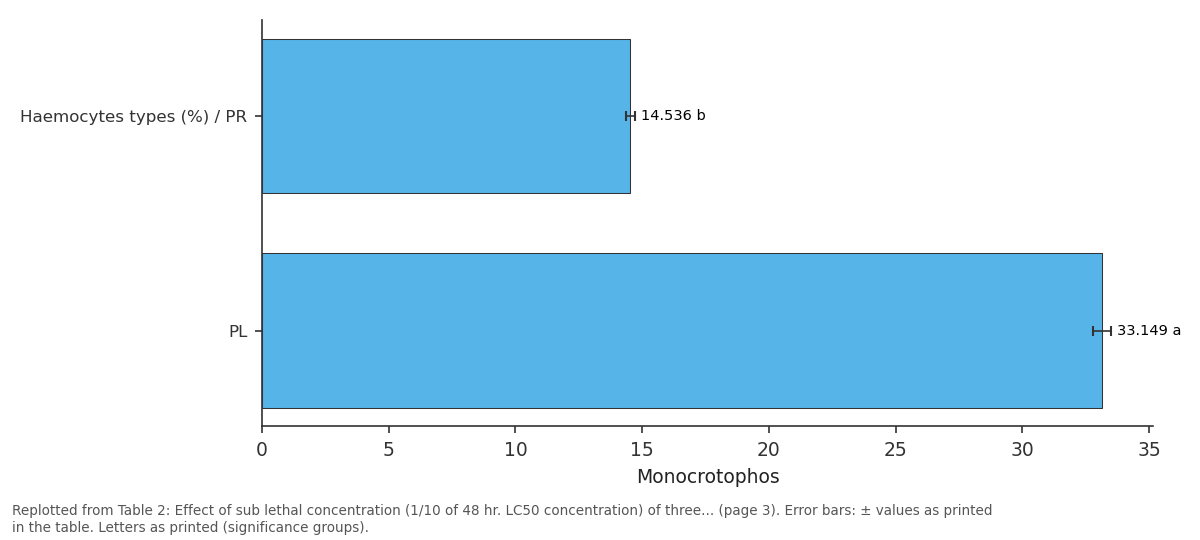
Monocrotophos: Haemocytes types (%) /... vs PL
Replotted from Table 2 (page 3) of the original paper. Every bar is the paper's own table value.
View source evidence ↗Figures & tables
From the original paper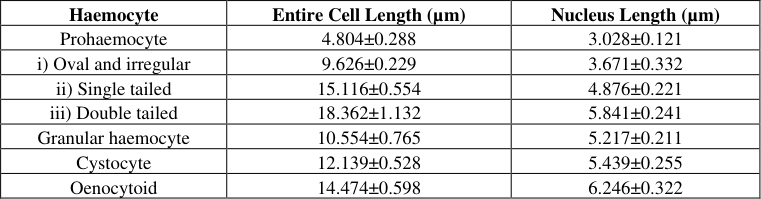 Table 1
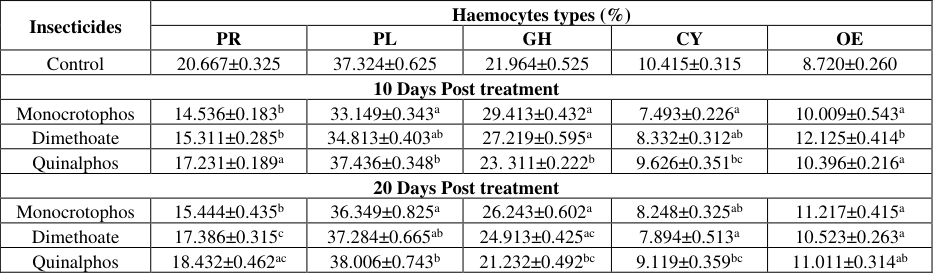 Table 2
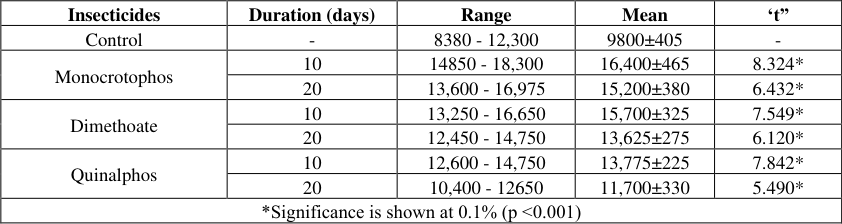 Table 3
Introduction
Modern agriculture relies on synthetic chemical pesticides to control pests. The ideal pesticides should selectively against specific pest organisms without adverse effects on nontarget organisms (Maksymiv, 2015) [20] . Many pesticides once employed in agroecosystems not solely affects the target insect pests. However, conjointly affects helpful insects and natural enemies. Moreover, investigations on the effects of chemical pesticides on parasitoids and predators are very scanty when compared to herbivorous pests (Ambrose and George, 1996a, b, c) [4,5,6] . In addition to reducing insect pest populations, the insecticides used in the agroecosystems should be safer to the natural predators available in the agroecosystems. The insect pest control programme must therefore analyze insecticides before using them (Croft, 1990; Croft and Brown, 1975) [8,9] . In order to evaluate pesticides before incorporating them into a programme to control insect pests, screening is essential. Only if we comprehend the toxicological consequences of the insecticides, we can employ them in the agroecosystems where pests and natural predators are together and such screening will be useful for an effective IPM (Ambrose, 2001; George et al., 2021) [2,13] . Reduviids are one of the common predators found along with the pests in the agricultural ecosystems of India. They belong to the family Reduviidae and it's one of the major predatory insect groups. In agricultural ecosystems, they can be found in a variety of habitats, and continuous studies are conducted to utilize them as biological pest control agents (Ambrose, 2000) [1] . One such effective predator of various insect pests in the agroecosystem is a harpactorine reduviid R. longifrons (Sahayaraj et al., 2020) [22] and so this predator was selected for the present study. Insecticides are used indiscriminately to manage insect pests, and as a result, reduviid predators' behavioural responses and in turn their physiological functions are highly affected. One such important physiological change is the change in haemocyte composition that has gone unnoticed for a long time. This information is important in developing strategies for a strong IPM program as there are changes in the haemocytes, which affect insects' behaviour, which in turn affects their predatory potential. Such informations are scarce on reduviids with the exception of the works done by Ambrose and George (1994, 1996 a, b, c) [3, 4, 5, 6] . This led the authors to investigate the effects of three regularly used pesticides -monocrotophos, dimethoate, and quinalphos at sub lethal dosages on the haemocyte composition of the significant potential biocontrol agent R. longifrons. Materials and Methods: R. longifrons adults and nymphal instars were obtained from the scrub forest Chunkankadai in the Kanyakumari District (8.1993° N, 77.3870° E). They were kept in plastic netted containers (80ml) at 32°C, RH varying from 75 to 80%, and photoperiod 11 to 13 hours fed with Corcyra cephalonica Stainton, in the Research unit laboratory at Kalasalingam university, Tamilnadu, India. The LC50 values of monocrotophos, dimethoate, and quinalphos were established in a preliminary investigation for each insecticide and they are 0.056, 0.087, and 0.079%, respectively, for 48 hours exposure and 1/10th of this concentration is used as the sub lethal concentration of each insecticide and it is 0.0056, 0.0087 and 0.0079% respectively, for monocrotophos, dimethoate and quinalphos. Using a micro pipette, 10 µl of the above concentration were applied topically to the insect's thorax and they were kept separately in plastic netted containers. Twenty of these plastic netted containers were preserved as experimental samples for each insecticide and 10 are treated with water serving as control. Twenty experimental plastic netted containers of each insecticide were once more split into two groups, each containing ten insects, and each group was held continuously for either 10 or 20 days. After the full exposure of 10 or twenty days, the evaluation was done to find out the variation in the differential haemocyte count (DHC) and the total haemocyte count (THC) due to insecticides, individually. In the same time, the different types of haemocytes present in the blood cells were classified using the identification key of Gupta (1986) [16] and their sizes were determined using stage and ocular micrometers. The antennae or the foreleg were amputated to prepare the Differential Haemocyte Count (DHC). The haemolymph that emerged from the cut ends was then neatly spread on clean slides using a coverslip and it was immediately fixed in methanol (100%). After the fixation, it was air-dried and after that stained with Giemsa stain (4%) and again air dried. Slides that were excessively stained were cleaned by gently immersing them in water. The slides thus prepared were subsequently examined under a compound microscope.
To ascertain whether there were variations between treatment means and control, the mean haemocyte counts of various pesticides were first evaluated by analysis of variance (SAS Institute, 1988) [23] . When significant variations are found between treatment means and control, Tukey test was employed to check the variations between individual treatment means (Tukey, 1953) [24] . The significance for each pair of comparisons was established at 95% significance (p>0.05). Amputation of the antenna or foreleg provided the necessary hemolymph for THC testing. For each insecticide, 10 control insects and 10 insecticides were maintained consistently for 10 days and another 10 were maintained consistently for 20 days. After the exposure duration, antenna or foreleg was amputed and live hemolymph was immediately collected in the dilution pipette and immediately it was diluted with 0.1 to 1.0% acetic acid saline and to stain add 0.01% Gentian violet dye. For a few minutes, shake the pipette filled with hemolymph to avoid clotting and uniform staining. The first few hemolymph droplets below the bulb in the Neubauer chamber have to be discarded and the haemolymph in the bulb is taken for the estimation of THC. For the THC estimation, the formula formulated by Jones (1967) [19] is used. THC = haemocytes in 1mm2 x dilution factor x chamber depth/number of 1 mm2 counted. By using the Students't' test, compare the data collected from the experimental and control insects and the significance level was set at 0.1% (p>0.001).
Results and Discussion
From the haemolymph preparations of R. longifrons, five different forms of haemocytes were identified: prohaemocytes, granular haemocytes, plasmatocytes, cystocytes, and oenocytoids. Prohaemocytes are comparatively tiny (4.804 0.288 µm), spherical or ovoid cells. They have minimum perinuclear space and relatively big nuclei (3.028 0.121 µm). Plasmatocytes are relatively larger which have a high degree of polymorphism. The polymorphic types are ovoid, irregular and the one with single and double tails. The largest plasmatocyte is the one with double tail (18.362 1.132) µm in length, while the nucleus within it was measured 5.841 0.224 µm in length. Granules are found in the cytoplasm of granular haemocytes. Cystocyte is also a big, ovoid haemocyte (12.139 0.528 µm) with nuclei in the form of a cartwheel. The oenocytiods were generally larger round cells (14.474±0.598µm) connected to flattened contact surfaces and their nuclei were comparatively larger than other haemocytes (6.246±0.322µm) (Table 1). The sub-lethal concentration (1/10 of the 48hr LC50 concentration) of the insecticides caused many variations on the constitution of the haemocytes (%) and are shown in Table 2. Monocrotophos and dimethoate insecticides reduced the percentage of prohaemocytes in both the first half of the exposure duration (10 days) and also in the second half of the exposure duration. [18] , Gupta and Sutherland (1966) [17] , and Beaulton and Monpeyssin (1976) [7] , this drop and the degree of the decrease may be caused by the transfer of these haemocytes in to other types of haemocytes to defend the body from the action of insecticides.
| Insecticides | Haemocytes types (%) | — | — | — | — |
|---|---|---|---|---|---|
| PR | PL | GH | CY | OE | |
| Control | 20.667±0.325 | 37.324±0.625 | 21.964±0.525 | 10.415±0.315 | 8.720±0.260 |
| 10 Days Post treatment | |||||
| Monocrotophos | 14.536±0.183b | 33.149±0.343a | 29.413±0.432a | 7.493±0.226a | 10.009±0.543a |
| Dimethoate | 15.311±0.285b | 34.813±0.403ab | 27.219±0.595a | 8.332±0.312ab | 12.125±0.414b |
| Quinalphos | 17.231±0.189a | 37.436±0.348b | 23. 311±0.222b | 9.626±0.351bc | 10.396±0.216a |
| 20 Days Post treatment | |||||
| Monocrotophos | 15.444±0.435b | 36.349±0.825a | 26.243±0.602a | 8.248±0.325ab | 11.217±0.415a |
| Dimethoate | 17.386±0.315c | 37.284±0.665ab | 24.913±0.425ac | 7.894±0.513a | 10.523±0.263a |
| Quinalphos | 18.432±0.462ac | 38.006±0.743b | 21.232±0.492bc | 9.119±0.359bc | 11.011±0.314ab |
Table text extracted from the original PDF; superscript letters are shown inline. The original table image is below.
View original table image
| Haemocyte | Entire Cell Length (µm) | Nucleus Length (µm) |
|---|---|---|
| Prohaemocyte | 4.804±0.288 | 3.028±0.121 |
| i) Oval and irregular | 9.626±0.229 | 3.671±0.332 |
| ii) Single tailed | 15.116±0.554 | 4.876±0.221 |
| iii) Double tailed | 18.362±1.132 | 5.841±0.241 |
| Granular haemocyte | 10.554±0.765 | 5.217±0.211 |
| Cystocyte | 12.139±0.528 | 5.439±0.255 |
| Oenocytoid | 14.474±0.598 | 6.246±0.322 |
Table text extracted from the original PDF; superscript letters are shown inline. The original table image is below.
View original table image
High plasmatocyte loss brought on by monocrotophos may be accompanied by a larger conversion of this plasmatocytes into another type of haemocyte called granular haemocytes, demonstrating the compound's higher toxicity. All insecticides and all exposure durations, with the exception of quinalphos' 20-day duration, increased the number of granular haemocytes. For all times, very little changes were noted in the cystocytes and oenocytoid by the action of insecticides. Granular haemocytes levels may have increased as a result of insecticide exposure because of their phagocytic action and other immunological processes that encapsulate foreign antigens (Gupta, 1985, 1986) [25,16] . It can be concluded that plasmatocytes are transformed into granular haemocytes in the process of detoxification.
Haemagglutinin secretion, antibacterial and antiviral factors, coagulation and wound healing are some of the other functions attributed to granular haemocytes and, depending on toxicity, plasmatocytes turn into granular haemocytes (Gupta,1979) [14] . The greatest rise of granular haemocytes was observed in monocrotophos exposed assassin bugs, indicating that the monocrotophos is more toxic. Significant changes in the proportion of cystocytes and oenocytes were induced by all pesticides. The total haemocyte count is increased in all the insecticidetreated categories and also in both the exposure durations. Monocrotophos increased the total haemocyte from 8380 -12,300 to 14850 -18,300 and 13,600 -16,975 respectively, for 10 days and 20 days exposed category. Dimethoate increased the total haemocyte count to 13,250 -16,650 and 12,450 -14,750 respectively, in 10 and 20 days exposed individuals. Quinalphos also slightly increased the total haemocyte count to 12,600 -14,750 and 10,400 -12650 respectively for 10 and 20 days exposed test individuals (Table 3). In the total number of haemocytes count, the individuals treated with insecticides and subjected to 10 days was having higher count than in control insects, and when the exposure duration was raised to 20 days, a small decrease was seen. This rise in total haemocyte count may be the result of the protective detoxifying function of haemocytes (Patton, 1961) [21] . The current findings are consistent with those of George et al. (2021) [13] who noted an increase in the total count in Rhynocoris marginatus after treatment with cypermethrin and fenvalerate Arya et al. (2023) [15] . Similar insecticidal increases in total haemocytes count were noted by Ambrose and George (1996 a, b, c) [4,5,6] and George and Ambrose (1998) [10] in another reduviid, Acanthaspis pedestris Stal. The total haemocytes count of R. marginatus and R. fuscipes significantly increased after being exposed to insecticides, according to George and Ambrose (2000 a, b) [11,12] . Hence, the highest toxicity created by monocrotophos could be attributed to the highest haemocyte count. The effects of commonly used insecticides on the differential and total haemocyte counts of the non-target insect R. longifrons reveals the consequences of chemical insect pest management on beneficial non-target species. Therefore, it's time to switch out "king Chemical" for "soft insecticides" or friendly helpful insecticides, especially for chemicals that are harmful to beneficial insects. Such inclusion could successfully lower the population of pests without having an impact on their natural beneficial insects available in the agroecosystem. The above work was carried out with the aim to eliminate the hazardous insecticide which cause physiological changes in the beneficial insects and the incorporation of safer insecticide in the agroecosystem. According to the present study, among the three insecticides tested, monocrotophos, one of the frequently used insecticides, has the highest effect on the morphology and physiology of the haemocytes of the ecofriendly predator R. longifrons followed by quinalphos and these insecticides are not recommended to be employed in the Integrated Pest Management programmes where R. longifrons is employed. As it was continuously reported in many articles about the toxicity of monocrotophos on non target reduviids, it is banned by the Government in 2023 but still it is available in many shops due to the stock available and so the work as conducted. Dimethoate has very less influence on both the total and differential haemocyte counts and it is considered as ecofriendly insecticide or soft insecticide which can be incorporated in the IPM programme where R. longifons is used.
| Insecticides | Duration (days) | Range | Mean | ‘t” |
|---|---|---|---|---|
| Control | - | 8380 - 12,300 | 9800±405 | - |
| Monocrotophos | 10 | 14850 - 18,300 | 16,400±465 | 8.324* |
| 20 | 13,600 - 16,975 | 15,200±380 | 6.432* | |
| Dimethoate | 10 | 13,250 - 16,650 | 15,700±325 | 7.549* |
| 20 | 12,450 - 14,750 | 13,625±275 | 6.120* | |
| Quinalphos | 10 | 12,600 - 14,750 | 13,775±225 | 7.842* |
| 20 | 10,400 - 12650 | 11,700±330 | 5.490* | |
| *Significance is shown at 0.1% (p ˂0.001) |
Table text extracted from the original PDF; superscript letters are shown inline. The original table image is below.
View original table image
Acknowledgement
Acknowledgement:The authors express their sincere gratitude to Kalasalingam Academy of Research and Education (KARE), Krishnankoil, Srivilliputhur, Tamil Nadu, for the institutional facilities provided. They are grateful to the Department of Biotechnology, Ministry of Science and Technology, Government of India, New Delhi, for the financial support provided through the STAR College Scheme (HRD-11011/48/2021-HRD-DBT) to Sri S. Ramasamy Naidu Memorial College (Autonomous), Sattur.
References
24 in the original paper- Ambrose DP. Assassin bugs (Reduviidae: Excluding Triatominae). In: Schaefer CW, Panizzi AR, editors. Heteroptera of Economic Importance. Florida (USA): CRC Press; 2000. p. 695-712.
- Ambrose DP. Friendly insecticides to conserve beneficial insects. Zoos' Print J. 2001;16:561-572.
- Ambrose DP, George PJE. Total and differential count of haemocytes in the life stages and adult haemocyte morphology in Catamiarus brevipennis Serville (Insecta: Heteroptera: Reduviidae). Fresenius Environ Bull. 1994;5:190-195.
- Ambrose DP, George PJE. Effect of monocrotophos, dimethoate and methylparathion on the differential and total haemocyte counts of Acanthaspis pedestris Stål (Insecta: Heteroptera: Reduviidae). Fresenius Environ Bull. 1996;5:190-195.
- Ambrose DP, George PJE. Effect of quinalphos and endosulfan on the differential and total haemocyte counts of Acanthaspis pedestris Stål (Insecta: Heteroptera: Reduviidae). Fresenius Environ Bull. 1996;5:207-212.
- Ambrose DP, George PJE. Effect of insecticides on the total and differential haemocyte diversity in three morphs of Rhynocoris marginatus (Insecta: Heteroptera: Reduviidae). Fresenius Environ Bull. 1996;5:202-206.
- Beaulaton J, Monpeyssin M. Ultrastructure and cytochemistry of the haemocytes of Antheraea pernyi Guérin-Méneville (Lepidoptera: Attacidae) during the 5th larval stage. I. Prohaemocytes, plasmatocytes and granulocytes. J Ultrastruct Res. 1976;55:143-156.
- Croft BA. Arthropods Biological Control Agents and Pesticides. New York: John Wiley & Sons; 1990.
- Croft BA, Brown AWA. Response of arthropod natural enemies to insecticides. Annu Rev Entomol. 1975;20:285-335.
- George PJE, Ambrose DP. Total and differential count of haemocytes in the life stages and adult haemocyte morphology in Acanthaspis pedestris Stål (Insecta: Heteroptera: Reduviidae). Indian J Entomol. 1998;60(3):228-232.
- George PJE, Ambrose DP. Impact of five insecticides on the differential and total haemocyte count of Rhynocoris marginatus (Fabricius) (Insecta: Heteroptera: Reduviidae). Indian J Environ Sci. 2000;4(2):169-173.
- George PJE, Ambrose DP. Insecticidal impact on the differential and total haemocyte counts in a harpactorine reduviid Rhynocoris fuscipes (Heteroptera: Reduviidae). Hexapoda. 2000;11(1-2):49-55.
- George PJE, Ravichandran B, Jesudurai A, Ambrose DP. Relative toxicity and haematological impact of insecticides cypermethrin and fenvalerate to a nontarget reduviid predator Rhynocoris marginatus (Fabricius) (Heteroptera: Reduviidae). J Entomol Zool Stud. 2021;9(1):2040-2043.
- Gupta AP. Hemocyte types: their structure, synonymies, interrelationships, and taxonomic significance. In: Gupta AP, editor. Insect Hemocytes. Cambridge: Cambridge University Press; 1979. p. 2339.
- Arya S, Goel R, Shukla G. Impact of chlorpyrifos insecticides on the haematology of Clarias gariepinus. Zool Entomol Lett. 2023;3(2):17-19.
- Gupta AP. Arthropod immunocytes: their identification, structure, functions and functional analogies with those of vertebrate B and T lymphocytes. In: Gupta AP, editor. Hemocytic and Humoral Immunity in Arthropods. New York: John Wiley & Sons; 1986. p. 359.
- Gupta AP, Sutherland DJ. In vitro transformations of the insect plasmatocyte in some insects. J Insect Physiol. 1966;12(1):69-1375.
- Jones JC. Current concepts concerning insect haemocytes. Am Zool. 1962;2:209-246.
- Jones JC. Normal differential count of haemocytes in relation to ecdysis and feeding in Rhodnius. J Insect Physiol. 1967;13:1133-1143.
- Maksymiv I. Pesticides: benefits and hazards. J Vasyl Stefanyk Precarpathian Natl Univ. 2015;2(1):70-76.
- Patton RL. The detoxification function of insect haemocytes. Ann Entomol Soc Am. 1961;52:240-242.
- Sahayaraj K, Kalidas S, Loko YL. Bioefficacy of Rhynocoris longifrons (Stål) (Heteroptera: Reduviidae) against multiple cotton pests under screen house and field conditions. Sci Rep. 2020;10:6637.
- Tukey JW. The Problem of Multiple Comparisons. Princeton (NJ): Princeton University Press; 1953.
- Gupta AP. The identity of the so-called crescent cell in the haemolymph of the cockroach Gromphadorhina portentosa (Schaum) (Dictyoptera: Blaberidae). Cytologia. 1985;50:737-745.