
Research article · 2026 · Full text
International Journal of Biology SciencesComparative Evaluation of Efficacy of a Polyherbal Restorative (Avasarga™ Liquid) at Improving Composition and Yield of Milk in Heat-stressed Cows
Volume 8(6) · Pages 178–182 · DOI: 10.33545/26649926.2026.v8.i6c.879 ↗
Research areasEffects of Environmental Stressors on LivestockThermoregulation and physiological responsesRuminant Nutrition and Digestive Physiology
Abstract
Author-writtenBackground: Thermal stress presents a key stress in dairy production. Heat-stressed dairy animals exhibit depression in both yield and composition of milk. Phytogenic products have been commonly used to alleviate heat stress and improve production traits of dairy cows. Methods: A trial was undertaken to evaluate the efficacy of a polyherbal restorative, Avasarga™ liquid, at improving the composition and yield of milk in heat-stressed cattle and buffalo cows. Avasarga™ was administered orally at 50 mL twice daily for five days to eight cattle and eight buffalo cows under severe to extreme heat stress. Another commercially available anti-stressor product was also included for comparison in an equal number of cattle and buffalo cows, reared under identical conditions of thermal stress. Milk-related parameters, viz., milk yield, fat content, and solids-not-fat, and clinical parameters, viz., body temperature, respiration rate, and heart rate, were recorded and compared before and after treatment. Results: Clinical parameters did not worsen in the Avasarga™-treated cows despite a progressive increase in thermal stress. Significant improvements in almost all milk-related parameters were observed in both cattle and buffaloes. Treatment with the other anti-stressor formulation also yielded similar results, but the improvements were greater with Avasarga™ treatment. Conclusion: Based on the findings of the trial, it could be concluded that Avasarga™ liquid, administered orally at 50 mL twice daily for five days, is efficacious at improving the composition and yield of milk in heat-stressed cattle and buffalo.
Summary
Source-checkedPlain-language reading of the full paper, prepared with AI and checked against the text. Each point links to the authors' own words.
Why it matters
- Thermal stress is a major challenge in dairy production because it reduces both the amount and the quality of milk produced by dairy animals. View evidence ↗
- Heat stress negatively impacts cows by disrupting water and feed intake and diverting energy away from milk production to manage the stress. View evidence ↗
- Plant-based products and herbal extracts are commonly used as a way to manage heat stress and improve production traits in dairy cows. View evidence ↗
The question
- The study aimed to compare the effectiveness of Avasarga™ liquid against another commercial polyherbal restorative in improving milk yield and composition in heat-stressed dairy animals. View evidence ↗
What they did
- The trial included 16 healthy lactating crossbred cattle and 16 Murrah buffalo cows. View evidence ↗
- The treatment consisted of administering 50 mL of the restorative orally twice daily for five days. View evidence ↗
- Researchers measured milk yield, fat percentage, and solids-not-fat (SNF) percentage on the first day (before treatment) and the sixth day (after treatment). View evidence ↗
- Daily clinical measurements were taken for body temperature, heart rate, and respiration rate. View evidence ↗
- A 2 x 2 mixed ANOVA was used to analyze the data, comparing the two different products over the time period before and after treatment. View evidence ↗
What they found
- During the study, the Thermal Humidity Index (THI) rose from 74.07 to 79.75, indicating severe stress for cattle and extreme stress for buffaloes. View evidence ↗
- Avasarga™ liquid significantly improved almost all milk-related parameters in both cattle and buffaloes, though it did not significantly improve raw milk yield in buffaloes. View evidence ↗
- When buffalo milk yield was corrected for 6% fat content, the improvement in yield became highly significant. View evidence ↗
- While the comparison product (Product X) also improved most parameters, Avasarga™ provided greater improvements. View evidence ↗
- Neither treatment significantly changed clinical parameters, but they prevented these parameters from worsening as heat stress increased. View evidence ↗
What it means
- The authors conclude that Avasarga™ liquid is effective at improving milk yield and composition in cattle and buffaloes experiencing heat stress. View evidence ↗
Visual summary
1 visualsIllustrations explain the paper; charts are replotted from the paper's own table values.
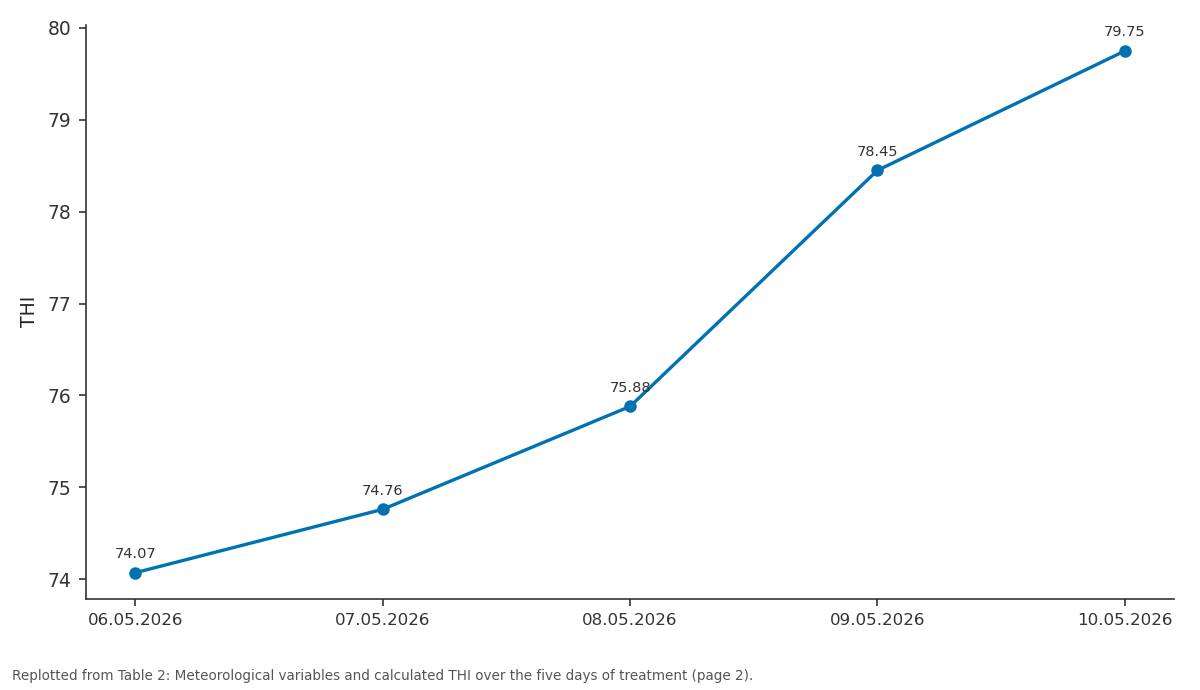
THI: 06.05.2026 vs 07.05.2026 vs 08.05.2026 vs 09.05.2026 vs 10.05.2026
Replotted from Table 2 (page 2) of the original paper. Every bar is the paper's own table value.
View source evidence ↗Figures & tables
From the original paper Table 1
 Table 2
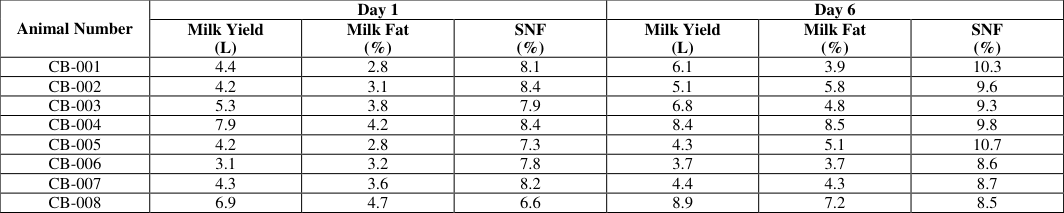 Table 3
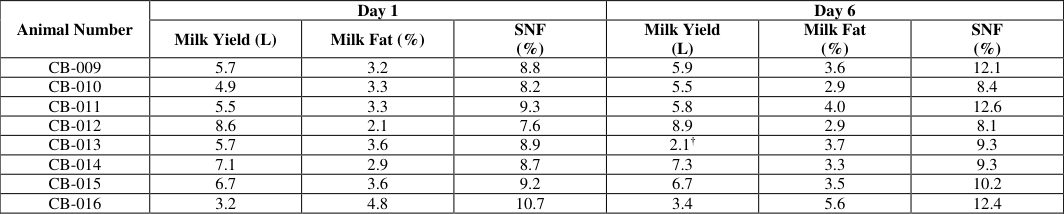 Table 4
 Table 5
 Table 6
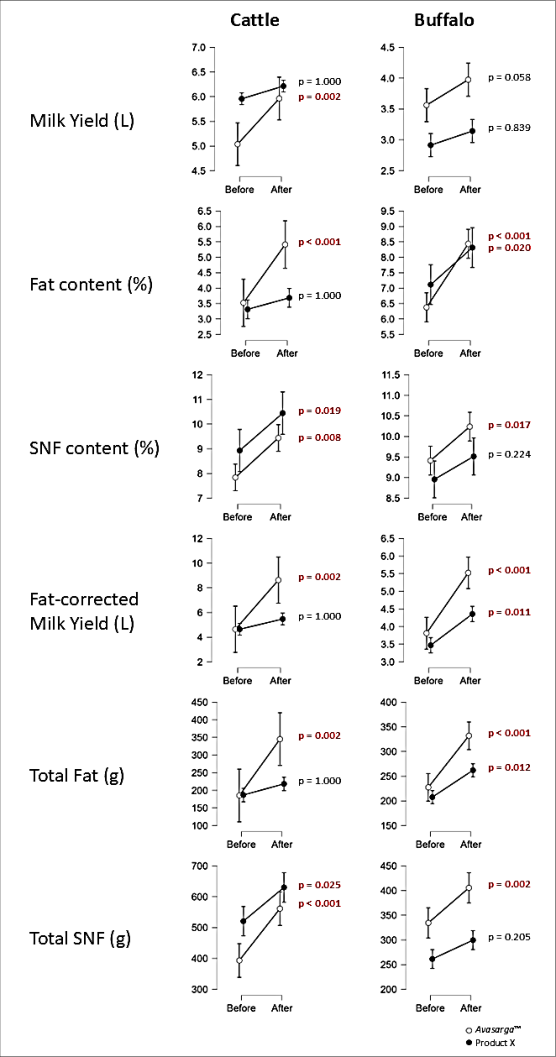 Figure 1
Introduction
Tackling thermal stress is a key challenge in dairy production systems, and the gravity of the challenge is increasing with climate change and intensive dairying practices (Guo et al., 2023) [1] . Thermal stress results in disturbed water consumption, reduced feed intake, slower transit of feed through the gut, and diversion of energy and bodily resources from production to fighting stress (Yang et al., 2022) [2] . Dairy animals under thermal stress suffer losses in both composition and yield of milk (Abulaiti et al., 2024) [3] . Besides good housing and husbandry practices, management of thermal stress may require supplementation with anti-stressors (Guo et al., 2023; Wang et al., 2026) [1,6] . Products of plant-origin, comprising whole plant parts or herbal extracts, have been used successfully for the management of heat stress in dairy animals (Bhamare et al., 2022 a & b) [4,5] . Many Indian herbs, traditionally reputed for their adaptogenic and galactagogue properties, have been found useful for combating thermal stress towards improving performance in dairy animals (Devi et al., 2024; Pahuja et al., 2024; Gupta et al., 2025; Devasena et al., 2026) [7,8,9,10] . This study reports the results of a trial aimed at comparative evaluation of two polyherbal restoratives (Avasarga ™ liquid; M/s Indian Immunologicals Limited, Hyderabad and another commercially available product) on the composition and yield of milk in heatstressed dairy animals.
Materials and methods
The trial was held at the Livestock Farm Complex of Khalsa College of Veterinary and Animal Sciences (KCVAS), Amritsar (Latitude: 31.63°N, Longitude: 74.87°E, Height: 229 msl), from 06.05.2026 to 11.05.2026. The trial recruited 16 each of apparently healthy crossbred cattle and Murrah buffalo lactating cows, maintained under intensive management conditions with proper ventilation, hygienic surroundings, and adequate space allocation. All animals had ad libitum access to feed and clean drinking water throughout the study period. Standard feeding, housing, and health management practices were followed uniformly to ensure optimum welfare and consistent management conditions. The animals were divided into four equal subgroups, as presented in Table 1. where T avg and RH avg are the average temperature and average relative humidity, obtained as the arithmetic mean of the daily minimum and maximum, respectively. Milk yield was recorded, and fat and SNF content were estimated by standard methods (Arora et al., 1996). Fatcorrected milk yield (4% for cattle and 6% for buffaloes), total milk fat (product of milk yield and fat content), and total SNF (product of milk yield and SNF content) were calculated. Milk yield, fat content, SNF content, fat-corrected milk yield, total milk fat, total SNF, and clinical parameters on days 1 and 6 were compared between treatment arms within groups. A 2 × 2 mixed Analysis of Variance (ANOVA) was conducted for each parameter to compare the efficacy of Avasarga ™ with another product. The treatment Arm (Avasarga ™ vs. Product X) was treated as the betweensubjects factor, and Time (before vs. after treatment) was treated as the within-subjects factor. The primary statistical focus was directed at the Arm × Time interaction effect to determine if changes in a parameter differed significantly between the two arms. Post-hoc pairwise comparisons were drawn based on estimated Marginal Means to isolate where specific differences occurred and to determine which treatment yielded superior results. A Bonferroni correction was applied to all post-hoc adjusted p-values to control for inflation of the Type I error rate across multiple comparisons. All statistical analyses were performed in JASP v.0.96 (Love et al., 2019) with the a priori significance threshold set at α = 0.05.
| Group | Arm | Treatment | n |
|---|---|---|---|
| Crossbred cattle | C-I | Avasarga™ @ 50 mL orally twice daily for 5 days | 8 |
| C-II | Product X @ 50 mL orally twice daily for 5 days | 8 | |
| Buffalo | B-I | Avasarga™ @ 50 mL orally twice daily for 5 days | 8 |
| B-II | Product X @ 50 mL orally twice daily for 5 days | 8 |
Table text extracted from the original PDF; superscript letters are shown inline. The original table image is below.
View original table image
Results and Discussion
The meteorological variables and THI over the five days of treatment are shown in Table 2, and the animal-wise milk parameters are shown in Tables 3456. Of the many formulae available for the calculation of THI, our study used the formula by NRC (1971), which has been shown to have greater accuracy in both cattle and buffaloes under varying conditions (Behera et al., 2018; Haritha lekshmi and Ajithkumar, 2021) [14] . As can be seen from [15,16] . One animal each from the arms C-II and B-II suffered loss of milk due to unrelated reasons and were excluded from the analysis. The marginal means (± 95% confidence intervals) of milk yield (L), fat content (%), SNF content (%), corrected milk yield (L), total fat (g), and total SNF (g) before and after treatment in both arms of both groups have been compared in Figure 1. Since milk-related parameters, viz., milk yield, fat content, and SNF content, depend on individual factors, a 2 × 2 mixed ANOVA was used to compare the values before and after treatment. Treatment of heat-stressed cows with the polyherbal restorative, Avasarga ™ liquid, at 50 mL orally twice daily for five days resulted in significant improvements of all milk-related parameters in both cattle and buffaloes, except milk yield in buffaloes. However, when the milk yield of buffaloes was corrected for 6% fat content, improvements in yield were also found to be highly significant. Product X, administered orally at 50 mL twice daily for five days, also yielded significant improvements in most parameters, although the improvements obtained with Avasarga ™ treatment were greater. Neither treatment resulted in any appreciable changes in the clinical parameters of the cows (data not shown). However, the clinical parameters did not worsen despite the progressive increase in heat stress during the study period. Avasarga ™ liquid is a rationally-formulated polyherbal restorative, licensed for use in ruminants, camels, horses and [20,17,19,18] . Besides inducing thermotolerance, licorice is gluconeogenic and supplements the galactagogue activity of asparagus by promoting the yield and improving the composition of milk (Wahab et al., 2021; Gajarmal et al., 2025) [20,21] .
| Date | Temperature (°C) | — | — | Relative Humidity (%) | — | — | THI |
|---|---|---|---|---|---|---|---|
| Min. | Max. | Average | Min. | Max. | Average | ||
| 06.05.2026 | 19.0 | 34.0 | 26.5 | 24.0 | 78.0 | 51.0 | 74.07 |
| 07.05.2026 | 21.0 | 34.0 | 27.5 | 28.0 | 64.0 | 46.0 | 74.76 |
| 08.05.2026 | 21.0 | 34.0 | 27.5 | 32.0 | 78.0 | 55.0 | 75.88 |
| 09.05.2026 | 25.0 | 35.0 | 30.0 | 34.0 | 65.0 | 49.5 | 78.45 |
| 10.05.2026 | 26.0 | 36.0 | 31.0 | 34.0 | 65.0 | 49.5 | 79.75 |
| Min.= minimum, Max. = maximum |
Table text extracted from the original PDF; superscript letters are shown inline. The original table image is below.
View original table image
Based on the findings of the study, it was concluded that herbal products can be used to restore heat stress-associated depressions in the yield and composition of milk of lactating cows. Further, it was concluded that the herbal restorative, Avasarga ™ liquid, administered orally at 50 mL twice daily for five days, is efficacious at improving milk yield and composition of cattle and buffaloes under severe to extreme thermal stress.
Acknowledgement
AcknowledgmentsThe authors acknowledge the Head, Livestock Farm Complex, Khalsa College of Veterinary and Animal Sciences, for facilitating the study. Funding JPP, SKR, ST, and BG were employed by IIL over the duration of the study. The costs of milk sample analyses were partially covered by IIL.
Figures and tables from the paper
| Animal Number | Day 1 | — | — | Day 6 | — | — |
|---|---|---|---|---|---|---|
| Milk Yield (L) | Milk Fat (%) | SNF (%) | Milk Yield (L) | Milk Fat (%) | SNF (%) | |
| CB-001 | 4.4 | 2.8 | 8.1 | 6.1 | 3.9 | 10.3 |
| CB-002 | 4.2 | 3.1 | 8.4 | 5.1 | 5.8 | 9.6 |
| CB-003 | 5.3 | 3.8 | 7.9 | 6.8 | 4.8 | 9.3 |
| CB-004 | 7.9 | 4.2 | 8.4 | 8.4 | 8.5 | 9.8 |
| CB-005 | 4.2 | 2.8 | 7.3 | 4.3 | 5.1 | 10.7 |
| CB-006 | 3.1 | 3.2 | 7.8 | 3.7 | 3.7 | 8.6 |
| CB-007 | 4.3 | 3.6 | 8.2 | 4.4 | 4.3 | 8.7 |
| CB-008 | 6.9 | 4.7 | 6.6 | 8.9 | 7.2 | 8.5 |
Table text extracted from the original PDF; superscript letters are shown inline. The original table image is below.
View original table image
| Animal Number | Day 1 | — | — | Day 6 | — | — |
|---|---|---|---|---|---|---|
| Milk Yield (L) | Milk Fat (%) | SNF (%) | Milk Yield (L) | Milk Fat (%) | SNF (%) | |
| CB-009 | 5.7 | 3.2 | 8.8 | 5.9 | 3.6 | 12.1 |
| CB-010 | 4.9 | 3.3 | 8.2 | 5.5 | 2.9 | 8.4 |
| CB-011 | 5.5 | 3.3 | 9.3 | 5.8 | 4.0 | 12.6 |
| CB-012 | 8.6 | 2.1 | 7.6 | 8.9 | 2.9 | 8.1 |
| CB-013 | 5.7 | 3.6 | 8.9 | 2.1† | 3.7 | 9.3 |
| CB-014 | 7.1 | 2.9 | 8.7 | 7.3 | 3.3 | 9.3 |
| CB-015 | 6.7 | 3.6 | 9.2 | 6.7 | 3.5 | 10.2 |
| CB-016 | 3.2 | 4.8 | 10.7 | 3.4 | 5.6 | 12.4 |
Table text extracted from the original PDF; superscript letters are shown inline. The original table image is below.
View original table image
| Animal Number | Day 1 | — | — | Day 6 | — | — |
|---|---|---|---|---|---|---|
| Milk Yield (L) | Milk Fat (%) | SNF (%) | Milk Yield (L) | Milk Fat (%) | SNF (%) | |
| MT- 001 | 3.8 | 6.3 | 9.8 | 4.4 | 8.2 | 10.4 |
| MT- 002 | 4.1 | 5.5 | 8.7 | 4.7 | 8.1 | 10.7 |
| MT- 003 | 3.7 | 5.8 | 8.5 | 4.8 | 7.0 | 9.4 |
| MT- 004 | 2.9 | 6.2 | 9.2 | 3.3 | 8.5 | 9.8 |
| MT- 005 | 4.1 | 7.1 | 9.2 | 4.2 | 8.6 | 9.6 |
| MT- 006 | 3.8 | 7.3 | 10.1 | 3.6 | 8.3 | 10.8 |
| MT- 007 | 3.2 | 6.9 | 10.0 | 3.1 | 9.7 | 11.3 |
| MT- 008 | 2.9 | 5.9 | 9.8 | 3.7 | 9.1 | 9.9 |
Table text extracted from the original PDF; superscript letters are shown inline. The original table image is below.
View original table image
| Animal Number | Day 1 | — | — | Day 6 | — | — |
|---|---|---|---|---|---|---|
| Milk Yield (L) | Milk Fat (%) | SNF (%) | Milk Yield (L) | Milk Fat (%) | SNF (%) | |
| MT- 009 | 3.3 | 6.7 | 8.3 | 3.2 | 9.0 | 9.9 |
| MT- 010 | 2.5 | 6.3 | 7.9 | 2.8 | 8.6 | 9.4 |
| MT- 011 | 4.3 | 7.4 | 8.6 | 4.1 | 9.1 | 8.6 |
| MT- 012 | 2.1 | 7.0 | 9.1 | 2.5 | 8.5 | 9.4 |
| MT- 013 | 3.6 | 7.8 | 10.1 | 4.2 | 7.9 | 10.3 |
| MT- 014 | 2.7 | 6.5 | 9.8 | 2.9 | 6.8 | 9.9 |
| MT- 015 | 1.9 | 8.1 | 8.9 | 2.3 | 8.3 | 9.1 |
| MT- 016 | 3.1 | 7.8 | 10.7 | 1.8‡ | 7.7 | 10.8 |
Table text extracted from the original PDF; superscript letters are shown inline. The original table image is below.
View original table image
References
21 in the original paper- Guo Y, Li L, Yan S, Shi B. Plant extracts to alleviating heat stress in dairy cows. Animals. 2023;13(18):2831.
- Yang L, Zhang L, Zhang P, Zhou Y, Huang X, Yan Q, et al. Alterations in nutrient digestibility and performance of heat-stressed dairy cows by dietary Ltheanine supplementation. Animal Nutrition. 2022;11:350-358.
- Abulaiti A, Ahsan U, Naseer Z, Ahmed Z, Liu W, Ruan C, et al. Effect of dietary Chinese herbal preparation on dry matter intake, milk yield and milk composition, serum biochemistry, hematological profile, and reproductive efficiency of Holstein dairy cows in early postpartum period. Front Vet Sci. 2024;11:1434548.
- Bhamare P, Thakur D, Ganguly B. Efficacy evaluation of a polyherbal antistressor premix at reducing summer stress-associated losses in dairy cows. J Phytopharmacol. 2022;11(4):272-274.
- Bhamare P, Thakur D, Ganguly B. Efficacy of a polyherbal antistressor liquid at reducing heat stress and improving milk production in Gir cows during summer. Pharma Innov J. 2022:2172-2174.
- Wang X, Yuan T, Arain MA, Al-Rasheed M, Shaukat A. Nutrigenomic potentials of phytobiotics against heat stress and allied afflictions in livestock species-an in silico supported review. Food Sci Nutr. 2026;14(4):e71788.
- Devi P, Singh M, Somagond YM, Roy AK. Comparative efficacy of physiological responses and skin temperatures in indigenous and crossbred cattle supplemented with Chlorophytum borivilianum in summer season. Indian J Anim Res. 2024;58(6).
- Pahuja A, Jain M, Rawat K. A review on galactogogic properties of India's rich tradition of medicinal herbs and spices for lactation. Trad Integr Med. 2024.
- Gupta K, Marskole S, Irpache D, Yadav S, Choudhary S. Evaluation of a novel herbal formulation for improving milk fat and yield in Indian Gir dairy cattle: a seasonal controlled trial. J Ayurveda Holist Med. 2025;13(7):2-14.
- Devasena B, Rani KS, Adilaxmamma K. Anti-oxidant potentiality of Guduchi (Tinospora cordifolia) supplemented to lactating buffaloes under field conditions. Int J Bio-resource Stress Manag. 2026;17(1):1-6.
- NRC. A guide to environmental research on animals. Vol. 12. Washington DC: National Academy of Science; 1971. p. 57-59.
- Arora KL, Lal D, Seth R, Ram J. Platform test for detection of refined mustard oil adulteration in milk. Indian J Dairy Sci. 1996;49(10):721-723.
- Love J, Selker R, Marsman M, Jamil T, Dropmann D, Verhagen J, et al. JASP: graphical statistical software for common statistical designs. J Stat Softw. 2019;88:1-7.
- Behera R, Chakravarty AK, Sahu A, Kashyap N, Rai S, Mandal A. Identification of best temperature humidity index model for assessing impact of heat stress on milk constituent traits in Murrah buffaloes under subtropical climatic conditions of Northern India. Indian J Anim Res. 2018;52(1):13-19.
- Jeelani R, Konwar D, Khan A, Kumar D, Chakraborty D, Brahma B. Reassessment of temperature-humidity index for measuring heat stress in crossbred dairy cattle of a sub-tropical region. J Therm Biol. 2019;82:99-106.
- Umar SI, Konwar D, Khan A, Bhat MA, Javid F, Jeelani R, et al. Delineation of temperature-humidity index (THI) as indicator of heat stress in riverine buffaloes (Bubalus bubalis) of a sub-tropical Indian region. Cell Stress Chaperones. 2021;26(4):657-669.
- Kumari A, Nagarjun P, Shinde KP, Tiwari S, Chandrakala K. Phytoimmunomodulators-approach towards potentiating immunity of cows during transition period: a review. Int J Livest Res. 2024;14(10):1-11.
- Kour J. Traditional use, phytochemistry and pharmacological potential of Crocus sativus and Emblica officinalis: high value medicinal plants from North Western Himalayan Mountains. In: High Altitude Medicinal Plants: Botany, Conservation and Cultivation. Cham: Springer Nature Switzerland; 2025. p. 169-200.
- Verma P, Jain AK, Mishra A, Jesse DD, Mandal S, Gattani A, et al. Ameliorative effect of Withania somnifera on haemato-biochemical and hormonal parameters during heat stress in Murrah buffalo calves. Int J Adv Biochem Res. 2024;8:80-85.
- Wahab S, Annadurai S, Abullais SS, Das G, Ahmad W, Ahmad MF, et al. Glycyrrhiza glabra (Licorice): a comprehensive review on its phytochemistry, biological activities, clinical evidence and toxicology. Plants. 2021;10(12):2751.
- Gajarmal A, Baheti S, Patekar R, Mane S, Sagar R, Rath SK. Bridging India's ethnobotanical traditions and Ayurveda: exploring galactagogue plants in livestock and human care. Ethnobot Res Appl. 2025;31:1-35.