
Research article · 2026 · Full text
International Journal of Horticulture and Food ScienceUnraveling the influence of organic manures on growth parameters of marigold cv. Pusa Narangi Gainda
Volume 8(6) · Pages 81–85 · DOI: 10.33545/26631067.2026.v8.i6b.763 ↗
Research areasAgricultural Science and FertilizationAgriculture, Plant Science, Crop ManagementPlant Growth and Agriculture Techniques
Abstract
Author-writtenThe present investigation was conducted during 2022-23 at Horticulture Research farm, Department of Horticulture, Ch. Charan Singh University Campus, Meerut (U.P.) which entitled “Unraveling the influence of organic manures on growth parameters of marigold cv. Pusa Narangi Gainda’’. The experiment was laid out in Randomized Block Design (RBD) with three replications. The performance of organic manures was studied for seven traits viz. Plant Height (cm.), Diameter of main stem (cm.), Plant spread (cm.), Number of primary branches per plant, Number of secondary branches per plants, Fresh weight of plant and Dry weight of plant. The organic manures were applied as basal dose. All the treatments were randomized separately in each replication. The soil of the experiment site was sandy loam. All the growth parameters were significantly influenced by various treatments of organic manures. Results revealed that among all the treatment the application of Poultry Manure @ 10 t / ha (100%) gave maximum plant height, stem diameter, plant spread, number of primary branches and number of secondary branches, Fresh weight of plant and dry weight of plant.
Summary
Source-checkedPlain-language reading of the full paper, prepared with AI and checked against the text. Each point links to the authors' own words.
Why it matters
- Marigold is a highly popular annual loose flower crop in India, accounting for over half of the country's loose flower production. View evidence ↗
- The crop is widely used for decorative purposes and religious offerings, such as garlands and bouquets. View evidence ↗
- Beyond aesthetics, marigold serves as an environmentally friendly trap crop to manage pests like Helicoverpa armigera in tomato and tobacco crops. View evidence ↗
What they did
- The researchers used a Randomized Block Design (RBD) with three replications for the experiment. View evidence ↗
- Seven treatments were tested: a control, 100% doses of FYM (50 t/ha), Vermicompost (20 t/ha), or Poultry Manure (10 t/ha), and three 50/50 combinations of these manures. View evidence ↗
- The study measured seven growth traits: plant height, main stem diameter, plant spread, number of primary and secondary branches, and the fresh and dry weights of the plants. View evidence ↗
- Data analysis was performed using the analysis of variance (ANOVA) technique. View evidence ↗
What they found
- Poultry Manure (T4) produced the maximum plant height (66.17 cm), while the control (T1) produced the minimum (56.11 cm). View evidence ↗
- The highest number of primary branches per plant (14.28) was found in the Poultry Manure treatment, and the lowest (11.96) in the control. View evidence ↗
- Poultry Manure (T4) led to the most secondary branches (29.24 per plant), whereas the control (T1) had the fewest (20.93). View evidence ↗
- The highest fresh plant weight (298.12 g) was recorded for Poultry Manure (T4), and the lowest (189.10 g) for the control (T1). View evidence ↗
- Poultry Manure (T4) produced the maximum dry plant weight (61.30 g), while the control (T1) produced the minimum (38.79 g). View evidence ↗
What it means
- The authors concluded that poultry manure applied at 10 t/ha is the most effective organic treatment for improving all measured growth and biomass parameters. View evidence ↗
- The authors recommend the application of poultry manure at 10 t/ha as a promising approach for increasing marigold flower production. View evidence ↗
Visual summary
3 visualsIllustrations explain the paper; charts are replotted from the paper's own table values.
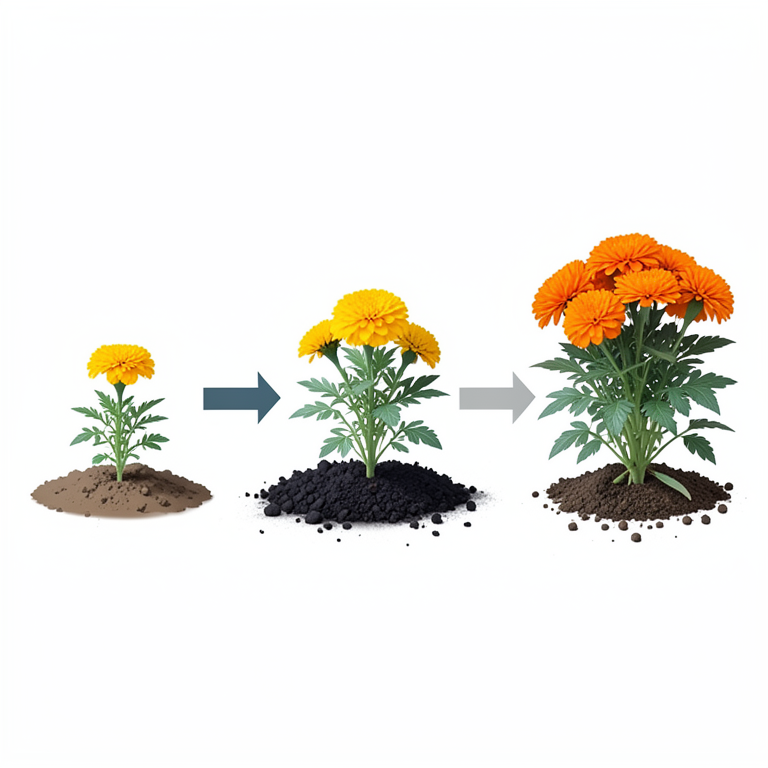
Comparison of Organic Manure Treatments
AI-generated conceptual illustration (marigold plants (cv. Pusa Narangi Gainda)). It explains the idea and does not show study data.
View source evidence ↗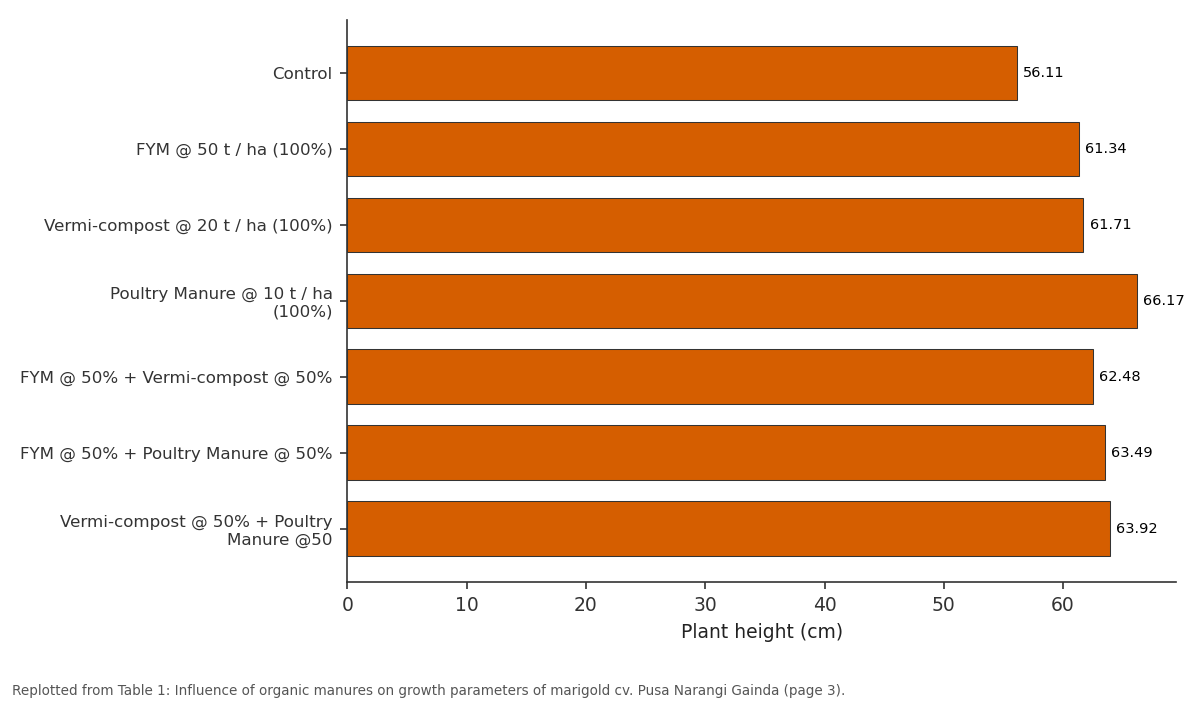
Plant height (cm): Control vs FYM @ 50 t / ha (100%) vs Vermi-compost @ 20 t /... vs Poultry Manure @ 10 t /... vs FYM @ 50% +...
Replotted from Table 1 (page 3) of the original paper. Every bar is the paper's own table value.
View source evidence ↗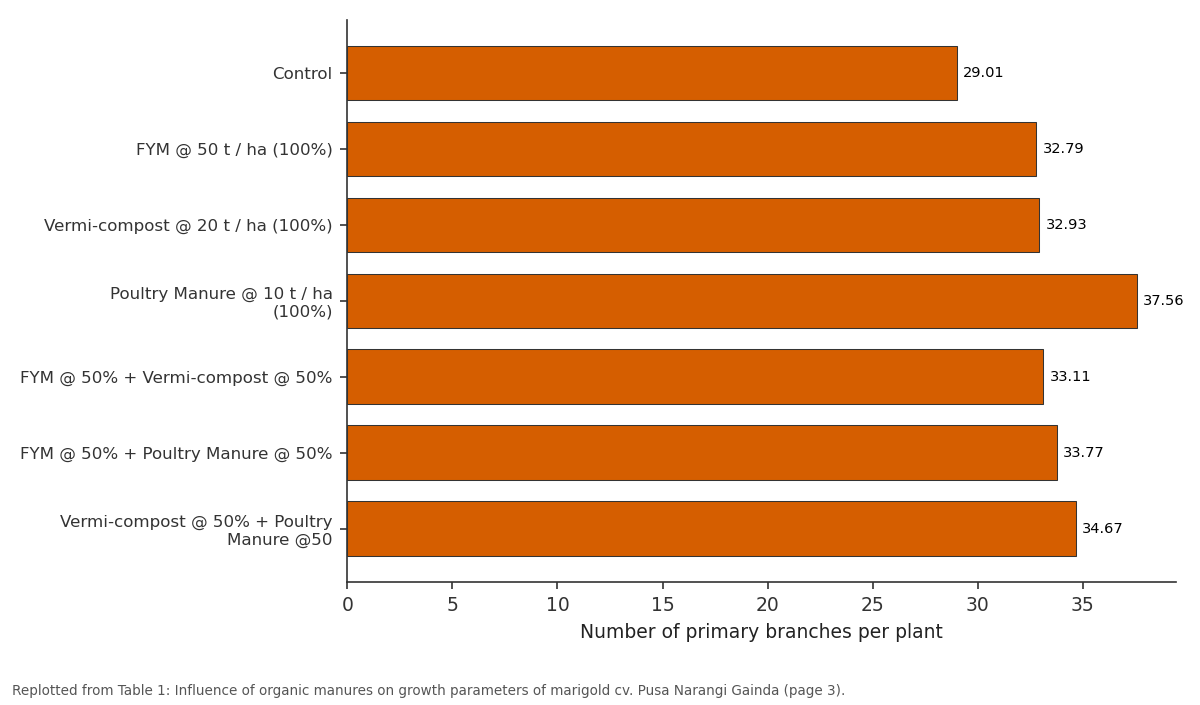
Plant spread (cm): Control vs FYM @ 50 t / ha (100%) vs Vermi-compost @ 20 t /... vs Poultry Manure @ 10 t /... vs FYM @ 50% +...
Replotted from Table 1 (page 3) of the original paper. Every bar is the paper's own table value.
View source evidence ↗Figures & tables
From the original paper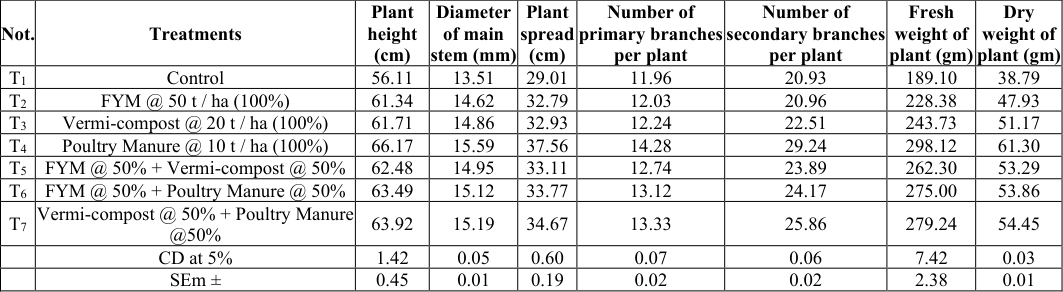 Table 1
Introduction
Marigold (Tagetes erecta L.) is one of the most popular annual loose flower crops which occupies more than half of India's loose flower production. It is planted all over the world. It is cultivated as potted plants in landscaping architecture as well as in flower beds and borders. Marigold is the most popular loose flower in India, followed by crossandra, tuberose, jasmine, and chrysanthemum. India produces 2095.16 thousand MT of loose flowers annually on 266.62 thousand hectares of land [NHB Database (2021-22)]. Marigold is one of the most often planted flowering plants. The most widely used loose flower in India is the marigold (Tagetes spp.). It is planted as a potted plant, an attractive crop, and in landscaping. Marigold can be used to fill up gaps and provide colour to pots, shrubberies, and herbaceous borders. It is one of the utmost popular flowers and commands a premium price. Marigold, sometimes known as the "versatile crop with golden harvest," has numerous applications. Marigold flowers are widely used for decorative purposes as well as for producing garlands, baskets, bouquets, and wreaths for religious offerings. Because of its enormous potential for value addition, marigold is becoming more and more important in the industrial sector. Marigold-like pigments, food coloring, and essential oils are used to create a variety of value-added goods. Additionally, marigold is produced as a trap crop to manage Helicoverpa armigera in crops like tobacco and tomatoes, and it is an environmentally friendly part of integrated pest management.
Materials and Methods
The current study was conducted in the winter of 2022-2023 at the Horticulture Research Farm, Department of Horticulture, Ch. Charan Singh University Campus Meerut (U.P), India. The location of the site is 222 meters above mean sea level and is situated at latitude 29.01° N and longitude 77.43° East. The research area had a semi-arid, subtropical environment with extreme weather. This area receives its rainfall from the South West Mansoon.
This area receives its rainfall from the South West Monsoon. Rainfall was mostly concentrated during the monsoon (July-September), with an average of about 800 mm. During the monsoon season, the mean relative humidity increased to about 81%, while during the peak summer months (April-June), it decreased to roughly 20%. Frost mostly occurs in December and January, and the winter season runs from November until early March. In this area, the average wind speed is roughly 8.2 km/h.The treatments involved in the study were seven in numbers viz. T 1 -Control, T 2 FYM @ 50 t / ha.(100%), T 3 -Vermicompost @ 20 t / ha.(100%), T 4 -Poultry Manure 10 t / ha.(100%), T 5 -FYM @ 50% + Vermi-compost @ 50%, T 6 -FYM @ 50%+ Poultry Manure @ 50% and T 7 -Vermicompost @ 50% + Poultry Manure @ 50%. The seed was sown on well prepared seed bed than 14 days old seedlings were shifted to portrays than five weeks old, healthy, and uniform seedlings were transplanted into plots 1.80×1.80 m in size, at the specified spacing. The data related to growth parameters namely: Plant Height (cm.), Diameter of main stem (cm.), Plant spread (cm.), Number of primary branches per plant, Number of secondary branches per plants, Fresh weight of plant and Dry weight of plant were recorded as per the procedure described below recorded for the analysis. The data recorded during the course of investigation were statistically analized by using analysis of variance (ANOVA) technique (Fisher, 1958) for drawing conclusion.
Results and Discussion
The present investigation was aimed at identifying suitable organic input treatments for marigold cultivation with respect to growth attributes. The effect of organic manures was found significant in respect to plant growth data presented in table 1. The observations on plant height were recorded and given in table 1. It is observed that the plant height was maximum in T₄ (Poultry Manure @ 10 t ha⁻¹), recording 66.17 cm, followed by T₇ (Vermi-compost @ 50% + Poultry Manure @ 50%) with 63.92 cm and T₆ (FYM @ 50% + Poultry Manure @ 50%) with 63.49 cm. The minimum plant height of 56.11 cm was observed in T₁ (Control). The result is in confirmation with the results reported by Naveen Chandra (2018) [19] . Plant nutrition supplied through organic sources had in-depth effect on development of crop by acceleration of mechanisms with increasing cell probability and hormonal growth action. Out of many organic inputs, Poultry manure has been identified as the most effective organic nutrient source, enhancing the physico-chemical properties (pH, EC, organic carbon, macro and micro nutrients) of soil due to its superior analytical values (Himaja et al., 2021) [8] . In marigold organic fertilization proved to be effective in increasing plant height and weight as well as the amounts of phenolics (Khalid and da Silva 2012) [12] . organic fertilizers extend the root network and improve nutrition uptake; it also provides improved conditions for water uptake by plants and, so, better thriving conditions for the crop (Khosravi Shakib et al., 2019; Ievinsh et al., 2020) [13,9] . Besides, organic fertilizers enrich the nutrition of the plants, improving their vegetative growth (Maddahi et al., 2021) [16] . Similar results were also observed by Razzaq (2014) in marigold. There was a significant effect of different organic manure treatments on the stem diameter of marigold. The maximum stem diameter was recorded in T₄ (Poultry Manure @ 10 t ha⁻¹), measuring 15.59 mm, which was followed by T₇ (Vermi-compost @ 50% + Poultry Manure @ 50%) with 15.19 mm and T₆ (FYM @ 50% + Poultry Manure @ 50%) with 15.12 mm. This was further followed by T₅ (FYM @ 50% + Vermi-compost @ 50%), which recorded a stem diameter of 14.95 mm. The minimum stem diameter of 13.51 mm was observed in T₁ (Control). The combined application of FYM with vermicompost in solid or liquid form has confirmed that it significantly impacts in the vegetative parameters, for instance, stem girth (cm). This might be associated with the sustained availability of minerals throughout the growth period of marigold plants. Moreover, the growth was reported to be significant by these organic applications which might be dealt with ability of vermicompost to provide phytohormones as well as micronutrients which helps to shot up the mechanism which were essential for growth of plants (Rashid et al. 2020) [24] . These findings are consistent with the reports of Madhuri et al. (2018) [17] , Pandey et al. (2018) [22] , Bordoloi and Talukdar (2019) [1] , and Kaushik and Singh (2020) [11] , who observed similar improvements in tuberose (Polianthes tuberosa L.), chrysanthemum (Chrysanthemum morifolium Ramat.), chrysanthemum cv. Snowball, and African marigold (Tagetes erecta L.), respectively. A significant effect was observed on plant spread of marigold due to the application of different organic manure treatments. The maximum plant spread was recorded in T₄ (Poultry Manure @ 10 t ha⁻¹), measuring 37.56 cm, which was followed by T₇ (Vermi-compost @ 50% + Poultry Manure @ 50%) with 34.67 cm and T₆ (FYM @ 50% + Poultry Manure @ 50%) with 33.77 cm. This was further followed by T₅ (FYM @ 50% + Vermi-compost @ 50%), which recorded a plant spread of 33.11 cm. The minimum plant spread of 29.01 cm was observed in T₁ (Control). The increased plant spread might be attributed to the combined application of organic nutrient sources, which possibly enhanced nutrient availability and supported better vegetative growth of the plants. These findings are in conformity with the reports of Gadagi et al. (2004) [4] in gaillardia, Palagani et al. (2013) [20] in chrysanthemum, Koli and Jayanthi (2018) [14] in marigold and Jogi et al. (2022) [10] in China aster. The positive influence on plant spread by the different combining organic applicants where poultry manures as basal followed by vermicompost as a conditioner. Vermicompost act as the source of macro (N, P, K) at micro nutrients (Zn, Fe, Cu and Mn), enzymes and growth hormones in the early growth phase which leads to vigorous vegetative growth. It might be due to application of Poultry manure which is abundant source of major nutrients viz., NPK and other essential nutrients (Garge et al., 2020) [5] . Nitrogen is the main constituent of chlorophyll, amino acids and protein which plays important role in cell division, protein synthesis and metabolite transport for building the plant tissues (Gupta & Prasad, 1991) [7] . Due to presence of higher amount of major essential nutrients and readily available form of nitrogen in uric acid and narrow C: N ratio than othernutrient facilitates increase in plant height, plant spread and number of leaves. The above findings were similar to the earlier study conducted by (Malik et al., 2021) [18] , (Swathi et al., 2018) [30] in Marigold and (Suseela et al., 2016) [29] in Tuberose. The maximum number of primary branches per plant (14.28) was observed in T₄ (Poultry Manure @ 10 t ha⁻¹), which was followed by T₇ (Vermi-compost @ 50% + Poultry Manure @ 50%) with 13.33 branches and T₆ (FYM @ 50% + Poultry Manure @ 50%) with 13.12 branches per plant. The least number of primary branches per plant (11.96) was recorded in T₁ (Control). The results of the present investigation are in close agreement with the findings of Gadagi et al. (2004) [4] in gaillardia, Deshmukh et al. (2008) [3] in gaillardia, Singh et al. (2015) [27] in marigold, Kumar et al. (2016) in marigold and Palagani et al. (2013) [20] in chrysanthemum. The increase in the number of primary branches with the concomitant of organic manures improves soil properties and its fertility rate. Enhanced soil properties allow better aeration and water retention, which are important factors for root development and overall plant health Prakash et al. (2022) [23] as healthy root systems contribute to better shoot and branch development. This view supported by Somasundaram (2003) [28] highlighted those organic inputsalong with soil application acted as a stimulus that further increased the production of growth regulators in the cell system. This helps in increase in absorption rates of nutrients to the plants. This availability of substantial amount of microbial load and growth hormones which contribute to an increased soil biomass, supporting the availability and absorption of both applied and existing soil nutrients resulting in increased growth Palekar (2006) [21] and Vasanth Kumar (2006) [32] . Similar results were reported by Singh et al. (2015) [27] in marigold for maximum number of primary branches. The maximum number of secondary branches per plant (29.24) was recorded in T₄ (Poultry Manure @ 10 t ha⁻¹), followed by T₇ (Vermi-compost @ 50% + Poultry Manure @ 50%) with 25.86 branches and T₆ (FYM @ 50% + Poultry Manure @ 50%) with 24.17 branches. The minimum number of secondary branches (20.93) was observed in T₁ (Control). The production of the maximum number of secondary branches is due to the reason that number of primary branches were more in plants. In general, the number of primary branches in a plant can influence the development of secondary branches. Primary branches are the main stems that arise directly from the main stem of a plant and secondary branches emerge from these primary branches (Tayeng, 2010) [31] . So, the higher the number of primary branches in the plant, the more will be the secondary branches. The production of more number of secondary branches in plantcould be attributed to poultry manure. This might have enhanced the cell division and cell elongation and concomitant increase in metabolic activities in the plants body. It also helps in enhancing the soil status to become a ready to serve zone for essential nutrients to plant's root system, which might have helped in increased nutrient uptake which in turn might have encouraged increased production of branches. The maximum fresh weight of plant (298.12 g) was observed in T₄ (Poultry Manure @ 10 t ha⁻¹), which was followed by T₇ (Vermi-compost @ 50% + Poultry Manure @ 50%) with 279.24 g and T₆ (FYM @ 50% + Poultry Manure @ 50%) with 275.00 g. The minimum fresh weight of plant (189.10 g) was recorded in T₁ (Control). The larger availability of nutrients enhanced the plant height, plant spread, number of branches, number of leaves, stem girth and leaf area, which encouraged luxuriant plant growth and in turn increased the fresh weight of plant and shoots. These findings are in agreement with the reports of Sainju et al. (2017) [26] , who stated that enhanced vegetative growth contributes to improved biomass accumulation and yield. The results are also in close conformity with the findings of Palagani et al. (2013) [20] in chrysanthemum. A similar trend was observed for plant dry weight. The maximum dry weight of plant (61.30 g) was recorded in T₄ (Poultry Manure @ 10 t ha⁻¹), followed by T₇ (54.45 g) and T₆ (53.86 g). In contrast, the minimum dry weight of plant (38.79 g) was observed under the control treatment (T₁). [27] in marigold and Chaitra and Patil (2007) in China aster. This change might be due to the higher accumulation of carbon in plant tissues, resulting from the enriched plant growth promoted by organic inputs such as vermicompost, poultry manure and farmyard manure. Due to the maximum number of leaves, photosynthetic capacity of marigold might have increased under the different organic manure treatments. Higher production of photosynthates would have been encouraged by these organic treatments, which might have resulted in increased accumulation of photosynthates, thus increasing the dry weight of the plant.
| Not. | Treatments | Plant height (cm) | Diameter of main stem (mm) | Plant spread (cm) | Number of primary branches per plant | Number of secondary branches per plant | Fresh weight of plant (gm) | Dry weight of plant (gm) |
|---|---|---|---|---|---|---|---|---|
| T1 | Control | 56.11 | 13.51 | 29.01 | 11.96 | 20.93 | 189.10 | 38.79 |
| T2 | FYM @ 50 t / ha (100%) | 61.34 | 14.62 | 32.79 | 12.03 | 20.96 | 228.38 | 47.93 |
| T3 | Vermi-compost @ 20 t / ha (100%) | 61.71 | 14.86 | 32.93 | 12.24 | 22.51 | 243.73 | 51.17 |
| T4 | Poultry Manure @ 10 t / ha (100%) | 66.17 | 15.59 | 37.56 | 14.28 | 29.24 | 298.12 | 61.30 |
| T5 | FYM @ 50% + Vermi-compost @ 50% | 62.48 | 14.95 | 33.11 | 12.74 | 23.89 | 262.30 | 53.29 |
| T6 | FYM @ 50% + Poultry Manure @ 50% | 63.49 | 15.12 | 33.77 | 13.12 | 24.17 | 275.00 | 53.86 |
| T7 | Vermi-compost @ 50% + Poultry Manure @50% | 63.92 | 15.19 | 34.67 | 13.33 | 25.86 | 279.24 | 54.45 |
| CD at 5% | 1.42 | 0.05 | 0.60 | 0.07 | 0.06 | 7.42 | 0.03 | |
| SEm ± | 0.45 | 0.01 | 0.19 | 0.02 | 0.02 | 2.38 | 0.01 |
Table text extracted from the original PDF; superscript letters are shown inline. The original table image is below.
View original table image
Conclusion
The present study revealed that different organic manure treatments significantly influenced the growth and biomass production of marigold cv. Pusa Narangi Gainda. Among the treatments, poultry manure @ 10 t ha⁻¹ proved most effective, recording the highest values for plant height, stem diameter, plant spread, number of primary and secondary branches, fresh weight, and dry weight of plant. Therefore, the application of poultry manure @ 10 t ha⁻¹ can be recommended as an effective and also a promising approach to grow more marigold flowers. These organic methods can potentially meet the sustainable needs of people of India and other countries.
References
31 in the original paper- Bordoloi S, Talukdar MC. Effect of organic inputs on growth and flowering attributes of chrysanthemum (Chrysanthemum morifolium Ramat.) cv. Snowball. International Journal of Current Microbiology and Applied Sciences. 2019;8(12):2735-2743.
- Chaitra R, Patil VS. Integrated nutrient management studies in China aster. Karnataka Journal of Agricultural Sciences. 2007;20(3):689-690.
- Deshmukh G, Khlralkar P, Bagde SD, Bhongle SA. Effect of bio-inoculants with graded doses of NPK on growth and yield of gaillardia. Journal of Soils and Crops. 2008;15(1):212-216.
- Gadagi RS, Krishnaraj PU, Kulkarni JH, Sa-Tong M. The effect of combined Azospirillum inoculation and nitrogen fertilizer on plant growth promotion and yield response of the blanket flower Gaillardia pulchella. Scientia Horticulturae. 2004;100(1-4):323-332.
- Garge VC, Malik S, Awasthi M, Singh SP, Chaudhary M, Kumar A. Effect of integrated nutrient management on flower quality of French marigold (Tagetes patula L.) cv. Pusa Arpita. International Journal of Pure & Applied Chemistry. 2020;21(24):154-156.
- Gotmare PT, Damke MM, Gonge VS, Deshmukh S. Influence of integrated nutrient management on vegetative growth parameters of marigold (Tagetes erecta L.). Asian Journal of Horticulture. 2007;2(2):3336.
- Gupta RD, Prasad. Phosphobacterin is an ideal phosphatic bacterial fertilizer. Farmer's Digest. 1991;5(4):13-14.
- Himaja R, Prasad VM, Bahadur V. Effect of organic manures on growth, flowering, yield and quality of African marigold (Tagetes erecta L.) in Prayagraj agro climatic conditions CV. Pusa Na rangi. The Pharma Innovation. 2021;10:1486-1488.
- Ievinsh G, Andersone-Ozola U, Zeipiņa S. Comparison of the effects of compost and vermicompost soil amendments in organic production of four herb species. Biological Agriculture and Horticulture. 2020;36(4):267-282.
- Jogi P, Tirkey T, Tamrakar SK. Effect of different doses of chemical fertilizer and different formulations of bio-fertilizer on growth parameters of China aster (Callistephus chinensis (L.) Nees) var. Arka Archana. The Pharma Innovation Journal. 2022;11(2):3006-3010.
- Kaushik H, Singh JP. Impact of integrated nutrient management (INM) on plant growth and flower yield of African marigold (Tagetes erecta L.). J Pharmacogn Phytochem. 2020;9:1481-1484.
- Khalid KA, Teixeira da Silva JA. Biology of Calendula officinalis Linn.: Focus on pharmacology, biological activities and agronomic practices. Medicinal and Aromatic Plant Science and Biotechnology. 2012;6(1):12-27.
- Khosravi Shakib A, Rezaei Nejad A, Khandan Mirkohi A, Kalate Jari S. Vermicompost and manure compost reduce water-deficit stress in pot marigold (Calendula officinalis L. cv. Candyman orange). Compost Science and Utilization. 2019;27(1):61-68.
- Koli R, Jayanthi R. Influence of integrated nutrient management on flower yield and economics of marigold (Tagetes erecta L.) cv. Pusa Basanti Gainda. International Journal of Chemical Studies. 2018;6(4):2651-2653.
- Kumar P, Kumar V, Kumar D. Response of INM to plant growth, flower yield and shelf life of African marigold (Tagetes erecta L.) cv. Pusa Basanti Gainda. International Journal of Agricultural Invention. 2016;1(1):108-112.
- Maddahi S, Rahimi A, Siavash Moghaddam S, Pourakbar L, Popović-Djordjević J. Effects of sowing time and chemical, organic, and biological fertilizer sources on yield components and antioxidant properties of dragon's Head (Lallemantia iberica (M. Bieb.) Fisch. & CA Mey). Journal of Plant Growth Regulation. 2021;40:1-15.
- Madhuri G, Palai SK, Pattanaik S. Growth and flowering parameters of tuberose (Polianthes tuberosa L.) cv. Phulerajani influenced by organic manures. The Pharma Innovation. 2018;7:97-99.
- Malik M, Kumar T, Jawla SK, Sahrawat A. Economic analysis of marigold production under the different application of organic manures. The Pharma Innovation Journal. 2021;10(3):155-157.
- Chandra N, Badoni A, Chamoli V, Khaan J, Joshi N, Muruglatha N. Affect of different doses of Fym on flower yield of marigold (Tagetes erecta L.) CV. Hawaii. Journal of Pharmacognosy and Phytochemistry. 2018;7(5S):154-156.
- Palagani N, Barad AV, Bhosale N, Thumar BV. Influence of integrated plant nutrition on growth and flower yield of chrysanthemum (Chrysanthemum morifolium Ramat.) cv. IIHR-6 under Saurashtra condition. Asian Journal of Horticulture. 2013;8(2):502-506.
- Pandey SK, Prasad VM, Singh VK, Kumar M, Saravanan S. Effect of bio-fertilizers and inorganic manures on plant growth and flowering of chrysanthemum (Chrysanthemum grandiflorum) cv. 'Haldighati'. Journal of Pharmacognosy and Phytochemistry. 2018;1:637-642.
- Prakash S, Kumar M, Kumar V, Kumar A, Singh MK, Singh R, et al. Effect of bio-stimulant on growth and yield of onion (Allium cepa L.) cv. 'NHRDF Red-3'. Agr Mech Asia AF. 2022;53:10265-10271.
- Rashid M, Khan A, Mahmood A, Shaukat M, Ahmed S. Mechanistic insights of the interaction of plant growthpromoting rhizobacteria with crops under stress conditions. Frontiers in Microbiology. 2020;11:1952.
- Razzaq OI, Prasad VM, Saravanan S. Effect of organic manures on flower yield of African marigold (Tagetes erecta L.) cv. Pusa Narangi Gainda. International Journal of Agricultural Science and Research (IJASR). 2014;4(1):39-50.
- Sainju UM, Allen BL, Lenssen AW, Ghimire RP. Root biomass, root/shoot ratio, and soil water content under perennial grasses with different nitrogen rates. Field Crops Research. 2017;210:183-191.
- Singh M, Dwivedi DH, Kumar M. Efficiency of organic and biodynamic manures on growth and flowering in marigold (Tagetes patula L.). Progress Agric. 2015;15:134-137.
- Somasundaram E, Amanullah MM, Thirukkumaran K, Chandrasekaran R. Biochemical changes, nitrogen flux and yield of crops due to organic sources of nutrients under maize based cropping system. Madras Agricultural Journal. 2003;90(11/12):633-637.
- Suseela T, Chandrasekha R, Bhaskar VV, Suneetha DRS, Umakrishna K. Effect of organic manures, inorganic fertilizers and micronutrients on vegetative and floral characters of tuberose (Polianthes tuberosa L.) cv. Suvasini. International Journal of Scientific and Research Publications. 2016;6(2):170-173.
- Swathi K, Sarkar I, Maitra S, Sharma S. Organic manures and bio-inoculants mediated influence on growth and flowering of African marigold (Tagetes erecta L.) cv. Pusa Narangi Gainda. International Journal of Bio-resource and Stress Management. 2018;8(3):429-432.
- Tayeng O. Studies on integrated nutrient management on growth, flowering and seed yield of African marigold (Tagetes erecta L.). 2010.
- Vasanthkumar HHR. Jeevamrut slurry preparation. Siri Samruddhi. 2006:4-5.