
Research article · 2026 · Full text
International Journal of Advanced Chemistry ResearchPhytochemical Profile and Therapeutic Relevance of Medicinal Plants of the Magadh Region, Bihar: A Natural Product Chemistry Perspective
Volume 8(6) · Pages 22–26 · DOI: 10.33545/26646781.2026.v8.i6a.684 ↗
Research areasMedicinal Plant ResearchPhytochemicals and Medicinal PlantsEthnobotanical and Medicinal Plants Studies
Abstract
Author-writtenThe Magadh region of Bihar harbours a rich diversity of medicinal plants that serve as an important source of structurally diverse natural products. Current study focuses on the phytochemical and chemical profile of selected medicinal species, emphasizing their major secondary metabolites and corresponding chemical classes. The documented plants contain a wide range of bioactive compounds including alkaloids, phenolics, flavonoids, terpenoids, glycosides, saponins, lignans and anthraquinones. Structurally significant molecules such as indole alkaloids, quinazoline alkaloids, curcuminoids, withanolides, triterpenoids and hydrolysable tannins highlight the chemical complexity present within these species. These compounds are known for their varied physicochemical properties, functional groups and biosynthetic origins, which contribute to their biological relevance. This article connects traditional medicinal usage with underlying chemical constituents, providing a framework for understanding plant-based natural products from a chemical perspective. Further, the application of modern analytical techniques such as HPLC, GC–MS, LC–MS and NMR spectroscopy is also proposed for for accurate identification, structural elucidation and profiling of these metabolites. Medicinal flora of Magadh represents a significant natural reservoir for phytochemical investigation and future natural product-based drug discovery.
Summary
Source-checkedPlain-language reading of the full paper, prepared with AI and checked against the text. Each point links to the authors' own words.
Why it matters
- Many healthcare therapeutic compounds originate from plants, which produce chemical constituents for survival and defense. View evidence ↗
- The Magadh region of Bihar possesses diverse natural vegetation, including forests and hills, that support a variety of medicinal plants. View evidence ↗
- The medicinal potential of plants is primarily determined by the specific nature and arrangement of their chemical constituents. View evidence ↗
The question
- The study aims to examine the phytochemical and chemical profiles of selected medicinal species in the Magadh region, focusing on their major secondary metabolites. View evidence ↗
- The review seeks to connect the chemical constituents of Magadh's medicinal plants to their significance in medicinal chemistry. View evidence ↗
What they did
- The review was conducted by collecting and analyzing published scientific data on medicinal plants, their traditional uses, and chemical constituents in the Magadh region. View evidence ↗
- The authors consulted scientific reports, review papers, and research articles focusing on natural product chemistry, phytochemistry, and ethnobotany. View evidence ↗
- The analysis focused on major phytochemical groups, specifically saponins, glycosides, tannins, terpenoids, phenolic compounds, flavonoids, and alkaloids. View evidence ↗
What they found
- The review compiled data on 40 medicinal plant species from the Magadh region and surrounding areas. View evidence ↗
- Alkaloids were identified in several species, including Rauvolfia serpentina (reserpine), Catharanthus roseus (vincristine and vinblastine), and Datura stramonium (tropane alkaloids). View evidence ↗
- Phenolic and flavonoid-rich plants identified include Curcuma longa (curcumin), Syzygium cumini (anthocyanins), and Terminalia bellirica (gallic and ellagic acids). View evidence ↗
- Terpenoid and steroidal compounds were found in species such as Withania somnifera (withanolides) and Azadirachta indica (azadirachtin and limonoids). View evidence ↗
- Saponins and glycosides were recorded in plants such as Bacopa monnieri (bacosides) and Calotropis gigantea (cardiac glycosides). View evidence ↗
- A correlation was found where plants used for inflammatory and antioxidant purposes were rich in flavonoids and phenolics, while those for respiratory, cardiovascular, and neurological issues contained glycosidic compounds, terpenoids, or alkaloids. View evidence ↗
What it means
- The authors conclude that the medicinal plants of the Magadh region are a valuable source of chemically diverse compounds that provide a basis for their traditional medicinal importance. View evidence ↗
- The authors recommend using advanced techniques like HPLC, GC-MS, LC-MS, NMR, and FTIR for the accurate identification and structural characterization of bioactive compounds. View evidence ↗
- The authors state that preliminary phytochemical screening is limited because it cannot provide molecular-level resolution or structural details of individual compounds. View evidence ↗
Figures & tables
From the original paper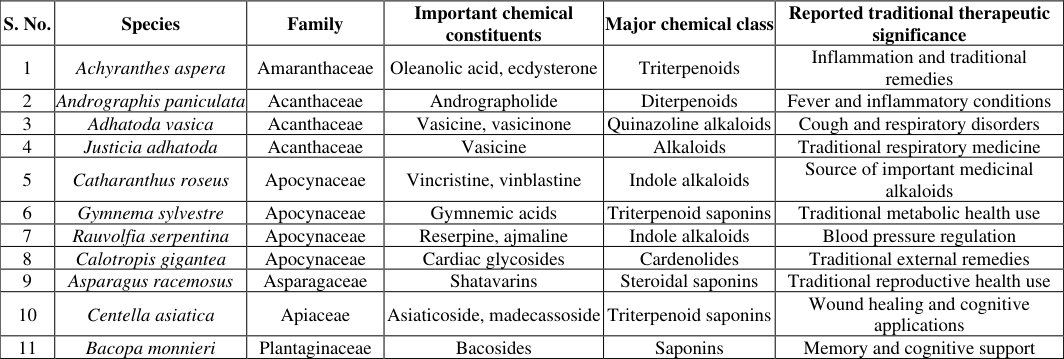 Table 1
Introduction
The relationship between chemistry and medicine has developed through the continuous exploration of natural substances and their effects on living systems. Many therapeutic compounds used in healthcare have originated from natural sources, particularly plants, where chemical constituents are produced as part of their survival and defence mechanisms. Medicinal plants are therefore important reservoirs of natural products containing a wide range of secondary metabolites, including alkaloids, terpenoids, phenolic compounds, flavonoids, tannins, glycosides and saponins. These molecules differ in their structures and chemical properties, which influence their biological activities and medicinal importance (Elshafie et al., 2023) [10] . Natural products from medicinal plants are biosynthetically derived secondary metabolites whose structural diversity governs their pharmacological potential. The therapeutic potential of medicinal plants is largely associated with the nature and arrangement of their chemical constituents. The presence of specific functional groups, molecular structures and reactive sites determines how these compounds interact with biological molecules. Phenolic compounds and flavonoids are among the most studied groups because their hydroxyl groups and aromatic structures contribute to antioxidant behaviour and their ability to influence various biochemical processes (Sun & Shahrajabian, 2023) [23] . Alkaloids, another major group of plant metabolites, contain nitrogen-based structures that often show strong biological activity through interactions with enzymes, receptors and cellular pathways. Their structural diversity has made them important molecules in natural product research and pharmaceutical development (Faisal et al., 2023) Terpenoids represent another chemically diverse group of plant compounds derived from isoprenoid pathways. Their structures vary from simple volatile molecules to complex triterpenes, creating a wide range of biological properties. Many terpenoid compounds have been investigated for antimicrobial, antioxidant and anti-inflammatory activities, demonstrating the close connection between plant chemistry and medicinal applications (Masyita et al., 2022) [16] . Traditional healthcare practices developed from the longterm association between humans and their surrounding environment. The preparation of herbal remedies involved several processes, including drying, grinding, extraction, boiling and fermentation. Such practices influenced the chemical composition of plant materials by affecting the release and concentration of active compounds. Modern phytochemical studies have helped explain these traditional approaches by identifying the molecules responsible for their biological effects. The advancement of analytical techniques has greatly improved the study of medicinal plant chemistry. Methods such as chromatography, mass spectrometry and nuclear magnetic resonance spectroscopy allow researchers to separate, identify and characterise complex natural compounds with greater accuracy. These approaches have strengthened the scientific evaluation of medicinal plants and provided a link between traditional medicine and modern pharmaceutical research (Wolfender et al., 2019) [26] . The Magadh region of Bihar provides an important setting for studying the connection between biodiversity and medicinal chemistry. The forests, hills and natural vegetation of the region support a variety of medicinal plants that produce chemically diverse compounds. These plants represent natural sources of organic molecules belonging to different chemical groups, including phenolics, alkaloids, terpenoids and glycosides. Investigation of medicinal plants from Magadh is important not only for understanding traditional uses but also for exploring their chemical potential. Identification and characterisation of plant constituents help establish relationships between molecular structure and biological activity. Such studies contribute towards the documentation of traditional knowledge and may provide valuable leads for natural product-based drug research. The medicinal plant diversity of Magadh can therefore be viewed as an important chemical resource. Understanding the phytochemical composition of these plants provides insight into the relationship between natural compounds, biological activity and therapeutic applications. The present review article discusses medicinal plants of the Magadh region with emphasis on their chemical constituents and their significance in the field of medicinal chemistry. Further, the application of modern analytical techniques such as HPLC, GC-MS, LC-MS and NMR spectroscopy is also proposed for for accurate identification, structural elucidation and profiling of these metabolites.
Methodology
This review was prepared by collecting and examining published scientific information related to medicinal plants, their chemical constituents and traditional uses in the Magadh region of Bihar. Relevant research articles, review papers and scientific reports dealing with ethnobotany, phytochemistry and natural product chemistry were consulted to understand the relationship between medicinal plants and their bioactive compounds. The available information was compiled with special emphasis on plant species that have been traditionally used for healthcare purposes. For each species, data related to botanical identity, medicinal applications and important chemical constituents were collected from published literature. The major groups of phytochemicals, including alkaloids, flavonoids, phenolic compounds, terpenoids, tannins, glycosides and saponins, were considered because of their importance in explaining the medicinal properties of plants. The selected plant species were further reviewed from a chemical perspective by examining the reported bioactive molecules and their structural characteristics. Published studies involving phytochemical screening and analytical techniques such as chromatography, mass spectrometry and spectroscopy were considered to understand the identification and characterisation of natural compounds.
Results
The present review compiled information on medicinal plants (n=40) reported from the Magadh region and nearby areas, with particular emphasis on their chemical constituents and traditional medicinal importance. The collected information revealed that medicinal plants of the region represent a wide range of species belonging to different families, including trees, shrubs and herbs (Table 1). 1). These include the management of digestive, respiratory, inflammatory, metabolic, neurological and skin-related disorders. Such therapeutic relevance is strongly associated with the presence of distinct phytochemical groups, particularly alkaloids, phenolics, flavonoids, terpenoids, glycosides and saponins. The variation in chemical composition among species explains their wide-ranging biological effects. Overall, the results highlight a clear link between phytochemical diversity and traditional medicinal practices in the region. It indicates that medicinal plants of Magadh seems to represent an important source of chemical diversity. Their varied phytochemical composition provides a scientific basis for traditional medicinal knowledge and highlights their potential value for further studies in phytochemistry and natural product-based medicine.
| S. No. | Species | Family | Important chemical constituents | Major chemical class | Reported traditional therapeutic significance |
|---|---|---|---|---|---|
| 1 | Achyranthes aspera | Amaranthaceae | Oleanolic acid, ecdysterone | Triterpenoids | Inflammation and traditional remedies |
| 2 | Andrographis paniculata | Acanthaceae | Andrographolide | Diterpenoids | Fever and inflammatory conditions |
| 3 | Adhatoda vasica | Acanthaceae | Vasicine, vasicinone | Quinazoline alkaloids | Cough and respiratory disorders |
| 4 | Justicia adhatoda | Acanthaceae | Vasicine | Alkaloids | Traditional respiratory medicine |
| 5 | Catharanthus roseus | Apocynaceae | Vincristine, vinblastine | Indole alkaloids | Source of important medicinal alkaloids |
| 6 | Gymnema sylvestre | Apocynaceae | Gymnemic acids | Triterpenoid saponins | Traditional metabolic health use |
| 7 | Rauvolfia serpentina | Apocynaceae | Reserpine, ajmaline | Indole alkaloids | Blood pressure regulation |
| 8 | Calotropis gigantea | Apocynaceae | Cardiac glycosides | Cardenolides | Traditional external remedies |
| 9 | Asparagus racemosus | Asparagaceae | Shatavarins | Steroidal saponins | Traditional reproductive health use |
| 10 | Centella asiatica | Apiaceae | Asiaticoside, madecassoside | Triterpenoid saponins | Wound healing and cognitive applications |
| 11 | Bacopa monnieri | Plantaginaceae | Bacosides | Saponins | Memory and cognitive support |
Table text extracted from the original PDF; superscript letters are shown inline. The original table image is below.
View original table image
Discussion
The [11,12,14,15,16,19] , provides a chemical basis for understanding the medicinal importance of these plants. These compounds are primarily involved in plant defence and adaptation, but their structural diversity has also made them valuable in phytochemical and pharmaceutical research (Atanasov et al., 2021; Elshafie et al., 2023) [2,10] . The traditional use of medicinal plants in the Magadh region is connected with the broader heritage of Indian traditional medicine. Classical Ayurvedic literature such as Charaka Samhita and Sushruta Samhita documented the therapeutic use of numerous plant resources, while later works on Indian medicinal plants provided extensive records of their traditional applications (Agnivesha, 2003; Kirtikar & Basu, 1935; Nadkarni, 1976; Sharma, 2003; Sushruta, 1963) [1,15,18,22,24] . Modern phytochemical investigations have helped to explain these traditional observations by identifying specific molecules associated with biological activity. Alkaloids constitute one of the most significant chemical groups found among medicinal plants. Their nitrogen-containing structures allow interaction with biological molecules and make them important compounds in natural product chemistry. Plants such as Rauvolfia serpentina, Adhatoda vasica, Tinospora cordifolia, Piper longum and Datura stramonium (Elshafie et al., 2023; Saha & Ghosh, 2010) [10,21] contain alkaloids that have received considerable scientific attention. Compounds such as reserpine, vasicine and piperine demonstrate the importance of alkaloid chemistry in the development of pharmacologically active natural products (Faisal et al., 2023) [12] . [3,4,8,9,20] contain chemically important polyphenolic molecules. The presence of aromatic rings and hydroxyl groups influences their antioxidant properties and their interactions with biological systems. Curcumin from Curcuma longa and phenolic compounds from Terminalia (Bag et al., 2013; Hewlings & Kalman, 2017) [4,13] species are examples of plant-derived molecules that continue to be investigated for their medicinal potential (Ciuca & Racovita, 2023; Sun & Shahrajabian, 2023) [8,23] . Terpenoids and related compounds contribute significantly to the chemical diversity of medicinal plants found in the region. Withanolides from Withania somnifera (Bashir et al., 2023; Mirjalili et al., 2009) [6,17] , limonoids from Azadirachta indica (Mirjalili et al., 2009) [17] and triterpenoid compounds from Centella asiatica represent structurally diverse molecules belonging to this group. The variation in their chemical structures contributes to the wide range of biological activities reported for terpenoid-rich medicinal plants (Bashir et al., 2023; Masyita et al., 2022) [8,23] .
Glycosides and saponins further add to the chemical complexity of medicinal plants. Compounds such as bacosides from Bacopa monnieri, asiaticosides from Centella asiatica and cardiac glycosides from Calotropis gigantea contain sugar-linked structures that influence their chemical behaviour and biological interactions. These compounds demonstrate how differences in molecular structure contribute to the diversity of medicinal properties observed in plants (Atanasov, 2021; Elshafie et al., 2023) [2,10] . The medicinal plants of Magadh are valuable natural source of chemically diverse molecules for natural drugs. The connection between traditional medicinal knowledge and phytochemical composition suggests that many traditionally used plants possess chemical constituents worthy of further scientific investigation. This requires the application of modern analytical techniques to achieve reliable and detailed chemical understanding beyond traditional phytochemical screening. While preliminary tests are useful for confirming the presence of major classes of secondary metabolites such as alkaloids, flavonoids, terpenoids, and phenolics, they do not provide structural or molecular-level resolution of individual compounds. Therefore, advanced techniques such as High-Performance Liquid Chromatography (HPLC), Gas Chromatography-Mass Spectrometry (GC-MS), and Liquid Chromatography-Mass Spectrometry (LC-MS) are essential for accurate separation, identification, and quantification of bioactive constituents present in complex plant matrices (Wolfender et al., 2019). Further, Nuclear Magnetic Resonance (NMR) Spectroscopy plays a key role in the precise structural elucidation of isolated compounds, while Fourier-Transform Infrared Spectroscopy (FTIR) spectroscopy supports rapid identification of functional groups. The integration of metabolomics and chemometric tools also helps in understanding phytochemical variation among species and environmental conditions (Wolfender et al., 2019). These modern approaches are important for scientifically validating traditional medicinal knowledge and for identifying potential lead molecules for future drug development. In the context of Magadh's rich medicinal plant diversity, such techniques provide a strong bridge between ethnobotanical knowledge and contemporary natural product chemistry.
Conclusion
The medicinal plant diversity of the Magadh region reflects the close relationship between biodiversity, traditional knowledge and natural product chemistry. The variety of plants used in traditional healthcare represents a valuable source of chemically diverse compounds, including alkaloids, phenolics, flavonoids, terpenoids, glycosides and saponins. These naturally occurring molecules provide a chemical basis for understanding the medicinal importance associated with many plant species used over generations. Future studies combining traditional knowledge with advanced phytochemical approaches can provide deeper insight into the chemical diversity of these plants. Techniques such as High-Performance Liquid Chromatography (HPLC), Gas Chromatography-Mass Spectrometry (GC-MS), Liquid Chromatography-Mass Spectrometry (LC-MS), Nuclear Magnetic Resonance (NMR) Spectroscopy and Fourier-Transform Infrared Spectroscopy (FTIR) can help in the identification, separation and structural characterisation of bioactive compounds. Such investigations may support the discovery of valuable natural products while contributing to the sustainable utilisation and conservation of medicinal plant resources in the Magadh region.
Acknowledgement
AcknowledgementsThe author gratefully acknowledges the contributions of earlier researchers and traditional knowledge systems that supported this study. The available literature on medicinal plants and phytochemistry provided valuable guidance in understanding the chemical and medicinal importance of these resources.
References
26 in the original paper- Agnivesha. Charaka Samhita: Text with English translation. Sharma RK, Dash B, translators. Varanasi (India): Chowkhamba Sanskrit Series Office; 2003.
- Atanasov AG, Zotchev SB, Dirsch VM, Supuran CT. Natural products in drug discovery: advances and opportunities. Nat Rev Drug Discov. 2021;20:200-216. doi:10.1038/s41573-020-00114-z.
- Ayyanar M, Subash-Babu P. Syzygium cumini: a review of phytochemical constituents and medicinal uses. Asian Pac J Trop Biomed. 2012;2:240-246.
- Bag A, Bhattacharyya SK, Chattopadhyay RR. Terminalia chebula in clinical research. Asian Pac J Trop Biomed. 2013;3:244-252.
- Baliga MS, Bhat HP, Joseph N, Fazal F. Aegle marmelos: a potential medicinal tree. Food Chem Toxicol. 2011;49:1496-1501.
- Bashir A, Nabi M, Tabassum N, Afzal S, Ayoub M. Withania somnifera phytochemistry and pharmacology. Front Pharmacol. 2023;14:1049334. doi:10.3389/fphar.2023.1049334.
- Biswas K, Chattopadhyay I, Banerjee RK, Bandyopadhyay U. Biological activities of Azadirachta indica. Curr Sci. 2002;82:1336-1345.
- Ciucă MD, Racoviță RC. Curcumin: extraction and biomedical applications. Int J Mol Sci. 2023;24:8874. doi:10.3390/ijms24108874.
- Dwivedi S. Terminalia arjuna in cardiovascular disorders. J Ethnopharmacol. 2007;114:114-129.
- Elshafie HS, Camele I, Mohamed AA. Secondary metabolites from plants. Int J Mol Sci. 2023;24:3266. doi:10.3390/ijms24043266.
- Fahey JW. Moringa oleifera: medicinal evidence. Trees Life J. 2005;1:5.
- Faisal S, Badshah SL, Kubra B, Emwas AH, Jaremko M, Jaremko Ł. Alkaloids as antivirals. Nat Prod Bioprospect. 2023;13:4. doi:10.1007/s13659-02200366-9.
- Hewlings SJ, Kalman DS. Curcumin: a review of its effects on human health. Foods. 2017;6:92. doi:10.3390/foods6100092.
- Intharuksa A, Kuljarusnont S, Sasaki Y, Tungmunnithum D. Flavonoids and polyphenols in medicinal plants. Molecules. 2024;29:5760.
- Kirtikar KR, Basu BD. Indian medicinal plants. Allahabad (India): Lalit Mohan Basu; 1935.
- Masyita A, Sari RM, Astuti AD, Yasmin NN, Rahmawati D. Terpenes and terpenoids in medicine. Food Chem X. 2022;13:100217. doi:10.1016/j.fochx.2022.100217.
- Mirjalili MH, Moyano E, Bonfill M, Cusidó RM, Palazón J. Steroidal lactones from Withania somnifera, an ancient plant for novel medicine. Phytochemistry. 2009;70:1245-1254. doi:10.1016/j.phytochem.2009.04.004.
- Nadkarni KM. Indian Materia Medica. 3rd ed. Bombay (India): Popular Prakashan; 1976.
- Parekh SS, Parmar GR, Kanojiya D, Baile SB, Trivedi R, Bhatt F. Therapeutic potential of terpenoids. Pharmacogn Res. 2024;16:698-705.
- Pattanayak P, Behera P, Das D, Panda SK. Ocimum sanctum Linn: a reservoir plant for therapeutic applications. Pharmacogn Rev. 2010;4:95-105.
- Saha S, Ghosh S. Tinospora cordifolia: one plant, many roles. Int J Pharm Sci Res. 2012;3:867-876.
- Sharma PV. Dravyaguna Vijnana. Varanasi (India): Chaukhamba Bharati Academy; 2003.
- Sun W, Shahrajabian MH. Phenolic compounds in medicinal plants and their biological activities. Molecules. 2023;28:1845. doi:10.3390/molecules28041845.
- Sushruta. Sushruta Samhita. Bhishagratna KL, translator. Varanasi (India): Chowkhamba Sanskrit Series Office; 1963.
- Variya BC, Bakrania AK, Patel SS. Emblica officinalis (Amla): a review for its phytochemistry, ethnomedicinal uses and medicinal potentials. J Tradit Complement Med. 2016;6:6-13.
- Wolfender JL, Litaudon M, Touboul D, Queiroz EF. Innovative omics-based approaches for prioritisation and targeted isolation of natural products-new strategies for drug discovery. Nat Prod Rep. 2019;36:855-868. doi:10.1039/C9NP00004F.