
Research article · 2026 · Full text
International Journal of Biology SciencesSperm kinematics and membrane integrity assessment in flow-cytometrically sorted bovine semen following variable storage durations
Volume 8(5) · Pages 48–51 · DOI: 10.33545/26649926.2026.v8.i5a.872 ↗
Research areasSperm and Testicular FunctionReproductive Physiology in LivestockAnimal Genetics and Reproduction
Abstract
Author-writtenSince Amann and Seidel first characterized sorting-induced damage to bovine spermatozoa in the early 1990s, questions about how storage duration compounds this fragility have remained only partially answered. This research evaluated sperm kinematic parameters and plasma membrane integrity in sex-sorted bovine semen stored for 0, 6, 12, 24, and 48 hours post-thaw at 37 °C. Ejaculates from 6 Japanese Black bulls were collected, processed through flow cytometric sorting (2.1 × 10⁶ cells/dose), and assessed using computer-assisted sperm analysis (CASA) alongside hypo-osmotic swelling (HOS) and SYBR-14/propidium iodide dual staining. Curvilinear velocity (VCL) declined from 128.4 ± 8.7 µm/s at 0 h to 61.2 ± 11.3 µm/s at 48 h (P<0.001). Membrane-intact spermatozoa dropped from 67.8 ± 4.2% to 28.4 ± 6.1% over the same interval. Conventional unsorted controls retained higher values at every time point. Progressive motility fell below the 30% threshold between 12 and 24 hours for sorted semen but not until beyond 48 hours for conventional. These data establish a practical storage window of 12 hours for sorted bovine semen under thermal incubation conditions.
Summary
Source-checkedPlain-language reading of the full paper, prepared with AI and checked against the text. Each point links to the authors' own words.
Why it matters
- Flow cytometric sorting of bovine semen can damage sperm by exposing them to electrostatic deflection, UV lasers, and mechanical shear, which harms their movement and membrane stability. View evidence ↗
- There is limited information on how sperm from Japanese Black cattle deteriorate during the time between thawing and insemination in field conditions. View evidence ↗
The question
- The study aimed to determine a practical storage limit for sex-sorted bovine semen by tracking its membrane integrity and kinematic parameters over 48 hours. View evidence ↗
What they did
- Semen straws were thawed and held at 37 °C, with samples collected at five intervals: 0, 6, 12, 24, and 48 hours. View evidence ↗
- Computer-assisted sperm analysis (CASA) via the IVOS II system was used to measure kinematic parameters, including curvilinear velocity (VCL), straight-line velocity (VSL), and average path velocity (VAP). View evidence ↗
- Membrane integrity was evaluated using two techniques: a hypo-osmotic swelling (HOS) test and dual fluorescent staining with SYBR-14 and propidium iodide. View evidence ↗
What they found
- In sorted semen, the curvilinear velocity (VCL) significantly decreased from 128.4 ± 8.7 µm/s at 0 hours to 61.2 ± 11.3 µm/s after 48 hours. View evidence ↗
- Sorted semen experienced a steeper decline in VCL (52.3%) over 48 hours compared to conventional controls (34.1%). View evidence ↗
- Sorted semen dropped below the 30% progressive motility threshold between 12 and 24 hours, whereas conventional semen remained above this threshold for over 48 hours. View evidence ↗
- At 12 hours, there was a strong correlation between VCL and membrane integrity (r = 0.76), and the HOS and dual-stain methods were highly consistent (r = 0.88). View evidence ↗
- There was moderate variation between bulls, with two bulls showing consistently higher viability after sorting than the other four. View evidence ↗
What it means
- The authors conclude that 12 hours post-thaw is the practical storage limit for sex-sorted bovine semen in artificial insemination programs. View evidence ↗
- The authors suggest future research to determine if membrane-stabilizing additives can extend storage time and if pre-sorting ejaculate traits can predict a bull's resilience to sorting. View evidence ↗
Visual summary
3 visualsIllustrations explain the paper; charts are replotted from the paper's own table values.
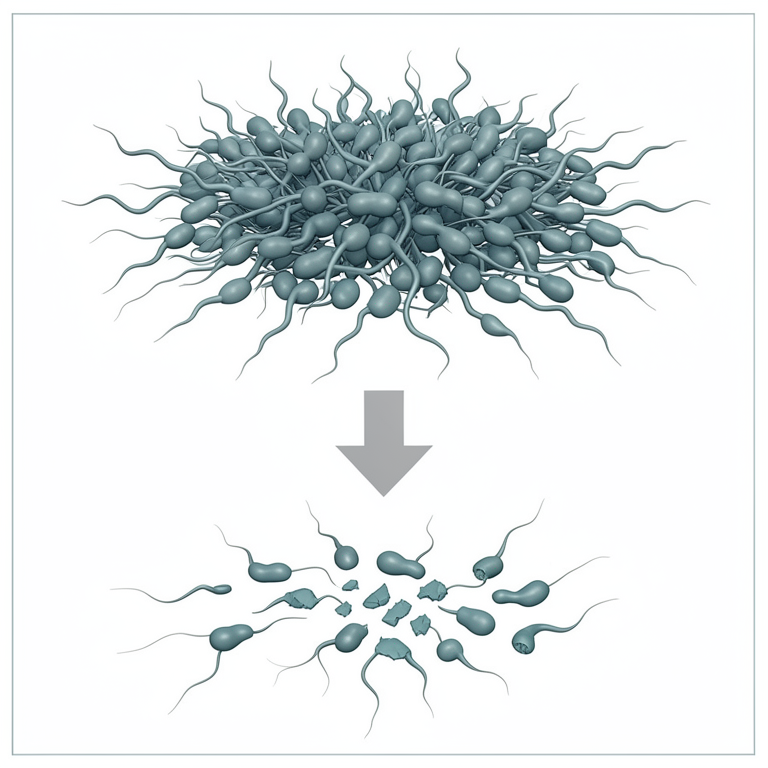
Motility Threshold Comparison
AI-generated conceptual illustration (bovine sperm cells). It explains the idea and does not show study data.
View source evidence ↗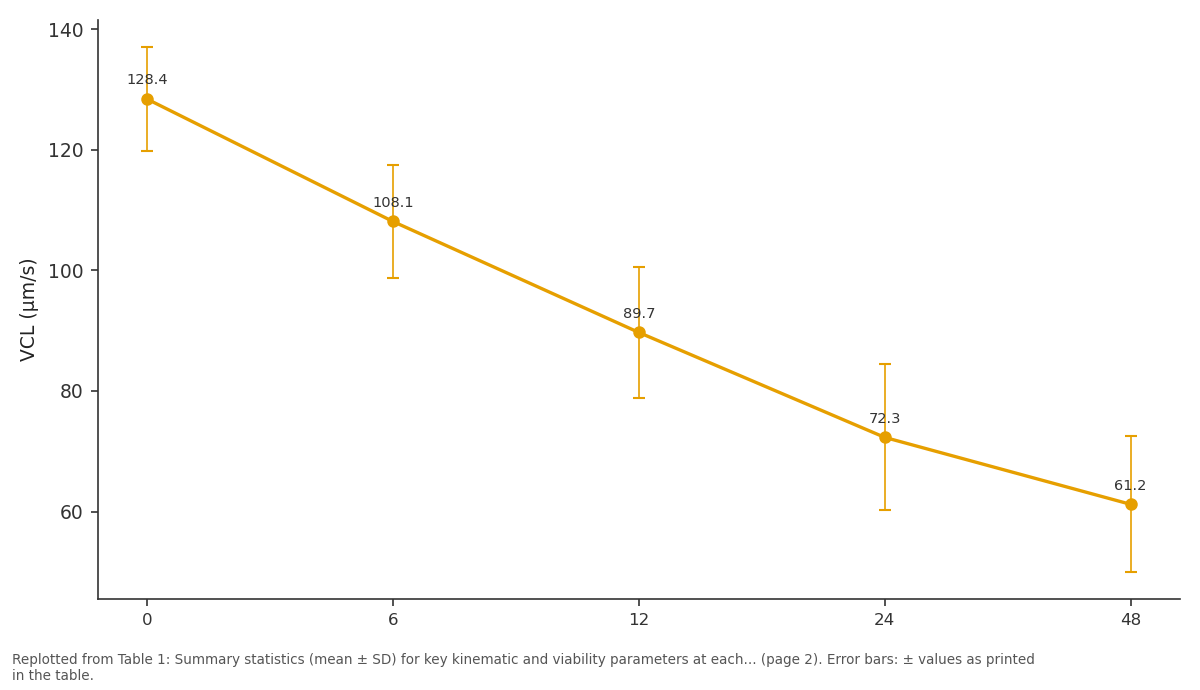
VCL (µm/s): 0 vs 6 vs 12 vs 24 vs 48
Replotted from Table 1 (page 2) of the original paper. Every bar is the paper's own table value.
View source evidence ↗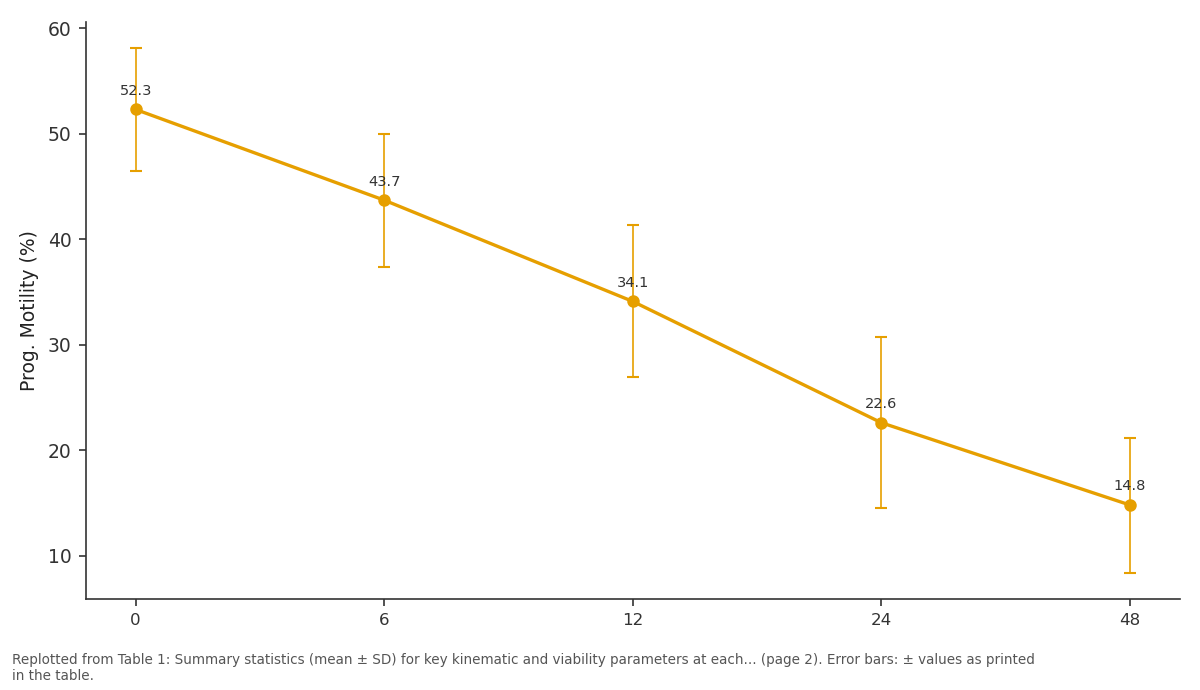
Prog. Motility (%): 0 vs 6 vs 12 vs 24 vs 48
Replotted from Table 1 (page 2) of the original paper. Every bar is the paper's own table value.
View source evidence ↗Figures & tables
From the original paper Table 1
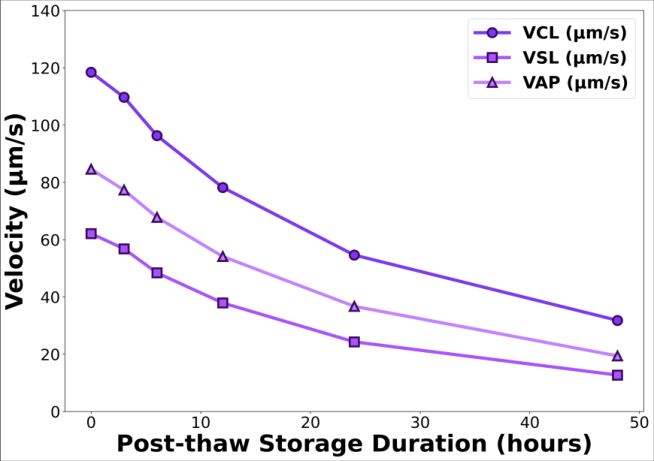 Figure 1
 Table 2
 Figure 2
Introduction
The first commercial application of sex-sorted bovine semen dates to the mid-1990s, when Amann [2] and subsequent researchers demonstrated that flow cytometric separation of Xand Y-bearing spermatozoa could shift offspring sex ratios above 90%. But three decades later, the technology still carries a trade-off: sorting subjects sperm to mechanical shear, UV laser exposure, and electrostatic deflection that compromise membrane stability and kinematic vigour [3,4] . Computer-assisted sperm analysis (CASA) has become the standard tool for quantifying these effects through parameters like curvilinear velocity (VCL), straight-line velocity (VSL), and average path velocity (VAP) [5] . Alongside kinematics, membrane integrity assessed via hypo-osmotic swelling (HOS) and fluorescent viability staining provides a complementary picture of functional competence [6] . Prior work has documented immediate post-sort declines in motility and viability, but the trajectory of deterioration during extended holding the hours between thawing and insemination in field conditions remains less characterized, particularly in Japanese Black cattle whose sperm may respond differently from Holstein spermatozoa [7,8] . Sharma et al. [9] noted that field fertility of sex-sorted semen ranges from 60-70% of conventional, with post-thaw handling as an important but underinvestigated modifier. Verstegen et al. [5] standardized CASA protocols for sorted semen but tested only immediate post-thaw samples. This research therefore tracked kinematic parameters and membrane integrity at five time points over 48 hours to define a practical storage limit for sex-sorted bovine semen under controlled thermal conditions.
Material and Methods
Material and Methods
Material
Semen was collected from 6 Japanese Black (Bos taurus) bulls aged 3-6 years maintained at the Tsukuba Academy of Biological Sciences research farm from May to November 2025.
Each bull provided 4 ejaculates at weekly intervals using an artificial vagina. Sorted semen (2.1 × 10 6 cells/dose, Xbearing fraction) was prepared by a commercial sorting facility using MoFlo SX sorter technology. Conventional unsorted semen (15 × 10 6 cells/dose) from the same ejaculates served as controls. All samples were cryopreserved in 0.25 mL straws using a standard egg-yolk citrate extender. The protocol was approved by the Tsukuba Academy Institutional Animal Care Committee (TAICC-2025-031, April 2025).
Methods
Straws were thawed at 37 °C for 30 seconds and maintained in a water bath at 37 °C. Aliquots were drawn at 0, 6, 12, 24, and 48 hours post-thaw. CASA analysis used a Hamilton Thorne IVOS II system (Beverly, MA) with species-specific settings: frame rate 60 Hz, minimum 200 cells per field, 5 fields per sample. Parameters recorded were VCL, VSL, VAP, linearity (LIN = VSL/VCL), straightness (STR = VSL/VAP), amplitude of lateral head displacement (ALH), and beat cross frequency (BCF). Membrane integrity was assessed by two methods: HOS test (100 mOsm/kg fructosecitrate solution, 30 min, 37 °C) counting tail-curled spermatozoa, and dual fluorescent staining with SYBR-14/propidium iodide (PI) evaluated by flow cytometry (BD FACSCalibur). At least 10,000 events were captured per sample. Data were analyzed in R 4.3 using repeated-measures ANOVA with Bonferroni post-hoc correction, treating bull as a random factor and storage time as repeated.
Instrumentation
The IVOS II system was calibrated daily against latex microsphere standards (50 µm diameter). Flow cytometric sorting was performed on a MoFlo SX equipped with a 355 nm UV laser and 488 nm argon laser. BD FACSCalibur (488 nm laser, 515/40 and 585/42 filters) was used for SYBR-14/PI viability analysis with compensation set using single-stained controls [5,1] .
Safety considerations
UV laser exposure during sorting was contained within the sealed optical chamber. Liquid nitrogen handling followed institutional cryogenic safety protocols. Propidium iodide a potential mutagen was handled with nitrile gloves and disposed through hazardous waste channels per institutional biosafety guidelines.
Results
All kinematic parameters showed time-dependent deterioration in both sorted and conventional semen, but the rate of decline was steeper for sorted samples at every interval measured. VCL dropped by 52.3% over 48 hours in sorted semen compared with 34.1% in conventional controls. Progressive motility crossed the 30% threshold often considered a minimum for acceptable fertility between 12 and 24 hours for sorted samples but remained above 30% beyond 48 hours for conventional semen [10,11] . Membrane integrity tracked kinematic decline closely: the correlation between VCL and membrane-intact percentage at 12 hours was r = 0.76 (P<0.01). HOS and dual-stain methods showed strong agreement (r = 0.88), confirming that both assays captured similar aspects of membrane competence [6,12] . Bull-to-bull variation was moderate (coefficient of variation 11-18% for VCL across time points), with two bulls consistently maintaining higher post-sort viability than the remaining four, suggesting individual tolerance to sorting stress [13] .
Discussion
The main finding is that sex-sorted bovine spermatozoa lose functional competence roughly twice as fast as conventional semen during post-thaw storage at 37 °C. This accelerated decline is consistent with sorting-induced membrane destabilization the flow cytometric process strips cholesterol from sperm membranes, triggering premature capacitationlike changes that reduce longevity [3,4] . Maxwell et al. [8] reported similar kinematic patterns in sorted ram semen, with VCL half-life approximately 40% shorter than unsorted controls. Our 12-hour practical storage limit aligns with the interval where progressive motility crosses 30% a threshold below which conception probability drops sharply in field AI programs [9,10] . Barrier Battut et al. [13] found that sorted equine spermatozoa maintained acceptable motility for only 8-10 hours, suggesting species differences in post-sort resilience. The strong correlations between kinematic and membrane parameters at 12 hours support using CASA as a rapid proxy for membrane competence, reducing reliance on slower fluorescent assays in time-sensitive field settings [5,14] . Individual bull variation in post-sort survival carries practical implications for sire selection. The two bulls retaining higher viability shared no obvious phenotypic similarity, pointing to intrinsic membrane composition differences that could serve as selection markers in breeding programs targeting sorted semen compatibility [15] .
Conclusion
This research aimed to define how storage duration affects kinematic vigor and membrane integrity of flowcytometrically sorted bovine semen. VCL declined by 52.3% and membrane-intact spermatozoa fell from 67.8% to 28.4% over 48 hours, with sorted samples deteriorating at nearly double the rate of conventional controls. A practical storage window of 12 hours post-thaw provides an evidence-based guideline for AI programs using sorted semen. Future work should investigate whether membranestabilizing additives can extend this window and whether bull-level variation in post-sort resilience can be predicted from ejaculate characteristics prior to sorting.
Acknowledgement
Acknowledgements Funding SourcesThis research was supported by an internal competitive grant from the Tsukuba Academy of Biological Sciences. Institutional SupportThe Academy's central laboratory provided CASA equipment access and flow cytometry facilities throughout the experimental period.
Figures and tables from the paper
| Time (h) | VCL (µm/s) | VSL (µm/s) | Prog. Motility (%) | HOS+ (%) | Membrane Intact (%) |
|---|---|---|---|---|---|
| 0 | 128.4 ± 8.7 | 78.6 ± 6.2 | 52.3 ± 5.8 | 61.4 ± 3.9 | 67.8 ± 4.2 |
| 6 | 108.1 ± 9.4 | 64.3 ± 7.1 | 43.7 ± 6.3 | 54.2 ± 4.7 | 58.1 ± 5.0 |
| 12 | 89.7 ± 10.8 | 51.8 ± 8.4 | 34.1 ± 7.2 | 45.6 ± 5.3 | 47.3 ± 5.6 |
| 24 | 72.3 ± 12.1 | 38.4 ± 9.6 | 22.6 ± 8.1 | 34.8 ± 6.2 | 35.9 ± 6.8 |
| 48 | 61.2 ± 11.3 | 27.1 ± 8.9 | 14.8 ± 6.4 | 22.1 ± 7.1 | 28.4 ± 6.1 |
Table text extracted from the original PDF; superscript letters are shown inline. The original table image is below.
View original table image
| — | VCL | Prog. Motility | HOS+ | Membrane Intact |
|---|---|---|---|---|
| VCL | 1.00 | 0.84** | 0.71** | 0.76** |
| Prog. Motility | 0.84** | 1.00 | 0.79** | 0.82** |
| HOS+ | 0.71** | 0.79** | 1.00 | 0.88** |
| Membrane Intact | 0.76** | 0.82** | 0.88** | 1.00 |
Table text extracted from the original PDF; superscript letters are shown inline. The original table image is below.
View original table image
References
15 in the original paper- Hossain MS, Johannisson A, Wallgren M, Nagy S, Siqueira AP, Rodriguez-Martinez H. Flow cytometry for the assessment of animal sperm integrity and functionality: state of the art. Asian J Androl. 2011;13(3):406-419.
- Amann RP. Physiology and endocrinology. In: Hafez ESE, editor. Reproduction in farm animals. 6th ed. Philadelphia: Lea & Febiger; 1993. p. 65-101.
- Mortimer ST, van der Horst G, Mortimer D. The future of computer-aided sperm analysis. Asian J Androl. 2015;17(4):545-553.
- Parrish JJ, Krogenaes A, Susko-Parrish JL. Effect of bovine sperm separation by swim-up or Percoll on success of in vitro fertilization. Theriogenology. 1995;44(6):859-869.
- Verstegen J, Iguer-Ouada M, Onclin K. Computerassisted semen analyzers in andrology research and veterinary practice. Theriogenology. 2002;57(1):149179.
- Hallap T, Nagy S, Jaakma U, Johannisson A, Rodriguez-Martinez H. Mitochondrial activity of frozen-thawed bull spermatozoa assessed by JC-1 staining. Theriogenology. 2006;65(6):1122-1136.
- Kanno C, Kang SS, Kitade Y, Yanagawa Y, Takahashi Y, Nagano M. Simultaneous evaluation of bovine sperm viability and acrosome integrity by flow cytometry. J Reprod Dev. 2016;62(5):527-533.
- Maxwell WMC, Evans G, Hollinshead FK, Bathgate R, De Graaf SP, Eriksson BM, Gillan L, Morton KM, O'Brien JK. Integration of sperm sexing technology into the ART toolbox. Anim Reprod Sci. 2004;8283:79-95.
- Sharma R, Khan MH, Patra MK, Kumar B, Bajia NP, Reddy AL, Biswas N, Kumar S. Status and prospects of sex sorted semen in India. Int J Vet Sci Anim Husb. 2024;9(5):39-47.
- Gillan L, Evans G, Maxwell WMC. Flow cytometric evaluation of sperm parameters in relation to fertility potential. Theriogenology. 2005;63(2):445-457.
- Anzar M, He L, Buhr MM, Kroetsch TG, Pauls KP. Sperm apoptosis in fresh and cryopreserved bull semen detected by flow cytometry and its relationship with fertility. Biol Reprod. 2002;66(2):354-360.
- Thomas CA, Garner DL, DeJarnette JM, Marshall CE. Effect of cryopreservation on bovine sperm organelle function and viability as determined by flow cytometry. Biol Reprod. 2006;58(3):786-793.
- Barrier Battut I, Kempfer A, Becker J, Lebailly L, Camugli S, Brachetti G, Destrumelle S, Fichou J. Development of a new fertility prediction model for stallion semen. Anim Reprod Sci. 2013;137(3-4):155162.
- Bergstein-Galan TG, Weiss RR, Bertol MAF, Kozicki LE. Quality and fertility of frozen bovine semen: a review. Rev Bras Reprod Anim. 2019;43(2):554-562.
- Moce E, Graham JK, Schenk JL. Effect of sex-sorting on the ability of fresh and cryopreserved bull sperm to undergo an acrosome reaction. Theriogenology. 2006;66(4):929-936.