
Research article · 2026 · Full text
International Journal of Horticulture and Food ScienceScenario of citrus nematode, Tylenchulus semipenetrans in Haryana and assessing their economic threshold level
Volume 8(6) · Pages 47–50 · DOI: 10.33545/26631067.2026.v8.i6a.761 ↗
Research areasNematode management and characterization studiesInsect-Plant Interactions and ControlPlant Disease Management Techniques
Abstract
Author-writtenThe citrus nematode, Tylenchulus semipenetrans is one of the most damaging plant parasitic nematodes (PPNs), affecting citrus and causing substantial yield losses worldwide. An extensive survey was carried out for the infestation of PPNs associated with citrus orchards during 2021-25. Soil and root samples were collected from 210 citrus orchards represents six different districts of Haryana. Samples were processed by Modified Baermann Funnel Technique (MBFT), and nematodes were identified to genus or species using morphological keys. Five genera were recorded, with T. semipenetrans (35.7% of orchards) was found to be more abundant followed by Hoplolaimus and Helicotylenchus. Out of 210 samples from citrus orchards were collected, 75 samples were found infested with T. semipenetrans with a 35.7% frequency of occurrence. Highest frequency of occurrence was observed in Sirsa (44.0%) followed by Fatehabad (40.0%), Hisar (38.0%), Jind (35.0%), Bhiwani (30.0%), and Sonipat (20.0%). Other PPNs which were found associated with citrus belonged to Meloidogyne incognita (17.3%), Pratylenchus spp. (14.0%), Hoplolaimus sp. (28.5%), Helicotylenchus sp. (20.5%). Overall in five years surveyed data, a total 75 sample were found infested with T. semipenetrans and 47 were above economic threshold level (ETL) in different districts. The findings provide a baseline pest inventory that can guide nematode management recommendations for citrus growers in the region.
Summary
Source-checkedPlain-language reading of the full paper, prepared with AI and checked against the text. Each point links to the authors' own words.
Why it matters
- Tylenchulus semipenetrans is a highly damaging plant parasitic nematode that causes significant yield losses in citrus crops globally. View evidence ↗
- Citrus production is significant in Haryana, with 25,176.3 hectares cultivated producing 3,59,084 MT. View evidence ↗
- T. semipenetrans attacks citrus roots, leading to a disease complex referred to as 'slow decline'. View evidence ↗
The question
- The study aimed to assess the frequency and abundance of plant parasitic nematodes (PPNs) in citrus orchards across six districts of Haryana from 2021 to 2025. View evidence ↗
What they did
- The researchers collected soil and root samples from 210 citrus orchards across six districts. View evidence ↗
- Soil was collected randomly from the citrus rhizosphere at depths of 0-45 cm using a soil auger. View evidence ↗
- Nematodes were extracted from 200 cc soil samples using Cobb's sieving and decanting method followed by the Modified Baermann Funnel Technique (MBFT) with a 300 mesh sieve. View evidence ↗
What they found
- T. semipenetrans was found in 75 out of 210 samples, representing a 35.7% frequency of occurrence. View evidence ↗
- The highest frequency of T. semipenetrans was in Sirsa (44.0%), while the lowest was in Sonipat (20.0%). View evidence ↗
- Of the 75 samples infested with T. semipenetrans, 47 were found to be above the economic threshold level (ETL). View evidence ↗
- Other associated PPNs included Hoplolaimus sp. (28.5%), Helicotylenchus sp. (20.5%), M. incognita (17.3%), and Pratylenchus spp. (14.0%). View evidence ↗
- In Hisar, T. semipenetrans occurred in 38.0% of samples (19/50) with a population density ranging from 165 to 340 J2s per 200 cc of soil. View evidence ↗
- In Jind, 35.0% of samples (21/60) were infested with T. semipenetrans, with densities between 75 and 285 J2s per 200 cc of soil. View evidence ↗
- T. semipenetrans was found to be a more predominant problem in Kinnow orchards compared to lemon orchards. View evidence ↗
What it means
- The authors conclude that molecular identification of nematode species is necessary to develop effective management plans to keep populations below the economic threshold. View evidence ↗
- The authors recommend increasing farmer literacy regarding nematode pests and promoting organic alternatives to chemical nematicides. View evidence ↗
- The authors state that further research is required to understand the significance of these nematodes and their interactions with the environment and other soil pathogens. View evidence ↗
Visual summary
2 visualsIllustrations explain the paper; charts are replotted from the paper's own table values.
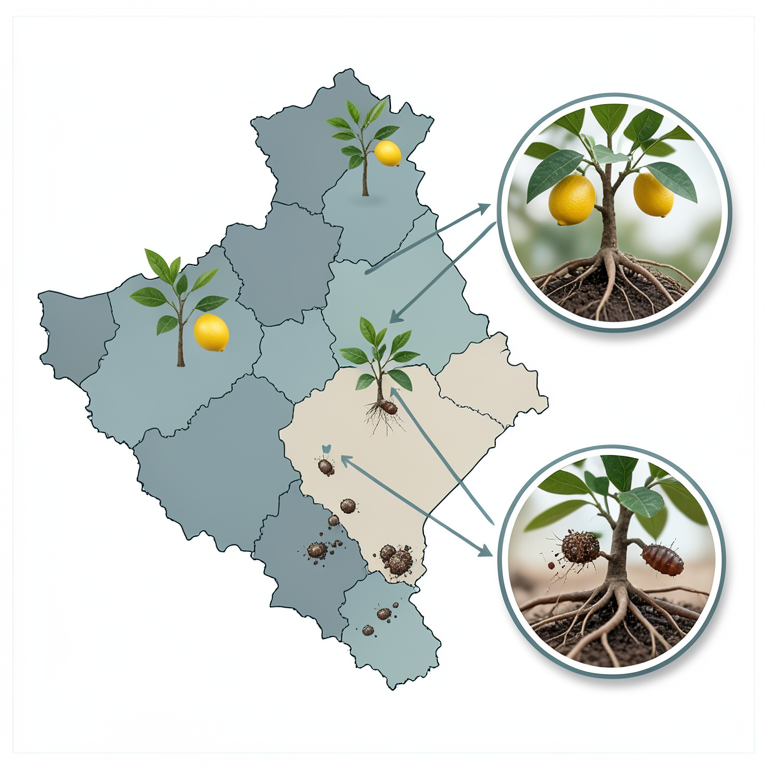
Geographic Distribution of T. semipenetrans
AI-generated conceptual illustration (Citrus plants and Tylenchulus semipenetrans nematodes in Haryana, India). It explains the idea and does not show study data.
View source evidence ↗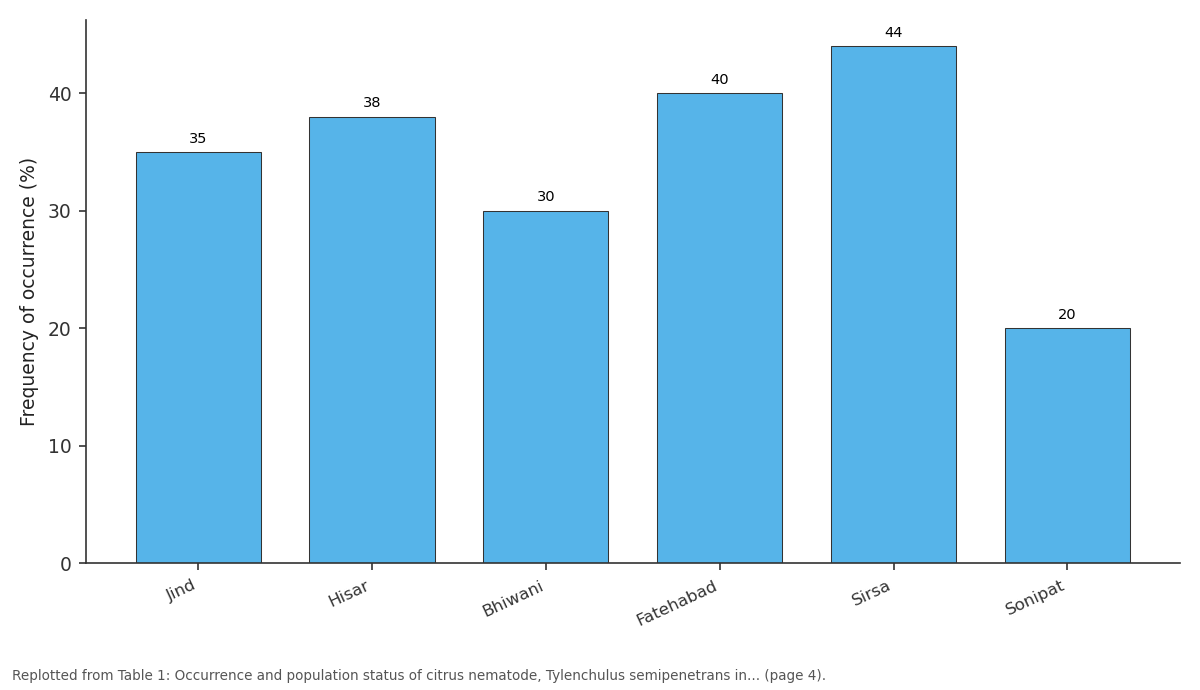
Frequency of occurrence (%): Jind vs Hisar vs Bhiwani vs Fatehabad vs Sirsa
Replotted from Table 1 (page 4) of the original paper. Every bar is the paper's own table value.
View source evidence ↗Figures & tables
From the original paper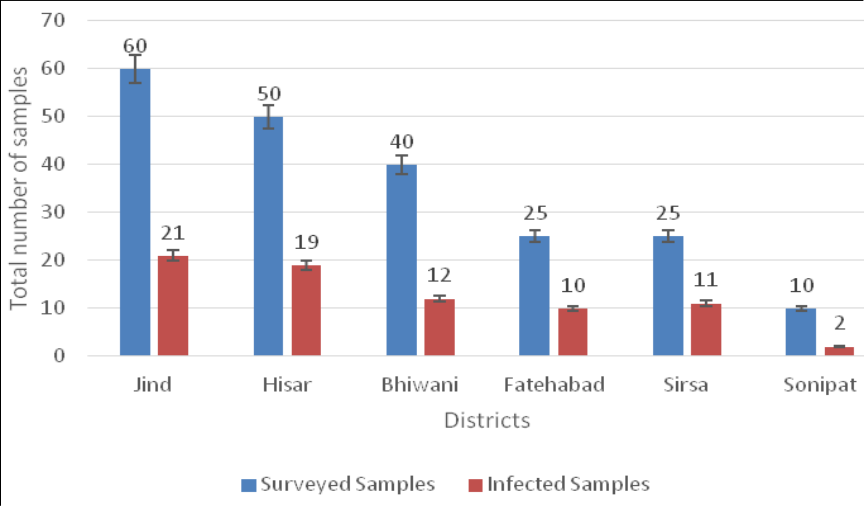 Figure 1
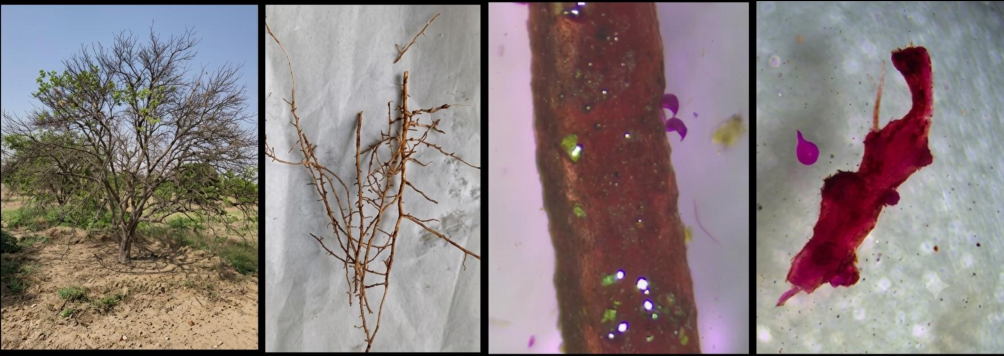 Plate 1
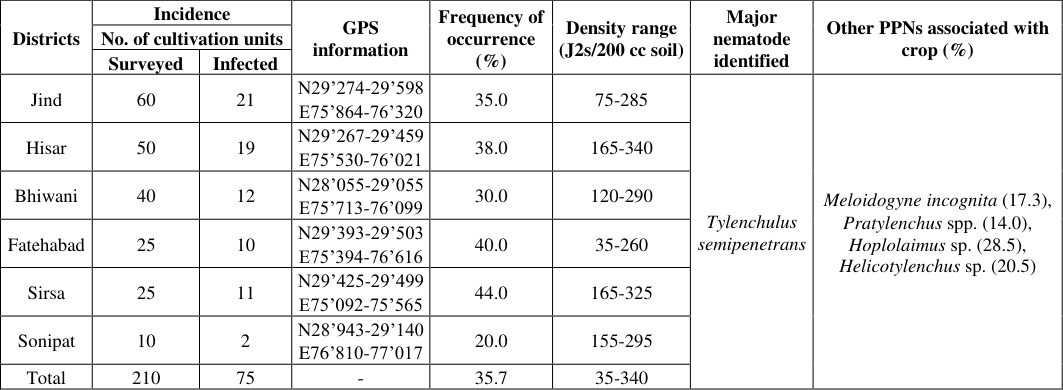 Table 1
Introduction
Citrus is among the top 10 economically important crops in terms of total global fruit yield and ranks first in international fruit trade in terms of value. Although, citrus is native to East Asia, currently, it is grown all over the world particularly in tropical, subtropical and Mediterranean climatic regions on more than 10 million hectares of land [1] . In India, citrus cultivation particularly of mandarin, sweet orange and acid lime is widely practiced in several states including Haryana, where favorable agro-climatic conditions support orchard establishment and productivity. In Haryana, citrus is grown on 25,176.3 hectare with production of 3,59,084 MT [2] . The biotic and abiotic factors were found to be responsible for yield loss in citrus. Among these, biotic factors such as plant parasitic nematodes (PPNs), bacteria, fungi, viruses, etc., play a crucial role in yield loss through the generation of several diseases. Nematodes that infest citrus are obligate parasites classified into different ecological groups. These include sedentary semi-endoparasites (Tylenchulus semipenetrans), migratory endoparasites (Pratylenchus spp. and Radopholus citrophilus) and ectoparasites (Xiphinema spp., Trichodorus spp., Paratrichodorus spp., Hemicycliophora spp., Criconemoides spp., and Belonolaimus longicaudatus) [3] . Among them, T. semipenetrans that specifically attacks the roots of citrus plants, causes the disease complex known as "slow decline." This nematode is widely distributed in Indian citrus orchards, including those of Haryana, and has been reported as a key factor limiting root development, nutrient and water uptake, tree vigor and fruit yield [4] . T. semipenetrans is a sedentary endoparasite that invades the root system, causing slow decline symptoms, including reduced root function, stunted growth, leaf chlorosis and poor fruit set.
Infected trees experience lower nutrient and water uptake, leading to a decline in fruit quality and yield [5] . Severe infestations can cause substantial economic losses, with yield reductions ranging from 10-30%, depending on nematode population density and environmental conditions [6] . In India, T. semipenetrans causes 27% yield reductions with monetary losses of Rs. 9828 million in citrus crops [7] . By implementing effective management strategies, it is possible to reduce the negative effects of nematodes and enhance agricultural productivity in Haryana. This part of Haryana is an important citrus producing area but an investigation of nematode pests of the crop is absent. This reason necessitated this work in order to identify the possible nematode affecting citrus production in Haryana in order for farmers and the authorities concerned to carry out the measures required to reduce their negative effect. Ongoing surveys and research are essential for understanding their diversity, distribution, and impact on agriculture. Therefore, to understand the severity of PPNs, an extensive survey was conducted to assess the frequency and abundance of PPNs associated with citrus in Haryana, particularly in the Hisar, Fatehabad, Sirsa, Jind, Bhiwani and Sonipat districts, during 2021-2025.
Materials and Methods
Surveys were conducted in the major citrus growing villages of districts of Jind, Hisar, Bhiwani Fatehabad, Sirsa and Sonipat districts of Haryana during 2021-2025. Soil and root samples of citrus plants exhibiting nematode symptoms were collected and analyzed for PPNs (Plate 1). Using soil auger, random sampling method was used for collecting soil from rhizosphere of citrus at depth 0-45 cm. Composite samples of soil and root were collected randomly from rhizosphere of disease infected citrus plants. A questionnaire was filled out in the survey field to obtain data like as the farmer's name, crop variety, crop history, diseases and management of crops. Soil samples were collected in polythene bags, labeled, handled and refrigerated at 7-10 0 C before processing. Data on nematode population densities were analyzed to assess the average density of each nematode species, and frequency of occurrence in each district.
Extraction of nematodes from samples
Soil sample of 200 cc was processed using Cobb's sieving and decanting method [8] followed by Modified Baermann Funnel Technique (MBFT) for extraction of nematodes [9] using 300 mesh sieve. A bank of 20, 100 and 300 mesh sieves was used for washing soil samples. Killing and fixing of nematodes was done by adding boiling fixative (8% formalin) to nematode suspension. The nematode suspension further processed by glycerol ethanol method for identification of nematodes. The suspension of nematodes obtained from roots and soil was investigated with the help of a stereomicroscope after incubation of 48h. One ml sample of nematode pipetted into a nematode counting plate and placed under a stereomicroscope for calculation. The event repeated for trice and the mean value ascertained.
Results and Discussion
Survey of Jind, Hisar, Bhiwani, Fatehabad, Sirsa and Sonipat districts of Haryana were conducted for the presence of PPNs during 2021-2025. Soil samples were collected from different locations along with roots. The samples were analyzed as per the standard protocol. A total of 210 samples from citrus fields were collected, 75 samples were found infested with T. semipenetrans with a 35.7% frequency of occurrence (Table 1). Highest frequency of occurrence was observed in Sirsa (44.0%) followed by Fatehabad (40.0%), Hisar (38.0%), Jind (35.0%), Bhiwani (30.0%), and Sonipat (20.0%). Other PPNs which were found associated with citrus belonged to M. incognita (17.3%), Pratylenchus spp. (14.0%), Hoplolaimus sp. (28.5%), Helicotylenchus sp. (20.5%). Overall in five years surveyed data, a total 75 sample were found infested with T. semipenetrans and 47 were above economic threshold level (ETL) in different districts. Among all the isolated PPNs, T. semipenetrans was found to be more abundant followed by Hoplolaimus sp. and Helicotylenchus sp. Our results emphasize the importance of pre-plant population density on nematode population dynamics. The results revealed that out of 60 samples from Jind district, 21 were found infested with T. semipenetrans with 35.0% frequency of occurrence and density range of 75-285 J2s/200 cc soil. In Hisar district, this nematode had 38.0% frequency of occurrence (19 out of 50 samples) with density range of 165-340 J2s/200 cc soil (Fig 1). A total of 40 samples were collected from Bhiwani district. Out of these samples, 12 were found infected with M. incognita with 30.0% frequency of occurrence. In Sirsa and Sonipat districts, this nematode had 44.0 and 20.0% frequency of occurrence, respectively. Results of this study suggest that moisture availability in surface soils of these regions could be a major determinant of the population differences in different districts of Haryana. Survey results indicated that T. semipenetrans was the predominant problem, particularly in Kinnow than lemon orchards. T. semipenetrans was found to be significantly present in citrus orchards, along with other PPNs such as Tylenchorhynchus spp., Helicotylenchus spp., Hoplolaimus spp., Rotylenchus reniformis and Pratylenchus spp. whereas, M. incognita was recorded only in Sirsa district. The citrus nematode is prevalent in higher densities in citrus (kinnow) growing particularly Sirsa and Fatehabad [10&11]. A random survey undertaken in the major citrus growing districts of south-west Haryana for the associated nematodes in citrus rhizosphere soil and root samples showed the presence of PPNs, mainly T. semipenetrans, Pratylenchus coffeae, Paratrichodorus mirzai, Hoplolaimus indicus, Helicotylenchus dihystera, Tylenchorynchus mashhoodi, Longidorus siddiqi and Xiphinema americanum [11] .
[12] accessed the incidence and distribution of citrus nematode in different major citrus growing areas of Punjab (Pakistan). Soil and root samples were collected from different citrus varieties comprising Feutrell's Early, Grapefruit, Kinnow, Lemon, Malta, Mitha, Musambi and Orange. A total of 604 samples containing mixed population of 21 genera and 25 species of PPNs were analyzed. Rootknot nematodes (M. incognita and M. javanica) with 36-62% frequency of occurrence, respectively, were the most frequently encountered nematodes. The citrus nematode (T. semipenetrans) had 94% frequency of occurrence on citrus trees, while the golden potato cyst nematode (Globodera rostochiensis) had a high (54%) frequency of occurrence on potato in El-Behera governorate [13] . Kinnow was the most infested by nematode with mean population 1161 while sweet orange was the least infested with 595 nematodes, in all localities. Maximum nematode population density in healthy and declining orchards was recorded in Kot Momin that was 2600 and 946 nematodes per 50 ml of soil, respectively. The lowest mean population was recorded in Silanwali with 1200 in healthy and 300 in declining orchards [14] . The presence of economically important PPNs in citrus fields in different districts of Haryana, deserve serious attention by researchers and extension workers. Further research is needed to determine the significance of these nematodes on citrus and to determine their possible interaction with other soil pathogens and the environment. This survey provides important background information for planning and administering nematode management strategies in citrus fields of Haryana.
Conclusion
In conclusion, this survey establishes a foundation for assessing the extent and intensity of these phytoparasitic nematode-related challenges, thus aiding in the formulation of effective mitigation strategies for sustainable plant health. This study illustrated that the citrus field is invaded by multiple PPNs in Haryana. The most invasive nematode genera are Tylenchulus, Meloidogyne, Pratylenchus, Hoplolaimus, and Helicotylenchus. Therefore, additional research is required to identify the nematode species on a molecular basis so that an appropriate and effective management plan may be developed to keep the PPN population below the economic threshold and at a sustainable level (ETL). On the other, it is a need of the hour to disseminate agrarian literacy among the farmers to let them educate about hazardous pests like nematodes and the importance of organic solutions as an alternative to nondegradable chemical nematicides.
References
14 in the original paper- Khanchouch K, Pane A, Chriki A, Cacciola SO. Major and emerging fungal diseases of citrus in the Mediterranean region. In: Gill H, Garg H, editors. Citrus Pathology. IntechOpen; 2017. https://doi.org/10.5772/66943.
- Anonymous. Haryana Horticulture Department [Internet]. 2024. Available from: http://hortharyana.gov.in.
- Duncan LW. Managing nematodes in citrus orchards. In: Moens M, d'Herde JL, Sikora A, editors. Integrated Management of Fruit Crops Nematodes. Integrated Management of Plant Pests and Diseases. Vol 4. Springer; 2021. p. 135-174. https://doi.org/10.1007/978-1-4020-9858-16.
- Shokoohi, Duncan LW. Nematode parasites of citrus. In: Plant Parasitic Nematodes in Subtropical and Tropical Agriculture. Wallingford (UK): CAB International; 2018. p. 446-476. https://doi.org/10.1079/9781786391247.0446.
- Norton DC, Niblack TL. Biology and ecology of nematodes. In: Manual of Agricultural Nematology. CRC Press; 2020. p. 47-72.
- Verdejo-Lucas S, McKenry MV. Management of the citrus nematode, Tylenchulus semipenetrans. Journal of Nematology. 2004;36(4):424-432.
- Kumar V, Khan MR, Walia RK. Crop loss estimations due to plant-parasitic nematodes in major crops in India. National Academy Science Letters. 2020;43(5):409-412. https://doi.org/10.1007/s40009-020-00895-2.
- Cobb NA. Estimating the nema population of soil, with special references to the sugarbeet and root-gall nemas, Heterodera schachtii Schmidt and Heterodera radicicola (Greef) Müller, and with a description of Tylencholaimus aequalis n. sp. Agricultural Technical Circular. 1918;1:48.
- Schindler AF. A simple substitute for Baermann funnel. Plant Disease Reporter. 1961;45:747-748.
- Bajaj HK. Phyto and soil inhabiting nemic fauna of Haryana. Department of Nematology, Haryana Agricultural University; 1989. p. 30.
- Sujata, Kanwar RS, Patil JA. Current status of plant parasitic nematodes associated with Kinnow in Haryana. In: 5th National Symposium on Plant Protection in Horticulture (NSPPH-2021): Challenges and Roadmap Ahead. ICAR-Indian Institute of Horticultural Research, Bengaluru; 2021. p. 20.
- Khanzada SA, Iqbal A, Munir A, Burney K, Hameed S, Rehman HU. Incidence and distribution of citrus nematode Tylenchulus semipenetrans in citrus orchards of Punjab. Pakistan Journal of Nematology. 2008;26:51-58.
- Ibrahim IKA, Kantor M, Habteweld A, Handoo ZA. A survey of phytoparasitic nematodes on some plant crops in Northern Egypt. Nematropica. 2023;53:104-109.
- Haseeb AY, Iftikhar MA, Zeshan S, Ali R, Binyamin S, Ghuffar M, Ghani MU. A study on population diversity of citrus nematodes in district Sargodha. Sarhad Journal of Agriculture. 2023;40(1):149-157.