
Research article · 2026 · Full text
International Journal of Geography Geology and EnvironmentIrrigation in Haryana since green revolution
Volume 8(6) · Pages 103–108 · DOI: 10.22271/27067483.2026.v8.i6b.789 ↗
Research areasIrrigation Practices and Water ManagementEngineering and Agricultural InnovationsAgricultural Economics and Practices
Abstract
Author-writtenSince the advent of the Green Revolution, Haryana has emerged as a major user of water for agricultural irrigation. Rivers and groundwater have become backbone of state’s agricultural productivity and development. Irrigation is essential not only on behalf of transforming agriculture and ensuring food security but also as a key source of income for Haryana’s population. As population growth continues to drive demand for food, shelter, and clothing, agriculture remains the region’s primary economic pursuit, entirely dependent on reliable irrigation methods. Furthermore, industrial and technological advancements, as well as institutional progress, hinge on effective water resource management. Addressing both present and future water requirements necessitates the prudent and efficient use of available water, with the urgent adoption of advanced soil-water management and micro-irrigation techniques. This transition from traditional flood irrigation to methods like drip and sprinkler irrigation is critical to sustaining Haryana’s agricultural future.
Summary
Source-checkedPlain-language reading of the full paper, prepared with AI and checked against the text. Each point links to the authors' own words.
Why it matters
- Irrigation is vital for Haryana as it transforms agriculture, ensures food security, and serves as a primary income source for the population. View evidence ↗
- With an average annual rainfall of around 450 mm and a brief rainfall period, Haryana requires substantial irrigation to sustain its farming. View evidence ↗
- The prevalence of sandy and sandy loam soils in the region further increases the need for additional irrigation. View evidence ↗
What they did
- The research utilizes secondary data sourced from the Census of India (2011) and the Statistical Abstract of Haryana covering 1972-73 to 2022-23. View evidence ↗
- The authors used descriptive, comparative, and percentile approaches to analyze spatial patterns and trends in irrigation. View evidence ↗
What they found
- In 1970-71, irrigation covered 43% of the net sown area, totaling 1.532 million hectares, primarily through wells and canals. View evidence ↗
- By 1990-91, the net irrigated area grew to 2.6 million hectares (72.7% of net sown area), with tube wells accounting for 48% of that land. View evidence ↗
- In 2000-01, tube well irrigation (1.467 million hectares) first exceeded canal irrigation (1.436 million hectares), bringing total coverage to 83.9% of net sown land. View evidence ↗
- By 2020-21, irrigation covered 94.9% of the net sown area (3.388 million hectares), with tube wells providing 63.6% and canals 36.4% of the irrigation. View evidence ↗
What it means
- The authors conclude that intensive and inefficient irrigation has led to the rapid exhaustion of groundwater and a scarcity of potable water. View evidence ↗
- The authors recommend shifting the focus from maximizing irrigated area to ensuring the sustainable and judicious use of water resources. View evidence ↗
- The authors suggest that future research should focus on the adoption rates and field-level impacts of micro-irrigation techniques like drip and sprinkler systems. View evidence ↗
Visual summary
3 visualsIllustrations explain the paper; charts are replotted from the paper's own table values.
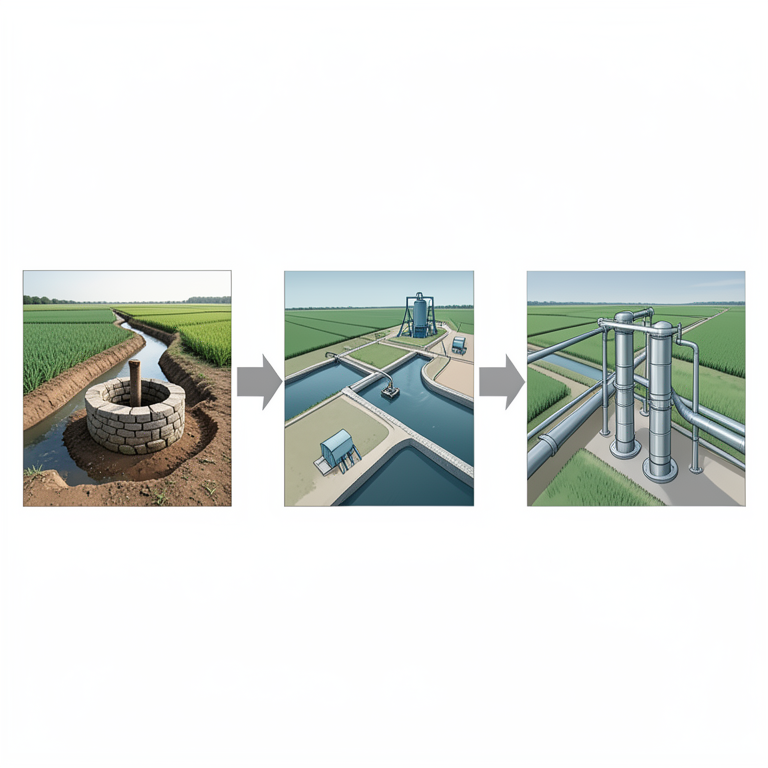
Evolution of Irrigation Sources
AI-generated conceptual illustration (Agricultural fields in Haryana, India). It explains the idea and does not show study data.
View source evidence ↗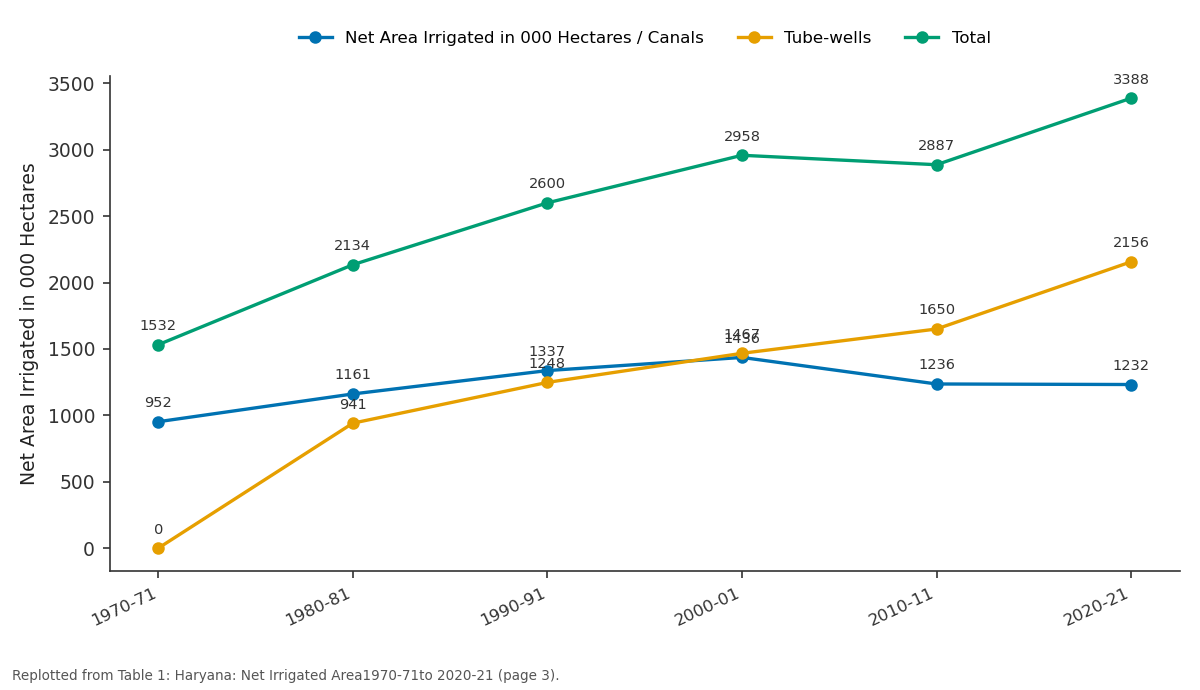
Net Area Irrigated in 000 Hectares / Canals and Tube-wells and more: 1970-71 vs 1980-81 vs 1990-91 vs 2000-01 vs 2010-11
Replotted from Table 1 (page 3) of the original paper. Every bar is the paper's own table value.
View source evidence ↗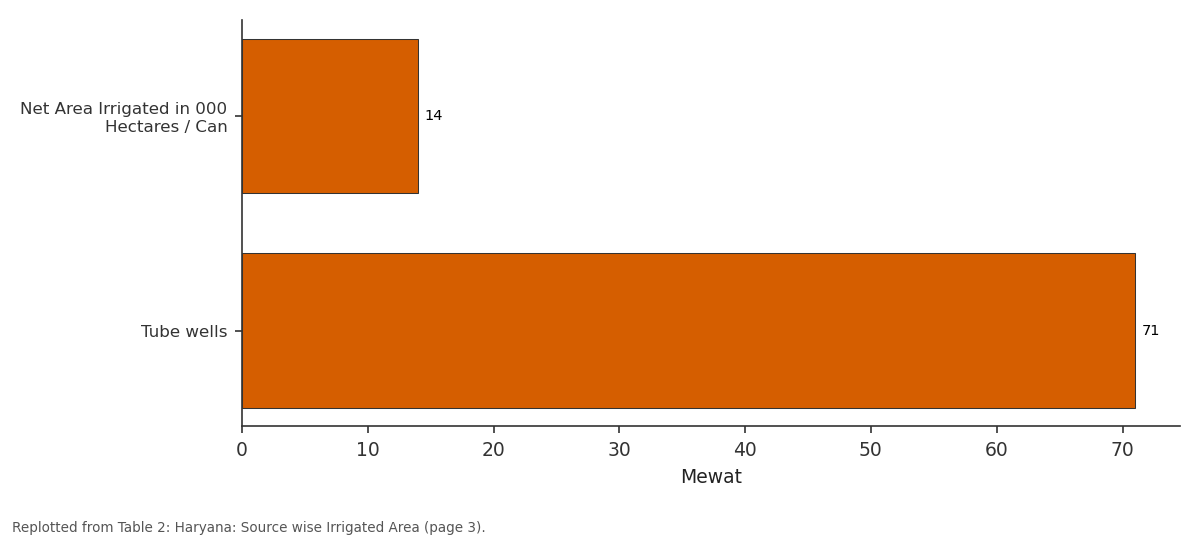
Mewat: Net Area Irrigated in... vs Tube wells
Replotted from Table 2 (page 3) of the original paper. Every bar is the paper's own table value.
View source evidence ↗Figures & tables
From the original paper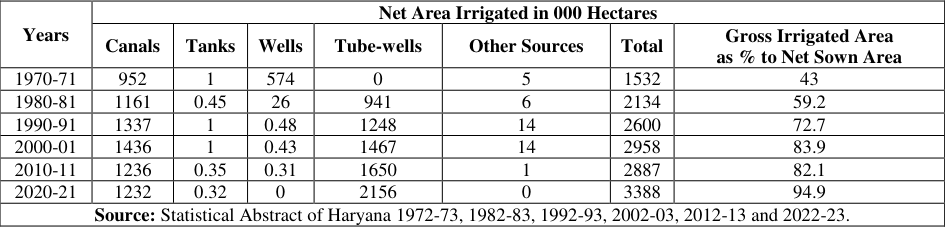 Table 1
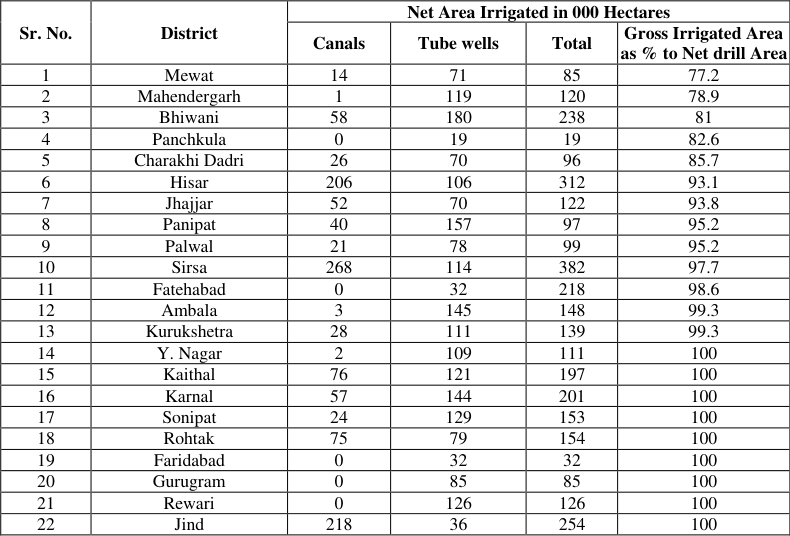 Table 2
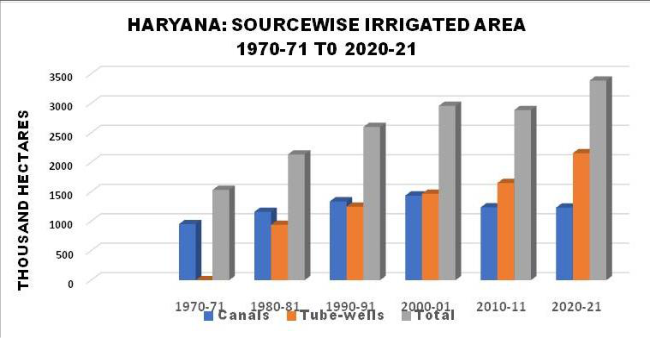 Figure 1
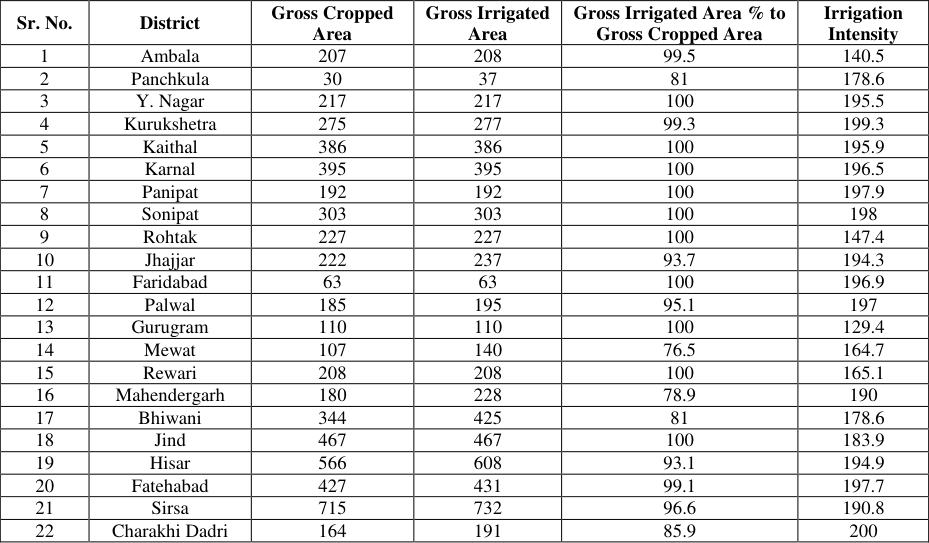 Table 3
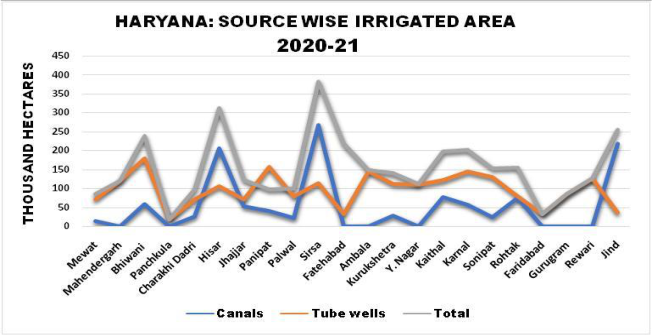 Figure 2
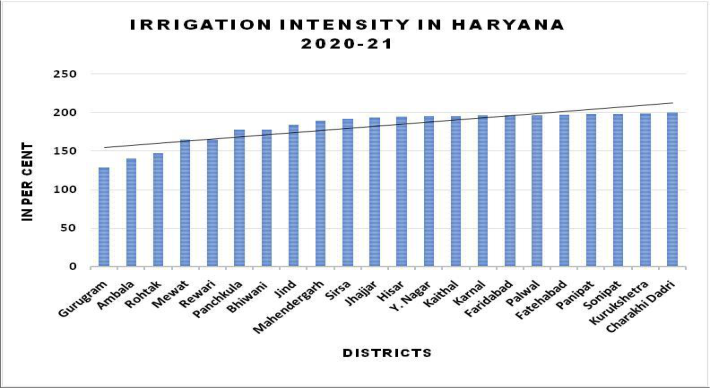 Figure 3
Introduction
The state of Haryana has undergone a remarkable transformation in its agricultural sector since the onset of the Green Revolution. Once primarily reliant on traditional irrigation methods, Haryana has surface as solitary of India's leading users of water for irrigation, leveraging both surface and groundwater resources to drive agricultural productivity with rural development. The role of irrigation in state extends beyond crop cultivation it has been fundamental to securing food supplies, supporting rural livelihoods, and underpinning Haryana's broader economic progress. Agriculture forms backbone of Haryana's economy, making efficient management of water resources a critical priority. The region's semi-arid climate, coupled with an uneven distribution of rainfall and mostly sandy or sandy loam soils, makes irrigation indispensable for sustaining crop yields and meeting the growing demands of a rising population. Over the decades, the state's irrigation infrastructure has evolved rapidly, transitioning from canals and wells to widespread adoption of tube wells and, more recently, a growing emphasis on modern micro-irrigation systems. The expansion of irrigation has enabled Haryana not only to meet its own food security requirements but also to contribute surplus grain to national reserves. However, this impressive growth has brought with it new challenges declining groundwater tables, increasing pressure on water resources, and the need for sustainable and equitable management of irrigation systems. As Haryana continues to modernize its agricultural sector, espousal of advanced water-saving techniques, such as drip as well as sprinkler irrigation, and judicious allocation of water resources have become more urgent than ever. A substantial body of research has explored the evolution and impact of irrigation in Haryana, reflecting broader themes in Indian agricultural geography and resource management. Gautam (2012) [2] offers a foundational overview of agricultural geography in India, highlighting the critical role that irrigation has played in transforming agrarian economies, with emphasis on the period following the Green Revolution. Similarly, Hussain (1996) [5] provides a systematic analysis of agricultural practices and their spatial variation, acknowledging that regions such as Haryana have seen significant shifts in cropping patterns and productivity due to expanded irrigation networks. Kaushik and Om Parkash (2010) [6] specifically examine how groundwater levels influence cropping patterns in Haryana's Karnal district. Their study underscores the direct relationship between irrigation availability and the selection of waterintensive crops, a pattern also seen statewide. Kumar (2014) [7] investigates both the economic advantages and environmental drawbacks associated with the Green Revolution in Haryana, noting that increased irrigation has led to higher yields but also to concerns regarding groundwater depletion and soil degradation. Neeraj (2014) [8] tracks the expansion of rice cultivation in Haryana from the late 1960s through 2010, attributing much of this growth to enhanced irrigation infrastructure, particularly the proliferation of tube wells. Sangwan and Monica (2017) [9] analyze spatio-temporal trends in irrigation development, finding that while access to irrigation has generally improved, disparities persist between districts due to differences in natural resource endowments and the availability of canal water versus groundwater. Sarkar, Sen, and Kumar (2009) extend the discussion to neighboring Punjab, comparing the sustainability of different irrigation systems within the rice-wheat cropping cycle. Their findings are relevant to Haryana, as both states share similar agroecological conditions and challenges related to water resource management. The Statistical Abstracts of Haryana (2001-02, 2011-12, 2017-18) provide comprehensive data on irrigation sources, coverage, and trends over time. These official reports serve as primary data sources in many academic and policy studies, documenting the transition from traditional wells and canals to modern tube wells and highlighting the increasing intensity of irrigation practices in the state. Collectively, these studies and sources emphasize that while Haryana's agricultural sector has greatly benefited from expanded irrigation, this progress has also brought new challenges. Groundwater depletion, declining water quality, and uneven access to reliable irrigation continue to threaten the long-term sustainability of farming in the region. The literature consistently calls for improved water management strategies, greater adoption of efficient irrigation technologies, and stronger policy interventions to ensure the future viability of Haryana's agriculture. This study examines the development of irrigation in Haryana from the Green Revolution to the present, focusing on trends in irrigated area, shifts in irrigation sources, and regional disparities in access. By analyzing historical data, the paper aims to provide insights that will inform more sustainable water management and agricultural policy in the years ahead.
Study Area
For this research, Haryana has been selected as study area. Recognized as one of India's most industrial states, Haryana is entirely landlocked, sharing its borders by Himachal Pradesh and Punjab to north, Rajasthan to west and south, and Uttarakhand to south. Most of the state consists of flat plains, though it is located at tail end of Aravalli mountain range. Geographically, Haryana spans from 27°39' to 30°35' North latitude in addition to 74°28' to 77°36' East longitude, with elevations ranging from 700 to 3,600 feet on top of sea level. The state can be divided into four major geographic regions: Yamuna-Ghaggar plain, Shivalik Hills in northeast, southwestern plains, and Aravalli hills in south. Haryana experiences a steamy climate similar to extra northern plains states, with most of region falling under a semi-arid classification. The state sees significant temperature variation all over year, by summer warmth rising to 40-46°C as well as winter temperatures dropping as low as 1.5-4°C; extremes can range from near freezing in winter to as high as 50°C in summer. Summers generally occur from April to July, while winters are from November to February. Rainfall is intense during monsoon months (July to September), which account for 80-90% of annual precipitation. The state's annual rainfalls vary on or after 300 mm in south and west to 700 mm in northeast, with an average around 450 mm. Of this, roughly 354 mm falls in the monsoon, with the remainder brought by western disturbances in winter. The brief and limited rainfall period necessitates substantial irrigation for agriculture. Haryana's soils are predominantly sandy and sandy loam, requiring additional irrigation to sustain farming. The Yamuna is solitary Perennial River, while Ghaggar, Markanda, Sahibi, as well as Dohan are seasonal, providing water only intermittently. Given the scarcity of reliable surface water, the state has become increasingly dependent on groundwater not only for irrigation excluding as well to meet broader needs of its human moreover animal populations. According to the Statistical Abstract of Haryana, the year 2010-11 saw a slight reduction in both the total irrigated area in addition to irrigation intensity. During this age, 2,887 thousand hectares of gross harvest area were irrigated, with canals and tube wells contributing 43% and 57% respectively to the total irrigated land area dropped to 82.1%. However, by 2020-21, the overall irrigated area had risen to 3,388 thousand hectares. Of this, canals accounted for 1,232 thousand hectares and tube wells for 2,156 thousand hectares, representing 36.4% and 63.6% of the total respectively. By the close of the decade, Haryana's irrigation facilities covered an impressive 94.9% of its net sown area. Districts with 85-95% Irrigated Area Kurukshetra, Jhajjar, Hisar, and Charakhi Dadri fall into this category. The moderate irrigation coverage is primarily due to inconsistent canal water supply, saline underground water, and high demand for water driven by dense populations. These constraints collectively limit the extent of land that can be reliably irrigated.
Objectives
Objectives
Districts with More Than 95% Irrigated Area
Districts such as Ambala, Yamuna Nagar, Kaithal, Karnal, Panipat, Sonipat, Rohtak, Faridabad, Palwal, Gurugram, Rewari, Jind, Fatehabad, and Sirsa exhibit very high levels of irrigation coverage. This is largely attributed to robust and well-maintained irrigation networks. Many of these districts, including Ambala, Yamuna Nagar, Karnal, Panipat, Sonipat, Faridabad, and Palwal, are situated near Haryana's only perennial river, the Yamuna. Meanwhile, the presence of high-quality groundwater in districts like Faridabad, Gurugram, and Rewari further bolsters their irrigation capacity.
Conclusion:
The irrigation scenario in Haryana largely mirrors the broader trends observed in other agricultural states across India. Over the past several decades, the state has made significant progress in expanding irrigation coverage and intensity, successfully transforming its agricultural landscape. This expansion has empowered Haryana not only to meet the food requirements of its own population but also to contribute substantial surplus grains to the national reserves, solidifying its role in India's food security network. However, this impressive achievement has not come without serious challenges. The widespread reliance on intensive irrigation, often through inefficient practices, has direct to a rapid exhaustion of groundwater resources and a growing scarcity of potable water for both humans and livestock. The over-extraction of groundwater, combined with the mismanagement of canal networks and the continued use of traditional flood irrigation methods, has created an unsustainable situation. As a result, many parts of the state now face falling water tables, deteriorating water quality, and increased vulnerability to drought and water stress. Given these realities, Haryana finds itself at a crossroads. The focus must now shift from merely maximizing irrigated area to guarantee sustainable and judicious use of water resources. Additionally, policies should be enacted to promote rainwater harvesting, groundwater recharge, and the rehabilitation of traditional water bodies. Community participation, farmer education, and government support will be crucial in implementing these reforms. Without decisive and collective action, the gains made in agricultural productivity could be eroded by an impending water crisis, threatening both rural livelihoods and ecological balance. Therefore, rather than celebrating past successes, it is imperative to recognize the looming challenges and take proactive, concrete steps towards conserving and managing water resources more efficiently. Only through such measures can Haryana ensure the long-term sustainability of its agriculture and safeguard the well-being of its people and future generations.
Socio-Economic Dimensions:
There is scope to study the social and economic impacts of irrigation development, including its role in rural livelihoods, gender equity in water access, and the financial sustainability of smallholder farmers under different irrigation regimes.
Policy and Institutional Innovations:
Investigating the effectiveness of new water management policies, community-based water governance, pricing mechanisms for water use, and public-private partnerships in irrigation infrastructure can provide valuable insights for scaling sustainable practices.
Integration of Technology:
Research can also examine the role of digital technologies, including mobile-based advisory services, IoT sensors for real-time water management, and GIS-based decision support systems in optimizing irrigation at the farm and regional scales.
Comparative Studies: Comparative analyses between
Haryana and other states or between different districts within Haryana can identify best practices and lessons learned for improving irrigation efficiency and sustainability.
Figures and tables from the paper
| Years | Net Area Irrigated in 000 Hectares | — | — | — | — | — | — |
|---|---|---|---|---|---|---|---|
| Canals | Tanks | Wells | Tube-wells | Other Sources | Total | Gross Irrigated Area as % to Net Sown Area | |
| 1970-71 | 952 | 1 | 574 | 0 | 5 | 1532 | 43 |
| 1980-81 | 1161 | 0.45 | 26 | 941 | 6 | 2134 | 59.2 |
| 1990-91 | 1337 | 1 | 0.48 | 1248 | 14 | 2600 | 72.7 |
| 2000-01 | 1436 | 1 | 0.43 | 1467 | 14 | 2958 | 83.9 |
| 2010-11 | 1236 | 0.35 | 0.31 | 1650 | 1 | 2887 | 82.1 |
| 2020-21 | 1232 | 0.32 | 0 | 2156 | 0 | 3388 | 94.9 |
| Source: Statistical Abstract of Haryana 1972-73, 1982-83, 1992-93, 2002-03, 2012-13 and 2022-23. |
Table text extracted from the original PDF; superscript letters are shown inline. The original table image is below.
View original table image
| Sr. No. | District | Net Area Irrigated in 000 Hectares | — | — | — |
|---|---|---|---|---|---|
| Canals | Tube wells | Total | Gross Irrigated Area as % to Net drill Area | ||
| 1 | Mewat | 14 | 71 | 85 | 77.2 |
| 2 | Mahendergarh | 1 | 119 | 120 | 78.9 |
| 3 | Bhiwani | 58 | 180 | 238 | 81 |
| 4 | Panchkula | 0 | 19 | 19 | 82.6 |
| 5 | Charakhi Dadri | 26 | 70 | 96 | 85.7 |
| 6 | Hisar | 206 | 106 | 312 | 93.1 |
| 7 | Jhajjar | 52 | 70 | 122 | 93.8 |
| 8 | Panipat | 40 | 157 | 97 | 95.2 |
| 9 | Palwal | 21 | 78 | 99 | 95.2 |
| 10 | Sirsa | 268 | 114 | 382 | 97.7 |
| 11 | Fatehabad | 0 | 32 | 218 | 98.6 |
| 12 | Ambala | 3 | 145 | 148 | 99.3 |
| 13 | Kurukshetra | 28 | 111 | 139 | 99.3 |
| 14 | Y. Nagar | 2 | 109 | 111 | 100 |
| 15 | Kaithal | 76 | 121 | 197 | 100 |
| 16 | Karnal | 57 | 144 | 201 | 100 |
| 17 | Sonipat | 24 | 129 | 153 | 100 |
| 18 | Rohtak | 75 | 79 | 154 | 100 |
| 19 | Faridabad | 0 | 32 | 32 | 100 |
| 20 | Gurugram | 0 | 85 | 85 | 100 |
| 21 | Rewari | 0 | 126 | 126 | 100 |
| 22 | Jind | 218 | 36 | 254 | 100 |
Table text extracted from the original PDF; superscript letters are shown inline. The original table image is below.
View original table image
| Sr. No. | District | Gross Cropped Area | Gross Irrigated Area | Gross Irrigated Area % to Gross Cropped Area | Irrigation Intensity |
|---|---|---|---|---|---|
| 1 | Ambala | 207 | 208 | 99.5 | 140.5 |
| 2 | Panchkula | 30 | 37 | 81 | 178.6 |
| 3 | Y. Nagar | 217 | 217 | 100 | 195.5 |
| 4 | Kurukshetra | 275 | 277 | 99.3 | 199.3 |
| 5 | Kaithal | 386 | 386 | 100 | 195.9 |
| 6 | Karnal | 395 | 395 | 100 | 196.5 |
| 7 | Panipat | 192 | 192 | 100 | 197.9 |
| 8 | Sonipat | 303 | 303 | 100 | 198 |
| 9 | Rohtak | 227 | 227 | 100 | 147.4 |
| 10 | Jhajjar | 222 | 237 | 93.7 | 194.3 |
| 11 | Faridabad | 63 | 63 | 100 | 196.9 |
| 12 | Palwal | 185 | 195 | 95.1 | 197 |
| 13 | Gurugram | 110 | 110 | 100 | 129.4 |
| 14 | Mewat | 107 | 140 | 76.5 | 164.7 |
| 15 | Rewari | 208 | 208 | 100 | 165.1 |
| 16 | Mahendergarh | 180 | 228 | 78.9 | 190 |
| 17 | Bhiwani | 344 | 425 | 81 | 178.6 |
| 18 | Jind | 467 | 467 | 100 | 183.9 |
| 19 | Hisar | 566 | 608 | 93.1 | 194.9 |
| 20 | Fatehabad | 427 | 431 | 99.1 | 197.7 |
| 21 | Sirsa | 715 | 732 | 96.6 | 190.8 |
| 22 | Charakhi Dadri | 164 | 191 | 85.9 | 200 |
Table text extracted from the original PDF; superscript letters are shown inline. The original table image is below.
View original table image
References
10 in the original paper- Statistical Abstract of Haryana 2001-02.
- Statistical Abstract of Haryana 2011-12.
- Statistical Abstract of Haryana 2017-18.
- Gautam A. Agricultural Geography. Allahabad: Sharda Pustak Bhawan; 2012.
- Hussain M. Systematic Agricultural Geography. Jaipur: Rawat Publication; 1996.
- Kaushik SP, Om Parkash. Impact of groundwater level on cropping pattern: a case study of district Karnal. Indian Journal of Regional Science. 2010;42(1):107115.
- Kumar V. Economic benefits and ecological cost of green revolution: a case study of Haryana, India. International Journal of Enhanced Research in Education Development. 2014;2(6):21-31.
- Neeraj. Expansion of rice cultivation in Haryana from 1966-67 to 2010-11. International Journal of Advanced Research in Management and Social Sciences. 2014;3(7):284-290.
- Sangwan B, Monica. Spatio-temporal trends in the development of irrigation in Haryana (1980-81 to 201011). Amar: An Inter-Disciplinary Research Journal. 2017;3(3):80-88.
- Sarkar A, Sen S, Kumar A. Rice-wheat cropping cycle in Punjab: a comparative analysis of sustainability status in different irrigation systems. Environment, Development and Sustainability. 2009;11(4):751-763.