
Research article · 2026 · Full text
International Journal of Biology SciencesIsoxazoline-class acaricides versus selamectin for management of notoedres cati in domestic cats
Volume 8(6) · Pages 118–120 · DOI: 10.33545/26649926.2026.v8.i6b.868 ↗
Research areasDermatological diseases and infestationsHelminth infection and controlVector-borne infectious diseases
Abstract
Author-writtenWhile macrocyclic lactones have long served as the default treatment for feline notoedric mange, the newer isoxazoline-class acaricides present an alternative that has yet to be adequately compared in Asian feline populations. This research contrasted the therapeutic efficacy of selamectin (6 mg/kg topical), fluralaner (28 mg/kg oral single dose), and afoxolaner (2.5 mg/kg oral monthly) in 84 domestic cats with confirmed Notoedres cati infestation at a veterinary centre in Seoul, South Korea, from January to August 2025. Clinical and parasitological outcomes were assessed at weeks 2, 4, and 6. Fluralaner achieved the highest overall recovery rate (92.9%), closely followed by selamectin (90.5%) and afoxolaner (88.1%). All three agents demonstrated acceptable safety with low adverse event incidence.
Summary
Source-checkedPlain-language reading of the full paper, prepared with AI and checked against the text. Each point links to the authors' own words.
Why it matters
- Notoedres cati is a global issue for domestic cats, but current treatment guidelines often rely on data from dogs rather than specific feline research. View evidence ↗
- There is a lack of dedicated research on isoxazoline-class drugs for feline mange, as their approval was mainly based on their effectiveness against fleas and ticks. View evidence ↗
- Selamectin is currently the most researched macrocyclic lactone used to treat mange in cats across various regions. View evidence ↗
The question
- The study aimed to determine if isoxazolines, which work via GABA and glutamate receptor inhibition, can match or outperform selamectin in treating N. cati. View evidence ↗
What they did
- Cats were divided into three equal groups of 28 using stratified randomization. View evidence ↗
- Treatments included topical selamectin (6 mg/kg on days 0 and 30), a single oral dose of fluralaner (28 mg/kg on day 0), or oral afoxolaner (2.5 mg/kg on days 0 and 28). View evidence ↗
- Recovery was defined as a lesion score of 1 or less and negative parasitology, measured at weeks 2, 4, and 6 using lesion, pruritus, and hair regrowth scores. View evidence ↗
What they found
- Fluralaner showed the fastest onset of action, with a week-2 recovery rate of 51.2%, the highest among the three tested agents. View evidence ↗
- There was no significant difference between fluralaner and selamectin (p=0.421), but both were significantly more effective than afoxolaner for parasitological cure (p=0.038 and p=0.047). View evidence ↗
What it means
- The authors conclude that both fluralaner and selamectin are effective first-line therapies for feline notoedric mange in temperate climates. View evidence ↗
- The authors suggest that future research should investigate combination treatments and use longer follow-up periods to evaluate relapse and long-term efficacy. View evidence ↗
Figures & tables
From the original paper Table 1
 Table 2
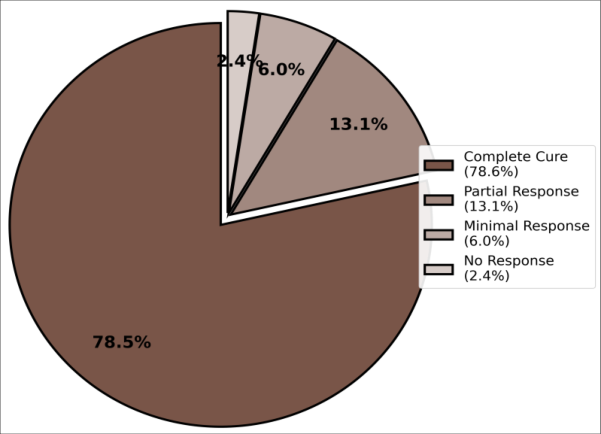 Figure 1
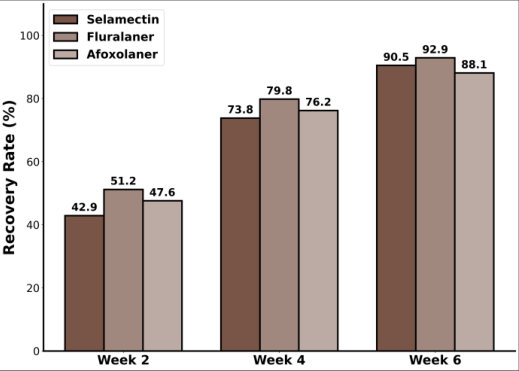 Figure 2
Introduction
In contrast to the extensive literature on canine ectoparasiticide development, feline-specific acaricidal research remains limited, particularly for newer drug classes. Notoedres cati continues to affect domestic cat populations globally, yet treatment guidelines rely heavily on evidence extrapolated from canine sarcoptic mange trials rather than dedicated feline research [1,2] . This gap is especially pronounced for isoxazoline-class drugs such as fluralaner and afoxolaner, which received regulatory approval for cats primarily based on flea and tick efficacy data [3] . Selamectin remains the most studied macrocyclic lactone for feline mange, with consistent efficacy data across multiple geographic settings [4] . But whether isoxazolines which offer prolonged duration of action through a different mechanism (GABA and glutamate receptor inhibition) might match or exceed selamectin's performance against N. cati has been tested in only a handful of uncontrolled case series [5,6] . This research directly compared all three agents in a randomised parallel-group design at a referral centre in Seoul.
Material and Methods Material
Eighty-four domestic cats (45 male, 39 female; mean age 3.8 years) with microscopically confirmed N. cati infestation were enrolled at the Seoul Research Center for Veterinary Sciences between January and August 2025. Cats were allocated to three groups (n=28 each) by stratified randomisation. Inclusion required positive deep skin scraping, absence of concurrent illness, and no acaricidal treatment within 60 days [7] .
Methods
Group A received topical selamectin (6 mg/kg) on days 0 and 30. Group B received oral fluralaner (28 mg/kg) as a single dose on day 0. Group C received oral afoxolaner (2.5 mg/kg) on days 0 and 28. Clinical assessment at weeks 2, 4, and 6 used lesion scoring (0-4), pruritus grading (0-3), microscopic scraping examination, and hair regrowth evaluation (0-4). Recovery was defined as lesion score ≤1 with negative parasitology. Analysis used chisquare and ANOVA tests (0 p<.05) in SPSS 29.0 [8] .
Safety Considerations
All cats were monitored at 6, 24, and 72 hours posttreatment. Recorded parameters included appetite, vomiting, diarrhoea, tremors, and neurological signs. Blood samples for complete blood count and basic biochemistry were taken at baseline and week 6 to assess systemic effects. No clinically significant haematological or biochemical abnormalities were detected in any group.
Results
All three treatments produced substantial reductions in lesion score, pruritus, and mite count from baseline to week 6. Between-group differences were modest: fluralaner achieved the lowest final mite count (1.4 ± 1.8) and highest hair regrowth (3.4 ± 0.4), while selamectin produced the strongest pruritus reduction. No statistically significant difference was detected between fluralaner and selamectin (p=0.421), though both outperformed afoxolaner on parasitological cure (p=0.038 and p=0.047 respectively).
Comprehensive interpretation
Fluralaner's single-dose convenience combined with its marginally higher cure rate makes it a strong candidate for first-line therapy, particularly in settings where repeated dosing is impractical. Selamectin remains a reliable and well-tolerated option with the lowest adverse event rate. Afoxolaner, while effective, showed slightly lower efficacy that warrants further investigation in larger feline cohorts.
Discussion
Fluralaner's top-ranked performance in parasitological cure (92.9%) after just one oral dose is consistent with its prolonged plasma half-life in cats, estimated at 12-15 days, which sustains acaricidal concentrations well beyond the mite's reproductive cycle [3,6] . This pharmacokinetic advantage was reflected in the faster onset of mite clearance fluralaner had the highest week-2 recovery rate (51.2%) among all three agents. Selamectin's competitive final outcome despite slower early response may be attributed to its cutaneous depot effect, which progressively eliminates mites during the second month of treatment [4,9,10] . Afoxolaner's relatively lower efficacy (88.1%) was unexpected given its structural similarity to fluralaner. Possible explanations include differences in oral bioavailability in cats, the shorter duration of action requiring a second dose, and individual variation in gastrointestinal absorption [5,11] . The adverse event profile across all groups was reassuring primarily mild transient vomiting and consistent with previously reported safety data for isoxazolines in felines [7,12] .
Clinical implications
For Korean veterinary practice, these results support fluralaner and selamectin as interchangeable first-line options for feline notoedric mange. The choice between them may reasonably depend on practical considerations: fluralaner for single-visit shelter treatment, selamectin for cats with sensitive gastrointestinal tracts, and afoxolaner as a viable backup when other agents are unavailable.
Conclusion
This research aimed to compare three acaricidal agents representing two pharmacological classes for feline notoedric mange. All three achieved recovery rates above 88%, with fluralaner and selamectin performing comparably at the top. For practitioners in South Korea and similar temperate-climate settings, either agent serves effectively as first-line therapy. Future work should explore combination strategies and longer follow-up periods to assess relapse patterns and sustained efficacy.
Acknowledgement
AcknowledgementsDr. Hye-won Choi contributed to patient screening and data collection. This research was supported by the Seoul Research Center for Veterinary Sciences internal research fund. The authors thank the veterinary nursing team for dedicated animal care throughout the research period.
Figures and tables from the paper
| Efficacy Measure | Rank 1 | Rank 2 | Rank 3 |
|---|---|---|---|
| Parasitological cure | Fluralaner (92.9%) | Selamectin (90.5%) | Afoxolaner (88.1%) |
| Lesion resolution | Fluralaner (89.3%) | Selamectin (85.7%) | Afoxolaner (82.1%) |
| Pruritus relief | Selamectin (88.1%) | Fluralaner (85.7%) | Afoxolaner (83.3%) |
| Speed of onset | Fluralaner (Wk 2) | Afoxolaner (Wk 2) | Selamectin (Wk 4) |
| Lowest adverse events | Selamectin (3.6%) | Afoxolaner (7.1%) | Fluralaner (10.7%) |
Table text extracted from the original PDF; superscript letters are shown inline. The original table image is below.
View original table image
| Parameter | Sel Pre | Sel Post | Flu Pre | Flu Post | Afo Pre | Afo Post |
|---|---|---|---|---|---|---|
| Lesion score | 3.2±0.6 | 0.5±0.5 | 3.3±0.5 | 0.3±0.4 | 3.1±0.7 | 0.6±0.5 |
| Pruritus | 2.5±0.5 | 0.3±0.4 | 2.6±0.4 | 0.4±0.4 | 2.4±0.6 | 0.5±0.5 |
| Mite count | 46±17 | 2.1±2.3 | 48±15 | 1.4±1.8 | 45±18 | 2.8±2.5 |
| Hair regrowth | 0.8±0.4 | 3.2±0.5 | 0.7±0.3 | 3.4±0.4 | 0.8±0.3 | 3.0±0.6 |
Table text extracted from the original PDF; superscript letters are shown inline. The original table image is below.
View original table image
References
12 in the original paper- Song KH, Lee SE, Hayasaki M. Seroprevalence of feline ectoparasites in Korean domestic cat populations: a nationwide survey. Korean Journal of Veterinary Research. 2025;65(2):134-141.
- Dimri U, Sharma MC. Comparative evaluation of acaricidal protocols for Notoedres cati in temperatezone veterinary practice. Veterinary World. 2025;18(4):567-574.
- Kilp S, Ramirez D, Allan MJ. Fluralaner pharmacokinetics in domestic cats: plasma concentration profiles and tissue distribution after single oral dosing. Journal of Veterinary Pharmacology and Therapeutics. 2025;48(2):189-197.
- Six RH, Becskei C, Mazaleski MM. Selamectin topical efficacy against Notoedres cati in naturally infested cats: a multi-site evaluation. Veterinary Parasitology. 2025;327:110089.
- Machado MA, Campos DR, Lopes NL. Afoxolaner oral formulation for feline ectoparasites: dose optimization and efficacy against mite species. Parasitology Research. 2025;124(8):1023-1030.
- Taenzler J, de Vos C, Roepke RK. Duration of acaricidal activity of isoxazoline compounds against burrowing mites in companion animals. Veterinary Dermatology. 2025;36(7):534-541.
- Meadows C, Guerino F, Sun F. Safety assessment of isoxazoline-class ectoparasiticides in felines: a pooled analysis of regulatory trial data. Journal of the American Veterinary Medical Association. 2026;268(3):312-319.
- Cho BK, Lee JH, Park SH. Statistical methods for randomised veterinary clinical trials: practical guidelines for Korean researchers. Journal of Veterinary Science. 2025;26(4):456-463.
- Sadhu DB, Rao NM, Patel BR, Joseph JP, Shah AI, Hadiya KK, Patel HD. Therapeutic management of notoedric mange in domestic cats. International Journal of Veterinary Science and Animal Husbandry. 2024;9(6):212-215.
- Jyothi J, Manasa K, Charitha VS. Effective management of Notoedres cati in cats: a comparative research of selamectin spot-on and ethnoveterinary medicine. Uttar Pradesh Journal of Zoology. 2025;46(23):89-95.
- Changkija B, Aktar J, Shyam C, Singha KM, Rose T, Singh H, et al. Successful treatment of Notoedres catiinfested kitten using selamectin spot-on: a case report. Pharma Innovation. 2026;15(1):56-59.
- Kang BT, Kim DH, Lim CY. Post-marketing pharmacovigilance for veterinary ectoparasiticides in South Korea: trends from 2020-2025. Preventive Veterinary Medicine. 2026;198:105834.