
Research article · 2026 · Full text
International Journal of Horticulture and Food ScienceTo study the effect of organic manures and bio-fertilizers on growth parameters of okra var. pusa makhamali
Volume 8(6) · Pages 43–46 · DOI: 10.33545/26631067.2026.v8.i6a.760 ↗
Research areasAgricultural Science and FertilizationAgriculture, Plant Science, Crop ManagementAgricultural Practices and Plant Genetics
Abstract
Author-writtenOkra (Abelmoschus esculentus L.) is an important vegetable crop widely cultivated in India for its tender pods and nutritional value. A field experiment was conducted during Kharif 2025 at the Horticulture Farm, Suresh Gyan Vihar University, Jaipur, to study the effect of organic manures and bio-fertilizers on the growth parameters of okra cv. Pusa Makhamali. The experiment was laid out in a Factorial Randomized Block Design (FRBD) with sixteen treatment combinations comprising organic manures (FYM, poultry manure, and vermicompost) and bio-fertilizers (PSB and Azotobacter) replicated thrice. The results revealed that among organic manures, vermicompost significantly recorded the highest plant height (63.07 cm at 45 DAS and 113.40 cm at harvest) and stem diameter (19.38 mm). Among bio-fertilizers, the combined application of PSB and Azotobacter resulted in maximum plant height (69.64 cm at 45 DAS and 130.41 cm at harvest) and stem diameter (19.83 mm). The interaction effect between organic manures and bio-fertilizers was non-significant. The study concluded that vermicompost and the combined inoculation of PSB and Azotobacter were the most effective treatments for improving growth parameters of okra.
Summary
Source-checkedPlain-language reading of the full paper, prepared with AI and checked against the text. Each point links to the authors' own words.
Why it matters
- Okra is a significant vegetable crop in India, valued for its nutritional content and tender pods. View evidence ↗
- Vegetable crops are known to respond positively to nutrient supplies provided by chemical fertilizers and organic manures. View evidence ↗
The question
- The study aimed to analyze how organic manures and bio-fertilizers affect the stem diameter and plant height of the Pusa Makhamali okra variety. View evidence ↗
What they did
- The field experiment took place during the Kharif 2025 season at Suresh Gyan Vihar University's Horticulture Farm in Jaipur. View evidence ↗
- The plants were spaced at 60 x 45 cm, with 30 plants per plot. View evidence ↗
What they found
- Vermicompost was the most effective organic manure for plant height, reaching 63.07 cm at 45 days after sowing (DAS) and 113.40 cm at harvest, compared to the control's 56.47 cm and 103.39 cm. View evidence ↗
- The combination of PSB and Azotobacter produced the greatest plant height among bio-fertilizers, measuring 69.64 cm at 45 DAS and 130.41 cm at harvest. View evidence ↗
- Vermicompost resulted in the largest stem diameter (19.38 mm) among organic manures, outperforming poultry manure (19.27 mm), farmyard manure (19.14 mm), and the control (19.04 mm). View evidence ↗
- The combined use of PSB and Azotobacter led to the maximum stem diameter (19.83 mm), which was higher than Azotobacter alone (19.36 mm), PSB alone (19.00 mm), and the control (18.64 mm). View evidence ↗
- The interaction between organic manures and bio-fertilizers was non-significant for both plant height and stem diameter, meaning the factors acted independently. View evidence ↗
What it means
- The authors recommend the integrated use of vermicompost, PSB, and Azotobacter as a sustainable and eco-friendly way to improve okra growth in Rajasthan's semi-arid conditions. View evidence ↗
Visual summary
3 visualsIllustrations explain the paper; charts are replotted from the paper's own table values.
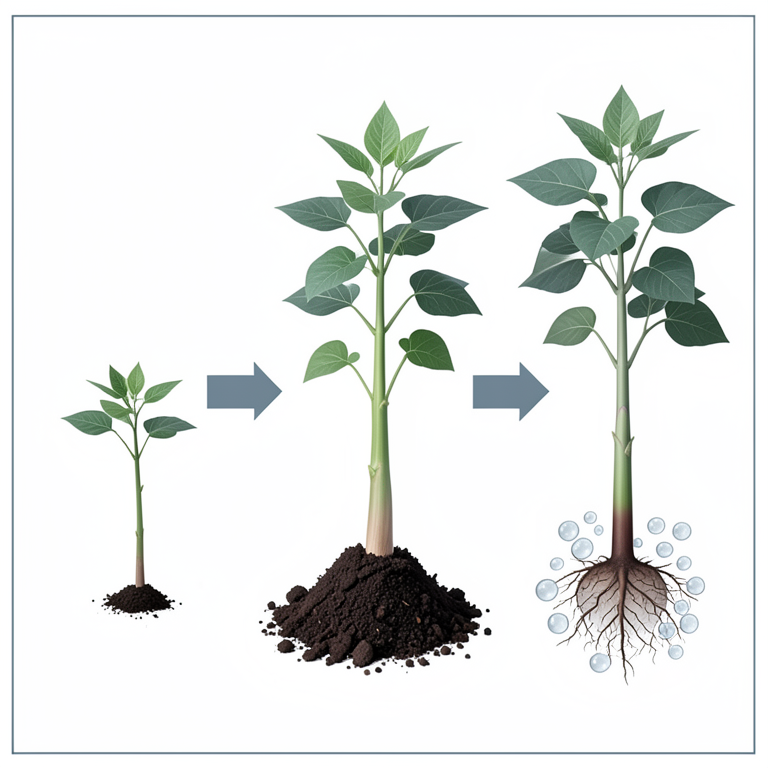
Comparative Growth Effects
AI-generated conceptual illustration (Okra plants (var. Pusa Makhamali)). It explains the idea and does not show study data.
View source evidence ↗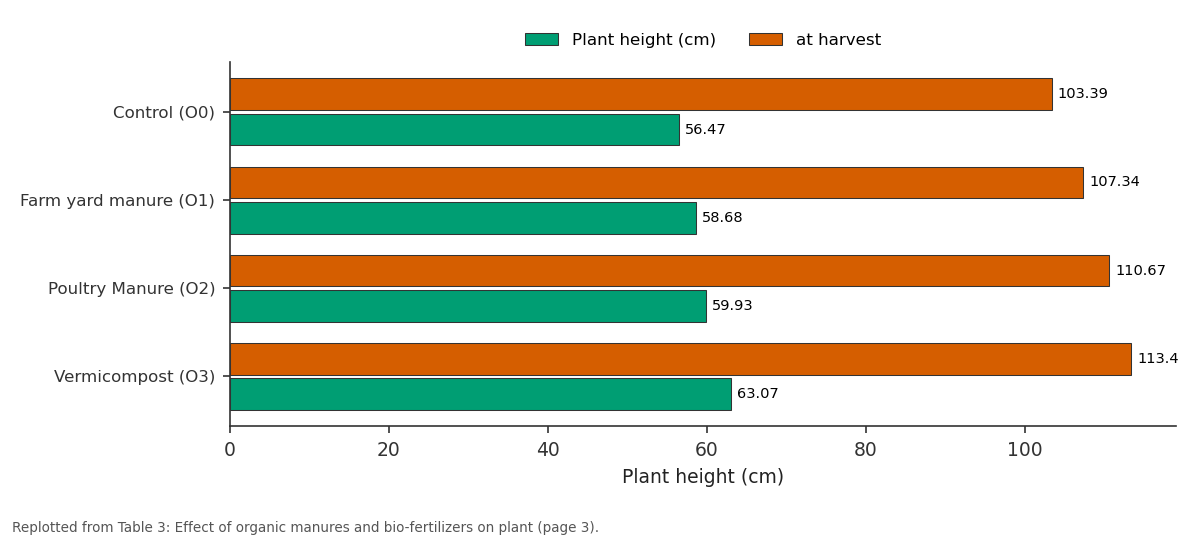
Plant height (cm) and at harvest: Control (O0) vs Farm yard manure (O1) vs Poultry Manure (O2) vs Vermicompost (O3)
Replotted from Table 3 (page 3) of the original paper. Every bar is the paper's own table value.
View source evidence ↗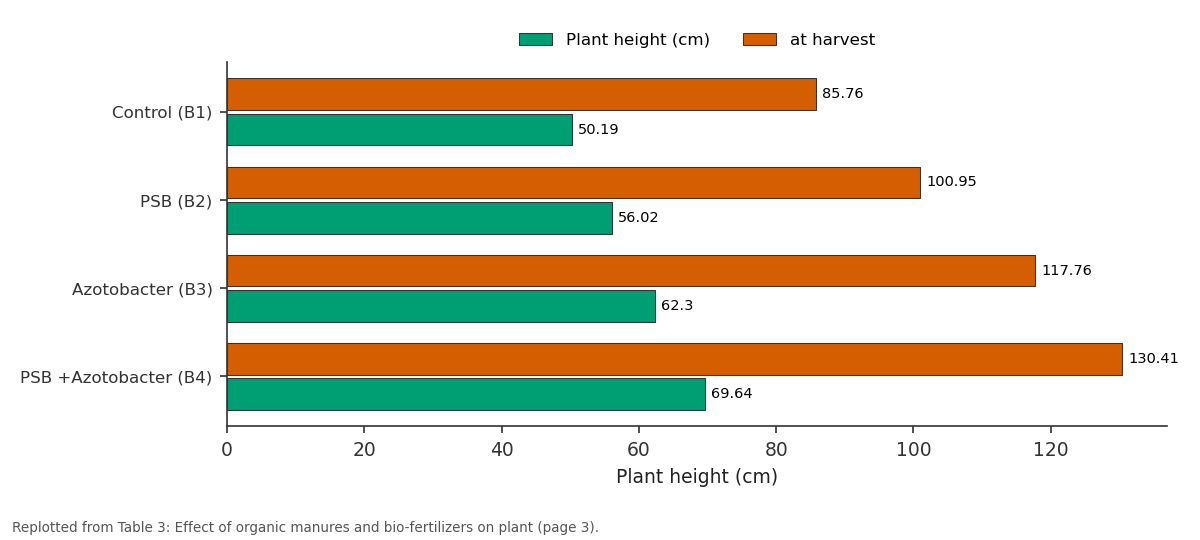
Plant height (cm) and at harvest: Control (B1) vs PSB (B2) vs Azotobacter (B3) vs PSB +Azotobacter (B4)
Replotted from Table 3 (page 3) of the original paper. Every bar is the paper's own table value.
View source evidence ↗Figures & tables
From the original paper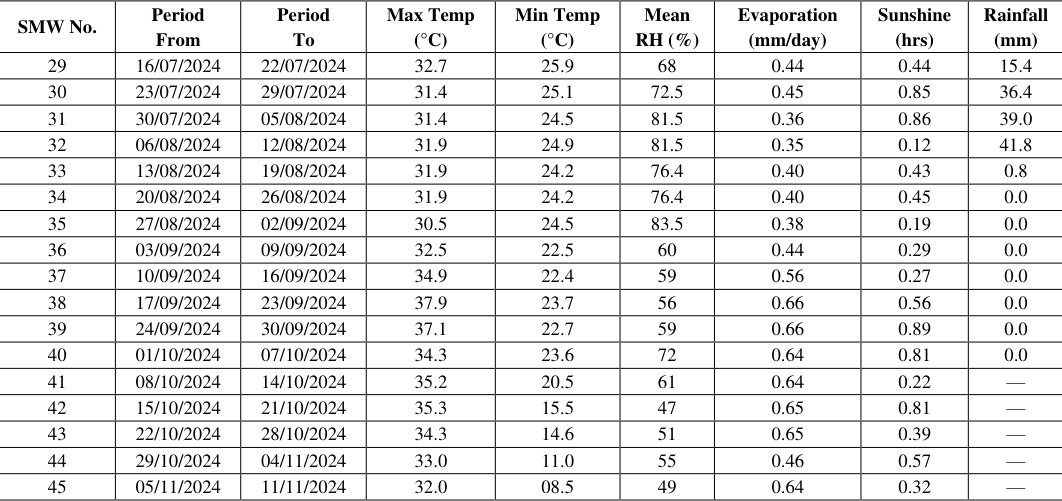 Table 1
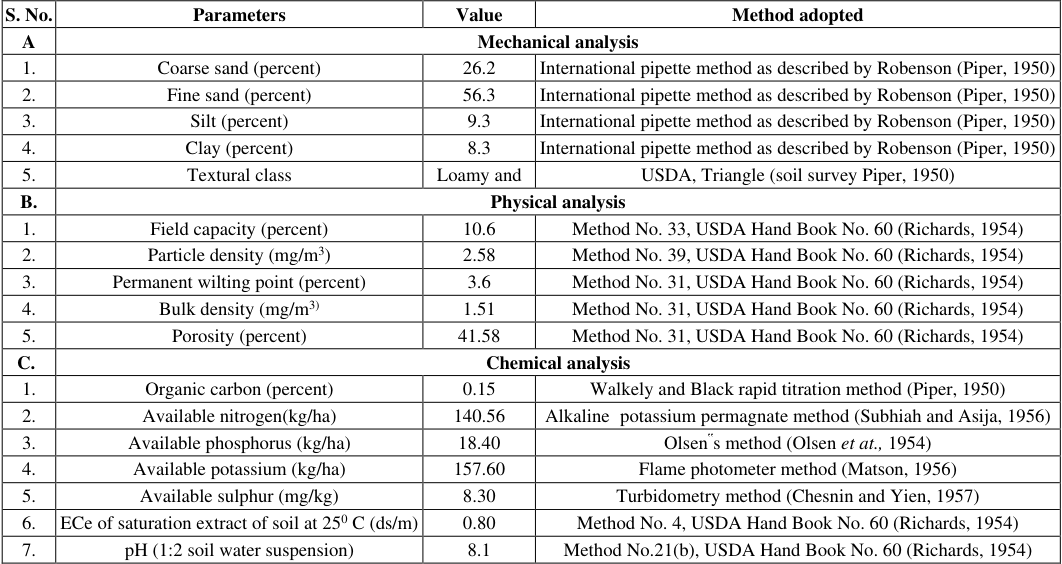 Table 2
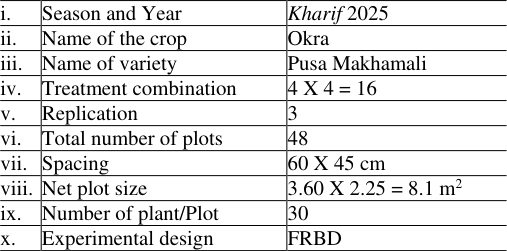 Table 3
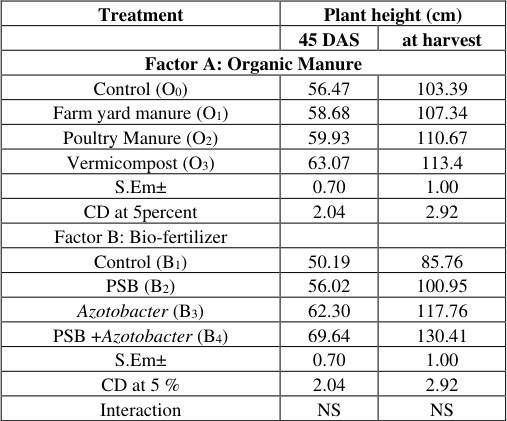 Table 3
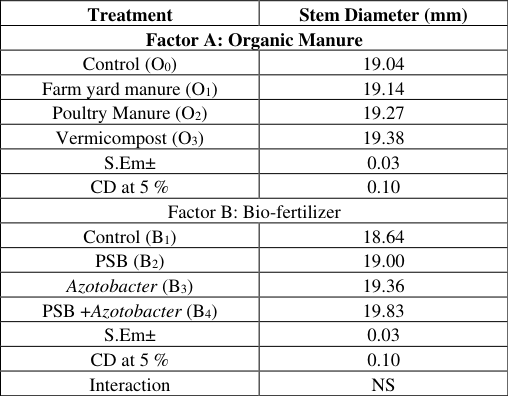 Table 4
Introduction
Okra [Abelmoschus esculentus (L.)] is commonly known as lady's finger or bhindi and it belongs to the malvaceae family. Okra is one of the most important vegetable crop grown in tropical and sub-tropical region and is said to be native of South Africa. In India, it is cultivated almost in all states throughout the year and consumed by bulk of the people. Okra is an important vegetable grown for its tender pods (fruits) which are used as a vegetable in various ways. It is also a very good source of dietary fiber, vitamin A, C, K, thiamine, vitamin B 6 , folate, calcium, magnesium and manganese. Its nutritive value varies in different cultivars depending upon the agro-climatic conditions. The dry seed contains 13-22 percent good quality edible oil and 20-24 percent protein.
In India, Okra is cultivated throughout the country for its immature tender pods (fruits), covering an area of 530.6 thousand hectares and production of 6465.6 thousand metric tonnes with productivity of 12.28 tonnes/ha (Anonymous, 2023). Okra is mostly growing in the states of Andhra Pradesh, West Bengal, Bihar, Gujarat, Orissa, Uttar Pradesh, Haryana and Rajasthan. In Rajasthan, it is grown in an area of 4.28 thousand hectares and annual production of 19.73 thousand metric tonnes with productivity of 4.61 tonnes/ha (Anonymous, 2023). Vegetable and vegetables based cropping system show that vegetable crops respond well to nutrient supply through organic manures and chemical fertilizers (Kale et. al., 1991) [2] .
Materials and Methods
A field experiment was conducted at Horticulture Farm, Suresh Gyan Vihar University, Jaipur during Kharif season 2024. Geographically, Jaipur, is situated at 26.89 0 North latitude and 75.77 0 East longitudes. The place falls under Agro-climatic zone-IIIa (Semi-Arid Eastern Plains), of Rajasthan.
The data on metrological observations recorded at the metrological observatory are presented in Table 1 and the physical and chemical composition of the soil is presented in Table 2. In this context, the present study aims to analyze the effect of organic manures and bio-fertilizers on growth parameters viz., plant height (cm) and stem diameter (mm) of Okra var. Pusa Makhamali. The meteorological conditions during the crop season showed considerable variation. Maximum temperature ranged from 30.5 to 37.9°C and minimum temperature from 8.5 to 25.9°C. The crop experienced humid conditions during the monsoon period, with relative humidity reaching up to 83.5%. Most of the rainfall was received during July and August, with the highest weekly rainfall of 70.0 mm recorded during SMW 31. Sunshine hours and evaporation remained low during the rainy season but increased steadily from September onwards as rainfall ceased. Overall, the season was characterized by adequate rainfall and high humidity during the initial growth period, followed by dry weather with higher sunshine and evaporative demand during the later stages of crop growth. Then seeds are soaked in this solution for 25 minutes. PSB also applied as seed treatment @ 5g/kg seed for this 125 g of Jaggery was mixed in one litre of boiled water. Appropriate quantity (2g) of was poured in Jaggery solution separately and stirred well. Okra requires enough soil moisture for seed germination. It was maintained by pre-sowing heavy irrigation. Further irrigations were given at an interval of 6-10 days except during the period of intermittent rains.
| S. No. | Parameters | Value | Method adopted |
|---|---|---|---|
| A | Mechanical analysis | ||
| 1. | Coarse sand (percent) | 26.2 | International pipette method as described by Robenson (Piper, 1950) |
| 2. | Fine sand (percent) | 56.3 | International pipette method as described by Robenson (Piper, 1950) |
| 3. | Silt (percent) | 9.3 | International pipette method as described by Robenson (Piper, 1950) |
| 4. | Clay (percent) | 8.3 | International pipette method as described by Robenson (Piper, 1950) |
| 5. | Textural class | Loamy and | USDA, Triangle (soil survey Piper, 1950) |
| B. | Physical analysis | ||
| 1. | Field capacity (percent) | 10.6 | Method No. 33, USDA Hand Book No. 60 (Richards, 1954) |
| 2. | Particle density (mg/m3) | 2.58 | Method No. 39, USDA Hand Book No. 60 (Richards, 1954) |
| 3. | Permanent wilting point (percent) | 3.6 | Method No. 31, USDA Hand Book No. 60 (Richards, 1954) |
| 4. | Bulk density (mg/m3) | 1.51 | Method No. 31, USDA Hand Book No. 60 (Richards, 1954) |
| 5. | Porosity (percent) | 41.58 | Method No. 31, USDA Hand Book No. 60 (Richards, 1954) |
| C. | Chemical analysis | ||
| 1. | Organic carbon (percent) | 0.15 | Walkely and Black rapid titration method (Piper, 1950) |
| 2. | Available nitrogen(kg/ha) | 140.56 | Alkaline potassium permagnate method (Subhiah and Asija, 1956) |
| 3. | Available phosphorus (kg/ha) | 18.40 | Olsen‟s method (Olsen et at., 1954) |
| 4. | Available potassium (kg/ha) | 157.60 | Flame photometer method (Matson, 1956) |
| 5. | Available sulphur (mg/kg) | 8.30 | Turbidometry method (Chesnin and Yien, 1957) |
| 6. | ECe of saturation extract of soil at 250 C (ds/m) | 0.80 | Method No. 4, USDA Hand Book No. 60 (Richards, 1954) |
| 7. | pH (1:2 soil water suspension) | 8.1 | Method No.21(b), USDA Hand Book No. 60 (Richards, 1954) |
Table text extracted from the original PDF; superscript letters are shown inline. The original table image is below.
View original table image
| SMW No. | Period From | Period To | Max Temp (°C) | Min Temp (°C) | Mean RH (%) | Evaporation (mm/day) | Sunshine (hrs) | Rainfall (mm) |
|---|---|---|---|---|---|---|---|---|
| 29 | 16/07/2024 | 22/07/2024 | 32.7 | 25.9 | 68 | 0.44 | 0.44 | 15.4 |
| 30 | 23/07/2024 | 29/07/2024 | 31.4 | 25.1 | 72.5 | 0.45 | 0.85 | 36.4 |
| 31 | 30/07/2024 | 05/08/2024 | 31.4 | 24.5 | 81.5 | 0.36 | 0.86 | 39.0 |
| 32 | 06/08/2024 | 12/08/2024 | 31.9 | 24.9 | 81.5 | 0.35 | 0.12 | 41.8 |
| 33 | 13/08/2024 | 19/08/2024 | 31.9 | 24.2 | 76.4 | 0.40 | 0.43 | 0.8 |
| 34 | 20/08/2024 | 26/08/2024 | 31.9 | 24.2 | 76.4 | 0.40 | 0.45 | 0.0 |
| 35 | 27/08/2024 | 02/09/2024 | 30.5 | 24.5 | 83.5 | 0.38 | 0.19 | 0.0 |
| 36 | 03/09/2024 | 09/09/2024 | 32.5 | 22.5 | 60 | 0.44 | 0.29 | 0.0 |
| 37 | 10/09/2024 | 16/09/2024 | 34.9 | 22.4 | 59 | 0.56 | 0.27 | 0.0 |
| 38 | 17/09/2024 | 23/09/2024 | 37.9 | 23.7 | 56 | 0.66 | 0.56 | 0.0 |
| 39 | 24/09/2024 | 30/09/2024 | 37.1 | 22.7 | 59 | 0.66 | 0.89 | 0.0 |
| 40 | 01/10/2024 | 07/10/2024 | 34.3 | 23.6 | 72 | 0.64 | 0.81 | 0.0 |
| 41 | 08/10/2024 | 14/10/2024 | 35.2 | 20.5 | 61 | 0.64 | 0.22 | — |
| 42 | 15/10/2024 | 21/10/2024 | 35.3 | 15.5 | 47 | 0.65 | 0.81 | — |
| 43 | 22/10/2024 | 28/10/2024 | 34.3 | 14.6 | 51 | 0.65 | 0.39 | — |
| 44 | 29/10/2024 | 04/11/2024 | 33.0 | 11.0 | 55 | 0.46 | 0.57 | — |
| 45 | 05/11/2024 | 11/11/2024 | 32.0 | 08.5 | 49 | 0.64 | 0.32 | — |
Table text extracted from the original PDF; superscript letters are shown inline. The original table image is below.
View original table image
To maintain the proper plant population thinning was done at 25 days after sowing, leaving single plant per hill. Hoeing and weeding were done twice i.e. at 30 and 55 days after sowing. To protect the crop from the attack of insect pests viz., jassids and whitefly, spray of Imidacloprid 17.5 SL (0.25percent) was done after 30 days of sowing thereafter, sprays of Diamethoate 30 EC (0.03percent) were done as and when needed to control fruit borers in Okra crop.
Treatment combinations
The treatment involved in the study were seven in number as mentioned below:
Results and Discussion
Table 3 and Table 4 presents the effect of organic manures and bio-fertilizers on plant height (cm) and stem diameter (mm) at 45 DAS and at harvest, respectively. Plant height was significantly influenced by both organic manures and bio-fertilizer treatments at 45 DAS and at harvest. Among the organic manure treatments, vermicompost (O₃) recorded the highest plant height (63.07 cm at 45 DAS and 113.40 cm at harvest), which was significantly superior to the control (56.47 cm and 103.39 cm, respectively). Poultry manure (O₂) and farmyard manure (O₁) also improved plant height over the control. Among the bio-fertilizer treatments, the combined application of PSB + Azotobacter (B₄) resulted in the maximum plant height (69.64 cm at 45 DAS and 130.41 cm at harvest), followed by Azotobacter alone (B₃). The lowest plant height was observed under the control treatment (B₁).
| Treatment | Stem Diameter (mm) |
|---|---|
| Factor A: Organic Manure | |
| Control (O0) | 19.04 |
| Farm yard manure (O1) | 19.14 |
| Poultry Manure (O2) | 19.27 |
| Vermicompost (O3) | 19.38 |
| S.Em± | 0.03 |
| CD at 5 % | 0.10 |
| Factor B: Bio-fertilizer | |
| Control (B1) | 18.64 |
| PSB (B2) | 19.00 |
| Azotobacter (B3) | 19.36 |
| PSB +Azotobacter (B4) | 19.83 |
| S.Em± | 0.03 |
| CD at 5 % | 0.10 |
| Interaction | NS |
Table text extracted from the original PDF; superscript letters are shown inline. The original table image is below.
View original table image
| Treatment | Plant height (cm) | — |
|---|---|---|
| 45 DAS | at harvest | |
| Factor A: Organic Manure | ||
| Control (O0) | 56.47 | 103.39 |
| Farm yard manure (O1) | 58.68 | 107.34 |
| Poultry Manure (O2) | 59.93 | 110.67 |
| Vermicompost (O3) | 63.07 | 113.4 |
| S.Em± | 0.70 | 1.00 |
| CD at 5percent | 2.04 | 2.92 |
| Factor B: Bio-fertilizer | ||
| Control (B1) | 50.19 | 85.76 |
| PSB (B2) | 56.02 | 100.95 |
| Azotobacter (B3) | 62.30 | 117.76 |
| PSB +Azotobacter (B4) | 69.64 | 130.41 |
| S.Em± | 0.70 | 1.00 |
| CD at 5 % | 2.04 | 2.92 |
| Interaction | NS | NS |
Table text extracted from the original PDF; superscript letters are shown inline. The original table image is below.
View original table image
| i. | Season and Year | Kharif 2025 |
|---|---|---|
| ii. | Name of the crop | Okra |
| iii. | Name of variety | Pusa Makhamali |
| iv. | Treatment combination | 4 X 4 = 16 |
| v. | Replication | 3 |
| vi. | Total number of plots | 48 |
| vii. | Spacing | 60 X 45 cm |
| viii. | Net plot size | 3.60 X 2.25 = 8.1 m2 |
| ix. | Number of plant/Plot | 30 |
| x. | Experimental design | FRBD |
Table text extracted from the original PDF; superscript letters are shown inline. The original table image is below.
View original table image
The increase in plant height with bio-fertilizer application may be attributed to enhanced nutrient availability, biological nitrogen fixation, and improved root growth. The interaction effect between organic manures and biofertilizers was found to be non-significant at both stages, indicating that the effects of the two factors were independent of each other. Overall, vermicompost and the combined inoculation of PSB + Azotobacter were the most effective treatments for improving plant height. The interaction effect between organic manures and biofertilizers was non-significant, indicating that the individual effects of these factors on stem diameter were independent. Overall, vermicompost and the combined application of PSB + Azotobacter were found to be the most effective treatments for improving stem diameter.
Conclusion
The present investigation demonstrated that the application of organic manures and bio-fertilizers significantly improved the growth performance of okra cv. Pusa Makhamali. Among the organic manure treatments, vermicompost proved superior in enhancing plant height and stem diameter. Similarly, the combined application of PSB and Azotobacter recorded the best performance among bio-fertilizer treatments. Although the interaction effect was non-significant, the individual effects of vermicompost and the combined use of PSB and Azotobacter substantially enhanced vegetative growth. Therefore, the integrated use of vermicompost along with PSB and Azotobacter can be recommended as an eco-friendly and sustainable nutrient management practice for improving the growth of okra under semi-arid conditions of Rajasthan.
References
8 in the original paper- Kale RD, Bano K, Wani MR. Effect of organic manures and fertilizers on vegetable crops. Agricultural Research Journal. 1991;22(4):1050-1056.
- Jagtap DN, More S.S, Nigade PM, Sagavekar VV, Bodake PS, Khanvilkar MH. Effect of different organic sources on soil quality, growth and yield of okra (Abelmoschus esculentus). The Indian Journal of Agricultural Sciences. 2025;95(6):653-659.
- Bhandari S, Pandey SR, Giri K, Wagle P, Bhattarai S, Neupane RB. Effects of different fertilizers on the growth and yield of okra (Abelmoschus esculentus L.) in summer season in Chitwan, Nepal. International Journal of Agricultural Invention. 2019;4(1):1-9.
- Vikas V, Sharma JP, Dhotra B, Sharma A, Verma D. Application of organic manures and their influence on okra growth parameters. Journal of Pharmacognosy and Phytochemistry. 2020;9(1):999-1005.
- Abha R, Meena ML, Singh R, Mandal RK. Effect of various organic manures on growth and yield of okra [Abelmoschus esculentus (L.) Moench]. Journal of Pharmacognosy and Phytochemistry. 2019;8(6):12031205.
- Meena DC, Meena ML, Kumar S. Influence of organic manures and biofertilizers on growth, yield and quality of okra (Abelmoschus esculentus L. Moench). Annals of Plant and Soil Research. 2019;21(2):130-134.
- Kumar A, Kumar J, Kumar S, Kumar P. Effect of organic manures and bio fertilizers on morphological growth of okra (Abelmoschus esculentus L. Moench) CV Arka Anamika. Progressive Agriculture. 2021;21(2):249-254.
- Karim MR, Sattar MA, Rouf A, Hossain S, Hoque MM. Effect of Different Organic and Inorganic Fertilizers on the Growth and Yield of Okra. IUBAT Review. 2024;7(2):85-99.