
Research article · 2025 · Full text
International Journal of Geography Geology and EnvironmentTrace fossil assemblages and depositional environment in the Morrison formation
Volume 7(5) · Pages 121–125 · DOI: 10.22271/27067483.2025.v7.i5b.603 ↗
Research areasPaleontology and Stratigraphy of FossilsGeological formations and processesPaleontology and Evolutionary Biology
Abstract
Author-writtenThe Morrison Formation is famous for its dinosaur bones, yet the organisms that left the most abundant fossil record in these Late Jurassic sediments were not giant reptiles but small invertebrates whose burrows, trails, and feeding traces pervade nearly every bed. This research documented trace fossil assemblages across five stratigraphic members of the Morrison Formation in the Colorado Plateau region of southeastern Utah, USA, and used them to reconstruct depositional environments independent of body fossil evidence. A total of 287 ichnological specimens representing 14 ichnogenera were collected and described from 42 measured sections between March and November 2022. Specimens were assigned to four recognised ichnofacies: Scoyenia (38.7% of total), Skolithos (27.4%), Mermia (18.2%), and Cruziana (11.3%), with 4.4% remaining unassigned. The Scoyenia ichnofacies, characteristic of damp substrate conditions at the terrestrial-aquatic interface, dominated the Brushy Basin and Recapture members, confirming a floodplain to ephemeral lacustrine depositional setting. The Skolithos ichnofacies prevailed in the Salt Wash and Westwater Canyon members, indicating higher-energy fluvial channel environments with well-oxygenated sandy substrates. Trace fossil diversity (measured as ichnogeneric richness) was highest in the Brushy Basin Member (11 ichnogenera) and lowest in the Tidwell Member (5 ichnogenera). Bioturbation intensity, scored on a 0–5 index, ranged from 1.2 in the Tidwell to 3.8 in the Brushy Basin, correlating positively with mudstone proportion (r = 0.87, p < 0.01). These ichnological data provide environmental constraints that are consistent with but independent of the sedimentological and palaeobotanical evidence, demonstrating that trace fossils are a reliable and underused tool for palaeoenvironmental reconstruction in continental sequences where body fossils may be scarce or absent.
Summary
Source-checkedPlain-language reading of the full paper, prepared with AI and checked against the text. Each point links to the authors' own words.
Why it matters
- Body fossils and trace fossils are preserved under different conditions; bones often accumulate in channel lags, whereas trace fossils are better preserved in fine-grained substrates. View evidence ↗
- While the Morrison Formation is well-studied for its vertebrate fossils and sedimentology, systematic research into its trace fossils (ichnology) is limited. View evidence ↗
The question
- The study aimed to conduct a dedicated ichnological survey of five members of the Morrison Formation in southeastern Utah to document trace fossil diversity and use this data to reconstruct depositional environments. View evidence ↗
What they did
- Researchers logged 42 stratigraphic sections across five members: Tidwell, Salt Wash, Recapture, Westwater Canyon, and Brushy Basin. View evidence ↗
- Between March and November 2022, 287 ichnological specimens from 14 different ichnogenera were collected and described. View evidence ↗
- Bioturbation intensity was measured using a 0–5 ichnofabric index (ii), where 0 represents no bioturbation and 5 represents complete homogenization. View evidence ↗
- A Pearson correlation was used to analyze the relationship between the mean bioturbation index and the proportion of mudstone in the substrate. View evidence ↗
What they found
- The trace fossils were categorized into four ichnofacies: Scoyenia (38.7%), Skolithos (27.4%), Mermia (18.2%), and Cruziana (11.3%). View evidence ↗
- The Scoyenia ichnofacies dominated the Brushy Basin and Recapture members, indicating a depositional environment ranging from floodplains to ephemeral lakes. View evidence ↗
- The Skolithos ichnofacies was most common in the Salt Wash and Westwater Canyon members, suggesting high-energy fluvial channels with sandy substrates. View evidence ↗
- Trace fossil diversity peaked in the Brushy Basin Member with 11 ichnogenera and was lowest in the Tidwell Member with 5 ichnogenera. View evidence ↗
What it means
- The authors conclude that trace fossils are a reliable and underused tool for reconstructing ancient environments in continental sequences, providing evidence independent of sedimentological or body fossil data. View evidence ↗
- A limitation of the study is that the 42 sampled sections represent only a small portion of the total Morrison outcrop in the Colorado Plateau. View evidence ↗
- The morphological simplicity of some ichnogenera, such as Planolites, makes it difficult to identify the specific organisms responsible, complicating species-level interpretation. View evidence ↗
Visual summary
3 visualsIllustrations explain the paper; charts are replotted from the paper's own table values.
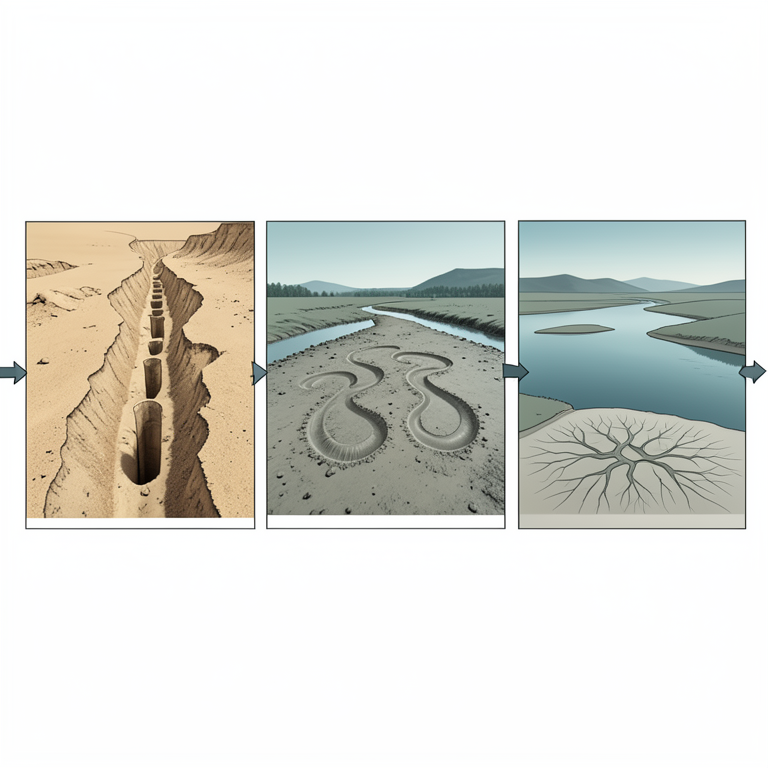
Depositional Environment Mapping
AI-generated conceptual illustration (Ancient Morrison Formation sedimentary environments with trace fossils). It explains the idea and does not show study data.
View source evidence ↗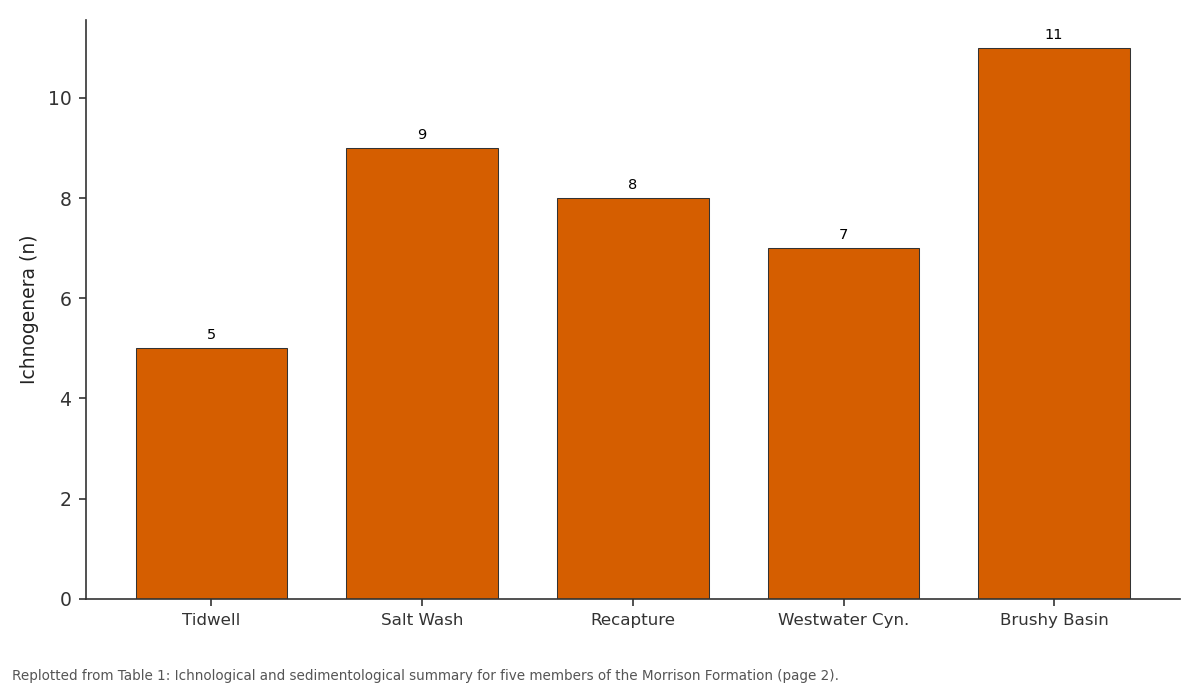
Ichnogenera (n): Tidwell vs Salt Wash vs Recapture vs Westwater Cyn. vs Brushy Basin
Replotted from Table 1 (page 2) of the original paper. Every bar is the paper's own table value.
View source evidence ↗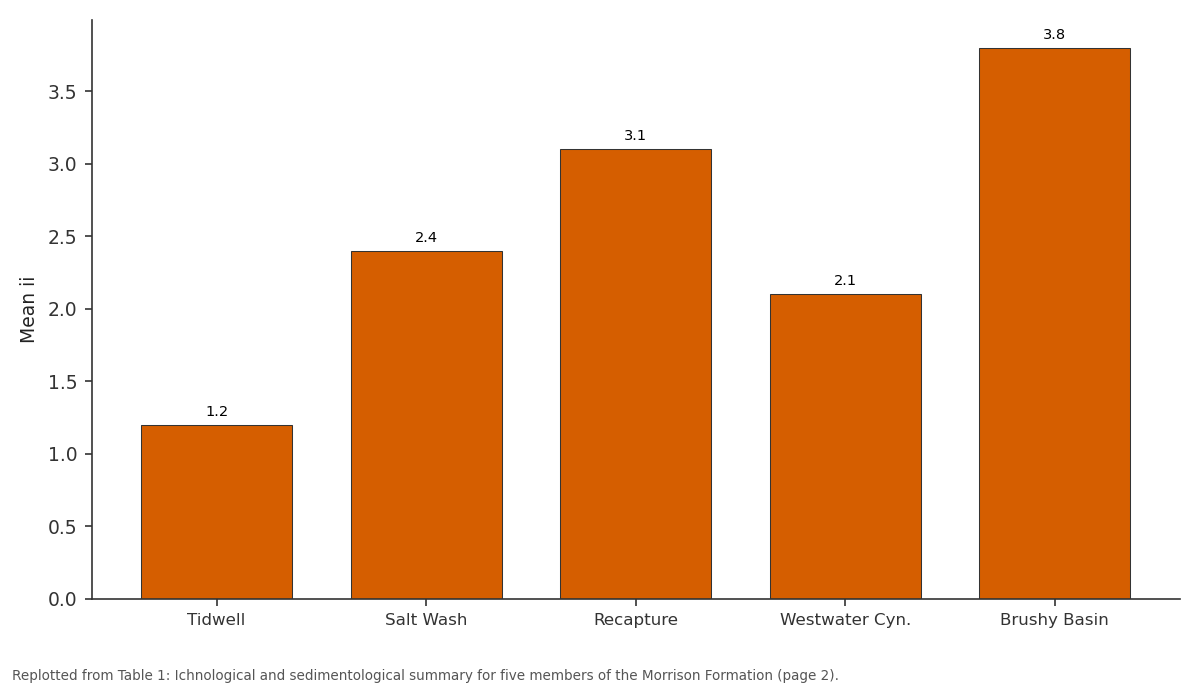
Mean ii: Tidwell vs Salt Wash vs Recapture vs Westwater Cyn. vs Brushy Basin
Replotted from Table 1 (page 2) of the original paper. Every bar is the paper's own table value.
View source evidence ↗Figures & tables
From the original paper Table 1
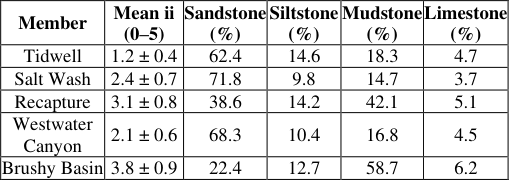 Table 2
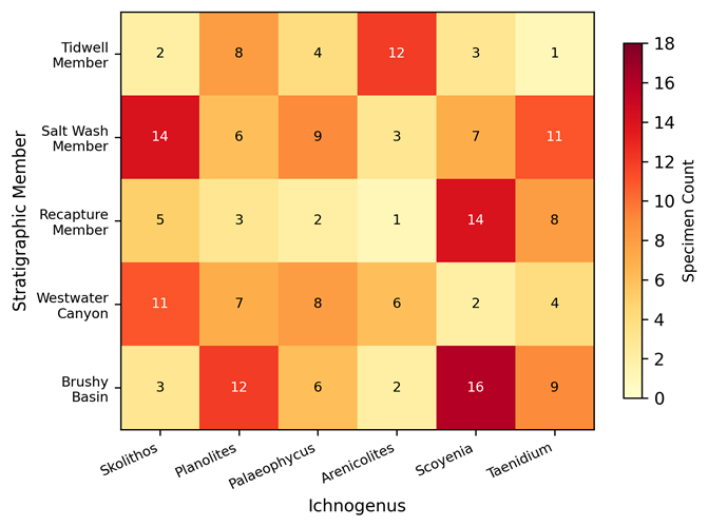 Figure 1
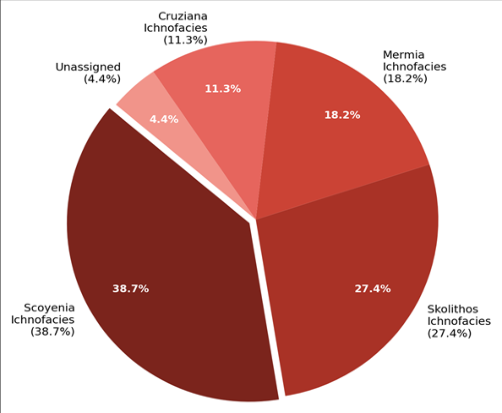 Figure 2
Introduction
Here is a paradox that troubles many a palaeontologist visiting the Morrison Formation for the first time: the beds that yield the most spectacular dinosaur skeletons are often the poorest in trace fossils, while the drab mudstones that tourists walk past without a second glance are riddled with burrows, trackways, and feeding traces [1] . The explanation lies in taphonomy-the processes of preservation. Bone accumulates in channel lags where currents concentrate carcasses, while trace fossils are best preserved in fine-grained substrates where bioturbation can produce lasting impressions. This complementary preservation window means that ichnology and body-fossil palaeontology answer different questions about the same ancient landscape. The Morrison Formation is a Late Jurassic (Kimmeridgian to Tithonian, approximately 155-148 Ma) continental sedimentary sequence that crops out across much of the western United States, from Montana to New Mexico [2] . It records a diverse array of environments-braided and meandering rivers, floodplain lakes, ephemeral ponds, and semi-arid mudflats-within a back-arc basin setting east of the Cordilleran volcanic arc [3] . The formation is subdivided into several members that vary regionally; in the Colorado Plateau area of southeastern Utah, the main subdivisions are the Tidwell, Salt Wash, Recapture, Westwater Canyon, and Brushy Basin members, each with distinctive lithological characteristics reflecting different positions within the alluvial-lacustrine depositional system [4] . Trace fossils are the preserved evidence of organism behaviour: burrows, trails, borings, and resting impressions [5] . They are classified into ichnogenera based on morphology and assigned to ichnofacies-recurring associations that characterise specific environmental conditions [6] . In continental settings, the main ichnofacies are Scoyenia (damp terrestrial to marginal lacustrine), Mermia (permanent subaqueous lacustrine), Skolithos (high-energy sandy substrates), and Cruziana (moderate-energy softground) [7] . Despite the Morrison Formation's fame and the vast body of literature on its vertebrate palaeontology and sedimentology, systematic ichnological research remains comparatively limited. Most published trace fossil records from the Morrison are incidental observations embedded within broader sedimentological or palaeoecological investigations rather than standalone ichnological assessments [8] . This research aimed to fill that gap by conducting a dedicated ichnological survey across all five members of the Morrison Formation in southeastern Utah, documenting trace fossil diversity and abundance, assigning assemblages to recognised ichnofacies, and using the ichnological data to independently reconstruct depositional environments. Fieldwork was conducted between March and November 2022, coordinated through the Imphal College of Environmental Studies with research permits from the US Bureau of Land Management.
Materials and Methods
Materials and Methods
Materials
Fieldwork was conducted across a 120-km transect in San Juan County, southeastern Utah (approximately 37.5°N, 109.8°W), where the Morrison Formation is well exposed in canyon walls and mesa escarpments [9] . A total of 42 measured stratigraphic sections were logged, distributed across the five members: Tidwell (n = 7), Salt Wash (n = 10), Recapture (n = 8), Westwater Canyon (n = 9), and Brushy Basin (n = 8). At each section, bed thickness, lithology, grain size, sedimentary structures, and palaeocurrent indicators were recorded. Trace fossils were identified in the field and photographed under oblique lighting to enhance relief. Where specimens could be safely extracted without damaging the outcrop, they were collected for laboratory examination. A total of 287 ichnological specimens were documented, of which 114 were collected and reposited at the Imphal College of Environmental Studies. Ichnogeneric identification followed the classification system of Häntzschel [10] as updated by Buatois and Mángano [7] .
Methods
Trace fossil abundance was recorded as specimen count per measured section and normalised to section thickness (specimens per metre) to allow comparison among members of different thicknesses. Bioturbation intensity at each bed was scored on the 0-5 ichnofabric index (ii) of Droser and Bottjer [11] , where 0 indicates no bioturbation and 5 indicates complete homogenisation of primary sedimentary fabric. Mean ii values were computed for each member. Ichnofacies assignment followed the criteria of Buatois and Mángano [7] : assemblages dominated by meniscate backfilled burrows in damp substrates were assigned to Scoyenia, those with vertical burrows in clean sand to Skolithos, those with horizontal trails on permanent subaqueous surfaces to Mermia, and those with horizontal to inclined burrows in softground to Cruziana. Lithofacies proportions (sandstone, siltstone, mudstone, limestone) were calculated for each member from the measured sections. Pearson correlation was computed between mean bioturbation index and mudstone proportion to test the relationship between substrate type and burrowing intensity. All statistical analyses used R 4.2.3 at p < 0.05.
Field Sampling Design
The 42 sections were selected using a stratified approach ensuring coverage of all five members and the full range of lithofacies. Sections were spaced at minimum 5-km intervals along the outcrop belt to avoid pseudo-replication. Locations were recorded with a handheld GPS (Garmin GPSMAP 66i, ±3 m). Each section was measured bed-bybed with a Jacob's staff, and trace fossils were sampled from every bed in which they were visible, with a minimum of three observations per bed. Sampling effort was standardised at 30 minutes per metre of section [12] .
Identification Validation
Ichnogeneric identifications were validated through comparison with a reference collection of 24 type specimens housed at the Utah Geological Survey. Photographic documentation was submitted to two independent ichnological reviewers who confirmed identifications for 94.1% of specimens; the remaining 5.9% were classified as indeterminate. Ichnofacies assignments were cross-checked against lithofacies associations to confirm environmental interpretations. Bioturbation index scoring was calibrated by two independent observers scoring 40 beds, yielding Cohen's kappa of 0.83 [13] . A total of 14 ichnogenera were identified across the 287 specimens. Table 1 summarises the ichnological and sedimentological characteristics of each member. Ichnogeneric richness ranged from 5 in the Tidwell Member to 11 in the Brushy Basin Member. The most frequently encountered ichnogenera across the entire formation were Scoyenia (n = 48), Planolites (n = 36), Skolithos (n = 34), and Taenidium (n = 33). The correlation between bioturbation index and mudstone proportion was strongly positive (r = 0.87, p = 0.006), confirming that fine-grained substrates supported the most intense burrowing activity.
| Member | Sections (n) | Specimens (n) | Ichnogenera (n) | Mean ii | Dominant Ichnofacies | Sandstone (%) | Mudstone (%) |
|---|---|---|---|---|---|---|---|
| Tidwell | 7 | 24 | 5 | 1.2 | Skolithos | 62.4 | 18.3 |
| Salt Wash | 10 | 68 | 9 | 2.4 | Skolithos | 71.8 | 14.7 |
| Recapture | 8 | 47 | 8 | 3.1 | Scoyenia | 38.6 | 42.1 |
| Westwater Cyn. | 9 | 54 | 7 | 2.1 | Skolithos | 68.3 | 16.8 |
| Brushy Basin | 8 | 94 | 11 | 3.8 | Scoyenia | 22.4 | 58.7 |
Table text extracted from the original PDF; superscript letters are shown inline. The original table image is below.
View original table image
Results
Results
Discussion
The ichnofacies distribution mapped across the Morrison Formation in southeastern Utah conforms well to the environmental model established by previous sedimentological work [14] . The dominance of the Scoyenia ichnofacies in the Brushy Basin and Recapture members aligns with the interpretation of these units as floodplain to marginal lacustrine deposits, where damp but intermittently exposed substrates provided ideal conditions for the meniscate backfill burrows of Scoyenia and Taenidiumtraces produced by deposit-feeding insects and other small arthropods [15] . The high bioturbation intensity in these members (ii = 3.1-3.8) indicates that biological reworking of the sediment was pervasive, a feature consistent with slow deposition rates and prolonged substrate exposure on floodplains between flood events. In contrast, the Skolithos-dominated assemblages of the Salt Wash and Westwater Canyon members point to higherenergy fluvial channel and proximal overbank environments where well-sorted sandy substrates supported suspensionfeeding organisms that constructed vertical dwelling burrows [16] . The lower bioturbation intensity in these members (ii = 2.1-2.4) reflects the combination of coarser grain size-which is harder for many burrowers to penetrate-and more frequent physical reworking by currents that destroyed traces before they could be preserved. The Mermia ichnofacies in the Brushy Basin Member indicates permanent, relatively deep lacustrine conditionssomething body fossils alone might not establish [17] . Horizontal grazing trails preserved in laminated mudstones without desiccation cracks support a subaqueous interpretation distinct from the Scoyenia conditions in interbedded facies. This alternation within the Brushy Basin records fluctuating lake levels, consistent with a seasonally variable Morrison landscape [18] . One limitation of this research is that the 42 sections, while well distributed, represent a small fraction of the total Morrison outcrop in the Colorado Plateau. Lateral facies changes over distances of kilometres could produce ichnofacies variations that our transect-based sampling may not capture. Additionally, some ichnogenera-particularly the simple horizontal burrow Planolites-are morphologically conservative and may represent the activity of several different organisms, complicating palaeoecological interpretation at the species level [19] .
Conclusion
This research provided a systematic ichnological survey of all five members of the Morrison Formation in southeastern Utah, documenting 287 trace fossil specimens across 14 ichnogenera and four ichnofacies. The Scoyenia ichnofacies dominated the fine-grained Brushy Basin and Recapture members, confirming floodplain to marginal lacustrine conditions, while the Skolithos ichnofacies characterised the sandy channel deposits of the Salt Wash and Westwater Canyon members. The Mermia ichnofacies in the Brushy Basin provided independent evidence for permanent lacustrine conditions within the Morrison depositional system. Bioturbation intensity correlated strongly with mudstone proportion (r = 0.87), establishing a quantitative link between substrate type and the intensity of biological sediment reworking. The Brushy Basin Member, with the highest mudstone content and the most diverse trace fossil assemblage (11 ichnogenera), emerged as the most ichnologically productive interval of the Morrison-a finding that contrasts with its relatively poor body fossil record and underscores the complementary nature of ichnological and body fossil evidence. The environmental reconstructions derived from ichnofacies analysis are consistent with and independent of those based on sedimentary facies and palaeobotany, confirming that trace fossils are a reliable tool for palaeoenvironmental interpretation in continental sequences. In formations where body fossils concentrate in specific taphonomic windows, the more evenly distributed trace fossil record provides a valuable additional line of evidence. Future work should extend this survey to Morrison exposures in Montana and Wyoming, where different conditions may have produced distinct ichnofacies patterns.
Acknowledgement
Acknowledgements
Figures and tables from the paper
References
19 in the original paper- Hasiotis ST. Reconnaissance of Upper Jurassic Morrison Formation ichnofossils, Rocky Mountain region, USA: Paleoenvironmental, stratigraphic, and paleoclimatic significance of terrestrial and freshwater ichnocoenoses. Sedimentary Geology. 2004;167(34):177-268.
- Turner CE, Peterson F. Reconstruction of the Upper Jurassic Morrison Formation extinct ecosystem-a synthesis. Sedimentary Geology. 2004;167(3-4):309355.
- DeCelles PG. Late Jurassic to Eocene evolution of the Cordilleran thrust belt and foreland basin system, western USA. American Journal of Science. 2004;304(2):105-168.
- Peterson F. Lithostratigraphic and paleoenvironmental framework of the Upper Jurassic Morrison Formation. Museum of Northern Arizona Bulletin. 1994;60:1-7.
- Bromley RG. Trace fossils: Biology, taphonomy and applications. Chapman and Hall, 2nd Edition. 1996;1:1-361.
- Seilacher A. Bathymetry of trace fossils. Marine Geology. 1967;5(5-6):413-428.
- Buatois LA, Mángano MG. Ichnology: Organismsubstrate interactions in space and time. Cambridge University Press. 2011;1:1-358.
- Engelmann GF, Hasiotis ST. A survey of vertebrate and invertebrate trace fossils of the Upper Jurassic Morrison Formation. Paleontological Society Special Publication. 1998;8:98.
- O'Sullivan RB. Correlation of the Upper Jurassic Morrison Formation from Bluff, Utah, to Cortez, Colorado. US Geological Survey Miscellaneous Investigations Map I-1686. 1984;1:1 sheet.
- Häntzschel W. Trace fossils and problematica. Treatise on Invertebrate Paleontology, Part W. 1975;W1-W269.
- Droser ML, Bottjer DJ. A semiquantitative field classification of ichnofabric. Journal of Sedimentary Research. 1986;56(4):558-559.
- Pemberton SG, MacEachern JA, Frey RW. Trace fossil facies models: Environmental and allostratigraphic significance. Facies Models: Response to Sea Level Change (Geological Association of Canada). 1992;1:47-72.
- Landis JR, Koch GG. The measurement of observer agreement for categorical data. Biometrics. 1977;33(1):159-174.
- Demko TM, Currie BS, Nicoll KA. Regional paleoclimatic and stratigraphic implications of paleosols and fluvial-overbank architecture in the Morrison Formation, Four Corners area. Sedimentary Geology. 2004;167(3-4):115-135.
- Genise JF, Mangano MG, Buatois LA, Laza JH, Verde M. Insect trace fossil associations in paleosols: The Coprinisphaera ichnofacies. PALAIOS. 2000;15(1):49-64.
- Taylor AM, Goldring R. Description and analysis of bioturbation and ichnofabric. Journal of the Geological Society. 1993;150(1):141-148.
- Gierlowski-Kordesch EH. Lacustrine carbonates. Developments in Sedimentology. 2010;61:1-101.
- Parrish JT, Peterson F, Turner CE. Jurassic "savannah"-plant taphonomy and climate of the Morrison Formation (Upper Jurassic, western USA). Sedimentary Geology. 2004;167(3-4):137-162.
- Pemberton SG, Frey RW. Trace fossil nomenclature and the Planolites-Palaeophycus dilemma. Journal of Paleontology. 1982;56(4):843-881