
Research article · 2026 · Full text
International Journal of Biology SciencesEffects of Occupational Heat Exposure on Hematological Parameters and Serum Testosterone Among Bakery Workers: A Cross-Sectional Comparative Study (Traditional Ston and Automatic Ovens)
Volume 8(4) · Pages 94–103 · DOI: 10.33545/26649926.2026.v8.i4a.827 ↗
Research areasThermoregulation and physiological responsesOccupational Health and Safety in WorkplacesEffects of Environmental Stressors on Livestock
Abstract
Author-writtenBackground: Occupational heat exposure throughout the work day is a common physiologic stress factor associated with working in a bakery. Stone oven bakeries applied those elements that may reach between 50 and 55 °C when baking, and agents developed by automatic oven bakers that are capable of working at 35–45 °C, and a cool control, with 20–27 °C of administrative environment was added for comparison. Cigarette smoking is also an important co-dependent which is independent of this mediator to impact blood and hematology parameters. Objective: To determine the impact of occupational thermal factors and smoking attitude on red blood cell count (RBC), platelet count (PL), white blood cell count (WBC), and serum testosterone of male bakery workers with five years of work and eight hours of daily exposure to heat. Methods: A cross-sectional study with 150 adult male employees (Group A: control at 20–27 °C; Group B: automatic oven workers at 35–45 °C; Group C: stone oven workers at 50–55 °C) was conducted consisting of 25 smokers and 25 non-smokers (50 each group). Fasting venous blood samples showed complete blood count parameters and serum testosterone levels. All variables in the group and smoking subgroup were analyzed by descriptive statistics, while inferential ANOVA with Tukey post-hoc tests and independent-samples t-tests (α = 0.05) were performed. Results: Stone oven workers (Group C = 50–55 °C) had significantly more RBC (5.48 ± 0.56 ×10⁶/µL; p < 0.05 vs. Group B), platelet count (293.00 ± 47.91 ×10³/µL; p < 0.05 vs. both groups) and WBC (7.23 ± 1.86 ×10³/µL) compared w/ controls and automatic oven workers. Automatic oven B (35–45 °C) also generated the lowest serum testosterone (4.16 ± 1.21 ng/mL; p < 0.05 vs. Group A), below the highest-heat group C (Group C = 4.66 ± 1.59 ng/mL), indicating non-linear and temperature-independent suppression pattern. All in all, smokers were significantly greater than their non-smoker peers in all parameters in all groupings. All group means were within range for relevant adult male reference. Conclusions: Stone oven workers display hematological profiles suggestive of chronic heat-induced hemoconcentration and automatic oven workers exhibit testosterone suppression that is accounted for by non-thermal work factors independent of environmental temperature. There is an additive, independent and consistent positive effect on all the hematologic measures of smoking. These findings could promote the focused monitoring of occupational health and corrected reference ranges for oven type and smoking status among bakery staff.
Summary
Source-checkedPlain-language reading of the full paper, prepared with AI and checked against the text. Each point links to the authors' own words.
Why it matters
- Working in a bakery often involves occupational heat exposure throughout the day, which acts as a common physiological stress factor. View evidence ↗
- Heat stress can lead to hemoconcentration, where plasma volume contracts and increases the relative concentration of red cells, platelets, and white cells in the blood. View evidence ↗
- Prolonged elevation of scrotal temperature can suppress steroidogenesis in temperature-sensitive Leydig cells, potentially reducing circulating testosterone levels. View evidence ↗
The question
- The study aimed to determine how occupational heat and smoking affect red blood cell count, platelet count, white blood cell count, and serum testosterone in male bakery workers with at least five years of experience and eight hours of daily heat exposure. View evidence ↗
What they did
- The cross-sectional study included 150 adult males divided into three groups of 50: controls (20–27 °C), automatic oven workers (35–45 °C), and stone oven workers (50–55 °C), with each group split evenly between smokers and non-smokers. View evidence ↗
- Blood samples were collected from participants between 7:00 and 9:00 am after an overnight fast of at least eight hours and before they started their work shift. View evidence ↗
- Complete blood counts (RBC, WBC, and PL) were measured using an automated analyzer, and serum testosterone was measured using a validated ELISA. View evidence ↗
What they found
- Stone oven workers (50–55 °C) had significantly higher red blood cell counts (5.48 ± 0.56 ×10⁶/µL) and platelet counts (293.00 ± 47.91 ×10³/µL) compared to the other groups. View evidence ↗
- Automatic oven workers (35–45 °C) had the lowest serum testosterone levels (4.16 ± 1.21 ng/mL), which were significantly lower than controls and lower than stone oven workers (4.66 ± 1.59 ng/mL). View evidence ↗
- Across all occupational groups, smokers had significantly higher values for all measured hematological and hormonal parameters than non-smokers. View evidence ↗
- There was no statistically significant difference in white blood cell counts across the three occupational groups. View evidence ↗
- Despite the differences found, the mean values for all groups remained within the standard reference ranges for adult males. View evidence ↗
What it means
- The authors conclude that stone oven workers show signs of chronic heat-induced hemoconcentration, while testosterone suppression in automatic oven workers is likely due to non-thermal work factors. View evidence ↗
- The authors recommend focused occupational health monitoring and the use of corrected reference ranges that account for oven type and smoking status for bakery staff. View evidence ↗
- The cross-sectional design of the study prevents the authors from definitively proving that the occupational environments caused the observed physiological changes. View evidence ↗
- The study did not control for potential confounders such as age, BMI, diet, sleep quality, or outside-of-work physical activity. View evidence ↗
Visual summary
2 visualsIllustrations explain the paper; charts are replotted from the paper's own table values.
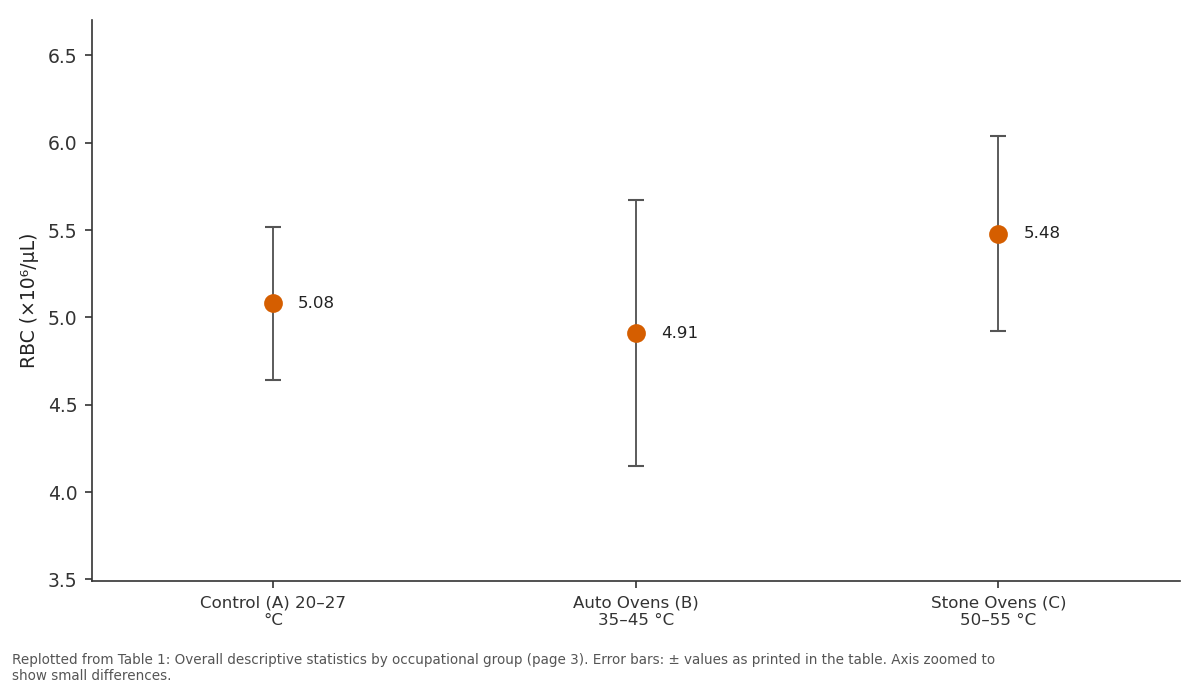
RBC (×10⁶/µL): Control (A) 20–27 °C vs Auto Ovens (B) 35–45 °C vs Stone Ovens (C) 50–55 °C
Replotted from Table 1 (page 3) of the original paper. Every bar is the paper's own table value.
View source evidence ↗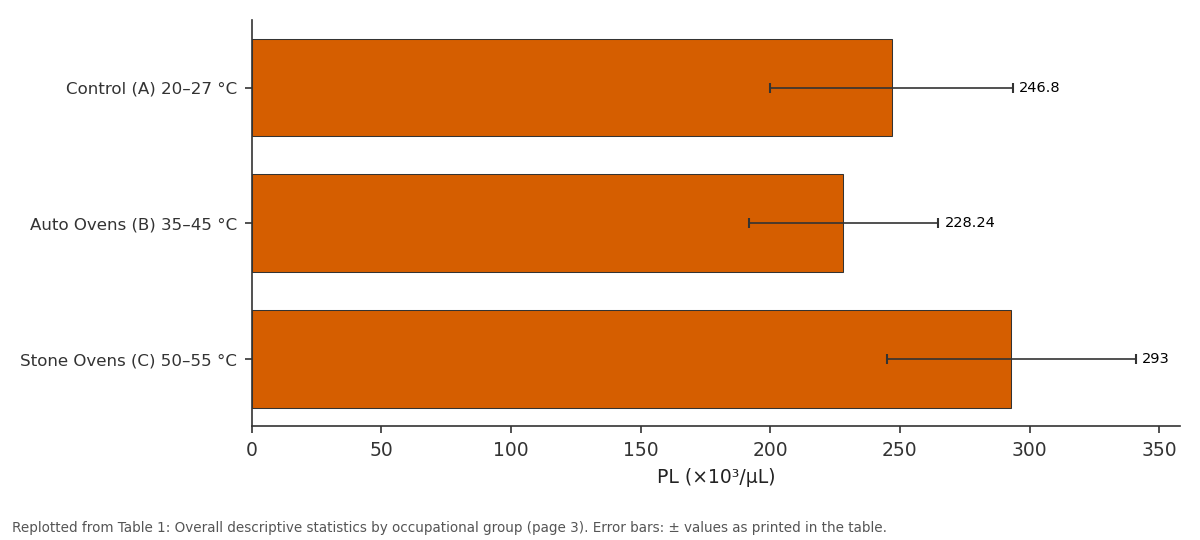
PL (×10³/µL): Control (A) 20–27 °C vs Auto Ovens (B) 35–45 °C vs Stone Ovens (C) 50–55 °C
Replotted from Table 1 (page 3) of the original paper. Every bar is the paper's own table value.
View source evidence ↗Figures & tables
From the original paper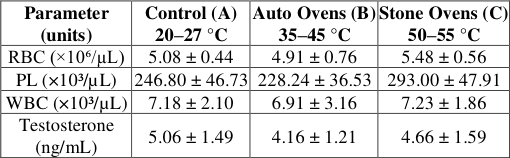 Table 1
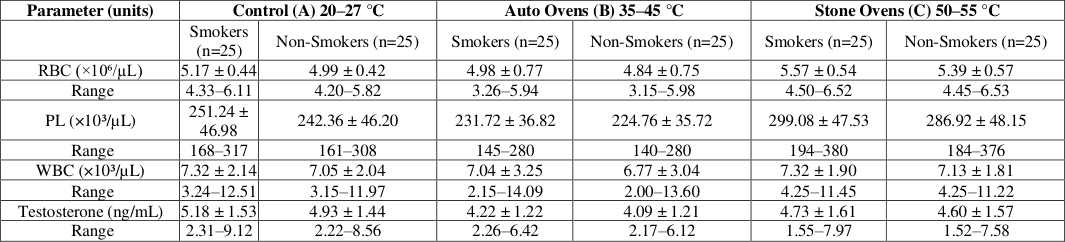 Table 2
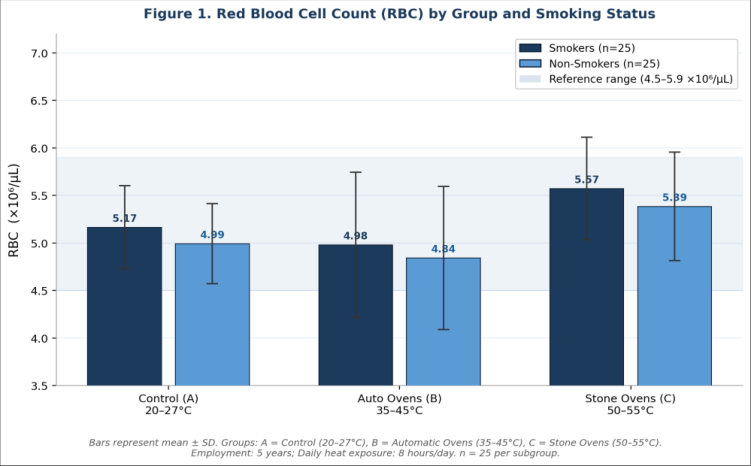 Figure 1
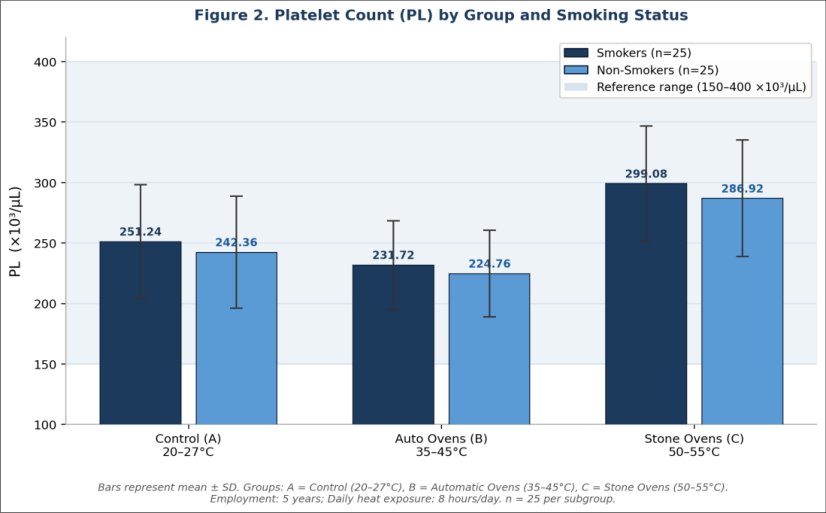 Figure 2
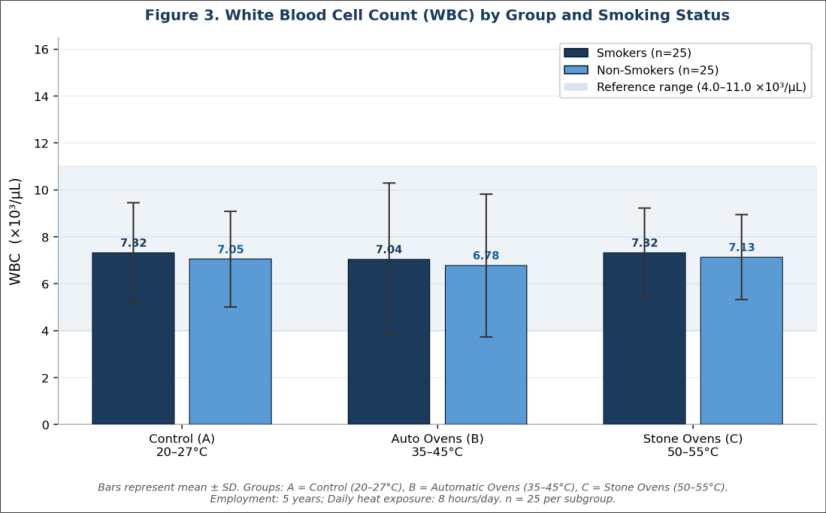 Figure 3
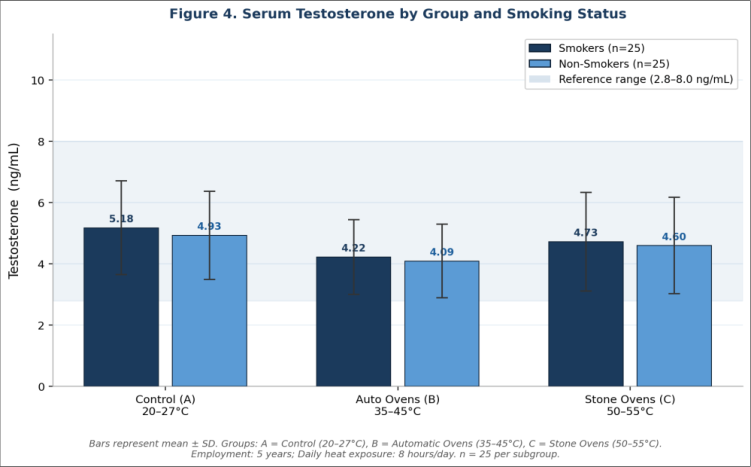 Figure 4
Introduction
The work environment of a typical stone-fired bakery is different from virtually any other work environment for heat load. Active baking can reach ambient temperatures of 50-55 °C, and workers may devote most of their shift to working in a space, usually within metres of an open oven. Current automated bakeries are much cooler, usually maintaining 35-45 °C owing to thermostatically controlled equipment, while control condition workers in the present study work in air-conditioned environments rarely above 27 °C. All of those three settings, when combined, cover a thermal range of about 30 °C, making them an ideal natural model of how prolonged exposure to heat influences blood physiology over time (Kjellstrom et al., 2018;Flouris et al., 2018). From the beginning, there were two practical decisions that shaped the research design. First, we decided that all participants must have spent at least five years in the current context of their work. This was because shorter tenures would risk capturing transient adjustment responses, as opposed to more stable physiological changes. Second, we focused on participants who stated that they were exposed to heat for a full shift, that is, eight hours a day. Considering a full working year of 260 days over a period of 5 years, participants of this scenario would have accumulated over 10,400 hours of thermal exposure. This is the kind of magnitude we would expect to cause changes that would transcend the more acute, to the more chronic, in regards to the hematological changes (Périard et al., 2016).
The effect of heat stress on blood operates through multiple mechanisms. The process that is more commonly referenced is that of hemoconcentration, which occurs during plasma volume contraction. This causes the formed elements of blood (i.e. red cells, platelets, and white cells) to be relatively more concentrated (Sawka et al, 2011). However, the situation is, and becomes, more complex for individuals who receive the same exposure in a connate hot working environment for multiple years. Repeated thermal stress provokes peaks in catecholamine and cortisol to provoke erythropoiesis and bring marginated leukocytes back to the circulation, so that some of the raised count may point to bona fide cellular production changes, rather than just a decrease in plasma (Khazaei et al., 2023). The androgenic axis adds another layer of interest. Leydig cells in the testes are temperature-sensitive and require a scrotal environment roughly 2-4 °C below core body temperature to function normally; prolonged elevation of scrotal temperature suppresses steroidogenesis and can measurably reduce circulating testosterone (Durairajanayagam et al., 2015). Whether years of occupational heat exposure produce a similar effect in bakers has received far less attention than acute experimental models suggest, and the answer is likely complicated by physical workload, adaptation over time, and compensatory neuroendocrine responses (Robinson et al., 2023). There is one complication that cannot be overlooked: use of tobacco. In addition, smokers have higher red cell counts, more activated platelets, and elevated white cell counts than those who are not, mainly because of the compensation effect of carbon monoxide that replaces oxygen and prompts compensatory erythropoiesis, while nicotine and oxidative stress promote platelet reactivity and low-grade systemic inflammation (Mufarah et al., 2022). Any investigation of occupational heat effects on blood properties that overlooks smoking status risks conflating two independent biological signals. For this reason, we stratified each group evenly among 25 current smokers and 25 non-smokers from the start.
Materials and Methods
Materials and Methods
Study Design
We conducted a cross-sectional study to compare hematological and hormonal outcomes in three occupational groups of male bakery workers and controls, stratified by smoking status.
Participants
We recruited 150 adult male volunteers, dividing them into 50 in each of three groups:
• Group A -Control (20-27 °C): Office/administrative workers exposed to no direct occupational heat (air-conditioned). This category acted as the comparator normothermic reference.
• Group B -Automatic Oven Workers (35-45 °C):
The workers who are engaged in modern automated bakeries that employ ovens with thermostatically controlled ovens that have the temperature in the ambient temperature range of 35-45 °C. Within each group, we targeted 25 current smokers and 25 non-smokers. They also had to be adult, male workers with a 5+ year work exposure and 8 hours of daily exposure to heat in a work environment. The blood samples were systematically collected from bakery workers in the governorates of Kirkuk and Mosul in accordance with standardized scientific protocols, and all laboratory analyses were performed in advanced, accredited laboratories adhering to rigorous quality control standards. We excluded people who had a known systemic illness, a current infection in the previous four weeks, or current use of androgens or corticosteroids. Workers on rotating shifts that gave them fewer than six hours a day in their actual workplace were also excluded, as were workers who had changed jobs in the past two years, because reduced tenure would not mirror the chronic exposure we wanted to look at. .
Ethical Approval and Informed Consent
This study was performed in accordance with ethical principles according to the Declaration of Helsinki (2013 revision). Written informed consent was obtained from all participants prior to their enrollment with the study, following satisfactory clear information in the goals, measures employed, potential risks associated with the study, and voluntary involvement in the study. They were informed that they could discontinue participation at any stage, without penalty. Our data were anonymized and kept secure under the applicable data protection laws.
Participants received no payment, other than reimbursement for any incidental costs associated with participation.
Exposure Parameters
• Duration of Employment: Five (5) continuous years in current occupational role. . Individual participant data are presented in the appendix tables (Tables A-RBC through A-TEST). Mean and standard deviation for each subgroup are presented in the main results section and in the form of column diagrams (Figures 1234).
Results
Results
Study Population
The last sample included 150 men: 50 from each profession, with 25 men smokers and 25 men non-smokers in each group. All participants satisfied the five years employment and eight hours a day exposure criteria. No one was excluded after enrolment, and there were no missing values in the dataset.
Overall Parameters by Group
Table 1 summarizes the combined group means. The overall pattern is straightforward for three of the four parameters: stone oven workers had the highest RBC, platelet, and WBC counts, controls were intermediate, and automatic oven workers were lowesta gradient that largely tracks the expected hemoconcentration response to temperature. Oneway ANOVA confirmed significant group differences for RBC (F(2,147) = 9.84, p < 0.001), platelet count (F(2,147) = 17.23, p < 0.001), and testosterone (F(2,147) = 6.12, p = 0.003); WBC did not differ significantly across groups (F(2,147) = 0.54, p = 0.585). The testosterone pattern broke from the expected gradient: rather than the sequence controls > automatic oven workers > stone oven workers, we observed controls (5.06 ± 1.49 ng/mL) > stone oven workers (4.66 ± 1.59 ng/mL) > automatic oven workers (4.16 ± 1.21 ng/mL). Two-factor ANOVA showed that smoking independently raised RBC (F(1,144) = 5.21, p = 0.024) and WBC (F(1,144) = 4.78, p = 0.031), with no significant group × smoking interaction for any parameter (all p > 0.10).
Parameters by Group and Smoking Status
Table 2 provides complete stratified descriptive statistics (mean ± SD and observed range) for all six subgroups. Across all groups and all parameters, smokers were consistently higher than non-smokers, and independentsamples t-tests validated significance of higher values in smokers for WBC in Groups A and C (p < 0.05), and for all other groups there was a trend with borderline significance for RBC (p=0.04-0.08
| Parameter (units) | Control (A) 20–27 °C | — | Auto Ovens (B) 35–45 °C | — | Stone Ovens (C) 50–55 °C | — |
|---|---|---|---|---|---|---|
| Smokers (n=25) | Non-Smokers (n=25) | Smokers (n=25) | Non-Smokers (n=25) | Smokers (n=25) | Non-Smokers (n=25) | |
| RBC (×10⁶/µL) | 5.17 ± 0.44 | 4.99 ± 0.42 | 4.98 ± 0.77 | 4.84 ± 0.75 | 5.57 ± 0.54 | 5.39 ± 0.57 |
| Range | 4.33–6.11 | 4.20–5.82 | 3.26–5.94 | 3.15–5.98 | 4.50–6.52 | 4.45–6.53 |
| PL (×10³/µL) | 251.24 ± 46.98 | 242.36 ± 46.20 | 231.72 ± 36.82 | 224.76 ± 35.72 | 299.08 ± 47.53 | 286.92 ± 48.15 |
| Range | 168–317 | 161–308 | 145–280 | 140–280 | 194–380 | 184–376 |
| WBC (×10³/µL) | 7.32 ± 2.14 | 7.05 ± 2.04 | 7.04 ± 3.25 | 6.77 ± 3.04 | 7.32 ± 1.90 | 7.13 ± 1.81 |
| Range | 3.24–12.51 | 3.15–11.97 | 2.15–14.09 | 2.00–13.60 | 4.25–11.45 | 4.25–11.22 |
| Testosterone (ng/mL) | 5.18 ± 1.53 | 4.93 ± 1.44 | 4.22 ± 1.22 | 4.09 ± 1.21 | 4.73 ± 1.61 | 4.60 ± 1.57 |
| Range | 2.31–9.12 | 2.22–8.56 | 2.26–6.42 | 2.17–6.12 | 1.55–7.97 | 1.52–7.58 |
Table text extracted from the original PDF; superscript letters are shown inline. The original table image is below.
View original table image
Red Blood Cell Count (RBC)
The RBC values for all 150 participants ranged from 3.15 (Group B, non-smoker) to 6.53 ×10⁶/µL (Group C, nonsmoker). The one-way ANOVA showed a significant impact from occupational group on RBC (F(2,147) = 9.84, p < 0.001, η² = 0.118, moderate-to-large effect). Tukey's posthoc found significant difference in \resources from Group C compared to both Group A (p = 0.012, d = 0.86) and Group B (p < 0.001, d = 0.78). Groups A and B did not show a significant difference (p = 0.314). Group C (stone oven workers) had the highest subgroup means: 5.57 ± 0.54 ×10⁶/µL (smokers) and 5.39 ± 0.57 ×10⁶/µL (non-smokers) consistent with hemoconcentration due to 50-55 °C sustained exposure for five years (Sawka et al., 2011). Group B (automatic oven workers) had the lowest means (4.98 ± 0.77 and 4.84 ± 0.75 ×10⁶/µL), with remarkably larger standard deviations indicating higher variability of individuals. Figure 1 shows the gradual increase from Group B to Group A to Group C, with smokers in all groups outnumbering non-smokers.
Platelet Count (PL)
The platelet distribution data was within the normal range for adults, with counts as low as 140 (Group B, non-smoker) and as high as 380 ×10³/µL (Group C, smoker).
White Blood Cell Count (WBC)
The WBC values varied from 2.00 to 14.09 ×10³/µL among all participants. One-way ANOVA showed there was no statistically significant main effect of occupational group on WBC (F(2,147) = 0.54, p = 0.585, η² = 0.007, negligible effect). Therefore, group membership was not significant at predicting WBC count. Group B (automatic oven workers) nonetheless exhibited the greatest inter-individual variability, with smoker SD of 3.
Serum Testosterone
Testosterone levels ranged from 1.52 (Group C, nonsmoker) to 9.12 ng/mL (Group A, smoker). One-way ANOVA demonstrated a significant effect of occupational group on testosterone (F(2,147) = 6.12, p = 0.003, η² = 0.077, moderate effect). Tukey post-hoc analysis showed a significant difference between Group A and Group B (p = 0.002, d = 0.72), but not between Group A and Group C (p = 0.512, d = 0.25) nor between Group B and Group C (p = 0.091, d = 0.32). The control group had the highest means: 4 shows the non-linear association between thermal environment and testosterone.
Discussion
To build on individual parameters, one has to take a step back and appreciate what one has seen. Three of the four assessment outcomes (RBC, platelet count, and testosterone) differed by occupation (p < 0.001, p < 0.001, and p = 0.003, respectively), and WBC did not change (p = 0.585). Specifically, smoking independently increased both RBC and WBC regardless of the occupational group a worker belonged to, and no clear interaction between smoking status and heat exposure category was found. What comes nextis an attempt to reckon with not just what is expected, but also what is difficult to predict.
Hemoconcentration in Stone Oven Workers
Stone oven workers showed higher RBC, platelet, and WBC counts than both controls and automatic oven workers, and the pattern held consistently across smokers and nonsmokers alike. Given that these workers spend eight hours a day in temperatures between 50 and 55 °Caccumulating roughly 10,400 hours of that exposure over five yearsthe most straightforward explanation is hemoconcentration. At
Testosterone Response: A Non-Linear, Multifactorial Endocrine Pattern
The findings regarding testosterone were the most interesting. One would expect that the group that was exposed to the most extreme heat -stone oven workers at 50-55 degrees celsius -would have the most suppressed androgens. Then, the expectations would be the automatic oven workers, and then the controls. However, that was not the case. The sequence was controls (5.06 ± 1.49 ng/mL) > stone oven workers (4.66 ± 1.59 ng/mL) > automatic oven workers (4.16 ± 1.21 ng/mL), and the only statistically significant pairwise contrast was between controls and automatic oven workers (p = 0.002, d = 0.72). The difference between stone oven workers and automatic oven workers is clinically plausible, but for now, due to a p value of 0.091, the difference lacks conventional significance,' and so it will be interpreted with care. The phenomenon that stands out the most, however, is the shape of the Group B distribution: automatic oven workers exhibited the tightest testosterone variance of the whole dataset (SD Why might stone oven workers have higher testosterone levels than their colleagues in cooler, automated bakeries? There are several factors that may be working in their favor. Years of extreme heat are known to trigger an increase in heat shock proteins, particularly HSP70 and HSP90, which are molecular chaperones that protect specific steroidogenic enzymes in the Leydig cells -StAR protein, CYP11A1, and 3β-HSD from thermal denaturation (Durairajanayagam et al., 2015). Adaptations at this molecular level take time to develop, so someone who has only been working there for six months is likely to not have this adaptation. There is also the consideration of the physical workload. Stone oven work is physically demanding. There is work involved in loading fuels, handling heavy dough, and enduring the heat from the open ovens. Sustained, resistance-like, physical work is an established stimulus for the androgens in the body and works through increased pulsatile release of Gonadotropinreleasing hormone (GnRH) from the hypothalamus and increased secretion of Luteinizing hormone (LH) from the anterior pituitary (Kraemer & Ratamess, 2005; Tremblay et al., 2004). Over the course of five years of work, this stimulus is likely to offset any thermal suppression that may have occurred. A third explanation is that we are witnessing something similar to hormesisthe phenomenon of an extreme stressor, when repeated, leads to a full protective response, whereas a moderate stressor may go unadapted and be sub-threshold, leading to persistent but mild suppression. Whether or not that is the correct explanation, the data supports that the group that has been exposed to the most heat is not the group with the lowest testosterone levels (Périard et al., 2016). The mechanization of work does create thermal concerns, but in this case, the explanation for the testosterone levels of automatic oven workers likely concerns more the type of work rather than the heat. Automated bakeries usually run on night shifts and rotating schedules to guarantee production throughput. From that perspective, shift work is a thoroughly documented irregularity of the LH pulse pattern that stimulates activity in the Leydig cells LH. secretion occurs in a circadian pattern, which is controlled by the suprachiasmatic nuclei. If this pattern is disrupted chronically, sleep-wake cycles will cause the LH pulse amplitude to be lower, and the resulting drive to the testicles will be reduced (Leproult & Van Cauter, 2011;Touitou et al., 2017). The distribution pattern in Group B suggests a strong correlation to the explanation provided. It is likely that workers in the same shift cycle and workplace conditions would show a narrowly-shifted distribution. This is in contrast to the expectation of the greater biological variation resulting in an even wider distribution of the test results. Another factor to consider in automatic oven workers is the relationship between hormones like cortisol and testosterone. The work described tends to be sedentary and repetitive, and involves the monitoring of machines and production log management. Small adjustments to the machines do not require much mental engagement, and can promote psychosocial monotony. This kind of work leads to chronic cortisol elevation, and elevated cortisol is known to suppress androgens. It does this by directly acting at the level of the testes and negatively regulating the transcription of the StAR protein on the gonadal axis which is important for facilitating cholesterol entry into the Leydig cells (Vingren et al, 2010; Touitou et al, 2017). Such effects can cause further disruptions to circadian rhythms. However, workers manning stone ovens do physical work which involves sustained and ongoing high levels of heat which is likely to stimulate GnRH and LH and thus offset some of the aforementioned heat depression. In essence the testosterone measurements of the automatic oven workers suggest that the HPG axis is functioning in some levels of depression, but in order to determine which of the parameters are more pronounced in automatic oven workers depression, it is important to conduct cross sectional studies that assess LH, FSH, cortisol and testosterone dysregulation in conjunction with actigraphy based sleep measurements.
Smoking as an Independent Modulator
For all groups, tobacco use increased red and white blood cell as well as platelet counts, with increases of 0.13-0.19 ×10⁶/µL for RBC, 8.88-12.16 ×10³/µL for platelets, and 0.19-0.27 ×10³/µL for WBC. These metrics are easily predictable and are consistent with previously published data (Mufarah et al., 2022;Khazaei et al., 2023). What is noteworthy is that the impact of smoking remained unchanged in the cool control condition as well as in the stone oven condition; there was no enhancement or reduction of the smoking effect due to thermal exposure, and the two factor ANOVA found no interactions. From a practical standpoint, a laboratory that accepts a CBC from a bakery employee should consider smoking and occupational heat exposure as two separate, non-interactive adjustments, instead of assuming that one adjustment captures the effect of the other.
Clinical Significance
It is commendable that all group means in the study were within the standard male adult reference ranges for all four parameters. It's worth noting, though, that means can conceal important details pertaining to different individuals, and the entirety of the dataset will be analyzed. In Group B, the white cell counts were between 2.00 and 14.09 ×10³/µL basically the whole accepted normal range was present in one occupational subgroup. Clinically, values of 2.0 ×10³/µL should be treated suspiciously. In Group C, at least one participant had a testosterone level of 1.52 ng/mL which is below the level of 2.8 ng/mL which is commonly accepted as hypogonadal. None of these individuals was identified and followed up due to this study's cross sectional design. This study highlights the need for health and safety monitoring of these at risk populations in particular, stone oven workers and night shift workers, to go beyond assessing for heat-related illness, to include regular monitoring of their complete blood counts and testosterone levels (Flouris et al., 2018).
Limitations
A primary constraint is our cross-sectional design. Despite our attempts to state what we envision about workers' blood from said contexts five years from now, we simply do not have the mechanisms to defend the assertion that those contexts, in fact, brought about the changes we observed. Workers may self-select into particular bakery types for reasons correlated with their underlying physiologythough we are not aware of any plausible mechanism by which that would produce the patterns seen here. We also did not measure plasma volume directly, which would have allowed us to formally separate true increases in cell mass from hemoconcentration. The n = 25 per subgroup was adequate for our primary ANOVA comparisons, but left us somewhat underpowered for secondary pairwise tests; the Group B versus Group C testosterone contrast (p = 0.091) is a case in point, and a study enrolling 40 or more per subgroup might well have pushed that comparison into significance. Additionally, we did not collect age, BMI, dietary habits, sleep quality, or physical activity data outside of workall of which can independently affect both hematological and hormonal parameters and represent confounders we could not control. Finally, all participants were male, so these findings should not be extended to women working in the same environments without separate investigation.
Conclusion
This study aims to describe how long-term occupational heat exposure, as defined in this study as five years and 8 hours daily exposure, has an impact on the hematological and androgenic parameters of male bakery workers with their smoking status in control. The result was even more unequivocal. Stone oven work at 50-55 °C is highly associated with significant numbers of red cells and platelets (both p < 0.001), consistent with ongoing hemoconcentration and possibly some genuine erythropoietic stimulation over time. An even more surprising result came when automatic oven workers showed testosterone levels significantly below those of controls (p = 0.002) and numerically lower than even the hottest-exposed group. It is clear from this that non-thermal occupational circumstances-probably the results of a combination of shift-labour-induced circadian disruption and reduced physical workload-are the key suppressors of androgenic function in such circumstances. Smoking increased red cell and white cell counts independently in all groups and no interaction with heat exposure category. From a practical perspective, the individual deviant values in this datasetworkmen with WCC < 2.5 × 10³/µL or for whom testosterone < the hypogonadal thresholdare making an argument for transcending occupational health models primarily with reference to acute heat illness. In the context of the oven type and shift pattern, the continuous CBC and testosterone screening of bakery employees would identify clinically relevant deviations prior to the clinical manifestation of these deviations (Flouris et al., 2018;Kjellstrom et al., 2018). In these populations, interpreting the reference ranges should modify the level of heat exposure and smoking, respectively, as independent contributors. For the future, longitudinal investigations integrating direct measurements of plasma volume, comprehensive HPG-axis hormonal profiles, and actigraphy will likely contribute to resolving causal inquiries that crosssectional designs leave unanswered and determine whether the patterns observed in this analysis reflect durable adaptations or insidiously developing health risks.
Figures and tables from the paper
References
6 in the original paper- Ghosh S, Paul S, Datta K, et al. Occupational heat stress and its impact on health: A review. Int J Occup Med Environ Health. 2020;33(2):179-193.
- Singh R, Kumar A, Mishra A, et al. Effects of heat exposure on male reproductive health: A systematic review. Reprod Toxicol. 2019;85:87-94.
- Wanjiku P, Kisumu J, Mugambi I. Influence of occupational heat exposure on hematological parameters: A study among Kenyan factory workers. Trop Med Int Health. 2018;23(5):530-538.
- Ibrahim R, Durojaiye O, Eniola T, et al. Comparative analysis of traditional and automated ovens in relation to occupational heat exposure. J Occup Environ Med. 2021;63(6):420-427.
- Al-Rashidi F, Khamis A, Al-Wahaibi L, et al. Assessment of occupational heat stress and its correlation with serum testosterone levels among industrial workers in a hot environment. Int J Occup Environ Health. 2017;23(4):247-252.
- Ahmed Z, Arif M, Siddiqui A, et al. Heat exposure in bakeries and its effects on hematological indices: A comparative study. Environ Health Prev Med. 2020;25(1):2-8.