
Research article · 2026 · Full text
International Journal of Agriculture and NutritionEffect of split nitrogen application on growth, yield and economics of summer pearl millet
Volume 8(6) · Pages 37–41 · DOI: 10.33545/26646064.2026.v8.i6a.651 ↗
Research areasAgricultural Science and FertilizationCrop Yield and Soil FertilityAgricultural Productivity and Crop Improvement
Abstract
Author-writtenA field experiment was conducted during summer 2024 at the Agronomy Instructional Farm, Chimanbhai Patel College of Agriculture, Sardarkrushinagar Dantiwada Agricultural University to evaluate the effect of split nitrogen application on growth, yield and economics of summer pearl millet [Pennisetum glaucum (L.)]. The experiment was laid out in a Randomized Block Design with seven treatments and four replications. Treatments consisted of different schedules of nitrogen split application using 100% and 75% recommended dose of nitrogen (RDN). The results revealed that split application of nitrogen significantly influenced growth parameters, yield attributes, yield and economic returns of summer pearl millet. Application of 100% RDN in four equal splits comprising 25% basal + 25% at tillering + 25% at earhead emergence + 25% at flowering (T₄) recorded significantly higher plant height (195.9 cm), effective tillers per plant (3.9), leaf area (437.8 cm²), earhead length (26.04 cm) and earhead girth (9.60 cm). The same treatment also produced the highest grain yield (4379 kg ha⁻¹) and straw yield (7207 kg ha⁻¹), along with maximum net realization (₹1,00,466 ha⁻¹) and benefit: cost ratio (2.80). Treatments receiving 100% RDN in three splits also performed better than treatments receiving 75% RDN. The improved performance under multiple split applications was mainly attributed to synchronized nitrogen availability during critical crop growth stages, resulting in better growth, higher nitrogen use efficiency and enhanced productivity. The study concluded that application of 100% recommended nitrogen in four equal splits proved most effective and economical for summer pearl millet cultivation under North Gujarat conditions.
Summary
Source-checkedPlain-language reading of the full paper, prepared with AI and checked against the text. Each point links to the authors' own words.
Why it matters
- Pearl millet is a critical cereal crop in India's arid and semi-arid regions, used for both food and livestock fodder. View evidence ↗
- In North Gujarat's sandy soils, nitrogen is easily lost through leaching and volatilization, making efficient nutrient management essential. View evidence ↗
- Applying nitrogen in split doses is a strategy to synchronize nutrient availability with crop demand, which can improve growth and profitability. View evidence ↗
The question
- The study aimed to evaluate how different nitrogen split application schedules affect the growth, yield, and economic returns of summer pearl millet in North Gujarat. View evidence ↗
What they did
- The field experiment was conducted during the summer of 2024 at the Agronomy Instructional Farm in Sardarkrushinagar, Gujarat. View evidence ↗
- Researchers used a Randomized Block Design with four replications and seven treatments, testing the pearl millet hybrid GHB 1129. View evidence ↗
- Treatments varied by nitrogen dose (100% or 75% of the recommended dose) and the number of splits (two, three, or four) applied at different growth stages. View evidence ↗
- The study measured growth parameters (height, tillers, leaf area), yield attributes (earhead length/girth, test weight), total grain and straw yields, and economic metrics. View evidence ↗
What they found
- The treatment with 100% RDN in four equal splits (T₄) achieved the highest plant height (195.9 cm), effective tillers (3.9), leaf area (437.8 cm²), earhead length (26.04 cm), and earhead girth (9.60 cm). View evidence ↗
- T₄ was the most profitable treatment, yielding a net realization of ₹1,00,466 ha⁻¹ and a benefit:cost ratio of 2.80. View evidence ↗
- The lowest productivity for both grain and straw was observed in treatment T₅, which used 75% RDN in two splits. View evidence ↗
- Generally, treatments receiving 100% of the recommended nitrogen dose in three splits outperformed those receiving only 75%. View evidence ↗
What it means
- The authors conclude that applying 100% of the recommended nitrogen in four equal splits is the most effective and economical method for summer pearl millet in North Gujarat. View evidence ↗
- The authors attribute the success of multiple split applications to the synchronization of nitrogen availability with critical growth stages, which increased nitrogen use efficiency. View evidence ↗
Visual summary
2 visualsIllustrations explain the paper; charts are replotted from the paper's own table values.
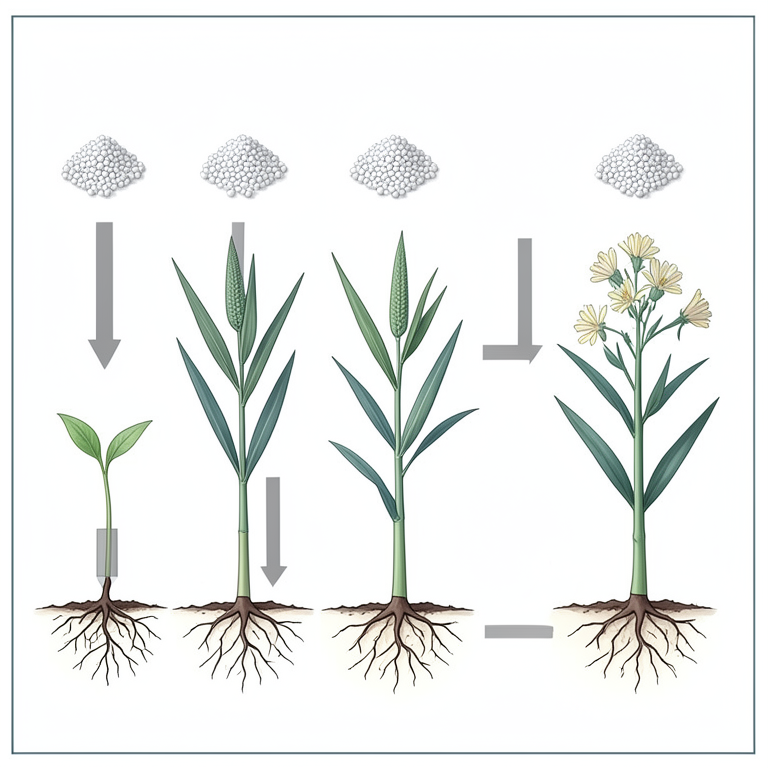
Nitrogen Application Timeline
AI-generated conceptual illustration (summer pearl millet plants). It explains the idea and does not show study data.
View source evidence ↗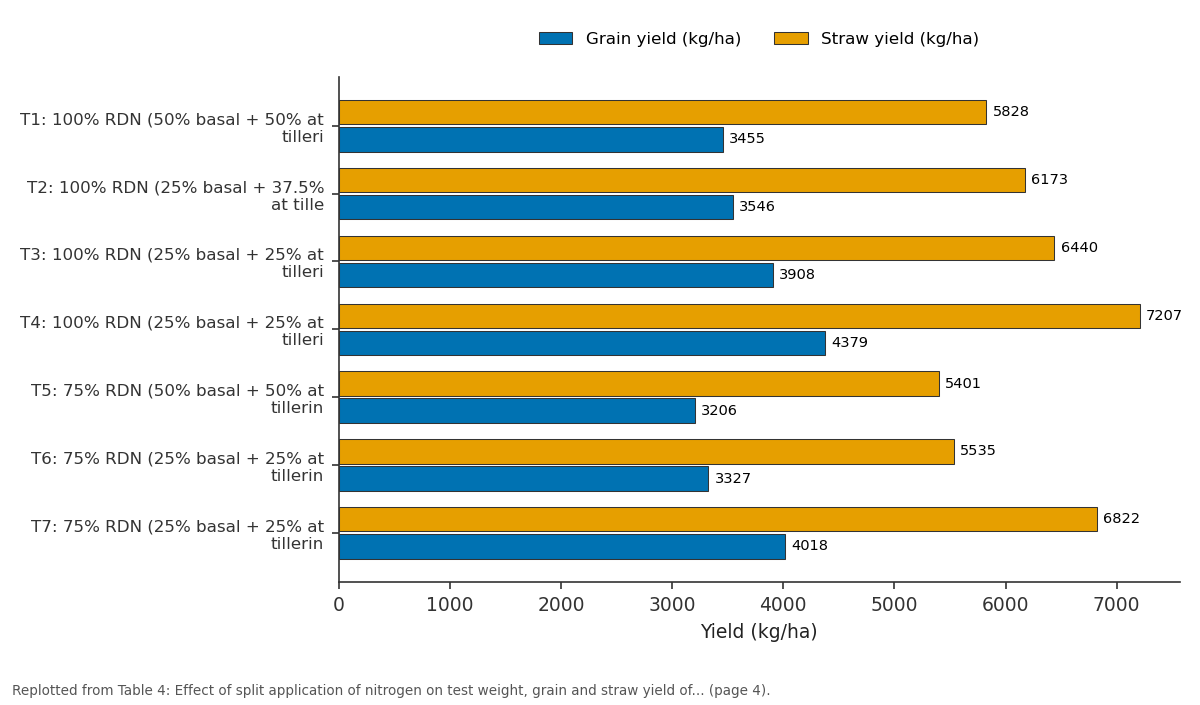
Grain yield (kg/ha) and Straw yield (kg/ha): T1: 100% RDN (50% basal... vs T2: 100% RDN (25% basal... vs T3: 100% RDN (25% basal... vs T4: 100% RDN (25% basal... vs T5: 75% RDN (50% basal...
Replotted from Table 4 (page 4) of the original paper. Every bar is the paper's own table value.
View source evidence ↗Figures & tables
From the original paper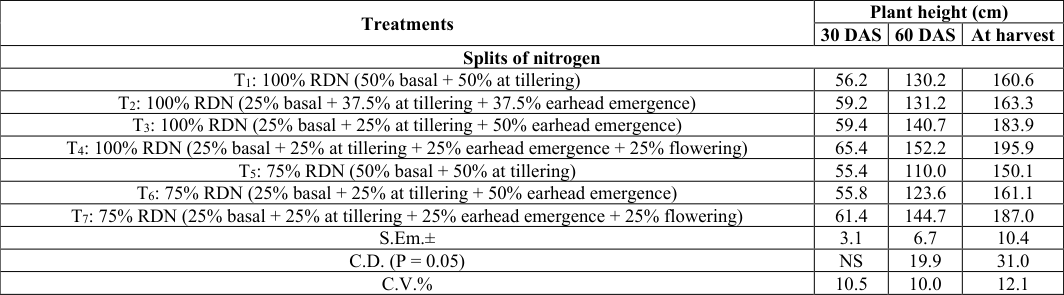 Table 1
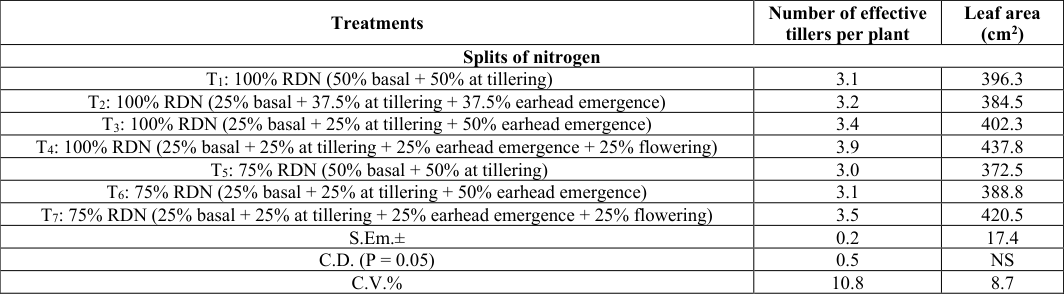 Table 2
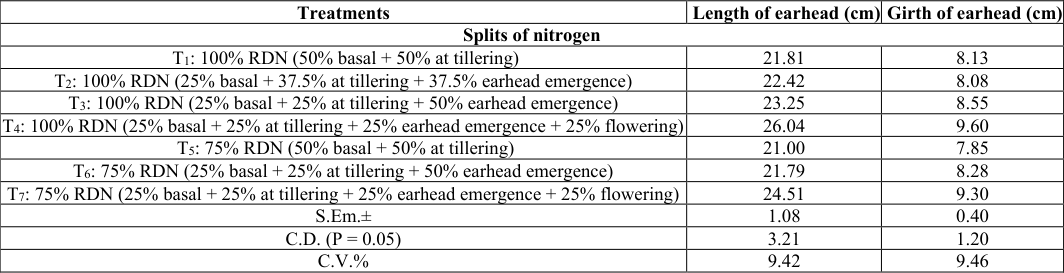 Table 3
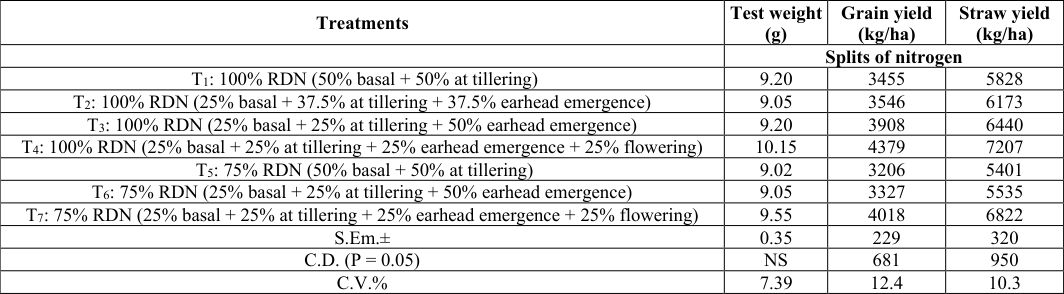 Table 4
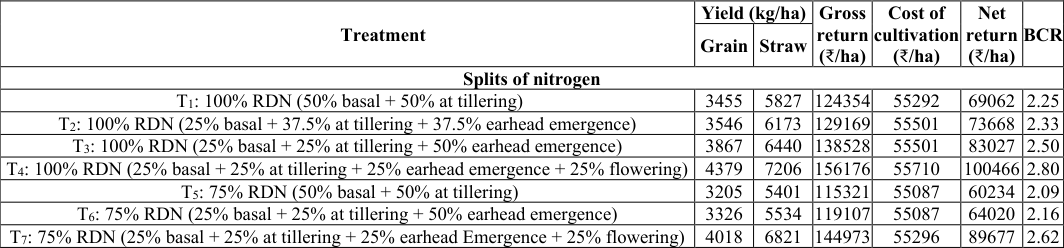 Table 5
Introduction
Pearl millet (Pennisetum glaucum L.) is one of the most important cereal crops cultivated in arid and semi-arid regions of India for both food and fodder purposes. It belongs to the family Poaceae and is popularly known as bajra. Owing to its drought tolerance, short duration and adaptability to poor sandy soils, pearl millet occupies a prominent place in dryland agriculture. The crop possesses remarkable ability to withstand high temperature and moisture stress conditions, making it suitable for cultivation under adverse climatic situations. In addition to its resilience, pearl millet grains are nutritionally rich and contain appreciable amounts of carbohydrates, protein, fat, fibre and minerals, thereby contributing significantly to nutritional security. In India, pearl millet ranks fourth among food crops after rice, wheat and maize. It is cultivated extensively in the states of Rajasthan, Uttar Pradesh, Gujarat, Haryana and Maharashtra. During recent years, increased awareness regarding the nutritional importance of millets has enhanced the significance of pearl millet cultivation. The declaration of 2023 as the "International Year of Millets" by the United Nations has further emphasized the role of millets in sustainable agriculture and human nutrition. In Gujarat, summer pearl millet has emerged as an important crop in intensive cropping systems because of assured irrigation facilities, higher productivity and efficient utilization of resources. Cropping sequences such as cotton-summer pearl millet, tobacco-summer pearl millet and potato-summer pearl millet are becoming increasingly popular among farmers for maximizing production per unit area and time. Summer pearl millet is characterized by rapid growth, efficient utilization of soil moisture, high heat tolerance and lower incidence of pests and diseases. The crop also provides highly digestible and nutritious fodder suitable for livestock feeding. The adoption of high yielding hybrids and improved agronomic practices has substantially increased the productivity potential of pearl millet in recent decades. However, the realization of higher yields largely depends upon efficient nutrient management, particularly nitrogen fertilization. Geographically, the experimental site is situated at 24°19′ North latitude and 72°19′ East longitude with an elevation of 154.52 m above mean sea level and falls under the North Gujarat Agroclimatic Zone. The climate of the region is sub-tropical and semi-arid with hot summers and moderately cold winters. During the crop growing period, the weather remained favourable for the growth and development of summer pearl millet and no rainfall was received. The soil of the experimental field was loamy sand in texture, low in organic carbon and available nitrogen, medium in available phosphorus and high in available potassium. The soil had pH 7.51 and EC 0.12 dS m⁻¹ indicating non-saline nature. The initial soil contained 164.71 kg available N ha⁻¹, 31.79 kg available P₂O₅ ha⁻¹ and 273.37 kg available K₂O ha⁻¹. The experiment was laid out in a Randomized Block Design (RBD) with seven treatments and four replications. Pearl millet hybrid GHB 1129 was used as the test variety.
The gross plot size was 6.0 m × 3.6 m, whereas net plot size was 4.5 m × 2.7 m with row spacing of 45 cm. The crop was sown on 6 March 2024 using a seed rate of 3.75 kg ha⁻¹. The treatments consisted of different nitrogen split schedules as follows: T₁: 100% RDN (50% basal + 50% at tillering), T₂: 100% RDN (25% basal + 37.5% at tillering + 37.5% at earhead emergence), T₃: 100% RDN (25% basal + 25% at tillering + 50% at earhead emergence), T₄: 100% RDN (25% basal + 25% at tillering + 25% at earhead emergence + 25% at flowering), T₅: 75% RDN (50% basal + 50% at tillering), T₆: 75% RDN (25% basal + 25% at tillering + 50% at earhead emergence) and T₇: 75% RDN (25% basal + 25% at tillering + 25% at earhead emergence + 25% at flowering). Recommended dose of phosphorus @ 60 kg P₂O₅ ha⁻¹ through single super phosphate was applied as basal to all treatments, while nitrogen was supplied through urea according to the treatment schedule. The land was prepared by ploughing followed by harrowing and planking to obtain fine tilth. Sowing was done manually in furrows at a depth of 3-5 cm immediately after sowing; irrigation was applied for proper germination and crop establishment. Subsequent irrigations were scheduled according to crop requirement and soil moisture condition. Standard agronomic practices including thinning, hand weeding and inter-culturing were carried out uniformly in all plots to maintain healthy crop growth. The crop was harvested at physiological maturity on 23 May 2024. Observations on growth parameters such as plant population, plant height, number of tillers per plant and leaf area per plant were recorded periodically from five tagged plants selected randomly from each net plot. Yield attributes including earhead length, earhead girth and test weight was recorded at harvest. Grain and straw yields were recorded from net plot area and converted into kg ha⁻¹. Economics of different treatments were worked out in terms of gross realization, net realization and benefit: cost ratio based on prevailing market prices of produce and cost of cultivation. The experimental data were statistically analysed following the procedure suggested by Panse and Sukhatme (1967). The treatment differences were tested by 'F' test and critical difference (CD) at 5% level of significance was used for comparison of treatment means.
Results and Discussion
Results and Discussion
Growth Parameters
The experimental results revealed that different schedules of split nitrogen application exerted significant influence on growth parameters of summer pearl millet. Plant population at harvest remained unaffected due to various nitrogen split treatments, indicating that nitrogen scheduling had no significant effect on crop establishment. However, plant height, number of tillers per plant and leaf area per plant were significantly influenced by split application of nitrogen. Among different treatments, application of 100% recommended dose of nitrogen (RDN) in four equal splits comprising 25% basal + 25% at tillering + 25% at earhead emergence + 25% at flowering (T₄) recorded significantly higher plant height, number of tillers per plant and leaf area compared to other treatments. The increase in growth parameters under T₄ might be attributed to continuous and balanced availability of nitrogen throughout the crop growth period, which enhanced cell division, chlorophyll formation and photosynthetic activity. Adequate nitrogen availability at critical growth stages promoted vigorous vegetative growth and resulted in better development of the crop canopy. The treatments receiving 100% RDN in three splits, particularly T₂ and T₃, also produced comparatively better growth attributes over treatments receiving 75% RDN. Lower growth performance under 75% RDN treatments might be due to insufficient nitrogen supply which restricted vegetative growth and development. Nitrogen being a major constituent of proteins and enzymes plays a vital role in metabolic activities and therefore adequate nitrogen supply throughout crop growth stages significantly improved growth characteristics of pearl millet. Similar beneficial effects of split nitrogen application on growth parameters have also been reported by earlier workers in pearl millet and other cereal crops.
Yield Attributes
Yield attributes of summer pearl millet viz., earhead length, earhead girth and test weight were significantly influenced by different nitrogen split schedules. The treatment T₄ (100% RDN applied in four equal splits) recorded significantly higher earhead length, earhead girth and test weight over most of the treatments. The improvement in yield attributes under this treatment may be due to better availability and efficient utilization of nitrogen throughout the crop growth period, which enhanced photosynthate production and translocation towards reproductive structures. Application of nitrogen in multiple splits synchronized nutrient supply with crop demand during critical growth stages, resulting in improved spike development and grain formation. Adequate nitrogen availability during earhead emergence and flowering stages might have enhanced grain filling and accumulation of dry matter in grains, thereby increasing test weight. In contrast, treatments receiving lower nitrogen dose (75% RDN) produced comparatively lower yield attributes because of inadequate nutrient availability during reproductive growth stages.
Grain and Straw Yield
Grain and straw yields of summer pearl millet were significantly affected by different nitrogen split applications. Among all the treatments, application of 100% RDN in four equal splits (T₄) recorded the highest grain yield (4379 kg ha⁻¹) and straw yield (7207 kg ha⁻¹), which remained statistically superior over most of the treatments. The increase in grain and straw yield under T₄ may be attributed to improvement in growth parameters and yield attributes resulting from continuous nitrogen availability throughout crop growth stages. Balanced nitrogen supply enhanced photosynthetic efficiency, dry matter accumulation and partitioning of assimilates towards grain and straw production. Split application of nitrogen reduced nutrient losses through leaching and volatilization and improved nitrogen use efficiency under loamy sand soils of North Gujarat. Treatments receiving 100% RDN in three splits (T₂ and T₃) also produced comparatively higher grain and straw yields and remained at par with T₄ in some cases. However, treatments receiving only 75% RDN recorded significantly lower yields due to inadequate nitrogen supply and poor crop growth. The lowest grain and straw yields were observed under T₅ treatment (75% RDN applied in two splits), indicating the importance of adequate nitrogen dose along with proper scheduling for achieving higher productivity of summer pearl millet. The findings of the present investigation are in close agreement with earlier reports indicating that split nitrogen application enhances nitrogen use efficiency and productivity of pearl millet by ensuring nutrient availability at critical growth stages.
Economics
Economic analysis indicated that different nitrogen split schedules markedly influenced the profitability of summer pearl millet cultivation. The treatment T₄ (100% RDN in four equal splits) recorded the highest gross realization, net realization and benefit: cost ratio. The net return obtained under T₄ was ₹1,00,466 ha⁻¹ with a benefit: cost ratio of 2.80. Higher economic returns under T₄ were mainly due to significantly higher grain and straw yields obtained under this treatment. Although split application of nitrogen involved slightly higher labour cost, the additional yield realized from efficient nitrogen management substantially increased profitability. Treatments receiving 100% RDN in three splits also produced higher economic returns compared to 75% RDN treatments owing to better crop productivity. Lower net returns and benefit: cost ratio under 75% RDN treatments were associated with reduced grain and straw yields resulting from inadequate nitrogen supply. The results clearly indicated that application of 100% recommended nitrogen in four equal splits proved economically advantageous for summer pearl millet cultivation under North Gujarat conditions.
Figures and tables from the paper
| Treatments | Plant height (cm) | — | — |
|---|---|---|---|
| 30 DAS | 60 DAS | At harvest | |
| Splits of nitrogen | |||
| T1: 100% RDN (50% basal + 50% at tillering) | 56.2 | 130.2 | 160.6 |
| T2: 100% RDN (25% basal + 37.5% at tillering + 37.5% earhead emergence) | 59.2 | 131.2 | 163.3 |
| T3: 100% RDN (25% basal + 25% at tillering + 50% earhead emergence) | 59.4 | 140.7 | 183.9 |
| T4: 100% RDN (25% basal + 25% at tillering + 25% earhead emergence + 25% flowering) | 65.4 | 152.2 | 195.9 |
| T5: 75% RDN (50% basal + 50% at tillering) | 55.4 | 110.0 | 150.1 |
| T6: 75% RDN (25% basal + 25% at tillering + 50% earhead emergence) | 55.8 | 123.6 | 161.1 |
| T7: 75% RDN (25% basal + 25% at tillering + 25% earhead emergence + 25% flowering) | 61.4 | 144.7 | 187.0 |
| S.Em.± | 3.1 | 6.7 | 10.4 |
| C.D. (P = 0.05) | NS | 19.9 | 31.0 |
| C.V.% | 10.5 | 10.0 | 12.1 |
Table text extracted from the original PDF; superscript letters are shown inline. The original table image is below.
View original table image
| Treatments | Number of effective tillers per plant | Leaf area (cm2) |
|---|---|---|
| Splits of nitrogen | ||
| T1: 100% RDN (50% basal + 50% at tillering) | 3.1 | 396.3 |
| T2: 100% RDN (25% basal + 37.5% at tillering + 37.5% earhead emergence) | 3.2 | 384.5 |
| T3: 100% RDN (25% basal + 25% at tillering + 50% earhead emergence) | 3.4 | 402.3 |
| T4: 100% RDN (25% basal + 25% at tillering + 25% earhead emergence + 25% flowering) | 3.9 | 437.8 |
| T5: 75% RDN (50% basal + 50% at tillering) | 3.0 | 372.5 |
| T6: 75% RDN (25% basal + 25% at tillering + 50% earhead emergence) | 3.1 | 388.8 |
| T7: 75% RDN (25% basal + 25% at tillering + 25% earhead emergence + 25% flowering) | 3.5 | 420.5 |
| S.Em.± | 0.2 | 17.4 |
| C.D. (P = 0.05) | 0.5 | NS |
| C.V.% | 10.8 | 8.7 |
Table text extracted from the original PDF; superscript letters are shown inline. The original table image is below.
View original table image
| Treatments | Length of earhead (cm) | Girth of earhead (cm) |
|---|---|---|
| Splits of nitrogen | ||
| T1: 100% RDN (50% basal + 50% at tillering) | 21.81 | 8.13 |
| T2: 100% RDN (25% basal + 37.5% at tillering + 37.5% earhead emergence) | 22.42 | 8.08 |
| T3: 100% RDN (25% basal + 25% at tillering + 50% earhead emergence) | 23.25 | 8.55 |
| T4: 100% RDN (25% basal + 25% at tillering + 25% earhead emergence + 25% flowering) | 26.04 | 9.60 |
| T5: 75% RDN (50% basal + 50% at tillering) | 21.00 | 7.85 |
| T6: 75% RDN (25% basal + 25% at tillering + 50% earhead emergence) | 21.79 | 8.28 |
| T7: 75% RDN (25% basal + 25% at tillering + 25% earhead emergence + 25% flowering) | 24.51 | 9.30 |
| S.Em.± | 1.08 | 0.40 |
| C.D. (P = 0.05) | 3.21 | 1.20 |
| C.V.% | 9.42 | 9.46 |
Table text extracted from the original PDF; superscript letters are shown inline. The original table image is below.
View original table image
| Treatments | Test weight (g) | Grain yield (kg/ha) | Straw yield (kg/ha) |
|---|---|---|---|
| Splits of nitrogen | |||
| T1: 100% RDN (50% basal + 50% at tillering) | 9.20 | 3455 | 5828 |
| T2: 100% RDN (25% basal + 37.5% at tillering + 37.5% earhead emergence) | 9.05 | 3546 | 6173 |
| T3: 100% RDN (25% basal + 25% at tillering + 50% earhead emergence) | 9.20 | 3908 | 6440 |
| T4: 100% RDN (25% basal + 25% at tillering + 25% earhead emergence + 25% flowering) | 10.15 | 4379 | 7207 |
| T5: 75% RDN (50% basal + 50% at tillering) | 9.02 | 3206 | 5401 |
| T6: 75% RDN (25% basal + 25% at tillering + 50% earhead emergence) | 9.05 | 3327 | 5535 |
| T7: 75% RDN (25% basal + 25% at tillering + 25% earhead emergence + 25% flowering) | 9.55 | 4018 | 6822 |
| S.Em.± | 0.35 | 229 | 320 |
| C.D. (P = 0.05) | NS | 681 | 950 |
| C.V.% | 7.39 | 12.4 | 10.3 |
Table text extracted from the original PDF; superscript letters are shown inline. The original table image is below.
View original table image
References
10 in the original paper- Anonymous. Millets and sustainable agriculture. Food and Agriculture Organization; 2023.
- Gomez KA, Gomez AA. Statistical Procedures for Agricultural Research. 2nd ed. New York: John Wiley and Sons; 1984.
- Panse VG, Sukhatme PV. Statistical Methods for Agricultural Workers. New Delhi: Indian Council of Agricultural Research; 1967.
- Rathore VS, Singh P, Gautam RC. Productivity and nitrogen use efficiency of pearl millet as influenced by nitrogen management. Indian Journal of Agronomy. 2006;51(4):289-291.
- Shivran AC, Kumar R, Kumawat PD. Effect of nitrogen scheduling on growth and yield of pearl millet under irrigated conditions. Annals of Agricultural Research. 2013;34(2):157-161.
- Singh B, Yadav RS, Singh F. Influence of split nitrogen application on productivity and economics of pearl millet. International Journal of Current Microbiology and Applied Sciences. 2017;6(8):1645-1651.
- Yadav OP, Rai KN, Rajpurohit BS. Pearl millet: genetics, breeding and productivity enhancement. Indian Journal of Genetics and Plant Breeding. 2012;72(4):385-398.
- Yadav SS, Hash CT, Bidinger FR, Cavan GP. Pearl millet: a climate-resilient nutritious cereal for arid and semi-arid regions. SAT eJournal. 2006;2(1):1-14.
- Yadav VP, Kumar M, Kumar A. Effect of nitrogen levels and split application on yield attributes and yield of pearl millet. The Bioscan. 2015;10(2):897-900.
- Zerbini E, Thomas D. Opportunities for improvement of pearl millet in the semi-arid tropics. International Crops Research Institute for the Semi-Arid Tropics; 2003.