
Research article · 2026 · Full text
International Journal of Biology SciencesFirst report of Clavigralla scutellaris (Westwood) infesting on mungbean in Anand, Gujarat, India
Volume 8(6) · Pages 93–95 · DOI: 10.33545/26649926.2026.v8.i6b.863 ↗
Research areasHemiptera Insect StudiesInsect-Plant Interactions and ControlAgricultural pest management studies
Abstract
Author-writtenThe study conducted on mungbean during summer 2025-26 revealed serious infestation of Clavigralla scutellaris (Hemiptera: Coreidae: Psudophloeini: Clavigrallini) during maturity stage of the crop. Both adult and nymphal stages feed on the host plant. The adults and nymphs of these bugs use their piercing mouthparts to penetrate the pod wall and suck the liquid from developing seeds. Damaged seeds become shriveled, and develop dark patches. The injury being similar to that of drought stress and the impact of these pests has been underestimated in the past. Seeds spoiled by pod- sucking bugs neither germinate nor are acceptable as human food. This small bug, Clavigralla scutellaris, was observed for the first time on mungbean in Anand, Gujarat, India, in large numbers on crop and adversely affected the plant growth.
Summary
Source-checkedPlain-language reading of the full paper, prepared with AI and checked against the text. Each point links to the authors' own words.
Why it matters
- Pulses are globally important because they provide essential protein for human diets and enhance soil health through nitrogen fixation. View evidence ↗
- India is a world leader in the pulse sector, accounting for 27-28% of global production and 27% of global consumption. View evidence ↗
- Mungbean (Vigna radiata) is one of India's most economically significant food legumes, ranking as the third most popular pulse crop. View evidence ↗
- Biotic stress is a major factor contributing to the low productivity of pulse crops in India. View evidence ↗
The question
- The study aimed to identify the insect pests infesting mungbean crops in Anand, Gujarat, India, during 2025-26. View evidence ↗
What they did
- The research was conducted at the Main Vegetable Research Station of Anand Agricultural University in Gujarat, India, during 2025-26. View evidence ↗
- Collected bug samples were preserved in 70% alcohol and sent to Modern College of Arts Science and Commerce in Pune for professional identification. View evidence ↗
What they found
- The study reports the first occurrence of Clavigralla scutellaris infesting mungbean in Anand, Gujarat, where it was found in large numbers and negatively impacted plant growth. View evidence ↗
- Both adult and nymphal stages of the bug damage the crop by using piercing mouthparts to penetrate pod walls and suck liquid from developing seeds. View evidence ↗
- Infestation is characterized by small brown or black feeding punctures on the pod surface and seeds that become shriveled with dark patches. View evidence ↗
- Seeds damaged by these pod-sucking bugs are rendered useless as they cannot germinate and are unfit for human consumption. View evidence ↗
- The adult Clavigralla scutellaris specimens observed had a total body length of 8.30 mm. View evidence ↗
What it means
- The authors conclude that their findings suggest certain Clavigralla species may be more agriculturally significant than previously recognized. View evidence ↗
- The authors emphasize that early identification of infestation symptoms is critical for implementing management strategies to reduce economic losses. View evidence ↗
Visual summary
1 visualsIllustrations explain the paper; they do not show study data.
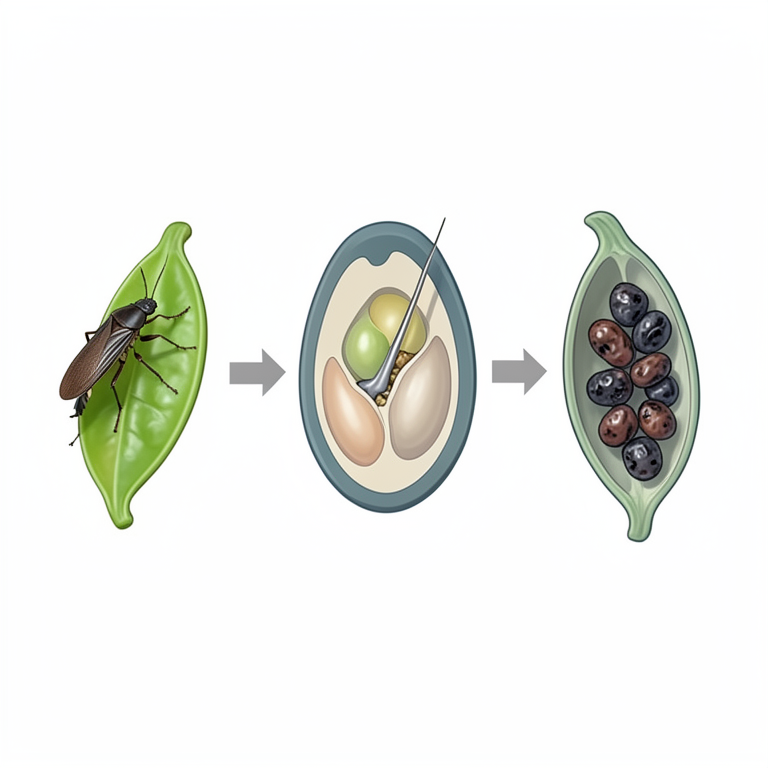
Mechanism of Pod Damage
AI-generated conceptual illustration (mungbean pods and Clavigralla scutellaris bugs). It explains the idea and does not show study data.
View source evidence ↗Figures & tables
From the original paper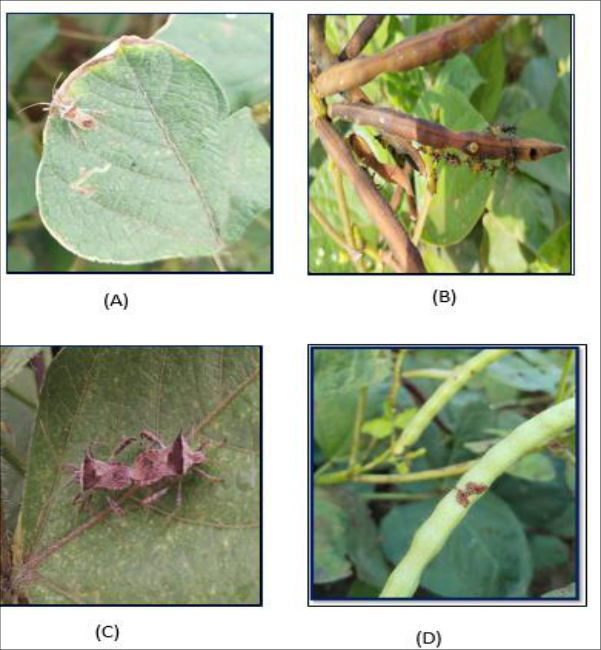 Fig. 1
Introduction
Pulses have always been in focus right from the theme declared by the United Nations in 2016 to being an essential component of daily diets in various forms worldwide. Pulses have many uses, including supplying vital protein for human meals and improving soil health by fixing nitrogen. India stands as the global leader in pulse production, contributing 27-28% of the global total, as well as leading in consumption at 27% and importation at 14% Pulses are an excellent source of protein for human consumption. About 20% of the food grain industry is made up of pulses, which account for 7-10% of India's overall food grain production. The cultivation of pulses is notably prominent across several major regions, including Maharashtra, Madhya Pradesh, Rajasthan, Karnataka, Uttar Pradesh, the West Bengal delta region, Tamil Nadu and Kerala. Bengal gram (Desi Chickpea/Desi Chana), Green gram (Moong bean), Pigeon pea (Arhar, Toor, Red gram), Chickpea (Kabuli Chana), Black-eyed pea (Lobiya), Mungo bean (Urad, Mah, Black gram), Lentil (Masoor), Red kidney bean (Rajma), and White pea (Matar) are the main pulses grown and consumed in India. These leguminous plants also maintain soil fertility by fixing atmospheric nitrogen. Mungbean, Vigna radiata (L.) is considered as one of the most economically important food legume crops of India. In India, it is the third most popular pulse crop after chickpea and pigeonpea (Swaminathan et al., 2012) [1] . According to Reddy (2009) [6] , India's pulse crop is reportedly affected by more than 250 insect species. Among the several factors contributing to the low productivity of pulses in India, biotic stress has been identified as the significant one (Kumar et al., 2021) [3] . Over 250 insect pests affect legume crops throughout the country, of which the key pests during the vegetative stage include Leaf webber, Leaf roller, Whitefly, Thrips, Leaf hopper, Bihar hairy caterpillar, Black aphid, and Stem fly, causing substantial damage (Pandey et al., 2024) [5] . The mungbean is infested by several insect pests starting from seedling to maturity and also in storage condition resulting and significant economic loss. So far, 64 species of insect pests and one species of millipede were found to infest mungbean (Siddapaji et al., 1979) [8] . Duraimurugan and Jagadish (2002) [2] reported that the avoidable losses due to pest complex on mungbean ranged from 27.03 to 38.06% with an average of 32.97%. In Indian entomological literature, Clavigralla gibbosa Spinola (Hemiptera: Coreidae) is referred to as the "tur pod bug" and was once thought to be the only significant coreid on tur (pigeonpea or red gram, Cajanus cajan (L.) Millsp.). Although mixed species aggregations have been observed on this crop in recent studies (Romeis et al., 2000; Mitchell et al., 2004) [7,4] , our finding raises the possibility that additional Clavigralla species may have more agricultural significance than was previously thought. Species of Clavigralla (Hemiptera: Coreidae) are among the most important insect pests of pulses. Three species of Clavigralla are associated with different pulses crops in India: C. gibbosa Spinola is distributed in all but the northeastern part of the country, C. scutellaris (Westwood) occurs in the south, and C. orientalis Dolling is present in the north (Dolling, 1978) [1] . .
Materials and methods
A study was conducted to identify the pests infesting mungbean crop at Main Vegetable Research Station, Anand Agricultural University, Anand, Gujarat, India, during the year 2025-26. During the field visit, a coreid bug was observed on mungbean. To identify the bug infesting on mungbean, gathered samples were delivered to the Main Vegetable Research Station, Anand. Furthermore, the samples were collected and stored in a glass vial containg 70% alcohol for further studies. Specimens were sent to Modern College of Arts Science and Commerce, Shivajinagar, Pune for identification.
Morphological character
Very similar to C. gibbosa, with a broad band of dark brown between the humeral angles and a dorsally predominantly light colored appearance due to silky pubescence. Dark brown eyes along with red ocelli observed. Head brown with irregular yellow patches. All antennal segments dark brown. Thorax has greater dorsal sclerotized and is brown with yellow spots. It is recognized by prosternum, mesosternum and metasternum dark brown approaching black colour. The dark brown color scutellum has been observed along with yellowish brown apex. Light to dark brown colour legs appear. Legs are slender and cylindrical. The leg segment (femora) anterior portion colour is yellow, while posterior half is brown colour with pubescent. Hemelytral membrane not reaching up to last abdominal segrnent. Total body length of the adult is 8.30 mm.
Symptoms of Infestation
Infestation by Clavigralla scutellaris can be recognized through several characteristic symptoms that appear on pods and seeds. One of the earliest signs is the presence of nymphs and adults congregating on developing pods, where they actively feed by sucking sap. Their feeding punctures appear as small brown or black spots on the pod surface, indicating areas of tissue damage. As feeding continues, developing seeds fail to fill properly and become shriveled, malformed, and lightweight. The pods may show discoloration and signs of premature drying before reaching physiological maturity. In severe cases, seed development is greatly impaired, resulting in reduced seed filling and poorquality grains. The harvested produce often contains deformed, discolored, and unattractive seeds that have lower commercial and nutritional value. Farmers can effectively detect infestations by regularly monitoring crops during the flowering, pod formation, and seed development stages. The occurrence of clusters of bugs on developing pods, together with feeding punctures, shriveled seeds, and premature pod drying, are reliable indicators of infestation. Early identification of these symptoms is essential for timely implementation of management strategies and for minimizing economic losses in pulse production systems.
Acknowledgment
We are thankful to Dr. Hemant Ghate, Department of Zoology, Modern College, Pune 411 005, India, for identifying the Clavigralla species.
Conclusion
Because of their high protein, vitamin, and mineral content, pulses are the second most important food in the diet after cereals. They are essential for maintaining the nutritional well-being of Indians, particularly for individuals living below the poverty line and lacking the means to purchase animal-based food products. Pulse crops have always been at risk from pest infestations, and this risk is currently at its worst due to the worsening effects of climate change and global warming. A significant sap-sucking insect pest, Clavigralla scutellaris (Westwood) is a member of the family Coreidae and order Hemiptera. It is commonly known as the pod-sucking bug and is a serious pest of leguminous crops, particularly pigeon pea, cowpea, and other pulse crops.