
Research article · 2026 · Full text
International Journal of Geography Geology and EnvironmentRestoring livelihoods of populations displaced by extractive industries in Sub-Saharan Africa: Lessons from Iamgold Essakane livelihood restoration program in Burkina Faso
Volume 8(6) · Pages 37–41 · DOI: 10.22271/27067483.2026.v8.i6a.783 ↗
Research areasMining and Resource ManagementEnvironmental and Social Impact AssessmentsHydropower, Displacement, Environmental Impact
Abstract
Author-writtenThe involuntary displacement of rural communities induced by the expansion of extractive industries constitutes one of the major challenges of sustainable development in sub-Saharan Africa. Given the documented shortcomings of conventional compensation mechanisms, integrated livelihood restoration programs (LRP) have been developed by mining operators as social impact management instruments. This article analyzes the effectiveness, relevance, and sustainability of the Livelihood Restoration Program (LRP) implemented by IAMGOLD Essakane SA in Burkina Faso, at the mid-point of its execution (2013-2015). Based on an external evaluation conducted using a participatory, multi-stakeholder approach, this article examines three programmatic components support for livestock farming, capacity building and microcredit, and support for vulnerable households against the standard development evaluation criteria: relevance, coherence, efficiency, effectiveness, impact, and sustainability. The results reveal an overall physical implementation rate of 70% for only 48.02% of the budget consumed, attesting to remarkable efficiency. While the livestock (84%) and vulnerable household support (83%) components show solid performance, the microcredit component (53%) suffers from structurally weak community uptake, a symptom of a misalignment between the program's logic and the social and religious representations of credit in the Sahelian setting. This article formulates theoretical and operational recommendations for LRP program designers and advocates for a programmatic architecture more firmly anchored in local value systems and socioeconomic structures.
Summary
Source-checkedPlain-language reading of the full paper, prepared with AI and checked against the text. Each point links to the authors' own words.
Why it matters
- Involuntary displacement caused by the growth of extractive industries is a significant challenge for sustainable development in sub-Saharan Africa. View evidence ↗
- Displacement disrupts the connection between communities and their productive resources, which threatens their income, food security, and social structures. View evidence ↗
- Because traditional financial compensation is often inadequate, mining companies use integrated Livelihood Restoration Programs (LRP) to manage social impacts. View evidence ↗
The question
- The study aims to evaluate the effectiveness, relevance, and sustainability of the LRP implemented by IAMGOLD Essakane SA in Burkina Faso during its mid-point (2013-2015). View evidence ↗
What they did
- The research uses data from an external mid-term evaluation conducted by CEFCOD SARL between April and July 2015. View evidence ↗
- A mixed-methods approach was used, combining quantitative analysis of execution rates and reports with qualitative interviews, focus groups, and site observations. View evidence ↗
- The qualitative data collection involved approximately 80 stakeholders through fourteen different semi-structured interview guides. View evidence ↗
What they found
- The program showed high efficiency, achieving a 70% physical execution rate while consuming only 48.02% of the total budget (67,800,643 FCFA of 141,186,851 FCFA). View evidence ↗
- The capacity building and microcredit component was the weakest, with a physical execution rate of only 53%. View evidence ↗
- Credit repayment was poor; by April 21, 2015, only 3 out of 16 beneficiaries had repaid, with the others having an average unpaid rate of 59.81%. View evidence ↗
- Support for vulnerable households (90 people across 17 households) was highly effective, achieving an execution rate of 83%. View evidence ↗
- Goat restocking for vulnerable households showed rapid success, with the herd growing by 72.5% to 88 head within eight months of distribution. View evidence ↗
- Microcredit failure was driven by the Islamic prohibition of interest (ribā) and the perception that credit limits (100,000 to 250,000 FCFA) were too low for viable cattle fattening. View evidence ↗
What it means
- The authors recommend that LRP designers systematically explore Islamic microfinance products in majority-Muslim regions to ensure community uptake. View evidence ↗
- The authors conclude that successful resettlement requires co-constructing programs with communities to integrate their specific views on development and solidarity into the program's design. View evidence ↗
- Because the evaluation was conducted at mid-term, long-term impacts, such as the full effect of pasture restoration, could not be measured. View evidence ↗
Visual summary
1 visualsIllustrations explain the paper; they do not show study data.
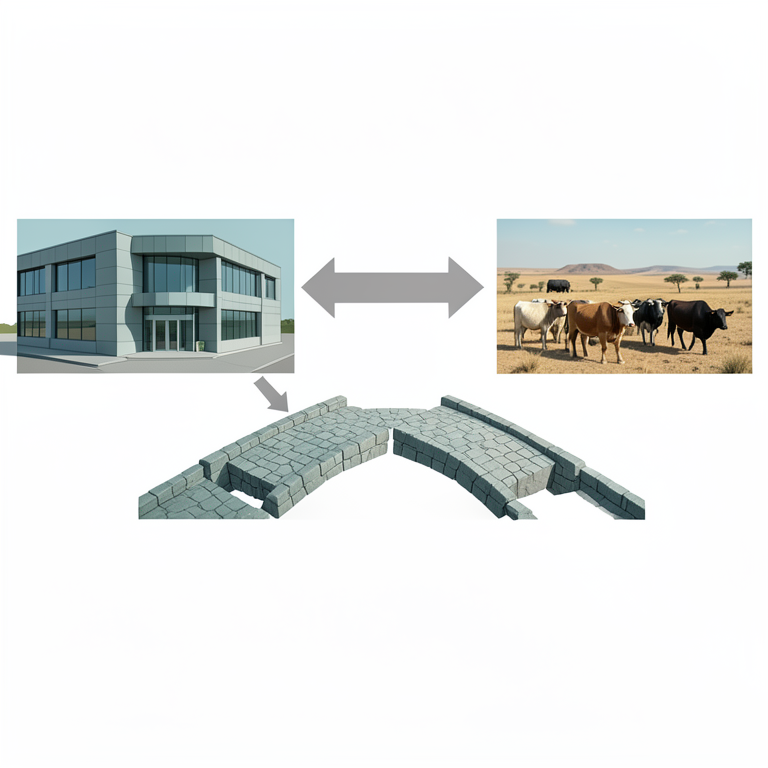
Barriers to Microcredit Uptake
AI-generated conceptual illustration (Rural livestock farmers and a bank building in Burkina Faso). It explains the idea and does not show study data.
View source evidence ↗Introduction
Mining extraction is one of the most powerful drivers of socio-spatial transformation in sub-Saharan Africa. While it generates significant tax revenues and contributes to integrating national economies into global production circuits, it is invariably accompanied by major social externalities, foremost among which is the involuntary displacement of populations (Cernea, 1997; Downing, 2002) [3,7] . Such displacement, whether physical or economic, abruptly severs the ties between communities and their productive bases farmland, pastures, water resources thereby jeopardizing their food security, incomes, and social fabric. In Burkina Faso, the rise of the gold mining industry since the 2000s has radically reshaped several rural territories, particularly in the Sahel and Eastern regions. The expansion of the Essakane gold mine, operated by IAMGOLD Essakane SA, typically illustrates this reality: in 2012, the extension of the Falangountou pits and satellite zones led to the involuntary displacement of households belonging to the localities of Guessakado, Sabangré, and the North Zone. These populations, mostly livestock farmers and crop farmers, were resettled on new host sites, in a Sahelian context already characterized by ecosystem fragility and precarious living conditions. In response to the recognized inadequacy of conventional financial compensation provided for in the Resettlement Action Plan (RAP), IAMGOLD Essakane SA developed the Livelihood Restoration Program (LRP), a large-scale programmatic instrument aimed at restoring the living conditions of Project-Affected Persons (PAP) and securing host populations for the 2013-2016 period.
This program is part of an increasingly demanding international normative framework. The United Nations Guiding Principles on Business and Human Rights (Ruggie, 2011) [16] , the performance standards of the International Finance Corporation (IFC, 2012) particularly Performance Standard 5 on land acquisition and involuntary resettlement as well as the World Bank's safeguard policies, define growing obligations for extractive operators regarding livelihood restoration. Yet, despite the proliferation of LRP programs in the wake of African mining expansion, the scientific literature remains fragmented as to their actual effectiveness, the conditions for their success, and their structural limits. This study aims to partially fill this knowledge gap by drawing on empirical data from the mid-term evaluation of the Essakane LRP. This article is structured around three complementary research questions: The article pursues four specific objectives: (i) to empirically document the levels of physical and financial execution of the LRP at mid-term; (ii) to analyze the explanatory factors behind the differentiated performance of the three programmatic components; (iii) to assess the relevance of the programmatic architecture in light of local socioeconomic and cultural realities; (iv) to formulate generalizable recommendations for designers and managers of LRP programs in African extractive contexts.
Theoretical Framework and Literature Review Involuntary displacement and its consequences: a consolidated field of research
The sociology of involuntary displacement has been dominated for three decades by the seminal work of Michael Cernea (1997) [3] , whose Risks and Reconstruction (RR) model identifies eight impoverishment processes associated with forced displacement: landlessness, joblessness, homelessness, marginalization, food insecurity, increased morbidity, loss of access to common property resources, and social disarticulation. This model, although criticized for its determinism (Mahapatra, 1999), remains the essential analytical reference for evaluating resettlement programs.
In the African mining context specifically, empirical studies conducted in Ghana (Tsikata & Yaro, 2011), Tanzania (Kabote, 2015), the Democratic Republic of Congo (Geenen, 2012), and Burkina Faso (Ouédraogo, 2016) converge in documenting the recurrence of the same failures: underestimation of impacts, inadequacy of compensation, insufficient monitoring mechanisms, and marginalization of vulnerable categories women, the elderly, persons with disabilities.
Livelihood restoration programs: between normative ambition and operational reality
The notion of livelihood restoration understood, following Chambers & Conway (1992) [4] , as a household's capacity to maintain and develop its productive, natural, human, financial, and social assets in the face of shocks has progressively supplanted that of simple financial compensation in international standards. The IFC standards (2012) now require mining operators not only to compensate for losses, but to improve, or at the very least to restore, pre-displacement living standards. This normative evolution has given rise to a new generation of integrated programs combining productive support, capacity building, access to credit, and support for vulnerable households. However, as Terminski (2013) [18] and Bhanumathi (2002) [2] point out, the effective implementation of these programs frequently runs up against structural obstacles: inadequacy with local production systems, weakness of participatory mechanisms, excessive dependence on operator funding, and lack of anchoring in national development policies.
The Sahelian context: an underestimated structuring variable
The Sahelian environment imposes specific biophysical and sociocultural constraints that deeply condition the design and implementation of rural development programs. The fragility of pastoral ecosystems, the marked seasonality of resources, the traditional mobility of livestock farmers, the importance of community solidarity networks, and the pervasiveness of Islamic religious norms in economic behavior all constitute structuring variables that any LRP program in a Sahelian setting must incorporate, on pain of ineffectiveness (Thébaud & Batterbury, 2001; Scoones, 2009) [19,17] .
Methodology Evaluation framework and design
This study is based on the primary and secondary data produced as part of the external mid-term evaluation of the LRP, conducted between April and July 2015 by the Centre d'Étude, de Formation et de Conseil en Développement (CEFCOD SARL), an independent firm mandated by IAMGOLD Essakane SA. The evaluation mission was initiated eighteen months after the effective launch of the program (October 2013), in accordance with the contractual provisions of the program document.
The methodological design adopts a mixed evaluation approach (Creswell & Plano Clark, 2011) [5] , combining quantitative methods analysis of physical and financial execution rates, review of periodic activity reports and qualitative methods semi-structured interviews, focus groups, direct observations on intervention sites.
Data collection
Data collection was structured around three complementary modalities:
Data analysis
Quantitative data analysis was based on the calculation of physical execution rates by activity, by result, and by component, as well as on the analysis of financial execution rates by budget line. Qualitative data were processed by thematic content analysis (Bardin, 2003), cross-referencing information from different sources to ensure triangulation. The evaluative analysis was based on the six standard criteria of the OECD Development Assistance Committee: relevance, coherence, efficiency, effectiveness, impact, and sustainability.
Methodological limitations
Several limitations must be noted. First, the evaluation takes place at mid-term, which does not allow the long-term impacts of certain activities to be measured particularly the restoration of pastures whose effects are inherently delayed. Second, the low mobilization of PAPs from Sabangré during a collective session, due to a misunderstanding about the meeting date, may have introduced a representation bias. Third, since the financial data were closed in March 2015, they do not reflect all disbursements made up to the date of the mission.
Results
Results
Overall program performance at mid-term
The most revealing summary indicator of the LRP's performance at mid-term is the relationship between physical and financial execution rates. With an overall physical execution rate of 70% achieved for only 48.02% of the total budget consumed (i.e., 67,800,643 FCFA out of a total budget of 141,186,851 FCFA), the program displays a particularly favorable efficiency ratio, reflecting rigorous resource management and effective operational organization. This overall result, however, conceals significant disparities between the three components, which constitute the analytical core of this article.
Component 1: Support for livestock farming practice: solid overall performance (84%) This component, structured around a single result livestock farming practice is supported and eight operational activities, records the highest physical execution rate of the three components at 84%. The most significant achievements include: the rehabilitation of 407 ha of grazing areas degraded by mechanized scarification with the "delfino" plough (execution rate: 80%), the participatory identification and securing of two grazing areas (Gosey and Tondia Kangué, rate: 75%), the creation and effective operation of two Livestock Feed Banks (LFB) equipped with working capital and already in their third supply cycle (rate: 100%), the development of a fenced 20 ha fodder perimeter with two haylofts under construction (rate: 85%), and the establishment of a network of animal health agents for the sanitary monitoring of the herd (rate: 100%). However, several first-order technical constraints have been identified. The failure to respect the contour line during subsoiling reduced the hydrological effectiveness of the halfmoon structures created, paradoxically encouraging the development of gullies. The constant pressure of animals on recently developed areas compromises plant regeneration. The presence of artisanal gold miners on the scarified perimeters constitutes a direct threat to restoration investments. Finally, the slowness in sinking pastoral wells linked to the exceptional hardness of the subsoil has delayed the full operationalization of the grazing areas.
This component, whose architecture is based on facilitating access to credit via two microfinance institutions (UCEC/Sahel and RCPB) backed by a 20 million FCFA guarantee fund, displays the lowest execution rate at 53%, and constitutes the major structural weak point of the program. Yet the objective conditions of access to credit have been substantially improved: two tripartite protocols signed, an operational guarantee fund, village credit committees set up, and intensive coaching by A2N facilitators. Despite this favorable arrangement, only 31 promoters out of the estimated target group received credit, for a cumulative amount of 4,275,000 FCFA of which 63.16% via UCEC/Sahel and 36.84% via RCPB. The activities developed on the basis of credit are concentrated around sheep fattening (71.43% of cases) and cattle fattening (28.57%), as well as the sale of animals. More worryingly, the repayment rate of the first wave of credit (August-September 2014) reveals that out of 16 beneficiaries, only 3 had repaid their credit by April 21, 2015, with the remaining 13 showing an average unpaid rate of 59.81%. The analysis of the causes of this under-engagement reveals a plurality of structural factors: the excessive length of the application processing (several months), which discouraged applicants whose investment opportunity had meanwhile evaporated; the Islamic religious prohibition of interestbearing credit (ribā), invoked by a significant fraction of the target group; the perception that the credit ceilings set between 100,000 and 250,000 FCFA are insufficient to finance viable cattle fattening activities; and above all, a fundamental misunderstanding about the nature of the expected assistance, with communities positioning themselves in anticipation of direct subsidies rather than credit facilities.
Component 3: Support for vulnerable households: proven humanitarian effectiveness (83%) This component, targeting 17 vulnerable households identified according to rigorous criteria (persons with disabilities, unsupported widows, orphans, unsupported elderly persons), i.e., 90 people in total, reaches an execution rate of 83% and generates the most immediate and unanimously appreciated impacts. The restocking activities made it possible to distribute 51 goats (two female goats and one male goat per household) accompanied by feed supplements. By November 2014, eight months after the initial distribution, the herd had already reached 88 head a 72.5% growth testifying to the relevance of the goat species in a Sahelian setting and to the quality of the zootechnical monitoring provided by A2N. The schooled children of vulnerable households benefited from a complementary restocking of 34 goats, accompanied by sacks of oilcake and salt licks. The distribution of food (6,480 kg of millet distributed in two installments to all 90 members of vulnerable households) and treated mosquito nets produced immediate effects on the food security and health of the beneficiaries. The component as a whole is unanimously approved by stakeholders, beneficiaries, and technical partners alike. One point of vigilance remains, however: the risk of institutionalizing aid dependency. Beneficiaries, almost without exception, apprehend the scheduled end of support and have not yet internalized the transitional vocation of the mechanism. This potential welfarism constitutes a limit to the sustainability of the component if gradual exit strategies are not formalized and communicated from now on.
Programmatic architecture and internal coherence
Analysis of the program's logical framework reveals a notable inconsistency between the various planning instruments logical framework, budget, multi-annual physical programming table, and first-year table. Activities present in the budget are absent from the logical framework (notably activity 2.1 relating to the mini-dairy, ultimately cancelled), while activities listed in the logical framework have no identified budget line. This disarticulation between planning instruments constitutes a documented design weakness, generating difficulties in monitoring and evaluation and in comparative performance analysis. Moreover, the absence of indicators formulated for the overall objective, the specific objectives, and the results the logical framework containing indicators only for activities has substantially complicated the measurement of the achievement of intermediate and final results.
Discussion
Discussion
Budgetary efficiency as a signal of institutional maturity
The 70% physical execution / 48.02% budget consumed ratio constitutes, in terms of cost-effectiveness analysis, a remarkable result in the context of rural development programs in sub-Saharan Africa, where budgetary absorption usually precedes physical achievements. This result is partly explained by the strategic choice to entrust implementation to a local NGO the Association Nodde Nooto (A2N) whose detailed knowledge of the intervention environment, structural lightness, and proximity to beneficiary communities have constituted powerful factors of operational efficiency. This result corroborates Riddell's (2007) thesis that delegation to embedded local organizations significantly improves the efficiency of aid programs in contexts of weak institutional development.
Resistance to microcredit: at the crossroads of culture, religion, and program expectations
The underperformance of the microcredit component constitutes the analytically richest result of this evaluation. It illustrates a well-documented phenomenon in the literature on microfinance in Sahelian Africa: the structural tension between formal financing models derived from liberal economic paradigms and the endogenous economic logics of rural communities. The Islamic prohibition of ribā (usurious interest) cannot be reduced to a simple technical obstacle that can be circumvented by communication adjustments. It refers to a fundamentally different conception of the relationship between aid, solidarity, and development (Guérin et al., 2011) [9] . In many Sahelian communities, the aid expected from a major economic operator is part of a register of asymmetric redistribution and reciprocity comparable to zakat (mandatory Islamic almsgiving) and not that of a market transaction accompanied by repayment obligations. The confusion between these two normative registers constitutes one of the deep causes of the fundamental misunderstanding identified in this article. This analysis argues for an in-depth review of IGA financing mechanisms in LRP programs in Sahelian contexts, in the direction of financial products consistent with the principles of Islamic finance (murabaha, ijara, musharaka), which would allow reconciliation of the imperatives of economic accountability and local religious norms.
Restocking: a model of intervention to be generalized?
The remarkable performance of the vulnerable household support component and in particular the success of the restocking operation invites reflection on the conditions for the transferability of this intervention model. The suitability of goats to the biophysical and cultural Sahelian context (a hardy animal with a rapid reproductive cycle, a symbol of social status in pastoral societies), combined with rigorous and participatory zootechnical monitoring, has produced quantifiable results within the first months. The 72.5% growth of the herd in eight months constitutes an impact indicator that is rare in its earliness and magnitude in rural development programs. However, the sustainability of this impact remains contingent on resolving the risk of aid dependency. The literature on social safety nets in West Africa (Devereux, 2016) [6] emphasizes that productive asset transfer programs generate lasting empowerment only when they are accompanied by exit strategies explicitly planned and communicated to beneficiaries from the outset.
Relevance of the programmatic architecture with regard to national policies
The multi-level relevance of the LRP aligned with the SCADD, the PNSR, the National Policy on Sustainable Livestock Development, the National Microfinance Strategy, and the National Social Protection Policy constitutes an undeniable asset of institutional legitimacy. This integration into national normative frameworks facilitates the mobilization of the State's decentralized technical services, whose involvement is a key factor for post-program sustainability. However, normative alignment does not guarantee operational congruence. The absence of assumptions in the logical framework a major analytical gap noted by the evaluation team reveals an underestimation of contextual risks, particularly climatic (Sahelian rainfall variability) and socioeconomic (volatility of livestock prices, pressure from artisanal gold miners). This shortcoming reduces program resilience in the face of external shocks.
Implications for the design of LRP programs in African mining contexts
Beyond the LRP case, the results of this mid-term evaluation make it possible to draw several generalizable lessons for the design and implementation of LRP programs in African extractive contexts: First, the cultural suitability of financing instruments constitutes a sine qua non condition for community uptake. Islamic microfinance products deserve to be systematically explored in majority-Muslim contexts. Second, the differentiation of support modalities according to the categories of beneficiaries distinguishing vulnerable households (asset transfers) from economic promoters (credit facilitation) and from livestock-farming communities (rehabilitation of pastoral resources) is a condition of effectiveness proven by the LRP data. Third, the technical quality of interventions on natural resources here pastures requires specialized expertise that generalist development NGOs do not necessarily possess. The systematic recourse to State technical services and agronomic research institutions (INERA) must be institutionalized from the design stage. Fourth, coherence between planning tools (logical framework, budget, operational planning) is a condition of readability and governance that cannot be sacrificed to implementation pressure.
Conclusion
This article has analyzed, through the lens of the mid-term evaluation of IAMGOLD Essakane SA's LRP, the conditions for the effectiveness, efficiency, impact, and sustainability of an integrated post-displacement livelihood restoration program in Burkina Faso's mining context. The empirical results reveal significant overall performance 70% physical execution for 48.02% of the budget consumed driven by two solid components (livestock farming and support for vulnerable households), but substantially hampered by the underperformance of the microcredit component, whose in-depth analysis highlights a structural mismatch between the program's theoretical assumptions and the sociocultural realities of beneficiary communities. More fundamentally, this article demonstrates that the restoration of livelihoods in a Sahelian post-miningdisplacement context cannot be reduced to a technical compensation exercise. It requires a fine-grained understanding of local production systems, of the social and religious norms that structure economic behavior, and of the power dynamics that define relations between displaced communities, host populations, and the mining operator. The path to truly restorative resettlement inevitably runs through a deeper programmatic co-construction with the communities, one that is not limited to formal consultation but integrates their representations of development, their conceptions of solidarity, and their long-term aspirations into the very architecture of programs. It is at this price that LRP programs will be able to claim not only mid-term efficiency, but the transformational impact that international standards and the ethics of development assign to them as their ultimate purpose.
References
20 in the original paper- Bardin L. L'analyse de contenu. Paris: Presses Universitaires de France; 2003.
- Bhanumathi K. The status of women affected by mining in India. In: Women and Mining Toolkit. New York: WEDO; 2002.
- Cernea MM. The risks and reconstruction model for resettling displaced populations. World Dev. 1997;25(10):1569-87.
- Chambers R, Conway G. Sustainable rural livelihoods: Practical concepts for the 21st century. IDS Discussion Paper No. 296. Brighton: Institute of Development Studies; 1992.
- Creswell JW, Plano Clark VL. Designing and conducting mixed methods research. 2nd ed. Thousand Oaks (CA): SAGE Publications; 2011.
- Devereux S. Social protection for enhanced food security in sub-Saharan Africa. Food Policy. 2016;60:52-62.
- Downing TE. Avoiding new poverty: Mining-induced displacement and resettlement. London: IIED and WBCSD; 2002.
- Geenen S. A dangerous bet: The challenges of formalizing artisanal mining in the Democratic Republic of Congo. Resour Policy. 2012;37(3):322-30.
- Guérin I, Morvant-Roux S, Servet JM. Understanding the diversity and complexity of demand for microfinance services. In: Armendariz B, Labie M, editors. The Handbook of Microfinance. Singapore: World Scientific; 2011.
- International Finance Corporation. Performance Standard 5: Land Acquisition and Involuntary Resettlement. Washington (DC): World Bank Group; 2012.
- Kabote SJ. Relationship between land use changes and livelihoods of local people in Tanzania. J Sustain Dev. 2015;8(2):181-91.
- Mahapatra LK. Resettlement, impoverishment and reconstruction in India. New Delhi: Vikas Publishing House; 1999.
- OECD Development Assistance Committee. OECD DAC Evaluation Criteria. Paris: OECD Publishing; 2019.
- Ouédraogo I. Industrie minière et mutations socioéconomiques au Burkina Faso. Rev Africaine Dév. 2016;28(1):45-61.
- Riddell RC. Does foreign aid really work? Oxford: Oxford University Press; 2007.
- Ruggie JG. Guiding Principles on Business and Human Rights. Geneva: United Nations Human Rights Council; 2011.
- Scoones I. Livelihoods perspectives and rural development. J Peasant Stud. 2009;36(1):171-96.
- Terminski B. Mining-induced displacement and resettlement: Social problem and human rights issue. Geneva: University of Geneva; 2013.
- Thébaud B, Batterbury S. Sahel pastoralists: Opportunism, struggle, conflict and negotiation. Glob Environ Change. 2001;11(1):69-78.
- Tsikata D, Yaro JA. Land market liberalization and trans-local agrarian capital in West Africa. J Agrar Change. 2011;11(4):468-87.