
Research article · 2026 · Full text
International Journal of Biology SciencesNatural vegetation of the northern hill region of Chhattisgarh: A geo-ecological study of Ambikapur and the Surguja division
Volume 8(6) · Pages 23–26 · DOI: 10.33545/26649926.2026.v8.i6a.856 ↗
Research areasForest Ecology and ConservationBotany and Plant Ecology StudiesPlant Ecology and Soil Science
Abstract
Author-writtenThe northern hill region of Chhattisgarh, particularly the Ambikapur-Surguja division, is an ecologically important part of central India, distinguished by its rich biodiversity, diverse terrain, and varied climatic conditions. This study examines the natural vegetation of the region with a focus on forest types, species composition, ecological processes, and socio-economic significance. The area is largely dominated by tropical deciduous forests, where Shorea robusta (sal) serves as the principal species. It is accompanied by other important flora such as bamboo, mahua (Madhuca indica), and tendu (Diospyros melanoxylon), which hold both ecological and economic value. The study also analyzes key environmental factors influencing vegetation distribution, including climate, soil characteristics, and topography. In addition, it considers the role of human activities such as traditional forest practices and land-use changes in shaping the vegetation patterns. The findings highlight the region’s role as a biodiversity-rich zone with significant ecological functions. At the same time, they emphasize the growing need for sustainable forest management approaches that balance environmental conservation with the livelihood needs of local communities.
Summary
Source-checkedPlain-language reading of the full paper, prepared with AI and checked against the text. Each point links to the authors' own words.
Why it matters
- Vegetation is a core part of the natural environment that reflects the interaction between topography, soil, and climate. View evidence ↗
- The northern hill region of Chhattisgarh is ecologically important but has not been sufficiently studied in academic literature. View evidence ↗
- Indigenous tribal communities in the region depend on forest resources for their subsistence economy, including food, fuel, and fodder. View evidence ↗
The question
- The study aims to examine the region's natural vegetation, specifically focusing on species composition, forest types, socio-economic importance, and ecological processes. View evidence ↗
What they did
- The research focused on the northern hill region of Chhattisgarh, specifically using Ambikapur and the Surguja division as central reference points. View evidence ↗
- The analysis evaluated how topography, soil characteristics, and climate influence the distribution of vegetation. View evidence ↗
- The study examined the impact of land-use changes and traditional forest practices on vegetation patterns. View evidence ↗
What they found
- Tropical deciduous forests dominate the region, with Shorea robusta (sal) being the primary species. View evidence ↗
- Annual rainfall in the region ranges from 1000 mm to 1400 mm, occurring mostly during the monsoon season from June to September. View evidence ↗
- Soil distribution varies by terrain, with alluvial soils in valleys, forest soils in hills, and lateritic soils on uplands. View evidence ↗
- Tropical dry deciduous forests in the region commonly feature species such as Acacia catechu, Diospyros melanoxylon (tendu), and Madhuca indica (mahua). View evidence ↗
- Grassland vegetation adapted to strong winds and cooler temperatures is found in plateau regions, specifically in Mainpat. View evidence ↗
- Deforestation is a major challenge caused by timber and fuelwood demand, infrastructure development, and agricultural expansion. View evidence ↗
- The regenerative capacity of the forests is pressured by unsustainable grazing, fuelwood collection, and excessive extraction of non-timber products. View evidence ↗
What it means
- The authors conclude that conservation strategies must balance the needs of local livelihoods with ecological preservation. View evidence ↗
- The authors recommend regulated resource use, afforestation, and community participation to maintain stability and human well-being. View evidence ↗
Visual summary
1 visualsIllustrations explain the paper; they do not show study data.
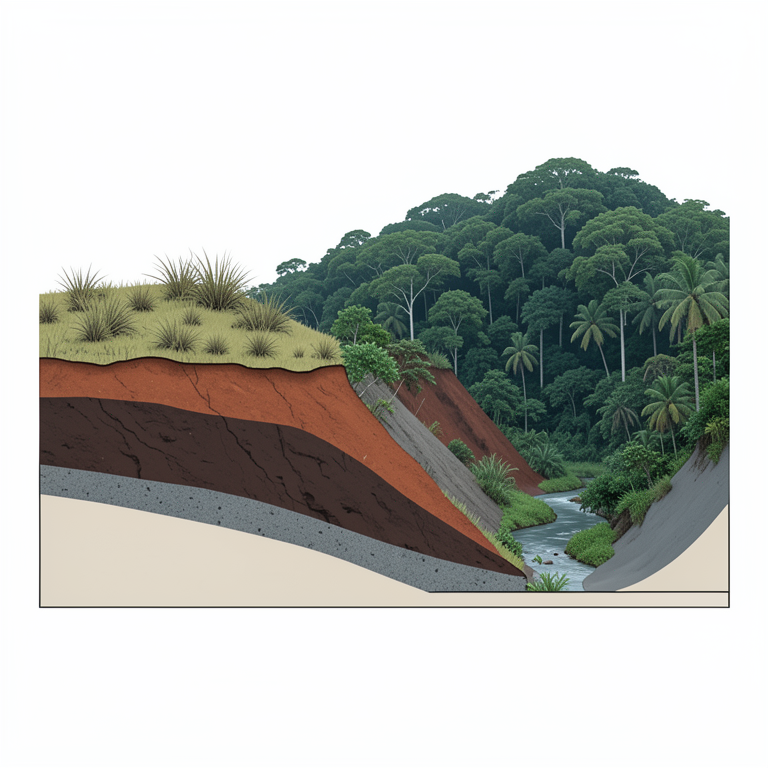
Topographic Vegetation Distribution
AI-generated conceptual illustration (The landscape of the northern hill region of Chhattisgarh, India). It explains the idea and does not show study data.
View source evidence ↗Introduction
Vegetation constitutes a fundamental component of the natural environment, embodying the dynamic interaction between climatic conditions, soil properties, and topographical features (Odum, 1971) [3] . It serves not only as an indicator of ecological processes but also as a vital regulator of environmental stability, influencing climate moderation, soil conservation, and biodiversity maintenance. In a geographically diverse country like India, the range of vegetation types is exceptionally broad, reflecting significant spatial variations in rainfall, temperature, altitude, and edaphic factors (Reddy, 2003) [4] . This diversity underscores the ecological complexity of the Indian subcontinent and highlights the importance of regionspecific studies. Within this broader ecological framework, the northern hill region of Chhattisgarh emerges as a particularly significant yet relatively understudied area. Encompassing districts such as Surguja, Korea, and Jashpur, this region is endowed with abundant forest resources, varied terrain, and rich biodiversity. Despite its ecological importance, it has not received commensurate academic attention, thereby necessitating focused research to better understand its environmental dynamics and resource potential. Ambikapur, the administrative headquarters of Surguja district, lies at the core of this region and exemplifies its physiographic diversity. The landscape is characterized by a mosaic of forested plateaus, undulating hill ranges, and fertile valleys, each supporting distinct vegetation types. Geographically, the area represents the eastern extension of the Central Indian Highlands and functions as a transitional zone between the Indo-Gangetic Plains in the north and the Deccan Plateau in the south (Sharma, 2006) [5] . This transitional positioning contributes to a unique convergence of ecological characteristics, fostering a high degree of species diversity and vegetation heterogeneity. Moreover, the natural vegetation of this region holds considerable ecological as well as socioeconomic significance. Forest ecosystems play a crucial role in sustaining International Journal of Biology Sciences https://www.biologyjournal.net environmental balance while simultaneously supporting the livelihoods of indigenous tribal communities. These communities rely heavily on forest resources for fuel, fodder, food, and non-timber forest products, which form the backbone of their subsistence economy (Tiwari, 2010) [7] . In this context, vegetation is not merely a natural asset but also a critical component of human survival and cultural identity. Therefore, the conservation and sustainable management of this region's vegetation are essential for ensuring both ecological resilience and socio-economic well-being.
Study Area
The study area encompasses the northern hill region of Chhattisgarh, with particular emphasis on the Surguja division and Ambikapur as the central reference point. This region represents an important segment of central India's physiographic and ecological framework. It is characterized by a combination of rugged terrain, forested landscapes, and diverse environmental conditions that collectively influence the distribution and composition of natural vegetation. The geographical setting of the region, along with its climatic and edaphic features, makes it a significant area for ecological and geographical investigation.
Physiography
The physiography of the northern hill region is highly varied and plays a crucial role in shaping its vegetation patterns. The terrain is predominantly undulating, consisting of hills, plateaus, and valleys that create a complex landscape mosaic. The Surguja plateau is the most prominent landform, forming the core of the region and extending across a substantial area. This plateau is interspersed with forest-covered hill ranges and dissected by numerous streams and river valleys, which contribute to variations in altitude, slope, and drainage patterns (Sharma, 2006) [5] . Such diversity in relief results in localized micro-environments that support different types of vegetation. Elevated regions such as Mainpat experience relatively cooler climatic conditions, while the lower valleys tend to be warmer and more humid, further enhancing ecological diversity.
Climate
The climate of the region is classified as sub-tropical monsoon, characterized by distinct seasonal variations in temperature and precipitation. The monsoon season, extending from June to September, brings the majority of the annual rainfall, which ranges between 1000 mm and 1400 mm (Indian Meteorological Department [IMD], 2020) [2] . This rainfall is a critical factor in sustaining the dense forest cover observed in the region. Summers are typically hot and dry, leading to partial leaf shedding in deciduous forests, while winters are relatively mild and pleasant. The seasonal distribution of rainfall and temperature significantly influences plant growth cycles, phenology, and the overall structure of vegetation.
Soil
Soil characteristics in the northern hill region vary considerably and have a direct impact on vegetation distribution and productivity. The dominant soil types include lateritic soils on uplands, forest soils in hilly areas, and patches of alluvial soils in valley regions. Lateritic soils are generally low in fertility but support specific types of vegetation adapted to such conditions, while forest soils are relatively richer in organic matter and conducive to dense tree growth. Alluvial soils found in valleys are more fertile and support both natural vegetation and agricultural activities. The variation in soil texture, depth, and moisture retention capacity plays a key role in determining the type and density of vegetation across the region (Reddy, 2003) [4] .
Types of Natural Vegetation
The northern hill region of Chhattisgarh exhibits a diverse range of natural vegetation, shaped by variations in rainfall, topography, and soil conditions. The most dominant vegetation type in the region is tropical moist deciduous forest, which thrives in areas receiving relatively high rainfall. These forests are characterized by a dense and multilayered canopy during the monsoon season and a marked leaf-shedding phase during the dry summer months. They are widely distributed across the region and form the ecological backbone of the forest landscape (Champion & Seth, 1968) [1] . The dominant species include Shorea robusta (sal), Terminalia tomentosa, Lagerstroemia parviflora, and bamboo (Dendrocalamus strictus). Among these, sal forests are particularly significant due to their extensive coverage and their crucial role in maintaining biodiversity, stabilizing ecosystems, and supporting wildlife habitats (Singh & Singh, 1992) [6] . In contrast, tropical dry deciduous forests are found in areas with relatively lower rainfall and higher seasonal variability. These forests exhibit a more open canopy structure and consist of species that are well adapted to drier conditions and prolonged periods of moisture stress (Champion & Seth, 1968) [1] . Common species found in these forests include Madhuca indica (mahua), Diospyros melanoxylon (tendu), and Acacia catechu. These forests are of considerable socio-economic importance as they provide a variety of non-timber forest products such as tendu leaves, mahua flowers, and other resources that are essential for the livelihoods of local tribal communities (Tiwari, 2010) [7] . Apart from forested areas, the plateau regions, particularly Mainpat, exhibit grassland vegetation that is adapted to relatively cooler temperatures and exposure to strong winds. These grasslands are interspersed with scattered shrubs and small trees, creating a distinct ecological setting that differs from the surrounding forested landscapes (Sharma, 2006) [5] . Additionally, the valleys and low-lying areas support moist vegetation due to higher humidity and water availability. These areas are characterized by the presence of ferns, orchids, mosses, and other shade-loving plant species, which contribute significantly to micro-level biodiversity and ecological richness (Odum, 1971) [3] .
Factors Influencing Vegetation
The distribution and composition of vegetation in the northern hill region of Chhattisgarh are governed by a complex interplay of natural and anthropogenic factors. Climate is the most significant determinant, particularly the monsoonal rainfall pattern, which regulates moisture availability essential for plant growth. The region receives moderate to high rainfall during the monsoon season, promoting the growth of dense deciduous forests. Seasonal variations in temperature and precipitation further influence vegetation cycles, including leaf fall, flowering, and regeneration (Indian Meteorological Department [IMD], 2020) [2] . Relief and topography also play a crucial role in shaping vegetation patterns. The presence of hills, plateaus, and valleys leads to variations in altitude, slope, and drainage conditions. These factors influence local temperature regimes and moisture retention, thereby affecting plant distribution. Plateau regions generally experience cooler conditions, while valleys tend to be warmer and more humid, resulting in distinct vegetation types across the landscape (Sharma, 2006) [5] . Soil characteristics are equally important in determining vegetation structure and productivity. The region is dominated by lateritic and forest soils in upland and hilly areas, along with alluvial soils in valleys. Variations in soil fertility, texture, depth, and water-holding capacity influence the type and density of vegetation. Certain plant species are well adapted to nutrient-poor lateritic soils, while more fertile soils support denser and more diverse vegetation (Reddy, 2003). In addition to natural factors, human activities significantly influence vegetation distribution. Practices such as shifting cultivation, grazing, and the extraction of forest resources have traditionally shaped the landscape. Although these activities were once sustainable, increasing population pressure and resource demand have led to forest degradation and changes in vegetation patterns in some areas (Tiwari, 2010) [4] .
Biodiversity and Wildlife
The northern hill region of supports a rich diversity of wildlife, closely linked to its varied vegetation. The forests provide essential habitats that sustain numerous species of fauna, contributing to the ecological importance of the region. Herbivorous animals such as deer and wild boar depend on forest vegetation for food, while carnivores like leopards rely on these herbivores for survival. In addition, the region hosts a wide variety of bird species, reptiles, amphibians, and insects, all of which are integral components of the ecosystem (Singh & Singh, 1992) [6] . Vegetation plays a vital role in maintaining these wildlife populations by providing shelter, breeding grounds, and food resources. Dense forest cover offers protection and supports complex food chains, ensuring ecological balance. The diversity of plant species further enhances habitat heterogeneity, allowing different animal species to coexist within the same landscape.
Overall, the strong interdependence between vegetation and wildlife highlights the ecological significance of the region. The preservation of natural vegetation is therefore essential not only for maintaining plant diversity but also for conserving wildlife and sustaining ecosystem stability.
Factors Influencing Vegetation
The distribution and composition of vegetation in the northern hill region of Chhattisgarh are governed by a complex interplay of natural and anthropogenic factors. Climate is the most significant determinant, particularly the monsoonal rainfall pattern, which regulates moisture availability essential for plant growth. The region receives moderate to high rainfall during the monsoon season, promoting the growth of dense deciduous forests. Seasonal variations in temperature and precipitation further influence vegetation cycles, including leaf fall, flowering, and regeneration (Indian Meteorological Department [IMD], 2020) [2] . Relief and topography also play a crucial role in shaping vegetation patterns. The presence of hills, plateaus, and valleys leads to variations in altitude, slope, and drainage conditions. These factors influence local temperature regimes and moisture retention, thereby affecting plant distribution. Plateau regions generally experience cooler conditions, while valleys tend to be warmer and more humid, resulting in distinct vegetation types across the landscape (Sharma, 2006) [5] . Soil characteristics are equally important in determining vegetation structure and productivity. The region is dominated by lateritic and forest soils in upland and hilly areas, along with alluvial soils in valleys. Variations in soil fertility, texture, depth, and water-holding capacity influence the type and density of vegetation. Certain plant species are well adapted to nutrient-poor lateritic soils, while more fertile soils support denser and more diverse vegetation (Reddy, 2003). In addition to natural factors, human activities significantly influence vegetation distribution. Practices such as shifting cultivation, grazing, and the extraction of forest resources have traditionally shaped the landscape. Although these activities were once sustainable, increasing population pressure and resource demand have led to forest degradation and changes in vegetation patterns in some areas (Tiwari, 2010) [4] .
Biodiversity and Wildlife
The northern hill region of Chhattisgarh supports a rich diversity of wildlife, closely linked to its varied vegetation. The forests provide essential habitats that sustain numerous species of fauna, contributing to the ecological importance of the region. Herbivorous animals such as deer and wild boar depend on forest vegetation for food, while carnivores like leopards rely on these herbivores for survival. In addition, the region hosts a wide variety of bird species, reptiles, amphibians, and insects, all of which are integral components of the ecosystem. Vegetation plays a vital role in maintaining these wildlife populations by providing shelter, breeding grounds, and food resources. Dense forest cover offers protection and supports complex food chains, ensuring ecological balance. The diversity of plant species further enhances habitat heterogeneity, allowing different animal species to coexist within the same landscape. Overall, the strong interdependence between vegetation and wildlife highlights the ecological significance of the region. The preservation of natural vegetation is therefore essential not only for maintaining plant diversity but also for conserving wildlife and sustaining ecosystem stability (Singh & Singh, 1992) [6] .
Environmental Challenges
The northern hill region of Chhattisgarh, despite its rich natural vegetation and ecological significance, is increasingly confronted with a range of environmental challenges. One of the most pressing issues is deforestation, driven by expanding agricultural activities, infrastructural development, and the growing demand for fuelwood and timber. The clearing of forest cover not only reduces biodiversity but also disrupts ecological balance, leading to soil erosion and the degradation of land resources. Over-exploitation of forest resources further exacerbates the problem. The excessive extraction of non-timber forest products, coupled with unsustainable grazing and fuelwood collection, places significant pressure on the regenerative capacity of forests (Reddy, 2003) [4] . Although local communities have traditionally depended on these resources for their livelihoods, rising population pressures and market demands have intensified their use beyond sustainable limits. In addition, climate change poses an emerging threat to the region's vegetation. Variability in rainfall patterns, increasing temperatures, and the occurrence of extreme weather events are likely to alter species composition, affect plant growth cycles, and reduce overall forest productivity. These changes may also impact the availability of forest-based resources, thereby affecting both ecological stability and human wellbeing.
Conservation and Management Strategies
In light of these challenges, the adoption of effective conservation and management strategies is essential to ensure the sustainable use of forest resources. A key approach is the promotion of community participation in forest management.
Involving local and tribal communities in decision-making processes can enhance conservation outcomes, as these communities possess traditional knowledge and a vested interest in preserving forest ecosystems. Sustainable forest use practices should be encouraged to balance resource extraction with regeneration. This includes regulated harvesting of forest products, controlled grazing, and the adoption of alternative energy sources to reduce dependence on fuelwood. Afforestation and reforestation programs are also crucial for restoring degraded lands and increasing forest cover (Singh & Singh, 1992) [6] . The selection of native species in such programs can help maintain ecological integrity and biodiversity. Furthermore, environmental education and awareness initiatives play a vital role in fostering responsible behavior toward natural resources. Educating local communities, especially younger generations, about the importance of conservation can lead to more sustainable practices in the long term. Collectively, these strategies can contribute to the preservation of the region's vegetation while supporting the livelihoods of its inhabitants.
Conclusion
The northern hill region of Chhattisgarh is an ecologically significant area characterized by diverse natural vegetation, predominantly tropical deciduous forests with sal (Shorea robusta) as the dominant species. The region's varied topography, climate, and soil conditions contribute to the development of multiple vegetation types, supporting rich biodiversity and maintaining ecological balance. These forests play a vital role in essential ecological functions such as carbon sequestration, soil conservation, and water regulation. In addition to their ecological importance, the forests hold substantial socio-economic value, particularly for indigenous tribal communities who rely on them for food, fuel, and non-timber forest products. However, increasing pressures from deforestation, over-exploitation of resources, and climate change pose serious threats to the sustainability of these ecosystems. Therefore, the need for sustainable management is critical. Conservation strategies must integrate ecological preservation with the livelihood needs of local populations. Approaches such as community participation, afforestation, and regulated resource use can help maintain ecological stability while supporting human well-being. Ensuring the long-term sustainability of this region's vegetation is essential for both biodiversity conservation and socio-economic development.
References
7 in the original paper- Champion HG, Seth SK. A revised survey of the forest types of India. New Delhi: Government of India Press; 1968.
- Indian Meteorological Department. Climatological tables of India. New Delhi: Government of India; 2020.
- Odum EP. Fundamentals of ecology. 3rd ed. Philadelphia: Saunders; 1971.
- Reddy MS. Vegetation ecology. New Delhi: Oxford & IBH Publishing; 2003.
- Sharma PD. Ecology and environment. 8th ed. Meerut: Rastogi Publications; 2006.
- Singh JS, Singh SP. Forests of Himalaya: Structure, functioning and impact of man. Nainital: Gyanodaya Prakashan; 1992.
- Tiwari BK. Forest resources and livelihood of tribal communities in central India. Indian Journal of Forestry. 2010;33(2):245-252.