
Research article · 2026 · Full text
International Journal of Biology SciencesAn observation on seasonal variations of ambient temperature in a pond under the geographical area of Darbhanga district on behaviour, feeding and breeding pattern of the major carp Catla catla (Hamilton, 1822)
Volume 8(6) · Pages 01–06 · DOI: 10.33545/26649926.2026.v8.i6a.853 ↗
Research areasFish Biology and Ecology StudiesPhysiological and biochemical adaptationsReproductive biology and impacts on aquatic species
Abstract
Author-writtenThis study evaluates the influence of seasonal ambient temperature variation on the behaviour, feeding and breeding pattern of Catla catla. Representative data were collected for five seasons over one annual cycle. An avarage ambient temperature varied from 18°C during winter to 32°C during summer. Feeding, swimming, surfacing, social interaction and breeding activities were carefully monitored. Behavioural activity increased with temperature up to summer, whereas reproductive activity reached its maximum during the monsoon season. Results indicate that temperature acts as a major ecological regulator of metabolism, activity level and reproductive readiness. The study highlights the significance of seasonal environmental monitoring for aquaculture and broodstock management.
Summary
Source-checkedPlain-language reading of the full paper, prepared with AI and checked against the text. Each point links to the authors' own words.
Why it matters
- Catla catla is a major Indian carp that is highly significant for freshwater aquaculture and inland fisheries in India and nearby countries. View evidence ↗
- Because fish are ectothermic, temperature is the most influential environmental factor regulating their physiology and behavior. View evidence ↗
- Changes in temperature across seasons affect key biological processes including growth, reproduction, movement, food consumption, and metabolic rate. View evidence ↗
The question
- The study aimed to examine how seasonal variations in ambient temperature relate to the reproductive characteristics, feeding, and behavior of Catla catla. View evidence ↗
What they did
- The research was conducted in an embankment pond, observing the impact of temperature fluctuations on the behavior, feeding, and breeding of the surface-feeding carp Catla catla. View evidence ↗
- Data were collected across five seasons (winter, spring, summer, monsoon, and autumn) in the Darbhanga district of eastern India. View evidence ↗
- The researchers measured social interaction, surfacing behavior, swimming activity, and feeding activity, expressing these levels as percentages of occurrence. View evidence ↗
- Breeding activity was assessed based on spawning readiness, courtship behavior, and gonadal maturity. View evidence ↗
What they found
- The mean ambient temperature ranged from a low of 18°C in winter to a high of 32°C in mid-May 2025 (summer). View evidence ↗
- Feeding activity rose from 20% in winter to 45% in summer. View evidence ↗
- Swimming activity increased from 25% in winter to 40% in summer. View evidence ↗
- Reproductive activity peaked at 100% during the monsoon season, which the authors identify as the period of optimum reproductive conditions. View evidence ↗
- Comparing winter (18°C) to summer (32°C), surfacing behavior increased from 10% to 25%, and breeding activity increased from 5% to 80%. View evidence ↗
- Social interaction and surfacing behaviors occurred more frequently when temperatures were warmer. View evidence ↗
What it means
- The authors conclude that seasonal temperature significantly impacts the breeding, feeding, and behavior of Catla catla, with feeding and swimming increasing as temperature rises and breeding peaking in the monsoon. View evidence ↗
- The study recommends environmental monitoring to improve aquaculture production, induced breeding programs, and broodstock management. View evidence ↗
- The authors note that future climate variability, specifically unpredictable rainfall and increasing temperatures, may alter these seasonal patterns and affect aquaculture productivity and spawning success. View evidence ↗
Visual summary
3 visualsIllustrations explain the paper; charts are replotted from the paper's own table values.
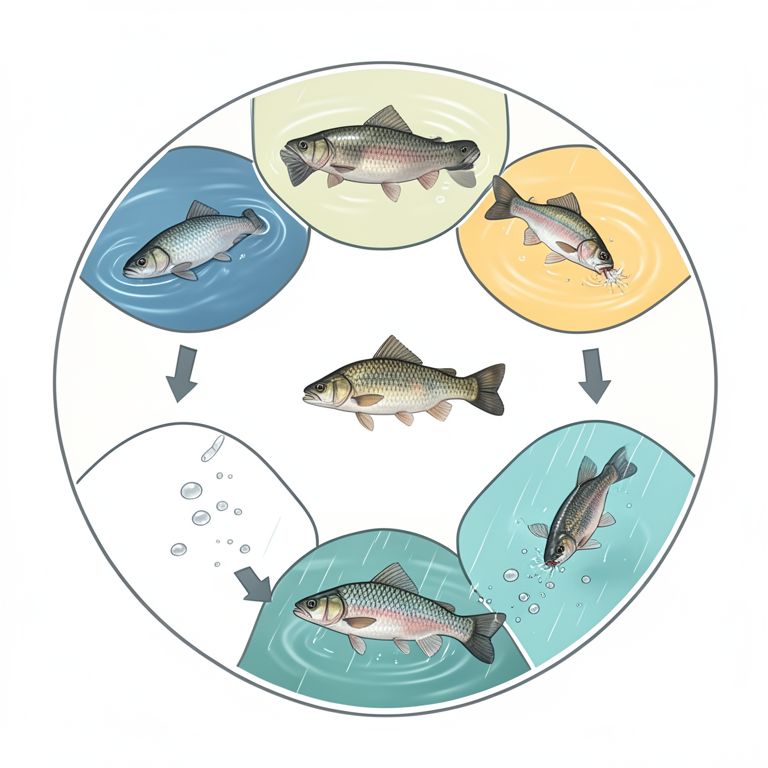
Seasonal Biological Response Cycle
AI-generated conceptual illustration (Catla catla (major carp fish) in a pond environment). It explains the idea and does not show study data.
View source evidence ↗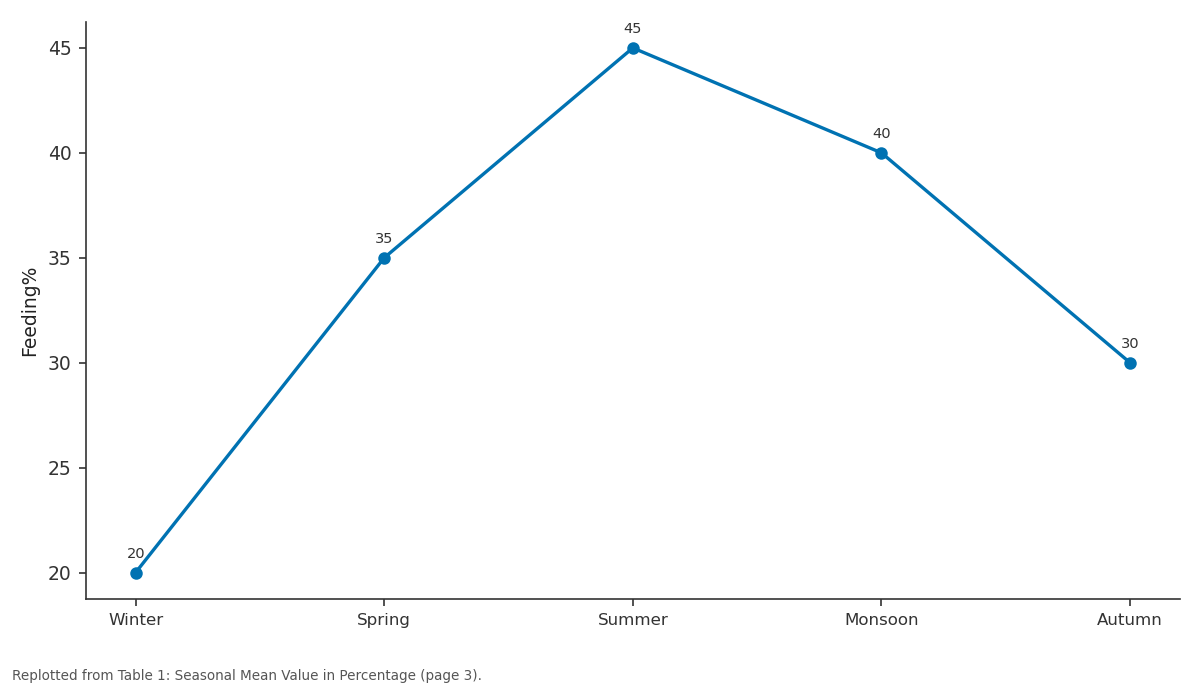
Feeding%: Winter vs Spring vs Summer vs Monsoon vs Autumn
Replotted from Table 1 (page 3) of the original paper. Every bar is the paper's own table value.
View source evidence ↗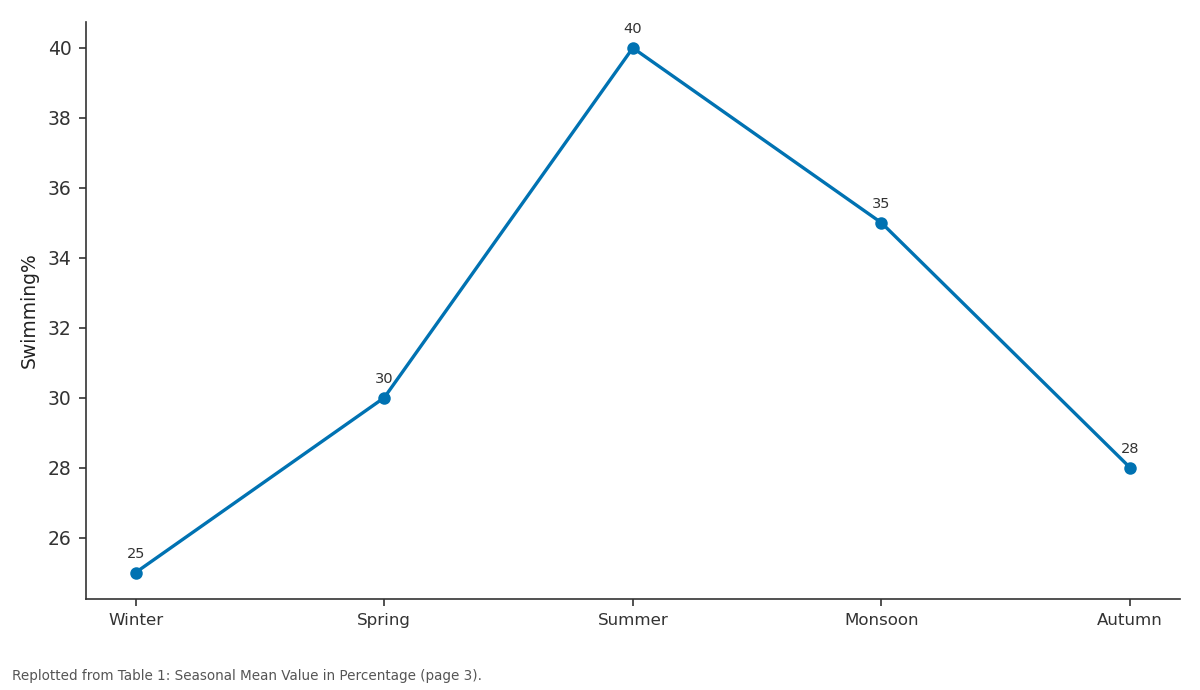
Swimming%: Winter vs Spring vs Summer vs Monsoon vs Autumn
Replotted from Table 1 (page 3) of the original paper. Every bar is the paper's own table value.
View source evidence ↗Figures & tables
From the original paper Table 1
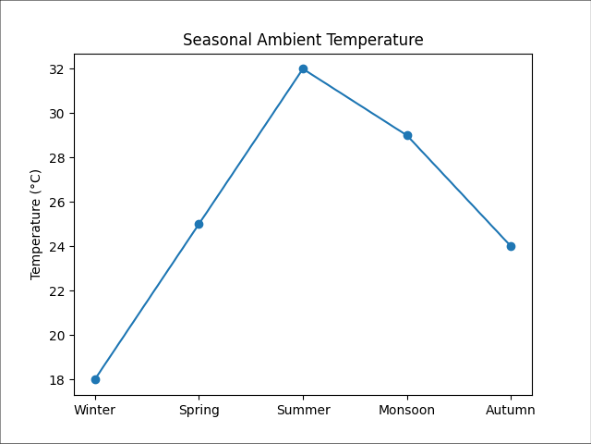 Figure 1
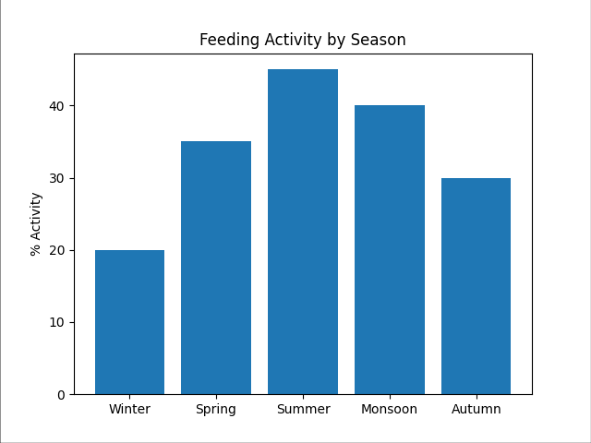 Figure 2
Introduction
Catla catla is one of the significant Indian major carp cultured throughout India and neighbouring countries. The species contributes substantially to inland fisheries and freshwater aquaculture. Environmental factors such as temperature, rainfall, photoperiod, dissolved oxygen and water level regulate fish physiology and behaviour. Among these variables, temperature is considered the most influential because fishes are ectothermic animal. Numerous studies (including Krüger 1982, Szumiec 1987, Pilarczyk 1998) [15,19] show that unfavourable environmental and nutritional conditions and disease eliminate from 50 to 90% of one-year-old carp prematurely. Seasonal changes in temperature alter metabolic rate, food consumption, movement, growth and reproduction. Fish generally exhibit reduced activity during colder months and enhanced feeding during warmer periods. Reproductive maturation is also synchronized with environmental conditions. In Indian freshwater ecosystems, spawning of major carps commonly coincides with the monsoon season when favourable temperature and hydrological conditions prevail. Water temperature, among other factors, plays an important role in fish survival. Both the upper and the lower lethal temperatures depend on a number of factors including the rate and range of temperature fluctuations and the age and condition of the fish (Smiek 1977, Lirski and Opuszynski 1988). As the fish aged and grow, their tolerance to low temperatures increases (D browski 1983, Lirski and Opuszynski 1988, Hamaaekova et al. 1995) [10,6] . Aquatic environmental alterations directly induce behavioral modifications in fish populations Sun, L. (2022) [18] . Organisms counteract environmental stress through cellular-level, so biochemical responses necessitating elevated metabolic energy production Sampaio, E.; Lopes, et al., (2018), and altering organismal behavior Rodriguez-Dominguez, A (2019). Liu et al., (2011) [11,16] demonstrated that formaldehyde exposure triggers characteristic neurobehavioral alterations in Danio rerio, manifesting as erratic locomotion (erratic turning/thigmotaxis) and restricted movement patterns; Liu, Y Lee () 2011) [11] and additionally Brunelle et al. (2022) demonstrated wastewater effluent containing organic contaminants (acetaminophen, etc) induced hyperactivity in Danio rerio larvae during colder seasons (autumn-winter) Brunelle, L.D.; Huang, (2022) [3] . Fish have been historically employed as real-time biomonitors due to their ease of aquaculture, availability, suitable specimen size, and lifespan Bownik, A. et al, 2021) [2] . Furthermore, their highly developed central nervous systems exhibit sensitivity to diverse industrial pollutants (e.g., heavy metals, herbicides, neurotoxins), and their behavioral responses holistically reflect the combined toxicity of multiple contaminants in real time Green, A.J(2018) [8] . Therefore, monitoring fish behavior is a reliable way to understand the current water environment. In contemporary research, the quantitative analysis of fish behavior has emerged as a foundational element in various investigative domains, including biological water quality monitoring,Yuan, F. et al, (2018) [20] . Additionally, the quantitative assessment of piscine behavioral patterns plays a crucial role in the design and operation of aquaculture systems Ma, Z.; Zhang, J et al, (2023). Overall, this analytical approach has demonstrated significant utility across multiple disciplines within the aquatic sciences. Alternative methodologies, such as opercular monitoring, among others, are more frequently used with the simultaneous implementation of monitoring technologies within a unified system This observation underscores the potential for integrating multiple monitoring approaches to improve the comprehensiveness and reliability of behavioral assessments in aquatic environments. The present study was undertaken to examine seasonal variation in ambient temperature and its relationship with behavioural feeding and reproductive characteristics of Catla catla using representative collected data observations.
Materials and Methods:
The investigation has been done with seasonal observation of temperature fluctuations and it's impact on behaviour, feeding and breeding pattern on Catla catla which is a surface feeder major carp widely used by fish farmers for fish farming in an embankment pond. Five seasonal periods were considered: winter, spring, summer, monsoon and autumn. Mean ambient temperature values were recorded on diurnal climatic conditions of Darbhanga, a district of eastern India. Behavioural parameters included feeding activity, swimming activity, surfacing behaviour and social interaction. Activity levels were expressed as percentage occurrence. Feeding pattern analysed in average by observing feeding behaviour on surface of water in pond at a time in different seasons. Such observation taken for consideration of feeding pattern during morning in summer and monsoon and mid of the day in winter,spring and and Autumn. Breeding activity was estimated using gonadal maturity, courtship behaviour and spawning readiness. Seasonal means were tabulated and compared descriptively. Data were analysed using percentage comparisons and graphical representation. A line graph was prepared to show seasonal temperature variation and a bar diagram was prepared to illustrate behavioural activity.
Observation: Temperature increased gradually from winter to summer and declined thereafter. Winter recorded the lowest mean temperature (18°C), while beginning of summer (during mid of the May 2025) recorded the highest (32°C). Behavioural responses varied markedly among seasons. Feeding activity increased from 20% during winter to 45% during summer. Swimming activity also increased from 25% to 40% over the same period. Surfacing and social interaction were more frequent under warmer conditions (figure 2). Breeding activity remained minimal during winter but increased during spring and summer. The highest breeding activity (100%) occurred during the monsoon season, indicating optimum reproductive conditions. The observed pattern suggests a close relationship between environmental temperature and biological performance. Rising temperature accelerates metabolism and increases food demand. Enhanced locomotion and feeding contribute to growth and energy accumulation. Monsoon conditions provide additional environmental stimuli including waterlevel fluctuations and improved habitat conditions, promoting spawning behaviour.
Result and Discussion
Temperature is a primary determinant of physiological performance in freshwater fishes. Increased temperature enhances enzyme activity, digestion and metabolic processes, leading to greater feeding and movement. The increase in feeding observed from winter to summer is consistent with established principles of fish bioenergetics. It is also a noticeable fact that rising temperature affect the swimming speed of the fish which ultimately related with the slow metabolic rate in extreme summer. Temperature affects fish behavior in diverse ways. These include lifestyle Freitas, R.(2017) [7] locomotor ability Pereira, E.(2019) [14] , swimming patterns Campos, D.F.;(2018) [4] , feeding, reproduction Madeira, D.(2016) [13] predator-prey dynamics Allan, B.J.M, (2015) and most importantly, lifespan Dong, Y (2008) [1,5] . The concentration of reproductive activity during the monsoon period reflects the adaptive breeding strategy of Indian major carps. Moderate temperature combined with rainfall, turbidity changes and increased water volume creates favourable conditions for egg development and larval survival. Similar seasonal reproductive patterns have been reported in numerous carp species. In this Observational study, breeding pattern is remarkably influenced by monsoon season as temperature is more optimum for egg production and reproduction. (Table 1). Reduced activity during winter can be attributed to lower metabolic demand. Fish conserve energy by reducing movement and feeding. Such responses are ecologically advantageous because food availability and physiological efficiency are often reduced under cooler conditions. Climate variability may alter these seasonal patterns in the future. Increasing temperatures and unpredictable rainfall could influence spawning success and aquaculture productivity. Continuous monitoring of environmental conditions is therefore essential for sustainable fishery management.
| Season | Temp °C | Feeding% | Swimming% | Surfacing% | Breeding% |
|---|---|---|---|---|---|
| Winter | 18 | 20 | 25 | 10 | 5 |
| Spring | 25 | 35 | 30 | 20 | 40 |
| Summer | 32 | 45 | 40 | 25 | 80 |
| Monsoon | 29 | 40 | 35 | 22 | 100 |
| Autumn | 24 | 30 | 28 | 15 | 20 |
Table text extracted from the original PDF; superscript letters are shown inline. The original table image is below.
View original table image
Conclusion:
Seasonal ambient temperature significantly influences the behaviour feeding and breeding pattern of Catla catla. Feeding and swimming activities increase with temperature, while peak reproductive activity occurs during the monsoon season. The findings emphasize the importance of environmental monitoring for broodstock management, induced breeding programmes and aquaculture production.
India Map Highlighting
India Map Highlighting
Figures and tables from the paper
References
20 in the original paper- Allan BJM, Domenici P, Munday PL, McCormick MI. Feeling the heat: The effect of acute temperature changes on predator-prey interactions in coral reef fish. Conserv Physiol. 2015;3:cov011.
- Bownik A, Wlodkowic D. Advances in real-time monitoring of water quality using automated analysis of animal behaviour. Sci Total Environ. 2021;789:147796.
- Brunelle LD, Huang IJ, Angeles LF, Running LS, Sirotkin HI, McElroy AE, Aga DS. Comprehensive assessment of chemical residues in surface and wastewater using passive sampling, chemical, biological, and fish behavioral assays. Sci Total Environ. 2022;828:154176.
- Campos DF, Val AL, Almeida-Val VMF. The influence of lifestyle and swimming behavior on metabolic rate and thermal tolerance of twelve Amazon forest stream fish species. J Therm Biol. 2018;72:148-154.
- Dong Y, Dong S, Ji T. Effect of different thermal regimes on growth and physiological performance of the sea cucumber Apostichopus japonicus. Aquaculture. 2008;275:329-334.
- Dąbrowski B. Climate and fish rearing in ponds. Olsztyn: Instytut Rybactwa Śródlądowego; 1983. No. 138. 12 p. (in Polish).
- Freitas LM, Valadares LPA, Camozzi MGM, de Oliveira PG, Ferreira Machado MR, Lima FC. Animal models in the neurotoxicology of 2,4-D. Hum Exp Toxicol. 2019;38:1178-1182.
- Green AJ, Planchart A. The neurological toxicity of heavy metals: A fish perspective. Comp Biochem Physiol C Toxicol Pharmacol. 2018;208:12-19.
- Hamačková J, Kouřil J, Kamler E, Szlamińska M, Vachta R, Stibranyiova I, Asenio CM. Influence of shortterm temperature decreases on survival, growth and metabolism of tench (Tinca tinca) larvae. Pol Arch Hydrobiol. 1995;42(1-2):109-120.
- Lirski A, Opuszyński K. Upper lethal temperatures for carp (Cyprinus carpio) and the phytophagous fishes Ctenopharyngodon idella, Hypophthalmichthys molitrix and Aristichthys nobilis. Rocz Nauk Roln H. 1988;101(4):31-49. (in Polish).
- Liu Y, Lee SH, Chon TS. Analysis of behavioral changes of zebrafish (Danio rerio) in response to formaldehyde International Journal of Biology Sciences https://www.biologyjournal.net using self-organizing map and a hidden Markov model. Ecol Model. 2011;222:2191-2201.
- Ma Z, Zhang J, Zhang X, Li H, Liu Y, Gao L. Effects of temperature and photoperiod on growth, physiological, and behavioral performance in steelhead trout (Oncorhynchus mykiss) under indoor aquaculture condition. Front Mar Sci. 2023;10:1114662.
- Madeira D, Vinagre C, Diniz MS. Are fish in hot water? Effects of warming on oxidative stress metabolism in the commercial species Sparus aurata. Ecol Indic. 2016;63:324-331.
- Pereira E, Cardoso GR, Quintella BR, Mateus CS, Alexandre CM, Oliveira RL, et al. Proposals for optimizing sea lamprey passage through a vertical-slot fishway. Ecohydrology. 2019;12:e2087.
- Pilarczyk A. Investigations on intensification of carp fingerling production. Part 2. State of health of fingerlings. Acta Hydrobiol. 1987;29(3):291-299.
- Rodriguez-Dominguez A, Connell SD, Leung JYS, Nagelkerken I. Adaptive responses of fishes to climate change: Feedback between physiology and behaviour. Sci Total Environ. 2019;692:1242-1249.
- Sampaio E, Lopes AR, Francisco S, Paula JR, Pimentel M, Maulvault AL, et al. Ocean acidification dampens physiological stress response to warming and contamination in a commercially important fish (Argyrosomus regius). Sci Total Environ. 2018;618:388398.
- Sun L, Wang B, Yang P, Wang X, Li D, Wang J. Water quality parameter analysis model based on fish behavior. Comput Electron Agric. 2022;203:107500.
- Szumiec MA. Thermal properties of carp ponds. Warszawa: PWN; 1984. 136 p.
- Yuan F, Lu L, Zhang Y, Wang S, Cai Y. Data mining of the cancer-related lncRNAs GO terms and KEGG pathways by using mRMR method. Math Biosci. 2018;304:1-8.