
Research article · 2026 · Full text
International Journal of Horticulture and Food ScienceProcessing and value addition of carrot
Volume 8(5) · Pages 28–30 · DOI: 10.33545/26631067.2026.v8.i5a.751 ↗
Research areasFood and Agricultural SciencesFood Science and Nutritional StudiesAgriculture and Agroindustry Studies
Abstract
Author-writtenThe advancement of vegetable products is always significant as it contributes to the longevity of vegetables and enhances their quality through the addition of value. This document involves the processing and enhancement of carrot value. In India, numerous types of under-utilized vegetables exist, yet they are not being properly utilized despite their high nutritional value. These crops possess great potential for ensuring sustainability regarding the nation's economy. Carrots are undervalued regarding their processing capability, despite having a high processing capacity. This review provides insights into the processing of carrots and the various value-added products derived from them.
Summary
Source-checkedPlain-language reading of the full paper, prepared with AI and checked against the text. Each point links to the authors' own words.
Why it matters
- Improving vegetable products is important because it increases their shelf life and enhances overall quality through value addition. View evidence ↗
- Many nutritionally rich vegetables in India are under-utilized, representing a missed opportunity for economic sustainability. View evidence ↗
- Despite their high capacity for processing, carrots are currently undervalued in terms of their potential for value-added products. View evidence ↗
The question
- The aim of this review is to provide insights into how carrots are processed and the different value-added products that can be created from them. View evidence ↗
What they did
- The review focuses on the carrot (Daucus carota subsp. sativus), which exists in various colors including red, orange, purple, black, white, and yellow. View evidence ↗
- The nutritional analysis considers the high vitamin A content, with 100 g of carrots providing over 100% of the Daily Value. View evidence ↗
What they found
- For canning, blanching carrots at 71 °C for 6 to 8 minutes improves the quality of the final product. View evidence ↗
- Freeze drying is highly effective for preservation, retaining 96-98% of carotenoids while maintaining color and flavor. View evidence ↗
- Reducing carrot particle size to 6-2 mm increases juice yield by 0.7% per millimeter and improves the color of blanched and macerated carrots. View evidence ↗
- UV treatment can extend the shelf life of carrot juice stored at 4 °C by up to 12 days without altering its sensory or physicochemical properties. View evidence ↗
- High-quality carrot yogurt can be produced by adding carrot juice to milk at concentrations between 5% and 20%. View evidence ↗
- To produce carrot candy, the total soluble solid content should be maintained between 70-75°B. View evidence ↗
- In jam production, mixing carrot juice with citrus juice is used to prevent the oxidation of carotene. View evidence ↗
What it means
- The authors conclude that carrots have significant processing potential that can be leveraged to create various value-added products. View evidence ↗
Visual summary
1 visualsIllustrations explain the paper; they do not show study data.
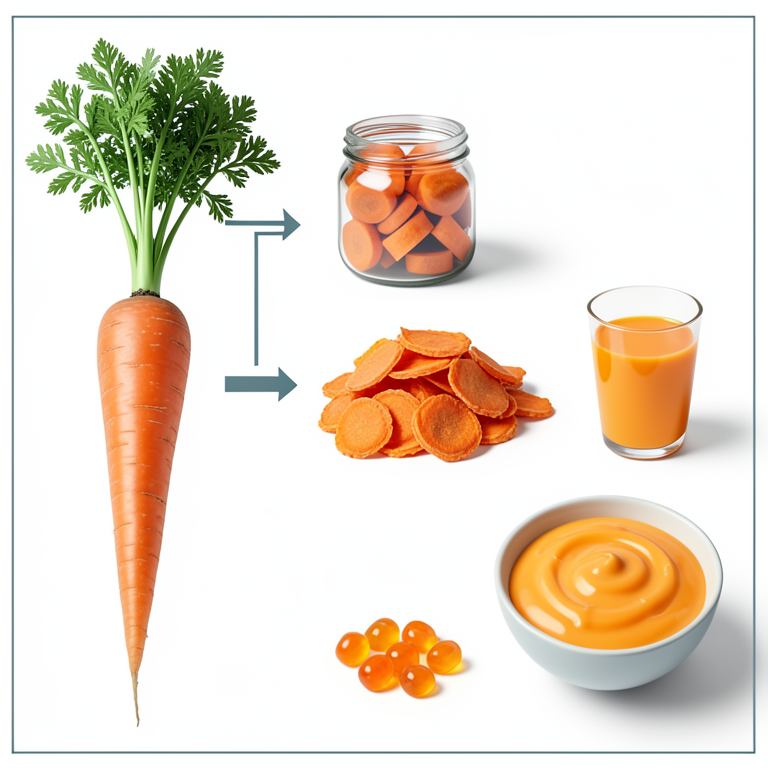
Carrot Value Addition Pathways
AI-generated conceptual illustration (Carrots and carrot-derived food products). It explains the idea and does not show study data.
View source evidence ↗Introduction
The carrot (Daucus carota subsp. sativus) is a root vegetable commonly red or orange, but there are also purple, black, white, and yellow varieties. The part of a carrot that is most frequently consumed is the taproot, although the greens are occasionally eaten too. It is a cultivated version of the wild carrot Daucus carota, indigenous to Europe and southwestern Asia. The cultivated carrot has been selectively developed for its significantly larger and tastier, less fibrous edible taproot (Kalra et al., 1987) [16] . Carrots are cultivated from seeds and may require up to 120 days reaching maturity, although numerous varieties can mature in 70 to 80 days when conditions are optimal. They thrive in full sunlight but can endure partial shade. The best temperature range is 16 to 21 °C. The preferred soil type is deep, loose, and well-drained, either sandy or loamy, with a pH between 6.3 and 6.8. Fertilizers need to be applied based on soil type since the crop needs low nitrogen levels, moderate phosphate, and high potash. Avoid rich or rocky soils, as they can lead to hairy and/or misshapen roots (Rubatzky et al., 1999) [24] . Irrigation is utilized as required to maintain moisture in the soil. Once the crop has sprouted, it is ultimately thinned to a distance of 8 to 10 cm and weeded to inhibit competition below the soil (CSIR, 2010). It is primarily a root vegetable featuring innately decompounds leaves and clusters of tiny white or yellow blooms. The edible part of a carrot is its taproot, consumed either raw or cooked (Simon and Wolff, 1987) [26] . Carrots can be found year-round, but locally cultivated ones are in season during summer and fall when they taste best and are freshest. Carrots are part of the Umbelliferae family, which is named for the umbrella-shaped flower clusters that these plants create (CSIR, 2010). Therefore, carrots are connected to parsnips, fennel, parsley, anise, caraway, cumin, and dill. Carrots may measure as short as two inches or as long as three feet, with diameters varying from half an inch to more than two inches (Gill and Kataria, 1974) [12] . Carrot roots possess a crisp consistency and a sweet, minty fragrant flavor, whereas the greens offer a fresh flavor with a hint of bitterness. Although we commonly link carrots to shades of red and orange, they can also be discovered in various other hues such as white, yellow, purple, or black. Indeed, purple, yellow, and red carrots were the sole color variations grown before the 15th or 16th century (Grassmann et al., 2007) [13] . The bright red or orange hue of the carrot is attributed to β-carotene, along with smaller quantities of α-carotene, γ-carotene, lutein, and zeaxanthin. Both α-and β-carotenes are partially converted into vitamin A, supplying over 100% of the Daily Value (DV) in a 100 g portion of carrots (Simon and Wolff, 1987) [26] . Carrots provide a decent amount of vitamin K (13% DV) and vitamin B6 (11% DV) (Krinsky, 1989) [17] , but their levels of other necessary nutrients are relatively low.
Carrot dietary fiber primarily consists of cellulose, along with lesser amounts of hemi-cellulose, lignin, and starch (Davidson-Hunt, 2006) [8] . Carrots contain free sugars such as sucrose, glucose, and fructose (Fu et al., 2009) [11] . Carrots can be kept for several months in the refrigerator or throughout the winter in a cool, moist location. For extended storage, unwashed carrots can be stored in a bucket layered with sand, a 50/50 blend of sand and wood shavings, or within soil. A temperature range between 0 and 5 °C is optimal (CSIR, 2010). Wild carrots possess a woody core that is less appealing, leading cultivation to gradually eliminate that trait, resulting in the familiar variety of carrots we recognize today. Carrots are enjoyed by both adults and children due to their crisp texture and sweet flavor, making them a worthwhile vegetable for parents and kids alike (Byers and Perry, 1992). Although people commonly recognize carrots as orange root vegetables, a stunning range of colors exists globally for this type of vegetable. All of these color variations, nevertheless, still fall under the same genus and species of plant, Daucus carota (Simon and Wolff, 1987; Kalra et al., 1987) [26,16] .
Processing and Value addition of Carrot Canned carrot
Tiny carrots are typically utilized in canning operations. Canning can occur in various ways, including diced, halved, quartered, or whole. The ideal temperature for the blanching process is 71 °C for 6 to 8 minutes, leading improved quality of the canned product. To enhance the color and quality, carrots underwent thermal treatment, resulting in a rise in the carotenoid content in the products (De Sa and Rodriguez-Amaya, 2004) [2] . Multiple studies indicated that the leaching of soluble solids during blanching is the primary factor contributing to the rise of carotenoids (Sulaeman et al., 2001) [28] and (Puuponen-Pimia et al., 2003) [20] .
Dehydrated carrot
Blanched pre-treated dried carrot is said to have more βcarotene and less ascorbic acid compared to unblanched dried carrot. The blanching process also inhibits the nonenzymatic browning of carrots (Negi and Roy, 2001) [19] . Extended drying periods and excessive heating of the product caused a brown hue, diminished flavor, and reduced rehydration capacity (Giri and Prasad, 2007) [14] . Pre-treating shredded carrot with a 5% sugar solution while blanching before dehydration was found to improve the retention of color and flavor; according to Alam et al. (2013) [2] , convective drying of citric acid blanched carrot at 65 °C was superior to solar drying, sun drying, and convective drying methods. Freeze drying has proven to be an outstanding method for preserving not just carotenoids (96-98%) but also the flavor and color of carrots (Rodriguez-Amaya, 1997) [23] . The use of vacuum and microwave drying reduces shrinkage while drying, leading to less damage to the physical structure and increased porosity (Béttega et al., 2014) [4] . Ultrasonic technology for drying is an energyefficient method
Carrot pickle
NaCl (sodium chloride) brine or potassium metabisulfite is utilized for the industrial manufacturing of pickles. It also prevents the carrot from softening since it serves as a preservative (Fernads, 2000) [10] . The application of lactic acid assists in the fermentation processes of carrot pickles. According to reports, pickles serve as a great appetizer and enhance the flavor of a meal (Sultana et al., 2014) [29] .
Carrot juice
Carrot juice is typically blended with other juices like orange juice and pineapple juice, which are quite popular in non-alcoholic drinks, and it is also utilized in the fermentation of yogurt. The juice extract from blanched carrots was observed to exceed that of cold-pressed juice, and blanched carrots also contain a higher quantity of carotenoids. Grinding carrots to a particle size of 6-2 mm increased yield by 0.7% per mile meter and enhanced the juice color for blanched and macerated carrots (Bin-Lim and Kyung-Jwa, 1996) [5] . Carrot juice is a high source of α and β carotene. Carrot juice helps to lessen the bitterness of kinnow and mandarin juice. (Salwa et al., 2004) [25] included carrot juice at a concentration of 5-20% in milk to produce high-quality carrot yogurt. To maintain the juice for a longer duration, various modern methods such as ozone processing, ultrasound treatment (US), high pressure (HP), and ultraviolet treatments are utilized (Adiamo et al., 2018) [1] . According to reports, the shelf life of UV treated carrot juice was extended by as much as 12 days without any notable changes in the physicochemical and sensory properties of the juice kept at 4 °C (Riganakos et al., 2017) [22] .
Carrot candy
It is a confection made from carrots by soaking them in sugar syrup, then removing excess syrup and drying to achieve a stable condition (Haq Raees-ul and Prasad, 2015) [15] . It has been noted that the total soluble solid content of the carrot candy must be 70-75°B (Beerh et al., 1984) [3] . The carrot candies stored in glass and LDPE materials possess enhanced sensory qualities
Carrot jam
The pulp is boiled with a specific amount of sugar and pectin until it takes on a jelly-like consistency. While jam is typically made from fruits, researchers have effectively adapted the process to certain vegetables, including tomato, cucumber, pumpkin, sweet potato, and carrot (Haq Raees-ul and Prasad, 2015) [15] . Currently, during the making of jam, carrot juice is mixed with citrus juice to prevent the oxidation of carotene. The mixed ingredients are heated with sugar and lemon juice along with pectin to create a suitable gel. This method is highly favored because it preserves a majority of the original compounds such as phenolics, carotene, and potassium, along with their color characteristics (Renna et al., 2013) [21] . Black carrot juice has been utilized as a dye in the production of strawberry jam (Kirca et al., 2007). Ultrasound-assisted vacuum drying has advantages over traditional drying techniques (Chen et al., 2016) [6] .
References
29 in the original paper- Adiamo OQ, Ghafoor K, Al-Juhaimi F, Babiker EE, Ahmed IAM. Thermosonication process for optimal functional properties in carrot juice containing orange peel and pulp extracts. Food Chemistry. 2018;245:7988.
- Alam MS, Gupta K, Khaira H, Javed M. Quality of dried pomace powder as affected by pre-treatments and methods of drying. Agricultural Engineering International: CIGR Journal. 2013;15(4):236-243.
- Beerh OP, Saxena AK, Manan JK. Improvement of the traditional method of manufacture of carrot murrabba. Indian Food Packer. 1984;38(4):59-63.
- Béttega R, Rosa JG, Corrêa RG, Freire JT. Comparison of carrot (Daucus carota) drying in microwave and in vacuum microwave. Brazilian Journal of Chemical Engineering. 2014;31(2):403-412.
- Bin-Lim S, Kyung-Jwa M. Effect of blanching conditions on the quality of carrot juice. Journal of the Korean Society of Food Science and Nutrition. 1996;25:680-686.
- Chen ZG, Guo XY, Wu T. A novel dehydration technique for carrot slices implementing ultrasound and vacuum drying methods. Ultrasonics Sonochemistry. 2016;30:28-34.
- Council of Scientific and Industrial Research. The Wealth of India. New Delhi: CSIR; 2010.
- Davidson-Hunt I. Ecological ethnobotany: stumbling toward new practices and paradigms. MASA Journal. 2006;16:1-13.
- De Sa MC, Rodriguez-Amaya DB. Optimization of HPLC quantification of carotenoids in cooked green vegetables: comparison of analytical and calculated data. Journal of Food Composition and Analysis. 2004;17:37-51.
- Fernads M. Role of salt, oil and acidity in the preservation of mango pickles against microbial spoilage. Journal of Food Science and Technology. 2000;37(5):532-536.
- Fu HW, Zhang L, Yi T, Tian JK. A new sesquiterpene from the fruits of Daucus carota L. Molecules. 2009;14(8):2862-2867.
- Gill HS, Kataria AS. Some biochemical studies in European and Asiatic varieties of carrot (Daucus carota). Current Science. 1974;43:32-36.
- Grassmann J, Schnitzler WH, Habegger R. Evaluation of different coloured carrot cultivars on antioxidative capacity based on their carotenoid and phenolic contents. International Journal of Food Sciences and Nutrition. 2007;58(8):603-611.
- Giri SK, Prasad S. Drying kinetics and rehydration characteristics of microwave-vacuum and convective hot-air dried mushrooms. Journal of Food Engineering. 2007;78(2):512-521.
- Haq RU, Prasad K. Nutritional and processing aspects of carrot (Daucus carota): a review. South Asian Journal of Food Technology and Environment. 2015;1(1):1-14.
- Kalra CL, Kulkarni SG, Berry SK. The carrot (Daucus carota L.): a most popular root vegetable. Indian Food Packer. 1987;41(6):46-73.
- Krinsky NI. Antioxidant functions of carotenoids. Free Radical Biology and Medicine. 1989;7(6):617-635.
- Kirca A, Ozkan M, Cemeroglu B. Storage stability of strawberry jam color enhanced with black carrot juice concentrate. Journal of Food Processing and Preservation. 2007;31(5):531-545.
- Negi PS, Roy SK. The effect of blanching on quality attributes of dehydrated carrots during long-term storage. European Food Research and Technology. 2001;212:445-448.
- Puuponen-Pimia R, Hakkinen ST, Aarni M, Suortti T, Lampi AM, Eurola M, et al. Blanching and long-term freezing affect various bioactive compounds of vegetables in different ways. Journal of the Science of Food and Agriculture. 2003;83(14):1389-1402.
- Renna M, Pace B, Cefola M, Santamaria P, Serio F, Gonnella M. Comparison of two jam making methods to preserve the quality of coloured carrots. LWT -Food Science and Technology. 2013;53:547-554.
- Riganakos KA, Karabagias IK, Gertzou I, Stahl M. Comparison of UV-C and thermal treatments for the preservation of carrot juice. Innovative Food Science and Emerging Technologies. 2017;42:165-172.
- Rodriguez-Amaya DB. Carotenoids and food preparation: the retention of provitamin A carotenoids in prepared, processed and stored foods. Washington (DC): OMNI Project, US Agency for International Development, Office of Health and Nutrition, John Snow Inc.; 1997. p. 22-23.
- Rubatzky VE, Quiros CF, Simon PW. Carrots and related vegetable Umbelliferae. Wallingford: CAB International Publishing; 1999.
- Salwa AA, Galal EA, Neimat A, Elewa. Carrot yoghurt: sensory, chemical, microbiological properties and consumer acceptance. Pakistan Journal of Nutrition. 2004;3(6):322-330.
- Simon PW, Wolff XY. Carotenes in typical and dark orange carrots. Journal of Agricultural and Food Chemistry. 1987;35(6):1017-1022.
- Sharma K, Karki S, Thakur N, Attri S. Chemical composition, functional properties and processing of carrot: a review. Journal of Food Science and Technology. 2012;49:22-32.
- Sulaeman A, Keeler L, Giraud DW, Taylor SL, Wehling RL, Driskell JA. Carotenoid content and physicochemical and sensory characteristics of carrot chips deep-fried in different oils at several temperatures. Journal of Food Science. 2001;66(9):1257-1264.
- Sultana S, Iqbal A, Islam MN. Preservation of carrot, green chilli and brinjal by fermentation and pickling. International Food Research Journal. 2014;21(6):24052412.