
Research article · 2026 · Full text
International Journal of Geography Geology and EnvironmentUrban water security assessment: A review of indicators and frameworks
Volume 8(6) · Pages 01–04 · DOI: 10.22271/27067483.2026.v8.i6a.778 ↗
Research areasWater Resources and SustainabilityWater-Energy-Food Nexus StudiesWater resources management and optimization
Abstract
Author-writtenUrban water security is important for urban development. In urban areas water related issues are rising due to climate change, landuse changes, and environmental degradation. As increase in population growth and competition increase in resources ensuring safe and affordable water access to all urban areas as become a complex challenge. This review systematically examine the state of water security, focusing on how the concept is defined and assessed, the frameworks and indicators employed. These research aims to identify the knowledge gap for urban water security. A literature review was conducted using prisma guidelines, reviewed articles, institutional reports, and worldwide case studies. The review evidence on assessment frameworks particularly indicator based tool such as WATSAT. The findings reveal that under water security multidimensional and evaluate water supply, sanitation, productivity, disaster risks, environmental quality and governance.
Summary
Source-checkedPlain-language reading of the full paper, prepared with AI and checked against the text. Each point links to the authors' own words.
Why it matters
- Urban water security is critical for the development of cities, but it is increasingly threatened by environmental degradation, land-use changes, and climate change. View evidence ↗
- Providing affordable and safe water access to all urban residents has become a complex challenge due to rising population growth and increased competition for resources. View evidence ↗
The question
- The study aims to systematically examine how urban water security is defined and assessed, the indicators and frameworks used, and to identify existing knowledge gaps. View evidence ↗
- The review specifically addresses how urban water security is measured, which indicators are most effective for assessment, and what challenges influence it. View evidence ↗
What they did
- The authors conducted a literature review following PRISMA guidelines, analyzing institutional reports, academic articles, and global case studies. View evidence ↗
- For the purpose of this review, urban water security is defined as the capacity to provide safe, sufficient, and affordable water to all residents while managing risks like pollution, scarcity, and climate change. View evidence ↗
- The assessment of urban water security is based on six key dimensions: quantity, quality, accessibility, reliability, affordability, and governance. View evidence ↗
- The Water Security Assessment Tool (WATSAT) uses a multilayered structure of variables, indicators, and dimensions to create a comprehensive water security index. View evidence ↗
- In the WATSAT tool, variables qualify indicators which are then normalized to produce a Water Security Index (WSI) on a scale from 1 to 5. View evidence ↗
What they found
- The review found that water security is multidimensional, requiring the evaluation of governance, environmental quality, disaster risks, productivity, sanitation, and water supply. View evidence ↗
- WATSAT was identified as an effective indicator-based framework for city authorities because its standardized dimensions align with the Sustainable Development Goals (SDGs). View evidence ↗
- Validation results indicate that there is significant room for improvement specifically within the dimensions of water environment and water-related disasters. View evidence ↗
What it means
- The authors conclude that cities must replace outdated methods with integrated strategies that combine strong leadership, nature-based solutions, and new technologies. View evidence ↗
- The authors state that the WATSAT tool is robust and holistic enough to be applied to any city worldwide to assist in informed decision-making. View evidence ↗
- The authors suggest a need to expand the use of web-based and digital tools to allow for the dynamic, real-time monitoring of urban water security. View evidence ↗
- Future work should focus on strengthening participatory research and promoting transdisciplinary approaches that bridge policy, social, and technical domains. View evidence ↗
Visual summary
1 visualsIllustrations explain the paper; they do not show study data.
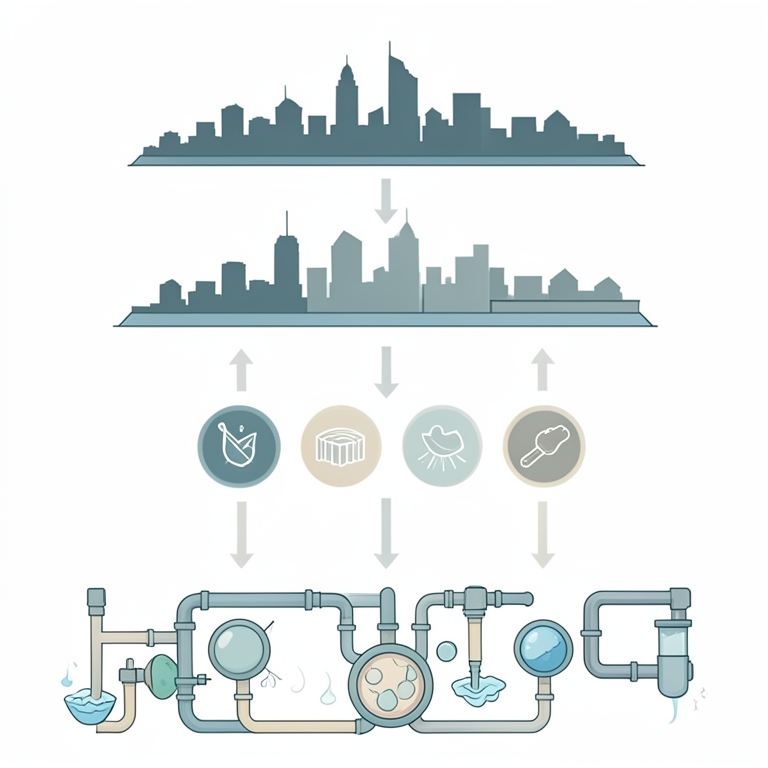
WATSAT Framework Structure
AI-generated conceptual illustration (Urban water infrastructure and natural water sources). It explains the idea and does not show study data.
View source evidence ↗Figures & tables
From the original paper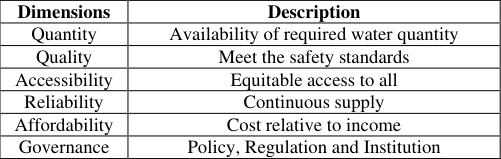 Table 1
Introduction
Urban water security is understood through aspects such as quality and quantity of drinking water, sanitation, human wellbeing, water productivity, social economic values, ecosystems and environmental health, water related hazards, and water governance are presented by frameworks (ABOELNGA, 2019) [1] and (BABEL, 2020) [11] . The indicators are used to assess the urban water security. Today climate change and population increase are placing tremendous stress on water resource. This study aims to carryout urban water security analysis, using WATSAT. The capacity of population to safeguard sustainable access to adequate quantities and acceptable quality of water for sustaining livelihoods, human wellbeing and socio economic development for ensuring protection against water-borne diseases, pollution and water related disasters and for reserving eco systems is a climate of peace and political stability (UN-WATER, 2013) [35] . WATSAT utilize a multilayer structure of dimensions, indicators and variables to generate comprehensive water security index, offering a wholistic view of a city's water security status (Aboelnga et al., 2019, Larsen et al., 2016; UN-Habitat, 2020) [1,25,34] . The research questions addressed • How urban water security is is measured? • Which indicators are effective for urban water security assessment?
• What are the challenges influencing urban water security? By exploring these questions, this review provide the current state of urban water security and to examine pathways that support resilience and equitable development in rapidly expanding cities.
• The target 6 a is to expand international cooperation and capacity building support to developing countries in water and sanitation related activities and programs, including water harvesting, desalination, water efficiency, waste water treatment, recycling and reuse technologies. • The target 6 b is to support and strength the participation of local communities in improving water and sanitation management.
Dimensions of Urban Water Security
The dimensions of urban water security are water quality, quantity, accessibility, reliability, affordability and governance.
Integrated Frameworks
Integrated urban water management is one of the approach that include water supply, sanitation, stormwater and waste water management. Integrated urban water management emphasizes cross sectoral coordination, stakeholder participation and the use of both supply side and demand side strategies to achieve sustainable, reliable and equitable urban water system (Larsen et al., 2016) [25] . [1,25,34] . WATSAT is an indicator based framework, developed to access water security for cities. It is useful for city authorities and decision makers. The usage of standardized dimensions and indicators aligned with Sustainable Development Goals.
Methodology
Methodology
Future Directions
• Expand digital and web based tools for real time, dynamic assessment and monitoring of urban water security (UN-Habitat, 2020) [34] . • Promote trans disciplinary approach that bridges technical, social and policy domains for holistic understand and action (Larsen et al., 2016) [25] . • Strengthen the participatory research By focusing on these recommendation, cities can move towards more sustainable, equitable urban water futures.
Conclusions
Urban water security is essential for a healthy city. It requires ensuring that every resident has reliable, safe and affordable access to it, even cities faces pressure from rapid growth and climate change. To achieve this, cities must move beyond old methods and adopt integrated strategies that combine new technologies, nature based solutions and strong leadership. The tool is in the public domain (www.watsat.org). The findings and reflections that emerged out of the study are summarized as follows:
The tool is holistic in nature and robust to capture the elements of water security and thus can be applied to any city across the globe; • City stakeholders can make an objective assessment and have a holistic understanding of water security and interconnections of various factors affecting it and assist them in informed decision-making to arrive at system-based interventions to tackle water security threats in the cities; and
• The validation of the tool is carried out. Results show the overall state of water security, there is considerable for improvement in terms of water-related disasters and water environment dimensions of water security.
By prioritizing water security and fair distribution, a city doesn't just provide a basic service-it protect public health strength the local economy and builds a more resilient future for everyone. Thus, it is expected that the tool will help build the capacity of city authorities, planners and decisionmakers, practitioners, and academicians, among others, in an improved understanding of the holistic nature of water security and its assessment.
Acknowledgement
AcknowledgementThe authors gratefully acknowledge the Centre for Water Resources for supporting this research work and the Centre for Research for providing financial assistance for the study.
Figures and tables from the paper
| Dimensions | Description |
|---|---|
| Quantity | Availability of required water quantity |
| Quality | Meet the safety standards |
| Accessibility | Equitable access to all |
| Reliability | Continuous supply |
| Affordability | Cost relative to income |
| Governance | Policy, Regulation and Institution |
Table text extracted from the original PDF; superscript letters are shown inline. The original table image is below.
View original table image
References
31 in the original paper- Cai X, Wallington K, Shafiee-Jood M, Marston L. Understanding and managing the food-energy-water nexus-opportunities for water resources research. Advances in Water Resources. 2018;111:259-273.
- Chang YJ, Zhu D. Urban water security of China's municipalities: comparison, features and challenges. Journal of Hydrology. 2020;587:125023.
- Chang YJ, Zhu D. Water security of the megacities in the Yangtze River basin: comparative assessment and policy implications. Journal of Cleaner Production. 2021;290:125812.
- Chapagain K, Aboelnga HT, Babel MS, Ribbe L, Shinde VR, Sharma D, et al. Urban water security: a comparative assessment and policy analysis of five cities in diverse developing countries of Asia. Environmental Development. 2022;43:100713.
- Cook C, Bakker K. Water security: debating an emerging paradigm. Global Environmental Change. 2012;22(1):94-102.
- Gerlak AK, House-Peters L, Varady RG, Albrecht T, Zúñiga-Terán A, de Grenade RR, et al. Water security: a review of place-based research. Environmental Science & Policy. 2018;82:79-89.
- Grey D, Sadoff CW. Sink or swim? Water security for growth and development. Water Policy. 2007;9(6):545571.
- Global Water Partnership. Towards water security: a framework for action. Stockholm: GWP; 2000.
- Hoff H. Understanding the nexus: background paper for the Bonn2011 Conference. Stockholm: Stockholm Environment Institute; 2011.
- Jensen O, Wu H. Urban water security indicators: development and pilot. Environmental Science & Policy. 2018;83:33-45.
- Khan S, Guan Y, Khan F, Khan Z. A comprehensive index for measuring water security in an urbanizing world: the case of Pakistan's capital. Water. 2020;12(1):166.
- Krueger E, Rao PSC, Borchardt D. Quantifying urban water supply security under global change. Global Environmental Change. 2019;56:66-74.
- Lall S, Lebrand M, Park H, Sturm D, Venables A. Pancakes to pyramids: city form to promote sustainable growth. Washington DC: World Bank Group; 2021.
- Larsen TA, Hoffmann S, Luthi C, Truffer B, Maurer M. Emerging solutions to the water challenges of an urbanization world. Science. 2016;352(6288):928-933.
- Liu J, Zhang H, Gosling SN, Kummu M, Flörke M, Pfister S, et al. Water scarcity assessments in the past, present and future. Earth's Future. 2017;5(6):545-559.
- Mehr S. Integrated framework for assessment of water security. Bangkok: Asian Institute of Technology; 2011.
- Ray B, Shaw R. Water insecurity in Asian cities. In: Ray B, Shaw R, editors. Urban drought. Singapore: Springer; 2019. p. 17-32.
- Revandh N, Katturajan K. Urban drinking water security: a comprehensive review of challenges, frameworks, and strategies. Governance. 2025;1:39.
- Saaty RW. The analytic hierarchy process -what it is and how it is used. Mathematical Modelling. 1987;9(35):161-176.
- Saikia P, Beane G, Ellis L, Giné R, Ward R, Avello P, et al. City water resilience approach: a five-step methodology to build water resilience at an urban scale. Paris: UNESCO; 2020.
- Sullivan C. Calculating a Water Poverty Index. World Development. 2002;30(7):1195-1210.
- UNESCO World Water Assessment Programme. Water: a shared responsibility; the United Nations world water development report 2. Paris: UNESCO; 2006.
- United Nations Human Settlements Programme. World cities report 2020: the value of sustainable urbanization. Nairobi: UN-Habitat; 2020.
- UN-Water. Water security and the global water agenda: a UN-Water analytical brief. Hamilton: United Nations University; 2013.
- van Leeuwen CJ, Chandy PC. The city blueprint: experiences with the implementation of 24 indicators to assess the sustainability of the urban water cycle. Water Supply. 2013;13(3):769-781.
- Vörösmarty CJ, McIntyre PB, Gessner MO, Dudgeon D, Prusevich A, Green P, et al. Global threats to human water security and river biodiversity. Nature. 2010;467:555-561.
- World Economic Forum. The global risks report 2020. Geneva: WEF; 2020.
- World Resources Institute. The new aqueduct water risk atlas: what's new and why does it matter to you? Washington DC: WRI; 2019.
- Xiao SC, Li JX, Xiao HL, Liu FM. Comprehensive assessment of water security for inland watersheds in the Hexi Corridor. Environmental Geology. 2008;55:369-376.
- Young SL, Boateng GO, Jamaluddine Z, Miller JD, Frongillo EA, Neilands TB, et al. The Household Water InSecurity Experiences (HWISE) scale: development and validation of a household water insecurity measure for low-income and middle-income countries. BMJ Global Health. 2019;4(5):e001750.
- Zakeri MA, Mirnia SK, Moradi H. Assessment of water security in the large watersheds of Iran. Environmental Science & Policy. 2022;127:31-37.