
Research article · 2022 · Full text
International Journal of Biology SciencesImpact of ultra-hydrophobic contact surfaces on micro environmental management of goat shed
Volume 4(2) · Pages 257–260 · DOI: 10.33545/26649926.2022.v4.i2d.850 ↗
Research areasEffects of Environmental Stressors on LivestockAnimal Behavior and Welfare StudiesLivestock Farming and Management
Abstract
Author-writtenTotal 30 adult goats were distributed into five different compartments on concrete floor as Control, T1, T2, T3, & T4 treatment groups for 106 days. Contact floors of all treatment groups except Control were modified by application of ultra-hydrophobic layers. Three different Improved cleaning methods ICT-A, ICT-B & ICT-C were implemented in T2, T3 and T4 respectively, Traditional cleaning resulted in least reduction of 18.81% MCS, 11.58% BCS, 30.42% PCS with 14.80 min. of TS. Non-significant difference was noted in TCS. About 38.48% reductions in MCS recorded in T4 with 31.61% reduced BCS, 74.20% reduction in PCS. TS was 11.02 min. with 4.91 min for TICT. T1 showed 32.84%, 19.77%, 35.46% reduction in respectively with 11.55 min. for TS & 11.09 for TICT. Treatment T2 resulted with reduced MCS, BCS & PCS by 28.92, 22.71 & 33.59% and consumed 11.02 & 7.47 min for TS & TICT respectively. 31.91, 25.63 & 50.71% reduction in MCS, BCS & PCS with 11.03 & 3.79 min for TS & TICT respectively. TCS for all treatments found increased by 3.74, 3.35, 3.95, 3.57 & 3.49% in Control, T1, T2, T3 & T4 respectively. Average gradation score reported 43.12, 50.00, 69.22, 74.10 & 89.44% observed cleanliness in Control, T1, T2, T3 & T4 respectively. It was concluded that, scientific management of micro-environment of goat floor can be enriched by means of ultra-hydrophobic coating of contact surfaces with the ICTs.
Summary
Source-checkedPlain-language reading of the full paper, prepared with AI and checked against the text. Each point links to the authors' own words.
Why it matters
- Goat shed flooring often suffers from dampness, urine staining, and dirt accumulation in cracks. View evidence ↗
- Poor flooring conditions promote the growth of bacteria, fungi, and parasites, which can lead to pneumonia, foot-rot, and neonatal mortality in goats. View evidence ↗
- Super-hydrophobic surfaces are highly water-repellent and possess self-cleaning properties due to low water contact angle hysteresis. View evidence ↗
The question
- The study aimed to evaluate how ultra-hydrophobic contact surfaces combined with various improved cleaning methods affect the micro-environmental management of goat housing. View evidence ↗
What they did
- The experiment used 30 adult goats divided into five groups (Control, T1, T2, T3, and T4) over a period of 106 days. View evidence ↗
- All treatment groups except the control group had their contact floors modified with ultra-hydrophobic layers. View evidence ↗
- Three improved cleaning treatments (ICT) were tested: ICT-A (pressure water pump), ICT-B (power air blower), and ICT-C (multi-purpose vacuum cleaner). View evidence ↗
- Moisture content of contact surfaces (MCS) was measured using a pin-type digital moisture meter at five points on the floor. View evidence ↗
- Bacterial counts (BCS) were determined by collecting floor dust, diluting it on agar media, and incubating for 36 hours. View evidence ↗
What they found
- Treatment T4 (vacuum cleaner) achieved the highest reductions in moisture content (38.48%), bacterial count (31.61%), and parasitic count (74.20%). View evidence ↗
- Traditional cleaning provided the lowest reductions in moisture (18.81%), bacteria (11.58%), and parasites (30.42%). View evidence ↗
- Treatment T1 showed reductions of 32.84% in MCS, 19.77% in BCS, and 35.46% in PCS. View evidence ↗
- Treatment T2 reduced moisture, bacteria, and parasites by 28.92%, 22.71%, and 33.59% respectively. View evidence ↗
- Observed cleanliness scores increased across groups, from 43.12% in the Control to 89.44% in T4. View evidence ↗
- Floor temperature (TCS) increased slightly across all groups, ranging from 3.35% to 3.95%. View evidence ↗
What it means
- The authors conclude that combining ultra-hydrophobic floors with improved cleaning treatments can effectively minimize bacterial infections, parasitic infestations, and neonatal mortality. View evidence ↗
- The study concludes that the micro-environment of goat floors can be improved through the use of ultra-hydrophobic coatings and ICTs. View evidence ↗
Visual summary
1 visualsIllustrations explain the paper; they do not show study data.
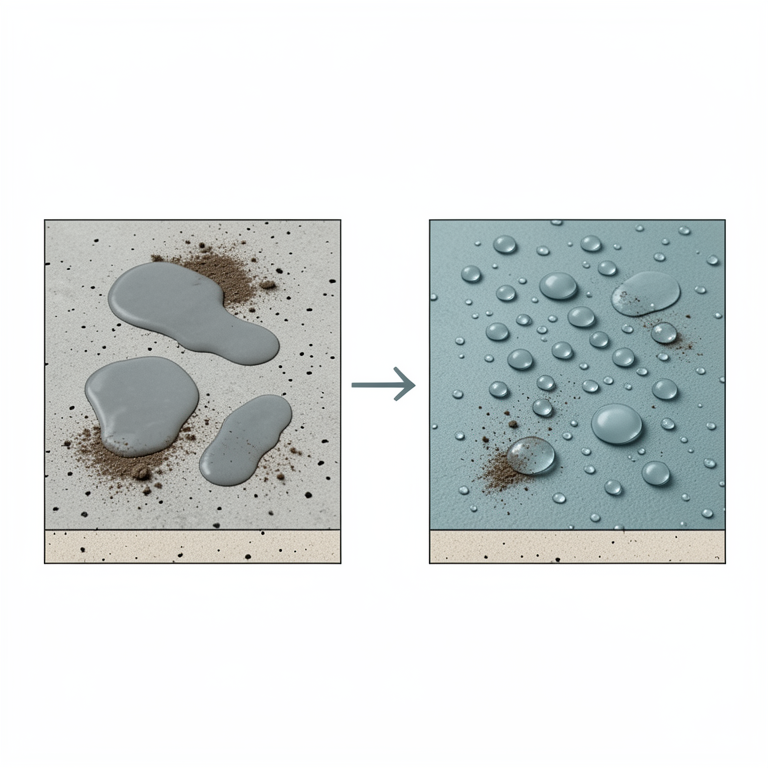
Mechanism of Ultra-Hydrophobic Flooring
AI-generated conceptual illustration (concrete flooring in a goat shed). It explains the idea and does not show study data.
View source evidence ↗Figures & tables
From the original paper Table 1
 Table 2
Introduction
Nanotechnology is not just about the size of very small things, it is the revolutionary science and the art of manipulating matter at the atomic or molecular scale. Super-hydrophobic surfaces have evoked great interest. Super-hydrophobic surfaces (SHS) exhibit extremely high water repellency, in addition to high contact angles, super hydrophobic surfaces exhibit very low water contact angle hysteresis CAH (<10) leads to the rolling and bouncing of the water droplets, leading to a self-cleaning property of super hydrophobic surfaces. The physical reason of self-cleaning is the joint action of small adhesion of dust particles to the surface and high capillary force acting on the dust particles at water drop-air interface. Besides water repellency and self-cleaning, other properties have also been incorporated in super-hydrophobic surfaces such as transparency and color, anisotropy, reversibility, flexibility, non-toxic, anti-microbial and breathability (Moisture vapor transfer). Goats are stall fed either on concrete floor or on traditional kattcha soil floor. Both the surfaces have their advantages and disadvantages. But the dampness, wetting of floor, staining of floor with urine and droppings, foul odorous air, stagnation of stagnation at corners, drainage channel, trapping of dirt in cracks and crevices are very common problems with flooring of goat shed. These problems collectively gives rise to growth and multiplication of different bacteria, fungi and parasites in the contact surfaces of goat shed that results into respiratory distress, pneumonia, foot-rot, neonatal kid's mortality particularly in goat management. The microbial load of contact surfaces in intensive management of animals plays very crucial role in health status of herd. Hence in present investigation major emphasis was employed for structural modification of contact surfaces of animal shed to reduce moisture level with layering of ultra-hydrophobic material. [12] Behzad Rezaei et al., (2006) [3] , Siti Hajar Othman et al., (2014) [9] , Lauren R. Freshcauf et al. (2012) [14] , Hongyan Gao et al (2019) [15] Xiaoxue Zhang et al (2013) [11] Average Daily parasitic load of experimental contact floors before traditional swiping during the first 8 days were 9.63, 10.13, 9.50, 9.75, & 8.50 (N×100/cm 2 ) however after traditional swiping for Control, T 1 , T 2 , T 3 and T 4 treatments were observed as 6.25, 6.13, 6.38, 4.75 & 2.50 (N×100/cm 2 ) respectively & during 9 th to 16 th days were 10.50, 10.25, 9.75, 10.13 & 8.00 (N×100/cm 2 ) for Control, T 1 , T 2 , T 3 and T 4 treatments respectively. During the second phase Average Parasitic load were observed as 7.75, 6.63, 6.50, 5.50 & 2.13 & before the cleaning of experimental compartments of all the treatment groups between 19 th to 34 th days of the study were 11.17, 10.00, 9.17, 10.00 & 9.50 ((N×100/cm 2 ) for Control, T 1 , T 2 , T 3 and T 4 treatments respectively. On every 3 rd day after and before the cleaning of experimental compartments of all the treatment groups between 19 th to 34 th days of the study were 7.67, 6.67, 6.50, 5.50 & 2.50 & were 10.33, 9.50, 10.33, 10.17 & 9.00 (N×100/cm 2 ) for Control, T 1 , T 2 , T 3 and T 4 treatments respectively with every 5 th day after & before the cleaning between 39 th to 64 th days of the study were 7.67, 6.50, 6.67, 3.50 & 2.33 & (N×100/cm 2 ) and Average weekly Parasitic load of experimental contact floors of treatment compartments before and after the cleaning of experimental compartments of all the treatment groups between 71 st to 106 th days of the study were 10.83, 9.83, 10.50, 9.50 & 9.83 & were 7.67, 6.17, 6.67, 5.17 & 2.33 (N×100/cm 2 ) for Control, T 1 , T 2 , T 3 and T 4 treatments respectively. Hassan et al., (2011) [11] , Bob Storey (2015) [4]
Conclusion
Under conventional goat housing, surface modification of rough concrete floor by means of application of ultrahydrophobic layer ensures healthy management of microenvironmental factors of contact surface. Incidences of bacterial infections, parasitic infestations, neonatal mortality etc. in goat shed can be minimised effectively with the ultrahydrophobic contact floor and any of the Improved Cleaning Treatment (ICT). Hence it is concluded that, as the future prospect of micro-environmental management of goat shed to harvest best results in conventional housing, modifying the contact surfaces of goat shed with ultra-hydrophobic coating with any of the Improved Cleaning methods will be definitely answered.
Acknowledgement
AcknowledgementsThe authors are thankful to the Associate Dean, Mumbai Veterinary College, Mumbai for providing all the required facilities. The technical support extended by Department of Veterinary Microbiology and Department of Veterinary Parasitology of BVC, Mumbai is highly acknowledged.
Figures and tables from the paper
| Sr. No | Treatment group | Number of Experimental Goats | Details of treatment |
|---|---|---|---|
| 01 | Control | 06 | Traditional cleaning of floor by using stick broom. |
| 02 | T1 | 06 | Swiping by stick broom only without any improved cleaning treatment. |
| 03 | T2 | 06 | Daily swiping by using SSD garden broom and prescribed ICT-A i.e. Cleaning of contact surfaces with pressure water pump,1.0 Hp (240-260V) |
| 04 | T3 | 06 | Daily swiping by using SSD garden broom and prescribed ICT-B i.e. Cleaning of contact surfaces with power air blower, 820W (240-260V) |
| 05 | T4 | 06 | Daily swiping by using SSD garden broom and ICT-C as Cleaning of contact surfaces with multi-purpose vacuum cleaner, 1000 W (240-260 V) |
Table text extracted from the original PDF; superscript letters are shown inline. The original table image is below.
View original table image
| Sr. No. | Time Phase (Days) | Scheduled Treatment Frequency Interval | — | — | — | — | — | — | — |
|---|---|---|---|---|---|---|---|---|---|
| Control | T1 | T2 | T3 | T4 | |||||
| Swiping | Swiping | Swiping | ICT-A | Swiping | ICT-B | Swiping | ICT-C | ||
| 1. | 0-7 | Daily | Daily | Daily | --- | Daily | --- | Daily | --- |
| 2. | 08-16 | Daily | Daily | Daily | Daily | Daily | Daily | Daily | Daily |
| 3. | 17-34 | Daily | Daily | Daily | Every 3rd day | Daily | Every 3rd day | Daily | Every 3rd day |
| 4. | 35-64 | Daily | Daily | Daily | Every 5th day | Daily | Every 5th day | Daily | Every 5th day |
| 5. | 65-106 | Daily | Daily | Daily | weekly | Daily | weekly | Daily | weekly |
Table text extracted from the original PDF; superscript letters are shown inline. The original table image is below.
View original table image
References
16 in the original paper- Marmur A. Super-hydrophobicity fundamentals: implications to biofouling prevention. Biofouling. 2006;22(2):107-115. doi:10.1080/08927010600562328.
- Mohamed AMA, Abdullah AM, Youngman NA. Corrosion behavior of superhydrophobic surfaces: a review. Arabian Journal of Chemistry. 2015;8:749-765.
- Rezaei B, Mosaddhegi H. Applications of titanium dioxide nano coating. In: Proceedings of the NanoTechnology in Environments Conference; 2006 Feb; Isfahan, Iran. Isfahan: Isfahan University of Technology; 2006.
- Storey B. Fecal egg counts: uses and limitations. Conference paper. 2015.
- Divyalakshmi D, Kumaravelu N, Ronald BSM, Devi T, Muthuramalingam T, Gnanaraj TT. Comparison of floor microbial load in different systems of floorings in livestock sheds. Indian Veterinary Journal. 2016;93(10):47-49.
- Hutchison ML, Walters LD, Avery SM, Munro F, Moore A. Analyses of livestock production, waste storage, and pathogen levels and prevalence in farm manures. Applied and Environmental Microbiology. 2005;71(3):1231-1236.
- Hassan MM, Hoque MA, Islam SKMA, Khan SA, Roy K, Banu Q. A prevalence of parasites in black Bengal goats in Chittagong, Bangladesh. International Journal of Livestock Production. 2011;2(4):40-44.
- Ogunmwonyi IN, Igbinosa OE, Aiyegoro OA, Odjadjare EE. Microbial analysis of different top soil samples of selected site in Obafemi Awolowo University, Nigeria. Scientific Research and Essay. 2008;3(3):120-124.
- Othman SH, Abd Salam NR, Zainal N, Basha RK, Talib RA. Antimicrobial activity of TiO₂ nanoparticlecoated film for potential food packaging applications. International Journal of Photoenergy. 2014;2014:945930.
- Karaman S, Gopal Z. Indoor air quality in animal housing systems: gas, odor and dust. Current Trends in Natural Sciences. 2017;6(12):267-271.
- Zhang X, Wang L, Levänen E. Superhydrophobic surfaces for the reduction of bacterial adhesion. RSC Advances. 2013;3:12003-12020.
- Ong YL. Adhesion forces between E. coli bacteria and biomaterial surfaces. Langmuir. 1999;15:2719-2725.
- Quan YY, Zhang LZ, Qi RH, Cai RR. Self-cleaning of surfaces: the role of surface wettability and dust types. Scientific Reports. 2016;6:38239. doi:10.1038/srep38239.
- Freshcauf LR, McLane J, Sharma H, Khine M. Shrinkinduced superhydrophobic and antibacterial surfaces in consumer plastics. PLoS One. 2012;7(8).
- Gao H, Xu KXH, Chen B, Wu LZ, Tung CH, Ji HF. Ultrahydrophobicity of polydimethylsiloxanes-based multi-layered thin film. Journal of Nanotechnology. 2009;2009:709748.
- Zhang X, Wang L, Levänen E. Superhydrophobic surfaces for the reduction of bacterial adhesion. RSC Advances. 2013;3(30):12003-12020.