
Research article · 2026 · Full text
International Journal of Horticulture and Food ScienceReducing microplastic pollution by replacing plastic items with edible vegetable-based products: A review
Volume 8(5) · Pages 21–24 · DOI: 10.33545/26631067.2026.v8.i5a.749 ↗
Research areasMicroplastics and Plastic PollutionNanocomposite Films for Food Packagingbiodegradable polymer synthesis and properties
Abstract
Author-writtenMicroplastic pollution has emerged as one of the most serious environmental threats of the twenty-first century. Single-use plastic products such as straws, cups, spoons, plates, and packaging materials contribute significantly to the generation of microplastics in terrestrial and aquatic ecosystems. These particles persist for decades and enter the food chain, posing risks to human health, marine organisms, and biodiversity. In recent years, edible and biodegradable products derived from vegetable and agricultural resources have gained attention as sustainable alternatives to conventional plastics. Vegetable-based edible products prepared from starch, cellulose, seaweed polysaccharides, fruit and vegetable waste, cereal flours, and plant proteins provide eco-friendly solutions that can reduce dependency on petroleum-derived plastics. The present review discusses the sources and impacts of microplastic pollution, the limitations of existing biodegradable plastics, and the growing importance of edible vegetable-based products such as edible straws, spoons, cups, and films. The review also highlights the utilization of agricultural and vegetable waste for the production of edible biopolymers and packaging materials The review concludes that edible vegetable-based products have significant potential to minimize microplastic generation, promote circular bioeconomy, and support sustainable development goals. However, large-scale commercialization, cost reduction, shelf-life improvement, and supportive policy frameworks are necessary for wider adoption.
Summary
Source-checkedPlain-language reading of the full paper, prepared with AI and checked against the text. Each point links to the authors' own words.
Why it matters
- Single-use plastic items like straws and packaging are major contributors to microplastic pollution in both land and water environments. View evidence ↗
- Microplastics are an environmental threat because they persist for decades and enter the food chain, risking biodiversity and human health. View evidence ↗
- Some biodegradable plastics, such as PLA, are limited because they may require industrial composting and can still leave microplastic residues in nature. View evidence ↗
The question
- The review aims to examine edible vegetable-based products as sustainable alternatives to plastic items to reduce microplastic pollution. View evidence ↗
What they did
- The analysis focuses specifically on edible packaging, utensils, and straws derived from agricultural and vegetable waste. View evidence ↗
- The review evaluates materials including starch, cellulose, seaweed polysaccharides, plant proteins, cereal flours, and fruit/vegetable waste. View evidence ↗
What they found
- Microplastics are defined as plastic particles that are usually less than 5 mm in size. View evidence ↗
- Starch from sources like potato, corn, and cassava is a primary biopolymer used for edible products due to its low cost and film-forming ability. View evidence ↗
- Edible products made from cellulose, sourced from residues like sugarcane bagasse and corn husk, offer better moisture resistance and high tensile strength. View evidence ↗
- Seaweed-derived polysaccharides (agar, alginate, carrageenan) create transparent edible films with antioxidant and antimicrobial properties. View evidence ↗
- Edible straws made from rice, tapioca, seaweed, or cellulose can remain stable in drinks for several hours before degrading naturally. View evidence ↗
- Edible cutlery is produced from materials like millet, sorghum, and rice flour, which are baked at high temperatures to ensure durability. View evidence ↗
- Edible films made from proteins, starch, pectin, and cellulose serve as packaging that blocks oxygen and moisture. View evidence ↗
- Manufacturing methods for these products include extrusion for straws, casting for films, and compression molding for plates and spoons. View evidence ↗
What it means
- The authors conclude that edible vegetable-based products can significantly reduce microplastic generation and support a circular bioeconomy. View evidence ↗
- Wider adoption of these products requires improvements in shelf-life, cost reduction, supportive policies, and large-scale commercialization. View evidence ↗
Visual summary
1 visualsIllustrations explain the paper; they do not show study data.
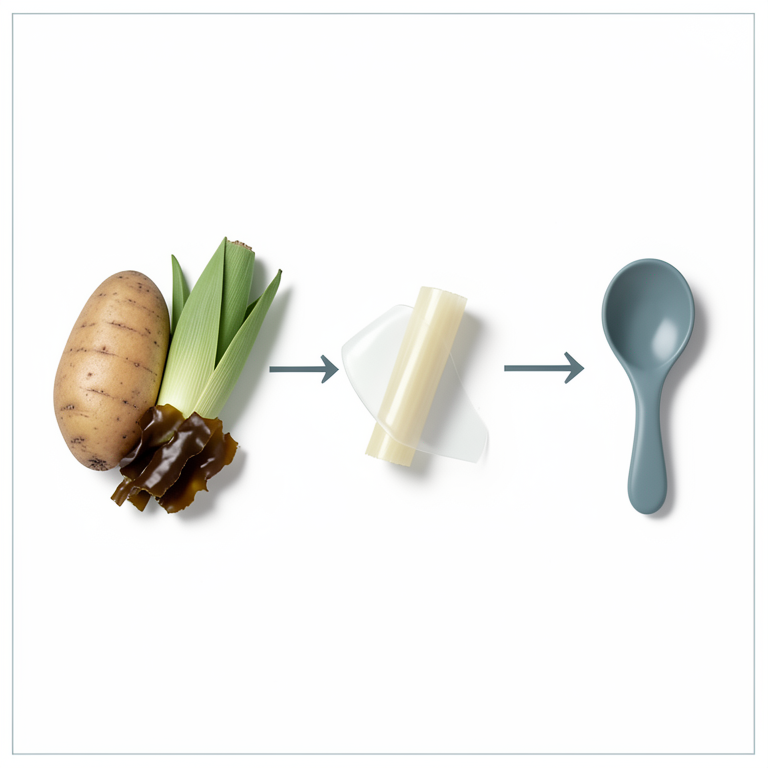
Vegetable-Based Biopolymer Sources
AI-generated conceptual illustration (Potato tubers, corn husks, and brown seaweed). It explains the idea and does not show study data.
View source evidence ↗Introduction
Plastic has become an inseparable part of modern life because of its low cost, lightweight nature, durability, and versatility. However, excessive use of single-use plastic products has created severe environmental problems worldwide. Disposable plastic straws, cups, spoons, food containers, and packaging materials are commonly discarded after a few minutes of use but remain in the environment for hundreds of years. During degradation, plastics break into smaller particles called microplastics, usually less than 5 mm in size. These particles accumulate in oceans, rivers, agricultural soil, and even atmospheric systems. Microplastics are now detected in seafood, drinking water, vegetables, and human blood. Their persistence and toxic nature have raised global concern regarding environmental safety and public health. Conventional plastic recycling systems are insufficient because a major proportion of plastic waste is either landfilled or openly burned. Even biodegradable plastics such as polylactic acid (PLA) may require industrial composting conditions and can still generate microplastic residues under natural environments. To address this problem, researchers and industries are focusing on edible and vegetablebased alternatives that are biodegradable, renewable, and safe for consumption. Edible products made from starch, cellulose, seaweed extracts, vegetable waste, cereal flour, and fruit by-products are emerging as promising substitutes for plastic items. These products can either be consumed directly or degraded naturally without generating toxic residues. The concept of edible packaging and utensils is not entirely new. Traditional food containers made from leaves and natural fibres have been used for centuries in Asian and African countries. Modern food engineering technologies have now enabled the development of edible straws, cups, spoons, and films with improved mechanical strength and water resistance. These innovations are capable of replacing many single-use plastic products while simultaneously reducing environmental pollution. This review aims to provide a comprehensive overview of edible vegetable-based products as alternatives to plastic items for reducing microplastic pollution. Special emphasis is placed on edible straws, utensils, and packaging materials prepared from vegetable and agricultural waste.
Microplastic Pollution and Environmental Concerns
Microplastics originate from the fragmentation of larger plastic materials or from primary sources such as cosmetic products, synthetic fibers, and industrial pellets. Single-use plastics are among the largest contributors to secondary microplastic generation because they are rapidly discarded after use. Plastic straws and disposable packaging materials are particularly problematic due to their extensive consumption and poor recyclability. Microplastics adversely affect aquatic organisms through ingestion and bioaccumulation. Fish, shellfish, turtles, and seabirds often consume plastic fragments, mistaking them for food. These particles can obstruct digestive systems, reduce nutrient and introduce toxic chemicals into biological tissues. Humans are indirectly exposed to microplastics through contaminated seafood, water, fruits, and vegetables.
Recent studies indicate that microplastics may carry toxic additives, heavy metals, and pathogenic microorganisms. They can also act as vectors for persistent organic pollutants. Continuous exposure to these contaminants has been associated with endocrine disruption, inflammation, oxidative stress, and immune disorders. The environmental persistence of plastics is another major challenge. Conventional plastics require hundreds of years for decomposition. Even biodegradable plastics may not degrade completely under natural conditions and can produce nano plastic residues. Therefore, replacing plastic materials with edible and naturally degradable products is considered a more sustainable approach.
Need for Edible and Vegetable-Based Alternatives
The growing concern regarding plastic pollution has increased demand for eco-friendly alternatives. Paper straws and biodegradable plastics have been introduced in many countries; however, they possess several limitations. Paper straws often lose structural integrity in liquids, while biodegradable plastics such as PLA require industrial composting facilities for complete degradation. Edible vegetable-based products provide several advantages over conventional biodegradable plastics: 1. They are prepared from renewable biological materials. 2. They degrade naturally without leaving harmful residues. 3. Many products are directly consumable. 4. They reduce dependence on fossil fuel resources. 5. Agricultural and vegetable waste can be effectively utilized. 6. They support circular economy and waste valorisation.
Researchers have developed edible products using starch, cellulose, pectin, agar, alginate, proteins, and vegetable fibres. These materials can be processed into films, straws, cups, spoons, and packaging coatings with acceptable mechanical and sensory properties.
Vegetable-Based Raw Materials Used for Edible Products 4.1 Starch-Based Materials
Starch is one of the most commonly used biopolymers for edible product development. It is obtained from potato, cassava, corn, rice, and sweet potato. Starch possesses filmforming ability, biodegradability, and low cost. Cassava and corn starch are widely used in edible straws and biodegradable packaging. Starch-based edible straws exhibit good flexibility and can be flavoured to improve consumer acceptance. However, pure starch products often possess poor water resistance and require blending with hydrocolloids or plasticizers.
Cellulose from Vegetable Waste
Cellulose is a natural polymer found abundantly in plant biomass. Agricultural residues such as sugarcane bagasse, banana pseudostem, corn husk, and vegetable peels are rich sources of cellulose. Cellulose-based edible products demonstrate high tensile strength and better resistance to moisture. Researchers have developed edible cellulose-based straws that remain stable in beverages for several hours without releasing microplastics.
Seaweed Polysaccharides
Seaweed-derived polysaccharides such as agar, carrageenan, and alginate are increasingly used in edible packaging. Seaweed-based films are transparent, biodegradable, and edible. They also possess antimicrobial and antioxidant properties. Seaweed straws and films are gaining commercial popularity because they decompose rapidly in natural environments and do not generate toxic residues.
Examples include
• Potato peel starch films • Tomato pomace biopolymer films • Carrot waste fiber composites
Edible Straws as Alternatives to Plastic Straws
Plastic straws are among the most common single-use plastic items found in marine ecosystems. Their lightweight nature makes collection and recycling difficult. As a result, edible straws have emerged as sustainable alternatives. Edible straws are prepared using starch, seaweed extracts, cellulose, rice flour, sorghum flour, and vegetable fibers. They can be manufactured through extrusion, molding, and drying techniques.
Commercial Examples
Several companies are producing edible straws using vegetable-derived materials. Some straws are made from rice and tapioca, while others utilize seaweed or cellulose. These products can remain stable in beverages for up to several hours and degrade naturally after disposal.
Edible Cups, Spoons, and Packaging Materials
Apart from straws, edible vegetable-based products are also being developed for spoons, cups, plates, and food packaging.
Edible Spoons and Cutlery
Edible spoons are commonly prepared from rice flour, wheat bran, millet, sorghum, and vegetable powders. These spoons are baked at high temperatures to achieve hardness and durability.
Edible cutlery offers several advantages:
Edible Cups
Edible cups are produced from grains, oats, chocolate, and plant-based biopolymers. These cups can hold beverages for a limited duration and may be consumed after use. Such products are increasingly used in cafes and restaurants to promote sustainability.
Edible Films and Coatings
Edible films prepared from pectin, starch, cellulose, and proteins are used as food packaging materials. These films act as barriers against moisture and oxygen while reducing plastic packaging waste. Functional additives such as essential oils and antioxidants improve shelf life and microbial safety.
Processing Technologies for Edible Products
Several technologies are used for manufacturing edible products:
Extrusion
Extrusion is widely used for edible straw and cutlery production. The process involves mixing biopolymer materials followed by heating and shaping.
Casting
Film casting is commonly used for edible packaging materials. Biopolymer solutions are spread into thin layers and dried.
Compression Molding
Compression molding is suitable for preparing edible spoons and plates with improved mechanical properties.
3D Printing
Advanced food-grade 3D printing technologies are being explored for customized edible products with complex structures.
Conclusion
Microplastic pollution caused by single-use plastics has become a major global environmental issue. Conventional plastic items such as straws, spoons, cups, and packaging materials contribute significantly to ecological contamination and human health risks. Edible vegetablebased products provide a sustainable and environmentally friendly alternative capable of reducing plastic waste generation. Materials derived from starch, cellulose, seaweed polysaccharides, and vegetable waste possess excellent potential for developing edible straws, spoons, cups, and packaging films. These products are biodegradable, renewable, and capable of minimizing microplastic accumulation in ecosystems. Additionally, the utilization of agricultural and vegetable waste promotes waste valorisation and circular economy practices. Replacing single-use plastics with edible vegetable-based products represents an important strategy for achieving sustainable development and protecting environmental and human health from the harmful effects of microplastic pollution.
Acknowledgment
The authors express sincere gratitude to all researchers and scholars whose published work on microplastic pollution, biodegradable materials, edible packaging, and sustainable waste utilization provided valuable scientific insight for this review. The authors are thankful to academic resources and scientific databases that facilitated access to relevant literature and recent advancements in this field. The authors also acknowledge the support and guidance provided by the Department of Vegetable Science and faculty members during the preparation of the manuscript. Appreciation is extended to individuals and organizations working toward environmentally sustainable alternatives to single-use plastics and the reduction of microplastic contamination.
References
7 in the original paper- Roy TR, Morya S. Edible cutlery: An eco-friendly replacement for plastic cutlery. Journal of Applied and Natural Science. 2022;14(3):1031-1038.
- Wandhekar S, et al. The futuristic trend of edible and biodegradable food packaging, its impact and need: A review. Discover Food. 2026.
- Vartanian A. A straw you can eat. Nature Reviews Materials. 2022;7:80.
- Akhila M, et al. A Review on Edible Straws. European Journal of Nutrition & Food Safety. 2025;17(7):290306.
- Shanmugam V, et al. Environmental performance of bioplastics: degradation pathways, chemical leaching, and life-cycle implications. npj Materials Sustainability. 2026.
- Ali MQ, et al. Exploring the potential of fruit and vegetable waste and by-products in food biodegradable packaging. Discover Food. 2024.
- Trends in Food Science & Technology. Emerging trends and developments in edible drinking straws for food and beverage applications. Trends in Food Science & Technology. 2025.