
Research article · 2026 · Full text
International Journal of Horticulture and Food SciencePerformance evaluation of telescopic fruit harvester
Volume 8(5) · Pages 25–27 · DOI: 10.33545/26631067.2026.v8.i5a.750 ↗
Research areasAgricultural Engineering and MechanizationCoconut Research and ApplicationsSmart Agriculture and AI
Abstract
Author-writtenIndia is a major producer of coconuts, contribute 72% of the world's total production. In India, Kerala, Karnataka, Tamil Nadu and Andhra Pradesh produces 89% of coconut production and 90% of coconut area. Coconuts are versatile crops used for a variety of purposes but in India, almost 70% of the coconut is used for edible purposes. Coconut trees are productive throughout the year. However, the yield may vary from season to season. A normal-bearing coconut palm usually produces one harvestable bunch on monthly basis. The number of bunches harvested per palm annually reaches about 14 from tall and 16 from dwarf trees. A bunch of coconuts from each tree has 5 to 15 nuts. Coconuts are harvested every month from a coconut palm. On average, 10-45 nuts are collected from each coconut tree at various maturity stages. A telescopic fruit Harvester for small crops was developed and its Performance evaluation of available coconut harvester was under taken. It has telescopic shaft up to 73 feet with sickle shape lade for Harvesting. The number of tree picking and harvested in one hour was observed in range of 6.5 to 11. The time required for extending the height of pole was observed as 8.74 to 10.90 seconds. The time required for fixing/removing the pruning blade was observed as 8.74 to 10.90 seconds. The time required for interchanging the tree was observed as 12.33 to 18.75 seconds. The improved harvesting system found better than traditional methods and reduces musculoskeletal stress on the operator.
Summary
Source-checkedPlain-language reading of the full paper, prepared with AI and checked against the text. Each point links to the authors' own words.
Why it matters
- India is a leading global producer of coconuts, accounting for 72% of the total world production. View evidence ↗
- Harvesting is the most labor-intensive part of fruit production, representing up to 60% of the total labor needed. View evidence ↗
- Traditional hand-picking methods are inefficient and can cause musculoskeletal disorders in workers while risking fruit quality. View evidence ↗
The question
- The study aimed to develop and evaluate the performance of a telescopic fruit harvester designed for small crops, specifically for coconut harvesting. View evidence ↗
What they did
- The developed harvester features a sickle-shaped blade and a telescopic shaft that can reach up to 73 feet. View evidence ↗
- The tool consists of 13 interlocking shafts made of Carbon Fibre High Modulus Tubes, reaching a maximum length of 23 meters. View evidence ↗
- The harvesting blade is constructed from high carbon steel, measuring 145 mm in width and 2 mm in thickness. View evidence ↗
- Ergonomic evaluations were conducted using three subjects of varying ages and body structures. View evidence ↗
What they found
- The harvester was able to pick and harvest between 6.5 and 11 trees per hour. View evidence ↗
- Extending the height of the telescopic pole took between 8.74 and 10.90 seconds. View evidence ↗
- The time required to move from one tree to another ranged from 12.33 to 18.75 seconds. View evidence ↗
- The tool successfully harvested trees with heights ranging from 17.56 to 22 meters. View evidence ↗
- Data analysis indicates that using the tool is moderate to heavy work but carries a lower risk of accidents compared to traditional methods. View evidence ↗
What it means
- The authors conclude that the telescopic harvesting system is superior to traditional methods and reduces musculoskeletal stress for the operator. View evidence ↗
Visual summary
3 visualsIllustrations explain the paper; charts are replotted from the paper's own table values.
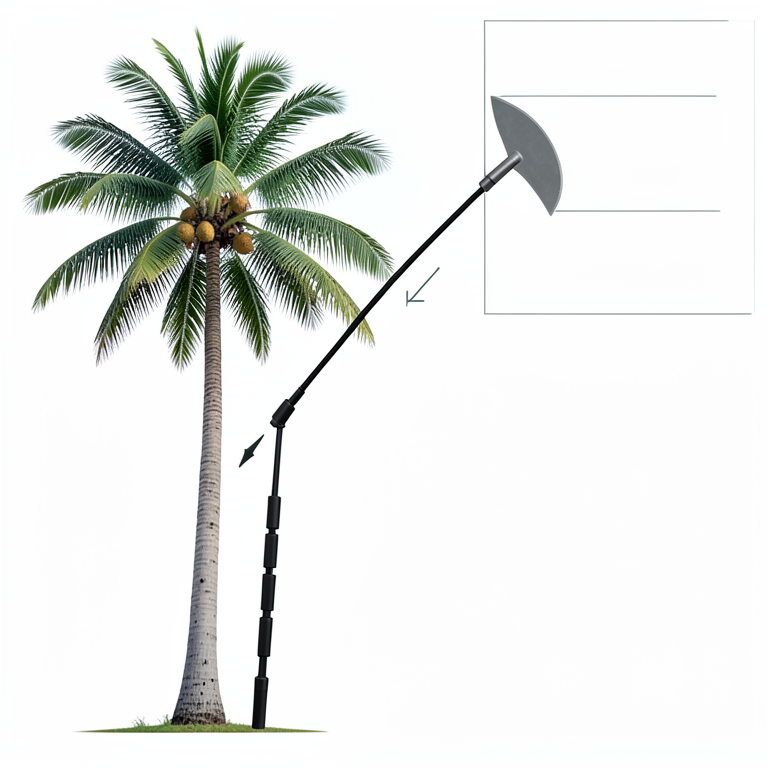
Telescopic Harvester Concept
AI-generated conceptual illustration (coconut tree and a carbon fiber telescopic fruit harvester). It explains the idea and does not show study data.
View source evidence ↗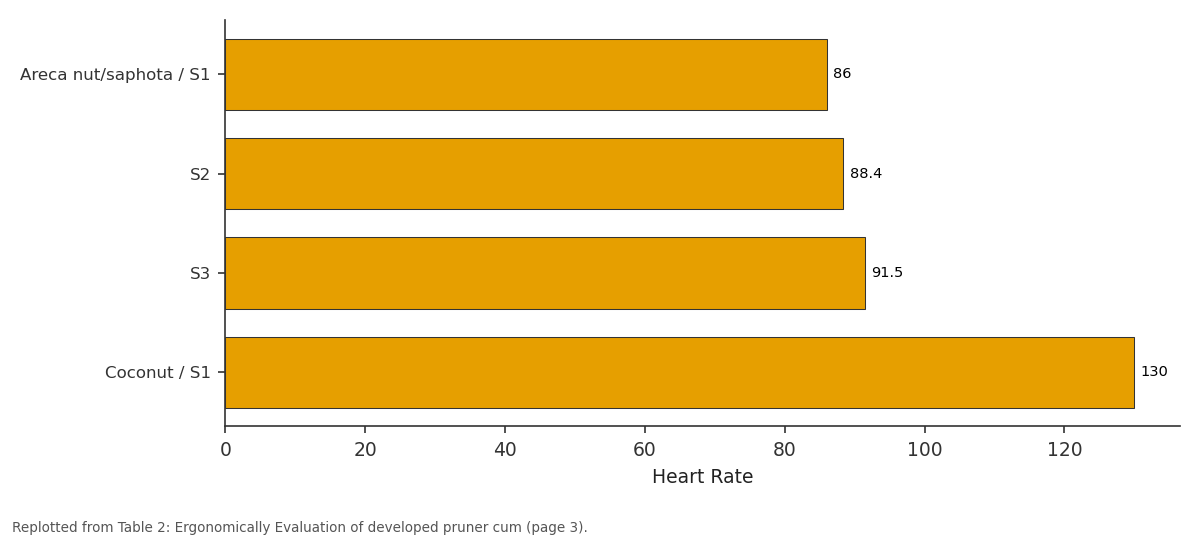
Heart Rate: Areca nut/saphota / S1 vs S2 vs S3 vs Coconut / S1
Replotted from Table 2 (page 3) of the original paper. Every bar is the paper's own table value.
View source evidence ↗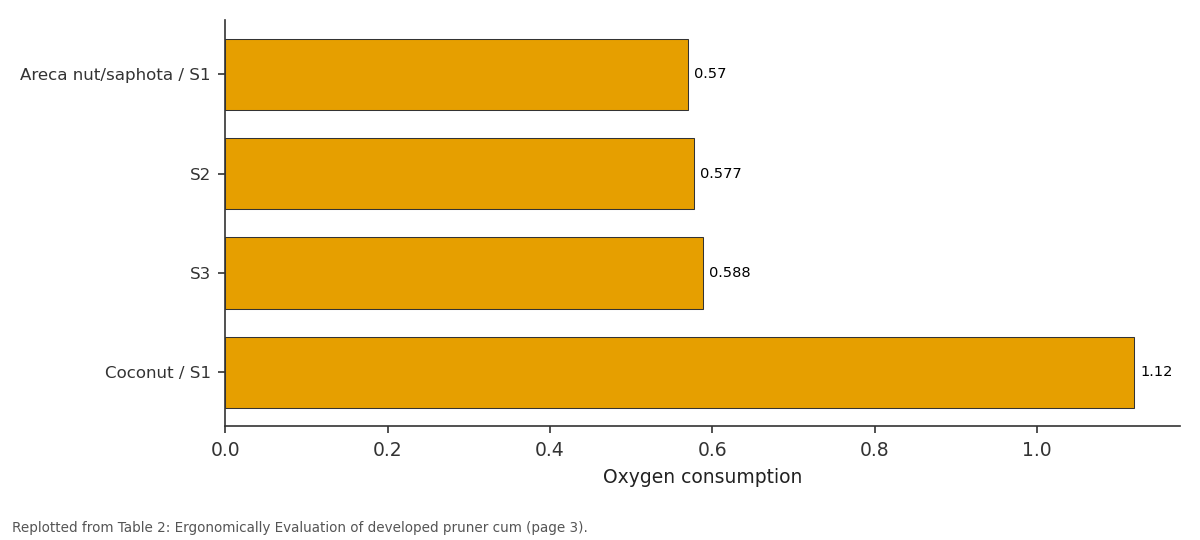
Oxygen consumption: Areca nut/saphota / S1 vs S2 vs S3 vs Coconut / S1
Replotted from Table 2 (page 3) of the original paper. Every bar is the paper's own table value.
View source evidence ↗Figures & tables
From the original paper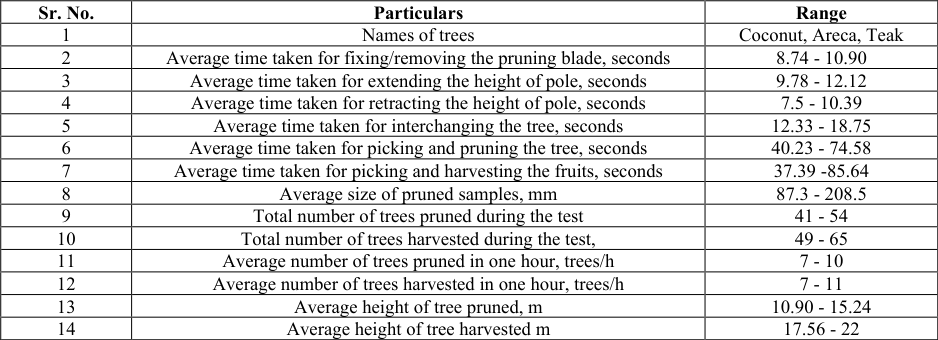 Table 1
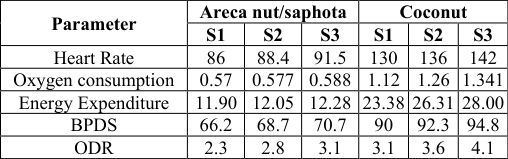 Table 2
Introduction
India is a major producer of fruits, vegetables, cereals, pulses, tuber crops and spices in the world. India produces around 40 million tons of fruits per year. World production of tree fruits is increasing rapidly leading to more competition on export market. Adoption of more efficient fruit production and harvesting system is one way for the industry to remain competitive and increase market share on the world stage. Production of fruit crop is expensive and labour intensive. Harvesting is the most labour intensive operation in the fruit production accounting for up to 60% of total labour requirement. Timely harvesting of fruits is important for maintaining quality and shelf life. Harvesting of fruits is a cumbersome and time-consuming process. Different methods are being practiced for harvesting fruits from trees. Harvesting of coconut, Areca nut is labour intensive operation and may involve 35-45% of total production cost. Most of the Indian farmers still practicing conventional hand-picking methods for harvesting. However, conventional methods are inefficient and more importantly results in risk on both the quality of harvested fruits and disorders of the musculoskeletal system of workers during the harvest (Mlotek, 2015) [6] . A high stress on the human motoric system is observed when the picker is holding a container of fruit (basket, bucket) with one hand and picking fruit with the other hand (Mlotek, 2015) [6] . Moreover, considerable neck pain has been reported during harvesting of fruits situated at the upper periphery of the tree. Therefore, the worker cannot harvest continuously (Mlotek, 2015) [5] .
Materials and Methods
Developed telescopic fruit harvester cum pruner consists of Telescopic shaft which is having maximum length of 23 meters. 13 shafts are fitted for getting height of 23 meters and the outer most (lower shaft) diameter is 60 mm and that of the inner most is 16 mm. these shafts are fitted with the flips with locking clamps diameters as inner diameter 18 mm to 45 mm with wall thickness of 3 mm and outer diameter as 27 to 54 mm.
Fruit Harvesting Blade
Fruit harvesting blade is made from high carbon steel with width of operation as 145 mm, and thickness of blade is 2 mm. This provided with clip which is fitted in the top inner shaft. The material of the shafts is Carbon Fibre High Modulus Tubes and tube-to-tube fully interlocking. Electricity cut-off slides and insulation coating provided, However strictly recommended to operate away from electrical lines are provided for safety.
Performance Evaluation of telescopic Pruner cum fruit harvester
In the field of KVK, the tool was tested for its performance as Average time to set the blade, extension of shafts and retracting height of shaft, interchanging of tress, size of pruned samples. Number of fruits harvested per hour. The number of tree pruned in one hour was observed in range of 7 to 10. The number of tree picking and harvested in one hour was observed in range of 6.5 to 11.The time required for extending the height of pole was observed as 8.74 to 10.90 seconds. The time required for retracting the height of pole was observed as 7.5 to 10.39 seconds. The time required for fixing/removing the pruning blade was observed as 8.74 to 10.90 seconds. The time required for interchanging the tree was observed as 12.33 to 18.75seconds.The time required for picking and pruning the tree was observed as 40.23 to 74.58 seconds. The height of tree pruned was observed in range of 10.90 to 15.24m. The height of tree harvested was observed in range of 17.56 to 22 m. The sizes of pruned samples were observed in range of 87.3 -208.5 mm. The maximum height of tree pruned was 15.24 m. The maximum height of tree harvested was 22 m.
Ergonomically Evaluation
The ergonomically evaluation of the tool was also carried for heart rate, Energy Expenditure, Body Part Discomfort and overall discomfort rating of the operator. Three subjects from different age groups and body structure were taken for observations. The selection was don from the anthropometric data available with department of farm Machinery and Power, College of Argil. Engineering and Technology, VNMKV, Parbhani. Heart rates were recorded with heart rate monitors during the experiments conducted for all subjects selected. The corresponding values of oxygen consumption (Vo2) of subjects were predicated from calibration charts of corresponding subjects. The selected subjects were calibrated as per the procedure mentioned in the materials and methods. From the table it is observed that heart for coconut harvesting was higher to 142 with oxygen consumption of 1,314 lps. This is due to balancing of shaft while harvesting at greater heights. The same trends observed rearguing body part discomfort scores and overall discomfort rating. From the analysis of the data, work is of moderate to heavy type with less risk of accidents while harvesting and pruning.
The operator can easily adjust the height of telescopic pole by extending and retracting the pole accordingly branch height. The height of pole was locked after attaining the required height. The speed of operation was depends on adeptness of the labour. No noticeable difficulty was observed during the operation.
Figures and tables from the paper
| Sr. No. | Particulars | Range |
|---|---|---|
| 1 | Names of trees | Coconut, Areca, Teak |
| 2 | Average time taken for fixing/removing the pruning blade, seconds | 8.74 - 10.90 |
| 3 | Average time taken for extending the height of pole, seconds | 9.78 - 12.12 |
| 4 | Average time taken for retracting the height of pole, seconds | 7.5 - 10.39 |
| 5 | Average time taken for interchanging the tree, seconds | 12.33 - 18.75 |
| 6 | Average time taken for picking and pruning the tree, seconds | 40.23 - 74.58 |
| 7 | Average time taken for picking and harvesting the fruits, seconds | 37.39 -85.64 |
| 8 | Average size of pruned samples, mm | 87.3 - 208.5 |
| 9 | Total number of trees pruned during the test | 41 - 54 |
| 10 | Total number of trees harvested during the test, | 49 - 65 |
| 11 | Average number of trees pruned in one hour, trees/h | 7 - 10 |
| 12 | Average number of trees harvested in one hour, trees/h | 7 - 11 |
| 13 | Average height of tree pruned, m | 10.90 - 15.24 |
| 14 | Average height of tree harvested m | 17.56 - 22 |
Table text extracted from the original PDF; superscript letters are shown inline. The original table image is below.
View original table image
| Parameter | Areca nut/saphota | — | — | Coconut | — | — |
|---|---|---|---|---|---|---|
| S1 | S2 | S3 | S1 | S2 | S3 | |
| Heart Rate | 86 | 88.4 | 91.5 | 130 | 136 | 142 |
| Oxygen consumption | 0.57 | 0.577 | 0.588 | 1.12 | 1.26 | 1.341 |
| Energy Expenditure | 11.90 | 12.05 | 12.28 | 23.38 | 26.31 | 28.00 |
| BPDS | 66.2 | 68.7 | 70.7 | 90 | 92.3 | 94.8 |
| ODR | 2.3 | 2.8 | 3.1 | 3.1 | 3.6 | 4.1 |
Table text extracted from the original PDF; superscript letters are shown inline. The original table image is below.
View original table image
References
6 in the original paper- Alexander DC. Workplace Safety and the ergonomic rule. FDCH Congressional Testimony; 2001.
- Alexander DC. Workplace Safety and the Ergonomics Rule. FDCH Congressional Testimony; 2001 April.
- Corlett HD, Clarke RP. A technique for accessing postural discomfort. Ergonomics. 1976;19:175-182.
- Astrand PO, Rodahl K. Text book of work physiology: Physiological Bases of Exercise. 2nd ed. New York: McGraw Hill; 1977.
- Peter PILE, Westgaard R, Winkel J. Ergonomic Intervention Studies for Improved Musculoskeletal Health: A Review of the Literature and some Implications for Practitioners. Proc Int Ergon Association. 2000;5:490-494.
- Młotek M, Kuta Ł, Stopa R, Komarnicki P. The effect of manual harvesting of fruit on the health of workers and the quality of the obtained produce. Procedia Manufacturing. 2015;3:1115-1122.