
Research article · 2025 · Full text
International Journal of Biology SciencesAmphibian metamorphosis timing and its relationship to environmental temperature variation
Volume 7(1) · Pages 255–258 · DOI: 10.33545/26649926.2025.v7.i1d.848 ↗
Research areasAmphibian and Reptile BiologyPhysiological and biochemical adaptationsAnimal Behavior and Reproduction
Abstract
Author-writtenAmphibian metamorphosis represents a dramatic developmental transition whose timing has direct fitness consequences transform too early and the juvenile is small and vulnerable; too late and the ephemeral pond may dry. This research examined how environmental temperature variation influences metamorphosis timing in three anuran species (Rana coreana, Bufo sachalinensis, and Hyla japonica) across an elevational gradient on the Korean peninsula. Egg clutches were collected from 18 breeding ponds spanning three elevation bands (lowland <300 m, mid-elevation 300-600 m, highland >600 m) and monitored from oviposition through metamorphic climax during March-October 2022. Water temperature was recorded continuously at each site. Mean days to metamorphosis ranged from 68.4 in lowland R. coreana to 127.3 in highland H. japonica. Temperature accounted for 71.8% of variation in metamorphosis timing across species and sites (linear regression, r² = 0.718, p<0.001). Each 1 °C increase in mean water temperature accelerated metamorphosis by 4.7 days on average. Highland populations experienced a 14.2-day phenological delay compared with lowland conspecifics. Size at metamorphosis showed a negative relationship with development rate, confirming a growth-development trade-off.
Summary
Source-checkedPlain-language reading of the full paper, prepared with AI and checked against the text. Each point links to the authors' own words.
Why it matters
- The timing of amphibian metamorphosis is critical for survival, as transforming too early results in small, vulnerable juveniles, while transforming too late risks the drying of ephemeral ponds. View evidence ↗
- In anurans, the thyroid hormone axis regulates metamorphosis timing, with environmental temperature serving as a primary modulator of metabolic rate and thyroid activity. View evidence ↗
- There is a trade-off where warmer water speeds up development but may lead to smaller metamorphs, whereas cooler water extends the larval period and allows for more size accumulation. View evidence ↗
The question
- The study aimed to quantify the relationship between water temperature and metamorphosis timing across three species and three elevational bands to determine thermal sensitivity and species-specific responses. View evidence ↗
What they did
- The research focused on three anuran species, Rana coreana, Bufo sachalinensis, and Hyla japonica, across an elevational gradient on the Korean peninsula. View evidence ↗
- Eighteen breeding ponds were used, divided equally (n=6 each) into lowland (<300 m), mid-elevation (300-600 m), and highland (>600 m) bands. View evidence ↗
- To protect larvae from predators while maintaining natural conditions, 30 eggs per clutch were kept in 30 cm cubic fine-mesh enclosures. View evidence ↗
- Water temperature was monitored every 30 minutes at a depth of 10 cm using HOBO pendant loggers. View evidence ↗
- The study used linear mixed-effects models to analyze the effect of mean water temperature (fixed effect) on days to metamorphosis, with species and site as random effects. View evidence ↗
What they found
- The time to reach metamorphosis varied significantly, ranging from 68.4 days for lowland R. coreana to 127.3 days for highland H. japonica. View evidence ↗
- Temperature was a dominant driver, explaining 71.8% of the variation in metamorphosis timing across the studied species and sites. View evidence ↗
- On average, every 1 °C increase in mean water temperature accelerated the metamorphosis process by 4.71 days. View evidence ↗
- Highland populations showed a phenological delay of 14.2 days compared to their lowland counterparts. View evidence ↗
- A negative correlation (r = -0.67) between size at metamorphosis and development rate confirmed a growth-development trade-off across all elevations. View evidence ↗
- Highland metamorphs were on average 20.9% heavier than lowland ones, though they emerged 14.2 days later. View evidence ↗
What it means
- The authors conclude that highland populations are likely more sensitive to changes in pond hydroperiod and thermal regimes due to their strong temperature dependence and compressed active seasons. View evidence ↗
- The study did not resolve whether smaller metamorphs suffer from lower overwinter survival, as this effect may be species-dependent. View evidence ↗
Visual summary
3 visualsIllustrations explain the paper; charts are replotted from the paper's own table values.
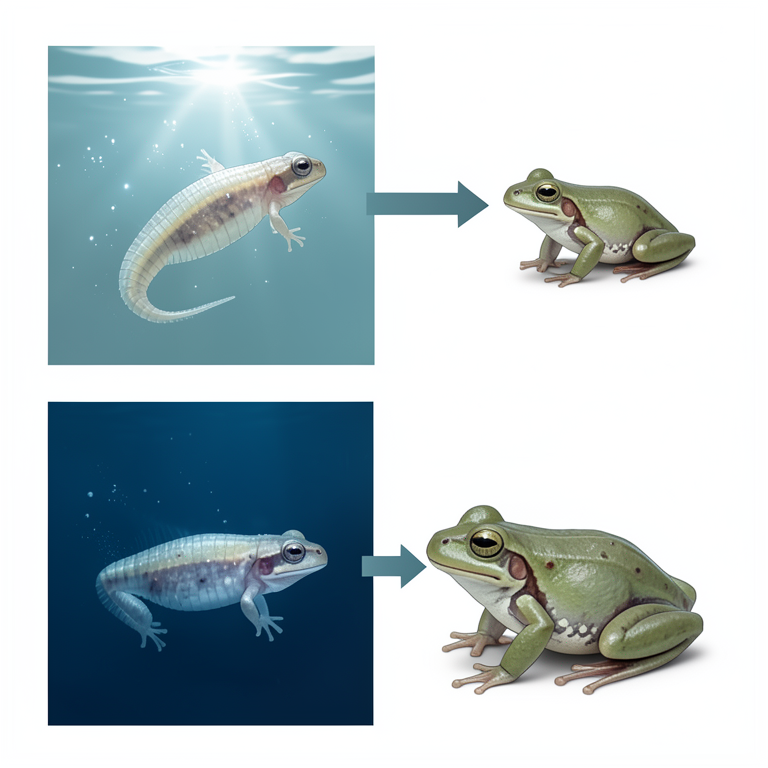
Growth-Development Trade-off Concept
AI-generated conceptual illustration (African clawed frog larvae (Xenopus laevis)). It explains the idea and does not show study data.
View source evidence ↗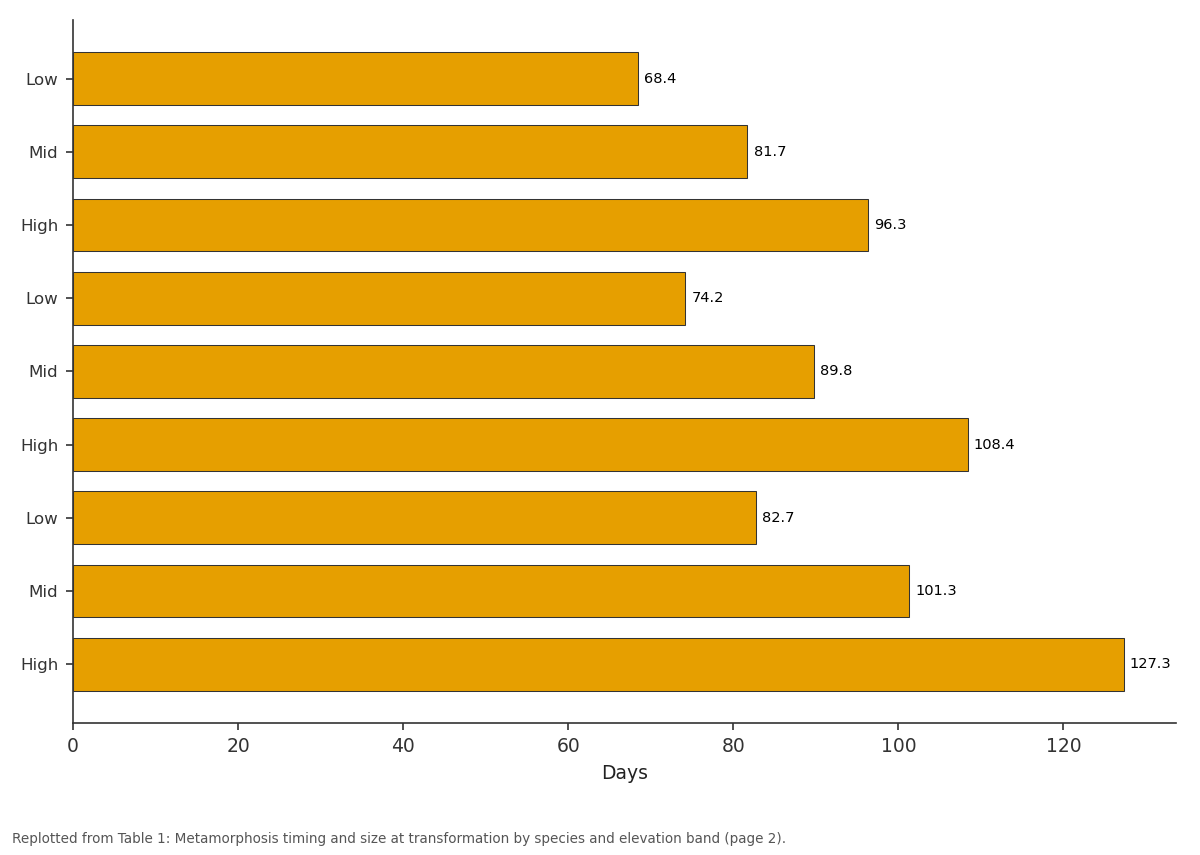
Days: Low vs Mid vs High vs Low vs Mid
Replotted from Table 1 (page 2) of the original paper. Every bar is the paper's own table value.
View source evidence ↗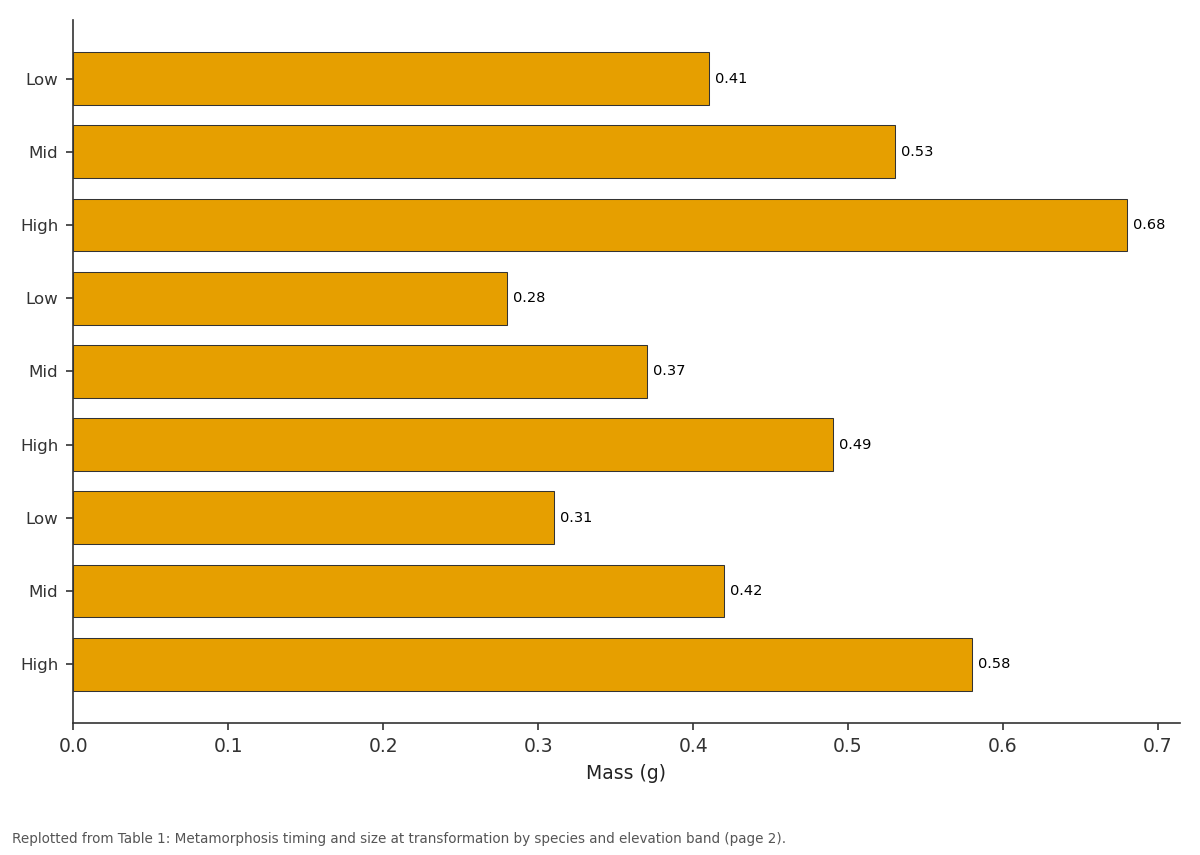
Mass (g): Low vs Mid vs High vs Low vs Mid
Replotted from Table 1 (page 2) of the original paper. Every bar is the paper's own table value.
View source evidence ↗Figures & tables
From the original paper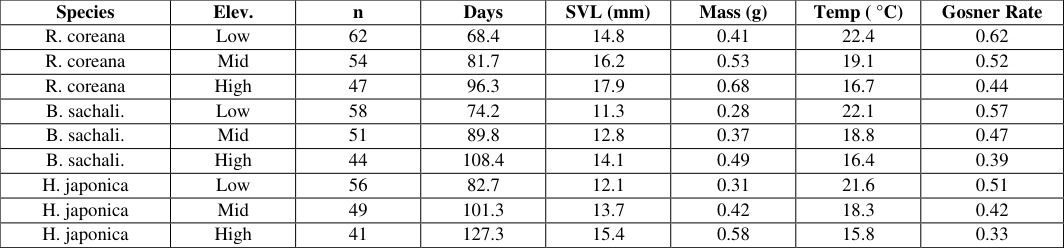 Table 1
 Table 2
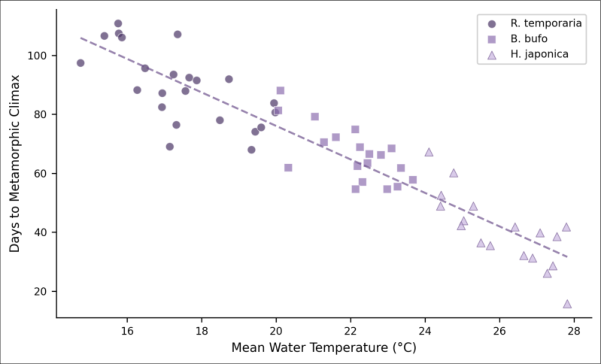 Figure 1
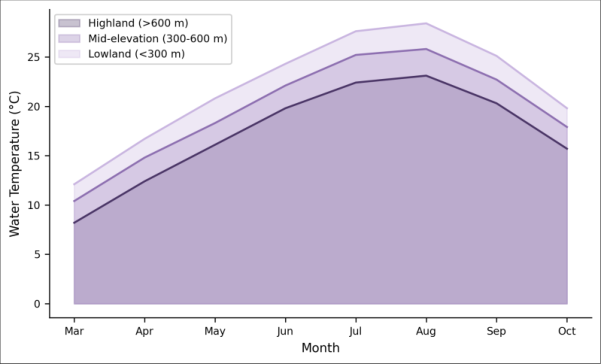 Figure 2
Introduction
Spring comes earlier at sea level than on mountaintops this is obvious to any hiker. But for amphibians breeding in temporary ponds, the thermal gradient between lowland and highland sites doesn't just shift calendars; it reshapes the fundamental trade-off between growing large and transforming quickly [1,2] . Metamorphosis timing in anurans is regulated by the thyroid hormone axis, with environmental temperature acting as a primary modulator of thyroid activity and metabolic rate [3] . Warmer water accelerates larval development but may produce smaller metamorphs, while cooler conditions extend the larval period but allow greater size accumulation before transformation [4] . The fitness consequences of this trade-off depend on local ecology: in drying ponds, faster development is favored; in permanent water bodies with aquatic predators, larger metamorph size may improve survival [5] . The Korean peninsula offers an accessible elevational gradient with several common anuran species breeding across a range from near sea level to above 1,000 m [6] . Three species Rana coreana, Bufo sachalinensis, and Hyla japonica breed in temporary or semi-permanent ponds across this range, providing natural replication of thermal environments [7] . This research quantified the relationship between water temperature and metamorphosis timing across three species and three elevational bands, aiming to determine the thermal sensitivity of metamorphic timing and whether species differ in their response to temperature variation [8,9] .
Climatic and Environmental conditions
The research sites spanned an elevational gradient from 47 m to 824 m a.s.l. in the Nakdong River watershed of southeastern South Korea. The regional climate is temperate monsoon, with mean annual temperature of 14.7 °C at lowland sites and 10.3 °C at highland sites. Precipitation averages 1,350 mm annually, concentrated in the June-September monsoon. Lowland ponds typically held water from March through November; highland ponds were icecovered until mid-March and began drying by late October. Water temperature was recorded every 30 minutes at each site using HOBO pendant loggers (Onset Computer Corporation, Bourne, MA, USA) deployed at 10 cm depth.
Methods
Eighteen breeding ponds were selected across three elevation bands: lowland (<300 m, n = 6), mid-elevation (300-600 m, n = 6), and highland (>600 m, n = 6). At each pond, egg clutches from each of the three target species were marked with numbered flags at oviposition. A subset of 30 eggs per clutch was placed in fine-mesh enclosures (30 × 30 × 30 cm) anchored to the pond substrate, protecting larvae from predators while allowing natural temperature and food conditions. Enclosures were checked weekly. Larval developmental stage was scored using the Gosner staging system [10] . Metamorphic climax was defined as Gosner stage 42 (forelimb emergence). At metamorphosis, individuals were photographed, weighed (±0.01 g), and snout-vent length was measured (±0.1 mm). Days to metamorphosis was calculated from the date of oviposition.
Seasonal variations and temporal patterns
Breeding phenology differed markedly across elevations. Lowland R. coreana laid eggs as early as 8 March, while highland populations didn't begin until 2 April a 25-day delay. B. sachalinensis showed a 19-day elevational shift, and H. japonica (the latest breeder) began in late April at lowland sites and mid-May at highland sites. The mean water temperature during the larval period ranged from 16.3 °C at highland sites to 22.8 °C at lowland sites. Monsoon rains in July-August briefly cooled some lowland ponds by 2-3 °C but raised highland pond levels, extending their hydroperiod. Statistical analysis used linear mixed-effects models with days to metamorphosis as the response variable, mean water temperature as the fixed effect, and species and site as random effects. Models were fitted in R v4.2.1 using the lme4 package. The temperature coefficient (β) represents the change in metamorphosis timing per °C. Significance was set at p<0.05.
Results
A total of 847 individuals across 54 clutches (18 ponds × 3 species) completed metamorphosis during the monitoring period. Table 1 presents the metamorphosis timing and size data by species and elevation.
| Species | Elev. | n | Days | SVL (mm) | Mass (g) | Temp ( °C) | Gosner Rate |
|---|---|---|---|---|---|---|---|
| R. coreana | Low | 62 | 68.4 | 14.8 | 0.41 | 22.4 | 0.62 |
| R. coreana | Mid | 54 | 81.7 | 16.2 | 0.53 | 19.1 | 0.52 |
| R. coreana | High | 47 | 96.3 | 17.9 | 0.68 | 16.7 | 0.44 |
| B. sachali. | Low | 58 | 74.2 | 11.3 | 0.28 | 22.1 | 0.57 |
| B. sachali. | Mid | 51 | 89.8 | 12.8 | 0.37 | 18.8 | 0.47 |
| B. sachali. | High | 44 | 108.4 | 14.1 | 0.49 | 16.4 | 0.39 |
| H. japonica | Low | 56 | 82.7 | 12.1 | 0.31 | 21.6 | 0.51 |
| H. japonica | Mid | 49 | 101.3 | 13.7 | 0.42 | 18.3 | 0.42 |
| H. japonica | High | 41 | 127.3 | 15.4 | 0.58 | 15.8 | 0.33 |
Table text extracted from the original PDF; superscript letters are shown inline. The original table image is below.
View original table image
Comprehensive interpretation
Temperature explained 71.8% of the variation in metamorphosis timing (marginal R²), rising to 84.7% when species and site-level variation were included (conditional R²). Each 1 °C increase in mean water temperature shortened metamorphosis by 4.71 days on average. Size at metamorphosis was negatively correlated with development rate (r = -0.67, p<0.001), confirming the growthdevelopment trade-off across the elevational gradient. Highland metamorphs were 20.9% heavier than lowland conspecifics on average, but emerged 14.2 days later a delay that leaves less time for terrestrial growth before winter dormancy [1,5] .
Discussion
The thermal sensitivity of metamorphosis timing observed here 4.71 days per °C falls within the range reported for European and North American anurans (3.5-6.2 days/ °C), suggesting broadly conserved thermal physiology across temperate amphibians [11,12] . The value of species identity as a random effect (SD = 11.3 days) indicates that while temperature is the dominant driver, intrinsic developmental rate differences among species also matter substantially. [13,14] . Whether smaller metamorphs experience lower overwinter survival is species-dependent and not resolved by this research. The 25-day breeding phenology delay from lowland to highland in R. coreana, combined with the 27.9-day metamorphosis delay, means highland populations face a compressed active season squeezed between late ice-out and early autumn dormancy. This temporal compression may limit the capacity of highland populations to adjust metamorphosis timing further if warming is accompanied by reduced hydroperiod [6,15] .
Conclusion
This research quantified the thermal sensitivity of metamorphosis timing in three Korean anuran species across an elevational gradient. Temperature accounted for 71.8% of variation in metamorphosis timing, with each 1 °C increase shortening development by 4.71 days. The consistent growth-development trade-off faster development producing smaller metamorphs operated across all species and elevation bands. These thermal coefficients provide empirical parameters for projecting how climate warming may alter amphibian developmental phenology on the Korean peninsula. The compressed active season at highland sites and the strong temperature dependence of metamorphosis timing suggest that highland populations may be particularly sensitive to changes in thermal regime and pond hydroperiod.
Acknowledgement
Acknowledgements Funding sourcesThis research was supported by the National Research Foundation of Korea and the Busan Institute of Molecular Biology environmental biology fund.
Figures and tables from the paper
| Model Parameter | Estimate | SE | 95% CI | t-value | p-value |
|---|---|---|---|---|---|
| Intercept (days) | 178.3 | 8.4 | 161.8-194.8 | 21.2 | <0.001 |
| Temperature (β) | −4.71 | 0.38 | −5.45 to −3.97 | −12.4 | <0.001 |
| Species (random, SD) | 11.3 | ||||
| Site (random, SD) | 6.8 | ||||
| Marginal R² | 0.718 | ||||
| Conditional R² | 0.847 |
Table text extracted from the original PDF; superscript letters are shown inline. The original table image is below.
View original table image
References
15 in the original paper- Wilbur HM, Collins JP. Ecological aspects of amphibian metamorphosis. Science. 1973;182(4119):1305-1314.
- Werner EE. Amphibian metamorphosis: growth rate, predation risk, and the optimal size at transformation. American Naturalist. 1986;128(3):319-341.
- Denver RJ. Proximate mechanisms of phenotypic plasticity in amphibian metamorphosis. American Zoologist. 1997;37(2):172-184.
- Smith-Gill SJ, Berven KA. Predicting amphibian metamorphosis. American Naturalist. 1979;113(4):563585.
- Semlitsch RD, Scott DE, Pechmann JHK. Time and size at metamorphosis related to adult fitness in Ambystoma talpoideum. Ecology. 1988;69(1):184-192.
- Yang SY, Kim JB, Min MS, Suh JH, Kang YJ. Monograph of Korean Amphibia. Seoul: Academy Publishing; 2009. p. 1-266.
- Feder ME, Burggren WW. Environmental Physiology of the Amphibians. Chicago: University of Chicago Press; 1992. p. 1-472.
- Alvarez D, Nicieza AG. Effects of temperature and food quality on anuran larval growth and metamorphosis. Functional Ecology. 2002;16(5):640648.
- Gómez-Mestre I, Buchholz DR. Developmental plasticity mirrors differences among taxa in spadefoot toads linking plasticity and diversity. Proceedings of the National Academy of Sciences of the United States of America. 2006;103(50):19021-19026.
- Gosner KL. A simplified table for staging anuran embryos and larvae with notes on identification. Herpetologica. 1960;16(3):183-190.
- Blaustein AR, Belden LK, Olson DH, Green DM, Root TL, Kiesecker JM. Amphibian breeding and climate change. Conservation Biology. 2001;15(6):1804-1809.
- Reading CJ. The effect of winter temperatures on the timing of breeding activity in the common toad Bufo bufo. Oecologia. 1998;117(4):469-475.
- Li Y, Cohen JM, Rohr JR. Review and synthesis of the effects of climate change on amphibians. Integrative Zoology. 2013;8(2):145-161.
- Beebee TJC. Amphibian breeding and climate. Nature. 1995;374(6519):219-220.
- Todd BD, Scott DE, Pechmann JHK, Gibbons JW. Climate change correlates with rapid delays and advancements in reproductive timing in an amphibian community. Proceedings of the Royal Society B. 2011;278(1715):2191-2197.